Presented by:
Mahewash Sana A. Pathan
ACCELERATED STABILITY
STUDIES
ACCELERATED STABILITY STUDIES
 Stability study to predict the shelf life of
product, by accelerating the rate of
decomposition, preferably by increasing
temperature of reaction.
 These are experimental designs.
 Preparations are subjected to high stresses
during stability testing such as-
1. Temperature
2. Humidity
3. Light
ARRHENIUS EQUATION
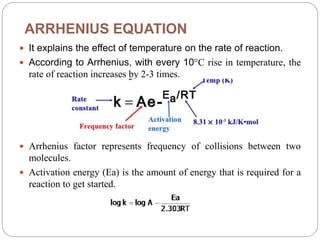
 It explains the effect of temperature on the rate of reaction.
 According to Arrhenius, with every 10°C rise in temperature, the
rate of reaction increases by 2-3 times.
 Arrhenius factor represents frequency of collisions between two
molecules.
 Activation energy (Ea) is the amount of energy that is required for a
reaction to get started.
STEPS INVOLVED IN PREDICTION OF SHELF
LIFE
1. Drug liquid preparations are stored at elevated temperature, i.e.
50, 60, 70, 85, 100 & 121°C. In addition, samples studied at
40°C/75% RH & 35°C.
2. During different time intervals, samples are withdrawn (0, 3, 6
months).
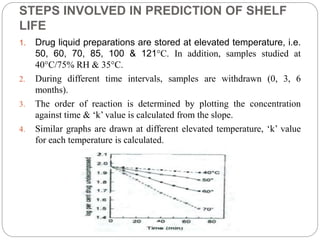
3. The order of reaction is determined by plotting the concentration
against time & ‘k’ value is calculated from the slope.
4. Similar graphs are drawn at different elevated temperature, ‘k’ value
for each temperature is calculated.
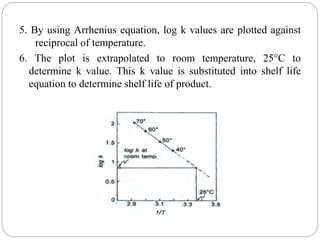
5. By using Arrhenius equation, log k values are plotted against
reciprocal of temperature.
6. The plot is extrapolated to room temperature, 25°C to
determine k value. This k value is substituted into shelf life
equation to determine shelf life of product.
Climatic zones
 Due to the diverse climatic conditions prevalent in
different countries, four climatic zones are proposed in
ICH guidelines.
CLIMATI
C ZONE
DESCRIPTION STORAGE
CONDITIONS
COUNTRIES
I Temperate
zone
21°C/45% RH Great britain,
northern Europe,
Canada, Russia
II Subtropical &
Mediteranean
25°C/ 60% RH USA, Japan,
Southern Europe
III Hot & dry 30°C/ 35% RH Iran, Iraq, Sudan
IV Hot & humid 30°C/ 70% RH Brazil, Ghana,
Indonesia, India,
Philippines.
LIMITATIONS OF ACCELERATED
STABILITY STUDIES
 This studies are only valid when the breakdown
depends on temperature.
 this method is not used in case of complex reactions.
 This method is valid only if energy of activation lies
between 10-30Kcal/mole.
 The products which loose their physical integrity at
elevated temperature is not suitable for accelerated
testing.
 This method is not valid when order changes at
higher temperature.
Accelerated stability studies

Accelerated stability studies

  • 1.
    Presented by: Mahewash SanaA. Pathan ACCELERATED STABILITY STUDIES
  • 2.
    ACCELERATED STABILITY STUDIES Stability study to predict the shelf life of product, by accelerating the rate of decomposition, preferably by increasing temperature of reaction.  These are experimental designs.  Preparations are subjected to high stresses during stability testing such as- 1. Temperature 2. Humidity 3. Light
  • 3.
    ARRHENIUS EQUATION  Itexplains the effect of temperature on the rate of reaction.  According to Arrhenius, with every 10°C rise in temperature, the rate of reaction increases by 2-3 times.  Arrhenius factor represents frequency of collisions between two molecules.  Activation energy (Ea) is the amount of energy that is required for a reaction to get started.
  • 4.
    STEPS INVOLVED INPREDICTION OF SHELF LIFE 1. Drug liquid preparations are stored at elevated temperature, i.e. 50, 60, 70, 85, 100 & 121°C. In addition, samples studied at 40°C/75% RH & 35°C. 2. During different time intervals, samples are withdrawn (0, 3, 6 months). 3. The order of reaction is determined by plotting the concentration against time & ‘k’ value is calculated from the slope. 4. Similar graphs are drawn at different elevated temperature, ‘k’ value for each temperature is calculated.
  • 5.
    5. By usingArrhenius equation, log k values are plotted against reciprocal of temperature. 6. The plot is extrapolated to room temperature, 25°C to determine k value. This k value is substituted into shelf life equation to determine shelf life of product.
  • 6.
    Climatic zones  Dueto the diverse climatic conditions prevalent in different countries, four climatic zones are proposed in ICH guidelines. CLIMATI C ZONE DESCRIPTION STORAGE CONDITIONS COUNTRIES I Temperate zone 21°C/45% RH Great britain, northern Europe, Canada, Russia II Subtropical & Mediteranean 25°C/ 60% RH USA, Japan, Southern Europe III Hot & dry 30°C/ 35% RH Iran, Iraq, Sudan IV Hot & humid 30°C/ 70% RH Brazil, Ghana, Indonesia, India, Philippines.
  • 7.
    LIMITATIONS OF ACCELERATED STABILITYSTUDIES  This studies are only valid when the breakdown depends on temperature.  this method is not used in case of complex reactions.  This method is valid only if energy of activation lies between 10-30Kcal/mole.  The products which loose their physical integrity at elevated temperature is not suitable for accelerated testing.  This method is not valid when order changes at higher temperature.