1
Stability,
Solubility,
pKa,
Dissolution rate
STABILITY, SOLUBILITY, pKa, DISSOLUTION RATE
Assignment of
PRODUCT DEVELOPMENT
PHS CC 1202
Session 2023-2024
Department of Pharmaceutical Sciences
Dr. Harisingh Gour Vishwavidyalaya,Sagar, (M.P.)
(A Central University)
Supervisors:
PROF. VANDANASONI
PROF. SANJAYK. JAIN
DR. DHARMENDRA JAIN
Submitted by:
ADARSH SHARMA
Y23254001
ACKNOWLEGEMENT
• I sincerely appreciate the assistance and support I received from my guide and other
faculty members : PROF. VANDANA SONI MAM, PROF.SANJAY K. JAIN SIR, DR.
DHARMENDRA JAIN SIR, during my assignment.
CONTENT:
4
1. INTRODUCTION
2. STABILITY
3. SOLUBILITY
4. pKa
5. DISSOLUTION
6. REFERENCES
• The stability of a product may be defined as an extent to which a product retains, within specified limits, throughout its period of
storage and use, the same properties and characteristics as possessed at the time of its packaging.
• Stability testing provides evidence on how the quality of drug substance or drug product varies with time under the influence of
variety of environmental factors such as temperature, humidity, light.
• It measures and documents the ability of product to retain its characteristics prior to predicted expiry date.
• FOCUS OF STABILITY TESTING:
STABILITY TESTING
PHYSICAL
- APPEARANCE
- PARTICLE SIZE
-WATER CONTENT ETC.
CHEMICAL
-ASSAY
- POTENCY
- DEGRADATION
MICROBIOLOGICAL
- LEVEL OF MICROBIAL
CONTAMINATION
FUNCTIONAL
PROPERTIES
- DISSOLUTION
- RELEASE
- DISINTEGRATION
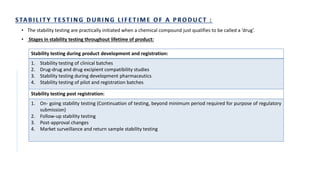
• The stability testing are practically initiated when a chemical compound just qualifies to be called a ‘drug’.
• Stages in stability testing throughout lifetime of product:
Stability testing during product development and registration:
1. Stability testing of clinical batches
2. Drug-drug and drug excipient compatibility studies
3. Stability testing during development pharmaceutics
4. Stability testing of pilot and registration batches
Stability testing post registration:
1. On- going stability testing (Continuation of testing, beyond minimum period required for purpose of regulatory
submission)
2. Follow-up stability testing
3. Post-approval changes
4. Market surveillance and return sample stability testing
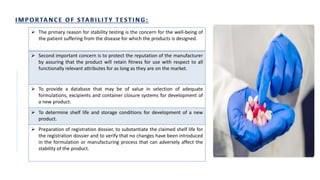
 The primary reason for stability testing is the concern for the well-being of
the patient suffering from the disease for which the products is designed.
 Second important concern is to protect the reputation of the manufacturer
by assuring that the product will retain fitness for use with respect to all
functionally relevant attributes for as long as they are on the market.
 To provide a database that may be of value in selection of adequate
formulations, excipients and container closure systems for development of
a new product.
 To determine shelf life and storage conditions for development of a new
product.
 Preparation of registration dossier, to substantiate the claimed shelf life for
the registration dossier and to verify that no changes have been introduced
in the formulation or manufacturing process that can adversely affect the
stability of the product.
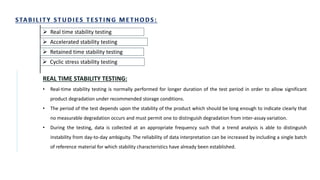
 Real time stability testingAsorption
 Accelerated stability testingAbsorption
 Retained time stability testing
 Cyclic stress stability testing
REAL TIME STABILITY TESTING:
• Real-time stability testing is normally performed for longer duration of the test period in order to allow significant
product degradation under recommended storage conditions.
• The period of the test depends upon the stability of the product which should be long enough to indicate clearly that
no measurable degradation occurs and must permit one to distinguish degradation from inter-assay variation.
• During the testing, data is collected at an appropriate frequency such that a trend analysis is able to distinguish
instability from day-to-day ambiguity. The reliability of data interpretation can be increased by including a single batch
of reference material for which stability characteristics have already been established.
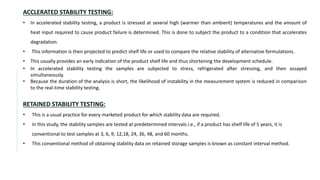
ACCLERATED STABILITY TESTING:
• In accelerated stability testing, a product is stressed at several high (warmer than ambient) temperatures and the amount of
heat input required to cause product failure is determined. This is done to subject the product to a condition that accelerates
degradation.
• This information is then projected to predict shelf life or used to compare the relative stability of alternative formulations.
• This usually provides an early indication of the product shelf life and thus shortening the development schedule.
• In accelerated stability testing the samples are subjected to stress, refrigerated after stressing, and then assayed
simultaneously.
• Because the duration of the analysis is short, the likelihood of instability in the measurement system is reduced in comparison
to the real-time stability testing.
RETAINED STABILITY TESTING:
• This is a usual practice for every marketed product for which stability data are required.
• In this study, the stability samples are tested at predetermined intervals i.e., if a product has shelf life of 5 years, it is
conventional to test samples at 3, 6, 9, 12,18, 24, 36, 48, and 60 months.
• This conventional method of obtaining stability data on retained storage samples is known as constant interval method.
CYCLIC STRESS STABILITY TESTING:
• This is not a routine testing method for marketed products. In this method, cyclic temperature stress tests are designed on
knowledge of the product to mimic likely conditions in market storage.
• The period of cycle mostly considered is 24 hours since the diurnal rhythm on earth is 24 hour, which the marketed
pharmaceuticals are most likely to experience during storage.
• he minimum and maximum temperatures for the cyclic stress testing is recommended to be selected on a product by- product
basis and considering factors like recommended storage temperatures for the product and specific chemical and physical
degradation properties of the products.
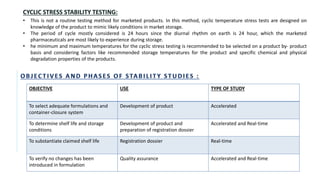
OBJECTIVE USE TYPE OF STUDY
To select adequate formulations and
container-closure system
Development of product Accelerated
To determine shelf life and storage
conditions
Development of product and
preparation of registration dossier
Accelerated and Real-time
To substantiate claimed shelf life Registration dossier Real-time
To verify no changes has been
introduced in formulation
Quality assurance Accelerated and Real-time
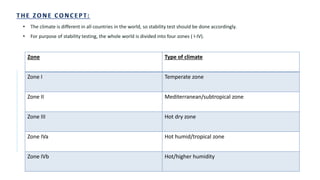
• The climate is different in all countries in the world, so stability test should be done accordingly.
• For purpose of stability testing, the whole world is divided into four zones ( I-IV).
Zone Type of climate
Zone I Temperate zone
Zone II Mediterranean/subtropical zone
Zone III Hot dry zone
Zone IVa Hot humid/tropical zone
Zone IVb Hot/higher humidity
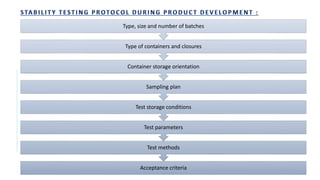
Acceptance criteria
Test methods
Test parameters
Test storage conditions
Sampling plan
Container storage orientation
Type of containers and closures
Type, size and number of batches
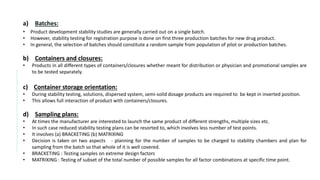
a) Batches:
• Product development stability studies are generally carried out on a single batch.
• However, stability testing for registration purpose is done on first three production batches for new drug product.
• In general, the selection of batches should constitute a random sample from population of pilot or production batches.
b) Containers and closures:
• Products in all different types of containers/closures whether meant for distribution or physician and promotional samples are
to be tested separately.
c) Container storage orientation:
• During stability testing, solutions, dispersed system, semi-solid dosage products are required to be kept in inverted position.
• This allows full interaction of product with containers/closures.
d) Sampling plans:
• At times the manufacturer are interested to launch the same product of different strengths, multiple sizes etc.
• In such case reduced stability testing plans can be resorted to, which involves less number of test points.
• It involves (a) BRACKETING (b) MATRIXING
• Decision is taken on two aspects - planning for the number of samples to be charged to stability chambers and plan for
sampling from the batch so that whole of it is well covered.
• BRACKETING : Testing samples on extreme design factors
• MATRIXING : Testing of subset of the total number of possible samples for all factor combinations at specific time point.
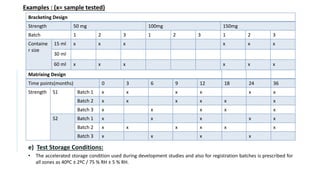
Examples : (x= sample tested)
Bracketing Design
Strength 50 mg 100mg 150mg
Batch 1 2 3 1 2 3 1 2 3
Containe
r size
15 ml x x x x x x
30 ml
60 ml x x x x x x
Matrixing Design
Time points(months) 0 3 6 9 12 18 24 36
Strength S1 Batch 1 x x x x x x
Batch 2 x x x x x x
Batch 3 x x x x x
S2 Batch 1 x x x x x
Batch 2 x x x x x x
Batch 3 x x x x
e) Test Storage Conditions:
• The accelerated storage condition used during development studies and also for registration batches is prescribed for
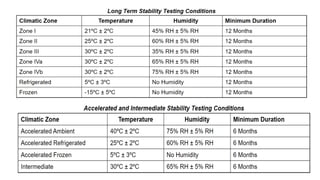
all zones as 40ºC ± 2ºC / 75 % RH ± 5 % RH.
f) Test Parameters:
• The stability test protocol should define test parameters that would define the test parameters that would be used for
evaluation of the stability samples.
• Stability parameters for various types of products are listed [WHO, 2009]
DOSAGE FORM TEST PARAMETERS
Tablets Dissolution, Disintegration, Water content, Friability
Hard gelatin capsules Brittleness, Dissolution, Disintegration, Level of microbial contamination
Soft gelatin capsules Dissolution, Disintegration, Level of microbial contamination, pH
Oral Solutions,
Suspension and Emulsion
Clarity, Precipitate formation, pH, Viscosity, Density
Suspension : Dispersibility, Rheological properties, Distribution of particles
Emulsion : Phase separation, Mean size of dispersed globules
Powders and Granules for
Oral Solution, Suspension
Water content
Metered dose inhalers Dose content uniformity, Labelled number of medication actuations per
container meeting dose uniformity , aerodynamic particle size distribution,
microscopic evaluation, water content, leak rate, pump delivery, foreign
particulate matter
Nasal sprays: Solutions
and Suspension
Clarity, Level of microbial contamination, pH, particulate matter , Foreign
particulate matter
Suppositories Softening range, Disintegration and Dissolution time ( 37º)
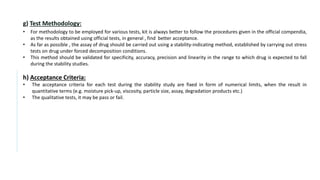
g) Test Methodology:
• For methodology to be employed for various tests, kit is always better to follow the procedures given in the official compendia,
as the results obtained using official tests, in general , find better acceptance.
• As far as possible , the assay of drug should be carried out using a stability-indicating method, established by carrying out stress
tests on drug under forced decomposition conditions.
• This method should be validated for specificity, accuracy, precision and linearity in the range to which drug is expected to fall
during the stability studies.
h) Acceptance Criteria:
• The acceptance criteria for each test during the stability study are fixed in form of numerical limits, when the result in
quantitative terms (e.g. moisture pick-up, viscosity, particle size, assay, degradation products etc.)
• The qualitative tests, it may be pass or fail.
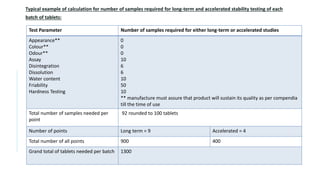
Test Parameter Number of samples required for either long-term or accelerated studies
Appearance**
Colour**
Odour**
Assay
Disintegration
Dissolution
Water content
Friability
Hardness Testing
0
0
0
10
6
6
10
50
10
** manufacture must assure that product will sustain its quality as per compendia
till the time of use
Total number of samples needed per
point
92 rounded to 100 tablets
Number of points Long term = 9 Accelerated = 4
Total number of all points 900 400
Grand total of tablets needed per batch 1300
Typical example of calculation for number of samples required for long-term and accelerated stability testing of each
batch of tablets:
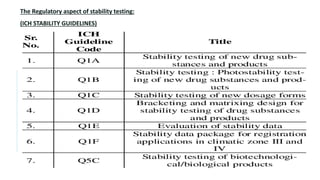
The Regulatory aspect of stability testing:
(ICH STABILITY GUIDELINES)
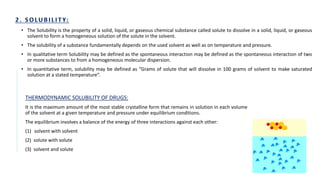
• The Solubility is the property of a solid, liquid, or gaseous chemical substance called solute to dissolve in a solid, liquid, or gaseous
solvent to form a homogeneous solution of the solute in the solvent.
• The solubility of a substance fundamentally depends on the used solvent as well as on temperature and pressure.
• In qualitative term Solubility may be defined as the spontaneous interaction may be defined as the spontaneous interaction of two
or more substances to from a homogeneous molecular dispersion.
• In quantitative term, solubility may be defined as “Grams of solute that will dissolve in 100 grams of solvent to make saturated
solution at a stated temperature”.
THERMODYNAMIC SOLUBILITY OF DRUGS:
It is the maximum amount of the most stable crystalline form that remains in solution in each volume
of the solvent at a given temperature and pressure under equilibrium conditions.
The equilibrium involves a balance of the energy of three interactions against each other:
(1) solvent with solvent
(2) solute with solute
(3) solvent and solute
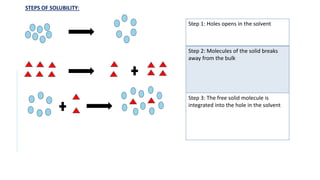
STEPS OF SOLUBILITY:
Step 1: Holes opens in the solvent
Step 2: Molecules of the solid breaks
away from the bulk
Step 3: The free solid molecule is
integrated into the hole in the solvent
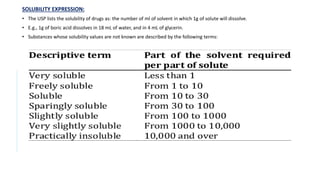
SOLUBILITY EXPRESSION:
• The USP lists the solubility of drugs as: the number of ml of solvent in which 1g of solute will dissolve.
• E.g., 1g of boric acid dissolves in 18 mL of water, and in 4 mL of glycerin.
• Substances whose solubility values are not known are described by the following terms:
 For a newly discovered molecule/drug to become an active drug it must transverse through number of
physiological barriers, both aqueous and non-aqueous, these barriers exist to protect our body from noxious
agents that can be toxic.
 The system by which nature chose to protect us is based on solubility of compounds.
 A compound highly soluble in water or highly insoluble in water would not be able to penetrate the deeper tissues
and thus rendered ineffective.
 Neutral compounds without any polarizable centers often prove to be inert pharmacologically.
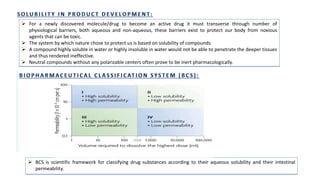
 BCS is scientific framework for classifying drug substances according to their aqueous solubility and their intestinal
permeability.
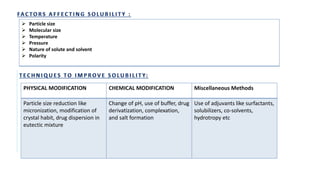
 Particle size
 Molecular size
 Temperature
 Pressure
 Nature of solute and solvent
 Polarity
PHYSICAL MODIFICATION CHEMICAL MODIFICATION Miscellaneous Methods
Particle size reduction like
micronization, modification of
crystal habit, drug dispersion in
eutectic mixture
Change of pH, use of buffer, drug
derivatization, complexation,
and salt formation
Use of adjuvants like surfactants,
solubilizers, co-solvents,
hydrotropy etc
• Ka or acid dissociation constant is a quantitative measurement of the strength of an acid in solution.
• Let us consider the dissociation of the compound ‘HA’ :
HA ⇌ A- + H+
The Ka for this reaction will be given by:
Ka = [A−][H+]
[HA]
• Expressing acidity in terms of Ka can be inconvenient for practical purposes, therefore, pKa is used.
• pKa can be defined as ‘the negative base-10 logarithm of acid dissociation constant (Ka) of a solution’.
pKa = -log10Ka
Example:
The Ka constant for acetic acid is 0.0000158, but the pKa constant is 4.8, which is a simpler expression.
The smaller the pKa value, the stronger the acid.
The pKa value of lactic acid is about 3.8, so that means lactic acid is stronger than acetic acid.
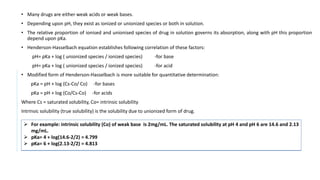
• Many drugs are either weak acids or weak bases.
• Depending upon pH, they exist as ionized or unionized species or both in solution.
• The relative proportion of ionised and unionised species of drug in solution governs its absorption, along with pH this proportion
depend upon pKa.
• Henderson-Hasselbach equation establishes following correlation of these factors:
pH= pKa + log ( unionized species / ionized species) -for base
pH= pKa + log ( unionized species / ionized species) -for acid
• Modified form of Henderson-Hasselbach is more suitable for quantitative determination:
pKa = pH + log (Cs-Co/ Co) -for bases
pKa = pH + log (Co/Cs-Co) -for acids
Where Cs = saturated solubility, Co= intrinsic solubility
Intrinsic solubility (true solubility) is the solubility due to unionized form of drug.
 For example: intrinsic solubility (Co) of weak base is 2mg/mL. The saturated solubility at pH 4 and pH 6 are 14.6 and 2.13
mg/mL.
 pKa= 4 + log(14.6-2/2) = 4.799
 pKa= 6 + log(2.13-2/2) = 4.813
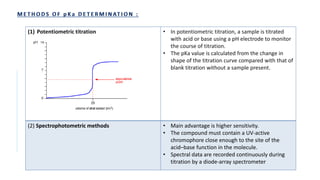
(1) Potentiometric titration • In potentiometric titration, a sample is titrated
with acid or base using a pH electrode to monitor
the course of titration.
• The pKa value is calculated from the change in
shape of the titration curve compared with that of
blank titration without a sample present.
(2) Spectrophotometric methods • Main advantage is higher sensitivity.
• The compound must contain a UV-active
chromophore close enough to the site of the
acid–base function in the molecule.
• Spectral data are recorded continuously during
titration by a diode-array spectrometer
(3) NMR titration • The protonation of a basic site leads to electronic
deshielding effects on the adjacent NMR-active
nuclei.
• The average chemical shifts of all the measurable
NMR-active nuclei, as a function of pH, are
expected to reflect the fractional protonation of
each basic group of a molecule.
• NMR titrations have not yet been applied to the
pKa determination of APIs.
(4) Liquid chromatography • LC is used as a powerful technique for the
determination of dissociation constants, as it
requires only a small quantity of compounds.
• Studied samples do not need to be pure and poor
water solubility is not a serious drawback.
(5) Computational Methods • ARChem’s SPARC software is an on-line calculator
that estimates the macroscopic and microscopic
pKa of any organic compound solely from its
chemical structure.
• Requirements- Aspirin, ethanol, sodium hydroxide, pH meter.
• Principle- Aspirin is a weak acid and partially ionizes in water.
• HA + H2O ↔ H3O+ + A-
It’s acid dissociation constant, Ka is given by:
Ka = [A−][H3O+]
[HA]
Aspirin and sodium hydroxide react in a 1:1 mole ratio:
Method-
1. A burette is filled with 0.1M sodium hydroxide solution.
2. 0.36g of aspirin is weighed in 250ml beaker and 10ml of 95% ethanol is added and volume is made up with deionized water.
3. 2ml portions of sodium hydroxide solution is added from burette to the beaker, stirring well between each additions and recording the pH using a pH
meter.
4. The pH begins to rise rapidly near the end-point
5. After adding 18ml of sodium hydroxide solution, addition is continued in 0.5ml portions.
6. After adding about 22ml, additions in 2ml portions is started again.
7. The addition is continued until total of 36ml has been added.
8. A Graph of pH against volume of 0.1M sodium hydroxide is plotted.
9. The end-point is calculated from the graph of titration.
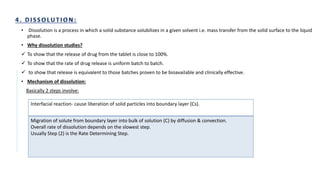
• Dissolution is a process in which a solid substance solubilizes in a given solvent i.e. mass transfer from the solid surface to the liquid
phase.
• Why dissolution studies?
 To show that the release of drug from the tablet is close to 100%.
 To show that the rate of drug release is uniform batch to batch.
 to show that release is equivalent to those batches proven to be bioavailable and clinically effective.
• Mechanism of dissolution:
Basically 2 steps involve:
Interfacial reaction- cause liberation of solid particles into boundary layer (Cs).
Migration of solute from boundary layer into bulk of solution (C) by diffusion & convection.
Overall rate of dissolution depends on the slowest step.
Usually Step (2) is the Rate Determining Step.
Theories of dissolution:
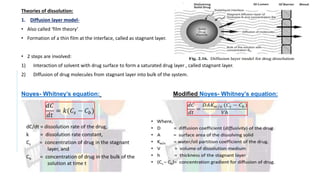
1. Diffusion layer model-
• Also called ‘film theory’
• Formation of a thin film at the interface, called as stagnant layer.
• 2 steps are involved:
1) Interaction of solvent with drug surface to form a saturated drug layer , called stagnant layer.
2) Diffusion of drug molecules from stagnant layer into bulk of the system.
Noyes- Whitney’s equation: Modified Noyes- Whitney’s equation:
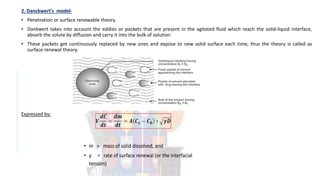
2. Danckwert's model-
• Penetration or surface renewable theory.
• Dankwert takes into account the eddies or packets that are present in the agitated fluid which reach the solid-liquid interface,
absorb the solute by diffusion and carry it into the bulk of solution
• These packets get continuously replaced by new ones and expose to new solid surface each time, thus the theory is called as
surface renewal theory.
Expressed by:
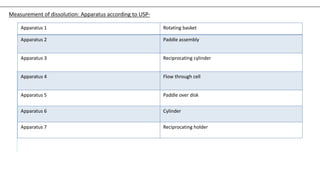
Measurement of dissolution: Apparatus according to USP-
Apparatus 1 Rotating basket
Apparatus 2 Paddle assembly
Apparatus 3 Reciprocating cylinder
Apparatus 4 Flow through cell
Apparatus 5 Paddle over disk
Apparatus 6 Cylinder
Apparatus 7 Reciprocating holder
REFERENCES:
• Jain N.K, “Pharmaceutical Product Development”, CBS Publishers & Distributors, 2nd edition,2010, Pg.no. 1-30, 335-367
• Vogel’s Textbook of Macro and Semimicro Qualitative Inorganic Analysis. Longman Group Limited, London. 1975 (5). 28-
31:130-131
• Brahmankar D.M, “Biopharmaceutics and Pharmacokinetics’, Vallabh Prakashan, 2nd edition, 2009, Pg.no. 1-50
• Khar R, Vyas S.P, Ahmad F, Jain G, “Lachman Liebermans The Theory And Practice Of Industrial Pharmacy”, CBS Publishers &
Distributors, 4th edition, 2020,Pg.no. 217-280
• Allen L, Popovich N, Ansel H, “Ansel's Pharmaceutical Dosage Forms and Drug Delivery System”, Lippincott William and
Wilkins publication, 8th edition, 2004, Pg.no. 145-225

PD-Stability, pka, dissolution ratw.pptx

  • 1.
  • 2.
    STABILITY, SOLUBILITY, pKa,DISSOLUTION RATE Assignment of PRODUCT DEVELOPMENT PHS CC 1202 Session 2023-2024 Department of Pharmaceutical Sciences Dr. Harisingh Gour Vishwavidyalaya,Sagar, (M.P.) (A Central University) Supervisors: PROF. VANDANASONI PROF. SANJAYK. JAIN DR. DHARMENDRA JAIN Submitted by: ADARSH SHARMA Y23254001
  • 3.
    ACKNOWLEGEMENT • I sincerelyappreciate the assistance and support I received from my guide and other faculty members : PROF. VANDANA SONI MAM, PROF.SANJAY K. JAIN SIR, DR. DHARMENDRA JAIN SIR, during my assignment.
  • 4.
    CONTENT: 4 1. INTRODUCTION 2. STABILITY 3.SOLUBILITY 4. pKa 5. DISSOLUTION 6. REFERENCES
  • 5.
    • The stabilityof a product may be defined as an extent to which a product retains, within specified limits, throughout its period of storage and use, the same properties and characteristics as possessed at the time of its packaging. • Stability testing provides evidence on how the quality of drug substance or drug product varies with time under the influence of variety of environmental factors such as temperature, humidity, light. • It measures and documents the ability of product to retain its characteristics prior to predicted expiry date. • FOCUS OF STABILITY TESTING: STABILITY TESTING PHYSICAL - APPEARANCE - PARTICLE SIZE -WATER CONTENT ETC. CHEMICAL -ASSAY - POTENCY - DEGRADATION MICROBIOLOGICAL - LEVEL OF MICROBIAL CONTAMINATION FUNCTIONAL PROPERTIES - DISSOLUTION - RELEASE - DISINTEGRATION
  • 6.
    • The stabilitytesting are practically initiated when a chemical compound just qualifies to be called a ‘drug’. • Stages in stability testing throughout lifetime of product: Stability testing during product development and registration: 1. Stability testing of clinical batches 2. Drug-drug and drug excipient compatibility studies 3. Stability testing during development pharmaceutics 4. Stability testing of pilot and registration batches Stability testing post registration: 1. On- going stability testing (Continuation of testing, beyond minimum period required for purpose of regulatory submission) 2. Follow-up stability testing 3. Post-approval changes 4. Market surveillance and return sample stability testing
  • 7.
     The primaryreason for stability testing is the concern for the well-being of the patient suffering from the disease for which the products is designed.  Second important concern is to protect the reputation of the manufacturer by assuring that the product will retain fitness for use with respect to all functionally relevant attributes for as long as they are on the market.  To provide a database that may be of value in selection of adequate formulations, excipients and container closure systems for development of a new product.  To determine shelf life and storage conditions for development of a new product.  Preparation of registration dossier, to substantiate the claimed shelf life for the registration dossier and to verify that no changes have been introduced in the formulation or manufacturing process that can adversely affect the stability of the product.
  • 8.
     Real timestability testingAsorption  Accelerated stability testingAbsorption  Retained time stability testing  Cyclic stress stability testing REAL TIME STABILITY TESTING: • Real-time stability testing is normally performed for longer duration of the test period in order to allow significant product degradation under recommended storage conditions. • The period of the test depends upon the stability of the product which should be long enough to indicate clearly that no measurable degradation occurs and must permit one to distinguish degradation from inter-assay variation. • During the testing, data is collected at an appropriate frequency such that a trend analysis is able to distinguish instability from day-to-day ambiguity. The reliability of data interpretation can be increased by including a single batch of reference material for which stability characteristics have already been established.
  • 9.
    ACCLERATED STABILITY TESTING: •In accelerated stability testing, a product is stressed at several high (warmer than ambient) temperatures and the amount of heat input required to cause product failure is determined. This is done to subject the product to a condition that accelerates degradation. • This information is then projected to predict shelf life or used to compare the relative stability of alternative formulations. • This usually provides an early indication of the product shelf life and thus shortening the development schedule. • In accelerated stability testing the samples are subjected to stress, refrigerated after stressing, and then assayed simultaneously. • Because the duration of the analysis is short, the likelihood of instability in the measurement system is reduced in comparison to the real-time stability testing. RETAINED STABILITY TESTING: • This is a usual practice for every marketed product for which stability data are required. • In this study, the stability samples are tested at predetermined intervals i.e., if a product has shelf life of 5 years, it is conventional to test samples at 3, 6, 9, 12,18, 24, 36, 48, and 60 months. • This conventional method of obtaining stability data on retained storage samples is known as constant interval method.
  • 10.
    CYCLIC STRESS STABILITYTESTING: • This is not a routine testing method for marketed products. In this method, cyclic temperature stress tests are designed on knowledge of the product to mimic likely conditions in market storage. • The period of cycle mostly considered is 24 hours since the diurnal rhythm on earth is 24 hour, which the marketed pharmaceuticals are most likely to experience during storage. • he minimum and maximum temperatures for the cyclic stress testing is recommended to be selected on a product by- product basis and considering factors like recommended storage temperatures for the product and specific chemical and physical degradation properties of the products. OBJECTIVE USE TYPE OF STUDY To select adequate formulations and container-closure system Development of product Accelerated To determine shelf life and storage conditions Development of product and preparation of registration dossier Accelerated and Real-time To substantiate claimed shelf life Registration dossier Real-time To verify no changes has been introduced in formulation Quality assurance Accelerated and Real-time
  • 11.
    • The climateis different in all countries in the world, so stability test should be done accordingly. • For purpose of stability testing, the whole world is divided into four zones ( I-IV). Zone Type of climate Zone I Temperate zone Zone II Mediterranean/subtropical zone Zone III Hot dry zone Zone IVa Hot humid/tropical zone Zone IVb Hot/higher humidity
  • 13.
    Acceptance criteria Test methods Testparameters Test storage conditions Sampling plan Container storage orientation Type of containers and closures Type, size and number of batches
  • 14.
    a) Batches: • Productdevelopment stability studies are generally carried out on a single batch. • However, stability testing for registration purpose is done on first three production batches for new drug product. • In general, the selection of batches should constitute a random sample from population of pilot or production batches. b) Containers and closures: • Products in all different types of containers/closures whether meant for distribution or physician and promotional samples are to be tested separately. c) Container storage orientation: • During stability testing, solutions, dispersed system, semi-solid dosage products are required to be kept in inverted position. • This allows full interaction of product with containers/closures. d) Sampling plans: • At times the manufacturer are interested to launch the same product of different strengths, multiple sizes etc. • In such case reduced stability testing plans can be resorted to, which involves less number of test points. • It involves (a) BRACKETING (b) MATRIXING • Decision is taken on two aspects - planning for the number of samples to be charged to stability chambers and plan for sampling from the batch so that whole of it is well covered. • BRACKETING : Testing samples on extreme design factors • MATRIXING : Testing of subset of the total number of possible samples for all factor combinations at specific time point.
  • 15.
    Examples : (x=sample tested) Bracketing Design Strength 50 mg 100mg 150mg Batch 1 2 3 1 2 3 1 2 3 Containe r size 15 ml x x x x x x 30 ml 60 ml x x x x x x Matrixing Design Time points(months) 0 3 6 9 12 18 24 36 Strength S1 Batch 1 x x x x x x Batch 2 x x x x x x Batch 3 x x x x x S2 Batch 1 x x x x x Batch 2 x x x x x x Batch 3 x x x x e) Test Storage Conditions: • The accelerated storage condition used during development studies and also for registration batches is prescribed for all zones as 40ºC ± 2ºC / 75 % RH ± 5 % RH.
  • 16.
    f) Test Parameters: •The stability test protocol should define test parameters that would define the test parameters that would be used for evaluation of the stability samples. • Stability parameters for various types of products are listed [WHO, 2009] DOSAGE FORM TEST PARAMETERS Tablets Dissolution, Disintegration, Water content, Friability Hard gelatin capsules Brittleness, Dissolution, Disintegration, Level of microbial contamination Soft gelatin capsules Dissolution, Disintegration, Level of microbial contamination, pH Oral Solutions, Suspension and Emulsion Clarity, Precipitate formation, pH, Viscosity, Density Suspension : Dispersibility, Rheological properties, Distribution of particles Emulsion : Phase separation, Mean size of dispersed globules Powders and Granules for Oral Solution, Suspension Water content Metered dose inhalers Dose content uniformity, Labelled number of medication actuations per container meeting dose uniformity , aerodynamic particle size distribution, microscopic evaluation, water content, leak rate, pump delivery, foreign particulate matter Nasal sprays: Solutions and Suspension Clarity, Level of microbial contamination, pH, particulate matter , Foreign particulate matter Suppositories Softening range, Disintegration and Dissolution time ( 37º)
  • 17.
    g) Test Methodology: •For methodology to be employed for various tests, kit is always better to follow the procedures given in the official compendia, as the results obtained using official tests, in general , find better acceptance. • As far as possible , the assay of drug should be carried out using a stability-indicating method, established by carrying out stress tests on drug under forced decomposition conditions. • This method should be validated for specificity, accuracy, precision and linearity in the range to which drug is expected to fall during the stability studies. h) Acceptance Criteria: • The acceptance criteria for each test during the stability study are fixed in form of numerical limits, when the result in quantitative terms (e.g. moisture pick-up, viscosity, particle size, assay, degradation products etc.) • The qualitative tests, it may be pass or fail.
  • 18.
    Test Parameter Numberof samples required for either long-term or accelerated studies Appearance** Colour** Odour** Assay Disintegration Dissolution Water content Friability Hardness Testing 0 0 0 10 6 6 10 50 10 ** manufacture must assure that product will sustain its quality as per compendia till the time of use Total number of samples needed per point 92 rounded to 100 tablets Number of points Long term = 9 Accelerated = 4 Total number of all points 900 400 Grand total of tablets needed per batch 1300 Typical example of calculation for number of samples required for long-term and accelerated stability testing of each batch of tablets:
  • 19.
    The Regulatory aspectof stability testing: (ICH STABILITY GUIDELINES)
  • 20.
    • The Solubilityis the property of a solid, liquid, or gaseous chemical substance called solute to dissolve in a solid, liquid, or gaseous solvent to form a homogeneous solution of the solute in the solvent. • The solubility of a substance fundamentally depends on the used solvent as well as on temperature and pressure. • In qualitative term Solubility may be defined as the spontaneous interaction may be defined as the spontaneous interaction of two or more substances to from a homogeneous molecular dispersion. • In quantitative term, solubility may be defined as “Grams of solute that will dissolve in 100 grams of solvent to make saturated solution at a stated temperature”. THERMODYNAMIC SOLUBILITY OF DRUGS: It is the maximum amount of the most stable crystalline form that remains in solution in each volume of the solvent at a given temperature and pressure under equilibrium conditions. The equilibrium involves a balance of the energy of three interactions against each other: (1) solvent with solvent (2) solute with solute (3) solvent and solute
  • 21.
    STEPS OF SOLUBILITY: Step1: Holes opens in the solvent Step 2: Molecules of the solid breaks away from the bulk Step 3: The free solid molecule is integrated into the hole in the solvent
  • 22.
    SOLUBILITY EXPRESSION: • TheUSP lists the solubility of drugs as: the number of ml of solvent in which 1g of solute will dissolve. • E.g., 1g of boric acid dissolves in 18 mL of water, and in 4 mL of glycerin. • Substances whose solubility values are not known are described by the following terms:
  • 23.
     For anewly discovered molecule/drug to become an active drug it must transverse through number of physiological barriers, both aqueous and non-aqueous, these barriers exist to protect our body from noxious agents that can be toxic.  The system by which nature chose to protect us is based on solubility of compounds.  A compound highly soluble in water or highly insoluble in water would not be able to penetrate the deeper tissues and thus rendered ineffective.  Neutral compounds without any polarizable centers often prove to be inert pharmacologically.  BCS is scientific framework for classifying drug substances according to their aqueous solubility and their intestinal permeability.
  • 24.
     Particle size Molecular size  Temperature  Pressure  Nature of solute and solvent  Polarity PHYSICAL MODIFICATION CHEMICAL MODIFICATION Miscellaneous Methods Particle size reduction like micronization, modification of crystal habit, drug dispersion in eutectic mixture Change of pH, use of buffer, drug derivatization, complexation, and salt formation Use of adjuvants like surfactants, solubilizers, co-solvents, hydrotropy etc
  • 25.
    • Ka oracid dissociation constant is a quantitative measurement of the strength of an acid in solution. • Let us consider the dissociation of the compound ‘HA’ : HA ⇌ A- + H+ The Ka for this reaction will be given by: Ka = [A−][H+] [HA] • Expressing acidity in terms of Ka can be inconvenient for practical purposes, therefore, pKa is used. • pKa can be defined as ‘the negative base-10 logarithm of acid dissociation constant (Ka) of a solution’. pKa = -log10Ka Example: The Ka constant for acetic acid is 0.0000158, but the pKa constant is 4.8, which is a simpler expression. The smaller the pKa value, the stronger the acid. The pKa value of lactic acid is about 3.8, so that means lactic acid is stronger than acetic acid.
  • 26.
    • Many drugsare either weak acids or weak bases. • Depending upon pH, they exist as ionized or unionized species or both in solution. • The relative proportion of ionised and unionised species of drug in solution governs its absorption, along with pH this proportion depend upon pKa. • Henderson-Hasselbach equation establishes following correlation of these factors: pH= pKa + log ( unionized species / ionized species) -for base pH= pKa + log ( unionized species / ionized species) -for acid • Modified form of Henderson-Hasselbach is more suitable for quantitative determination: pKa = pH + log (Cs-Co/ Co) -for bases pKa = pH + log (Co/Cs-Co) -for acids Where Cs = saturated solubility, Co= intrinsic solubility Intrinsic solubility (true solubility) is the solubility due to unionized form of drug.  For example: intrinsic solubility (Co) of weak base is 2mg/mL. The saturated solubility at pH 4 and pH 6 are 14.6 and 2.13 mg/mL.  pKa= 4 + log(14.6-2/2) = 4.799  pKa= 6 + log(2.13-2/2) = 4.813
  • 27.
    (1) Potentiometric titration• In potentiometric titration, a sample is titrated with acid or base using a pH electrode to monitor the course of titration. • The pKa value is calculated from the change in shape of the titration curve compared with that of blank titration without a sample present. (2) Spectrophotometric methods • Main advantage is higher sensitivity. • The compound must contain a UV-active chromophore close enough to the site of the acid–base function in the molecule. • Spectral data are recorded continuously during titration by a diode-array spectrometer
  • 28.
    (3) NMR titration• The protonation of a basic site leads to electronic deshielding effects on the adjacent NMR-active nuclei. • The average chemical shifts of all the measurable NMR-active nuclei, as a function of pH, are expected to reflect the fractional protonation of each basic group of a molecule. • NMR titrations have not yet been applied to the pKa determination of APIs. (4) Liquid chromatography • LC is used as a powerful technique for the determination of dissociation constants, as it requires only a small quantity of compounds. • Studied samples do not need to be pure and poor water solubility is not a serious drawback. (5) Computational Methods • ARChem’s SPARC software is an on-line calculator that estimates the macroscopic and microscopic pKa of any organic compound solely from its chemical structure.
  • 29.
    • Requirements- Aspirin,ethanol, sodium hydroxide, pH meter. • Principle- Aspirin is a weak acid and partially ionizes in water. • HA + H2O ↔ H3O+ + A- It’s acid dissociation constant, Ka is given by: Ka = [A−][H3O+] [HA] Aspirin and sodium hydroxide react in a 1:1 mole ratio: Method- 1. A burette is filled with 0.1M sodium hydroxide solution. 2. 0.36g of aspirin is weighed in 250ml beaker and 10ml of 95% ethanol is added and volume is made up with deionized water. 3. 2ml portions of sodium hydroxide solution is added from burette to the beaker, stirring well between each additions and recording the pH using a pH meter. 4. The pH begins to rise rapidly near the end-point 5. After adding 18ml of sodium hydroxide solution, addition is continued in 0.5ml portions. 6. After adding about 22ml, additions in 2ml portions is started again. 7. The addition is continued until total of 36ml has been added. 8. A Graph of pH against volume of 0.1M sodium hydroxide is plotted. 9. The end-point is calculated from the graph of titration.
  • 30.
    • Dissolution isa process in which a solid substance solubilizes in a given solvent i.e. mass transfer from the solid surface to the liquid phase. • Why dissolution studies?  To show that the release of drug from the tablet is close to 100%.  To show that the rate of drug release is uniform batch to batch.  to show that release is equivalent to those batches proven to be bioavailable and clinically effective. • Mechanism of dissolution: Basically 2 steps involve: Interfacial reaction- cause liberation of solid particles into boundary layer (Cs). Migration of solute from boundary layer into bulk of solution (C) by diffusion & convection. Overall rate of dissolution depends on the slowest step. Usually Step (2) is the Rate Determining Step.
  • 31.
    Theories of dissolution: 1.Diffusion layer model- • Also called ‘film theory’ • Formation of a thin film at the interface, called as stagnant layer. • 2 steps are involved: 1) Interaction of solvent with drug surface to form a saturated drug layer , called stagnant layer. 2) Diffusion of drug molecules from stagnant layer into bulk of the system. Noyes- Whitney’s equation: Modified Noyes- Whitney’s equation:
  • 32.
    2. Danckwert's model- •Penetration or surface renewable theory. • Dankwert takes into account the eddies or packets that are present in the agitated fluid which reach the solid-liquid interface, absorb the solute by diffusion and carry it into the bulk of solution • These packets get continuously replaced by new ones and expose to new solid surface each time, thus the theory is called as surface renewal theory. Expressed by:
  • 33.
    Measurement of dissolution:Apparatus according to USP- Apparatus 1 Rotating basket Apparatus 2 Paddle assembly Apparatus 3 Reciprocating cylinder Apparatus 4 Flow through cell Apparatus 5 Paddle over disk Apparatus 6 Cylinder Apparatus 7 Reciprocating holder
  • 34.
    REFERENCES: • Jain N.K,“Pharmaceutical Product Development”, CBS Publishers & Distributors, 2nd edition,2010, Pg.no. 1-30, 335-367 • Vogel’s Textbook of Macro and Semimicro Qualitative Inorganic Analysis. Longman Group Limited, London. 1975 (5). 28- 31:130-131 • Brahmankar D.M, “Biopharmaceutics and Pharmacokinetics’, Vallabh Prakashan, 2nd edition, 2009, Pg.no. 1-50 • Khar R, Vyas S.P, Ahmad F, Jain G, “Lachman Liebermans The Theory And Practice Of Industrial Pharmacy”, CBS Publishers & Distributors, 4th edition, 2020,Pg.no. 217-280 • Allen L, Popovich N, Ansel H, “Ansel's Pharmaceutical Dosage Forms and Drug Delivery System”, Lippincott William and Wilkins publication, 8th edition, 2004, Pg.no. 145-225