STABILITY STUDIES
A
PRESENTATION
OF
MASTER OF PHARMACY
IN
PHARMACEUTICS 1ST SEM
COURSE CODE - MPH102T
COURSE NAME- MORDEN PHARMACEUTICS
DEPARTMENT OF PHARMACEUTICS
TEERTHANKER MAHAVEER COLLEGE OF PHARMACY
TEERTHANKER MAHAVEER UNIVERSITY
MORADABAD INDIA
SESSION: 2022-2023
SUBMITTED BY
PRAKHAR VARSHNEY
CONTENT
INTRODUCTION
FACTORS EFFECTING STABILITY
OBJECTIVE
TYPES OF STABILITY
TYPES OF STABILITY THAT MUST BE CONSIDERED FOR ANY
DRUG
REGULATORY REQUIREMENTS
STABILITY STUDIES FOR PHARMACEUTICAL PRODUCTS
DEGRADATIVE PATHWAYS
REFERENCE
INTRODUCTION
Stability studies are performed in life sciences, chemical, and food and beverage
industries to determine the effects of environmental conditions on product quality.
Environmental conditions can impact product shelf life, and the viability of
product formulation.
DEFINATION
The capacity of a drug or product to remain within established specifications of
identity, quality, purity in a specific period of time.
COUNTINUED…….
OR
The capacity or the capability of a particular formulation in a specific
container to remain with in particular chemical, microbiological,
therapeutically, and toxicological specifications.
USP defines stability of pharmaceutical product as, "extent to which a
product retains with in specified limits and throughout its period of storage
and use (i.e. shelf life).
FACTORS EFFECTING DRUG STABILITY
The primary factors effecting stability:
PH, Temperature, Moisture, humidity, light, Storage closure and containers
Oxygen.
The major factors effecting drug stability are:
Particle size (suspension and emulsion), PH, additives and molecular binding
and diffusion of drugs and excipients.
OBJECTIVES
To determine maximum expiration date/ shelf life
.To provide better storage condition.
To determine the packaging components.
To gather information during Preformulation stage to produce a stable
product.
To establish transport condition.
To establish retest period of pharmaceuticals.
TYPE OF STABILITY
I
AM STABLE
THERAP
EUTICAL
STABLE
PHYSICA
L
STABILI
TY
TOXICO
LOGIC
STABILI
TY
MICROB
IOLOGI
CAL
STABILI
TY
CHEMIC
AL
STABILI
TY
TYPES OF STABILITY THAT MUST BE CONSIDERED FOR
ANY DRUG
 CHEMICAL
Each active ingredient retains its chemical integrity and labeled potency within the specified limit.
 PHYSICAL
The physical stability properties includes appearance, palatability, uniformity ,dissolution and
suspendability are retained.
 MICROBIOLOGICAL
Sterility or resistance to microbial growth is retained according to specified requirement.
 THERAPEUTIC
Therapeutic activity remains unchanged.
 TOXICOLOGIC
No significant increase in toxicity occurs.
REGULATORY REQUIREMENTS
Stability study requirement and expiration dates are covered in the current
GMP, USP and FDA
GMP (Good Manufacturing Practice) states that there will be written
testing program design to access the stability characteristics of drug
products. And result of such stability testing will be used to determine
appropriate storage condition and expiration dates
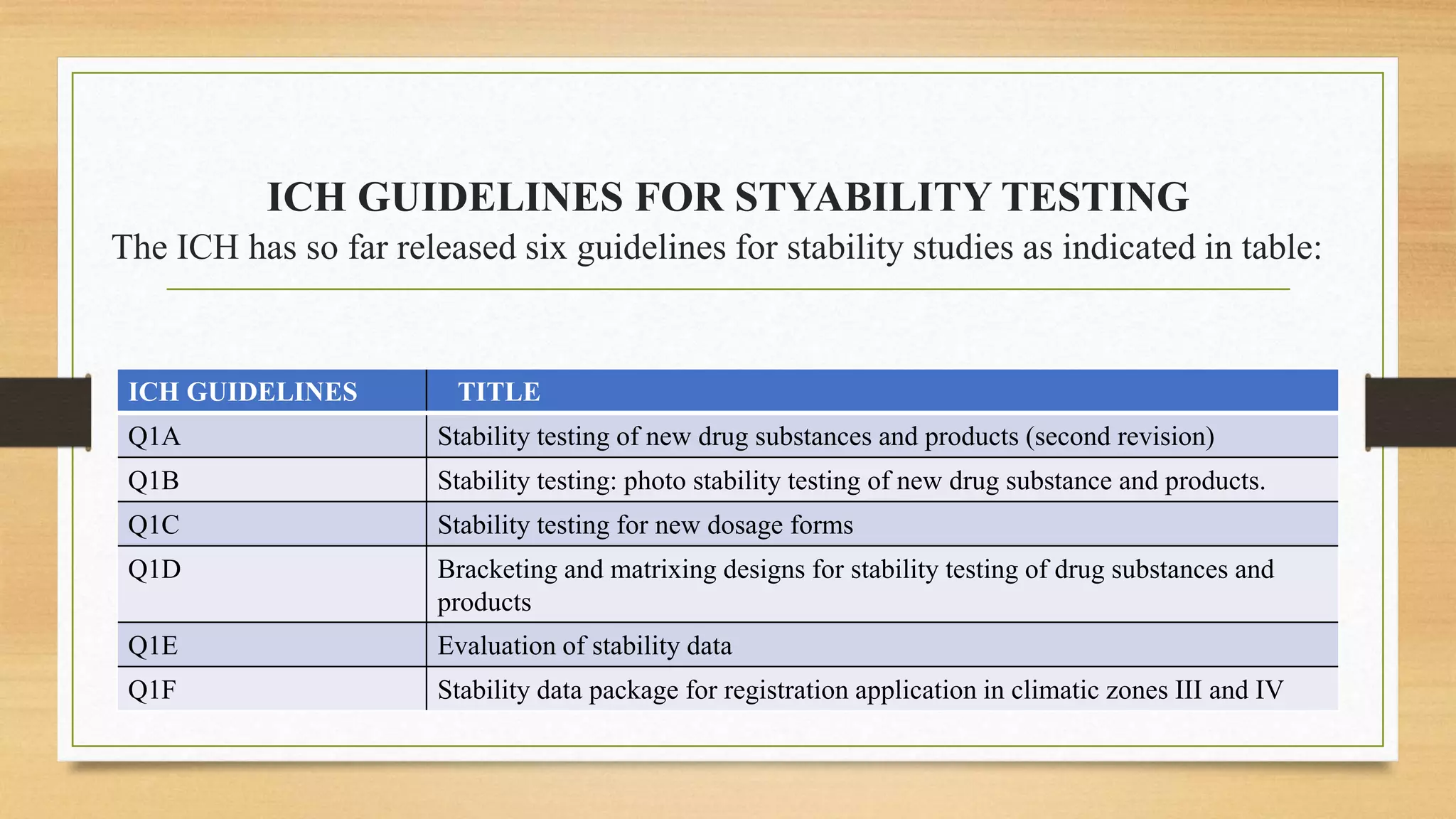
ICH GUIDELINES FOR STYABILITY TESTING
The ICH has so far released six guidelines for stability studies as indicated in table:
ICH GUIDELINES TITLE
Q1A Stability testing of new drug substances and products (second revision)
Q1B Stability testing: photo stability testing of new drug substance and products.
Q1C Stability testing for new dosage forms
Q1D Bracketing and matrixing designs for stability testing of drug substances and
products
Q1E Evaluation of stability data
Q1F Stability data package for registration application in climatic zones III and IV
CLIMATIC ZONESAS
AS per ICH and WHO guidelines ,world has been divided into four zones:
ZONE 1-TEMPERATE
ZONE2-SUBTROPICAL WITH POSSIBLE HIGH HUMIDITY
ZONE 3-HOT, DRY
ZONE 4-HOT,HUMID
LONG TERM STABILITY STUDIES
According to WHO, long term stability testing during and beyond expected
shelf life under storage conditions in the intended market.
RECOMMENDED CONDITIONS FOR LONG TERM STABILITY
STORAGE CONDITIONS
TEMPERATURE (‘C) RELATIVE HUMIDITY % MINIMUM TIME
25’C +/- 60 +/- 5% 12 MONTHS
30’C +/- 30 +/- 5% 6 MONTHS
ACCELERATED STABILITY STUDIES:
In general the accelerated stability conditions must be at least 15'C above the actual
storage temperature and appropriate relative humidity. Substances and drugs
products intended to be stored in a refrigerator. the accelerated stability studies
should be carried out at 25+/-2'c and 60+/-5% relative
STORAGE CONDITIONS
TEMPERATURE (C) RELATIVE HUMIDITY% MINIMUM TIME
40'C +/- 2'C 75 +/-5% 6 MONTHS
DEGRADATIVE PATHWAYS OF
PHARMACEUTICAL DOSAGE FORMS
Degradation of active drug leads to lowering of quantity of the therapeutic
agent in the dosage form.
It may not be extensive, a toxic product formation may take place due to
decomposition instability of drug product can lead to a decrease in its
bioavailability.
Changes in physical appearance of given dosage form may take place.
Degradation may increase or may decrease the potency of drug.
Sometimes active drug may retain its potency, but excipients like -
antimicrobial, preservatives, solubilizers, emulsifying or suspending agent
may degrade, lead to compromising the integrity of drug product
EXAMPLE:
• Drugs like 5-fluorouracil, carbamazipine, digioxin and theophylline have
narrow therapeutic indices these needs to be carefully treated in patient so
that plasma levels are neither too high as to be toxic nor too low as to be
ineffective
• The antimicrobial chloroquine can produce toxic reactions that are
attribute to the photochemical degradation of the substance.
DEGRADATION MAY BE OF TWO TYPES
• PHYSICAL DEGRADATION:
The physical stability properties includes appearance, palatability,
uniformity, dissolution and suspend ability are retained. Maintained
throughout the shelf life of the drug.
IT INCLUDES FOLLOWING:
• Loss of water
• loss of volatile oil
• Water Absorbance
• Polymorphism
• Color change
CHEMICAL DEGRADITION
• OXIDATIONDE
• CARBOXYLATION
• PROTOLYSIS
• RACEMIZATION
• HYDROLYSIS
• PHYSICAL DEGRADATION
REFERENCE
K.Wolters:"Rehmington The science and practice of pharmacy":21st edition volume-
2005:published in Philadelphia College of Pharmacy and science";page no-1025-1033.
J.S Ptrick;"Martin's Physical pharmacy and pharmaceutical sciences";5th edition; published
byWolters Kluver Health(India) Pvt. Ltd. New Delhi. Page no - 428-432.
L Lachman, K.Herbert A.: The Theory and Practice of Industrial Pharmacy: special Indian
edition 2009; CBS Publishers and Distributors Pvt Ltd Page no-772,777,849.
ICH Q1B: "Photostability Testing of New Drug Substances and Products".
ICH Q1C: Stability Testing of New Dosage Forms".

STABILITY STUDIES

  • 1.
    STABILITY STUDIES A PRESENTATION OF MASTER OFPHARMACY IN PHARMACEUTICS 1ST SEM COURSE CODE - MPH102T COURSE NAME- MORDEN PHARMACEUTICS DEPARTMENT OF PHARMACEUTICS TEERTHANKER MAHAVEER COLLEGE OF PHARMACY TEERTHANKER MAHAVEER UNIVERSITY MORADABAD INDIA SESSION: 2022-2023 SUBMITTED BY PRAKHAR VARSHNEY
  • 2.
    CONTENT INTRODUCTION FACTORS EFFECTING STABILITY OBJECTIVE TYPESOF STABILITY TYPES OF STABILITY THAT MUST BE CONSIDERED FOR ANY DRUG REGULATORY REQUIREMENTS STABILITY STUDIES FOR PHARMACEUTICAL PRODUCTS DEGRADATIVE PATHWAYS REFERENCE
  • 3.
    INTRODUCTION Stability studies areperformed in life sciences, chemical, and food and beverage industries to determine the effects of environmental conditions on product quality. Environmental conditions can impact product shelf life, and the viability of product formulation. DEFINATION The capacity of a drug or product to remain within established specifications of identity, quality, purity in a specific period of time.
  • 4.
    COUNTINUED……. OR The capacity orthe capability of a particular formulation in a specific container to remain with in particular chemical, microbiological, therapeutically, and toxicological specifications. USP defines stability of pharmaceutical product as, "extent to which a product retains with in specified limits and throughout its period of storage and use (i.e. shelf life).
  • 5.
    FACTORS EFFECTING DRUGSTABILITY The primary factors effecting stability: PH, Temperature, Moisture, humidity, light, Storage closure and containers Oxygen. The major factors effecting drug stability are: Particle size (suspension and emulsion), PH, additives and molecular binding and diffusion of drugs and excipients.
  • 6.
    OBJECTIVES To determine maximumexpiration date/ shelf life .To provide better storage condition. To determine the packaging components. To gather information during Preformulation stage to produce a stable product. To establish transport condition. To establish retest period of pharmaceuticals.
  • 7.
    TYPE OF STABILITY I AMSTABLE THERAP EUTICAL STABLE PHYSICA L STABILI TY TOXICO LOGIC STABILI TY MICROB IOLOGI CAL STABILI TY CHEMIC AL STABILI TY
  • 8.
    TYPES OF STABILITYTHAT MUST BE CONSIDERED FOR ANY DRUG  CHEMICAL Each active ingredient retains its chemical integrity and labeled potency within the specified limit.  PHYSICAL The physical stability properties includes appearance, palatability, uniformity ,dissolution and suspendability are retained.  MICROBIOLOGICAL Sterility or resistance to microbial growth is retained according to specified requirement.  THERAPEUTIC Therapeutic activity remains unchanged.  TOXICOLOGIC No significant increase in toxicity occurs.
  • 9.
    REGULATORY REQUIREMENTS Stability studyrequirement and expiration dates are covered in the current GMP, USP and FDA GMP (Good Manufacturing Practice) states that there will be written testing program design to access the stability characteristics of drug products. And result of such stability testing will be used to determine appropriate storage condition and expiration dates
  • 10.
    ICH GUIDELINES FORSTYABILITY TESTING The ICH has so far released six guidelines for stability studies as indicated in table: ICH GUIDELINES TITLE Q1A Stability testing of new drug substances and products (second revision) Q1B Stability testing: photo stability testing of new drug substance and products. Q1C Stability testing for new dosage forms Q1D Bracketing and matrixing designs for stability testing of drug substances and products Q1E Evaluation of stability data Q1F Stability data package for registration application in climatic zones III and IV
  • 11.
    CLIMATIC ZONESAS AS perICH and WHO guidelines ,world has been divided into four zones: ZONE 1-TEMPERATE ZONE2-SUBTROPICAL WITH POSSIBLE HIGH HUMIDITY ZONE 3-HOT, DRY ZONE 4-HOT,HUMID
  • 12.
    LONG TERM STABILITYSTUDIES According to WHO, long term stability testing during and beyond expected shelf life under storage conditions in the intended market. RECOMMENDED CONDITIONS FOR LONG TERM STABILITY STORAGE CONDITIONS TEMPERATURE (‘C) RELATIVE HUMIDITY % MINIMUM TIME 25’C +/- 60 +/- 5% 12 MONTHS 30’C +/- 30 +/- 5% 6 MONTHS
  • 13.
    ACCELERATED STABILITY STUDIES: Ingeneral the accelerated stability conditions must be at least 15'C above the actual storage temperature and appropriate relative humidity. Substances and drugs products intended to be stored in a refrigerator. the accelerated stability studies should be carried out at 25+/-2'c and 60+/-5% relative STORAGE CONDITIONS TEMPERATURE (C) RELATIVE HUMIDITY% MINIMUM TIME 40'C +/- 2'C 75 +/-5% 6 MONTHS
  • 14.
    DEGRADATIVE PATHWAYS OF PHARMACEUTICALDOSAGE FORMS Degradation of active drug leads to lowering of quantity of the therapeutic agent in the dosage form. It may not be extensive, a toxic product formation may take place due to decomposition instability of drug product can lead to a decrease in its bioavailability. Changes in physical appearance of given dosage form may take place. Degradation may increase or may decrease the potency of drug. Sometimes active drug may retain its potency, but excipients like - antimicrobial, preservatives, solubilizers, emulsifying or suspending agent may degrade, lead to compromising the integrity of drug product
  • 15.
    EXAMPLE: • Drugs like5-fluorouracil, carbamazipine, digioxin and theophylline have narrow therapeutic indices these needs to be carefully treated in patient so that plasma levels are neither too high as to be toxic nor too low as to be ineffective • The antimicrobial chloroquine can produce toxic reactions that are attribute to the photochemical degradation of the substance.
  • 16.
    DEGRADATION MAY BEOF TWO TYPES • PHYSICAL DEGRADATION: The physical stability properties includes appearance, palatability, uniformity, dissolution and suspend ability are retained. Maintained throughout the shelf life of the drug. IT INCLUDES FOLLOWING: • Loss of water • loss of volatile oil • Water Absorbance • Polymorphism • Color change
  • 17.
    CHEMICAL DEGRADITION • OXIDATIONDE •CARBOXYLATION • PROTOLYSIS • RACEMIZATION • HYDROLYSIS • PHYSICAL DEGRADATION
  • 18.
    REFERENCE K.Wolters:"Rehmington The scienceand practice of pharmacy":21st edition volume- 2005:published in Philadelphia College of Pharmacy and science";page no-1025-1033. J.S Ptrick;"Martin's Physical pharmacy and pharmaceutical sciences";5th edition; published byWolters Kluver Health(India) Pvt. Ltd. New Delhi. Page no - 428-432. L Lachman, K.Herbert A.: The Theory and Practice of Industrial Pharmacy: special Indian edition 2009; CBS Publishers and Distributors Pvt Ltd Page no-772,777,849. ICH Q1B: "Photostability Testing of New Drug Substances and Products". ICH Q1C: Stability Testing of New Dosage Forms".