COLD CHAIN &
IMMUNISATION
SCHEDULE
Roll No. 76 to 80
DISCUSSION
TIME
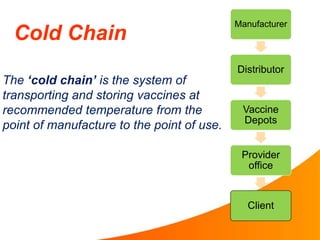
Cold Chain
The ‘cold chain’ is the system of
transporting and storing vaccines at
recommended temperature from the
point of manufacture to the point of use.
Manufacturer
Distributor
Vaccine
Depots
Provider
office
Client
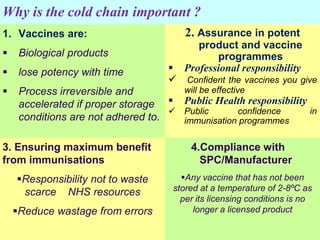
Why is the cold chain important ?
1. Vaccines are:
 Biological products
 lose potency with time
 Process irreversible and
accelerated if proper storage
conditions are not adhered to.
2. Assurance in potent
product and vaccine
programmes
 Professional responsibility
 Confident the vaccines you give
will be effective
 Public Health responsibility
 Public confidence in
immunisation programmes
3. Ensuring maximum benefit
from immunisations
Responsibility not to waste
scarce NHS resources
Reduce wastage from errors
4.Compliance with
SPC/Manufacturer
Any vaccine that has not been
stored at a temperature of 2-8ºC as
per its licensing conditions is no
longer a licensed product
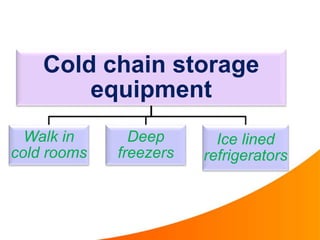
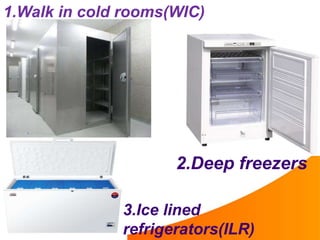
Cold chain storage
equipment
Walk in
cold rooms
Deep
freezers
Ice lined
refrigerators
1.Walk in cold rooms(WIC)
2.Deep freezers
3.Ice lined
refrigerators(ILR)
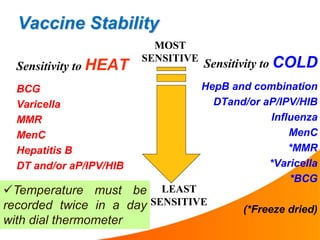
Vaccine Stability
Sensitivity to HEAT
BCG
Varicella
MMR
MenC
Hepatitis B
DT and/or aP/IPV/HIB
Sensitivity to COLD
HepB and combination
DTand/or aP/IPV/HIB
Influenza
MenC
*MMR
*Varicella
*BCG
(*Freeze dried)
MOST
SENSITIVE
Temperature must be
recorded twice in a day
with dial thermometer
LEAST
SENSITIVE
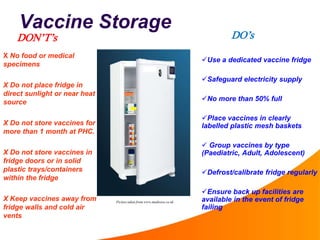
Vaccine Storage
Use a dedicated vaccine fridge
Safeguard electricity supply
No more than 50% full
Place vaccines in clearly
labelled plastic mesh baskets
 Group vaccines by type
(Paediatric, Adult, Adolescent)
Defrost/calibrate fridge regularly
Ensure back up facilities are
available in the event of fridge
failing
X No food or medical
specimens
X Do not place fridge in
direct sunlight or near heat
source
X Do not store vaccines for
more than 1 month at PHC.
X Do not store vaccines in
fridge doors or in solid
plastic trays/containers
within the fridge
X Keep vaccines away from
fridge walls and cold air
vents
Picture taken from www.medisave.co.uk
DO’sDON’T’s
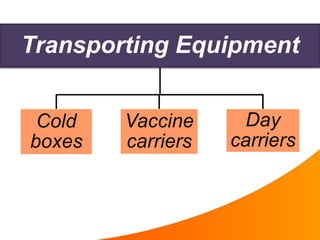
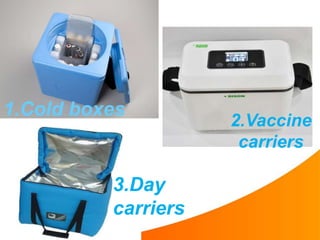
Transporting Equipment
Cold
boxes
Vaccine
carriers
Day
carriers
1.Cold boxes
2.Vaccine
carriers
3.Day
carriers
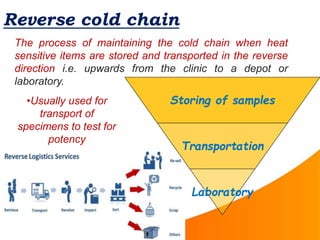
Reverse cold chain
The process of maintaining the cold chain when heat
sensitive items are stored and transported in the reverse
direction i.e. upwards from the clinic to a depot or
laboratory.
Storing of samples
Transportation
Laboratory
•Usually used for
transport of
specimens to test for
potency
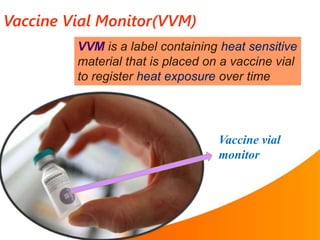
Vaccine Vial Monitor(VVM)
VVM is a label containing heat sensitive
material that is placed on a vaccine vial
to register heat exposure over time
Vaccine vial
monitor
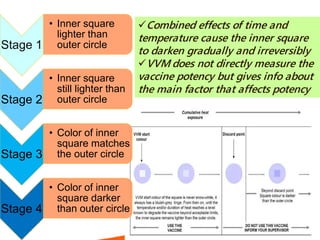
Stage 1
• Inner square
lighter than
outer circle
Stage 2
• Inner square
still lighter than
outer circle
Stage 3
• Color of inner
square matches
the outer circle
Stage 4
• Color of inner
square darker
than outer circle
Combined effects of time and
temperature cause the inner square
to darken gradually and irreversibly
VVM does not directly measure the
vaccine potency but gives info about
the main factor that affects potency
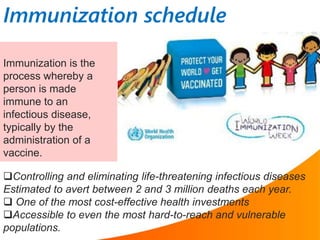
Immunization is the
process whereby a
person is made
immune to an
infectious disease,
typically by the
administration of a
vaccine.
Controlling and eliminating life-threatening infectious diseases
Estimated to avert between 2 and 3 million deaths each year.
 One of the most cost-effective health investments
Accessible to even the most hard-to-reach and vulnerable
populations.
Immunization schedule
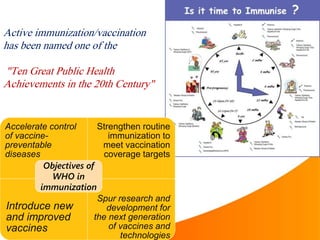
Accelerate control
of vaccine-
preventable
diseases
Strengthen routine
immunization to
meet vaccination
coverage targets
Introduce new
and improved
vaccines
Spur research and
development for
the next generation
of vaccines and
technologies
Objectives of
WHO in
immunization
Active immunization/vaccination
has been named one of the
"Ten Great Public Health
Achievements in the 20th Century"
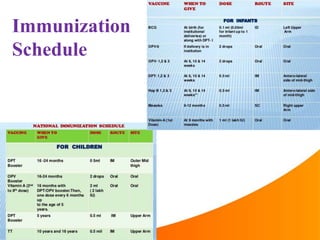
Immunization
Schedule
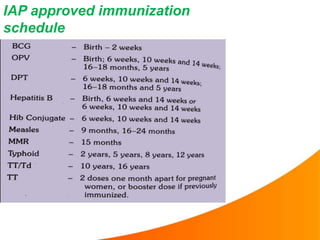
IAP approved immunization
schedule
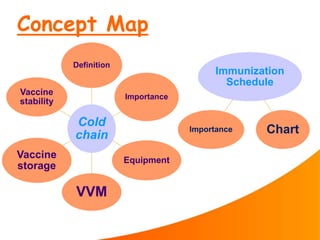
Cold
chain
Definition
Importance
Equipment
VVM
Vaccine
storage
Vaccine
stability
Immunization
Schedule
ChartImportance
Concept Map
References
Park textbook of preventive and social medicine
(22nd edition)
Hand book for vaccine and cold
chain handling (UNICEF)
Immunisation Department, Centre for Infections

SPM ppt

  • 1.
  • 2.
  • 3.
    Cold Chain The ‘coldchain’ is the system of transporting and storing vaccines at recommended temperature from the point of manufacture to the point of use. Manufacturer Distributor Vaccine Depots Provider office Client
  • 4.
    Why is thecold chain important ? 1. Vaccines are:  Biological products  lose potency with time  Process irreversible and accelerated if proper storage conditions are not adhered to. 2. Assurance in potent product and vaccine programmes  Professional responsibility  Confident the vaccines you give will be effective  Public Health responsibility  Public confidence in immunisation programmes 3. Ensuring maximum benefit from immunisations Responsibility not to waste scarce NHS resources Reduce wastage from errors 4.Compliance with SPC/Manufacturer Any vaccine that has not been stored at a temperature of 2-8ºC as per its licensing conditions is no longer a licensed product
  • 5.
    Cold chain storage equipment Walkin cold rooms Deep freezers Ice lined refrigerators
  • 6.
    1.Walk in coldrooms(WIC) 2.Deep freezers 3.Ice lined refrigerators(ILR)
  • 7.
    Vaccine Stability Sensitivity toHEAT BCG Varicella MMR MenC Hepatitis B DT and/or aP/IPV/HIB Sensitivity to COLD HepB and combination DTand/or aP/IPV/HIB Influenza MenC *MMR *Varicella *BCG (*Freeze dried) MOST SENSITIVE Temperature must be recorded twice in a day with dial thermometer LEAST SENSITIVE
  • 8.
    Vaccine Storage Use adedicated vaccine fridge Safeguard electricity supply No more than 50% full Place vaccines in clearly labelled plastic mesh baskets  Group vaccines by type (Paediatric, Adult, Adolescent) Defrost/calibrate fridge regularly Ensure back up facilities are available in the event of fridge failing X No food or medical specimens X Do not place fridge in direct sunlight or near heat source X Do not store vaccines for more than 1 month at PHC. X Do not store vaccines in fridge doors or in solid plastic trays/containers within the fridge X Keep vaccines away from fridge walls and cold air vents Picture taken from www.medisave.co.uk DO’sDON’T’s
  • 9.
  • 10.
  • 11.
    Reverse cold chain Theprocess of maintaining the cold chain when heat sensitive items are stored and transported in the reverse direction i.e. upwards from the clinic to a depot or laboratory. Storing of samples Transportation Laboratory •Usually used for transport of specimens to test for potency
  • 12.
    Vaccine Vial Monitor(VVM) VVMis a label containing heat sensitive material that is placed on a vaccine vial to register heat exposure over time Vaccine vial monitor
  • 13.
    Stage 1 • Innersquare lighter than outer circle Stage 2 • Inner square still lighter than outer circle Stage 3 • Color of inner square matches the outer circle Stage 4 • Color of inner square darker than outer circle Combined effects of time and temperature cause the inner square to darken gradually and irreversibly VVM does not directly measure the vaccine potency but gives info about the main factor that affects potency
  • 14.
    Immunization is the processwhereby a person is made immune to an infectious disease, typically by the administration of a vaccine. Controlling and eliminating life-threatening infectious diseases Estimated to avert between 2 and 3 million deaths each year.  One of the most cost-effective health investments Accessible to even the most hard-to-reach and vulnerable populations. Immunization schedule
  • 15.
    Accelerate control of vaccine- preventable diseases Strengthenroutine immunization to meet vaccination coverage targets Introduce new and improved vaccines Spur research and development for the next generation of vaccines and technologies Objectives of WHO in immunization Active immunization/vaccination has been named one of the "Ten Great Public Health Achievements in the 20th Century"
  • 16.
  • 17.
  • 18.
  • 19.
    References Park textbook ofpreventive and social medicine (22nd edition) Hand book for vaccine and cold chain handling (UNICEF)
  • 20.