COLD CHAIN
Ms. Ulfat Amin
Tutor SMCNMT
INTRODUCTION
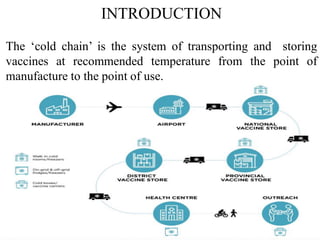
The ‘cold chain’ is the system of transporting and storing
vaccines at recommended temperature from the point of
manufacture to the point of use.
Definition
“A system of storing and transporting the
vaccine, at a low temperature from the
place of manufacture to the actual
vaccination site is called cold chain”.
Importance of cold chain
1. Obtaining the vaccines from the manufacturers
2. Storing and transporting the vaccines
3. Maintaining the supply of vaccines
4. Having information about essential
equipments, supply of electricity etc
5. Keeping the vaccine at low temperature
6. Protecting the vaccine from sunlight exposure
7. Maintaining the potency of vaccines.
Components of cold chain
1. Apparatus/ equipments
2. Supplies
3. Manual efforts
4. Transportation
5. Communication
Production and distribution of
vaccines in India
1. Primary stores(GMSDs/ government medical store
depots ) - 3 months
• 4 GMSDs (Karnal, chennai, Mumbai and kolkatta)
2. State vaccine stores
3. Divisional vaccine store
4. District vaccine store
5. CHC/PHC
Store level Number
GMSDs 4
State vaccine stores 35
Regional vaccine stores 20
Divisional vaccine stores 96
District vaccine stores 626
CHC/PHC 26439
Number of vaccine store in India
Why is the cold chain important ?
1. Vaccines are:
 Biological products
 lose potency with time
 Process irreversible and accelerated if proper
storage conditions are not adhered to.
2. Assurance in potent product and vaccine programmes
 Professional responsibility
 Confident the vaccines you give will be effective
 Public Health responsibility
 Public confidence in immunisation programmes
3. Reduce wastage from errors.
4. Compliance with manufacturer
Any vaccine that has not been stored at a temperature
of 2-8ºC as per its licensing conditions is no longer a
licensed product
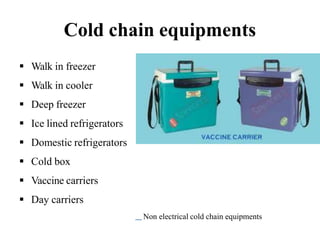
Cold chain equipments
 Walk in freezer
 Walk in cooler
 Deep freezer
 Ice lined refrigerators
 Domestic refrigerators
 Cold box
 Vaccine carriers
 Day carriers
Non electrical cold chain equipments
Walk in freezer
 State level
 Bulk storage of OPV
 Prepare frozen ice packs
 Maintain temperature : - 20 deg C
 Storage capacity: 15 – 20 Lakh doses.
 Stand by generator
 Alarm
Walk in cold rooms(WIC)
 At state/regional level
 4-5 districts
 Store for 3 month requirement / 25% buffer stock
 Temp : +2 to 8 degree C
 Storage capacity: 12 to 15 Lakh doses.
 Sizes – 16.5 cum and 32 cum
 Standby generator – auto start/stop
 Temperature recorder
 Alarm(+10 degree C)
Deep freezer
 Districts – 2-5 large deep freezers.
 PHCs – 1 small deep freezer.
 Temperature : -15 to -25 degree C.
 Maintain temperature for 18 to 26 hours (42 – 32
degree C).
Ice lined refrigerator(ILR)
 Both at district and
PHC levels
 Temp :- +2oc to +8oc
 2 sections –Aand B.
A- bottom – OPV and Measles.
B- upper – BCG, DPT, DT and TT.
Heat sensitive vaccines
BCG
(after reconstitution)
OPV
Measles
DPT
DT
Hep B
Freeze sensitivity
HepB
DPT
DT/TT
Shake test
The “shake test” was
designed to detect freeze
damage in aluminum-based,
adsorbed, freeze
sensitive vaccines such as
DTP, DT, Td, TT, ty- phoid,
and hepatitis B.
These vaccines must nev- er
be frozen as this reduces
their immunogenic- ity.
Do’s for Use of ILR/Freezer
 Keep the equipment in a cool room
 Away from direct sunlight
 At least 10 cms away from the wall.
 Keep the equipment properly levelled.
 Fix the plug permanently to the socket.
 Use voltage stabilizer.
 Keep the vaccines neatly stacked with space for
circulation of air.
 Keep the equipment locked and open it only when
necessary.
 Defrost periodically.
 Check the temperature twice a day
 Maintain a record
Supervised and signed - supervisor/Medical Officer
regularly.
 Outside the equipment - notice of the
contingency plan
 Should know whom to contact
 Should arrange for alternate place for storing
vaccines.
Don’ts for Use of ILR/Freezer
• Do not keep other drugs and vaccines not used in
UIP.
• Do not open the top un-necessarily
• (Paste this message on the top of the ILR).
• Do not keep food or drinking water in the DFs/ILR.
 Do not keep –
 More than one month’s requirement at PHC
headquarters
 More than 3 months requirement at district level.
 Do not keep vaccines, which have expired.
 Do not disturb thermostat setting frequently.
Domestic refrigerators
• 2 to 8 degree C
• Not recommended for UIP
Ice
packs
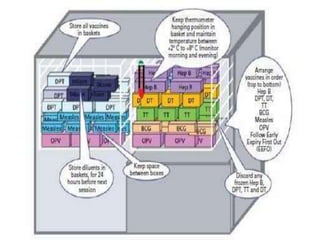
Arrange vaccine in
order
Measles
BCG,TT
DPT, DT
Hep B
Diluents in
door
pocket
2 Thermometer
Vaccine storage
 No food or medical specimens
 Do not place fridge in direct sunlight or near heat
source
 Do not store vaccines for more than 1 month at
PHC.
 Do not store vaccines in fridge doors or in solid
plastic trays/containers within the fridge
 Safeguard electricity supply
 Not more than 50% full
 Place vaccines in clearly labelled plastic mesh
baskets
 Group vaccines by type (Paediatric,Adult,
Adolescent)
 Defrost/calibrate fridge regularly
Cold Box
• Collect and transport large quantities of vaccines.
• These are of different sizes
5, 8, 20 and 22 litres.
• Store vaccines for transfer up to five days
• The hold over time is-
 More than 90 hours for 5 Litre
 Six days for 20 Litre cold box
 Remember - ?
If not opened at
all
Vaccine carriers
• Carrying small quantities of
vaccines
• 16-20 vials
• Sub-centers or session sites.
Day carriers
 Used to carry very small quantities of vaccines(6 to 8
vials)
 For a near by session
 Icepacks - 2
 For only 2 hours period
Cold chain monitoring
equipment:
 Thermometers.
 Cold Chain Monitor (CCM).
 VVM
Dial type Thermometer
Bar type Thermometer
Vaccine cold chain monitor
VVM
Thank you!

Coldchain

  • 1.
    COLD CHAIN Ms. UlfatAmin Tutor SMCNMT
  • 2.
    INTRODUCTION The ‘cold chain’is the system of transporting and storing vaccines at recommended temperature from the point of manufacture to the point of use.
  • 4.
    Definition “A system ofstoring and transporting the vaccine, at a low temperature from the place of manufacture to the actual vaccination site is called cold chain”.
  • 5.
    Importance of coldchain 1. Obtaining the vaccines from the manufacturers 2. Storing and transporting the vaccines 3. Maintaining the supply of vaccines 4. Having information about essential equipments, supply of electricity etc 5. Keeping the vaccine at low temperature 6. Protecting the vaccine from sunlight exposure 7. Maintaining the potency of vaccines.
  • 6.
    Components of coldchain 1. Apparatus/ equipments 2. Supplies 3. Manual efforts 4. Transportation 5. Communication
  • 7.
    Production and distributionof vaccines in India 1. Primary stores(GMSDs/ government medical store depots ) - 3 months • 4 GMSDs (Karnal, chennai, Mumbai and kolkatta) 2. State vaccine stores 3. Divisional vaccine store 4. District vaccine store 5. CHC/PHC
  • 8.
    Store level Number GMSDs4 State vaccine stores 35 Regional vaccine stores 20 Divisional vaccine stores 96 District vaccine stores 626 CHC/PHC 26439 Number of vaccine store in India
  • 9.
    Why is thecold chain important ? 1. Vaccines are:  Biological products  lose potency with time  Process irreversible and accelerated if proper storage conditions are not adhered to.
  • 10.
    2. Assurance inpotent product and vaccine programmes  Professional responsibility  Confident the vaccines you give will be effective  Public Health responsibility  Public confidence in immunisation programmes
  • 11.
    3. Reduce wastagefrom errors. 4. Compliance with manufacturer Any vaccine that has not been stored at a temperature of 2-8ºC as per its licensing conditions is no longer a licensed product
  • 12.
    Cold chain equipments Walk in freezer  Walk in cooler  Deep freezer  Ice lined refrigerators  Domestic refrigerators  Cold box  Vaccine carriers  Day carriers Non electrical cold chain equipments
  • 13.
    Walk in freezer State level  Bulk storage of OPV  Prepare frozen ice packs
  • 14.
     Maintain temperature: - 20 deg C  Storage capacity: 15 – 20 Lakh doses.  Stand by generator  Alarm
  • 15.
    Walk in coldrooms(WIC)  At state/regional level  4-5 districts  Store for 3 month requirement / 25% buffer stock  Temp : +2 to 8 degree C
  • 16.
     Storage capacity:12 to 15 Lakh doses.  Sizes – 16.5 cum and 32 cum  Standby generator – auto start/stop  Temperature recorder  Alarm(+10 degree C)
  • 17.
    Deep freezer  Districts– 2-5 large deep freezers.  PHCs – 1 small deep freezer.
  • 18.
     Temperature :-15 to -25 degree C.  Maintain temperature for 18 to 26 hours (42 – 32 degree C).
  • 20.
    Ice lined refrigerator(ILR) Both at district and PHC levels  Temp :- +2oc to +8oc
  • 21.
     2 sections–Aand B. A- bottom – OPV and Measles. B- upper – BCG, DPT, DT and TT.
  • 22.
    Heat sensitive vaccines BCG (afterreconstitution) OPV Measles DPT DT Hep B
  • 23.
  • 25.
    Shake test The “shaketest” was designed to detect freeze damage in aluminum-based, adsorbed, freeze sensitive vaccines such as DTP, DT, Td, TT, ty- phoid, and hepatitis B. These vaccines must nev- er be frozen as this reduces their immunogenic- ity.
  • 26.
    Do’s for Useof ILR/Freezer  Keep the equipment in a cool room  Away from direct sunlight  At least 10 cms away from the wall.  Keep the equipment properly levelled.  Fix the plug permanently to the socket.  Use voltage stabilizer.
  • 27.
     Keep thevaccines neatly stacked with space for circulation of air.  Keep the equipment locked and open it only when necessary.  Defrost periodically.  Check the temperature twice a day
  • 28.
     Maintain arecord Supervised and signed - supervisor/Medical Officer regularly.  Outside the equipment - notice of the contingency plan  Should know whom to contact  Should arrange for alternate place for storing vaccines.
  • 30.
    Don’ts for Useof ILR/Freezer • Do not keep other drugs and vaccines not used in UIP. • Do not open the top un-necessarily • (Paste this message on the top of the ILR). • Do not keep food or drinking water in the DFs/ILR.
  • 31.
     Do notkeep –  More than one month’s requirement at PHC headquarters  More than 3 months requirement at district level.  Do not keep vaccines, which have expired.  Do not disturb thermostat setting frequently.
  • 32.
    Domestic refrigerators • 2to 8 degree C • Not recommended for UIP
  • 33.
    Ice packs Arrange vaccine in order Measles BCG,TT DPT,DT Hep B Diluents in door pocket 2 Thermometer
  • 34.
    Vaccine storage  Nofood or medical specimens  Do not place fridge in direct sunlight or near heat source  Do not store vaccines for more than 1 month at PHC.  Do not store vaccines in fridge doors or in solid plastic trays/containers within the fridge
  • 35.
     Safeguard electricitysupply  Not more than 50% full  Place vaccines in clearly labelled plastic mesh baskets  Group vaccines by type (Paediatric,Adult, Adolescent)  Defrost/calibrate fridge regularly
  • 36.
  • 37.
    • Collect andtransport large quantities of vaccines. • These are of different sizes 5, 8, 20 and 22 litres. • Store vaccines for transfer up to five days
  • 38.
    • The holdover time is-  More than 90 hours for 5 Litre  Six days for 20 Litre cold box  Remember - ? If not opened at all
  • 39.
    Vaccine carriers • Carryingsmall quantities of vaccines • 16-20 vials • Sub-centers or session sites.
  • 40.
    Day carriers  Usedto carry very small quantities of vaccines(6 to 8 vials)  For a near by session  Icepacks - 2  For only 2 hours period
  • 41.
    Cold chain monitoring equipment: Thermometers.  Cold Chain Monitor (CCM).  VVM
  • 42.
  • 43.
  • 44.
  • 46.
  • 47.