Cold Chain System
DR BUSHRA JABEEN
MD COMMUNITY MEDICINE
1
2
1. Introduction
2. Cold Chain
Equipments
3. Placement Of Vaccine
Vials
4. Potency Of Vaccine
5. Maintenance In
Practice
6. Summary
3
“
”
Vaccine-potency once lost cannot be
restored.
Cold Chain is a system of storing and transporting vaccine at
the recommended temperature range from the point of
manufacture to point of use.
INTRODUCTION
Manufacturer Distributor
Vaccine
depots
Health
care
provider
Vaccine
recipient
4
Cold chain network in the country has been the
backbone to ensure the delivery of vaccine
(6 rights)
• In right quantity
• In right quality
• In right time
• In right temperature
• In right place
• To right beneficiary
INTRODUCTION 5
Key Elements
 Personnel
To manage vaccine storage and distribution.
 Equipment
To store and transport vaccine and monitor
temperature.
 Procedures
To ensure correct utilization of equipment and
ensure vaccines are stored and transported safely.
6
2 to 8c
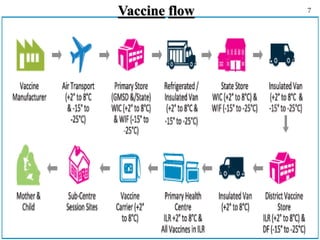
Vaccine flow 7
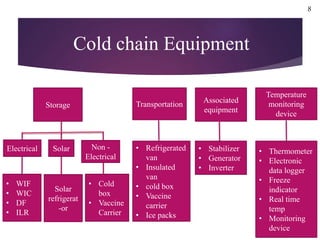
Cold chain Equipment
Storage Transportation
Associated
equipment
Temperature
monitoring
device
Electrical Solar Non -
Electrical
• WIF
• WIC
• DF
• ILR
Solar
refrigerat
-or
• Cold
box
• Vaccine
Carrier
• Refrigerated
van
• Insulated
van
• cold box
• Vaccine
carrier
• Ice packs
• Stabilizer
• Generator
• Inverter
• Thermometer
• Electronic
data logger
• Freeze
indicator
• Real time
temp
• Monitoring
device
8
 Pre-fabricated modular polyurethane foam insulated panel
assembled cold room
 Two identical refrigerator units
 Standby generator set.
 National, State and Regional/Divisional Stores.
 -150C to -250C.
 Bulk storage of OPV Vaccine
 Preparation of frozen Ice Packs for vaccine transportation
Walk-in-Freezers (WIF)
Cold Chain Equipment 9
10
Walk-in-Coolers (WIC)
 Pre-fabricated modular Polyurethane insulated panel assembled cold
room.
 Two identical cooling units with standby generator.
 Maintain temperature of +2°C to +8°C.
 Used for storage of large quantities of UIP vaccines
 Installed at state & regional vaccine store.
 Components:
Graphic chart temperature recorder
Alarm systems
Voltage Stabilizer
Cold Chain Equipment 11
12
Deep Freezer
 Operates on vapour compression system (220 volts A.C)
 -150 C to -250 C.
 Used for storing of OPV (district level and above only)
 Frozen ice packs kept permanently for increasing hold over time.
 Large deep freezers at district headquarters have been supplied for:
• Storage of OPV
• Preparation of ice packs
 Small deep freezers at PHC headquarters have been supplied for:
• Preparation of ice packs only
Cold Chain Equipment 13
Hold over time
Time taken by the equipment to raise the inside cabinet
temperature from its temperature at the time of power
cut, to maximum temperature limit of its recommended
range.
Depends on :
 Ambient temperature
 Frequency of opening the lid
 Quantity of vaccines kept inside
 Condition of ice pack lining.
14
15
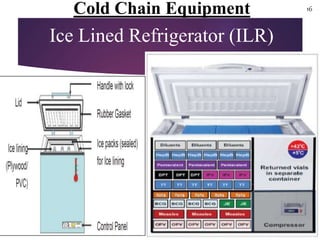
Ice Lined Refrigerator (ILR)
Cold Chain Equipment 16
Domestic Refrigerators
 Continuous power supply is ensured & dedicated for storage of
vaccines.
 20C to 80C
 Do not store other supplies such as drugs, ointment, serum,
samples, food articles, drinks etc.
 Do not put vaccines on the door shelves.
Cold Chain Equipment 17
18
Cold Box
 Big insulated boxes
 5 & 8 litres - 1500 & 2400 doses
 20-22 litres - 6000 – 6600 doses
 Mainly used for transportation
 The vaccines should be placed in cartons or polythene bags
and then place in the cold box.
The vials of DPT, DT, TT and Hep B vaccines should never
be placed in direct contact with the ice packs
 Store vaccines for transfer up to five days
Cold Chain Equipment 19
Packing a cold box
20
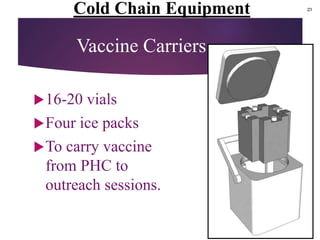
Vaccine Carriers
16-20 vials
Four ice packs
To carry vaccine
from PHC to
outreach sessions.
Cold Chain Equipment 21
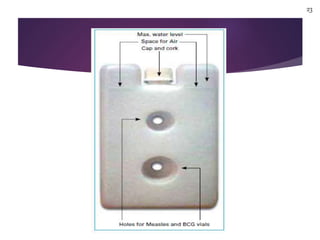
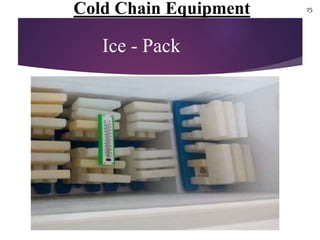
Ice Packs and their use
 Used for ice lining inside the cold box and vaccine
carrier.
 Start freezing ice packs several days before you
need them.
 Salt should never be added to the water
 Ice-packs need not be refilled every time they are
used.
22
23
Conditioning of Ice Packs 24
Ice - Pack
Cold Chain Equipment 25
Placement of vaccines when at the RI site
26
Vaccines lose their potency due to exposure to :
Safeguarding Vaccines 27
Sensitivity of vaccines to
Heat, Light And Freezing
28
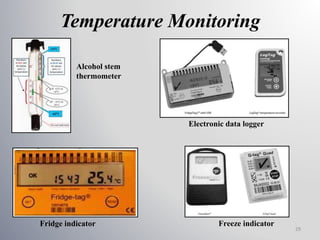
Temperature Monitoring
Alcohol stem
thermometer
Electronic data logger
Fridge indicator Freeze indicator
29
How to check vaccines for correct maintenance of cold chain?
Checking vaccines for heat damage?
VVM showing colour change sequence and interpretation 30
31
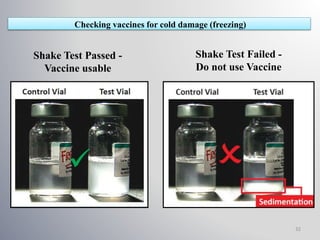
Checking vaccines for cold damage (freezing)
Shake Test Passed -
Vaccine usable
Shake Test Failed -
Do not use Vaccine
32
 Transportation in bulk quantity.
 From GMSD to SVS.
 Provide temperature range for specific vaccine
33
34
35
REVERSE COLD CHAIN
 It is used in AFP (Acute Flaccid Paralysis)
surveillance.
 Transportation of stool sample from a suspected
polio case for diagnosis from periphery to central
laboratory.
 Specific RED vaccine carrier is used for reverse
cold chain.
 Temperature 2°C to 8°C.
36
Summary
 Vaccine transportation from site of manufacture to
field level.
 Equipment's used for :- Storage, Transportation,
Supportive Equipment and maintenance of vaccine.
 Different position for different types of vaccines
 Checking for potency of vaccine before use
 Vaccine vial monitor
37
38
Further reading
 Park K. Park’s Text Book Of Preventive And
Social Medicine. 25th Ed. Jabalpur: Banarsidas
Bhanot Publishers; 2019.
 A H Suryakantha. Textbook of community
medicine with recent advances; 5th edition; 2019.
 Immunization Handbook for Medical Officers,
Ministry of Health and Family Welfare; 3rd
edition; 2016.
39
Thank YOU
40

Cold chain

  • 1.
    Cold Chain System DRBUSHRA JABEEN MD COMMUNITY MEDICINE 1
  • 2.
  • 3.
    1. Introduction 2. ColdChain Equipments 3. Placement Of Vaccine Vials 4. Potency Of Vaccine 5. Maintenance In Practice 6. Summary 3
  • 4.
    “ ” Vaccine-potency once lostcannot be restored. Cold Chain is a system of storing and transporting vaccine at the recommended temperature range from the point of manufacture to point of use. INTRODUCTION Manufacturer Distributor Vaccine depots Health care provider Vaccine recipient 4
  • 5.
    Cold chain networkin the country has been the backbone to ensure the delivery of vaccine (6 rights) • In right quantity • In right quality • In right time • In right temperature • In right place • To right beneficiary INTRODUCTION 5
  • 6.
    Key Elements  Personnel Tomanage vaccine storage and distribution.  Equipment To store and transport vaccine and monitor temperature.  Procedures To ensure correct utilization of equipment and ensure vaccines are stored and transported safely. 6
  • 7.
  • 8.
    Cold chain Equipment StorageTransportation Associated equipment Temperature monitoring device Electrical Solar Non - Electrical • WIF • WIC • DF • ILR Solar refrigerat -or • Cold box • Vaccine Carrier • Refrigerated van • Insulated van • cold box • Vaccine carrier • Ice packs • Stabilizer • Generator • Inverter • Thermometer • Electronic data logger • Freeze indicator • Real time temp • Monitoring device 8
  • 9.
     Pre-fabricated modularpolyurethane foam insulated panel assembled cold room  Two identical refrigerator units  Standby generator set.  National, State and Regional/Divisional Stores.  -150C to -250C.  Bulk storage of OPV Vaccine  Preparation of frozen Ice Packs for vaccine transportation Walk-in-Freezers (WIF) Cold Chain Equipment 9
  • 10.
  • 11.
    Walk-in-Coolers (WIC)  Pre-fabricatedmodular Polyurethane insulated panel assembled cold room.  Two identical cooling units with standby generator.  Maintain temperature of +2°C to +8°C.  Used for storage of large quantities of UIP vaccines  Installed at state & regional vaccine store.  Components: Graphic chart temperature recorder Alarm systems Voltage Stabilizer Cold Chain Equipment 11
  • 12.
  • 13.
    Deep Freezer  Operateson vapour compression system (220 volts A.C)  -150 C to -250 C.  Used for storing of OPV (district level and above only)  Frozen ice packs kept permanently for increasing hold over time.  Large deep freezers at district headquarters have been supplied for: • Storage of OPV • Preparation of ice packs  Small deep freezers at PHC headquarters have been supplied for: • Preparation of ice packs only Cold Chain Equipment 13
  • 14.
    Hold over time Timetaken by the equipment to raise the inside cabinet temperature from its temperature at the time of power cut, to maximum temperature limit of its recommended range. Depends on :  Ambient temperature  Frequency of opening the lid  Quantity of vaccines kept inside  Condition of ice pack lining. 14
  • 15.
  • 16.
    Ice Lined Refrigerator(ILR) Cold Chain Equipment 16
  • 17.
    Domestic Refrigerators  Continuouspower supply is ensured & dedicated for storage of vaccines.  20C to 80C  Do not store other supplies such as drugs, ointment, serum, samples, food articles, drinks etc.  Do not put vaccines on the door shelves. Cold Chain Equipment 17
  • 18.
  • 19.
    Cold Box  Biginsulated boxes  5 & 8 litres - 1500 & 2400 doses  20-22 litres - 6000 – 6600 doses  Mainly used for transportation  The vaccines should be placed in cartons or polythene bags and then place in the cold box. The vials of DPT, DT, TT and Hep B vaccines should never be placed in direct contact with the ice packs  Store vaccines for transfer up to five days Cold Chain Equipment 19
  • 20.
  • 21.
    Vaccine Carriers 16-20 vials Fourice packs To carry vaccine from PHC to outreach sessions. Cold Chain Equipment 21
  • 22.
    Ice Packs andtheir use  Used for ice lining inside the cold box and vaccine carrier.  Start freezing ice packs several days before you need them.  Salt should never be added to the water  Ice-packs need not be refilled every time they are used. 22
  • 23.
  • 24.
  • 25.
    Ice - Pack ColdChain Equipment 25
  • 26.
    Placement of vaccineswhen at the RI site 26
  • 27.
    Vaccines lose theirpotency due to exposure to : Safeguarding Vaccines 27
  • 28.
    Sensitivity of vaccinesto Heat, Light And Freezing 28
  • 29.
    Temperature Monitoring Alcohol stem thermometer Electronicdata logger Fridge indicator Freeze indicator 29
  • 30.
    How to checkvaccines for correct maintenance of cold chain? Checking vaccines for heat damage? VVM showing colour change sequence and interpretation 30
  • 31.
  • 32.
    Checking vaccines forcold damage (freezing) Shake Test Passed - Vaccine usable Shake Test Failed - Do not use Vaccine 32
  • 33.
     Transportation inbulk quantity.  From GMSD to SVS.  Provide temperature range for specific vaccine 33
  • 34.
  • 35.
  • 36.
    REVERSE COLD CHAIN It is used in AFP (Acute Flaccid Paralysis) surveillance.  Transportation of stool sample from a suspected polio case for diagnosis from periphery to central laboratory.  Specific RED vaccine carrier is used for reverse cold chain.  Temperature 2°C to 8°C. 36
  • 37.
    Summary  Vaccine transportationfrom site of manufacture to field level.  Equipment's used for :- Storage, Transportation, Supportive Equipment and maintenance of vaccine.  Different position for different types of vaccines  Checking for potency of vaccine before use  Vaccine vial monitor 37
  • 38.
  • 39.
    Further reading  ParkK. Park’s Text Book Of Preventive And Social Medicine. 25th Ed. Jabalpur: Banarsidas Bhanot Publishers; 2019.  A H Suryakantha. Textbook of community medicine with recent advances; 5th edition; 2019.  Immunization Handbook for Medical Officers, Ministry of Health and Family Welfare; 3rd edition; 2016. 39
  • 40.

Editor's Notes

  • #8 The cold chain system and vaccine flow in the country is schematically represented below.
  • #12  In India, under UIP usually WIC with capacity of 16.5, 32 and 40 Cubic meter are in use.
  • #14 All routine immunization vaccines including OPV/Measles should be stored only in ILR at PHC/CHC level for maximum period of one month.
  • #25 Keep at room temperature for a period of time to allow temperature at core of icepack to rise to 0 C Droplets of water appears and listen for sound of water.
  • #28 The physical appearance of the vaccine may remain unchanged even after it is damaged which is permanent. Evidence suggests that freezing could occur at any level and the vaccine handlers should take precautionary steps to prevent vaccine freezing and discard vaccines that are damaged due to freezing
  • #30 Alcohol stem thermometer, Electronic data logger (30DTR – 30 days temperature recorder), Fridge indicator, Freeze indicator,Temperature logbook, VVM.
  • #31 Vaccines need to be checked both for damage from excessive heat as well as from freezing. However, the physical appearance of a vaccine may remain unchanged even after it is damaged.