COLD CHAIN SYSTEM
Dr Preeti Solanki
Assistant Professor
Department of Community Medicine
16-03-2021 1
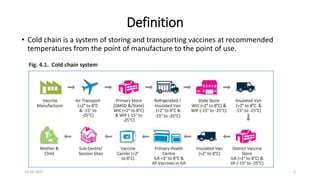
Definition
• Cold chain is a system of storing and transporting vaccines at recommended
temperatures from the point of manufacture to the point of use.
16-03-2021 2
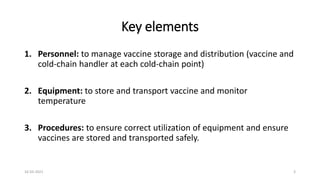
Key elements
1. Personnel: to manage vaccine storage and distribution (vaccine and
cold-chain handler at each cold-chain point)
2. Equipment: to store and transport vaccine and monitor
temperature
3. Procedures: to ensure correct utilization of equipment and ensure
vaccines are stored and transported safely.
16-03-2021 3
Personnel
Vaccine and cold-chain handler:
• At every ILR point, designate a senior male or female HW (pharmacist/staff
nurse/ANM/LHV/MPW/health supervisor) as the VCCH.
• He/she should be responsible for forecasting, indenting, receiving, storing and
distributing vaccines and logistics, maintaining cold-chain equipment and related
records.
• They will require training or update of knowledge and skills in order to perform
their roles effectively
16-03-2021 4
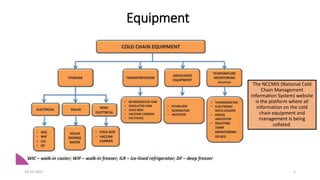
Equipment
The NCCMIS (National Cold
Chain Management
Information System) website
is the platform where all
information on the cold
chain equipment and
management is being
collated.
16-03-2021 5
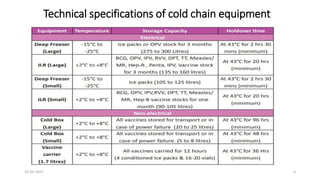
Technical specifications of cold chain equipment
16-03-2021 6
Holdover time
The time taken by the equipment to raise the inside cabinet temperature from its cut-
off temperature to the maximum temperature limit of its recommended range.
Example:
In the case of ILR, if the temperature is 4°C, then the time taken to reach 8°C from 4°C
will be the holdover time for that ILR.
16-03-2021 7
Holdover time of ILR depends on the following factors:
• Ambient temperature – more the ambient temperature, less will be the holdover
time.
• Frequency of opening of lid and use of basket.
• Quantity of vaccines kept inside with adequate space between the containers
(equipment empty/loaded).
• Condition of the ice pack lining (frozen/partially frozen/melted) inside
electrical/non-electrical cold-chain equipment.
16-03-2021 8
ILR point or Cold Chain point
• Located at a health centre (usually PHC/UHC/CHC) with an Ice Lined Refrigerator
for storage of vaccines and a deep freezer for preparation of frozen ice packs.
• The cold chain point must have a generator as power back up.
• The function of the CCP point is to receive, store and further distribute vaccines,
diluents and other logistics to another ILR point or directly to the session sites.
16-03-2021 9
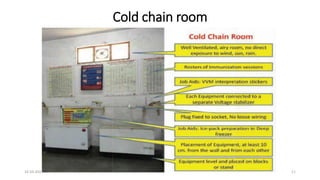
Cold-chain room
• Keep all electrical cold-chain equipment in a separate room with
restricted entry to keep the vaccines and cold-chain equipment safe
and secure.
• During visits to the cold chain room and the weekly meetings, review
the cold chain and vaccine distribution system of your centre.
• Ensure proper display of all the cold chain related job aids and use
them to refresh knowledge and skills
16-03-2021 10
Cold chain room
16-03-2021 11
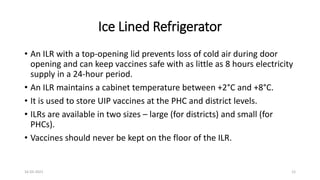
Ice Lined Refrigerator
• An ILR with a top-opening lid prevents loss of cold air during door
opening and can keep vaccines safe with as little as 8 hours electricity
supply in a 24-hour period.
• An ILR maintains a cabinet temperature between +2°C and +8°C.
• It is used to store UIP vaccines at the PHC and district levels.
• ILRs are available in two sizes – large (for districts) and small (for
PHCs).
• Vaccines should never be kept on the floor of the ILR.
16-03-2021 12
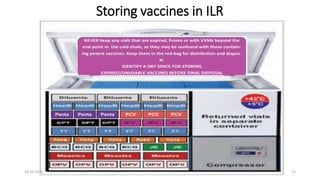
Storing vaccines in ILR
16-03-2021 13
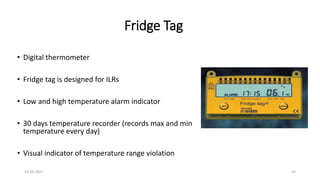
Fridge Tag
• Digital thermometer
• Fridge tag is designed for ILRs
• Low and high temperature alarm indicator
• 30 days temperature recorder (records max and min
temperature every day)
• Visual indicator of temperature range violation
16-03-2021 14
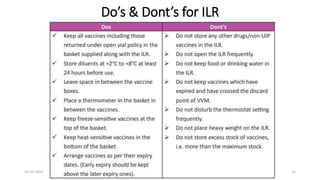
Do’s & Dont’s for ILR
16-03-2021 15
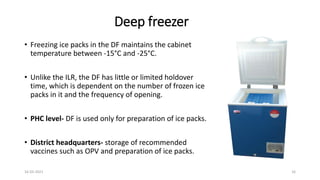
Deep freezer
• Freezing ice packs in the DF maintains the cabinet
temperature between -15°C and -25°C.
• Unlike the ILR, the DF has little or limited holdover
time, which is dependent on the number of frozen ice
packs in it and the frequency of opening.
• PHC level- DF is used only for preparation of ice packs.
• District headquarters- storage of recommended
vaccines such as OPV and preparation of ice packs.
16-03-2021 16
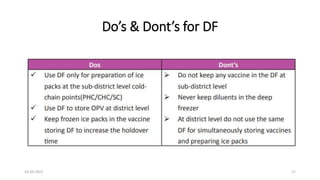
Do’s & Dont’s for DF
16-03-2021 17
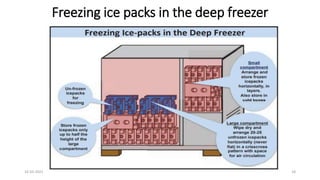
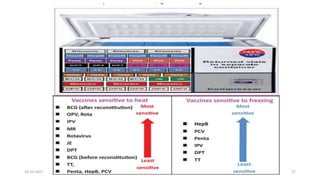
Freezing ice packs in the deep freezer
16-03-2021 18
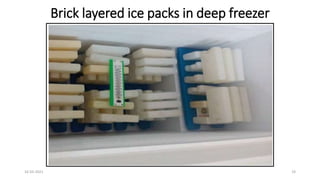
Brick layered ice packs in deep freezer
16-03-2021 19
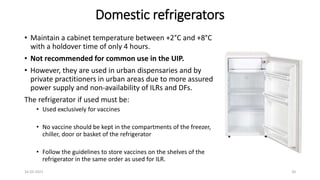
Domestic refrigerators
• Maintain a cabinet temperature between +2°C and +8°C
with a holdover time of only 4 hours.
• Not recommended for common use in the UIP.
• However, they are used in urban dispensaries and by
private practitioners in urban areas due to more assured
power supply and non-availability of ILRs and DFs.
The refrigerator if used must be:
• Used exclusively for vaccines
• No vaccine should be kept in the compartments of the freezer,
chiller, door or basket of the refrigerator
• Follow the guidelines to store vaccines on the shelves of the
refrigerator in the same order as used for ILR.
16-03-2021 20
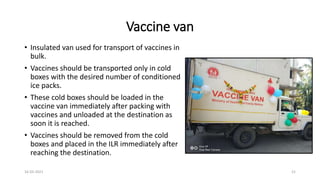
Vaccine van
• Insulated van used for transport of vaccines in
bulk.
• Vaccines should be transported only in cold
boxes with the desired number of conditioned
ice packs.
• These cold boxes should be loaded in the
vaccine van immediately after packing with
vaccines and unloaded at the destination as
soon it is reached.
• Vaccines should be removed from the cold
boxes and placed in the ILR immediately after
reaching the destination.
16-03-2021 21
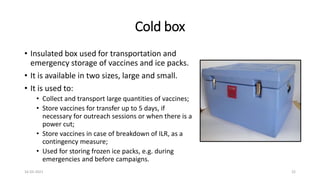
Cold box
• Insulated box used for transportation and
emergency storage of vaccines and ice packs.
• It is available in two sizes, large and small.
• It is used to:
• Collect and transport large quantities of vaccines;
• Store vaccines for transfer up to 5 days, if
necessary for outreach sessions or when there is a
power cut;
• Store vaccines in case of breakdown of ILR, as a
contingency measure;
• Used for storing frozen ice packs, e.g. during
emergencies and before campaigns.
16-03-2021 22
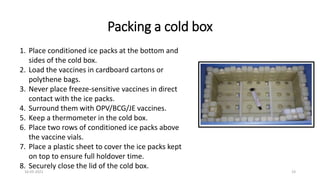
Packing a cold box
1. Place conditioned ice packs at the bottom and
sides of the cold box.
2. Load the vaccines in cardboard cartons or
polythene bags.
3. Never place freeze-sensitive vaccines in direct
contact with the ice packs.
4. Surround them with OPV/BCG/JE vaccines.
5. Keep a thermometer in the cold box.
6. Place two rows of conditioned ice packs above
the vaccine vials.
7. Place a plastic sheet to cover the ice packs kept
on top to ensure full holdover time.
8. Securely close the lid of the cold box.
16-03-2021 23
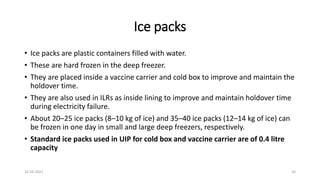
Ice packs
• Ice packs are plastic containers filled with water.
• These are hard frozen in the deep freezer.
• They are placed inside a vaccine carrier and cold box to improve and maintain the
holdover time.
• They are also used in ILRs as inside lining to improve and maintain holdover time
during electricity failure.
• About 20–25 ice packs (8–10 kg of ice) and 35–40 ice packs (12–14 kg of ice) can
be frozen in one day in small and large deep freezers, respectively.
• Standard ice packs used in UIP for cold box and vaccine carrier are of 0.4 litre
capacity
16-03-2021 24
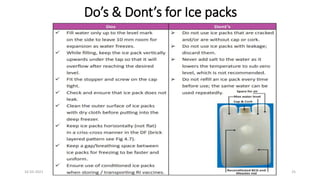
Do’s & Dont’s for Ice packs
16-03-2021 25
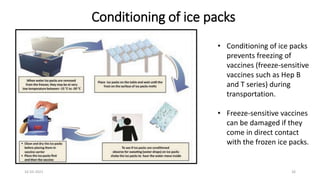
• Conditioning of ice packs
prevents freezing of
vaccines (freeze-sensitive
vaccines such as Hep B
and T series) during
transportation.
• Freeze-sensitive vaccines
can be damaged if they
come in direct contact
with the frozen ice packs.
Conditioning of ice packs
16-03-2021 26
16-03-2021 27
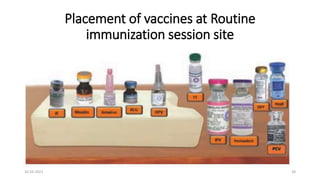
Placement of vaccines at Routine
immunization session site
16-03-2021 28
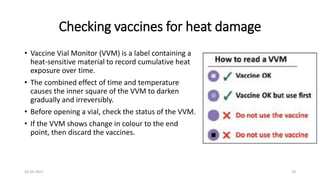
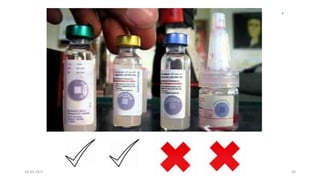
Checking vaccines for heat damage
• Vaccine Vial Monitor (VVM) is a label containing a
heat-sensitive material to record cumulative heat
exposure over time.
• The combined effect of time and temperature
causes the inner square of the VVM to darken
gradually and irreversibly.
• Before opening a vial, check the status of the VVM.
• If the VVM shows change in colour to the end
point, then discard the vaccines.
16-03-2021 29
16-03-2021 30
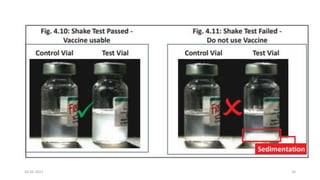
Checking vaccines for cold damage (freezing)
• Conduct the shake test if you suspect that a large number of vials at
the cold-chain point could have been frozen.
• DPT, TT, IPV, HepB and penta vaccines lose their potency if frozen.
• Moreover, the risk of adverse events following immunization (AEFIs)
such as sterile abscesses may increase.
16-03-2021 31
16-03-2021 32
16-03-2021 34
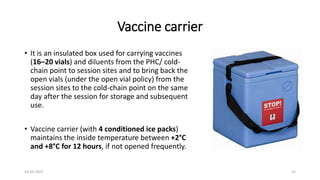
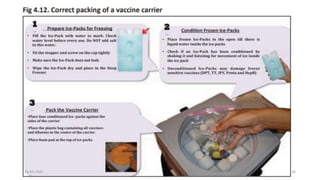
Vaccine carrier
• It is an insulated box used for carrying vaccines
(16–20 vials) and diluents from the PHC/ cold-
chain point to session sites and to bring back the
open vials (under the open vial policy) from the
session sites to the cold-chain point on the same
day after the session for storage and subsequent
use.
• Vaccine carrier (with 4 conditioned ice packs)
maintains the inside temperature between +2°C
and +8°C for 12 hours, if not opened frequently.
16-03-2021 35
16-03-2021 36
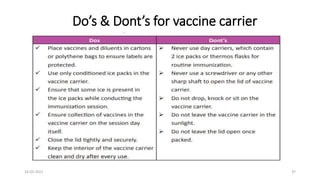
Do’s & Dont’s for vaccine carrier
16-03-2021 37
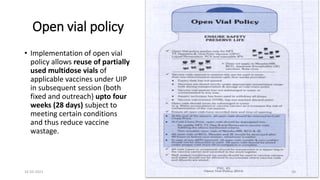
Open vial policy
• Implementation of open vial
policy allows reuse of partially
used multidose vials of
applicable vaccines under UIP
in subsequent session (both
fixed and outreach} upto four
weeks (28 days) subject to
meeting certain conditions
and thus reduce vaccine
wastage.
16-03-2021 39
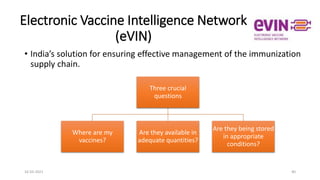
Electronic Vaccine Intelligence Network
(eVIN)
• India’s solution for ensuring effective management of the immunization
supply chain.
16-03-2021 40
Three crucial
questions
Where are my
vaccines?
Are they available in
adequate quantities?
Are they being stored
in appropriate
conditions?
• Conceptualized and piloted by the Immunisation Technical Support
Unit (ITSU), MoHFW.
• Three components:
1. Processes
2. Technology
3. Human resources
16-03-2021 41
How do cold-chain handlers interact with eVIN?
• Interaction 1: eVIN’s registers
• Interaction 2: eVIN’s technology
• Interaction 3: Training of cold-chain handlers and VCCMs
16-03-2021 42
eVIN’s Registers
1. Vaccine Distribution Register
• The number of doses distributed and returned for each vaccine to each session
site is recorded in this register.
• At the end of the session day, cold-chain handlers calculate the net utilization for
each vaccine (total distributed - total returned).
2. Vaccine Stock Register
• At the end of a session day, the net utilisation for a vaccine is deducted from the
day’s opening stock balance to create a closing balance.
• In addition, important information such as batch number, expiry date, name of
manufacturer and VVM status is recorded for every transaction.
16-03-2021 43
Interaction 2: eVIN’s technology
• Mobile phone alerts are sent to cold-chain handlers in case storage
temperatures or stock levels are too high or too low.
1. Mobile Logistics Management Information System (LMIS)
application
2. Temperature loggers
16-03-2021 44
Thank you
16-03-2021 45

Cold chain system

  • 1.
    COLD CHAIN SYSTEM DrPreeti Solanki Assistant Professor Department of Community Medicine 16-03-2021 1
  • 2.
    Definition • Cold chainis a system of storing and transporting vaccines at recommended temperatures from the point of manufacture to the point of use. 16-03-2021 2
  • 3.
    Key elements 1. Personnel:to manage vaccine storage and distribution (vaccine and cold-chain handler at each cold-chain point) 2. Equipment: to store and transport vaccine and monitor temperature 3. Procedures: to ensure correct utilization of equipment and ensure vaccines are stored and transported safely. 16-03-2021 3
  • 4.
    Personnel Vaccine and cold-chainhandler: • At every ILR point, designate a senior male or female HW (pharmacist/staff nurse/ANM/LHV/MPW/health supervisor) as the VCCH. • He/she should be responsible for forecasting, indenting, receiving, storing and distributing vaccines and logistics, maintaining cold-chain equipment and related records. • They will require training or update of knowledge and skills in order to perform their roles effectively 16-03-2021 4
  • 5.
    Equipment The NCCMIS (NationalCold Chain Management Information System) website is the platform where all information on the cold chain equipment and management is being collated. 16-03-2021 5
  • 6.
    Technical specifications ofcold chain equipment 16-03-2021 6
  • 7.
    Holdover time The timetaken by the equipment to raise the inside cabinet temperature from its cut- off temperature to the maximum temperature limit of its recommended range. Example: In the case of ILR, if the temperature is 4°C, then the time taken to reach 8°C from 4°C will be the holdover time for that ILR. 16-03-2021 7
  • 8.
    Holdover time ofILR depends on the following factors: • Ambient temperature – more the ambient temperature, less will be the holdover time. • Frequency of opening of lid and use of basket. • Quantity of vaccines kept inside with adequate space between the containers (equipment empty/loaded). • Condition of the ice pack lining (frozen/partially frozen/melted) inside electrical/non-electrical cold-chain equipment. 16-03-2021 8
  • 9.
    ILR point orCold Chain point • Located at a health centre (usually PHC/UHC/CHC) with an Ice Lined Refrigerator for storage of vaccines and a deep freezer for preparation of frozen ice packs. • The cold chain point must have a generator as power back up. • The function of the CCP point is to receive, store and further distribute vaccines, diluents and other logistics to another ILR point or directly to the session sites. 16-03-2021 9
  • 10.
    Cold-chain room • Keepall electrical cold-chain equipment in a separate room with restricted entry to keep the vaccines and cold-chain equipment safe and secure. • During visits to the cold chain room and the weekly meetings, review the cold chain and vaccine distribution system of your centre. • Ensure proper display of all the cold chain related job aids and use them to refresh knowledge and skills 16-03-2021 10
  • 11.
  • 12.
    Ice Lined Refrigerator •An ILR with a top-opening lid prevents loss of cold air during door opening and can keep vaccines safe with as little as 8 hours electricity supply in a 24-hour period. • An ILR maintains a cabinet temperature between +2°C and +8°C. • It is used to store UIP vaccines at the PHC and district levels. • ILRs are available in two sizes – large (for districts) and small (for PHCs). • Vaccines should never be kept on the floor of the ILR. 16-03-2021 12
  • 13.
    Storing vaccines inILR 16-03-2021 13
  • 14.
    Fridge Tag • Digitalthermometer • Fridge tag is designed for ILRs • Low and high temperature alarm indicator • 30 days temperature recorder (records max and min temperature every day) • Visual indicator of temperature range violation 16-03-2021 14
  • 15.
    Do’s & Dont’sfor ILR 16-03-2021 15
  • 16.
    Deep freezer • Freezingice packs in the DF maintains the cabinet temperature between -15°C and -25°C. • Unlike the ILR, the DF has little or limited holdover time, which is dependent on the number of frozen ice packs in it and the frequency of opening. • PHC level- DF is used only for preparation of ice packs. • District headquarters- storage of recommended vaccines such as OPV and preparation of ice packs. 16-03-2021 16
  • 17.
    Do’s & Dont’sfor DF 16-03-2021 17
  • 18.
    Freezing ice packsin the deep freezer 16-03-2021 18
  • 19.
    Brick layered icepacks in deep freezer 16-03-2021 19
  • 20.
    Domestic refrigerators • Maintaina cabinet temperature between +2°C and +8°C with a holdover time of only 4 hours. • Not recommended for common use in the UIP. • However, they are used in urban dispensaries and by private practitioners in urban areas due to more assured power supply and non-availability of ILRs and DFs. The refrigerator if used must be: • Used exclusively for vaccines • No vaccine should be kept in the compartments of the freezer, chiller, door or basket of the refrigerator • Follow the guidelines to store vaccines on the shelves of the refrigerator in the same order as used for ILR. 16-03-2021 20
  • 21.
    Vaccine van • Insulatedvan used for transport of vaccines in bulk. • Vaccines should be transported only in cold boxes with the desired number of conditioned ice packs. • These cold boxes should be loaded in the vaccine van immediately after packing with vaccines and unloaded at the destination as soon it is reached. • Vaccines should be removed from the cold boxes and placed in the ILR immediately after reaching the destination. 16-03-2021 21
  • 22.
    Cold box • Insulatedbox used for transportation and emergency storage of vaccines and ice packs. • It is available in two sizes, large and small. • It is used to: • Collect and transport large quantities of vaccines; • Store vaccines for transfer up to 5 days, if necessary for outreach sessions or when there is a power cut; • Store vaccines in case of breakdown of ILR, as a contingency measure; • Used for storing frozen ice packs, e.g. during emergencies and before campaigns. 16-03-2021 22
  • 23.
    Packing a coldbox 1. Place conditioned ice packs at the bottom and sides of the cold box. 2. Load the vaccines in cardboard cartons or polythene bags. 3. Never place freeze-sensitive vaccines in direct contact with the ice packs. 4. Surround them with OPV/BCG/JE vaccines. 5. Keep a thermometer in the cold box. 6. Place two rows of conditioned ice packs above the vaccine vials. 7. Place a plastic sheet to cover the ice packs kept on top to ensure full holdover time. 8. Securely close the lid of the cold box. 16-03-2021 23
  • 24.
    Ice packs • Icepacks are plastic containers filled with water. • These are hard frozen in the deep freezer. • They are placed inside a vaccine carrier and cold box to improve and maintain the holdover time. • They are also used in ILRs as inside lining to improve and maintain holdover time during electricity failure. • About 20–25 ice packs (8–10 kg of ice) and 35–40 ice packs (12–14 kg of ice) can be frozen in one day in small and large deep freezers, respectively. • Standard ice packs used in UIP for cold box and vaccine carrier are of 0.4 litre capacity 16-03-2021 24
  • 25.
    Do’s & Dont’sfor Ice packs 16-03-2021 25
  • 26.
    • Conditioning ofice packs prevents freezing of vaccines (freeze-sensitive vaccines such as Hep B and T series) during transportation. • Freeze-sensitive vaccines can be damaged if they come in direct contact with the frozen ice packs. Conditioning of ice packs 16-03-2021 26
  • 27.
  • 28.
    Placement of vaccinesat Routine immunization session site 16-03-2021 28
  • 29.
    Checking vaccines forheat damage • Vaccine Vial Monitor (VVM) is a label containing a heat-sensitive material to record cumulative heat exposure over time. • The combined effect of time and temperature causes the inner square of the VVM to darken gradually and irreversibly. • Before opening a vial, check the status of the VVM. • If the VVM shows change in colour to the end point, then discard the vaccines. 16-03-2021 29
  • 30.
  • 31.
    Checking vaccines forcold damage (freezing) • Conduct the shake test if you suspect that a large number of vials at the cold-chain point could have been frozen. • DPT, TT, IPV, HepB and penta vaccines lose their potency if frozen. • Moreover, the risk of adverse events following immunization (AEFIs) such as sterile abscesses may increase. 16-03-2021 31
  • 32.
  • 33.
  • 34.
    Vaccine carrier • Itis an insulated box used for carrying vaccines (16–20 vials) and diluents from the PHC/ cold- chain point to session sites and to bring back the open vials (under the open vial policy) from the session sites to the cold-chain point on the same day after the session for storage and subsequent use. • Vaccine carrier (with 4 conditioned ice packs) maintains the inside temperature between +2°C and +8°C for 12 hours, if not opened frequently. 16-03-2021 35
  • 35.
  • 36.
    Do’s & Dont’sfor vaccine carrier 16-03-2021 37
  • 37.
    Open vial policy •Implementation of open vial policy allows reuse of partially used multidose vials of applicable vaccines under UIP in subsequent session (both fixed and outreach} upto four weeks (28 days) subject to meeting certain conditions and thus reduce vaccine wastage. 16-03-2021 39
  • 38.
    Electronic Vaccine IntelligenceNetwork (eVIN) • India’s solution for ensuring effective management of the immunization supply chain. 16-03-2021 40 Three crucial questions Where are my vaccines? Are they available in adequate quantities? Are they being stored in appropriate conditions?
  • 39.
    • Conceptualized andpiloted by the Immunisation Technical Support Unit (ITSU), MoHFW. • Three components: 1. Processes 2. Technology 3. Human resources 16-03-2021 41
  • 40.
    How do cold-chainhandlers interact with eVIN? • Interaction 1: eVIN’s registers • Interaction 2: eVIN’s technology • Interaction 3: Training of cold-chain handlers and VCCMs 16-03-2021 42
  • 41.
    eVIN’s Registers 1. VaccineDistribution Register • The number of doses distributed and returned for each vaccine to each session site is recorded in this register. • At the end of the session day, cold-chain handlers calculate the net utilization for each vaccine (total distributed - total returned). 2. Vaccine Stock Register • At the end of a session day, the net utilisation for a vaccine is deducted from the day’s opening stock balance to create a closing balance. • In addition, important information such as batch number, expiry date, name of manufacturer and VVM status is recorded for every transaction. 16-03-2021 43
  • 42.
    Interaction 2: eVIN’stechnology • Mobile phone alerts are sent to cold-chain handlers in case storage temperatures or stock levels are too high or too low. 1. Mobile Logistics Management Information System (LMIS) application 2. Temperature loggers 16-03-2021 44
  • 43.