TABLE OF CONTENTS

                                                                                        Page
                            Health, Disease and Epidemiology                             1

                            Useful Formula                                               8

                            Population                                                  10

                            National Health Situation and Health Care Delivery System   13

                            Phil Health                                                 16

                            Primary Health Care                                         18

                            Assessment of Results                                       21

                            Environmental Control                                       23
PREVENTIVE MEDICINE NOTES   Occupational Health                                         29

                            Family and Illness                                          31

                            Traditional Medicine Program of the Philippines             36

                            Philippine National Drug Policy                             37

                            Revised Tuberculosis Control Program                        39

                            Malaria Control Program                                     41

                            National Dengue Prevention and Control Program              46

                            Philippine National AIDS Council                            47

                            Cancer and Cardiovascular Disease                           48

                            Department of Health Comprehensive Nutrition Program        50

                            Expanded Program of Immunization                            51

                            Integrated Management of Childhood Illness                  54

                            Family Planning                                             58

                            Economics in Health Care                                    62

                            Research                                                    64

                            Biostatistics                                               70
HEALTH, DISEASE AND EPIDEMIOLOGY                                                           3. Environment: sum of all forces that influence the growth and development of an organism
                                                                                                                              o Components: physical, biologic, socio-cultural, economic, political
Health                                                                                                                        o Host Agent Interaction Requirements
  Complete physical, mental and social well-being, and not merely the absence of disease (WHO, 1948)                            a. Favorable conditions in the environment for the agent
  Ability to identify and to realize aspirations, to satisfy needs and to change or cope with the environment                   b. Suitable receivers
   (WHO, 1986)                                                                                                                   c. Susceptible host
                                                                                                                                 d. Satisfactory portal of entry
                                                                                                                                 e. Accessible portal of exit
Disease                                                                                                                          f. Appropriate means of dissemination or transmission
  Any deviation or interruption of the normal structure or function of any part of an organ or functional group of
   organs that is manifested by symptoms or signs                                                                      Premises of the Disease Causation
                                                                                                                         1. Disease results from an imbalance between a disease agent and man
  Theories of Disease Causation                                                                                         2. The nature and extent of the imbalance depends on the nature and characteristics of the host and agent
    1. Theory of Supernatural Causation                                                                                  3. The characteristics of the two are influenced considerably by the conditions of their environment
        a. Mystical: fate, ominous sensation, retribution
        b. Animistic: spirit aggression, soul loss                                                                     Natural History
        c. Magical: sorcery, witchcraft                                                                                  o Comprises the body of both quantitative and qualitative knowledge of agent, host and environmental factors
    2. Materialistic Theory: health inequities are a consequence of material deprivation                                 o Phases
    3. Cultural and Behavioral Theory: health determined by differences in knowledge, attitudes and behaviors                1. Pre-pathogenesis: preliminary interaction of potential agent, host and environmental factors in
    4. Theory of General Susceptibility: seeks to explain the vulnerability of some groups to disease using social               disease production
       and psychological variable                                                                                            2. Pathogenesis: course of disorder in man from the first interaction with disease hence provoking
                                                                                                                                 stimuli to the changes in form and function until equilibrium is reached or results in recovery, defect,
  Factors of Disease Causation                                                                                                  disability or death
    1. Agent: substance or force whose presence or absence causes diseases                                                          - Incubation Period: from exposure to manifestation
         o Types: Biologic, Physical, Chemical, Nutrient                                                                            - Gradient of Infection: sequence of manifestations of illness in the host reflecting his response
         o Characteristics: Mode of transmission, Source of infection, Virulence, Infectivity, Pathogenicity,                         to infectious agent which extends from death at one extreme to unapparent infection at the other
            Antigenicity, Organ of parasitism, Immunity conferred
                                                                                                                       Interplaying Factors in the Level of Disease in a Population
    2. Host: organic body where agent depends for survival                                                               1. Individual Factors
        o Food, water and vehicles are not host                                                                                o Age, sex, civil status, social class, state of nutrition, occupation
        o Resistance/Susceptibility: influenced by age (most important), sex, nutrition, genetics, ethnic group,         2. Spatial Factors
           physiologic state, prior immunologic experience, behavior                                                           o International Variation: related to geographic variations as well as race, ethnicity and culture
        o Exposure: influenced by behavior, environment, occupation                                                            o National Variation: result from difference in socio-economic development as well as cultural and
        o Immunity                                                                                                               geographic differences
             a. Natural: innate resistance to infection                                                                        o Local Variation: related to environmental and access to health differences
             b. Acquired: follows overt or subclinical invasion of body by organisms                                     3. Temporal Factors
                 - Natural Active: acquired by natural infection with agent which produces either clinical                     o Secular/Trend: long term fluctuation of disease occurrence over many decades
                    illness or unapparent infection                                                                            o Cyclic Intrinsic Variation: increase in number of cases more or less regularly every five years due to
                 - Natural Passive: antibodies in the maternal blood are transplacentally transferred to the fetus               accumulation of susceptible through births
                 - Artificial Active: induced by administration of vaccines which contain the antigen in a                     o Sectional Variation: fluctuation of disease occurrence during a year reflecting climatic (seasonal)
                    harmless form                                                                                                changes
                 - Artificial Passive: inoculation of specific protective antibodies from immunized animals or
                    convalescent hyperimmune serum                                                                     Community Reactions to Disease
                                                                                                                         1. Sporadic
                                                                                                                              o Occurrence of a few scattered cases often without relationship to each other
                                                                                                                              o Irregular and unpredictable intermittent presence of the disease
                                                                                                                         2. Endemic
                                                                                                                              o Constant presence of a disease or infectious agent within a given geographical area
                                                                                                                              o Disease occurs at expected frequency and present in population or region at all times however the
                                                                                                                                level of disease is usually low and predictable
Page 1                                                                                                                                                                                                              Page 2
3. Epidemic                                                                                                            o Specific Protection: process by which one can avoid having a particular disease
         o Occurrence in a community or region of cases of an illness clearly in excess of normal expectancy                    a. Prophylactic Measures
           and derived from a common or propagated source                                                                             - Immunization against communicable diseases
                                                                                                                                      - Chemoprophylaxis: administration of drugs to prevent occurrence
    4. Pandemic                                                                                                                       - Mechanical prophylaxis: placing mechanical barriers between course of agent and host
         o Outbreak of an exceptional proportion spreading quickly from one area to another, continental or
                                                                                                                                        interaction
           worldwide proportion
                                                                                                                                b. Control of the Environment
                                                                                                                                c. Occupational Health
  Control: to put limit or to hold in check                                                                          2. Secondary
                                                                                                                           o Applied in the pathogenesis period and aims to block the progression of disease
                                                                                                                           o Prevention of progression of the disease process by diagnosing the disease early and promptly
 Prevention                                                                                                                  initiating treatment:
  Interrupts or slow progression of a disease                                                                                  a. Improving utilization of services through health education
  Cycle of disease generally may be broken by:                                                                                 b. Screening and case finding activities
    1. Increasing host resistance                                                                                               c. Periodic health inventory
    2. Destruction of the agent in the environment                                                                              d. Provision of medical care services
    3. Destruction of the agent in the source/reservoir of infection                                                       o Limiting disabilities from disease
    4. Avoidance of exposure                                                                                          3. Tertiary
                                                                                                                           o Tries to promote independence by preventing disability or complications as a result of the disease
  Strategies towards Sources or Reservoirs                                                                                o Rehabilitation: restoration of the disabled to useful place in society with maximum use of his
    1. Isolation: separation during the period of communicability of infected persons                                        remaining capabilities
    2. Quarantine: limitation of movement of well persons who have been exposed to a communicable disease                  o Basic Health Services
    3. Cleaning: removal by scrubbing and washing of infectious agents on surfaces favorable for their growth                   a. Vital statistics
    4. Treatment: specific cure to shorten the period of communicability and/or course of illness                               b. Medical care
                                                                                                                                c. Environmental sanitation
  Strategies towards Susceptible Population                                                                                    d. Control of communicable disease
    1. Health education                                                                                                         e. Maternal and child health
    2. Personal hygiene                                                                                                         f. Health education and the public
    3. Chemoprophylaxis                                                                                                         g. Public health nursing
    4. Use of repellants                                                                                                        h. Laboratory services
    5. Immunization                                                                                                             i. Control of chronic disease
                                                                                                                                j. Mental health
  Levels of Prevention
    1. Primary                                                                                                    Measurement of Health and Disease
          o Tries to prevent the disease before the pathological process has started                                Determination of health problems (needs and demands) of the community by use of statistics
          o Health Promotion: strategies that enable or enhance achievements of optimal health for individuals,     Disease Indices
             groups and communities                                                                                   1. Morbidity
               a. Exercise, posture, rest, relaxation and sleep                                                           a. Incidence Rate: risk of developing disease per year
               b. Nutrition                                                                                               b. Prevalence Rate: proportion of people suffering from disease at a given instant of time
                    - Age: subtract 5% for every 10 years over 25 years
                    - External temperature: subtract or add 3% for every 1 C over                                     2. Mortality
                    - Physiologic state                                                                                   a. Cause-specific Mortality Rate: risk of dying from a specific disease
                    - Pathologic conditions                                                                               b. Age-specific Mortality Rate: risk of dying for a specific age group
                    - Weight                                                                                              c. Case Fatality Rate: killing power of a disease
               c. Personal Cleanliness                                                                                    d. Proportionate Mortality Rate: proportion of total deaths ascribed to a specific disease
               d. Protection from external forces, injuries, infectious agents                                            e. Maternal Mortality Rate: risk of a woman dying associated with pregnancy, delivery and
               e. Proper personality development, development of healthy social life and sexual life                         puerperium
                                                                                                                          f. Stillbirth or Fetal Mortality Rate: risk of losing the product of conception before delivery
                                                                                                                          g. Infant Mortality Rate: risk of dying during first year of life
                                                                                                                          h. Neonatal Mortality Rate: risk of dying during first 28 days of life
                                                                                                                          i. Perinatal Mortality Rate: sum of stillbirth and neonatal death rates
Page 3                                                                                                                                                                                                        Page 4
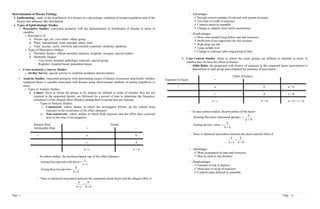
Determination of Disease Etiology                                                                                                           - Advantages
  Epidemiology: study of the distribution of a disease or a physiologic condition in human population and of the                               Provide correct estimate of risk and with greater accuracy
   factors that influence this distribution                                                                                                     Less bias of recall of exposure
  Types of Epidemiologic Studies                                                                                                               Controls easier to assemble
    1. Descriptive Studies: concerned primarily with the determination of distribution of disease in terms of                                   Change in subjects more easily ascertained
        variables                                                                                                                           - Disadvantages
         o Descriptive of:
                                                                                                                                                More time needed (long follow-up) and resources
              a. Person: age, sex, civil status, ethnic group
                                                                                                                                                Inefficient if not impossible for rare diseases
              b. Place: international, local, national, urban, rural
                                                                                                                                                High drop-out rate
              c. Time: secular, cyclic, instrinsic and extrinsic (seasonal variation), epidemic
                                                                                                                                                Large sample size
         o Types of Descriptive Studies
                                                                                                                                                Change in exposure after long period of time
              a. Mortality Studies: official mortality statistics, hospitals, morgues, special studies
              b. Morbidity Studies                                                                                                  b. Case-Control Studies: those in which the study groups are defined or selected in terms of
                    - Case series: hospital, pathologic materials, special group
                                                                                                                                       whether they do have the effect or disease
                    - Registers: hospital based, population based
                                                                                                                                         - Odds Ratio: the proportion with history of exposure to the suspected factor (prevalence) is
    2. Cross-sectional or Survey Studies                                                                                                   determined in each group and compared for presence of association
        o Ad Hoc Survey: special surveys to establish incidence and prevalence
                                                                                                                                                                                Effect (Disease)
    3. Analytic Studies: concerned primarily with determining causes of disease occurrence specifically whether        Exposure to Factor                        +                                         -
       suspected factor is causally associated with disease using observational methods of testing hypothesis or
       cause                                                                                                                    +                                a                                         b              a+b
        o Types of Analytic Studies
            a. Cohort: those in which the groups to be studied are defined in terms of whether they are not                     -                                c                                         d              c+d
               exposed to the suspected factors, are followed for a period of time to determine the frequency
               (incidence) of the alleged effect (disease) among them (exposed and not exposed                                                                 a+c                                       b+d              a+b+c+d
                  - Types of Analytic Studies
                      i. Concurrent: cohort studies in which the investigator follows up the cohorts from
                          exposure to the occurrence of the effect (disease)                                                                - In case control studies, the prevalence of the factor:
                     ii. Non-concurrent: cohort studies in which both exposure and the effect have occurred                                                                                  a
                          prior to the time of investigation                                                                                   Among the cases (diseased group) 
                                                                                                                                                                                           ab
                                                                                                                                                                           b
                 Relative Risk                                                   Factor                                                       Among the non - cases 
                 Attributable Risk                             +                                     -                                                                   bd

                   +                                           a                                     b                                      - There is statistical association between the factor and the effect if:
                                                                                                                                                                               a      b
                                                                                                                                                                                   
                   -                                           c                                     d                                                                        ac bd

                                                             a+c                                    b+d                                     - Advantages
                                                                                                                                                More economical in time and resources
                   - In cohort studies, the incidence/attack rate of the effect (disease)                                                       May be used in rare diseases
                                                              a
                       Among those exposed to the factor                                                                                   - Disadvantages
                                                             ac                                                                                Estimate of risk is indirect
                                                    b                                                                                           More bias of recall of exposure
                       Among those not exposed 
                                                   bd                                                                                          Controls more difficult to assemble
                   - There is statistical association between the suspected causal factor and the alleged effect if:
                                                      a      b
                                                          
                                                     ac bd

Page 5                                                                                                                                                                                                                 Page   6
c. Experimental Studies: primarily concerned with testing hypothesis of cause
              - These are essentially cohort studies except that the groups being studied differ from each        Useful Formula
                other only in the presence of characteristics or exposure to some factor that is artificially      A. Fertility Rates
                induced.                                                                                               1. Crude Birth Rate
              - Types of Experimental Studies                                                                                      Total no. of live births
                  i. Field/Community Trials: selection of a population and determination of its necessary                  CBR                              1000
                                                                                                                                    Midyear Population
                     size depend on prediction of incidence of the disease
                     e.g. Field Trials of Immunization Agents
                                                                                                                        2. General Fertility Rate
                 ii. Clinical Trials: the expected incidence of the disease or unfavorable outcome (eg.
                                                                                                                                                Total no. of live births
                     death) and estimates of differences in outcome in the different groups is required for the            GFR                                                  1000
                     determination of sizes of the groups                                                                          Midyear population of women 15 - 44 years old
                     e.g. Therapeutic/Surgical Trials
                                                                                                                   B. Mortality Rates
               - Other requirements:                                                                                   1. Crude Death Rate
                   High incidence of the disease under study                                                                     number of deaths, all causes
                   Availability of facilities for observation                                                            CBR                                 1000
                   Accessibility of subjects of study                                                                                midyear population
                   Availability of medical/health resources for precise diagnosis and adequate follow-up
                                                                                                                        2. Specific Death Rate
                                                                                                                                    number of deaths in a specified group
                                                                                                                           GFR                                            F
                                                        Preventive Measure                                                         midyear population of a specified group
         Disease                                        +                                      -
                                                                                                                        3. Cause-specific Death Rate
               +                                        a                                      b                                    number of deaths due to a specific cause
                                                                                                                           CSDR                                             F
                                                                                                                                              midyear population
               -                                        c                                      d

                                                       a+c                                   b+d                        4. Proportionate Mortality Rate
                                                                                                                                   number of deaths due to a specific cause
                                                                                                                           PMR                                             100
                                                                                                                                                total deaths
               - Disease Rate in Experimental Group
                       a                                                                                                5. Infant Mortality Rate
                 P1                                                                                                               number of deaths below 1 year of age
                      ac                                                                                                  IMR                                         1000
                                                                                                                                         total number of live births
               - Disease Rate in Control Group
                        b                                                                                               6. Neonate Mortality Rate
                 P2                                                                                                               number of deaths in a year of children less than 28 days of age
                      bd                                                                                                  NMR                                                                    1000
                                                                                                                                              total number of live births in same year
               - Protective Value
                     P P                                                                                               7. Fetal Death Ratio
                 P 2 1
                       P2                                                                                                               number of deaths during the year
                                                                                                                           FDRatio                                        1000
                                                                                                                                        number of live births in same year
               - Advantage
                   Strongest evidence for testing hypothesis                                                           8. Perinatal Mortality Rate
                                                                                                                                                      number of deaths 17 weeks or more
               - Disadvantage
                   Ethical issue especially for clinical trials                                                                                   and infant deaths under 7 days of age
                                                                                                                            M ortality Rate                                                     1000
                                                                                                                                                number of live births and fetal deaths 28 weeks
                                                                                                                                                or more during the same year


Page 7                                                                                                                                                                                                     Page 8
POPULATION
         9. Fetal Death Rate                                                              Demography
                                  number of deaths during the year                          Is the mathematical and statistical study of the size, composition and spatial distribution of human populations,
             FDRate                                                              1000      and of changes over time in these aspects, through the operation of the five processes of:
                      number of live births and fetal deaths during the same year
                                                                                              1. Fertility: number of children being born
                                                                                              2. Mortality: deaths
         10. Maternal Mortality Rate
                                                                                              3. Marriage: age getting married
                      number of deaths from puerperial causes in a year
             MMR                                                       1000                 4. Migration: in and out migration
                         total number of live births in the same year                         5. Social mobility

         11. Case Fatality Rate                                                             Sources of Demographic Data
                      number of deaths due to a particular case                               1. Census: minimum list of population characteristics about which information is collected
             CFR                                               100                              a. De jure method: assign individuals to the place of their usual residence regardless of where they were
                           number of case - same cause                                                actually enumerated during the census
                                                                                                  b. De facto method: people are allocated to the areas where they are physically present at the census date
   C. Morbidity Rates                                                                         2. Sample surveys: collect information from only a subset of the population
       1. Period Prevalence Rate
                number of new and old cases within a period                                 Uses
          PR                                               100                              1. To determine the number and distribution of a population in a certain area for planning, priority setting and
                            midyear population
                                                                                                  for purposes of fund allocation
                                                                                              2. To determine the growth and dispersal of population in the past
         2. Point Prevalence Rate
                                                                                              3. To establish a “causal relationship” between population trends and organization
                    total cases (new and old) at fixed point of time
            PPR                                                     100                     4. To predict future developments and their possible consequences
                              total population at that time

         3. Cumulative Incidence                                                          Demographic Characteristics of Importance to Health
                              number of new cases during a period                          A. Population Size and Growth
            CI                                                                    F
                 number of individual s free of disease at the beginning of period               Population Size: population at risk
                                                                                                 Population Density: number per land area
   D. Others                                                                                     Geographic Distribution: migration and urban vs rural distribution
       1. Sex Ratio                                                                              Population Growth: difference between birth rate and death rate, and is affected by migration
                     Males                                                                         o Factors in Population Growth
             SR            100                                                                       1. Fecundity
                    Females                                                                            2. Coitus rate
                                                                                                       3. Death
         2. Dependency Ratio                                                                           4. Migration
                  Persons aged 0 - 14 and 65 and above
            DR                                        100
                       Persons 15 - 64 years old                                           B. Population Structure
                                                                                                 Population Pyramid
         3. Swaroop’s Index                                                                      Young Population: high fertility rate and high death rate with median age of 15 to 20 years
                    total deaths 50 years old and above                                          Old Population: low fertility rate and low death rate with a median age of 26 to 30 years
             SI                                        100
                            total death, all causes
                                                                                           C. Health Related Characteristics
                                                                                                 Overpopulation or Population Explosion: exists when the economy cannot support the population in the
                                                                                                  face of a rapid population growth economic support is measured in terms of:
                                                                                                   1. State of health and nutrition
                                                                                                   2. Level of unemployment
                                                                                                   3. Level of education
                                                                                                   4. State of housing

Page 9                                                                                                                                                                                    Page 10
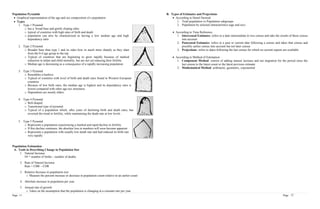
Population Pyramids                                                                                    B. Types of Estimates and Projections
  Graphical representation of the age and sex composition of a population                                  According to Detail Desired
  Types                                                                                                      1. Total population vs Population subgroups
    1. Type 1 Pyramid                                                                                         2. Population by selected characteristics (age and sex)
         o has a broad base and gently sloping sides
         o typical of countries with high rates of birth and death                                          According to Time Reference
         o population can also be characterized as having a low median age and high                           1. Intercensal Estimates: refers to a date intermediate to two census and take the results of these census
           dependency ratio                                                                                      into account
                                                                                                              2. Postcensal Estimates: refers to a past or current date following a census and takes that census and
    2. Type 2 Pyramid                                                                                            possibly earlier census into account but not later census
        o Broader base than type 1 and its sides bow in much more sharply as they slant                       3. Projections: refers to dates following the last census for which no current reports are available
          from the 0-4 age group to the top
        o Typical of countries that are beginning to grow rapidly because of marked                         According to Method of Estimation
          reduction in infant and child mortality, but are not yet reducing their fertility                   1. Component Method: consist of adding natural increase and net migration for the period since the
        o Median age is decreasing as a consequence of a rapidly increasing population                           last census to the latest count or the latest previous estimate
                                                                                                              2. Mathematical Method: arithmetic, geometric, exponential
    3. Type 3 Pyramid
        o Resembles a beehive
        o Typical of countries with level of birth and death rates found in Western European
          countries
        o Because of low birth rates, the median age is highest and its dependency ratio is
          lowest compared with other age-sex structures
        o Dependents are mostly elders

    4. Type 4 Pyramid
        o Bell-shaped
        o Transitional type of pyramid
        o Typical of a population which, after years of declining birth and death rates, has
          reversed the trend in fertility, while maintaining the death rate at low levels

    5. Type 5 Pyramid
        o Represents a population experiencing a marked and rapid decline in fertility
        o If this decline continues, the absolute loss in numbers will soon become apparent
        o Represents a population with usually low death rate and had reduced its birth rate
          very rapidly


Population Estimation
 A. Tools in Describing Change in Population Size
     1. Natural Increase
         NI = number of births – number of deaths
     2. Rate of Natural Increase
        Rate = CBR – CDR
     3. Relative Increase in population size
         o Measure the percent increase or decrease in population count relative to an earlier count
     4. Absolute increase in population per year
     5. Annual rate of growth
         o Takes on the assumption that the population is changing at a constant rate per year
Page 11                                                                                                                                                                                             Page 12
NATIONAL HEALTH SITUATION AND HEALTH CARE DELIVERY SYSTEM
                                                                                                               E. Economic Characteristics
Health System                                                                                                  Five Community Health Questions
  Composed of all activities whose primary purpose is to promote, restore or maintain health (WHO)            A. What is the state of the community?
  Essential Functions                                                                                              1. Mortality Rate
    1. Service provision                                                                                                  Leading Causes of Mortality (2002)
    2. Resource generation                                                                                                  a. Heart                                        f. Tuberculosis
    3. Financing                                                                                                            b. Vascular System                              g. COPD
    4. Stewardship                                                                                                          c. Malignant Neoplasms                          h. Conditions from perinatal
  Composition of a Health System                                                                                           d. Pneumonia (M<F)                              i.   Diabetes mellitus (M<F)
    1. Health care institutions                                                                                             e. Accidents                                    j.   Kidney
    2. Supporting human resources                                                                                   2. Illness or Disease
    3. Financing mechanisms                                                                                               Leading Causes of Morbidity (2004)
    4. Information systems                                                                                                  a. Acute lower respiratory tract infection and pneumonia
    5. Organizational structures                                                                                            b. Bronchitis/Bronchiolitis
  Health System Models                                                                                                     c. Acute watery diarrhea
    1. Private Enterprise Health Care                                                                                       d. Influenza
         o Purely private enterprise health care systems are comparatively rare                                             e. Hypertension
    2. Social Security Health Model                                                                                         f. Tuberculosis
         o Workers and their families are insured by the state                                                              g. Chicken pox
         o Refers to social welfare service concerned with social protection or protection against socially                 h. Disease of the heart
            recognized conditions, including poverty, old age, disability, and unemployment.                                i. Malaria
    3. Publicly Funded Health Care Model                                                                                    j. Dengue fever
         o Residents of the country are insured by the state                                                        3. Nutritional Status
         o Health care that is financed entirely or in majority part by citizen’s tax payment                             Philippines is one of 42 countries that account for 90% of global deaths among under 5 years old
    4. Social Health Insurance
         o Whole population or most of the population is a member of a sickness insurance company
                                                                                                               B. What are the factors contributing to this state of health?
Major Influences in Health System                                                                                   Infant Morbidity Rate
A. Geographic Characteristic                                                                                          1. Pneumonias
      The Philippines is an archipelago of 7107 islands southeast of Asia with a total land area of 300,000          2. Bacterial sepsis
       square kilometers                                                                                              3. Disorders related to short gestation (LBW)
B. Demographic Characteristic                                                                                         4. Respiratory distress
      Population as of August 2, 2007: 88,574,614                                                                    5. Congenital malformation of heart other perinatal conditions
      Average annual population growth rate (2000-2007): 2%                                                        Infant Mortality Rate
      Population density: 295/square kilometer                                                                       1. Pneumonia
                                                                                                                      2. Accidents
C. Government and Political System                                                                                    3. Diarrhea
      Democratic./Republican                                                                                       Maternal Mortality Rate
      Executive: President/Head of State/Commander in Chief of the Armed Forces                                      1. Hypertension
      Legislative: 2 houses composed of the Senate and Represenatitives                                              2. Postpartum Hemorrhage
      Judicial                                                                                                       3. Complications from abortion
      Administrative autonomy enables LGU to raise local revenues to borrow and determine types of local           Economic, Political, Cultural, Environmental Factors
       expenditure including health care expenditures                                                                 1. Poverty: P 5,111 income of family of 5 for minimum basic needs
                                                                                                                      2. Environmental: Key Transmissions
D. Socio-cultural Characteristics                                                                                              a. Agricultural production or food scarcity
      Predominantly Christian (82.0%)                                                                                         b. Water stress or water insecurity
      Overall literacy rate: 92.5%                                                                                            c. Rising sea levels or exposure to climate disasters
      110 ethno-linguistic groups with 8 major languages                                                                      d. Ecosystems and biodiversity
      Basic unit of society: Family                                                                                           e. Human health
Page   13                                                                                                                                                                                                    Page 14
3. Socioeconomic inequity: People who live in rural and isolated communities receive less and lower                                                          PHILHEALTH
             quality health services
          4. Mass migration: Health care mainly financed thru out of pocket payments                                   Introduction
                                                                                                                       The National Health Insurance Program (formerly Medicare) or NHIP was instituted in 1995 by virtue of Republic
C. What is being done by the health services, community and other sectors?                                             Act 7875 popularly known as the National Health Insurance Act of 1995. Being the country’s largest and premiere
     Preventive, Promotive, Curative, Rehabilitative                                                                  social health insurance program, the NHIP aims to effectively provide accessible, affordable, acceptable and
                                                                                                                       adequate and health care services for all Filipinos from all walks of life.
D. What more can be done?
     Elements                                                                                                         The said law mandates the Philippine Health Insurance Corporation (Phil Health), a government owned and
       1. Health Financing (Goal: Foster greater, better sustained investments in health, Philippine Health            controlled corporation, to administer and manage a sustainable program that will not only ensure better benefits at
          Insurance Corporation thru NHIP and DOH)                                                                     an affordable cost but also extend quality and relevant health care services to a broader membership base that will
       2. Health Regulation (Goal: Ensure quality and affordability of health goods and services)                      led to a universal coverage.
       3. Health Service Delivery (Goal: Improve and ensure accessibility and availability of basic and essential
                                                                                                                       Considered as one of the most important social legislation in history, the National insurance Act of 1995, has
          health care in both public and private facilities and services)
                                                                                                                       institutionalized our ideals and aspiration for a healthy Filipino nation in the new millennium
       4. Good Governance (Goal: Enhance health system performance at national and local levels)
     Human Development Index [on 2003, Philippines has 0.76]
       o Longevity: life expectancy at birth
                                                                                                                       Reason for replacement of the Medicare Program
       o Knowledge: adult literacy rate + enrollment ratio (primary, secondary, tertiary)
                                                                                                                        1. Accelerate universal coverage: give all Filipinos access to relevant and quality health care services through an
       o Decent standards of living: GDP per capita
                                                                                                                           affordable health insurance program
E. What measures are needed to continue Health Surveillance of the community and to evaluate the effects of what        2. Enhance and expand the benefits to include more outpatient services
   is being done?                                                                                                       3. Consolidate the Medicare program previously administered separately by the SSS, GSIS and OWWA.
      National Unified Health Research Agenda: joint effort of the PCHRD-DOST, DOH and CHED which                      4. Ensure a sustainable National Health Insurance Program for all.
       provides focus in health research and development efforts in the country, and serves both as template for the
       country’s research and development efforts for the next 5 years and as plateform to advocate local, national
       and international support.                                                                                      Program covers the following:
                                                                                                                        1. Employed sector
                                                                                                                        2. Individual paying members (include self-employed)
                                                                                                                        3. Non-paying members
                                                                                                                        4. Retirees and pensioners
                                                                                                                        5. Permanent and partial disability pensioners and death pensioners (survivors)
                                                                                                                        6. Indigent members under the Medicare para sa Masa


                                                                                                                       Coverage that Extends to Family
                                                                                                                        1. Legitimate spouse not an NHIP member
                                                                                                                        2. Children (legitimate, illegitimate adopted and step child) below 21 years old unmarried and unemployed
                                                                                                                           Those above 60 years old and not retiree/pensioner members and are wholly dependent on the member for
                                                                                                                           support.


                                                                                                                       Declaring the Dependents
                                                                                                                         Form needed to enroll the dependents are as follows:
                                                                                                                           1. M1a or the Member Data Record for employed members
                                                                                                                           2. M1b or the Member Data Record for Individually Paying Members


Page 15                                                                                                                                                                                                                Page 16
Services Uncompensated in Phil Health                                                                                                                        PRIMARY HEALTH CARE
 1. Non-prescription drugs and medicine
 2. Outpatient psychotherapy and counseling for mental disorders                                                      Introduction
 3. Drugs and alcohol abuses and dependency treatment                                                                  A. Articulation of Primary Health Care on the Alma Ata
 4. Cosmetic surgery                                                                                                         Set of guiding values for health development
 5. Home and rehabilitation services                                                                                         Set of principles for the organization of health services
 6. Optometric services                                                                                                      Range of approaches for addressing priority health needs and the fundamental determinants of health
 7. Normal obstetric delivery
       Not included because it is a natural process of reproduction                                                   B. After the Declaration of Alma Ata
       Repair of episiotomy or repair of the incision to prevent laceration and facilitate passage of fetus during         Health: not a result of medical intervention but a product of intertwining economic, socio-political, and
        the first natural vaginal delivery is compensable under the NHIP                                                     cultural circumstances
 8. Other cost ineffective procedures as defined by Phil Health                                                             Development: not measured by investment on infrastructure but by the quality of the people’s lives
                                                                                                                            Socio-economic Structure: characterized by inequities and dual economy to one characterized by equality
                                                                                                                             and greater distribution of wealth
Single Period of Confinement                                                                                                Role of the Community: from passive recipient to actively sharing responsibility for the maintenance of its
  Series of successive confinement for the same illness, injury or condition not separated from each other and not          own wealth
   more than 90 days
  Member or a beneficiary will not be provided with the single period of confinement except for room and board
   fees until 45 days allowance is exhausted                                                                          Primary Health Care
  Member can avail of a new set of benefits if succeeding confinements are of different illness or condition          A. General Principle
                                                                                                                            Intents
                                                                                                                              1. Equal access to health care
Benefit entitlement                                                                                                         Key to attain the target
  Avail benefits if:                                                                                                         1. Should be part of the development
    1. At least 3 monthly contributions within the immediate six months period prior to the month of                          2. Should be in the spirit of social justice
        confinement                                                                                                         Characteristics
    2. For OFWs, the payment of the required annual contributions                                                             1. Community-Based
    3. Confinement to any accredited hospital for not less than 24 hours due to illness or injury requiring                   2. Accessible
        hospitalization                                                                                                       3. Acceptable
  Minor surgical procedures and chemotherapy, radiotherapy, hemodialysis and cataract extraction are also                    4. Affordable
   compensable even on an outpatient basis:                                                                                   5. Participatory
    1. The 45 days allowance for room and board has not been consumed yet                                                   Components
    2. Principal members are entitled to 45 days coverage each year while their dependents also have 45 days                  1. Education
        which will be shared among them. Any unused benefit for the given year is not carried over to the                     2. Local or Endemic Disease Control
        succeeding year is not cumulative                                                                                     3. Expanded Program of Immunization
  Confinement in non-accredited hospitals:                                                                                   4. Maternal and Child Health
    1. Phil Health will not pay for confinement except for emergency cases and the hospital or clinic in duly                 5. Essential Drugs
        licensed by the DOH                                                                                                   6. Nutrition
  Confinement of less than 24 hours                                                                                          7. Technology Transfer
    1. Phil Health will not pay except for the following:                                                                     8. Sanitation
          a. Case is emergency                                                                                              Essential health care based on practical, scientifically sound and socially acceptable methods and
          b. Patient is transferred to another hospital                                                                      technology made universally accessible to individuals in the community through their full participation
          c. Patient expires during confinement                                                                              and at a cost that the community and country can afford to maintain at every stage of their development in
                                                                                                                             the spirit of self-reliance and self determination
                                                                                                                            Forms an integral part both of country’s health system of which is the central function and the main focus
It takes about 60 days to process and adjudicate your claim. Check payments are promptly sent to the                         of over-all social and economic development of the community
member/health care provider (depending on who filed the claim) through registered mail.                                     Brings health care as close as possible to where people live and work
                                                                                                                            Constitute the first element of a continuing health care process


Page 17                                                                                                                                                                                                             Page 18
B. Principles of Health Care                                                                                          C. Approach
     1. Essential Health Care 1                                                                                            1. Partnership between government and private
           Reflects and evolves from economic conditions, socio-cultural and political characteristics of the             2. Integration of preventive and curative
            country                                                                                                        3. Linkage with other sectors
           Based on the application of the relevant results of social, biomedical and health services research and        4. Use of village health workers
            public health experience (Appropriate Technology)                                                              5. Cooperation, with traditional medical system
                                                                                                                           6. Community organizing
     2. Essential Health Care 2
          Address the main health problems in the community, providing:                                               D. Indicators for Health Development in Primary Health Care
            a. Promotive                                                                                                   1. Proportion of population with access to basic health services
            b. Preventive                                                                                                  2. Existence of active community organization for health
            c. Curative                                                                                                    3. Level of community self-reliance in health
            d. Rehabilitative Services                                                                                     4. Reduction of demands for curative care
     3. Essential Health Care 3
          Elements                                                                                                    E. Comparison of Traditional Health Care System and Primary Health Care Approach
            a. Education concerning prevailing health problems and methods of preventing and controlling                          Traditional Health Care System                        Primary Health Care Approach
                 them                                                                                                   Health care system separate from other government Functions best through inter-sectoral cooperation
            b. Promotion of food supply and proper nutrition                                                            department
            c. Adequate supply of safe water and basic sanitation                                                       Emphasis on durative medicine using treatment and Emphasis on promotive, preventive care, mainly
            d. Maternal and child health care including family planning                                                 drugs, doctors and hospitals, health centers          sanitation, education, immunization and nutrition
            e. Immunization against the major infectious diseases                                                       Emphasis on hi-tech and specialization                Emphasis on common technology at risk groups and
            f. Prevention and control of locally endemic diseases                                                                                                             child survival
            g. Appropriate treatment of common diseases and injuries                                                    Auxiliaries are assistant/substitute of doctors       Auxiliaries are main agents of health promotion and
            h. Provision of essential drugs                                                                                                                                   of change
                                                                                                                        Discourage traditional medicine and ignores cultures  Encourage traditional medicine and culture
     4. Essential Health Care 4: Intersectoral Collaboration                                                            Expensive with strong bias towards urban areas and Less expensive, with bias for equal distribution, rural
          Involves in addition to the Health Sector, all related sectors and aspects of national and community         hospitals                                             areas and urban poor
           development                                                                                                  Often paid for by central government finance          Partly supported by community self-reliance
          Demands coordinated efforts of all those sectors                                                             Causes the patient to be dependent on the doctor, Helps the individuals and community to become
     5. Essential Health Care 5: Community Participation                                                                nurse and health services                             more capable of looking after themselves
          Requires and promote maximum community and individual self-reliance
          Participation in the plan, organization and operation, and control of primary health care
          Making fullest use of local, national and other available resources and to this end develops through       WHO Key Elements for Better Health for All
           appropriate education the ability of communities to participate                                             1. Reducing exclusion and social disparities in health (Universal Coverage Reforms)
                                                                                                                       2. Organizing health services around people’s needs and expectations (Service Delivery Reforms)
     6. Essential Health Care 6: Intrasectoral Collaboration                                                           3. Integrating health into all sectors (Public Policy Reforms)
          Sustained by integrated, functional and mutually-supportive referral systems leading to progressive         4. Pursuing collaborative models of policy dialogue (Leadership Reforms)
           improvement of comprehensive health care for all and giving priority to those most in need                  5. Increasing stakeholder participation
     7. Essential Health Care 7
          Relies at local and referral levels on health workers including physicians, nurses, midwives,
           auxiliaries and community workers as applicable, as well as traditional practitioners as needed,
           suitably trained socially and technically to work as a health team
          Levels of Health Care
            a. Primary level: barangay health sectors and rural health units
            b. Secondary level: municipal hospitals, district hospitals, provincial hospitals, private hospitals
                 and clinics
            c. Tertiary level: regional hospitals, medical centers


Page 19                                                                                                                                                                                                          Page 20
ASSESSMENT OF RESULTS                                                             - Protective Value

                                                                                                                                Disease                                          Preventive Measure
Statistical Methods
                                                                                                                                                                      +                                -
 A. Data Collection
       Registration: routine and systemic collection of data as event occurs, usually required by law                              +                                 a                                b
       Review of hospital, clinic or laboratory records
       Census: complete enumeration of individuals or events in a geographic area at a given time                                  -                                 c                                d
       Survey: investigation to determine prevalence of disease or other events in a geographic
                                                                                                                                                                    a+c                               b+d
 B. Summarization
      Classification: grouping of individuals or events that are similar according to certain descriptive variables            Disease Rate in Experimental Group
       either qualitative or quantitative                                                                                                   a
                                                                                                                                    P1 
      Statistical Constants: measures of central tendency and dispersion                                                                  ac
 C. Presentation                                                                                                                Disease Rate in Control Group
      Text, outline form, tabular, graphical                                                                                               b
                                                                                                                                    P2 
 D. Analysis and Interpretation                                                                                                            bd
      Central tedency: mean, median, mode
      Dispersion: range, standard deviation, variance                                                                          Protective Value
      Rates and Ratio                                                                                                                  P2  P1
                                                                                                                                    
      Frequency distribution                                                                                                             P2

Association Existing Between Suspected Factor and Alleged Effect                                                       2.   Temporality: time sequence – exposure antedated the effect
  Criteria                                                                                                            3.   Dose-Response Relationship: gradient of risk
    1. Incidence of the effect among the exposed has equal incidence among those not exposed                           4.   Specificity: suspected causal factor associated with only one or limited number of disease
    2. Prevalence of the factor among the diseases had equal prevalence among the non-diseased                         5.   Consistency of Findings: risk factor and disease have similar distribution
                                                                                                                       6.   Biologic Plausibility: consistency with existing knowledge
    3. Linear correlation in terms of correlation coefficient
  Reason for Association
    o Merely due to chance, hence, chance association or sampling variation
    o Due to some extraneous or confounding variables, hence, indirect or even spurious or artificial association
    o Applicable to other populations
    o A cause and effect relationship or causal association
  Handling the Issue
    o To determine if it is due to chance, do a significance test
    o To handle extraneous and/or confounding variables
        - By prevention, appropriate matching of subjects and controls
        - By specification, analyze by small specific groups
        - By adjustment or standardization (direct or indirect)
    o To be certain to which population the association applies, specify from the beginning the population involved
    o To determine if the association is causal:
          1. Strength of Association
              - Relative Risk: ratio of incidence of effect or disease among exposed to incidence among unexposed

               - Odds Ratio  a  d
                                bc


Page 21                                                                                                                                                                                                                  Page 22
ENVIRONMENTAL CONTROL                                                           Water Sanitation
                                                                                                                         single most important preventive measure against diseases
                                                                                                                         More filtration of water reduces mortality not only of water-borne diseases but mortality from other diseases
Environmental Sanitation                                                                                                  (Mills-Reineke Phenomenon)
  control of all these factors in man’s physical environment which exercise or may exercise a deleterious effect        Examination of Water
   on his physical development, health and survival                                                                        1. Field survey: assess situation of watershed
  Types of Pollution                                                                                                      2. Laboratory analysis: for potability of water
    1. Air Pollution: release of chemicals/particulates in atmosphere                                                           a. Physical: turbidity, color, taste and odor
    2. Water Pollution: via surface run off, leaching to ground water, liquid spills, waste water discharges,                   b. Chemical: pH, alkalinity, total solid, chlorides, hardness and iron
        eutrophication, littering                                                                                               c. Bacteriological: most important single test (coliform = fecal contamination)
    3. Soil Contamination: chemicals released by spill or underground storage tank leakage                                      d. Biological: microorganism responsible for bad odor and taste
    4. Radioactive Contamination: alpha-emitters and actinides in environment                                                   e. Radiological: done only for water receiving wastes from nuclear installation or radioisotope lab
    5. Noise Pollution: roadway noise, aircraft noise, industrial noise
                                                                                                                         Water Purification
    6. Visual Pollution: overhead power lines, billboards, strip mining, open storage trash
    7. Light Pollution: over illumination                                                                                  o Household treatment: boiling, filtration, chemical disinfection, storage
    8. Thermal Pollution: temperature change in natural water bodies                                                       o Public Water Supply
    9. Stationary Pollution sources: livestock farms, plastic factories, oil refineries, metal production factories,          1. Basic: coagulation, sedimentation, filtration, disinfection
        PVC factories                                                                                                         2. Others: aeration, softening, fluoridation
                                                                                                                           o Residual Chlorine: 0.1 ppm to ensure bacteriological safety of water
Housing Sanitation
  sanitation of building used for human habitation. Acceptable house must:                                              Well
    1. Satisfy fundamental physiologic needs thru:                                                                         o Major water supply in rural areas
                                                                                                                           o Should be located higher than and at a distance 100 ft from source of pollution
           Adequate space
                                                                                                                           o Should be constructed only in places with sandy loam and not in clay or limestone
           Adequate heat and ventilation
             o Temperature: 20-25 C                                                                                      Distribution of water
             o Movement: 15-25 ft/min                                                                                      o Part of the urban water system
             o Humidity: 50-80%                                                                                            o Must be adequate and well-maintained to avoid water contamination and wastage
           Lighting intensity of illumination vary with activity (ie. 100 ft candles for reading)
                                                                                                                         Pollution and contamination of water: impairment of physical, chemical and bacteriological qualities of water
           Noise: not more than 30 decibels
                                                                                                                         Contamination: presence of deleterious chemicals and/or microorganisms in water
           Water/supply: 15-20 gallons per capital per day
           Sanitary toilet facility
                                                                                                                       Proper Waste Disposal
           Verm in control
                                                                                                                         Sewage and Excreta should not:
           Food storage
                                                                                                                           1. Contaminated drinking water, water used to culture shellfish and marine life, and water for recreational
           Fire protection: proper electric wiring, refuse disposal, two exits                                               purposes
           Protection against accidents                                                                                   2. Contaminated soil to prevent spread of intestinal parasites
     2. Satisfy fundamental psychological needs thru:                                                                      3. Be accessible to flies, insects, and rodents
          Privacy                                                                                                       Qualities of a good toilet
          Cleanliness and presence of convenience                                                                         1. Sanitary
          Provision for normal family life                                                                                2. Simple and easy to construct
          Provision for normal community life                                                                             3. Economical and durable
                                                                                                                           4. Accessible and acceptable to users
                                                                                                                           5. Easy to maintain
                                                                                                                           6. Provide protection and privacy


Page 23                                                                                                                                                                                                              Page 24
 Recommended systems of excreta disposal                                                                          Sources of Air Pollutants
    o Rural area: water-sealed, sanitary pit privy                                                                    1. Motor vehicles
    o Suburban: septic tank system                                                                                    2. Industries
    o Urban: sewerage system, separate type                                                                           3. Power plants
    o Other types                                                                                                     4. Burning of refuse
       1. Cathole                                                                                                     5. Fires and volcanic eruptions
       2. Straddle trench                                                                                             6. Radioactive explosions
       3. Antipolo type
       4. Bored hole                                                                                                Factors favoring air pollutions
       5. Chemical toilet                                                                                             1. High population density
       6. Pail system                                                                                                 2. Prevalence of heavy industries
       7. Overhung latrine                                                                                            3. Temperature inversion
       8. Oxidation pond                                                                                              4. Humid, warm, slow-moving air
                                                                                                                      5. Mountain around a valley
  Sewage treatment processes
    o Screening or separation of large solids                                                                       Preventing Air Pollutions
    o Sedimentation and anaerobic decomposition                                                                       1. Minimize production of waste
    o Aerobic decomposition                                                                                           2. Remove waste at source by filters, collectors
    o Disinfection of effluent                                                                                        3. Discharge waste into air through high stacks
                                                                                                                      4. Proper zoning in town planning
  Final disposition of the effluent                                                                                  5. Build plants in elevated places and/or near extensive water surfaces
    o Dilution in body of water
    o Land (surface or subsurface irrigation)                                                                     Food and Milk Sanitation
                                                                                                                    Objectives of Food Sanitation
  Refuse                                                                                                             1. To insure consumption of safe and wholesome food (prevention of food-borne infections and food
    o Solid and semisolid other than excreta                                                                             poisoning)
    o Storage in garbage cans with tight cover, adequate collection in trucks with cover, and proper disposal         2. To prevent sale of food offensive to purchaser or of inferior quality (prevention of adulteration)
                                                                                                                      3. To reduce spoilage and wastage of food
  Individual Disposal
    o Burying                                                                                                       Types of Food-borne Disease
    o Burning                                                                                                         1. Food-borne infections: caused by living organisms such as bacteria, viruses, parasites, etc.
    o Animal feeding                                                                                                  2. Food poisoning or intoxication: caused by bacterial toxins, chemicals or naturally occurring poisons
    o Composting
    o Garbage grinding                                                                                              Food Technology for Preservation
    o Dumping on land or water                                                                                        1. Drying, dehydration and prevention                           6.    Canning
                                                                                                                      2. Refrigeration at 0-4 C                                       7.    Sugaring
  Community Disposal                                                                                                 3. Cooking, boiling, sterilization                              8.    Pickling or souring
    o Sanitary landfill                                                                                               4. Addition of preservatives                                    9.    Salting
    o Incineration                                                                                                    5. Smoking                                                      10.   Radiation
    o Composting (most common way of disposal in the Philippines)
    o Dumping                                                                                                       Essentials of Food Establishment Sanitation
                                                                                                                      1. Health food handlers                                         5.    Sanitary toilets
Air Pollution                                                                                                         2. Adequate food storage and refrigeration                      6.    Lavatory facilities
                                                                                                                      3. Adequate lighting and ventilation                            7.    Safety of food and drinks
  Introduction into the atmosphere of substance injurious to health or relatively harm less substances in such
                                                                                                                      4. Adequate clean water
   quantities that they may create a nuisance
  General Effects                                                                                                  Essentials of Sanitary Milk Production
     1. Damage to health                                                                                              1. Healthy cows                                                 5.    Pasteurization
     2. Irritation of eye, ears, nose and throat                                                                      2. Clean milking barns                                          6.    Sanitation of milking equipment
     3. Damage to plants and animals                                                                                  3. Adequate storage                                             7.    Healthy milk handlers
     4. Objectionable odor                                                                                            4. Adequate clean water                                         8.    Proper waste disposal
     5. Reduced visibility which may cause accidents
     6. Damage to buildings, clothing, etc

Page   25                                                                                                                                                                                                         Page   26
 Examination of Milk                                                                                                 Vectors
    1. Physical: for total solids, butter fat                                                                            o Arthropods or other invertebrates which transmit infection by inoculation into or through the skin or
    2. Chemical: for suspected preservatives added                                                                         mucous membrane by biting, or by deposition of infective materials on the skin or on food or other objects
    3. Bacteriological: plate count, direct microscopy                                                                   o Types
    4. Others: reductase test, phosphate test                                                                               1. Mechanical: facilitate transmission of disease agent through attachment to their body part
                                                                                                                            2. Biologic: as biologic vector, the insect may be the definitive host or intermediate host of the agent
  Ways by which Food may be Adultered
   1. Mixing injurious or other substance to increase bulk                                                               o Control
   2. Concealing inferior quality                                                                                           - Transmission of insect borne disease has 3 links: sick person, vector, well person
   3. Abstraction of an essential ingredient                                                                                - Defensive measures include protective clothing, repellants, use of nets or screens, and avoidance of
   4. Addition of powdered substances                                                                                         places with insects
   5. Selling of partly decomposed products (eg. double dead animals)                                                       - Offensive or attack measures: directed towards control of the insect population
   6. Misbranding or mislabeling                                                                                               1. Naturalistic or environmental control: proper waste disposal, drainage or flushing of stagnant
                                                                                                                                   water, damming, control of water level
Regulation of Disease                                                                                                          2. Mechanical control: fly paper, swatting
  The pattern and extent of change in the incidence of a particular infectious disease depends on:                            3. Chemical control: larvicides, insecticides
    1. Particular ecosystems affected                                                                                          4. Biologic control: release of sterile male insects
    2. Type of land use change
    3. Disease-specific transmission dynamics                                                                          Rodent Control
    4. Socio-cultural changes                                                                                            o Rodents cause harm by serving as reservoir of infection for plague, Weil’s disease, murine typhus, rat bite
    5. Susceptibility of human populations                                                                                 fever, salmonellosis, and by destroying food, clothing and furnitures
                                                                                                                         o Control Measure:
  Infectious disease risks are affected particularly by:                                                                   1. Killing: poisoning, trapping, fumigation
    1. Destruction of or encroachment into wildlife habitat (e.g. logging and road building)                                2. Rodent stoppage and rat proofing
    2. Changes in the distribution and availability of surface water (e.g. through dam construction, irrigation and         3. Environmental sanitation
        stream diversion)
    3. Agricultural land-use changes, including proliferation of both livestock and crops
    4. Uncontrolled urbanization or urban sprawl
    5. Resistance to pesticide chemicals used to control certain disease vectors
    6. Climate variability and change
    7. Migration and international travel and trade
    8. Accidental or intentional human introduction of pathogens
  Factors contributing to increase in rate, emergence or re-emergence of infection:
    1. Intensified human encroachment on natural environments
    2. Reductions in biodiversity
    3. Particular livestock and poultry production methods
    4. Increased long-distance trade in wild animal species
    5. Habitat alterations that lead to changes in the number of vector breeding sites or in reservoir host
        distribution
    6. Niche invasions or interspecies host transfers
    7. Human-induced genetic changes of disease vectors or pathogens
    8. Environmental contamination by infectious disease agents

  Insect control
    o Disease may be caused by insects directly by:
        1. Hypersensitivity to bites or allergy to hair or scales
        2. Infestation or direct invasion by mites or parasitic larvae
        3. Indirectly by acting as a vector


Page   27                                                                                                                                                                                                         Page 28
OCCUPATIONAL HEALTH                                                             Basic Approaches in the Control of Workplace Hazards
                                                                                                                         1. Engineering: physical changes in the workplace environment (substitution, isolation, ventilation)
Occupational Health (Article 162 Book IV Labor Code)                                                                     2. Administrative: institution of breaks, rotation of workers, rescheduling of operations, job orientation or
  Is an important strategy not only to ensure the health of workers, but also to contribute positively to                  training, proper selection and placement of workers, health examinations
   productivity, quality of products, work motivation, job satisfaction and thereby to the overall quality of life of    3. Personal Protective Equipment: include devices that can protect the worker from head to foot and is “last
   individuals and society                                                                                                  resort” type of protection or control
  Workers in the highest risk industries
    1. Mining                                   3. Construction                                                         Priority Objectives in Occupational Health for All
                                                                                                                         1. Strengthening of international and national policies for health at work and developing the necessary policy
    2. Forestry                                 4. Agriculture
                                                                                                                             tools
  Most Common Types of Hazards in Establishments
                                                                                                                         2. Development of health work environment
    1. Poor ergonomic conditions                2. Physical hazards
                                                                                                                         3. Development of healthy work practices and promotion of health at work
  Most Common Injuries Acquired at the Workplace                                                                        4. Strengthening of occupational health services (OHS)
    1. Muscle strain (78.4%)                    3. Fractures (38.3%)                                                     5. Establishment of support services for occupational health
    2. Abrasions or cuts (62.3%)                4. Sprain (25.2%)                                                        6. Development of occupational health standards based on scientific risk assessment
  Most Common Body Parts Injured                                                                                        7. Development of human resources for occupational health
    1. Right thigh (68%)                        4. Knee (25.5%)                                                          8. Establishment of registration and data systems, development of information services for experts, effective
    2. Back (28.1%)                             5. Leg (22.9%)                                                               transmission of data and raising of public awareness through public information
    3. Feet (26.4%)                                                                                                      9. Strengthening of research
                                                                                                                         10. Development of collaboration in occupational health and with other activities and services
Strategic Thrusts for 2005-2010
 1. Protect individuals, families, workers and communities from exposure to occupational and environmental
     hazards, disease agents or stressors that could affect their health, through public health and environmental       Occupational Health Service (Rule 1960)
     interventions                                                                                                        Preliminary orientation to the enterprise
 2. Set up health and safe workplaces in national agencies and LGUs.                                                      Surveillance of the working environment
 3. Strengthen infrastructure, human resource capabilities and systems for the registration of occupational disease       Informing employer, enterprise management and workers about occupational health hazards
     and injuries.                                                                                                        Assessment of health risks
 4. Review, update and strengthen laws, standards and regulations related to occupational health.                         Surveillance of the workers’ health
                                                                                                                          Purpose of Health Examination
Elements of Occupational Health                                                                                             1. Assess fitness of the worker               3. Identify cases of occupational disease
 1. Worker: genetic composition, physical constitution, psychological characteristic, disease susceptibility                2. Assess any health impairment
 2. Tool: biochemical designs and specification                                                                           Classification of Employee
 3. Task or Job: application, software design, change, training, job satisfaction, rest breaks, shift works, support        1. Class A                                    3. Class C
    systems, management systems                                                                                             2. Class B                                    4. Class D
 4. Working Environment: physical condition, biomechanical, furniture or equipment                                        Types of Health Examination
                                                                                                                            1. Pre-employment/pre-assignment              4. General health examination
Classification of Health Hazards
                                                                                                                            2. Periodic                                   5. End of service health examination
 1. Physical: noise, vibration, defective illumination, temperature extremes, radiation
                                                                                                                            3. Return to work
 2. Chemical: dust, fumes, mist, smoke, gases, vapors
 3. Biological: microbes, parasites, insects, rodents, birds, snakes, dogs                                                Initiatives for preventive and control measures
 4. Ergonomic: unsatisfactory working conditions of work, lack of recognition, participation in planning                  First aid services and emergency preparedness
 5. Mechanical: movements of machine, cutting instruments                                                                 Occupational health care, general preventive and curative health services
                                                                                                                          Rehabilitation
Basic Principles to the Control of Workplace Hazards                                                                      Adaptation of work to the worker
 1. Isolation: separating the hazard from man in terms of either distance or time to prevent or minimize contact          Protection of the vulnerable groups
 2. Substitution: use of other materials, products, activities, processes, methods, machines and other equipment          Information, education and training
    instead of hazardous ones                                                                                             Health promotion activities
 3. Shielding: setting up physical barriers between the source of the problem or hazard and man                           Data collecting and record-keeping
 4. Treatment: involves measures to terminate the existence of a hazard through destruction or inhibition with the        Research
    aid of physical, chemical or biological agents
 5. Prevention: eliminating effects of exposure to a hazard                                                             *Administrative Code Section 938 charges the Bureau of Health the protection of the health of workers
                                                                                                                        * Women and Child Labor Law RA 679 regulates employment of women and children in industries
Page 29                                                                                                                                                                                                               Page 30
FAMILY AND ILLNESS                                                        Basic Areas of Family Function
                                                                                                                         1. Biologic: reproduction, care and rearing of children, nutrition, maintenance of health
Family                                                                                                                   2. Economic: provide adequate financial resources, determine allocation of resources, ensure financial
  Group of people relation by blood, marriage or adoption, who live together in one household (UN)                         security of members
  Family Strengths                                                                                                      3. Educational: teach skills, attitudes and knowledge relating to other functions
    1. Ability to provide for the family’s physical, emotional, spiritual and cultural need                              4. Psychological Affection: promotes natural development of personalities, offer optimum psychological
    2. Child-rearing practices and discipline: capability of both parents to respect each other’s views and                 protection, and promotes ability to form relationship with people outside the family circle
        decisions on child rearing practice                                                                              5. Socio-cultural or Socialization: associated with socialization of children, provision of social status or
    3. Communication: ability to communicate and express a wide range of emotions and feeling both verbally                 legitimacy
        and non-verbally
    4. Support, Security and Encouragement: provide each member with feelings of security and encouragement            Parent Child Interaction or Family Relationship
    5. Growth: producing relationships                                                                                   1. Rejecting Parent: has an insecure, aggressive, sadistic, nervous, stubborn and uncooperative child
    6. Responsible Community Relationships: capacity of the family members to assume responsibility through              2. Submissive Parent: bears an aggressive, careless, disobedient and uncooperative child
        participations in social, cultural or community activities                                                       3. Dominating Parent: gives out an uncooperative, tense, quarrelsome and disinterested child
    7. Self-Help and Accepting Help: ability to seek and accept help when they think they need it                        4. Absent Father or Mother: child is aggressive, neurotic, jealous, uncooperative, delinquent and less
    8. Flexibility of Family Function and Roles: family members fill in for one another during times of illness or          confident in the future and less able to trust adults
        when needed
                                                                                                                       Ordinal Position
    9. Crisis as a Means of Growth: ability to unite and become supportive during a crisis or traumatic
                                                                                                                         1. First Born: persevering, serious, more responsive to adults, achievement oriented
        experience
                                                                                                                         2. Middle Child: optimistic, sociable, aggressive and competitive
    10. Family Unity, Loyalty and Intra-family Cooperation: ability to recognize and use family traditions and
                                                                                                                         3. Youngest Child: demanding, outgoing, narcissistic, affectionate
        rituals that promote unity and pride
                                                                                                                       Social Class Pattern
  Classification of Families According to Structure
                                                                                                                         1. Upper Class Family
    1. Nuclear Family: consisting of parents and their skill-dependent children occupying a separate dwelling
                                                                                                                         2. Middle Class Family
       not shared with members of the family of orientation of either spouse
                                                                                                                         3. Lower Class Family
    2. Extended Family: includes three generation
    3. Communal Family: formed for specific ideologic or societal purposes                                             Family Set-up
    4. Single-parent Family: may result from the loss of spouse from death, divorce, separation or desertion,            1. Democratic Set-up: parents respect their child’s decision and ideas, tolerance, understanding and
       from the out of wedlock birth of a child, or from the adoption of a child                                            permissiveness prevail
    5. Blended Family: includes step parents, and step children                                                          2. Authoritarian Set-up: conformity to parental guidance, more punishments than praises
  Stages of Marriage                                                                                                  Family Assessment Tools
                               Years        Emotional Issues                        Stage Critical Tasks                 1. Family Genogram
    1. Honeymoon Stage          0-2      o Commitment to the             o   Differentiation from family origin              o Identifies family structure
                                           marriage                      o   Making room for spouse with family              o Documents health risk, medical problems of each member
                                                                             and friends                                     o Records names, age, and deaths of each family member
                                                                         o   Adjusting career demands
    2. Early Marriage           2-10     o Maturing of relationship      o   Keeping romance in the marriage             2. APGAR
                                                                         o   Balancing        separateness      and          o Adaptation
                                                                             togetherness                                    o Partnership
                                                                         o   Renewing marriage commitment                    o Growth
    3. Middle Marriage         10-25     o Post-career planning          o   Adjusting to mid-life changes                   o Affection
                                                                         o   Renegotiating relationship                      o Resolve
                                                                         o   Renewing marriage commitment                    o Scoring
    4. Long-term                25+      o Review and farewells          o   Maintaining couple functioning                     - Normal: 8 to 10
       Marriage                                                          o   Closing or adapting family home                    - Moderately Dysfunctional: 6 to 7
                                                                         o   Coping with death of spouse                        - Severely Dysfunction: less than 5
                                                                                                                         3. Family Map


Page 31                                                                                                                                                                                                          Page 32
Illness
    4. Family SCREEM                                                                                             Includes the sufferer’s experience of the disease and the broad range of dislocations felt by the sufferer and his
        o Social                                                                                                   family
        o Cultural                                                                                               Family Illness Trajectory
        o Religious                                                                                                 1. Stage I – Onset of Illness
        o Economic                                                                                                       o Stage before contact with a medical care provider
        o Educational
        o Medical                                                                                                            Nature of Onset      Characteristics of Experience             Impact on Family
    5. Family Lifeline                                                                                                       Rapid, clear         Little time for                    Caught up in suddenness
        o Timeline of events                                                                                                 onset                physical/psychological             Deal with immediate decision
                                                                                                                                                  adjustment
  Stages of Family Life Cycle
                                                                                                                                                  Short period between onset,        Often with little support from
    1. Married Couple
                                                                                                                                                  diagnosis & management = no        within & outside the family
        o Establishing a mutually satisfying marriage
                                                                                                                                                  time to remain in state of         unit
        o Adjusting to pregnancy and parenthood
                                                                                                                                                  uncertainty
    2. Child Bearing Families                                                                                                                                                        If less threatening, may be
        o Adjusting to and encouraging the development of infants                                                                                                                    dramatic but less crisis oriented
        o Establishing a nurturing or satisfying home for both parents and infants                                                                                                   problem
    3. Families with Preschool Age                                                                                           Gradual onset        Suffer from state of uncertainty   Vague apprehension & anxiety
        o Nurturing the growth of preschool children in stimulating growth-promoting ways                                                         over meaning & symptom
        o Coping with energy depletion and lack of privacy as parents                                                                                                                Fearful fantasies over denial of
    4. Families with School Age                                                                                                                                                      seriousness of symptoms &
        o Fitting into the community of school-age families in constructive ways                                                                                                     possible complications
        o Encouraging children’s educational achievement
                                                                                                                    2. Stage II – Impact Phase
    5. Families with Teenager
        o Balancing freedom with responsibility as teenagers mature and emancipate themselves                                        Emotional Phase                                  Cognitive Phase
        o Establish post-parental interests and careers as growing parents                                                At onset, initially there’s denial,        Phase 1: initially tension & confusion w/
    6. Launching Families                                                                                                 disbelief & anxiety (minutes to hours)     probable lack of capacity for problem solving
        o Releasing young adults into work, military service, college, marriage with appropriate rituals and              Followed by emotional upheaval eg.         Phase 2: failure to diagnose leads to exacerbation
          assistance                                                                                                      strong emotions – anger, anxiety           of tension & increase distress (resort to prayers;
        o Maintaining a supportive home base                                                                              depression (weeks)                         earn capacity to problem solving)
        o Empty nest syndrome
                                                                                                                          Last phase – accommodation- patient        Phase 3: increase assessment & receptivity of
    7. Middle-Aged Parents                                                                                                & family learn to accommodate &            family to new approach for relief of distress
        o Rebuilding the marriage relationship                                                                            accept the diagnosis (very important       (doctor shopping; willing & capable of active
        o Maintaining kin ties with older and younger generations                                                         for the implementation of therapeutic      participation; realignment of roles & expectations,
        o Establishing meaningful relationships with peers                                                                plans)                                     new skills, adjustment; accept responsibilities)
    8. Aging Family                                                                                                 3. Stage III – Major Therapeutic Efforts
        o Coping with bereavement and living alone                                                                      o Represents one of the most challenging and rewarding part of medical practice
        o Maintaining functional independence                                                                           o Physicians deal with multiple variables, works with wishes of patient or family and coordinate all
        o Adapting to aging and frailty, degenerative diseases, and adjusting to retirement                               aspects of therapy
                                                                                                                        o Critical Issues in Choosing Therapeutic Plan
  Family Wellness Plan
                                                                                                                           a. Psychological state and preparedness of patient or family
    o Incorporates family assessment in clinical practice
                                                                                                                           b. Responsibility of care of each party
    o One-on-one basis for every member
                                                                                                                           c. Economy of therapeutic plan
                                                                                                                           d. Lifestyle and cultural characteristics
                                                                                                                           e. Effect of hospitalization, surgery and other therapeutic method
Page 33                                                                                                                                                                                                        Page 34
4. Stage IV – Early Adjustment to Outcome or Recovery                                                                               TRADITIONAL MEDICINE PROGRAM OF THE PHILIPPINES
         o Return from hospital or major therapy
         o Experience of recovery is an important phase for the family                                                  Definitions
         o Partial recovery followed by a period of waiting will return fear of death                                    1. Conventional Medicine: medicine that is practiced by holders of MD and allied professions including
                                                                                                                            physical therapists, psychologists, and registered nurses
     5. Stage V – Adjustment to the Permanency of the Outcome
                                                                                                                         2. Complementary Medicine: used together with conventional medicine (e.g. Aroma therapy with anesthesia
         o Point to family’s adjustment to crisis
                                                                                                                            for better pain control)
         o Second crisis: family realizes acceptance and adjustment to permanent disability
                                                                                                                         3. Alternative Medicine: used in place of conventional medicine (e.g. Special diets for cancer patients already
            a. Acute Crisis: potential for crisis especially if family routine is suspended
                                                                                                                            unresponsive to chemotherapy)
            b. Chronic Illness: high incidence of illness in other member and over indulgence may lead to
                                                                                                                         4. Traditional Medicine: based on the theory, belief and experiences that are indigenous to the different culture
                fatigue
                                                                                                                            and that is developed and handed down from generation to generation (e.g. Acupunture is a traditional
            c. Terminal Illness: highly emotional and potentially devastating
                                                                                                                            medicine for Chinese)
                   - Moment of Diagnosis: single most difficult time of the entire illness experience
                                                                                                                         5. Alternative Medicine: other forms of non-allopathic, occasionally non-indigenous or imported healing
                   - Initial Response: shock and overwhelming anxiety
                                                                                                                            method, though not necessarily practiced for centuries (e.g. Acupuncture is an alternative medicine for
                   - Dysfunctional family: seed for future discord and breakdown
                                                                                                                            Filipinos)
                   - Functional family: closer to provide care and support to patient
                                                                                                                         6. Integrative Medicine: combines mainstream medical therapies and CAM therapies for which there is some
                                                                                                                            high-quality evidence of safety and effectiveness
Family Reaction to Death
 1. Denial
                                                                                                                        Forms of Complementary and Alternative Medicine
 2. Anger
                                                                                                                         1. Alternative Medical System: have complete systems of theory and practice and evolved apart from and
 3. Bargaining
                                                                                                                            earlier than conventional medicine (e.g. the body is a delicate balance between the Yin and Yang and any
 4. Depression
                                                                                                                            disease is brought about by the imbalance)
 5. Acceptance
                                                                                                                         2. Mind Body Intervention: enhance the mind’s capacity to affect bodily functions and symptoms (e.g. yoga)
                                                                                                                         3. Biologically-based Therapies: use of substances found in nature (e.g. use of shark cartilage capsules)
Family in Crisis
                                                                                                                         4. Energy Therapies: uses electromagnetism to cure the body (e.g. silver bracelets) or use of energy (e.g. Reiki
  When the family moves into a state of disequilibrium in response to any situation or event that it can not resolve
                                                                                                                            from Japan)
   by use of available problem-solving skills, behavior or resource
  Evaluation
                                                                                                                        Traditional Medicine Program
    1. Assess family history of coping with problem and stressor
                                                                                                                          1992 Administrative Order Number 12: Traditional Medicine Program promotes traditional medicine
    2. Determine style of family development
                                                                                                                           nationwide
    3. Role of patient to the family
                                                                                                                          1997 Republic Act Number 8423: Traditional and Alternative Medicine Act
    4. Monitoring role disruption
    5. Determine nature of illness whether acute, chronic or terminally ill                                               Scientificall Validated Herbal Medicines
                                                                                                                                Common Name             Scientific Name               Use
                                                                                                                             1. Lagundi              Vitex negundo         Anti-asthma; Anti-pyretic
                                                                                                                             2. Tsaang-gubat         Carmoria retusa       Anti-motility
                                                                                                                             3. Sambong              Blumea balsamica      Diuretic
                                                                                                                             4. Yerba Buena          Mentha cordifolia     Analgesic; Anti-pyretic
                                                                                                                             5. Akalpulko            Cassia alata          Anti-fungal
                                                                                                                             6. Ampalaya             Momordica charantia Anti-diabetes
                                                                                                                             7. Bawang               Allium sativum        Anti-cholesterol
                                                                                                                             8. Bayabas              Psidium guajava       Antiseptic
                                                                                                                             9. Niyug-niyogan        Quiqualis indica      Anti-helminthic
                                                                                                                             10. Ulasimang Bato      Peperomia pellucida   Anti-hyperuricemia


Page 35                                                                                                                                                                                                               Page 36
PHILIPPINE NATIONAL DRUG POLICY                                                          Government and Non-Government Institutions Involved
                                                                                                                          1. Public
The Philippine National Drug Policy is the government’s response to the problem of inadequate provision of good               a. Department of Health
quality essential drugs to the people. Part of the problem is the high cost of drugs, which renders them inaccessible         b. Bureau of Food and Drugs and Philippine Health Insurance Corporation
to the majority of the population. The PNDP stands on five pillars designed to eventually bring about the                     c. Department of Trade and Industry (Philippine International Trade Corporation and Philippine Health
availability and affordability of safe, effective and good quality drugs for all sectors of the country especially for            Insurance Corporation)
the poor who need them most, but who can least afford them. These five pillars form an integral unit mutually                 d. Philippine Charity Sweepstakes
complementary and supportive of each other.                                                                                   e. National Food Authority
                                                                                                                              f. Local Government Units
Five Pillars of the PNDP
 1. Assurance of the safety, efficacy and usefulness of the pharmaceutical products through quality controls. This        2. Private
     will involve the regulation of the importation, manufacture, marketing, and consumer utilization of all drugs            a. Association of Drug Industries in the Philippines
     and their intermediates.                                                                                                 b. Philippine Health Care Association of the Philippines
 2. Promotion of rational use of drugs by both health professionals and the general public. Rational drug use                 c. Chamber of Filipino Pharmaceutical Manufacturers and Distributors
     refers to a carefully considered pattern of behavior on the part of the prescriber and the consumer. This will           d. Filipino Drug Association
     limit the use of medicines to situations where there are clear valid indications for them.                               e. Generics Association of the Philippines
 3. Development of self-reliance in the local pharmaceutical industry. This intends to strengthen Filipino                    f. United Laboratories, Inc.
     capabilities for the manufacture of basic and intermediate ingredients for drugs and medicine.                           g. Drugstore Association of the Philippines
 4. Tailored or targeted procurement of drugs by the government with the objective of making available to its own
     clientele, particularly the lower-income sectors of the society, the best drugs at the lowest possible cost.        Substance Abuse
 5. People empowerment aims to assist people in exercising an informed choice in the purchase of cost-effective            Dangerous Drug Abuse is a direct and indirect cause of mental illness
     medicines.                                                                                                            In 1998, the Dangerous Drug Board estimated that there are about 2.5% regular users and 2.2% occasional
                                                                                                                            users of dangerous drugs of the total population in the country
Philippine National Drug Policy                                                                                            The first dangerous drug of choice is methamphetamine HCl or shabu followed by marijuana
  Objectives                                                                                                              Due to the increasing problems, the government implemented the following:
     o The PNDP is a policy and program of the national government that aim to ensure the availability of safe and           1. Comprehensive Dangerous Drug Act of 2002 or RA 9165: highlighted the responsibility of the DOH in
       effective drugs to all Filipinos at any time and place and at a reasonable and affordable cost                            developing policies and standard licensing and accreditation of drug testing laboratories and drug facilities
  Strategies                                                                                                                2. Philippine Drug Enforcement Agency: responsible for enforcing legal provisions related to dangerous
     o Regulation, Legislation, Essential Drug List, Local Production, IEC                                                       drugs
     o Key strategy under the rational drug use pillar is the development and implementation of a PNDP which                 3. Drug Test Operations Management Information System: tract drug testing results from various
       shall list those drugs which are most essential for the diseases and conditions encountered in the Philippines            laboratories all over the country
       and describe the appropriate use of these drugs.                                                                      4. Executive Order 273 series 2004: mandated the transfer of all government drug treatment and
     o These rules and regulations governing the promotion and advertising of pharmaceutical products shall be                   rehabilitation facilities and personnel from the other agencies like the NBI and the PNP to DOH
       reviewed and amended in order to contribute towards the promotion of rational use of drugs.
  National Drug Formulary: Essential Drug List                                                                            Some Abused Substances
                                                                                                                             1. Tobacco
  Essential Drug Price Monitoring System
                                                                                                                                 o There is as much as 3.4% annual increase in people smoking in developing countries (WHO)
  Generic Law of 1988                                                                                                           o In the Philippines, about 35 out of 100 Filipinos are smokers.
     o Mandatory use of generic names and development of a National Drug Formulary with pharmacists as a
                                                                                                                                 o RA 9211 or Tobacco Regulation Act 2003: increases the excise tax rated of tobacco products
       source of information allowing
                                                                                                                             2. Alcohol: peer influence and curiosity are the 2 top most reasons for the use of alcohol among adolescents
     o Informed choice by the patient/client
                                                                                                                             3. Marijuana (aka grass, pot, weed): comes from the plant Cannabis sativa and its effects include pleasure,
     o Incentives for manufacturers of generic products
                                                                                                                                relaxation, impaired coordination and memory
     o IEC on Generic Law and Rational Drug Use
                                                                                                                             4. Coccaine (aka crack, rock): effects include pleasure, increased alertness, paranoia
     o Emergency power to import active ingredients and raw materials
                                                                                                                             5. Heroine (aka smack, horse): effects include drowsiness, pleasure and slowed breathing
     o Does not impose any control on prices and allows doctors to write “brand” names in prescriptions
                                                                                                                             6. Methamphetamine (aka shabu, ice): effects include increase alertness, decrease in appetite
  Present Status                                                                                                            7. Ecstasy (MDMA, ADAM, STP): stimulant and allogen
     o Doctors prescribe 25% generics only, 25% branded only, the rest both
     o Pharmacies offer the consumer 50% generics only, 25% branded only                                                   Some Medications for Treatment for Substance Abuse
     o Consumers buy 50% generics only, 25% branded only                                                                     1. Naltrexone: given for alcohol and opiate dependency
     o 25% of the consumers are not aware of generic drugs                                                                   2. Methadone: for treatment of heroine addiction
     o 25% claim that generic and branded are equally effective                                                              3. Wellbutrin: for smoking and marijuana abuse
     o 59% claim that drugs are very expensive
Page 37                                                                                                                                                                                                                  Page 38
REVISED TUBERCULOSIS CONTROL PROGRAM                                                          National Tuberculosis Program WHO Categories
                                                                                                                            Class        Classification                                   Description
The present tuberculosis situation shows that the Philippines is one of the 20 high-burdened countries in the WHO           0       No TB exposure           No history of exposure
TB Watchlist, where TB is the sixth leading cause of death and morbidity and the third in the Western Pacific as far                Not infected             Negative reaction to tuberculin skin test
as case notification is concerned with a prevalence of smear (+) 3.1/1000 cases amonth the 240,000 reported cases.          1       TB exposure              Positive history of exposure
                                                                                                                                    No evidence of infection Negative reaction to tuberculin skin test
The Department of Health setting the policies, standards and guidelines has revised the TB Control Program for              2       TB infectious            Positive reaction to tuberculin skin test
implementation. The program component are case finding, case holding, records and reporting, monitoring and                         No disease               Negative bacteriologic studies
supervision.                                                                                                                                                 No clinical, bacteriological, or radiographic evidence of TB
                                                                                                                            3       Clinically active TB     TB cultured
Case Finding                                                                                                                                                 Clinical, bacteriologic, or radiographic evidence of current disease
  Objectives                                                                                                               4       Previous TB disease      History of TB
    1. To identify TB symptomatics                                                                                                  Not clinically active    OR
    2. To identify and diagnose TB cases early                                                                                                               Abnormal but stable radiographic findings
  Major Policies                                                                                                                                            (+) Tuberculin skin test
    1. Direct sputum smear microscopy shall be the primary diagnostic tool                                                                                   (-) bacteriologic studies
    2. All TB symptomatics must undergo sputum examination, with or without X ray results. Only                                                              No clinical or radiographic evidence of current disease
        contraindication is massive hemoptysis.                                                                             5       TB Suspect               Diagnosis pending
    3. Three sputum specimens must be submitted (1st spot, early morning, 2nd spot)                                                                          TB disease should be ruled in or ruled out within 3 months
    4. Passive case finding shall be implemented in all health centers and stations
    5. Sputum microscopy work shall be performed only by adequately trained health personnel.                          Treatment Regimen (WHO Regimen)
    6. Quality control of smear examination must be observed. Validation system must be established.                         WHO                          TB Patients                                TB Treatment Regimen
                                                                                                                           Regimen                                                            Initial Phase   Continuation Phase
Definition of Pulmonary Case                                                                                              Category I New smear (+) PTB                                       2 HRZE           4 HR
  Smear (+): 2 AFB (+) OR 1 AFB (+) plus radiographic abnormalities as determined by clinician OR 1 AFB                              New smear (-) PTB with extensive parenchymal
   (+) plus sputum culture (+) for TB                                                                                                 involvement
  Smear (-): 3 AFB (-) OR no radiographic abnormality OR No response to a course of antibiotics                                      New cases of severe forms of extra-pulmonary TB
                                                                                                                          Category    Sputum smear (+)                                       2 HRZES and       5 HRE
Case Definition                                                                                                           II          Relapse                                                1 HRZE
  New: Never treated or on anti-TB medication for less than a month                                                                  Treatment failure
  Relapse: Previously treated for TB with cure or complete outcome and now bacteriologically positive                                Treatment after interruption
  Failure: While on treatment, AFB (+) at 5 months or later                                                              Category    New smear (-) PTB                                      2 HRZE            4 HR
  Return After Default: Returns to treatment with (+) bacteriology following interruption for 2 months or more           III         New less severe forms of extra-pulmonary TB
  Chronic Case: patient who became or remained smear (+) after completing fully a supervised retreatment
   regimen                                                                                                             Directly Observed Treatment Short Course (DOTS)
                                                                                                                        1. Political commitment with increased and sustained financing
Case Holding                                                                                                            2. Case detection through quality-assured bacteriology
  Objectives                                                                                                           3. Standardized treatment, with supervision and patient support
    1. To render as many smear (+) cases as non-infectious and cured as early as possible                               4. An effective drug supply and management system
    2. To treat seriously ill smear (-) cases with other potential infectious case                                      5. Monitoring and evaluation system, and impact measurement
  Major Policies
    1. Treatment of all TB cases shall be based on reliable diagnostic techniques aside from clinical findings.
    2. Short course regimens shall be the mode of treatment for the different classification and types of
       tuberculosis
    3. Domiciliary treatment for the different classifications and types of tuberculosis
    4. No patient shall be initiated into treatment unless a case holding mechanism for the treatment compliance
       has been agreed upon by the patient and health workers
    5. The national and/or local governments shall ensure the provision of drugs to all sputum (+) TB cases.


Page 39                                                                                                                                                                                                            Page 40
MALARIA CONTROL PROGRAM                                                              Malaria Control Program
                                                                                                                         The program began in 1956 with a well-organized nationwide eradication. Noteworthy improvements were attained
Malaria is a protozoal infection from Plasmodium vivax, Plasmodium falciparum, Plasmodium malariae, and                  but were short-lived due to changing policies, priorities and insufficient funds. The present control program is a
Plasmodium ovale. In the Philippines, most common causes are P. falciparum and P. vivax.                                 partnership with Roll Back Malaria and the Global Strategy for Malaria Control.
The life cycle of these microorganisms has sexual and asexual divisions. The sexual division occurs in its vectors         Objectives
while in humans, the asexual division takes place.                                                                            1. Health Status Objectives
Prodromal symptoms include lassitude, malaise, headache, nausea, anorexia, chills, and low grade fever. The                        a. To reduce malaria morbidity rate to 24 cases per 100,000 population
classic paroxysms of malaria, which correspond to erythrocyte lysis occur at 36 to 72 hours intervals, depending                   b. To reduce mortality to 0.45 deaths per 100,000 population
the Plasmodium species. These paroxysms have 3 stages: cold stage (chills), hot stage (fever), and sweating stage.                 c. To prevent the recurrence of transmission in malaria free provinces
These last for about 6-10 hours and during intervals patients feel better                                                          d. Declare 18 other provinces malaria-free.
An accurate diagnosis of malaria is through blood smear examination with Giemsa stain.
                                                                                                                              2. Risk Reduction Objectives
                                                                                                                                  a. Increase household utilization of mosquito nets
Treatment Purpose (MCP Guideline)
                                                                                                                                  b. Increase compliance rate on malaria treatment
 1. Primarily to ensure prompt, effective and safe treatment of malaria disease
                                                                                                                                  c. Increase coverage of streams that serve as breeding site seeded with larvivorous fish to 50%
 2. Secondly to minimize the propagation of transmission
                                                                                                                                  d. Increase coverage of streams that serve as breeding site cleared quarterly to 25%
Goals of Therapy (Textbook of Pediatrics and Child Health)                                                                    3. Service and Protection Objectives
 1. Prompt destruction of all asexual forms in the red blood cells to cure clinical attacks                                       a. Sustain the coverage of blood smear examination of clinically diagnosed cases at 100%
 2. Destruction of the exo-erythrocytic forms in the liver to prevent relapses                                                    b. Sustain the coverage of treatment of clinically diagnosed and confirmed cases at 100%
 3. Destruction of the sexual forms or gametocytes to prevent infection in mosquito vectors                                       c. Provide at least 1 mosquito net to 100% of households without mosquito net in indigenous
                                                                                                                                      communities and at least one mosquito net to 60% of households without mosquito nets in all other
Malaria Control Program advocates the following medications:                                                                          endemic areas.
 1. Combination therapy of Chloroquine and Sulfadoxine Pyrimethamine is the first line of treatment or both                       d. Increase percentage of mosquito nets treated with insecticide twice a year in malarious A barangays
    suspected and confined cases                                                                                                      in Category A provinces to 100%.
 2. Artemer-Lumefantrine combination is the second-line drug and should be used only for confirmed malaria                        e. Increase the coverage of houses sprayed once a year in malarious B barangays in Category A
    cases that are resistant to the first line of treatment. This is not recommended for pregnant and lactating                       provinces to 90%
    women, infants less than 1 year old and those with severe malaria.
 3. Quinine combined with either Tetracycline or Doxycycline shall be the third line of treatment for                    Categories of Provinces
    uncomplicated P. falciparum malaria. For pregnant patients and children less than 8 years old, clindamycin             Category A: highly endemic                                Category C: low endemic
    may be substituted for tetracycline and doxycycline                                                                    Category B: moderately endemic                            Category D: malaria free
 4. In addition to these options, Primaquine must be given on the 4 th day as a single dose to all microscopically
    confirmed P. falciparum cases to prevent transmission. This is contraindicated in pregnancy and children less        Policies of Malaria Control Program
    than 1 year old.                                                                                                       Integral component of the socio-economic development of endemic areas.
                                                                                                                           There will be malaria control program coordinators designated at regional, provincial, and municipal levels who
Prevention and Control                                                                                                      will coordinate all the malaria control program related activities with local health units, network with different
This involves measures aimed at selective vector control measures which is defined as the application of targeted,          agencies, supervise and monitor vector control activities and consolidate, analyze and submit reports
site-specific control activities that are cost-effective. This includes insecticide treated materials, indoor residual
spraying houses with insecticide, biological control, environmental management, space-spraying, and use of                 Functions of Municipal Health Officers
personal protection measures.                                                                                                1. Oversee the overall program planning
                                                                                                                             2. Implementation, monitoring and evaluation within the municipality
Malaria in the Philippines                                                                                                   3. General support for the program from the municipal government as well as from other agencies
  The number of confirmed cases in the Philippines decreased from 110,400 in 1992 to 42,000 in 1997.                        4. Provide early diagnosis and adequate treatment of malaria cases at the health centers or barangay health
  Malaria free provinces as of 1997                                                                                            stations
             Aklan                 Capiz                 Guimaras              Leyte del Sur                                 5. Mobilize the people to actively participate in community-based vector control activites
             Biliran               Catanduanes           Iloilo                Northern Samar                                6. Analyze data on malaria collected through FHSIS and from other sources
             Bohol                 Cebu                  Leyte                 Siquijor                                    Role of Provincial Health Officers
             Camiguin                                                                                                        1. Oversee the overall program planning
                                                                                                                             2. Implementation and evaluation of the province
                                                                                                                             3. Provide early diagnosis and adequate treatment of malaria cases
                                                                                                                             4. Assist in the conduction of training and advocacy campaigns
Page 41                                                                                                                                                                                                                  Page 42
 Center for Health Development                                                                                           o Process Framework
    o DOH integrated regional field offices                                                                                   1. Recognize critically a health problem
    o Responsible for the networking and coordination with other agencies, overall planning, implementation,                  2. Determine factors affecting the identified health problem with key decision makers
      monitoring and evaluation of activities within the region                                                               3. Describe the desirable action from these key contributors at various levels (policy or program decision
    o Provide technical assistance to implementing agencies to generate and manage resources for the program                     making, allocation of resources, delivery of services)
      and to oversee the administration of retained malaria control program field personnel.
                                                                                                                           o Components
  MCP is managed along with other program for parasitic diseases under the Center for Infectious and                         1. Information Dissemination and Educational Campaigns
   Degenerative Diseases of the National Center of Disease Prevention and Control                                                 - Could facilitate one-way communication (information dissemination and agenda-setting) or two-
                                                                                                                                     way communication (aims to accomplish behavioral change)
Stratification                                                                                                                    - Basic rules are know the culture of the audience, do not overload people with data, know the issue
                                                                                                                                     (root of the problem), and be as specific as possible in your call to action
          Criteria                Malarious A         Malarious B            Malaria          Potentially Malarious           2. Training
                                                                        Epidemic Prone                Area                        - Develop competencies of the community, health sector workers and those of the other sectors in
                                                                              Area                                                   undertaking the identified tasks from resource sharing to provision of specific health procedures
Slide positivity rate of          Greater than      1-2%               1% or below         No more reported               3. Advocacy
general population or trend        2%                Medium             Low                  cases at least in the              - Organization of information into arguments used to persuade or convince a specific group of
of cases in the last 5 years      High               transmission        transmission         last three years                      people to take necessary action on a specific goal
                                   transmission      Unstable           Unstable                                                - Considerations include studying the key players, establishing mutual trust, and provision of
                                  Stable             transmission        transmission                                               positive reinforcement to sustain collaborative work
                                   transmission                                                                               4. Community Organizing
Topography                        Mountains                             Forested                                                - Build the community’s capability for problem-solving, decision making and collective action while
                                  Less developed agriculture            Forest fringes                                             developing and strengthening its own networks
                                  Foothills                             Agriculturally developed                                - Implementation required to:
                                  Plains                                                                                             a. identify and utilize village communication networks
Population movement               Mobile population                     With indigenous communities                                 b. train field workers
Socio-economic and housing        Seasonal movement due to              Poor housing condition                                      c. locate and mobilize opinion leaders
                                                                                                                                      d. activate link persons
condition                          socio-economic activities             Good housing condition
                                                                                                                                      e. establish rotating peer group discussions
                                  More or less stable population
                                                                                                                                      f. provide information and supplies at meetings
The main health center            Difficult and accessible only by walking or by boat (island barangay)                          - Types
                                  Medium travel by land transport > 5 km distance                                                    a. Core-group formation: key people who you will train or develop
                                  Easy regular transport available < 5 km distance                                                   b. Issue-based mobilization
Barangay health station           BH station > 5 km distance                                                                         c. Sectoral organizing
                                  BH station < 5 km distance                                                                         d. Combination of issue based and core group formation
                                  BH station on site                                                                         5. Monitoring and Evaluation
                                                                                                                         Prevention and Vector Control
Strategies
  Social Mobilization                                                                                                   Rapid Diagnosis and Prompt Treatment
     o Process of generating and sustaining the active and coordinated participation of all sectors at various levels    Information-based Decision Making
       to facilitate and accelerate improvement of the situation of the community specially the vulnerable groups          o Data is the most important tool for making an informed decision.
     o Process of bringing together all feasible and practical inter-sectoral social allies to:                            o Known as Public Health Surveillance
        1. Raise people’s awareness of and demand for a particular development program                                     o Ongoing, systemic collection, analysis, interpretation and dissemination of data regarding a health-related
        2. Assist in the delivery of resources and services                                                                  event for use in public health action to reduce morbidity and mortality to improve health
        3. Strengthen community participation for sustainability and self-reliance                                         o The data collected will provide the community information on the magnitude of malaria problem in the
     o Shifts the focus of service delivery from the field personnel or the municipal health office to the community         municipality, existing health infrastructure and manpower in the municipality, financial status of the
     o Creates and sustains awareness, knowledge and commitment                                                              municipality and total community involvement
     o Purpose: To bring together organizations, policy makers and communities to forge a collective identity and          o With the data collected and analysis, the community led by the community health workers will now
       to work toward a goal                                                                                                 formulate plans to address the problem of controlling and eliminating malaria in the area


Page 43                                                                                                                                                                                                             Page 44
Malaria Control Strategies                                                                                           NATIONAL DENGUE PREVENTION AND CONTROL PROGRAM
                                                            Stratification of Areas
          Strategies/Activities                                                                      The National Dengue Prevention and Control Program was first initiated by the Department of Health in 1993. The
                                          Malarious A   Malarious B          MEPA        PEMA        target population of the program is the general population, the local government unit and the local health workers.
SOCIAL MOBILIZATION                                                                     
Multisectoral Collaboration                                                                          Goal: Reduce morbidity and mortality from dengue infection by preventing the transmission of the virus from the
Partnership Building                                                                                 mosquito vector.
Capability Building
Community Health Education                                                                           Health Status Objectives
PREVENTION          AND     VECTOR                                                                    1. Reduce the incidence from 32 cases per 100,000 population to 20 cases per 100,000 population
CONTROL                                                                                               2. Reduce case fatality rate by less than 1%
Treated mosquito nets                                  Selected areas     In case of   In case of    3. Detect and contain all epidemics
                                                                           epidemics    epidemics
Indoor residual spraying                     Focal        In case of       In case of   In case of   Risk Reduction Objectives
                                                          epidemics        epidemics    epidemics     1. Reduce the risk of human exposure to aedes bite by house index of less than 5 and Breteau index of 20
Seeding of streams                                                                                2. Increase percentage of HH practicing removal of mosquito breeding places to 80%
Clearing of streams                         When                                                   3. Increase awareness on dengue fever and dengue hemorrhagic fever to 100%
                                           practical
Personal protection measures                                                                     Services and Protection Objectives
RAPID DIAGNOSIS AND PROMPT                                                                        1. Establish a Dengue Reference Laboratory capable of performing IgM capture ELISA for Dengue Surveillance
TREATMENT                                                                                             2. Increase the percent of primary and secondary government hospitals with laboratory capable of platelet count
INFORMATION-BASED DECISION                                                                           and hematocrit
MAKING                                                                                                3. Ensure surveillance and investigation of all epidemics
Surveillance                                                                             
Early detection, prevention and control                                                          Dengue Case Classification and Levels of Severity
epidemic
Epidemiological investigation                                                            


Page 45                                                                                                                                                                                             Page 46
PHILIPPINE NATIONAL AIDS COUNCIL                                                                                     CANCER AND CARDIOVASCULAR DISEASE

Philippine National AIDS Council                                                                                         Cancer
  Created through the executive order 39 on December 3, 1989                                                              Ranks 3rd in leading causes of morbidity and mortality after communicable diseases and cardiovascular diseases
  Serves as the central advisory, planning and policy making body for the comprehensive and integrated                    Philippine Cancer Control Program
    HIV/AIDS prevention and control program.                                                                                 o Integrated approach utilizing primary, secondary and tertiary prevention in different regions of the country
  Vision: Fully empowered nation where different individual and sectors in partnership to prevent HIV                         at both hospital and community levels
    transmission and to lessen its impact on affected persons in particular and society in general.                          o Top 10 Causes of Cancer Deaths
  Function                                                                                                                      1. Breast Cancer
      1. Secure the government agencies concerned recommendation on how their respective agencies could                               - Most common cancer among the females (43.2%)
         operationalize specific provision of RA 8504. The council shall likewise ensure that there is adequate                       - Pregnancy increases the risk of breast cancer, however, in the long run, pregnancy has a beneficial
         coverage of the following:                                                                                                      effect since parous women have higher level of prolactin than nulliparous women. These result in a
          a. Institution of a nationwide HIV/AIDS information and education program.                                                     protective role of early age at first pregnancy.
          b. Establishment of comprehensive HIV/AIDS monitoring system                                                                - Highest rate of 5-year survival rate among females and in both sexes
          c. Issuance of guidelines on medical and other practices and procedures that carry the risk of HIV                          - Breast Cancer Control Program refers to the implementation of a nationwide anti-breast cancer
              transmission                                                                                                               scheme through public information and health education, case finding and treatment integrated into
          d. The provision of acceptable health and support services for persons with HIV/AIDS in hospital and in                        the community health structure and equipped to control breast cancer in a systemic sustained
              communities                                                                                                                manner.
          e. The protection and promotion of the rights of individuals with HIV                                                       - Monthly self-breast examination and annual physician breast examination is preventive measure
          f. Strict observance of medical confidentiality
                                                                                                                                 2. Lung Cancer
      2. Monitor the implementation of these rules and regulations, issue or cause the issuance of orders or make
                                                                                                                                     - Most common cancer among the males (64.7%) and the general population
         recommendations to the implementing agencies as the council considers appropriate
                                                                                                                                     - Highly associated with smokers (35 out of 100 Filipinos are smokers)
      3. Develop a strategic plan and update regularly, through a process of multi-sectoral consultation, that details
                                                                                                                                     - Non-smokers also become prone of lung cancer through second hand and third hand smoke.
         a comprehensive national HIV/AIDS prevention and control program.
                                                                                                                                     - Lung Cancer Control Program utilizes primary prevention at the community level (smoking
      4. Coordinate the activities and strengthen working relationships between all partners
                                                                                                                                       control) and tertiary prevention at special medical centers and rehabilitation activities.
      5. Coordinate and cooperate with foreign and international organizations regarding data collection, research
                                                                                                                                     - Republic Act 7394 (Labeling and Fair Packaging Act) Article 94 provides that all cigarettes for
         and treatment modalities concerning HIV/AIDS
                                                                                                                                       sale or distribution within the country shall be contained in a package which shall bear the
      6. Evaluate the adequacy and make recommendations regarding the utilization of national resources for the
                                                                                                                                       following statement or its equivalent in Filipino: “Warning: Cigarette Smoking is Dangerous to
         prevention and control of HIV/AIDS.
                                                                                                                                       Your Health”
  AIDS Executive Order 39                                                                                                           - Senate Bill 1859 seeks to severely restrict cigarette promotion and trade and smoking in public
    1. Department of Education, CHED and TESDA utilizing official information provided by DOH shall                                    places
       integrate instruction on the causes, mode of transmission, and ways of preventing HIV/AIDS and other                      3. Liver Cancer
       sexually transmitted diseases in subjects taught in public and private schools at all levels.                                 - Alcohol intake increases the risk of hepatocellular carcinoma
    2. All laboratory or institution shall not accept a donation of tissue or organ unless a sample from the donor                   - Chronic Hepatitis B affect 10% to 12% of all Filipinos. Chronic Hepatitis B causes cirrhosis of the
       has been tested negative for HIV                                                                                                liver which is a major risk factor of liver cancer
    3. No compulsory HIV testing shall be allowed. The state, however, encourage voluntary testing for                               - Prevention include vaccination of newborns against hepatitis B, proper screening of blood prior to
       individuals with a high risk for contracting HIV, provided that written consent must first be obtained.                         transfusion, avoidance of multiple syringe or needle use, education regarding drug abuse, and strict
    4. Persons with HIV/AIDS shall be afforded basic health services in all government hospitals without                               implementation of health check-ups among commercial sex workers.
       prejudice to optimum care.
    5. AIDSWATCH, a comprehensive HIV/AIDS monitoring program shall be established under the DOH to                              4. Cervical Cancer
       determine and monitor the magnitude and progression of HIV infection in the country and for the purpose                       - HPV showed a very strong association with cervical cancer
       of the countermeasures, being employed.                                                                                       - Common among women ages 30 to 55
    6. All health professionals, medical instructions, workers, employers, recruitment agencies, insurance                           - 22 in 100,000 women will get cervical cancer and only 44% will survive this disease
       companies, data encoders and other custodians of any medical records, file, data, or test results as directed                 - Screening for cervical cancer starts 3 years after the first sexual contact through pap smear and this
       to strictly observe confidentiality in the handling of all medical information, particularly the identity and                   can be discontinued after age 65 in women who have had regular previous screening in which
       status of the person with HIV                                                                                                   smears have been consistently normal.
    7. Discrimination in any from pre-employment to post-employment and refusal of admission to an                                   - Administration of cervical cancer vaccine to Filipinas above 10 years old is also recommended.
       educational institution, based on the actual, perceived, or suspected HIV status of an individual is
       prohibited.                                                                                                               5. Colon Cancer
                                                                                                                                     - Best detected early through fecal occult blood test and colonoscopy
Page 47                                                                                                                                                                                                                 Page 48
6. Thyroid Cancer                                                                                                       DEPARTMENT OF HEALTH COMPREHENSIVE NUTRITION PROGRAM
              - More common in women than in men
              - Risk factors include family history, exposure to radiation, and iodine insufficiency                    Program Objectives
          7. Rectal Cancer                                                                                                General
              - Caused by cancer cells that grow in the last 15 cm of the colon                                             1. Reduction of avitamonosis and other nutritional deficiency morbidity and mortality rates
              - Risk factors include diet rich in red and processed meat, lack of exercise, obesity, smoking, type 2      Specific
                diabetes, and alcoholism                                                                                    1. Reduction of PEM prevalence rates among infants and pre schoolers
                                                                                                                            2. Elimination of vitamin A deficiency among those under 5 years of age.
          8. Ovarian Cancer                                                                                                 3. Elimination of iodine deficiency disorders among school children in endemic areas
              - 5th most common cancer among women and considered as a silent killer                                        4. Reduction of iron deficiency anemia prevalence rates among pregnant women, lactating mothers and
                                                                                                                               infants
          9. Prostate Cancer
              - Second most common cancer for men (19.3 out of every 100,000 Filipinos)
                                                                                                                        Program Strategies
          10. Non-Hodgkin’s Lymphoma                                                                                      Standard Nutrition Intervention Programs
               - Type of lymphoma that commonly affects the adults and have a lower survival rate (63%)                     1. Food and Micronutrient Supplementation
                 compared to patients with Hodgkin’s lymphoma (90%)                                                             o Using indigenous food and micronutrient for treatment prophylaxis
                                                                                                                                o “Araw ng Sangkap Pinoy” from 1993 to 1998 provide the following:
Cardiovascular Disease                                                                                                               a. Vitamin A cap 200,000 IU for 12-59 months old children
  Leading cause of death and disability in many industrialized countries and developing world                                       b. Iron tablet 200 mg Ferrous Sulfate for pregnant and lactating mothers
  30% of adolescents, 46% of adults and 22% of elderly in the Philippines are alcohol drinkers                                      c. Iron syrup and drops for preschoolers and infants
  Majority of cardiovascular disease mortality occurs outside of hospitals as “sudden” cardiac death                                d. Iodized oil capsule
  Most important preventable risk factors for coronary artery disease (CAD) are hypercholesterolemia, cigarette            2. Food Fortification
   smoking, and hypertension                                                                                                    o Salt iodization program or fortification for iodine deficiency elimination
  Factors that increase risk of cardiovascular disease                                                                         o Fortified high value rice (iron fortified rice)
    1. Smoking                                                                                                                  o Flour and sugar fortification with vitamin A
    2. Dietary Habits: many traditional Filipino dishes are high in fat and sodium                                              o Sangkap Pinoy Seal Program
    3. Stress                                                                                                               3. Advocacy
    4. Socioeconomic Status                                                                                                 4. Support Programs
    5. Lack of time                                                                                                             o Nutrition surveillance
                                                                                                                                o Training of personnel
  CVD Prevention and Control                                                                                                   o Operations research
    o Risk Factors
             Risk Factor                    Prevalence                                 Sub-Program
           Smoking              46%                                   Institution of anti-smoking areas
                                                                      Development of an environment conducive to
                                                                      non-smoking and smoking cessation
           Hypertension         22%                                   Institution of support for the proper nutrition
                                                                      and diet patterns
           Congenital heart     At birth: 5 per 1,000 livebirths.     Development of health personnel’s capability
           disease              At 5 years of age: 1.5 per 1,000      to diagnose RHD/RF/ congenital heart disease
                                More than 8 years: 1.2 per 1,000

    o Prevention
       1. Primary Prevention (Prophylaxis)
           - All registered cases of RF-RHD will be provided with free chemoprophylaxis in the form of
              Benzathine Penicillin G, oral Penicillin or Erythromycin sulfate
       2. Secondary Prevention (Control of Disease)
           - Non pharmacologic measures should take precedence in the control of CVD risk factors
       3. Tertiary Prevention (Rehabilitation)

Page 49                                                                                                                                                                                                         Page 50
EXPANDED PROGRAM OF IMMUNIZATION                                                          Immunization Schedule
                                                                                                                        Vaccine       Minimum Age            Number of          Minimum          Route     Dose          Site of
Expanded Program of Immunization                                                                                                        at 1st Dose            Doses        Interval Between                          Administration
  Launched on July 12, 1976                                                                                                                                                      Dose
  1986, it made a response to the Universal Child Immunization Goal. The four major strategies included are:         1. BCG            Birth or any time         1                              ID       0.05      Right deltoid region
    1. Sustain high routine full immunized child coverage of at least 90% in all provinces and cities                                   after birth                                                       mL        of the arm
    2. Sustain polio-free country for global certification                                                            2. DPT            6 weeks                   3        4 weeks               IM       0.5       Upper outer portion
    3. Eliminate measles by 2008                                                                                                                                                                          mL        of the thigh
    4. Eliminate neonatal tetanus by 2008.                                                                            3. OPV            6 weeks                   3        4 weeks               PO       2         Mouth
  On 1992, Pres. Proclamation number 46 reaffirm the commitment to the Universal Child Immunization and                                                                                                  drops
   Mother Universal Goal by launching the Polio Eradication Project                                                   4. Hepatitis      6 weeks                   3        4 weeks               IM       0.5       Outer part of the
  Program Goals                                                                                                         B                                                                                mL        upper arm
    o Sustain high coverage rate of 90% or better (Universal Child Immunization Goal of 80% attained in 1989)         5. Measles        9 months                  1                              SC       0.5
    o Maintain quality immunization services                                                                                                                                                              mL
                                                                                                                      6. Tetanus        At 5th to 6th                      4 weeks after the     IM       0.5
Targets for Disease Reduction Initiatives                                                                                               month of                           first                          mL
 1. Polio Eradication                                                                                                                   pregnancy
     o OPV3 coverage must be maintained at 90%
     o Extra OPV may be given to children 0-59 months during NID and OIR (outbreak response immunization).            Reason for Immunization Schedule
        Coverage target for NID = 90%; ORI = 100% of eligible children where Acute Flaccid Paralysis Index             1. BCG given at the earliest possible age protects against the possibility of infection from other family members.
        cases reside                                                                                                   2. An early start with DPT reduces the chance of severe pertussis.
     o Maintenance of polio eradication surveillance system                                                            3. The extent of protection against polio is increased the earlier the OPV is given
 2. Neonatal Tetanus Elimination                                                                                       4. An early start of Hepatitis B reduces the chance of being infected and becoming a carrier.
     o Expansion of coverage from just the pregnant women to all mothers who bring their children to health            5. At least 80% of measles can be prevented by immunization at this age.
        centers. Coverage target 1995 and onwards = 90%
     o Secondary target population: All mothers of neonatal causes
     o Target population during NID: All women 15-44 years old
     o Surveillance
 3. Measles Control
     o One dose vaccination of all 9-12 months old infants
     o Coverage target: 90% of eligible population
     o During NID, target population includes 1-5 years old children in remote, high risk areas 1-40 years old
     o Continuous surveillance
 4. Continue to provide maximal immunity to the seven (7) EPI diseases before a child’s first birthday

School Entrants
BCG immunization shall be given to all school entrants in private and public schools, regardless of the presence or
absence of BCG scar.

General Principles which Apply when Screening Children for Vaccinations
  Repeat BCG vaccination if the child does not develop a scar after the first injection
  All EPI vaccines can be safely and effectively administered to an eligible subject on the same day at different
   sites of the body
  Measles vaccine should be given at 9 months old
  Vaccination schedule should not be restarted even if proper interval is missed or delayed by months or years.
  Moderate fever, malnutrition, mild respiratory infection, cough, diarrhea, and vomiting are not contraindication
   to vaccination unless the child is very sick.
  Contraindications include history of convulsions or shock within 3 days after DPT 1 or DPT 2, and BCG
   vaccination to a child with clinical AIDS
  Repeat BCG vaccination if child does not develop a scar after the first injection.
Page 51                                                                                                                                                                                                              Page 52
Vaccine Information                                                                                                                   INTEGRATED MANAGEMENT OF CHILDHOOD ILLNESS
 Vaccine           Contents                            Form                     Conditions when Exposed to
                                                                                         Heat/Freeze               Integrated Management of Childhood Illness
BCG          Live attenuated bacterial   Freeze dried and reconstituted      Destroyed by heat, sunlight but not     Integrated approach to child health that focuses on the well-being of the whole child
             vaccines                    with a special diluent              by freezing                             Aims to reduce death, illness and disability, and to promote improved growth and development among children
DPT          Toxoid which is a           Liquid                              Destroyed by freezing, heat               under 5 years of age
             weekend toxin                                                   Damaged by heat or freezing             Designed to integrate the management of sick infants and children to first level health workers in primary care
             Killed bacteria                                                 Damaged by heat                           setting that have no laboratory support and only a limited number of essential drugs
             Toxoid which is a                                                                                       Action-oriented classifications, rather than exact diagnoses are used
             weekend toxin                                                                                           Using few clinical signs as possible which health workers of diverse background can be trained to recognize
OPV          Live attenuated virus       Liquid                              Easily damaged by heat but not          Guidelines rely on detection of cases based on simple clinical signs without laboratory tests and offer empiric
                                                                             destroyed by freezing                     treatment
Hepatitis    Plasma derived RNA          Liquid                              Damaged by heat or freezing             Benefits
B            recombinant                                                                                                 1. Promote accurate identification of childhood illnesses in outpatient settings
Measles      Live attenuated virus    Freeze dried and reconstituted       Easily damaged by heat but not                2. Ensures appropriate combined treatment of all major illnesses
                                      with a special diluent               destroyed by freezing                         3. Strengthens the counseling of caretakers and the provision of preventive services
Tetanus     Weakened toxin            Liquid                               Damaged by heat or freezing                   4. Speeds up the referral of severally ill children
**Newly added vaccines are Hib, Pneumococcal, and Rotavirus vaccine. Influenza vaccine is also given yearly.             5. Improves the quality of care of sick children
                                                                                                                         6. Promotes appropriate care-seeking behavior, improved nutrition and preventive care, and correct
Adverse Reactions                                                                                                            implementation of prescribed care in the home setting
 1. Pertussis: most commonly implicated in the development of serious complications following DPT vaccination            7. Improves the cost-effectiveness of essential child health care services
 2. Measles Vaccination: adverse reactions enumerated below occur far less than the complications encountered            8. Strengthens the capacity for decentralized management at district level
    when one develops the actual disease:                                                                                9. Supports the new role of the Ministry of Health
     a. Encephalitis or Encephalopathy                                                                                   10. Improves private health care provision for your children
     b. Subacute Sclerosing Panencephalitis                                                                              11. Cost savings
     c. Convulsion                                                                                                       12. Strengthen drug supply and management
     d. Death
 3. OPV: most tolerated vaccine, very low risk of developing associated poliomyelitis                                Components of IMCI
 4. BCG: most common complication is suppurative lymphadenitis (0.1% to 4%) and the most serious                       o Improvement in the case management skills of health staff through the provision of locally adapted
    complication is BCG osteitis and BCG bacillus                                                                        guidelines on the integrated management of childhood illness and activities to promote their use
                                                                                                                       o Improvements in the health required for effective management of childhood illness
Important Policies                                                                                                     o Improvements in family and community practices
 1. One needle and one syringe policy                                                                                Objectives
 2. Steam sterilization at 121 C for 20 minutes is recommended for reusable syringe and needles                        1. Breastfeeding
                                                                                                                           o Increasing breastfeeding is highly feasible and cost-effective approach to reducing the number of
Cold Chain                                                                                                                    children who die from infectious disease and malnutrition
  a system for ensuring potency of vaccine from the time of manufacture to the time it is given to an eligible            o Requirements
   subject.                                                                                                                    a. Maximum support for mothers to establish optimal breastfeeding from birth
  Most sensitive to heat: Oral polio, measles                                                                                 b. Equipping health workers with counseling skills
  Least sensitive to heat: DPT, BCG, Hepatitis B, Tetanus toxoid                                                              c. Individual counseling and support for breastfeeding
                                                                                                                       2. Malnutrition
                                                                                                                           o Promoting breastfeeding and improving feeding practices
                                                                                                                           o Providing micronutrient supplement routinely for children who need them
                                                                                                                       3. Malaria
                                                                                                                           o Encouraging parents to seek prompt care
                                                                                                                           o Accurate assessment of the condition of the child
                                                                                                                           o Prompt treatment with appropriate anti-malarial drugs
                                                                                                                           o Recognition and treatment of other co-existing conditions such as malnutrition and anemia
                                                                                                                           o Prevention by using mosquito-proof bed nets
Page 53                                                                                                                                                                                                          Page 54
4. Measles                                                                                                     Middle         The health         Reduce            Increase the             Increase the percentage
        o Wider immunization coverage                                                                              Childhood       and nutritional     mortality rate     percentage of             of elementary schools
        o Rapid referral of serious cases                                                                                          status of           among              mothers or caregivers     implementing school-
        o Prompt treatment of conditions that occur in association with measles                                                    school age          children 5-9       who know and              based health and
        o Improved nutrition, including breastfeeding and Vitamin A supplementation                                                children are        years old          practice home             nutrition programs to
    5. Diarrhea
                                                                                                                                   promoted           Reduce the         management of             80%
        o Rapid and effective treatment through standard case management                                                                               prevalence         common childhood         Increase the percentage
                                                                                                                                                       rate of            illness to 80%            of elementary schools
        o Prompt recognition and treatment of conditions that occur in association with the diarrhea
        o Improve home management                                                                                                                      protein-          Increase percentage       with established school-
        o Prevention through increased breastfeeding and measles vaccination                                                                           energy             of mothers or             based health screening
                                                                                                                                                       malnutrition       caregivers who            programs to 80%
    6. Pneumonia                                                                                                                                       among              practice timely care     Ensure the elementary
        o Prompt recognition of pneumonia                                                                                                              school age         seeking behaviors         schools are conducting
        o Rapid treatment with antibiotics                                                                                                             children                                     regular child-parent-
        o Rapid referral of most serious cases                                                                                                                                                      teacher-health worker
        o Improved home management                                                                                                                                                                  interaction
        o Prevention through immunization, reduced indoor air pollution and improved nutrition including                                                                                           Ensure 80% of
          breastfeeding                                                                                                                                                                             elementary schools are
    7. Expanded Program of Immunization                                                                                                                                                             enforcing policy against
        o Eliminating sickness and death through the development of strong, sustainable national immunization                                                                                       smoking and other
          program                                                                                                                                                                                   substance abuse
                                                                                                                                                                                                   Ensure 80% of school
  Goals and Objectives of Childhood Health in Different Age Groups (DOH)                                                                                                                           children are provided
                                                                                                                                                                                                    with essential health
                                                                                                                                                                                                    care package
  Age Group           Goal              National             Risk Reduction          Services and Protection
                                         Health                 Objective                  Objectives
                                        Objective                                                                  Adolescents    Total health,      Reduce the        Reduce the               Increase percentage of
                                                                                                                   and Youth       well-being          mortality rate     proportion of teenage     health facilities
 Early            Survival and        Reduce             Increase the              Increase the percentage
 Childhood         full growth          mortality           percentage of              of sick child who are                       and self-           among              girls (15-19 years)       providing basic health
                   and                  rate among          mothers or                 treated appropriately                       esteem of           adolescents        who began child           services for adolescents
                   development          children 1-4        caregivers who             for the diagnosis made                      young people        and youth          bearing to 3.5%           and youth to 70%
                   of children          years old to        know and practice          by health worker to                         are promoted                          Increase the health-     Establish specialized
                   beyond five          33.6 deaths         home management            80%                                                                                seeking behavior of       services for
                   years are            per 1000            of common illness         Increase the percentage                                                            adolescents to 50%        occupational illness,
                   ensured.             live births.        to 80%                     of health facilities with                                                         Increase the              victims of rape and
                                                           Increase the               available stocks of                                                                knowledge and             violence, substance
                                                            percentage of              essential drugs for                                                                awareness level of        abuse in 50% of DOH
                                                            mothers or                 common childhood                                                                   adolescents on            hospitals
                                                            caregivers who seek        illness to 80%                                                                     fertility, sexuality     Integrate gender
                                                            care when a child is      Ensure 80% of                                                                      and sexual health to      sensitivity training and
                                                            sick to 80%                children are provided                                                              80%                       reproductive health in
                                                           Increase the               with essential health                                                             Increase the              the secondary school
                                                            percentage of              care package.                                                                      knowledge and             curriculum
                                                            mothers or                                                                                                    awareness level of       Establish resource
                                                            caregivers who                                                                                                adolescents on            centers in each province
                                                            continue feeding                                                                                              accidents and injury     Ensure 50% of
                                                            during illness to                                                                                             prevention to 50%         adolescents and youths
                                                            80%                                                                                                                                     are provided with
                                                                                                                                                                                                    essential health care
                                                                                                                                                                                                    package
Page 55                                                                                                                                                                                                   Page 56
IMCI Case Management Process                                                                                                                                     FAMILY PLANNING
  Assess
    o Assessment of sick children through history taking, checking for general danger signs and asking the 4 main   Maternal Mortality Rate
      symptoms (cough, diarrhea, fever, ear problems)                                                                 Number of maternal deaths per 100,000 live births
                                                                                                                      In 2011, 194 deaths per 100,000 live births has been recorded
  Classify
    o Pink: Urgent referral                                                                                           Three Delay Model
    o Yellow: Specific medical treatment and advice                                                                     1. Delay in deciding to seek medical care
    o Green: Simple advice on home care                                                                                 2. Delay in reaching appropriate care
                                                                                                                        3. Delay in receiving care at health facilities
  Treat
  Counsel                                                                                                          Major Causes of Maternal Deaths in the Philippines
                                                                                                                     1. Postpartum medical conditions complicated by pregnancy
  Follow-up                                                                                                         2. Hypertensive diseases or toxemia
                                                                                                                     3. Cardiopulmonary and renal diseases
General Danger Signs for 2 months to 5 years                                                                         4. Embolic complications
 1. Convulsion                                                                                                       5. Metabolic and electrolyte abnormalities or infections
 2. Unconscious or lethargic                                                                                         6. Post-abortion complications
 3. Inability to drink or breastfeed
 4. Vomiting                                                                                                        Teenage Pregnancy
                                                                                                                      At the national level, approximately 3.4% of women aged 15-19 years were reported to be currently pregnant
                                                                                                                       with their first child
                                                                                                                      Births to women aged 15-19 years old have the highest risk of infant and child mortality as well as a higher risk
                                                                                                                       of morbidity and mortality for the young mother

                                                                                                                    Family Planning
                                                                                                                      Allows people to attain their desired number of children and determine the spacing of pregnancies
                                                                                                                      Achieved through the use of contraceptive methods and the treatment of infertility
                                                                                                                      In 2000, it is estimated that 473,400 women had abortions and 78,900 were hospitalized for post-abortion care
                                                                                                                      Responsible Parenthood: each family has the right and duty to determine the desired number of children they
                                                                                                                       might have and when they might have them
                                                                                                                      Responsible Parenting: proper upbringing and education of children so that they grow up to be upright,
                                                                                                                       productive and civic-minded citizens
                                                                                                                      Executive Order 119 and 102
                                                                                                                        o Respect for life: Abortion is not a family planning method
                                                                                                                        o Birth Spacing refers to interval between pregnancies which is ideally 3 years. It enables women to recover
                                                                                                                           their health, improve women’s potential to be more productive and to realize their personal aspiration and
                                                                                                                           allows more time to care for children and spouse.
                                                                                                                      Informed choice that is upholding and ensuring the rights of couples to determine the number and spacing of
                                                                                                                       their children according to their life’s aspiration and reminding couples that planning the size of their families
                                                                                                                       have a direct bearing on the quality of their children’s and their own lives.
                                                                                                                      Latest survey showed that 34% of currently married women were reported to use modern contraceptive
                                                                                                                       methods
                                                                                                                      Pill is the most commonly used method (16%), followed by female sterilization (9%)


Page 57                                                                                                                                                                                                             Page 58
 Contraceptive Methods                                                                                          Male Condoms         Sheaths or coverings      Forms a barrier to      98% with          Also protects against
       Method            Description              How It Works          Effectiveness         Comments                                 that fit over a man's     keep sperm out of       correct and       sexually transmitted
  Combined           Contains estrogen and      Prevents the release   More than 99%     Reduces risk of                               erect penis               the vagina              consistent use    infections, including
  Contraceptives     progestogen                of eggs from the       with correct      endometrial and                                                                                                   HIV
  (COC)                                         ovaries (ovulation)    and consistent    ovarian cancer;
                                                                                                                  Female Condoms       Sheaths, or linings,      Forms a barrier to      90% with          Also protects against
                                                                       use               should not be taken
                                                                                                                                       that fit loosely inside   prevent sperm and       correct and       sexually transmitted
                                                                       92% as            while breastfeeding
                                                                                                                                       a woman's vagina,         egg from meeting        consistent use    infections, including
                                                                       commonly used
                                                                                                                                       made of thin,                                                       HIV
                                                                                                                                       transparent, soft
 Progestogen-Only     Contains only             Thickens cervical      99% with          Can be used while
                                                                                                                                       plastic film
 Pills (POP)          progestogen hormone       mucus to block         correct and       breastfeeding; must
                                                sperm and egg          consistent use    be taken at the same     Male Sterilization   Permanent                 Keeps sperm out of      More than 99%     3 months delay in
                                                from meeting and                         time each day            (Vasectomy)          contraception to block    ejaculated semen        after 3 months    taking effect while
                                                prevents ovulation                                                                     or cut the vas deferens                           semen             stored sperm is still
                                                                                                                                       tubes that carry sperm                            evaluation        present; does not
 Implants             Small, flexible rods or   Same mechanism         More than 99%     Health-care provider                          from the testicles                                                  affect male sexual
                      capsules placed under     as POP                 (most effective   must insert and                                                                                                   performance
                      the skin of the upper                            among all         remove it. It can be
                      arm and contains                                 family planning   used for 3–5 years       Female               Permanent                 Eggs are blocked        More than 99%     Voluntary and
                      progestogen hormone                              methods)          depending on             Sterilization        contraception to block    from meeting                              informed choice is
                      only                                                               implant and irregular    (Tubal Ligation)     or cut the fallopian      sperm                                     essential
                                                                                         vaginal bleeding                              tubes
                                                                                         common but not           Withdrawal           Man withdraws his         Keeps sperm out of      96% with          One of the least
                                                                                         harmful                  (Coitus              penis from his            the woman's body,       correct and       effective methods
                                                                                                                  Interruptus)         partner's vagina, and     preventing              consistent use
 Progestogen Only     Injected into the         Same mechanism         More than 99%     Delayed return to                             ejaculates outside the    fertilization
 Injectables          muscle every 2 or 3       as POPs                with correct      fertility (1-4 months)                        vagina
                      months, depending on                             and consistent    after use and
                      product                                          use               irregular vaginal        Fertility            Calendar-based            The couple              75%               Can be used to
                                                                                         bleeding is common       Awareness            methods is monitoring     prevents pregnancy                        identify fertile days
                                                                                         but not harmful          Methods (Natural     fertile days in           by avoiding                               by both women who
 Monthly              Injected monthly into     Same mechanism         More than 99%     Irregular vaginal        Family Planning)     menstrual cycle while     unprotected vaginal                       want to become
 injectables or       the muscle, contains      as COCs                with correct      bleeding is common                            symptom-based             sex during these                          pregnant and women
 Combined             estrogen and                                     and consistent    but not harmful                               methods is monitoring     fertile days, usually                     who want to avoid
 Injectable           progestogen                                      use                                                             cervical mucus and        by abstaining or by                       pregnancy
 Contraceptives                                                                                                                        body temperature          using condoms
                                                                                                                  Lactational          Requires exclusive        Prevents the release    99% with          A temporary family
 Intrauterine         Small flexible plastic    Copper component       More than 99%     Longer and heavier       Amenorrhea           breastfeeding for 6       of eggs from the        correct and       planning method
 Device (IUD):        device containing         damages sperm and                        periods during first     Method (LAM)         months                    ovaries (ovulation)     consistent use    based on the natural
 Copper               copper sleeves or wire    prevents it from                         months of use are                                                                                                 effect of
 Containing           that is inserted into     meeting the egg                          common but not                                                                                                    breastfeeding on
                      the uterus                                                         harmful                                                                                                           fertility

 Intrauterine         A T-shaped plastic        Suppresses the         More than 99%     Reduces menstrual        Emergency            Progestogen-only          Prevents ovulation      Reduces risk of   Does not disrupt an
 Device (IUD):        device inserted into      growth of the lining                     cramps and               Contraception        pills taken to prevent                            pregnancy by      already existing
 Levonorgestrel       the uterus that           of endometrium                           symptoms of              (Levonorgestrel)     pregnancy up to 5                                 60-90%            pregnancy
                      steadily releases small                                            endometriosis                                 days after unprotected
                      amounts of                                                                                                       sex
                      Levonorgestrel each
                      day

Page 59                                                                                                                                                                                                       Page 60
Reproductive Health Bill                                                                                                                                   ECONOMICS IN HEALTH CARE
  RH Bill 4244
  Section 7: Access to Family Planning                                                                               Economics
    o All accredited health facilities shall provide a full range of modern family planning methods.                    A social science which studies how people attempt to make use of resources which are scarce to satisfy their
    o For poor patients, such services shall be fully covered by the Philippine Health Insurance Corporation             wants which are numerous and how attempts interact through exchange
      (PhilHealth) and/or government financial assistance on a no balance billing.                                      Resource: all inputs used to produce goods and services
    o After the use of any PhilHealth benefit involving childbirth and all other pregnancy-related services, if the       1. Land: physical resources
      beneficiary wishes to space or prevent her next pregnancy, PhilHealth shall pay for the full cost of family         2. Labor: human resources
      planning.                                                                                                           3. Capital: created by humans to aid production such as tools, machinery and factories
                                                                                                                          4. Enterprise: human resource of organizing the other three factors to produce goods and services
  Section 10: Family Planning Supplies as Essential Medicines
                                                                                                                        Wants: desires or needs
    o Products and supplies for modern family planning methods shall be part of the National Drug Formulary
      and the same shall be included in the regular purchase of essential medicines and supplies of all national
      and local hospitals and other government health units.                                                          Concepts Attached with the Use of Money
                                                                                                                       1. Exchange
  Section 11: Procurement and Distribution of Family Planning Supplies                                                     Money is the principal medium of exchange in society
    o The DOH shall spearhead the efficient procurement, distribution to Local Government Units (LGUs) and             2. Scarcity
      usage-monitoring of family planning supplies for the whole country.                                                   Deficiency in the quantity or quality of available goods or services relative to the quantity and quality
                                                                                                                             desired
  Section 12: Integration of Family Planning and Responsible Parenthood Component in Anti-Poverty Programs
                                                                                                                       3. Choice
    o A multi-dimensional approach shall be adopted in the implementation of policies and programs to fight
                                                                                                                            Choosing between commodities to satisfy a need
      poverty.
    o Towards this end, the DOH shall endeavor to integrate a family planning and responsible parenthood
                                                                                                                      Health Economics
      component into all anti-poverty programs of government, with corresponding fund support.
                                                                                                                        Branch of economics concerned with issues related to scarcity in the allocation of health and health care
    o The DOH shall provide such programs technical support, including capacity-building and monitoring
                                                                                                                        Efficiency: work gets done with the minimum of financial inputs and as quickly as possible
  Section 13: Roles of Local Government in Family Planning Programs                                                    Equity: ability to allocate the interventions according to the needs and expected health benefits
    o The LGUs shall ensure that poor families receive preferential access to services, commodities and programs        Benefits of control program – returns from investments in education and training
      for family planning.                                                                                              Aspects of health problems – type, quality, quantity and prices of the resources used, population problem, the
    o The role of Population Officers at municipal, city and barangay levels in the family planning effort shall be      quantity and quality of resources allocated to the health area, medical industry’s efficiency, losses due to
      strengthened.                                                                                                      illness, disability and premature death
    o The Barangay Health Workers and Volunteers shall be capacitated to give priority to family planning work.         Characteristics of the health system that are of economic significance:
                                                                                                                           o Demand for curative services in the case of a life-threatening condition is not particularly influenced by the
                                                                                                                             patient’s income and price of service.
                                                                                                                           o Demand for curative services in non-life threatening conditions is influenced by the patient’s income and
                                                                                                                             price of service. The higher the income or the lower the price, the more demand will be made.
                                                                                                                           o Demand for preventive health services is not influence by income and price. The demand for these is
                                                                                                                             usually low.
                                                                                                                           o The consumer of health services does not determine the amount, kind and quality of what he purchases.
                                                                                                                           o The economy of scale does not seem to work in hospitals
                                                                                                                           o Competition does not result in lowering the charges for health services
                                                                                                                           o Marketing goal to maximize demands for services apply only to preventive and promoted health programs.
                                                                                                                             It is not the goal of a physician to stimulate demand for his or her services
                                                                                                                        Importance of health economics
                                                                                                                          o Increasing demands in the health care system
                                                                                                                          o Increasing costs of medical expenses
                                                                                                                          o New technology
                                                                                                                        Efficiency: maximizing benefit for a given set of resources
                                                                                                                        Equity: distribution of resources within society


Page 61                                                                                                                                                                                                               Page 62
Types of Cost of Illness                                                                                                                                             RESEARCH
  Direct Cost
    o Accurately correlated with an illness                                                                         Steps in Conducting a Research
    o Preventing, diagnosing, treating the disease                                                                   1. Identify and define the research problem
  Incidental Cost                                                                                                   2. Formulate the research objectives
    o Non-medical costs like travel costs, food and lodging, costs of attendants                                     3. Review of literature
  Indirect Cost                                                                                                     4. Research design
    o Production losses, economic losses (loss of wage due to illness, disability)                                   5. Design the tools for data analysis
  Psychic or Intangible Cost                                                                                        6. Collect the data
    o Pain, suffering, disruption of normal lifestyle                                                                7. Write the research report
  Opportunity Cost                                                                                                  8. Disseminate the results
    o Potential benefit that could have been received if the resources has been used for another alternative         9. Utilize the results

Economic Efficiency                                                                                                 Research Problem
  Work gets done with the minimum of financial inputs and as quickly as possible                                     Sources of Researches Problem in Medicine
  Total benefit is maximized and cost is minimized                                                                     1. Intellectual curiosity
                                                                                                                        2. Serendipity
Economic Appraisal or Evaluation                                                                                        3. Analysis of needs and practices
  Systemic and comparative analysis of two courses of action in terms of both costs and consequences or benefits       4. Organized and systemic determination of research needs
  Cost minimization analysis                                                                                         Criteria of Good Research Problem
    o Consequences of competing interventions are the same and in which only inputs, that is, costs are                 1. Researchable
      considered                                                                                                        2. Significance: Problem affects a large population has serious morbidity consequences is related to on-going
    o Used when the effect of both interventions is identical. Thus, there is no outcome measures, only costs are           projects. The answer fills gap in knowledge or technology has practical application will improve the
      accounted for                                                                                                         practice of profession.
    o Aim is to decide the least costly way of achieving the same outcome                                               3. Feasible
  Cost effectiveness analysis                                                                                               a. Adequate subjects can be gathered for the study
    o An economic evaluation in which the costs and consequences of alternative interventions are expressed as               b. The procedures are technically possible
      cost per unit of health outcome                                                                                        c. The information needed can be collected
    o Used when there is differential success in outcome but the outcome is present in both interventions                    d. Resources are available
    o Compares interventions with a common outcome to discover which produces the maximum outcome for the                    e. The study can be completed within a reasonable period of time
      same input of resources in a given population.
    o Interprets benefits in non-monetary terms                                                                     Review of Literature
    o Measures outcome in natural units (cases detected, lives or life-years saved, heart attacks prevented)          Sources include publications of abstracts, indexes, advances, annual reviews, year books, statistical reports,
  Cost benefit analysis                                                                                               medical and public health journals
    o Outcome of two programs differ
    o All costs and consequences of a program are expressed in the same units, usually money                        Sampling
    o Comparison of costs and benefits across programs serving different patient groups                               Types of Population
    o Monetary value on all outcomes                                                                                    1. Target Population: group form which representative information is desired and to which interferences
  Cost utility analysis                                                                                                   will be made whatever conclusion that will be derived from the study will be generalized to the target
    o Patient’s preferences are considered with respect to the effects of the intervention                                 population
    o Used when treatments have a wide range of outcomes and a common unit is required                                  2. Sampling Population: the population from which a sample will be actually taken
    o Outcomes are measured in a composite metric of both length and quality of life                                        a. Elementary unit or element: an object or person on which a measurement is actually taken or an
        - DALYs: Disability Adjusted Life Years                                                                                 observation is made
        - QALYs: Quality Adjusted Life Years                                                                                b. Sampling frame: listing or collection of all the sampling elementary units
                                                                                                                            c. Sampling error: the difference of the value of the parameter being investigated and the estimate of
                                                                                                                                this value based on the different samples

                                                                                                                           Representativeness: has all the characteristics of the population from which it is drawn


Page 63                                                                                                                                                                                                            Page 64
 Criteria of Good Sampling Design                                                                                 Bias in Sampling
    1. Representative of the population                                                                               Systematic error in sampling procedures which leads to a distortion in the results of the study
    2. Sample size should be adequate                                                                                 Non-Response: can occur in any interview situation but it is mostly encountered in large-scale surveys with
    3. Practicability and feasibility of the sampling procedure                                                        self-administered questionnaires. Problem lies in the fact that non-respondents in a sample may exhibit
    4. Economy and efficiency of the sampling design                                                                   characteristics that differ systematically from the characteristics of respondents
  General Types of Sampling Design                                                                                   Studying Volunteers Only: Volunteers are different from the study population on the factors being studied.
    1. Non-Probability                                                                                                Sampling of Registered Patients Only: patients reporting to a clinic are likely to differ systematically from
         o probability for the different units to be selected in the sample is not known                               people seeking alternative treatments
         o units do not have equal chances of being chosen                                                            Missing Cases of Short Duration: in studies of prevalence of disease, cases of short duration are more likely
           a. Convenience Sampling: for convenience sake, the study units that happen to be available at the           to be missed. This may mean missing fatal cases are cases with short illness episodes and mild cases.
               time of data collection are selected in the sample                                                     Seasonal Bias: problem under study exhibits different characteristics in different seasons of the year
           b. Haphazard Sampling: purposeful sampling should not be haphazard and selection rules are                 Tarmac Bias: study areas are often selected because they are easily accessible by car but these areas are likely
               developed to prevent the researcher from sampling according to personal preference                      to be systematically different from more inaccessible areas
           c. Purposeful Sampling: qualitative research methods are typically used when focusing on a limited
               number of informants, who we select strategically so that their in-depth information will give       Research Designs (Epidemiologic Studies)
               optimal insight into an issue about which little is known                                             1. Descriptive Studies: describe the distribution of cases by the variables of persons, place and time in order to
                 - Extreme Case Sampling: selection of extreme cases is a powerful and rapid strategy to                study and explain acute outbreaks of disease, to follow secular trends of disease occurrence over time and to
                   identify contributing factors to poor compliance                                                     develop hypotheses about the disease transmission
                 - Maximum Variation Sampling: if a researcher wants to obtain as complete as possible insight           a. Ecological Studies (Correlational Study): unit of analysis is a group and most often defined
                   in a certain issue in all its variations, maximum variation sampling will be used                         geographically
                     Quota Sampling: method that ensures that a certain number of sample units from the                 b. Case Reports: most basic and is characterized as a careful, detailed report of the profile of a single
                        different categories with specific characteristics appear in the sample so that all these            patient
                        characteristics are represented                                                                  c. Case Series: experiences or characteristics of a group of patients with similar diagnosis
                 - Homogenous Sampling: researcher focuses on a specific information about one particular                d. Cross Sectional Surveys (Prevalence Surveys): special surveys to establish incidence and prevalence
                   group that is considered to be more at risk than others
                 - Typical Case Sampling: typical examples can either be selected with cooperation of key            2. Analytic Studies: concerned with determining causes of disease occurrence, specifically whether a suspected
                   informants who know the study population well or from a survey that helps to identify the            factor is causally associated with disease using observational method of testing hypothesis or cause
                   normal distribution and the modus of the characteristics we are interested.                           a. Cross Sectional
                 - Critical Case Sampling: needed intervention for evaluation                                                   Examines the relationship between diseases and other variables of interest as they exist in a defined
                 - Snowball or Chain Sampling: approach is particularly suitable for locating key informants or                   population at one particular point in time
                   critical cases                                                                                               Subject selection is random
                                                                                                                                Uses
    2. Probability                                                                                                                 o Determine the magnitude of a disease
        o Rules and procedures on selecting life sample and estimating the parameters are explicitly and rigidly                   o Hypothesis generation
          specified resulting to known non-zero chance of being included in the sample.                                            o Evaluation of medical care and health service delivery
        o Generalizations can be made about the study population with a measurable degree of precision and                         o Establish baseline data
          confidence                                                                                                               o Useful for studying conditions that are quantitative measured and that vary over time or relatively
          a. Simple Random Design: each element with equal chance of being included in the sample and                                frequent diseases that have long duration
             sampling frame is needed                                                                                           Advantage
          b. Systemic Sampling: variation of simple random sampling by determining the sample interval                             o Less costly than cohort
          c. Stratified Random Sampling: population is first divided into non-overlapping groups called                            o Conducted more quickly
             strata. A simple random sample is then selected from each stratum                                                     o Provides data on the disease rate in a population and descriptive information on other
          d. Cluster Sampling: no sampling frame                                                                                     characteristics of the population
          e. Multistage Sampling Design: population is divided into a set of primary or first stage called a                       o Can identify early stage of a disease before it is clinically apparent
             sampling unit then a sample of each unit is selected. Each primary sampling unit in the sample is                  Disadvantage
             further divided into secondary or second type sampling units from which a sample will again be                        o Does not measure the effects of both incidence and duration
             taken. The procedure continues until the divided stage is reached.                                                    o Cannot identify duration of etiologic association (temporal sequence)
                                                                                                                                   o Sensitive to response bias
                                                                                                                                   o Observation bias can easily occur since both are measured simultaneously


Page 65                                                                                                                                                                                                             Page 66
b. Case Control                                                                                                       Advantages
          Persons with a given disease (case) and persons without the disease (control) are selected                        o Investigator can be reasonable sure that the hypothesized cause preceded the occurrence of the
          Proportions of cases and controls who have been exposed to a probable risk factor are then                          disease
           determined and compared for presence of association                                                               o No observation bias in the ascertainment of exposure factors
          Measure of association: Odds Ratio                                                                                o Allows for calculation of incidence rates
          Advantage                                                                                                         o Can study the association of one factor and many subsequent effect
            o Provide the opportunity to investigate rare diseases as well as those with long period of latency            Disadvantages
            o Less time consuming and less expensive to carry out                                                            o Attrition over the study period can lead to distortion of results
            o Requires a smaller sampler size
                                                                                                                             o Requires a large sample and long follow up period especially for rare disease
            o Allow for the evaluation of a wide range of potential etiologic exposure                                       o Potential for observation bias in the ascertainment of disease
           Disadvantage                                                                                                     o Identification of an exposure factor may cause the participant to change the level of exposure
             o Disease status is measured as a dichotomous categorical variable                                              o More expensive to carry out
             o Disease status of the subject is likely to influence ascertainment of exposure factor                       Interpretation
             o Temporal relationship between exposure and disease may be difficult to establish in some                      o Relative Risk: measure of the strength of association between an exposure and diseases
               situations                                                                                                    o Attributable Risk: measure of public health impact of an exposure assuming that the association
             o Has to deal with the problem of selective survival, differential reporting of exposure information               is one of cause and effect
               between study groups based on their disease status and differential selection of either the cases or        Issues in interpretation
               controls on the basis of their exposure status                                                                o Selection Bias: distortion in the estimate of effect resulting from the manner in which subjects are
             o Information on the potential risk factor and confounders may not be available either from records                selected for the study population
               or the subject’s memories                                                                                     o Information Bias: distortion in the estimation of effect due to measurement or misclassification
                                                                                                                                of subjects
           Selection of cases                                                                                               o Confounding Bias: distortion of effect of the exposure of interest by an extraneous factor
             o Hospital-based: convenient, less expensive, prone to selection bias
             o Population-based: avoids bias, more expensive                                                          d. Randomized Control Trial
           Issues in Interpretation                                                                                       Provide the best evidence for testing any hypothesis or to investigate possible cause and effect
             o Selection bias: can occur whenever the inclusion of cases or controls into the study depends in              relationships
                some way or the exposure of interest                                                                       Resemble cohort studies in that they require follow-up of subjects
             o Observation bias: can occur because knowledge of the disease status, recording or interpretation            Involves action or manipulation or intervention on the part of the investigator
                of this information by the investigator may be avoided by making the procedures used to obtain             Uses a control group for baseline against which to compare the groups receiving the experimental
                information as similar as possible or by blinding the investigator                                          treatment
             o Recall bias: relates to differences in the ways exposure information is remembered or reported by           Difficult to carry out and raise some ethical issues
                cases who have experienced an adverse health outcome, and by controls who have not                         Forms Based on Experimental Units Used
             o Misclassification: refers to errors in the categorization of either exposure or disease status                 o Clinical Trials: individual subjects or patients are used as experimental unit
                                                                                                                              o Community or Field Trial: unit of analysis is a group of individuals or a community
     c. Cohort
          At the time exposure status is defined, all potential subjects must be free from the disease under              Forms Based on Nature of Intervention or Treatments
           investigation and eligible participants are then followed up over a period of time to assess the                  o Prophylactic Trials: interventions given are aimed for disease prevention
           occurrence of the outcome                                                                                         o Therapeutic Trials: interventions given are aimed to treat established disease process
          Types                                                                                                           Choice of Experimental Design
            o Retrospect: all relevant events have already occurred when the study is initiated                              o Procedure to deal with differences in composition of comparison groups
            o Prospective: relevant exposure may or may not have occurred at the time the study is begun the                    - Randomization
              outcome have certainly not yet occurred                                                                           - Stratified Randomization or Blocking
           Uses                                                                                                                - Matching
             o Describe the natural history of diseases                                                                         - Using each patient as his own comparison
             o Identify the number of new cases occurring in a population over time for planning health care                  o Procedures to deal with subject expectations and observer bias
               services and to determine the effectiveness of preventive measures                                                - Open Trials: both subject and investigator are fully aware of what treatment is being given or
             o Determine the etiologic factors associated with the onset of disease                                                received
                                                                                                                                 - Blinding (single, double, triple): unawareness of true nature of treatment

Page 67                                                                                                                                                                                                        Page 68
o Procedures to deal with interference between treatments                                                                                       BASIC BIOSTATISTICS
                - Cross-over Designs: subjects in each group are taken off one treatment and crossed over to the
                  treatment previously given to other subjects                                                     Biostatistics
                - Latin square Design                                                                                Branches
             o Procedures to deal with sporadic availability of patients                                               o Descriptive Statistics: refers to the different methods applied in order to summarize and present data in a
                - Sequential Designs: sufficiency of sample size constantly being monitored each time a new               form which will make them easier to analyze and interpret
                  patient is included in the trial or fails to respond to treatment                                    o Inferential Statistics: methods involved in order to make generalizations and conclusions about a target
                                                                                                                          population, based on results from a sample
           Problems with Sample Attrition                                                                           Variation: refers to the tendency of a measurable characteristic to change from one individual or one setting to
             o Creates problems in statistical analysis                                                               another
             o Affects comparability of treatment and control groups
                - Tendency of patients to drop-out in clinical trials related to severity of illness               Variables
                - Severe side-effects in treatment group may lead investigator to withdraw patient from trial        A phenomenon whose values or categories cannot be predicted with certainty
                - Treatment may be so effective that patient believe themselves to have been cured and cease         Constant: a phenomenon whose value remains the same from person to person, from time to time, or from
                  taking medications                                                                                  place to place
             o Replacement of drop-outs not advisable                                                                Types
             o Drop-out rates should be considered in sample size estimation                                           1. Quantitative: one whose categories can be measured or expressed numerically
             o Drop-out data can be used as indicator of therapeutic usefulness and effectiveness and should be             a. Discrete: can assume only integral values or whole numbers
               considered when drawing conclusions from trials                                                              b. Continuous: can attain any value including fractions
                                                                                                                       2. Qualitative: sex, occupation, disease status
                                                                                                                            a. Nominal
                                                                                                                            b. Ordinal
                                                                                                                            c. Interval
                                                                                                                            d. Ratio
                                                                                                                     Relationship Between Variables
                                                                                                                       1. Graphical Approach
                                                                                                                       2. Test of Association
                                                                                                                            a. Chi-Square Test: establish association between two qualitative variables
                                                                                                                            b. Correlation Coefficient: establish association between two quantitative variables
                                                                                                                            c. Regression Analysis: identify the predictors of some variables
                                                                                                                   Characteristic of Normal Distribution
                                                                                                                     Bell-shaped and symmetrical about the mean
                                                                                                                     Mean, Median, Mode are all equal
                                                                                                                     Total area under the curve and above the x-axis is equal to 1
                                                                                                                     It has long tapering tails extending infinitely but never touching the x-axis
                                                                                                                     It is determined by two parameters: mean and standard deviation
                                                                                                                     The standard deviation becomes a more meaningful quantity than merely being a measure of dispersion

                                                                                                                   Statistical Inference
                                                                                                                     The process of generalizing or drawing conclusions about the target population on the basis of results from a
                                                                                                                      sample
                                                                                                                     Summarizing Figures
                                                                                                                        1. Parameter: a numerical constant obtained by observing the total population
                                                                                                                        2. Statistic: a numerical variable obtained by observing a random sample from the population
                                                                                                                     Sampling Variation: brought about by the element of chance which is inherent in random sampling
                                                                                                                     Types of Statistical Inference
                                                                                                                        1. Estimation
                                                                                                                        2. Hypothesis Testing
Page 69                                                                                                                                                                                                            Page 70
Measures of Central Tendency
  Mean: affected by extremes of values
      sum of observation
    number of observations
  Median: middlemost observation in a set of observations put in numerical order or in an array
  Mode: the most frequently occurring value in a set of observations

Measure of Dispersion
  Range: simplest measure of variability
  Variance: average of the squared deviations from the mean
  Standard Deviation: square root of the variance
  Coefficient of Variation: expresses the standard deviation as a percentage of the mean

Measures of Location
  Percentile: one of the 99 values of a variable which divides the distribution into 100 equal parts
  Decile: one of the 9 values of a variable which divides the distribution into 10 equal parts
  Quartile: one of the three values of a variable which divides the distribution into four equal parts

Hypothesis Testing
  Set of procedures to either reject or not a hypothesis simply defined as a statement about the population based
   on the probability of occurrence of the sample results if the null hypothesis were true
  Steps
    1. State the null and alternate hypothesis
    2. State the level of significance
    3. Choose the test statistic
    4. Determine the critical region
    5. Compute the test statistics
    6. Make a statistical decision
    7. Draw conclusions about the population
  Test Statistics
    1. Two-tailed Test: Research hypothesis states that there is a difference but does not specify its direction
    2. One-tailed Test: Research hypothesis states that there is a difference and specifies the direction of the
        difference
  Stating the Level of Significance
    o α - the probability of occurrence that is considered too low to support the hypothesis
    o If p < α, the probability is low and we reject the null hypothesis
    o Types of Errors
        1. Type I or α error
             - Error of rejecting a true hypothesis
             - Stated and fixed during the process of hypothesis
        2. Type II or β error
             - Error of not rejecting a false hypothesis
             - Cannot be fixed during hypothesis testing instead specified during the computation of sample sized

Determining the Critical Region
  Set of values of the test statistics which lead to the rejection of null hypothesis
  Found at the tail end of the distribution where p < α


Page 71                                                                                                              Page

preventive medicine notes

  • 1.
    TABLE OF CONTENTS Page Health, Disease and Epidemiology 1 Useful Formula 8 Population 10 National Health Situation and Health Care Delivery System 13 Phil Health 16 Primary Health Care 18 Assessment of Results 21 Environmental Control 23 PREVENTIVE MEDICINE NOTES Occupational Health 29 Family and Illness 31 Traditional Medicine Program of the Philippines 36 Philippine National Drug Policy 37 Revised Tuberculosis Control Program 39 Malaria Control Program 41 National Dengue Prevention and Control Program 46 Philippine National AIDS Council 47 Cancer and Cardiovascular Disease 48 Department of Health Comprehensive Nutrition Program 50 Expanded Program of Immunization 51 Integrated Management of Childhood Illness 54 Family Planning 58 Economics in Health Care 62 Research 64 Biostatistics 70
  • 2.
    HEALTH, DISEASE ANDEPIDEMIOLOGY 3. Environment: sum of all forces that influence the growth and development of an organism o Components: physical, biologic, socio-cultural, economic, political Health o Host Agent Interaction Requirements  Complete physical, mental and social well-being, and not merely the absence of disease (WHO, 1948) a. Favorable conditions in the environment for the agent  Ability to identify and to realize aspirations, to satisfy needs and to change or cope with the environment b. Suitable receivers (WHO, 1986) c. Susceptible host d. Satisfactory portal of entry e. Accessible portal of exit Disease f. Appropriate means of dissemination or transmission  Any deviation or interruption of the normal structure or function of any part of an organ or functional group of organs that is manifested by symptoms or signs  Premises of the Disease Causation 1. Disease results from an imbalance between a disease agent and man  Theories of Disease Causation 2. The nature and extent of the imbalance depends on the nature and characteristics of the host and agent 1. Theory of Supernatural Causation 3. The characteristics of the two are influenced considerably by the conditions of their environment a. Mystical: fate, ominous sensation, retribution b. Animistic: spirit aggression, soul loss  Natural History c. Magical: sorcery, witchcraft o Comprises the body of both quantitative and qualitative knowledge of agent, host and environmental factors 2. Materialistic Theory: health inequities are a consequence of material deprivation o Phases 3. Cultural and Behavioral Theory: health determined by differences in knowledge, attitudes and behaviors 1. Pre-pathogenesis: preliminary interaction of potential agent, host and environmental factors in 4. Theory of General Susceptibility: seeks to explain the vulnerability of some groups to disease using social disease production and psychological variable 2. Pathogenesis: course of disorder in man from the first interaction with disease hence provoking stimuli to the changes in form and function until equilibrium is reached or results in recovery, defect,  Factors of Disease Causation disability or death 1. Agent: substance or force whose presence or absence causes diseases - Incubation Period: from exposure to manifestation o Types: Biologic, Physical, Chemical, Nutrient - Gradient of Infection: sequence of manifestations of illness in the host reflecting his response o Characteristics: Mode of transmission, Source of infection, Virulence, Infectivity, Pathogenicity, to infectious agent which extends from death at one extreme to unapparent infection at the other Antigenicity, Organ of parasitism, Immunity conferred  Interplaying Factors in the Level of Disease in a Population 2. Host: organic body where agent depends for survival 1. Individual Factors o Food, water and vehicles are not host o Age, sex, civil status, social class, state of nutrition, occupation o Resistance/Susceptibility: influenced by age (most important), sex, nutrition, genetics, ethnic group, 2. Spatial Factors physiologic state, prior immunologic experience, behavior o International Variation: related to geographic variations as well as race, ethnicity and culture o Exposure: influenced by behavior, environment, occupation o National Variation: result from difference in socio-economic development as well as cultural and o Immunity geographic differences a. Natural: innate resistance to infection o Local Variation: related to environmental and access to health differences b. Acquired: follows overt or subclinical invasion of body by organisms 3. Temporal Factors - Natural Active: acquired by natural infection with agent which produces either clinical o Secular/Trend: long term fluctuation of disease occurrence over many decades illness or unapparent infection o Cyclic Intrinsic Variation: increase in number of cases more or less regularly every five years due to - Natural Passive: antibodies in the maternal blood are transplacentally transferred to the fetus accumulation of susceptible through births - Artificial Active: induced by administration of vaccines which contain the antigen in a o Sectional Variation: fluctuation of disease occurrence during a year reflecting climatic (seasonal) harmless form changes - Artificial Passive: inoculation of specific protective antibodies from immunized animals or convalescent hyperimmune serum  Community Reactions to Disease 1. Sporadic o Occurrence of a few scattered cases often without relationship to each other o Irregular and unpredictable intermittent presence of the disease 2. Endemic o Constant presence of a disease or infectious agent within a given geographical area o Disease occurs at expected frequency and present in population or region at all times however the level of disease is usually low and predictable Page 1 Page 2
  • 3.
    3. Epidemic o Specific Protection: process by which one can avoid having a particular disease o Occurrence in a community or region of cases of an illness clearly in excess of normal expectancy a. Prophylactic Measures and derived from a common or propagated source - Immunization against communicable diseases - Chemoprophylaxis: administration of drugs to prevent occurrence 4. Pandemic - Mechanical prophylaxis: placing mechanical barriers between course of agent and host o Outbreak of an exceptional proportion spreading quickly from one area to another, continental or interaction worldwide proportion b. Control of the Environment c. Occupational Health  Control: to put limit or to hold in check 2. Secondary o Applied in the pathogenesis period and aims to block the progression of disease o Prevention of progression of the disease process by diagnosing the disease early and promptly Prevention initiating treatment:  Interrupts or slow progression of a disease a. Improving utilization of services through health education  Cycle of disease generally may be broken by: b. Screening and case finding activities 1. Increasing host resistance c. Periodic health inventory 2. Destruction of the agent in the environment d. Provision of medical care services 3. Destruction of the agent in the source/reservoir of infection o Limiting disabilities from disease 4. Avoidance of exposure 3. Tertiary o Tries to promote independence by preventing disability or complications as a result of the disease  Strategies towards Sources or Reservoirs o Rehabilitation: restoration of the disabled to useful place in society with maximum use of his 1. Isolation: separation during the period of communicability of infected persons remaining capabilities 2. Quarantine: limitation of movement of well persons who have been exposed to a communicable disease o Basic Health Services 3. Cleaning: removal by scrubbing and washing of infectious agents on surfaces favorable for their growth a. Vital statistics 4. Treatment: specific cure to shorten the period of communicability and/or course of illness b. Medical care c. Environmental sanitation  Strategies towards Susceptible Population d. Control of communicable disease 1. Health education e. Maternal and child health 2. Personal hygiene f. Health education and the public 3. Chemoprophylaxis g. Public health nursing 4. Use of repellants h. Laboratory services 5. Immunization i. Control of chronic disease j. Mental health  Levels of Prevention 1. Primary Measurement of Health and Disease o Tries to prevent the disease before the pathological process has started  Determination of health problems (needs and demands) of the community by use of statistics o Health Promotion: strategies that enable or enhance achievements of optimal health for individuals,  Disease Indices groups and communities 1. Morbidity a. Exercise, posture, rest, relaxation and sleep a. Incidence Rate: risk of developing disease per year b. Nutrition b. Prevalence Rate: proportion of people suffering from disease at a given instant of time - Age: subtract 5% for every 10 years over 25 years - External temperature: subtract or add 3% for every 1 C over 2. Mortality - Physiologic state a. Cause-specific Mortality Rate: risk of dying from a specific disease - Pathologic conditions b. Age-specific Mortality Rate: risk of dying for a specific age group - Weight c. Case Fatality Rate: killing power of a disease c. Personal Cleanliness d. Proportionate Mortality Rate: proportion of total deaths ascribed to a specific disease d. Protection from external forces, injuries, infectious agents e. Maternal Mortality Rate: risk of a woman dying associated with pregnancy, delivery and e. Proper personality development, development of healthy social life and sexual life puerperium f. Stillbirth or Fetal Mortality Rate: risk of losing the product of conception before delivery g. Infant Mortality Rate: risk of dying during first year of life h. Neonatal Mortality Rate: risk of dying during first 28 days of life i. Perinatal Mortality Rate: sum of stillbirth and neonatal death rates Page 3 Page 4
  • 4.
    Determination of DiseaseEtiology - Advantages  Epidemiology: study of the distribution of a disease or a physiologic condition in human population and of the  Provide correct estimate of risk and with greater accuracy factors that influence this distribution  Less bias of recall of exposure  Types of Epidemiologic Studies  Controls easier to assemble 1. Descriptive Studies: concerned primarily with the determination of distribution of disease in terms of  Change in subjects more easily ascertained variables - Disadvantages o Descriptive of:  More time needed (long follow-up) and resources a. Person: age, sex, civil status, ethnic group  Inefficient if not impossible for rare diseases b. Place: international, local, national, urban, rural  High drop-out rate c. Time: secular, cyclic, instrinsic and extrinsic (seasonal variation), epidemic  Large sample size o Types of Descriptive Studies  Change in exposure after long period of time a. Mortality Studies: official mortality statistics, hospitals, morgues, special studies b. Morbidity Studies b. Case-Control Studies: those in which the study groups are defined or selected in terms of - Case series: hospital, pathologic materials, special group whether they do have the effect or disease - Registers: hospital based, population based - Odds Ratio: the proportion with history of exposure to the suspected factor (prevalence) is 2. Cross-sectional or Survey Studies determined in each group and compared for presence of association o Ad Hoc Survey: special surveys to establish incidence and prevalence Effect (Disease) 3. Analytic Studies: concerned primarily with determining causes of disease occurrence specifically whether Exposure to Factor + - suspected factor is causally associated with disease using observational methods of testing hypothesis or cause + a b a+b o Types of Analytic Studies a. Cohort: those in which the groups to be studied are defined in terms of whether they are not - c d c+d exposed to the suspected factors, are followed for a period of time to determine the frequency (incidence) of the alleged effect (disease) among them (exposed and not exposed a+c b+d a+b+c+d - Types of Analytic Studies i. Concurrent: cohort studies in which the investigator follows up the cohorts from exposure to the occurrence of the effect (disease) - In case control studies, the prevalence of the factor: ii. Non-concurrent: cohort studies in which both exposure and the effect have occurred a prior to the time of investigation Among the cases (diseased group)  ab b Relative Risk Factor Among the non - cases  Attributable Risk + - bd + a b - There is statistical association between the factor and the effect if: a b  - c d ac bd a+c b+d - Advantages  More economical in time and resources - In cohort studies, the incidence/attack rate of the effect (disease)  May be used in rare diseases a Among those exposed to the factor  - Disadvantages ac  Estimate of risk is indirect b  More bias of recall of exposure Among those not exposed  bd  Controls more difficult to assemble - There is statistical association between the suspected causal factor and the alleged effect if: a b  ac bd Page 5 Page 6
  • 5.
    c. Experimental Studies:primarily concerned with testing hypothesis of cause - These are essentially cohort studies except that the groups being studied differ from each Useful Formula other only in the presence of characteristics or exposure to some factor that is artificially A. Fertility Rates induced. 1. Crude Birth Rate - Types of Experimental Studies Total no. of live births i. Field/Community Trials: selection of a population and determination of its necessary CBR   1000 Midyear Population size depend on prediction of incidence of the disease e.g. Field Trials of Immunization Agents 2. General Fertility Rate ii. Clinical Trials: the expected incidence of the disease or unfavorable outcome (eg. Total no. of live births death) and estimates of differences in outcome in the different groups is required for the GFR  1000 determination of sizes of the groups Midyear population of women 15 - 44 years old e.g. Therapeutic/Surgical Trials B. Mortality Rates - Other requirements: 1. Crude Death Rate  High incidence of the disease under study number of deaths, all causes  Availability of facilities for observation CBR  1000  Accessibility of subjects of study midyear population  Availability of medical/health resources for precise diagnosis and adequate follow-up 2. Specific Death Rate number of deaths in a specified group GFR  F Preventive Measure midyear population of a specified group Disease + - 3. Cause-specific Death Rate + a b number of deaths due to a specific cause CSDR  F midyear population - c d a+c b+d 4. Proportionate Mortality Rate number of deaths due to a specific cause PMR  100 total deaths - Disease Rate in Experimental Group a 5. Infant Mortality Rate P1  number of deaths below 1 year of age ac IMR  1000 total number of live births - Disease Rate in Control Group b 6. Neonate Mortality Rate P2  number of deaths in a year of children less than 28 days of age bd NMR  1000 total number of live births in same year - Protective Value P P 7. Fetal Death Ratio P 2 1 P2 number of deaths during the year FDRatio  1000 number of live births in same year - Advantage  Strongest evidence for testing hypothesis 8. Perinatal Mortality Rate number of deaths 17 weeks or more - Disadvantage  Ethical issue especially for clinical trials and infant deaths under 7 days of age M ortality Rate   1000 number of live births and fetal deaths 28 weeks or more during the same year Page 7 Page 8
  • 6.
    POPULATION 9. Fetal Death Rate Demography number of deaths during the year  Is the mathematical and statistical study of the size, composition and spatial distribution of human populations, FDRate  1000 and of changes over time in these aspects, through the operation of the five processes of: number of live births and fetal deaths during the same year 1. Fertility: number of children being born 2. Mortality: deaths 10. Maternal Mortality Rate 3. Marriage: age getting married number of deaths from puerperial causes in a year MMR  1000 4. Migration: in and out migration total number of live births in the same year 5. Social mobility 11. Case Fatality Rate  Sources of Demographic Data number of deaths due to a particular case 1. Census: minimum list of population characteristics about which information is collected CFR  100 a. De jure method: assign individuals to the place of their usual residence regardless of where they were number of case - same cause actually enumerated during the census b. De facto method: people are allocated to the areas where they are physically present at the census date C. Morbidity Rates 2. Sample surveys: collect information from only a subset of the population 1. Period Prevalence Rate number of new and old cases within a period  Uses PR  100 1. To determine the number and distribution of a population in a certain area for planning, priority setting and midyear population for purposes of fund allocation 2. To determine the growth and dispersal of population in the past 2. Point Prevalence Rate 3. To establish a “causal relationship” between population trends and organization total cases (new and old) at fixed point of time PPR  100 4. To predict future developments and their possible consequences total population at that time 3. Cumulative Incidence Demographic Characteristics of Importance to Health number of new cases during a period A. Population Size and Growth CI  F number of individual s free of disease at the beginning of period  Population Size: population at risk  Population Density: number per land area D. Others  Geographic Distribution: migration and urban vs rural distribution 1. Sex Ratio  Population Growth: difference between birth rate and death rate, and is affected by migration Males o Factors in Population Growth SR  100 1. Fecundity Females 2. Coitus rate 3. Death 2. Dependency Ratio 4. Migration Persons aged 0 - 14 and 65 and above DR  100 Persons 15 - 64 years old B. Population Structure  Population Pyramid 3. Swaroop’s Index  Young Population: high fertility rate and high death rate with median age of 15 to 20 years total deaths 50 years old and above  Old Population: low fertility rate and low death rate with a median age of 26 to 30 years SI  100 total death, all causes C. Health Related Characteristics  Overpopulation or Population Explosion: exists when the economy cannot support the population in the face of a rapid population growth economic support is measured in terms of: 1. State of health and nutrition 2. Level of unemployment 3. Level of education 4. State of housing Page 9 Page 10
  • 7.
    Population Pyramids B. Types of Estimates and Projections  Graphical representation of the age and sex composition of a population  According to Detail Desired  Types 1. Total population vs Population subgroups 1. Type 1 Pyramid 2. Population by selected characteristics (age and sex) o has a broad base and gently sloping sides o typical of countries with high rates of birth and death  According to Time Reference o population can also be characterized as having a low median age and high 1. Intercensal Estimates: refers to a date intermediate to two census and take the results of these census dependency ratio into account 2. Postcensal Estimates: refers to a past or current date following a census and takes that census and 2. Type 2 Pyramid possibly earlier census into account but not later census o Broader base than type 1 and its sides bow in much more sharply as they slant 3. Projections: refers to dates following the last census for which no current reports are available from the 0-4 age group to the top o Typical of countries that are beginning to grow rapidly because of marked  According to Method of Estimation reduction in infant and child mortality, but are not yet reducing their fertility 1. Component Method: consist of adding natural increase and net migration for the period since the o Median age is decreasing as a consequence of a rapidly increasing population last census to the latest count or the latest previous estimate 2. Mathematical Method: arithmetic, geometric, exponential 3. Type 3 Pyramid o Resembles a beehive o Typical of countries with level of birth and death rates found in Western European countries o Because of low birth rates, the median age is highest and its dependency ratio is lowest compared with other age-sex structures o Dependents are mostly elders 4. Type 4 Pyramid o Bell-shaped o Transitional type of pyramid o Typical of a population which, after years of declining birth and death rates, has reversed the trend in fertility, while maintaining the death rate at low levels 5. Type 5 Pyramid o Represents a population experiencing a marked and rapid decline in fertility o If this decline continues, the absolute loss in numbers will soon become apparent o Represents a population with usually low death rate and had reduced its birth rate very rapidly Population Estimation A. Tools in Describing Change in Population Size 1. Natural Increase NI = number of births – number of deaths 2. Rate of Natural Increase Rate = CBR – CDR 3. Relative Increase in population size o Measure the percent increase or decrease in population count relative to an earlier count 4. Absolute increase in population per year 5. Annual rate of growth o Takes on the assumption that the population is changing at a constant rate per year Page 11 Page 12
  • 8.
    NATIONAL HEALTH SITUATIONAND HEALTH CARE DELIVERY SYSTEM E. Economic Characteristics Health System Five Community Health Questions  Composed of all activities whose primary purpose is to promote, restore or maintain health (WHO) A. What is the state of the community?  Essential Functions 1. Mortality Rate 1. Service provision  Leading Causes of Mortality (2002) 2. Resource generation a. Heart f. Tuberculosis 3. Financing b. Vascular System g. COPD 4. Stewardship c. Malignant Neoplasms h. Conditions from perinatal  Composition of a Health System d. Pneumonia (M<F) i. Diabetes mellitus (M<F) 1. Health care institutions e. Accidents j. Kidney 2. Supporting human resources 2. Illness or Disease 3. Financing mechanisms  Leading Causes of Morbidity (2004) 4. Information systems a. Acute lower respiratory tract infection and pneumonia 5. Organizational structures b. Bronchitis/Bronchiolitis  Health System Models c. Acute watery diarrhea 1. Private Enterprise Health Care d. Influenza o Purely private enterprise health care systems are comparatively rare e. Hypertension 2. Social Security Health Model f. Tuberculosis o Workers and their families are insured by the state g. Chicken pox o Refers to social welfare service concerned with social protection or protection against socially h. Disease of the heart recognized conditions, including poverty, old age, disability, and unemployment. i. Malaria 3. Publicly Funded Health Care Model j. Dengue fever o Residents of the country are insured by the state 3. Nutritional Status o Health care that is financed entirely or in majority part by citizen’s tax payment  Philippines is one of 42 countries that account for 90% of global deaths among under 5 years old 4. Social Health Insurance o Whole population or most of the population is a member of a sickness insurance company B. What are the factors contributing to this state of health? Major Influences in Health System  Infant Morbidity Rate A. Geographic Characteristic 1. Pneumonias  The Philippines is an archipelago of 7107 islands southeast of Asia with a total land area of 300,000 2. Bacterial sepsis square kilometers 3. Disorders related to short gestation (LBW) B. Demographic Characteristic 4. Respiratory distress  Population as of August 2, 2007: 88,574,614 5. Congenital malformation of heart other perinatal conditions  Average annual population growth rate (2000-2007): 2%  Infant Mortality Rate  Population density: 295/square kilometer 1. Pneumonia 2. Accidents C. Government and Political System 3. Diarrhea  Democratic./Republican  Maternal Mortality Rate  Executive: President/Head of State/Commander in Chief of the Armed Forces 1. Hypertension  Legislative: 2 houses composed of the Senate and Represenatitives 2. Postpartum Hemorrhage  Judicial 3. Complications from abortion  Administrative autonomy enables LGU to raise local revenues to borrow and determine types of local  Economic, Political, Cultural, Environmental Factors expenditure including health care expenditures 1. Poverty: P 5,111 income of family of 5 for minimum basic needs 2. Environmental: Key Transmissions D. Socio-cultural Characteristics a. Agricultural production or food scarcity  Predominantly Christian (82.0%) b. Water stress or water insecurity  Overall literacy rate: 92.5% c. Rising sea levels or exposure to climate disasters  110 ethno-linguistic groups with 8 major languages d. Ecosystems and biodiversity  Basic unit of society: Family e. Human health Page 13 Page 14
  • 9.
    3. Socioeconomic inequity:People who live in rural and isolated communities receive less and lower PHILHEALTH quality health services 4. Mass migration: Health care mainly financed thru out of pocket payments Introduction The National Health Insurance Program (formerly Medicare) or NHIP was instituted in 1995 by virtue of Republic C. What is being done by the health services, community and other sectors? Act 7875 popularly known as the National Health Insurance Act of 1995. Being the country’s largest and premiere  Preventive, Promotive, Curative, Rehabilitative social health insurance program, the NHIP aims to effectively provide accessible, affordable, acceptable and adequate and health care services for all Filipinos from all walks of life. D. What more can be done?  Elements The said law mandates the Philippine Health Insurance Corporation (Phil Health), a government owned and 1. Health Financing (Goal: Foster greater, better sustained investments in health, Philippine Health controlled corporation, to administer and manage a sustainable program that will not only ensure better benefits at Insurance Corporation thru NHIP and DOH) an affordable cost but also extend quality and relevant health care services to a broader membership base that will 2. Health Regulation (Goal: Ensure quality and affordability of health goods and services) led to a universal coverage. 3. Health Service Delivery (Goal: Improve and ensure accessibility and availability of basic and essential Considered as one of the most important social legislation in history, the National insurance Act of 1995, has health care in both public and private facilities and services) institutionalized our ideals and aspiration for a healthy Filipino nation in the new millennium 4. Good Governance (Goal: Enhance health system performance at national and local levels)  Human Development Index [on 2003, Philippines has 0.76] o Longevity: life expectancy at birth Reason for replacement of the Medicare Program o Knowledge: adult literacy rate + enrollment ratio (primary, secondary, tertiary) 1. Accelerate universal coverage: give all Filipinos access to relevant and quality health care services through an o Decent standards of living: GDP per capita affordable health insurance program E. What measures are needed to continue Health Surveillance of the community and to evaluate the effects of what 2. Enhance and expand the benefits to include more outpatient services is being done? 3. Consolidate the Medicare program previously administered separately by the SSS, GSIS and OWWA.  National Unified Health Research Agenda: joint effort of the PCHRD-DOST, DOH and CHED which 4. Ensure a sustainable National Health Insurance Program for all. provides focus in health research and development efforts in the country, and serves both as template for the country’s research and development efforts for the next 5 years and as plateform to advocate local, national and international support. Program covers the following: 1. Employed sector 2. Individual paying members (include self-employed) 3. Non-paying members 4. Retirees and pensioners 5. Permanent and partial disability pensioners and death pensioners (survivors) 6. Indigent members under the Medicare para sa Masa Coverage that Extends to Family 1. Legitimate spouse not an NHIP member 2. Children (legitimate, illegitimate adopted and step child) below 21 years old unmarried and unemployed Those above 60 years old and not retiree/pensioner members and are wholly dependent on the member for support. Declaring the Dependents  Form needed to enroll the dependents are as follows: 1. M1a or the Member Data Record for employed members 2. M1b or the Member Data Record for Individually Paying Members Page 15 Page 16
  • 10.
    Services Uncompensated inPhil Health PRIMARY HEALTH CARE 1. Non-prescription drugs and medicine 2. Outpatient psychotherapy and counseling for mental disorders Introduction 3. Drugs and alcohol abuses and dependency treatment A. Articulation of Primary Health Care on the Alma Ata 4. Cosmetic surgery  Set of guiding values for health development 5. Home and rehabilitation services  Set of principles for the organization of health services 6. Optometric services  Range of approaches for addressing priority health needs and the fundamental determinants of health 7. Normal obstetric delivery  Not included because it is a natural process of reproduction B. After the Declaration of Alma Ata  Repair of episiotomy or repair of the incision to prevent laceration and facilitate passage of fetus during  Health: not a result of medical intervention but a product of intertwining economic, socio-political, and the first natural vaginal delivery is compensable under the NHIP cultural circumstances 8. Other cost ineffective procedures as defined by Phil Health  Development: not measured by investment on infrastructure but by the quality of the people’s lives  Socio-economic Structure: characterized by inequities and dual economy to one characterized by equality and greater distribution of wealth Single Period of Confinement  Role of the Community: from passive recipient to actively sharing responsibility for the maintenance of its  Series of successive confinement for the same illness, injury or condition not separated from each other and not own wealth more than 90 days  Member or a beneficiary will not be provided with the single period of confinement except for room and board fees until 45 days allowance is exhausted Primary Health Care  Member can avail of a new set of benefits if succeeding confinements are of different illness or condition A. General Principle  Intents 1. Equal access to health care Benefit entitlement  Key to attain the target  Avail benefits if: 1. Should be part of the development 1. At least 3 monthly contributions within the immediate six months period prior to the month of 2. Should be in the spirit of social justice confinement  Characteristics 2. For OFWs, the payment of the required annual contributions 1. Community-Based 3. Confinement to any accredited hospital for not less than 24 hours due to illness or injury requiring 2. Accessible hospitalization 3. Acceptable  Minor surgical procedures and chemotherapy, radiotherapy, hemodialysis and cataract extraction are also 4. Affordable compensable even on an outpatient basis: 5. Participatory 1. The 45 days allowance for room and board has not been consumed yet  Components 2. Principal members are entitled to 45 days coverage each year while their dependents also have 45 days 1. Education which will be shared among them. Any unused benefit for the given year is not carried over to the 2. Local or Endemic Disease Control succeeding year is not cumulative 3. Expanded Program of Immunization  Confinement in non-accredited hospitals: 4. Maternal and Child Health 1. Phil Health will not pay for confinement except for emergency cases and the hospital or clinic in duly 5. Essential Drugs licensed by the DOH 6. Nutrition  Confinement of less than 24 hours 7. Technology Transfer 1. Phil Health will not pay except for the following: 8. Sanitation a. Case is emergency  Essential health care based on practical, scientifically sound and socially acceptable methods and b. Patient is transferred to another hospital technology made universally accessible to individuals in the community through their full participation c. Patient expires during confinement and at a cost that the community and country can afford to maintain at every stage of their development in the spirit of self-reliance and self determination  Forms an integral part both of country’s health system of which is the central function and the main focus It takes about 60 days to process and adjudicate your claim. Check payments are promptly sent to the of over-all social and economic development of the community member/health care provider (depending on who filed the claim) through registered mail.  Brings health care as close as possible to where people live and work  Constitute the first element of a continuing health care process Page 17 Page 18
  • 11.
    B. Principles ofHealth Care C. Approach 1. Essential Health Care 1 1. Partnership between government and private  Reflects and evolves from economic conditions, socio-cultural and political characteristics of the 2. Integration of preventive and curative country 3. Linkage with other sectors  Based on the application of the relevant results of social, biomedical and health services research and 4. Use of village health workers public health experience (Appropriate Technology) 5. Cooperation, with traditional medical system 6. Community organizing 2. Essential Health Care 2  Address the main health problems in the community, providing: D. Indicators for Health Development in Primary Health Care a. Promotive 1. Proportion of population with access to basic health services b. Preventive 2. Existence of active community organization for health c. Curative 3. Level of community self-reliance in health d. Rehabilitative Services 4. Reduction of demands for curative care 3. Essential Health Care 3  Elements E. Comparison of Traditional Health Care System and Primary Health Care Approach a. Education concerning prevailing health problems and methods of preventing and controlling Traditional Health Care System Primary Health Care Approach them Health care system separate from other government Functions best through inter-sectoral cooperation b. Promotion of food supply and proper nutrition department c. Adequate supply of safe water and basic sanitation Emphasis on durative medicine using treatment and Emphasis on promotive, preventive care, mainly d. Maternal and child health care including family planning drugs, doctors and hospitals, health centers sanitation, education, immunization and nutrition e. Immunization against the major infectious diseases Emphasis on hi-tech and specialization Emphasis on common technology at risk groups and f. Prevention and control of locally endemic diseases child survival g. Appropriate treatment of common diseases and injuries Auxiliaries are assistant/substitute of doctors Auxiliaries are main agents of health promotion and h. Provision of essential drugs of change Discourage traditional medicine and ignores cultures Encourage traditional medicine and culture 4. Essential Health Care 4: Intersectoral Collaboration Expensive with strong bias towards urban areas and Less expensive, with bias for equal distribution, rural  Involves in addition to the Health Sector, all related sectors and aspects of national and community hospitals areas and urban poor development Often paid for by central government finance Partly supported by community self-reliance  Demands coordinated efforts of all those sectors Causes the patient to be dependent on the doctor, Helps the individuals and community to become 5. Essential Health Care 5: Community Participation nurse and health services more capable of looking after themselves  Requires and promote maximum community and individual self-reliance  Participation in the plan, organization and operation, and control of primary health care  Making fullest use of local, national and other available resources and to this end develops through WHO Key Elements for Better Health for All appropriate education the ability of communities to participate 1. Reducing exclusion and social disparities in health (Universal Coverage Reforms) 2. Organizing health services around people’s needs and expectations (Service Delivery Reforms) 6. Essential Health Care 6: Intrasectoral Collaboration 3. Integrating health into all sectors (Public Policy Reforms)  Sustained by integrated, functional and mutually-supportive referral systems leading to progressive 4. Pursuing collaborative models of policy dialogue (Leadership Reforms) improvement of comprehensive health care for all and giving priority to those most in need 5. Increasing stakeholder participation 7. Essential Health Care 7  Relies at local and referral levels on health workers including physicians, nurses, midwives, auxiliaries and community workers as applicable, as well as traditional practitioners as needed, suitably trained socially and technically to work as a health team  Levels of Health Care a. Primary level: barangay health sectors and rural health units b. Secondary level: municipal hospitals, district hospitals, provincial hospitals, private hospitals and clinics c. Tertiary level: regional hospitals, medical centers Page 19 Page 20
  • 12.
    ASSESSMENT OF RESULTS - Protective Value Disease Preventive Measure Statistical Methods + - A. Data Collection  Registration: routine and systemic collection of data as event occurs, usually required by law + a b  Review of hospital, clinic or laboratory records  Census: complete enumeration of individuals or events in a geographic area at a given time - c d  Survey: investigation to determine prevalence of disease or other events in a geographic a+c b+d B. Summarization  Classification: grouping of individuals or events that are similar according to certain descriptive variables Disease Rate in Experimental Group either qualitative or quantitative a P1   Statistical Constants: measures of central tendency and dispersion ac C. Presentation Disease Rate in Control Group  Text, outline form, tabular, graphical b P2  D. Analysis and Interpretation bd  Central tedency: mean, median, mode  Dispersion: range, standard deviation, variance Protective Value  Rates and Ratio P2  P1   Frequency distribution P2 Association Existing Between Suspected Factor and Alleged Effect 2. Temporality: time sequence – exposure antedated the effect  Criteria 3. Dose-Response Relationship: gradient of risk 1. Incidence of the effect among the exposed has equal incidence among those not exposed 4. Specificity: suspected causal factor associated with only one or limited number of disease 2. Prevalence of the factor among the diseases had equal prevalence among the non-diseased 5. Consistency of Findings: risk factor and disease have similar distribution 6. Biologic Plausibility: consistency with existing knowledge 3. Linear correlation in terms of correlation coefficient  Reason for Association o Merely due to chance, hence, chance association or sampling variation o Due to some extraneous or confounding variables, hence, indirect or even spurious or artificial association o Applicable to other populations o A cause and effect relationship or causal association  Handling the Issue o To determine if it is due to chance, do a significance test o To handle extraneous and/or confounding variables - By prevention, appropriate matching of subjects and controls - By specification, analyze by small specific groups - By adjustment or standardization (direct or indirect) o To be certain to which population the association applies, specify from the beginning the population involved o To determine if the association is causal: 1. Strength of Association - Relative Risk: ratio of incidence of effect or disease among exposed to incidence among unexposed - Odds Ratio  a  d bc Page 21 Page 22
  • 13.
    ENVIRONMENTAL CONTROL Water Sanitation  single most important preventive measure against diseases  More filtration of water reduces mortality not only of water-borne diseases but mortality from other diseases Environmental Sanitation (Mills-Reineke Phenomenon)  control of all these factors in man’s physical environment which exercise or may exercise a deleterious effect  Examination of Water on his physical development, health and survival 1. Field survey: assess situation of watershed  Types of Pollution 2. Laboratory analysis: for potability of water 1. Air Pollution: release of chemicals/particulates in atmosphere a. Physical: turbidity, color, taste and odor 2. Water Pollution: via surface run off, leaching to ground water, liquid spills, waste water discharges, b. Chemical: pH, alkalinity, total solid, chlorides, hardness and iron eutrophication, littering c. Bacteriological: most important single test (coliform = fecal contamination) 3. Soil Contamination: chemicals released by spill or underground storage tank leakage d. Biological: microorganism responsible for bad odor and taste 4. Radioactive Contamination: alpha-emitters and actinides in environment e. Radiological: done only for water receiving wastes from nuclear installation or radioisotope lab 5. Noise Pollution: roadway noise, aircraft noise, industrial noise  Water Purification 6. Visual Pollution: overhead power lines, billboards, strip mining, open storage trash 7. Light Pollution: over illumination o Household treatment: boiling, filtration, chemical disinfection, storage 8. Thermal Pollution: temperature change in natural water bodies o Public Water Supply 9. Stationary Pollution sources: livestock farms, plastic factories, oil refineries, metal production factories, 1. Basic: coagulation, sedimentation, filtration, disinfection PVC factories 2. Others: aeration, softening, fluoridation o Residual Chlorine: 0.1 ppm to ensure bacteriological safety of water Housing Sanitation  sanitation of building used for human habitation. Acceptable house must:  Well 1. Satisfy fundamental physiologic needs thru: o Major water supply in rural areas o Should be located higher than and at a distance 100 ft from source of pollution  Adequate space o Should be constructed only in places with sandy loam and not in clay or limestone  Adequate heat and ventilation o Temperature: 20-25 C  Distribution of water o Movement: 15-25 ft/min o Part of the urban water system o Humidity: 50-80% o Must be adequate and well-maintained to avoid water contamination and wastage  Lighting intensity of illumination vary with activity (ie. 100 ft candles for reading)  Pollution and contamination of water: impairment of physical, chemical and bacteriological qualities of water  Noise: not more than 30 decibels  Contamination: presence of deleterious chemicals and/or microorganisms in water  Water/supply: 15-20 gallons per capital per day  Sanitary toilet facility Proper Waste Disposal  Verm in control  Sewage and Excreta should not:  Food storage 1. Contaminated drinking water, water used to culture shellfish and marine life, and water for recreational  Fire protection: proper electric wiring, refuse disposal, two exits purposes  Protection against accidents 2. Contaminated soil to prevent spread of intestinal parasites 2. Satisfy fundamental psychological needs thru: 3. Be accessible to flies, insects, and rodents  Privacy  Qualities of a good toilet  Cleanliness and presence of convenience 1. Sanitary  Provision for normal family life 2. Simple and easy to construct  Provision for normal community life 3. Economical and durable 4. Accessible and acceptable to users 5. Easy to maintain 6. Provide protection and privacy Page 23 Page 24
  • 14.
     Recommended systemsof excreta disposal  Sources of Air Pollutants o Rural area: water-sealed, sanitary pit privy 1. Motor vehicles o Suburban: septic tank system 2. Industries o Urban: sewerage system, separate type 3. Power plants o Other types 4. Burning of refuse 1. Cathole 5. Fires and volcanic eruptions 2. Straddle trench 6. Radioactive explosions 3. Antipolo type 4. Bored hole  Factors favoring air pollutions 5. Chemical toilet 1. High population density 6. Pail system 2. Prevalence of heavy industries 7. Overhung latrine 3. Temperature inversion 8. Oxidation pond 4. Humid, warm, slow-moving air 5. Mountain around a valley  Sewage treatment processes o Screening or separation of large solids  Preventing Air Pollutions o Sedimentation and anaerobic decomposition 1. Minimize production of waste o Aerobic decomposition 2. Remove waste at source by filters, collectors o Disinfection of effluent 3. Discharge waste into air through high stacks 4. Proper zoning in town planning  Final disposition of the effluent 5. Build plants in elevated places and/or near extensive water surfaces o Dilution in body of water o Land (surface or subsurface irrigation) Food and Milk Sanitation  Objectives of Food Sanitation  Refuse 1. To insure consumption of safe and wholesome food (prevention of food-borne infections and food o Solid and semisolid other than excreta poisoning) o Storage in garbage cans with tight cover, adequate collection in trucks with cover, and proper disposal 2. To prevent sale of food offensive to purchaser or of inferior quality (prevention of adulteration) 3. To reduce spoilage and wastage of food  Individual Disposal o Burying  Types of Food-borne Disease o Burning 1. Food-borne infections: caused by living organisms such as bacteria, viruses, parasites, etc. o Animal feeding 2. Food poisoning or intoxication: caused by bacterial toxins, chemicals or naturally occurring poisons o Composting o Garbage grinding  Food Technology for Preservation o Dumping on land or water 1. Drying, dehydration and prevention 6. Canning 2. Refrigeration at 0-4 C 7. Sugaring  Community Disposal 3. Cooking, boiling, sterilization 8. Pickling or souring o Sanitary landfill 4. Addition of preservatives 9. Salting o Incineration 5. Smoking 10. Radiation o Composting (most common way of disposal in the Philippines) o Dumping  Essentials of Food Establishment Sanitation 1. Health food handlers 5. Sanitary toilets Air Pollution 2. Adequate food storage and refrigeration 6. Lavatory facilities 3. Adequate lighting and ventilation 7. Safety of food and drinks  Introduction into the atmosphere of substance injurious to health or relatively harm less substances in such 4. Adequate clean water quantities that they may create a nuisance  General Effects  Essentials of Sanitary Milk Production 1. Damage to health 1. Healthy cows 5. Pasteurization 2. Irritation of eye, ears, nose and throat 2. Clean milking barns 6. Sanitation of milking equipment 3. Damage to plants and animals 3. Adequate storage 7. Healthy milk handlers 4. Objectionable odor 4. Adequate clean water 8. Proper waste disposal 5. Reduced visibility which may cause accidents 6. Damage to buildings, clothing, etc Page 25 Page 26
  • 15.
     Examination ofMilk  Vectors 1. Physical: for total solids, butter fat o Arthropods or other invertebrates which transmit infection by inoculation into or through the skin or 2. Chemical: for suspected preservatives added mucous membrane by biting, or by deposition of infective materials on the skin or on food or other objects 3. Bacteriological: plate count, direct microscopy o Types 4. Others: reductase test, phosphate test 1. Mechanical: facilitate transmission of disease agent through attachment to their body part 2. Biologic: as biologic vector, the insect may be the definitive host or intermediate host of the agent  Ways by which Food may be Adultered 1. Mixing injurious or other substance to increase bulk o Control 2. Concealing inferior quality - Transmission of insect borne disease has 3 links: sick person, vector, well person 3. Abstraction of an essential ingredient - Defensive measures include protective clothing, repellants, use of nets or screens, and avoidance of 4. Addition of powdered substances places with insects 5. Selling of partly decomposed products (eg. double dead animals) - Offensive or attack measures: directed towards control of the insect population 6. Misbranding or mislabeling 1. Naturalistic or environmental control: proper waste disposal, drainage or flushing of stagnant water, damming, control of water level Regulation of Disease 2. Mechanical control: fly paper, swatting  The pattern and extent of change in the incidence of a particular infectious disease depends on: 3. Chemical control: larvicides, insecticides 1. Particular ecosystems affected 4. Biologic control: release of sterile male insects 2. Type of land use change 3. Disease-specific transmission dynamics  Rodent Control 4. Socio-cultural changes o Rodents cause harm by serving as reservoir of infection for plague, Weil’s disease, murine typhus, rat bite 5. Susceptibility of human populations fever, salmonellosis, and by destroying food, clothing and furnitures o Control Measure:  Infectious disease risks are affected particularly by: 1. Killing: poisoning, trapping, fumigation 1. Destruction of or encroachment into wildlife habitat (e.g. logging and road building) 2. Rodent stoppage and rat proofing 2. Changes in the distribution and availability of surface water (e.g. through dam construction, irrigation and 3. Environmental sanitation stream diversion) 3. Agricultural land-use changes, including proliferation of both livestock and crops 4. Uncontrolled urbanization or urban sprawl 5. Resistance to pesticide chemicals used to control certain disease vectors 6. Climate variability and change 7. Migration and international travel and trade 8. Accidental or intentional human introduction of pathogens  Factors contributing to increase in rate, emergence or re-emergence of infection: 1. Intensified human encroachment on natural environments 2. Reductions in biodiversity 3. Particular livestock and poultry production methods 4. Increased long-distance trade in wild animal species 5. Habitat alterations that lead to changes in the number of vector breeding sites or in reservoir host distribution 6. Niche invasions or interspecies host transfers 7. Human-induced genetic changes of disease vectors or pathogens 8. Environmental contamination by infectious disease agents  Insect control o Disease may be caused by insects directly by: 1. Hypersensitivity to bites or allergy to hair or scales 2. Infestation or direct invasion by mites or parasitic larvae 3. Indirectly by acting as a vector Page 27 Page 28
  • 16.
    OCCUPATIONAL HEALTH Basic Approaches in the Control of Workplace Hazards 1. Engineering: physical changes in the workplace environment (substitution, isolation, ventilation) Occupational Health (Article 162 Book IV Labor Code) 2. Administrative: institution of breaks, rotation of workers, rescheduling of operations, job orientation or  Is an important strategy not only to ensure the health of workers, but also to contribute positively to training, proper selection and placement of workers, health examinations productivity, quality of products, work motivation, job satisfaction and thereby to the overall quality of life of 3. Personal Protective Equipment: include devices that can protect the worker from head to foot and is “last individuals and society resort” type of protection or control  Workers in the highest risk industries 1. Mining 3. Construction Priority Objectives in Occupational Health for All 1. Strengthening of international and national policies for health at work and developing the necessary policy 2. Forestry 4. Agriculture tools  Most Common Types of Hazards in Establishments 2. Development of health work environment 1. Poor ergonomic conditions 2. Physical hazards 3. Development of healthy work practices and promotion of health at work  Most Common Injuries Acquired at the Workplace 4. Strengthening of occupational health services (OHS) 1. Muscle strain (78.4%) 3. Fractures (38.3%) 5. Establishment of support services for occupational health 2. Abrasions or cuts (62.3%) 4. Sprain (25.2%) 6. Development of occupational health standards based on scientific risk assessment  Most Common Body Parts Injured 7. Development of human resources for occupational health 1. Right thigh (68%) 4. Knee (25.5%) 8. Establishment of registration and data systems, development of information services for experts, effective 2. Back (28.1%) 5. Leg (22.9%) transmission of data and raising of public awareness through public information 3. Feet (26.4%) 9. Strengthening of research 10. Development of collaboration in occupational health and with other activities and services Strategic Thrusts for 2005-2010 1. Protect individuals, families, workers and communities from exposure to occupational and environmental hazards, disease agents or stressors that could affect their health, through public health and environmental Occupational Health Service (Rule 1960) interventions  Preliminary orientation to the enterprise 2. Set up health and safe workplaces in national agencies and LGUs.  Surveillance of the working environment 3. Strengthen infrastructure, human resource capabilities and systems for the registration of occupational disease  Informing employer, enterprise management and workers about occupational health hazards and injuries.  Assessment of health risks 4. Review, update and strengthen laws, standards and regulations related to occupational health.  Surveillance of the workers’ health  Purpose of Health Examination Elements of Occupational Health 1. Assess fitness of the worker 3. Identify cases of occupational disease 1. Worker: genetic composition, physical constitution, psychological characteristic, disease susceptibility 2. Assess any health impairment 2. Tool: biochemical designs and specification  Classification of Employee 3. Task or Job: application, software design, change, training, job satisfaction, rest breaks, shift works, support 1. Class A 3. Class C systems, management systems 2. Class B 4. Class D 4. Working Environment: physical condition, biomechanical, furniture or equipment  Types of Health Examination 1. Pre-employment/pre-assignment 4. General health examination Classification of Health Hazards 2. Periodic 5. End of service health examination 1. Physical: noise, vibration, defective illumination, temperature extremes, radiation 3. Return to work 2. Chemical: dust, fumes, mist, smoke, gases, vapors 3. Biological: microbes, parasites, insects, rodents, birds, snakes, dogs  Initiatives for preventive and control measures 4. Ergonomic: unsatisfactory working conditions of work, lack of recognition, participation in planning  First aid services and emergency preparedness 5. Mechanical: movements of machine, cutting instruments  Occupational health care, general preventive and curative health services  Rehabilitation Basic Principles to the Control of Workplace Hazards  Adaptation of work to the worker 1. Isolation: separating the hazard from man in terms of either distance or time to prevent or minimize contact  Protection of the vulnerable groups 2. Substitution: use of other materials, products, activities, processes, methods, machines and other equipment  Information, education and training instead of hazardous ones  Health promotion activities 3. Shielding: setting up physical barriers between the source of the problem or hazard and man  Data collecting and record-keeping 4. Treatment: involves measures to terminate the existence of a hazard through destruction or inhibition with the  Research aid of physical, chemical or biological agents 5. Prevention: eliminating effects of exposure to a hazard *Administrative Code Section 938 charges the Bureau of Health the protection of the health of workers * Women and Child Labor Law RA 679 regulates employment of women and children in industries Page 29 Page 30
  • 17.
    FAMILY AND ILLNESS  Basic Areas of Family Function 1. Biologic: reproduction, care and rearing of children, nutrition, maintenance of health Family 2. Economic: provide adequate financial resources, determine allocation of resources, ensure financial  Group of people relation by blood, marriage or adoption, who live together in one household (UN) security of members  Family Strengths 3. Educational: teach skills, attitudes and knowledge relating to other functions 1. Ability to provide for the family’s physical, emotional, spiritual and cultural need 4. Psychological Affection: promotes natural development of personalities, offer optimum psychological 2. Child-rearing practices and discipline: capability of both parents to respect each other’s views and protection, and promotes ability to form relationship with people outside the family circle decisions on child rearing practice 5. Socio-cultural or Socialization: associated with socialization of children, provision of social status or 3. Communication: ability to communicate and express a wide range of emotions and feeling both verbally legitimacy and non-verbally 4. Support, Security and Encouragement: provide each member with feelings of security and encouragement  Parent Child Interaction or Family Relationship 5. Growth: producing relationships 1. Rejecting Parent: has an insecure, aggressive, sadistic, nervous, stubborn and uncooperative child 6. Responsible Community Relationships: capacity of the family members to assume responsibility through 2. Submissive Parent: bears an aggressive, careless, disobedient and uncooperative child participations in social, cultural or community activities 3. Dominating Parent: gives out an uncooperative, tense, quarrelsome and disinterested child 7. Self-Help and Accepting Help: ability to seek and accept help when they think they need it 4. Absent Father or Mother: child is aggressive, neurotic, jealous, uncooperative, delinquent and less 8. Flexibility of Family Function and Roles: family members fill in for one another during times of illness or confident in the future and less able to trust adults when needed  Ordinal Position 9. Crisis as a Means of Growth: ability to unite and become supportive during a crisis or traumatic 1. First Born: persevering, serious, more responsive to adults, achievement oriented experience 2. Middle Child: optimistic, sociable, aggressive and competitive 10. Family Unity, Loyalty and Intra-family Cooperation: ability to recognize and use family traditions and 3. Youngest Child: demanding, outgoing, narcissistic, affectionate rituals that promote unity and pride  Social Class Pattern  Classification of Families According to Structure 1. Upper Class Family 1. Nuclear Family: consisting of parents and their skill-dependent children occupying a separate dwelling 2. Middle Class Family not shared with members of the family of orientation of either spouse 3. Lower Class Family 2. Extended Family: includes three generation 3. Communal Family: formed for specific ideologic or societal purposes  Family Set-up 4. Single-parent Family: may result from the loss of spouse from death, divorce, separation or desertion, 1. Democratic Set-up: parents respect their child’s decision and ideas, tolerance, understanding and from the out of wedlock birth of a child, or from the adoption of a child permissiveness prevail 5. Blended Family: includes step parents, and step children 2. Authoritarian Set-up: conformity to parental guidance, more punishments than praises  Stages of Marriage  Family Assessment Tools Years Emotional Issues Stage Critical Tasks 1. Family Genogram 1. Honeymoon Stage 0-2 o Commitment to the o Differentiation from family origin o Identifies family structure marriage o Making room for spouse with family o Documents health risk, medical problems of each member and friends o Records names, age, and deaths of each family member o Adjusting career demands 2. Early Marriage 2-10 o Maturing of relationship o Keeping romance in the marriage 2. APGAR o Balancing separateness and o Adaptation togetherness o Partnership o Renewing marriage commitment o Growth 3. Middle Marriage 10-25 o Post-career planning o Adjusting to mid-life changes o Affection o Renegotiating relationship o Resolve o Renewing marriage commitment o Scoring 4. Long-term 25+ o Review and farewells o Maintaining couple functioning - Normal: 8 to 10 Marriage o Closing or adapting family home - Moderately Dysfunctional: 6 to 7 o Coping with death of spouse - Severely Dysfunction: less than 5 3. Family Map Page 31 Page 32
  • 18.
    Illness 4. Family SCREEM  Includes the sufferer’s experience of the disease and the broad range of dislocations felt by the sufferer and his o Social family o Cultural  Family Illness Trajectory o Religious 1. Stage I – Onset of Illness o Economic o Stage before contact with a medical care provider o Educational o Medical Nature of Onset Characteristics of Experience Impact on Family 5. Family Lifeline Rapid, clear Little time for Caught up in suddenness o Timeline of events onset physical/psychological Deal with immediate decision adjustment  Stages of Family Life Cycle Short period between onset, Often with little support from 1. Married Couple diagnosis & management = no within & outside the family o Establishing a mutually satisfying marriage time to remain in state of unit o Adjusting to pregnancy and parenthood uncertainty 2. Child Bearing Families If less threatening, may be o Adjusting to and encouraging the development of infants dramatic but less crisis oriented o Establishing a nurturing or satisfying home for both parents and infants problem 3. Families with Preschool Age Gradual onset Suffer from state of uncertainty Vague apprehension & anxiety o Nurturing the growth of preschool children in stimulating growth-promoting ways over meaning & symptom o Coping with energy depletion and lack of privacy as parents Fearful fantasies over denial of 4. Families with School Age seriousness of symptoms & o Fitting into the community of school-age families in constructive ways possible complications o Encouraging children’s educational achievement 2. Stage II – Impact Phase 5. Families with Teenager o Balancing freedom with responsibility as teenagers mature and emancipate themselves Emotional Phase Cognitive Phase o Establish post-parental interests and careers as growing parents At onset, initially there’s denial, Phase 1: initially tension & confusion w/ 6. Launching Families disbelief & anxiety (minutes to hours) probable lack of capacity for problem solving o Releasing young adults into work, military service, college, marriage with appropriate rituals and Followed by emotional upheaval eg. Phase 2: failure to diagnose leads to exacerbation assistance strong emotions – anger, anxiety of tension & increase distress (resort to prayers; o Maintaining a supportive home base depression (weeks) earn capacity to problem solving) o Empty nest syndrome Last phase – accommodation- patient Phase 3: increase assessment & receptivity of 7. Middle-Aged Parents & family learn to accommodate & family to new approach for relief of distress o Rebuilding the marriage relationship accept the diagnosis (very important (doctor shopping; willing & capable of active o Maintaining kin ties with older and younger generations for the implementation of therapeutic participation; realignment of roles & expectations, o Establishing meaningful relationships with peers plans) new skills, adjustment; accept responsibilities) 8. Aging Family 3. Stage III – Major Therapeutic Efforts o Coping with bereavement and living alone o Represents one of the most challenging and rewarding part of medical practice o Maintaining functional independence o Physicians deal with multiple variables, works with wishes of patient or family and coordinate all o Adapting to aging and frailty, degenerative diseases, and adjusting to retirement aspects of therapy o Critical Issues in Choosing Therapeutic Plan  Family Wellness Plan a. Psychological state and preparedness of patient or family o Incorporates family assessment in clinical practice b. Responsibility of care of each party o One-on-one basis for every member c. Economy of therapeutic plan d. Lifestyle and cultural characteristics e. Effect of hospitalization, surgery and other therapeutic method Page 33 Page 34
  • 19.
    4. Stage IV– Early Adjustment to Outcome or Recovery TRADITIONAL MEDICINE PROGRAM OF THE PHILIPPINES o Return from hospital or major therapy o Experience of recovery is an important phase for the family Definitions o Partial recovery followed by a period of waiting will return fear of death 1. Conventional Medicine: medicine that is practiced by holders of MD and allied professions including physical therapists, psychologists, and registered nurses 5. Stage V – Adjustment to the Permanency of the Outcome 2. Complementary Medicine: used together with conventional medicine (e.g. Aroma therapy with anesthesia o Point to family’s adjustment to crisis for better pain control) o Second crisis: family realizes acceptance and adjustment to permanent disability 3. Alternative Medicine: used in place of conventional medicine (e.g. Special diets for cancer patients already a. Acute Crisis: potential for crisis especially if family routine is suspended unresponsive to chemotherapy) b. Chronic Illness: high incidence of illness in other member and over indulgence may lead to 4. Traditional Medicine: based on the theory, belief and experiences that are indigenous to the different culture fatigue and that is developed and handed down from generation to generation (e.g. Acupunture is a traditional c. Terminal Illness: highly emotional and potentially devastating medicine for Chinese) - Moment of Diagnosis: single most difficult time of the entire illness experience 5. Alternative Medicine: other forms of non-allopathic, occasionally non-indigenous or imported healing - Initial Response: shock and overwhelming anxiety method, though not necessarily practiced for centuries (e.g. Acupuncture is an alternative medicine for - Dysfunctional family: seed for future discord and breakdown Filipinos) - Functional family: closer to provide care and support to patient 6. Integrative Medicine: combines mainstream medical therapies and CAM therapies for which there is some high-quality evidence of safety and effectiveness Family Reaction to Death 1. Denial Forms of Complementary and Alternative Medicine 2. Anger 1. Alternative Medical System: have complete systems of theory and practice and evolved apart from and 3. Bargaining earlier than conventional medicine (e.g. the body is a delicate balance between the Yin and Yang and any 4. Depression disease is brought about by the imbalance) 5. Acceptance 2. Mind Body Intervention: enhance the mind’s capacity to affect bodily functions and symptoms (e.g. yoga) 3. Biologically-based Therapies: use of substances found in nature (e.g. use of shark cartilage capsules) Family in Crisis 4. Energy Therapies: uses electromagnetism to cure the body (e.g. silver bracelets) or use of energy (e.g. Reiki  When the family moves into a state of disequilibrium in response to any situation or event that it can not resolve from Japan) by use of available problem-solving skills, behavior or resource  Evaluation Traditional Medicine Program 1. Assess family history of coping with problem and stressor  1992 Administrative Order Number 12: Traditional Medicine Program promotes traditional medicine 2. Determine style of family development nationwide 3. Role of patient to the family  1997 Republic Act Number 8423: Traditional and Alternative Medicine Act 4. Monitoring role disruption 5. Determine nature of illness whether acute, chronic or terminally ill  Scientificall Validated Herbal Medicines Common Name Scientific Name Use 1. Lagundi Vitex negundo Anti-asthma; Anti-pyretic 2. Tsaang-gubat Carmoria retusa Anti-motility 3. Sambong Blumea balsamica Diuretic 4. Yerba Buena Mentha cordifolia Analgesic; Anti-pyretic 5. Akalpulko Cassia alata Anti-fungal 6. Ampalaya Momordica charantia Anti-diabetes 7. Bawang Allium sativum Anti-cholesterol 8. Bayabas Psidium guajava Antiseptic 9. Niyug-niyogan Quiqualis indica Anti-helminthic 10. Ulasimang Bato Peperomia pellucida Anti-hyperuricemia Page 35 Page 36
  • 20.
    PHILIPPINE NATIONAL DRUGPOLICY Government and Non-Government Institutions Involved 1. Public The Philippine National Drug Policy is the government’s response to the problem of inadequate provision of good a. Department of Health quality essential drugs to the people. Part of the problem is the high cost of drugs, which renders them inaccessible b. Bureau of Food and Drugs and Philippine Health Insurance Corporation to the majority of the population. The PNDP stands on five pillars designed to eventually bring about the c. Department of Trade and Industry (Philippine International Trade Corporation and Philippine Health availability and affordability of safe, effective and good quality drugs for all sectors of the country especially for Insurance Corporation) the poor who need them most, but who can least afford them. These five pillars form an integral unit mutually d. Philippine Charity Sweepstakes complementary and supportive of each other. e. National Food Authority f. Local Government Units Five Pillars of the PNDP 1. Assurance of the safety, efficacy and usefulness of the pharmaceutical products through quality controls. This 2. Private will involve the regulation of the importation, manufacture, marketing, and consumer utilization of all drugs a. Association of Drug Industries in the Philippines and their intermediates. b. Philippine Health Care Association of the Philippines 2. Promotion of rational use of drugs by both health professionals and the general public. Rational drug use c. Chamber of Filipino Pharmaceutical Manufacturers and Distributors refers to a carefully considered pattern of behavior on the part of the prescriber and the consumer. This will d. Filipino Drug Association limit the use of medicines to situations where there are clear valid indications for them. e. Generics Association of the Philippines 3. Development of self-reliance in the local pharmaceutical industry. This intends to strengthen Filipino f. United Laboratories, Inc. capabilities for the manufacture of basic and intermediate ingredients for drugs and medicine. g. Drugstore Association of the Philippines 4. Tailored or targeted procurement of drugs by the government with the objective of making available to its own clientele, particularly the lower-income sectors of the society, the best drugs at the lowest possible cost. Substance Abuse 5. People empowerment aims to assist people in exercising an informed choice in the purchase of cost-effective  Dangerous Drug Abuse is a direct and indirect cause of mental illness medicines.  In 1998, the Dangerous Drug Board estimated that there are about 2.5% regular users and 2.2% occasional users of dangerous drugs of the total population in the country Philippine National Drug Policy  The first dangerous drug of choice is methamphetamine HCl or shabu followed by marijuana  Objectives  Due to the increasing problems, the government implemented the following: o The PNDP is a policy and program of the national government that aim to ensure the availability of safe and 1. Comprehensive Dangerous Drug Act of 2002 or RA 9165: highlighted the responsibility of the DOH in effective drugs to all Filipinos at any time and place and at a reasonable and affordable cost developing policies and standard licensing and accreditation of drug testing laboratories and drug facilities  Strategies 2. Philippine Drug Enforcement Agency: responsible for enforcing legal provisions related to dangerous o Regulation, Legislation, Essential Drug List, Local Production, IEC drugs o Key strategy under the rational drug use pillar is the development and implementation of a PNDP which 3. Drug Test Operations Management Information System: tract drug testing results from various shall list those drugs which are most essential for the diseases and conditions encountered in the Philippines laboratories all over the country and describe the appropriate use of these drugs. 4. Executive Order 273 series 2004: mandated the transfer of all government drug treatment and o These rules and regulations governing the promotion and advertising of pharmaceutical products shall be rehabilitation facilities and personnel from the other agencies like the NBI and the PNP to DOH reviewed and amended in order to contribute towards the promotion of rational use of drugs.  National Drug Formulary: Essential Drug List  Some Abused Substances 1. Tobacco  Essential Drug Price Monitoring System o There is as much as 3.4% annual increase in people smoking in developing countries (WHO)  Generic Law of 1988 o In the Philippines, about 35 out of 100 Filipinos are smokers. o Mandatory use of generic names and development of a National Drug Formulary with pharmacists as a o RA 9211 or Tobacco Regulation Act 2003: increases the excise tax rated of tobacco products source of information allowing 2. Alcohol: peer influence and curiosity are the 2 top most reasons for the use of alcohol among adolescents o Informed choice by the patient/client 3. Marijuana (aka grass, pot, weed): comes from the plant Cannabis sativa and its effects include pleasure, o Incentives for manufacturers of generic products relaxation, impaired coordination and memory o IEC on Generic Law and Rational Drug Use 4. Coccaine (aka crack, rock): effects include pleasure, increased alertness, paranoia o Emergency power to import active ingredients and raw materials 5. Heroine (aka smack, horse): effects include drowsiness, pleasure and slowed breathing o Does not impose any control on prices and allows doctors to write “brand” names in prescriptions 6. Methamphetamine (aka shabu, ice): effects include increase alertness, decrease in appetite  Present Status 7. Ecstasy (MDMA, ADAM, STP): stimulant and allogen o Doctors prescribe 25% generics only, 25% branded only, the rest both o Pharmacies offer the consumer 50% generics only, 25% branded only  Some Medications for Treatment for Substance Abuse o Consumers buy 50% generics only, 25% branded only 1. Naltrexone: given for alcohol and opiate dependency o 25% of the consumers are not aware of generic drugs 2. Methadone: for treatment of heroine addiction o 25% claim that generic and branded are equally effective 3. Wellbutrin: for smoking and marijuana abuse o 59% claim that drugs are very expensive Page 37 Page 38
  • 21.
    REVISED TUBERCULOSIS CONTROLPROGRAM National Tuberculosis Program WHO Categories Class Classification Description The present tuberculosis situation shows that the Philippines is one of the 20 high-burdened countries in the WHO 0 No TB exposure No history of exposure TB Watchlist, where TB is the sixth leading cause of death and morbidity and the third in the Western Pacific as far Not infected Negative reaction to tuberculin skin test as case notification is concerned with a prevalence of smear (+) 3.1/1000 cases amonth the 240,000 reported cases. 1 TB exposure Positive history of exposure No evidence of infection Negative reaction to tuberculin skin test The Department of Health setting the policies, standards and guidelines has revised the TB Control Program for 2 TB infectious Positive reaction to tuberculin skin test implementation. The program component are case finding, case holding, records and reporting, monitoring and No disease Negative bacteriologic studies supervision. No clinical, bacteriological, or radiographic evidence of TB 3 Clinically active TB TB cultured Case Finding Clinical, bacteriologic, or radiographic evidence of current disease  Objectives 4 Previous TB disease History of TB 1. To identify TB symptomatics Not clinically active OR 2. To identify and diagnose TB cases early Abnormal but stable radiographic findings  Major Policies (+) Tuberculin skin test 1. Direct sputum smear microscopy shall be the primary diagnostic tool (-) bacteriologic studies 2. All TB symptomatics must undergo sputum examination, with or without X ray results. Only No clinical or radiographic evidence of current disease contraindication is massive hemoptysis. 5 TB Suspect Diagnosis pending 3. Three sputum specimens must be submitted (1st spot, early morning, 2nd spot) TB disease should be ruled in or ruled out within 3 months 4. Passive case finding shall be implemented in all health centers and stations 5. Sputum microscopy work shall be performed only by adequately trained health personnel. Treatment Regimen (WHO Regimen) 6. Quality control of smear examination must be observed. Validation system must be established. WHO TB Patients TB Treatment Regimen Regimen Initial Phase Continuation Phase Definition of Pulmonary Case Category I New smear (+) PTB 2 HRZE 4 HR  Smear (+): 2 AFB (+) OR 1 AFB (+) plus radiographic abnormalities as determined by clinician OR 1 AFB New smear (-) PTB with extensive parenchymal (+) plus sputum culture (+) for TB involvement  Smear (-): 3 AFB (-) OR no radiographic abnormality OR No response to a course of antibiotics New cases of severe forms of extra-pulmonary TB Category Sputum smear (+) 2 HRZES and 5 HRE Case Definition II Relapse 1 HRZE  New: Never treated or on anti-TB medication for less than a month Treatment failure  Relapse: Previously treated for TB with cure or complete outcome and now bacteriologically positive Treatment after interruption  Failure: While on treatment, AFB (+) at 5 months or later Category New smear (-) PTB 2 HRZE 4 HR  Return After Default: Returns to treatment with (+) bacteriology following interruption for 2 months or more III New less severe forms of extra-pulmonary TB  Chronic Case: patient who became or remained smear (+) after completing fully a supervised retreatment regimen Directly Observed Treatment Short Course (DOTS) 1. Political commitment with increased and sustained financing Case Holding 2. Case detection through quality-assured bacteriology  Objectives 3. Standardized treatment, with supervision and patient support 1. To render as many smear (+) cases as non-infectious and cured as early as possible 4. An effective drug supply and management system 2. To treat seriously ill smear (-) cases with other potential infectious case 5. Monitoring and evaluation system, and impact measurement  Major Policies 1. Treatment of all TB cases shall be based on reliable diagnostic techniques aside from clinical findings. 2. Short course regimens shall be the mode of treatment for the different classification and types of tuberculosis 3. Domiciliary treatment for the different classifications and types of tuberculosis 4. No patient shall be initiated into treatment unless a case holding mechanism for the treatment compliance has been agreed upon by the patient and health workers 5. The national and/or local governments shall ensure the provision of drugs to all sputum (+) TB cases. Page 39 Page 40
  • 22.
    MALARIA CONTROL PROGRAM Malaria Control Program The program began in 1956 with a well-organized nationwide eradication. Noteworthy improvements were attained Malaria is a protozoal infection from Plasmodium vivax, Plasmodium falciparum, Plasmodium malariae, and but were short-lived due to changing policies, priorities and insufficient funds. The present control program is a Plasmodium ovale. In the Philippines, most common causes are P. falciparum and P. vivax. partnership with Roll Back Malaria and the Global Strategy for Malaria Control. The life cycle of these microorganisms has sexual and asexual divisions. The sexual division occurs in its vectors  Objectives while in humans, the asexual division takes place. 1. Health Status Objectives Prodromal symptoms include lassitude, malaise, headache, nausea, anorexia, chills, and low grade fever. The a. To reduce malaria morbidity rate to 24 cases per 100,000 population classic paroxysms of malaria, which correspond to erythrocyte lysis occur at 36 to 72 hours intervals, depending b. To reduce mortality to 0.45 deaths per 100,000 population the Plasmodium species. These paroxysms have 3 stages: cold stage (chills), hot stage (fever), and sweating stage. c. To prevent the recurrence of transmission in malaria free provinces These last for about 6-10 hours and during intervals patients feel better d. Declare 18 other provinces malaria-free. An accurate diagnosis of malaria is through blood smear examination with Giemsa stain. 2. Risk Reduction Objectives a. Increase household utilization of mosquito nets Treatment Purpose (MCP Guideline) b. Increase compliance rate on malaria treatment 1. Primarily to ensure prompt, effective and safe treatment of malaria disease c. Increase coverage of streams that serve as breeding site seeded with larvivorous fish to 50% 2. Secondly to minimize the propagation of transmission d. Increase coverage of streams that serve as breeding site cleared quarterly to 25% Goals of Therapy (Textbook of Pediatrics and Child Health) 3. Service and Protection Objectives 1. Prompt destruction of all asexual forms in the red blood cells to cure clinical attacks a. Sustain the coverage of blood smear examination of clinically diagnosed cases at 100% 2. Destruction of the exo-erythrocytic forms in the liver to prevent relapses b. Sustain the coverage of treatment of clinically diagnosed and confirmed cases at 100% 3. Destruction of the sexual forms or gametocytes to prevent infection in mosquito vectors c. Provide at least 1 mosquito net to 100% of households without mosquito net in indigenous communities and at least one mosquito net to 60% of households without mosquito nets in all other Malaria Control Program advocates the following medications: endemic areas. 1. Combination therapy of Chloroquine and Sulfadoxine Pyrimethamine is the first line of treatment or both d. Increase percentage of mosquito nets treated with insecticide twice a year in malarious A barangays suspected and confined cases in Category A provinces to 100%. 2. Artemer-Lumefantrine combination is the second-line drug and should be used only for confirmed malaria e. Increase the coverage of houses sprayed once a year in malarious B barangays in Category A cases that are resistant to the first line of treatment. This is not recommended for pregnant and lactating provinces to 90% women, infants less than 1 year old and those with severe malaria. 3. Quinine combined with either Tetracycline or Doxycycline shall be the third line of treatment for Categories of Provinces uncomplicated P. falciparum malaria. For pregnant patients and children less than 8 years old, clindamycin  Category A: highly endemic  Category C: low endemic may be substituted for tetracycline and doxycycline  Category B: moderately endemic  Category D: malaria free 4. In addition to these options, Primaquine must be given on the 4 th day as a single dose to all microscopically confirmed P. falciparum cases to prevent transmission. This is contraindicated in pregnancy and children less Policies of Malaria Control Program than 1 year old.  Integral component of the socio-economic development of endemic areas.  There will be malaria control program coordinators designated at regional, provincial, and municipal levels who Prevention and Control will coordinate all the malaria control program related activities with local health units, network with different This involves measures aimed at selective vector control measures which is defined as the application of targeted, agencies, supervise and monitor vector control activities and consolidate, analyze and submit reports site-specific control activities that are cost-effective. This includes insecticide treated materials, indoor residual spraying houses with insecticide, biological control, environmental management, space-spraying, and use of  Functions of Municipal Health Officers personal protection measures. 1. Oversee the overall program planning 2. Implementation, monitoring and evaluation within the municipality Malaria in the Philippines 3. General support for the program from the municipal government as well as from other agencies  The number of confirmed cases in the Philippines decreased from 110,400 in 1992 to 42,000 in 1997. 4. Provide early diagnosis and adequate treatment of malaria cases at the health centers or barangay health  Malaria free provinces as of 1997 stations Aklan Capiz Guimaras Leyte del Sur 5. Mobilize the people to actively participate in community-based vector control activites Biliran Catanduanes Iloilo Northern Samar 6. Analyze data on malaria collected through FHSIS and from other sources Bohol Cebu Leyte Siquijor  Role of Provincial Health Officers Camiguin 1. Oversee the overall program planning 2. Implementation and evaluation of the province 3. Provide early diagnosis and adequate treatment of malaria cases 4. Assist in the conduction of training and advocacy campaigns Page 41 Page 42
  • 23.
     Center forHealth Development o Process Framework o DOH integrated regional field offices 1. Recognize critically a health problem o Responsible for the networking and coordination with other agencies, overall planning, implementation, 2. Determine factors affecting the identified health problem with key decision makers monitoring and evaluation of activities within the region 3. Describe the desirable action from these key contributors at various levels (policy or program decision o Provide technical assistance to implementing agencies to generate and manage resources for the program making, allocation of resources, delivery of services) and to oversee the administration of retained malaria control program field personnel. o Components  MCP is managed along with other program for parasitic diseases under the Center for Infectious and 1. Information Dissemination and Educational Campaigns Degenerative Diseases of the National Center of Disease Prevention and Control - Could facilitate one-way communication (information dissemination and agenda-setting) or two- way communication (aims to accomplish behavioral change) Stratification - Basic rules are know the culture of the audience, do not overload people with data, know the issue (root of the problem), and be as specific as possible in your call to action Criteria Malarious A Malarious B Malaria Potentially Malarious 2. Training Epidemic Prone Area - Develop competencies of the community, health sector workers and those of the other sectors in Area undertaking the identified tasks from resource sharing to provision of specific health procedures Slide positivity rate of  Greater than  1-2%  1% or below  No more reported 3. Advocacy general population or trend 2%  Medium  Low cases at least in the - Organization of information into arguments used to persuade or convince a specific group of of cases in the last 5 years  High transmission transmission last three years people to take necessary action on a specific goal transmission  Unstable  Unstable - Considerations include studying the key players, establishing mutual trust, and provision of  Stable transmission transmission positive reinforcement to sustain collaborative work transmission 4. Community Organizing Topography  Mountains  Forested - Build the community’s capability for problem-solving, decision making and collective action while  Less developed agriculture  Forest fringes developing and strengthening its own networks  Foothills  Agriculturally developed - Implementation required to:  Plains a. identify and utilize village communication networks Population movement  Mobile population  With indigenous communities b. train field workers Socio-economic and housing  Seasonal movement due to  Poor housing condition c. locate and mobilize opinion leaders d. activate link persons condition socio-economic activities  Good housing condition e. establish rotating peer group discussions  More or less stable population f. provide information and supplies at meetings The main health center  Difficult and accessible only by walking or by boat (island barangay) - Types  Medium travel by land transport > 5 km distance a. Core-group formation: key people who you will train or develop  Easy regular transport available < 5 km distance b. Issue-based mobilization Barangay health station  BH station > 5 km distance c. Sectoral organizing  BH station < 5 km distance d. Combination of issue based and core group formation  BH station on site 5. Monitoring and Evaluation  Prevention and Vector Control Strategies  Social Mobilization  Rapid Diagnosis and Prompt Treatment o Process of generating and sustaining the active and coordinated participation of all sectors at various levels  Information-based Decision Making to facilitate and accelerate improvement of the situation of the community specially the vulnerable groups o Data is the most important tool for making an informed decision. o Process of bringing together all feasible and practical inter-sectoral social allies to: o Known as Public Health Surveillance 1. Raise people’s awareness of and demand for a particular development program o Ongoing, systemic collection, analysis, interpretation and dissemination of data regarding a health-related 2. Assist in the delivery of resources and services event for use in public health action to reduce morbidity and mortality to improve health 3. Strengthen community participation for sustainability and self-reliance o The data collected will provide the community information on the magnitude of malaria problem in the o Shifts the focus of service delivery from the field personnel or the municipal health office to the community municipality, existing health infrastructure and manpower in the municipality, financial status of the o Creates and sustains awareness, knowledge and commitment municipality and total community involvement o Purpose: To bring together organizations, policy makers and communities to forge a collective identity and o With the data collected and analysis, the community led by the community health workers will now to work toward a goal formulate plans to address the problem of controlling and eliminating malaria in the area Page 43 Page 44
  • 24.
    Malaria Control Strategies NATIONAL DENGUE PREVENTION AND CONTROL PROGRAM Stratification of Areas Strategies/Activities The National Dengue Prevention and Control Program was first initiated by the Department of Health in 1993. The Malarious A Malarious B MEPA PEMA target population of the program is the general population, the local government unit and the local health workers. SOCIAL MOBILIZATION     Multisectoral Collaboration Goal: Reduce morbidity and mortality from dengue infection by preventing the transmission of the virus from the Partnership Building mosquito vector. Capability Building Community Health Education Health Status Objectives PREVENTION AND VECTOR 1. Reduce the incidence from 32 cases per 100,000 population to 20 cases per 100,000 population CONTROL 2. Reduce case fatality rate by less than 1% Treated mosquito nets  Selected areas In case of In case of 3. Detect and contain all epidemics epidemics epidemics Indoor residual spraying Focal In case of In case of In case of Risk Reduction Objectives epidemics epidemics epidemics 1. Reduce the risk of human exposure to aedes bite by house index of less than 5 and Breteau index of 20 Seeding of streams     2. Increase percentage of HH practicing removal of mosquito breeding places to 80% Clearing of streams When    3. Increase awareness on dengue fever and dengue hemorrhagic fever to 100% practical Personal protection measures     Services and Protection Objectives RAPID DIAGNOSIS AND PROMPT     1. Establish a Dengue Reference Laboratory capable of performing IgM capture ELISA for Dengue Surveillance TREATMENT 2. Increase the percent of primary and secondary government hospitals with laboratory capable of platelet count INFORMATION-BASED DECISION     and hematocrit MAKING 3. Ensure surveillance and investigation of all epidemics Surveillance     Early detection, prevention and control     Dengue Case Classification and Levels of Severity epidemic Epidemiological investigation     Page 45 Page 46
  • 25.
    PHILIPPINE NATIONAL AIDSCOUNCIL CANCER AND CARDIOVASCULAR DISEASE Philippine National AIDS Council Cancer  Created through the executive order 39 on December 3, 1989  Ranks 3rd in leading causes of morbidity and mortality after communicable diseases and cardiovascular diseases  Serves as the central advisory, planning and policy making body for the comprehensive and integrated  Philippine Cancer Control Program HIV/AIDS prevention and control program. o Integrated approach utilizing primary, secondary and tertiary prevention in different regions of the country  Vision: Fully empowered nation where different individual and sectors in partnership to prevent HIV at both hospital and community levels transmission and to lessen its impact on affected persons in particular and society in general. o Top 10 Causes of Cancer Deaths  Function 1. Breast Cancer 1. Secure the government agencies concerned recommendation on how their respective agencies could - Most common cancer among the females (43.2%) operationalize specific provision of RA 8504. The council shall likewise ensure that there is adequate - Pregnancy increases the risk of breast cancer, however, in the long run, pregnancy has a beneficial coverage of the following: effect since parous women have higher level of prolactin than nulliparous women. These result in a a. Institution of a nationwide HIV/AIDS information and education program. protective role of early age at first pregnancy. b. Establishment of comprehensive HIV/AIDS monitoring system - Highest rate of 5-year survival rate among females and in both sexes c. Issuance of guidelines on medical and other practices and procedures that carry the risk of HIV - Breast Cancer Control Program refers to the implementation of a nationwide anti-breast cancer transmission scheme through public information and health education, case finding and treatment integrated into d. The provision of acceptable health and support services for persons with HIV/AIDS in hospital and in the community health structure and equipped to control breast cancer in a systemic sustained communities manner. e. The protection and promotion of the rights of individuals with HIV - Monthly self-breast examination and annual physician breast examination is preventive measure f. Strict observance of medical confidentiality 2. Lung Cancer 2. Monitor the implementation of these rules and regulations, issue or cause the issuance of orders or make - Most common cancer among the males (64.7%) and the general population recommendations to the implementing agencies as the council considers appropriate - Highly associated with smokers (35 out of 100 Filipinos are smokers) 3. Develop a strategic plan and update regularly, through a process of multi-sectoral consultation, that details - Non-smokers also become prone of lung cancer through second hand and third hand smoke. a comprehensive national HIV/AIDS prevention and control program. - Lung Cancer Control Program utilizes primary prevention at the community level (smoking 4. Coordinate the activities and strengthen working relationships between all partners control) and tertiary prevention at special medical centers and rehabilitation activities. 5. Coordinate and cooperate with foreign and international organizations regarding data collection, research - Republic Act 7394 (Labeling and Fair Packaging Act) Article 94 provides that all cigarettes for and treatment modalities concerning HIV/AIDS sale or distribution within the country shall be contained in a package which shall bear the 6. Evaluate the adequacy and make recommendations regarding the utilization of national resources for the following statement or its equivalent in Filipino: “Warning: Cigarette Smoking is Dangerous to prevention and control of HIV/AIDS. Your Health”  AIDS Executive Order 39 - Senate Bill 1859 seeks to severely restrict cigarette promotion and trade and smoking in public 1. Department of Education, CHED and TESDA utilizing official information provided by DOH shall places integrate instruction on the causes, mode of transmission, and ways of preventing HIV/AIDS and other 3. Liver Cancer sexually transmitted diseases in subjects taught in public and private schools at all levels. - Alcohol intake increases the risk of hepatocellular carcinoma 2. All laboratory or institution shall not accept a donation of tissue or organ unless a sample from the donor - Chronic Hepatitis B affect 10% to 12% of all Filipinos. Chronic Hepatitis B causes cirrhosis of the has been tested negative for HIV liver which is a major risk factor of liver cancer 3. No compulsory HIV testing shall be allowed. The state, however, encourage voluntary testing for - Prevention include vaccination of newborns against hepatitis B, proper screening of blood prior to individuals with a high risk for contracting HIV, provided that written consent must first be obtained. transfusion, avoidance of multiple syringe or needle use, education regarding drug abuse, and strict 4. Persons with HIV/AIDS shall be afforded basic health services in all government hospitals without implementation of health check-ups among commercial sex workers. prejudice to optimum care. 5. AIDSWATCH, a comprehensive HIV/AIDS monitoring program shall be established under the DOH to 4. Cervical Cancer determine and monitor the magnitude and progression of HIV infection in the country and for the purpose - HPV showed a very strong association with cervical cancer of the countermeasures, being employed. - Common among women ages 30 to 55 6. All health professionals, medical instructions, workers, employers, recruitment agencies, insurance - 22 in 100,000 women will get cervical cancer and only 44% will survive this disease companies, data encoders and other custodians of any medical records, file, data, or test results as directed - Screening for cervical cancer starts 3 years after the first sexual contact through pap smear and this to strictly observe confidentiality in the handling of all medical information, particularly the identity and can be discontinued after age 65 in women who have had regular previous screening in which status of the person with HIV smears have been consistently normal. 7. Discrimination in any from pre-employment to post-employment and refusal of admission to an - Administration of cervical cancer vaccine to Filipinas above 10 years old is also recommended. educational institution, based on the actual, perceived, or suspected HIV status of an individual is prohibited. 5. Colon Cancer - Best detected early through fecal occult blood test and colonoscopy Page 47 Page 48
  • 26.
    6. Thyroid Cancer DEPARTMENT OF HEALTH COMPREHENSIVE NUTRITION PROGRAM - More common in women than in men - Risk factors include family history, exposure to radiation, and iodine insufficiency Program Objectives 7. Rectal Cancer  General - Caused by cancer cells that grow in the last 15 cm of the colon 1. Reduction of avitamonosis and other nutritional deficiency morbidity and mortality rates - Risk factors include diet rich in red and processed meat, lack of exercise, obesity, smoking, type 2  Specific diabetes, and alcoholism 1. Reduction of PEM prevalence rates among infants and pre schoolers 2. Elimination of vitamin A deficiency among those under 5 years of age. 8. Ovarian Cancer 3. Elimination of iodine deficiency disorders among school children in endemic areas - 5th most common cancer among women and considered as a silent killer 4. Reduction of iron deficiency anemia prevalence rates among pregnant women, lactating mothers and infants 9. Prostate Cancer - Second most common cancer for men (19.3 out of every 100,000 Filipinos) Program Strategies 10. Non-Hodgkin’s Lymphoma  Standard Nutrition Intervention Programs - Type of lymphoma that commonly affects the adults and have a lower survival rate (63%) 1. Food and Micronutrient Supplementation compared to patients with Hodgkin’s lymphoma (90%) o Using indigenous food and micronutrient for treatment prophylaxis o “Araw ng Sangkap Pinoy” from 1993 to 1998 provide the following: Cardiovascular Disease a. Vitamin A cap 200,000 IU for 12-59 months old children  Leading cause of death and disability in many industrialized countries and developing world b. Iron tablet 200 mg Ferrous Sulfate for pregnant and lactating mothers  30% of adolescents, 46% of adults and 22% of elderly in the Philippines are alcohol drinkers c. Iron syrup and drops for preschoolers and infants  Majority of cardiovascular disease mortality occurs outside of hospitals as “sudden” cardiac death d. Iodized oil capsule  Most important preventable risk factors for coronary artery disease (CAD) are hypercholesterolemia, cigarette 2. Food Fortification smoking, and hypertension o Salt iodization program or fortification for iodine deficiency elimination  Factors that increase risk of cardiovascular disease o Fortified high value rice (iron fortified rice) 1. Smoking o Flour and sugar fortification with vitamin A 2. Dietary Habits: many traditional Filipino dishes are high in fat and sodium o Sangkap Pinoy Seal Program 3. Stress 3. Advocacy 4. Socioeconomic Status 4. Support Programs 5. Lack of time o Nutrition surveillance o Training of personnel  CVD Prevention and Control o Operations research o Risk Factors Risk Factor Prevalence Sub-Program Smoking 46% Institution of anti-smoking areas Development of an environment conducive to non-smoking and smoking cessation Hypertension 22% Institution of support for the proper nutrition and diet patterns Congenital heart At birth: 5 per 1,000 livebirths. Development of health personnel’s capability disease At 5 years of age: 1.5 per 1,000 to diagnose RHD/RF/ congenital heart disease More than 8 years: 1.2 per 1,000 o Prevention 1. Primary Prevention (Prophylaxis) - All registered cases of RF-RHD will be provided with free chemoprophylaxis in the form of Benzathine Penicillin G, oral Penicillin or Erythromycin sulfate 2. Secondary Prevention (Control of Disease) - Non pharmacologic measures should take precedence in the control of CVD risk factors 3. Tertiary Prevention (Rehabilitation) Page 49 Page 50
  • 27.
    EXPANDED PROGRAM OFIMMUNIZATION Immunization Schedule Vaccine Minimum Age Number of Minimum Route Dose Site of Expanded Program of Immunization at 1st Dose Doses Interval Between Administration  Launched on July 12, 1976 Dose  1986, it made a response to the Universal Child Immunization Goal. The four major strategies included are: 1. BCG Birth or any time 1 ID 0.05 Right deltoid region 1. Sustain high routine full immunized child coverage of at least 90% in all provinces and cities after birth mL of the arm 2. Sustain polio-free country for global certification 2. DPT 6 weeks 3 4 weeks IM 0.5 Upper outer portion 3. Eliminate measles by 2008 mL of the thigh 4. Eliminate neonatal tetanus by 2008. 3. OPV 6 weeks 3 4 weeks PO 2 Mouth  On 1992, Pres. Proclamation number 46 reaffirm the commitment to the Universal Child Immunization and drops Mother Universal Goal by launching the Polio Eradication Project 4. Hepatitis 6 weeks 3 4 weeks IM 0.5 Outer part of the  Program Goals B mL upper arm o Sustain high coverage rate of 90% or better (Universal Child Immunization Goal of 80% attained in 1989) 5. Measles 9 months 1 SC 0.5 o Maintain quality immunization services mL 6. Tetanus At 5th to 6th 4 weeks after the IM 0.5 Targets for Disease Reduction Initiatives month of first mL 1. Polio Eradication pregnancy o OPV3 coverage must be maintained at 90% o Extra OPV may be given to children 0-59 months during NID and OIR (outbreak response immunization). Reason for Immunization Schedule Coverage target for NID = 90%; ORI = 100% of eligible children where Acute Flaccid Paralysis Index 1. BCG given at the earliest possible age protects against the possibility of infection from other family members. cases reside 2. An early start with DPT reduces the chance of severe pertussis. o Maintenance of polio eradication surveillance system 3. The extent of protection against polio is increased the earlier the OPV is given 2. Neonatal Tetanus Elimination 4. An early start of Hepatitis B reduces the chance of being infected and becoming a carrier. o Expansion of coverage from just the pregnant women to all mothers who bring their children to health 5. At least 80% of measles can be prevented by immunization at this age. centers. Coverage target 1995 and onwards = 90% o Secondary target population: All mothers of neonatal causes o Target population during NID: All women 15-44 years old o Surveillance 3. Measles Control o One dose vaccination of all 9-12 months old infants o Coverage target: 90% of eligible population o During NID, target population includes 1-5 years old children in remote, high risk areas 1-40 years old o Continuous surveillance 4. Continue to provide maximal immunity to the seven (7) EPI diseases before a child’s first birthday School Entrants BCG immunization shall be given to all school entrants in private and public schools, regardless of the presence or absence of BCG scar. General Principles which Apply when Screening Children for Vaccinations  Repeat BCG vaccination if the child does not develop a scar after the first injection  All EPI vaccines can be safely and effectively administered to an eligible subject on the same day at different sites of the body  Measles vaccine should be given at 9 months old  Vaccination schedule should not be restarted even if proper interval is missed or delayed by months or years.  Moderate fever, malnutrition, mild respiratory infection, cough, diarrhea, and vomiting are not contraindication to vaccination unless the child is very sick.  Contraindications include history of convulsions or shock within 3 days after DPT 1 or DPT 2, and BCG vaccination to a child with clinical AIDS  Repeat BCG vaccination if child does not develop a scar after the first injection. Page 51 Page 52
  • 28.
    Vaccine Information INTEGRATED MANAGEMENT OF CHILDHOOD ILLNESS Vaccine Contents Form Conditions when Exposed to Heat/Freeze Integrated Management of Childhood Illness BCG Live attenuated bacterial Freeze dried and reconstituted Destroyed by heat, sunlight but not  Integrated approach to child health that focuses on the well-being of the whole child vaccines with a special diluent by freezing  Aims to reduce death, illness and disability, and to promote improved growth and development among children DPT Toxoid which is a Liquid Destroyed by freezing, heat under 5 years of age weekend toxin Damaged by heat or freezing  Designed to integrate the management of sick infants and children to first level health workers in primary care Killed bacteria Damaged by heat setting that have no laboratory support and only a limited number of essential drugs Toxoid which is a  Action-oriented classifications, rather than exact diagnoses are used weekend toxin  Using few clinical signs as possible which health workers of diverse background can be trained to recognize OPV Live attenuated virus Liquid Easily damaged by heat but not  Guidelines rely on detection of cases based on simple clinical signs without laboratory tests and offer empiric destroyed by freezing treatment Hepatitis Plasma derived RNA Liquid Damaged by heat or freezing  Benefits B recombinant 1. Promote accurate identification of childhood illnesses in outpatient settings Measles Live attenuated virus Freeze dried and reconstituted Easily damaged by heat but not 2. Ensures appropriate combined treatment of all major illnesses with a special diluent destroyed by freezing 3. Strengthens the counseling of caretakers and the provision of preventive services Tetanus Weakened toxin Liquid Damaged by heat or freezing 4. Speeds up the referral of severally ill children **Newly added vaccines are Hib, Pneumococcal, and Rotavirus vaccine. Influenza vaccine is also given yearly. 5. Improves the quality of care of sick children 6. Promotes appropriate care-seeking behavior, improved nutrition and preventive care, and correct Adverse Reactions implementation of prescribed care in the home setting 1. Pertussis: most commonly implicated in the development of serious complications following DPT vaccination 7. Improves the cost-effectiveness of essential child health care services 2. Measles Vaccination: adverse reactions enumerated below occur far less than the complications encountered 8. Strengthens the capacity for decentralized management at district level when one develops the actual disease: 9. Supports the new role of the Ministry of Health a. Encephalitis or Encephalopathy 10. Improves private health care provision for your children b. Subacute Sclerosing Panencephalitis 11. Cost savings c. Convulsion 12. Strengthen drug supply and management d. Death 3. OPV: most tolerated vaccine, very low risk of developing associated poliomyelitis  Components of IMCI 4. BCG: most common complication is suppurative lymphadenitis (0.1% to 4%) and the most serious o Improvement in the case management skills of health staff through the provision of locally adapted complication is BCG osteitis and BCG bacillus guidelines on the integrated management of childhood illness and activities to promote their use o Improvements in the health required for effective management of childhood illness Important Policies o Improvements in family and community practices 1. One needle and one syringe policy  Objectives 2. Steam sterilization at 121 C for 20 minutes is recommended for reusable syringe and needles 1. Breastfeeding o Increasing breastfeeding is highly feasible and cost-effective approach to reducing the number of Cold Chain children who die from infectious disease and malnutrition  a system for ensuring potency of vaccine from the time of manufacture to the time it is given to an eligible o Requirements subject. a. Maximum support for mothers to establish optimal breastfeeding from birth  Most sensitive to heat: Oral polio, measles b. Equipping health workers with counseling skills  Least sensitive to heat: DPT, BCG, Hepatitis B, Tetanus toxoid c. Individual counseling and support for breastfeeding 2. Malnutrition o Promoting breastfeeding and improving feeding practices o Providing micronutrient supplement routinely for children who need them 3. Malaria o Encouraging parents to seek prompt care o Accurate assessment of the condition of the child o Prompt treatment with appropriate anti-malarial drugs o Recognition and treatment of other co-existing conditions such as malnutrition and anemia o Prevention by using mosquito-proof bed nets Page 53 Page 54
  • 29.
    4. Measles Middle  The health  Reduce  Increase the  Increase the percentage o Wider immunization coverage Childhood and nutritional mortality rate percentage of of elementary schools o Rapid referral of serious cases status of among mothers or caregivers implementing school- o Prompt treatment of conditions that occur in association with measles school age children 5-9 who know and based health and o Improved nutrition, including breastfeeding and Vitamin A supplementation children are years old practice home nutrition programs to 5. Diarrhea promoted  Reduce the management of 80% o Rapid and effective treatment through standard case management prevalence common childhood  Increase the percentage rate of illness to 80% of elementary schools o Prompt recognition and treatment of conditions that occur in association with the diarrhea o Improve home management protein-  Increase percentage with established school- o Prevention through increased breastfeeding and measles vaccination energy of mothers or based health screening malnutrition caregivers who programs to 80% 6. Pneumonia among practice timely care  Ensure the elementary o Prompt recognition of pneumonia school age seeking behaviors schools are conducting o Rapid treatment with antibiotics children regular child-parent- o Rapid referral of most serious cases teacher-health worker o Improved home management interaction o Prevention through immunization, reduced indoor air pollution and improved nutrition including  Ensure 80% of breastfeeding elementary schools are 7. Expanded Program of Immunization enforcing policy against o Eliminating sickness and death through the development of strong, sustainable national immunization smoking and other program substance abuse  Ensure 80% of school  Goals and Objectives of Childhood Health in Different Age Groups (DOH) children are provided with essential health care package Age Group Goal National Risk Reduction Services and Protection Health Objective Objectives Objective Adolescents  Total health,  Reduce the  Reduce the  Increase percentage of and Youth well-being mortality rate proportion of teenage health facilities Early  Survival and  Reduce  Increase the  Increase the percentage Childhood full growth mortality percentage of of sick child who are and self- among girls (15-19 years) providing basic health and rate among mothers or treated appropriately esteem of adolescents who began child services for adolescents development children 1-4 caregivers who for the diagnosis made young people and youth bearing to 3.5% and youth to 70% of children years old to know and practice by health worker to are promoted  Increase the health-  Establish specialized beyond five 33.6 deaths home management 80% seeking behavior of services for years are per 1000 of common illness  Increase the percentage adolescents to 50% occupational illness, ensured. live births. to 80% of health facilities with  Increase the victims of rape and  Increase the available stocks of knowledge and violence, substance percentage of essential drugs for awareness level of abuse in 50% of DOH mothers or common childhood adolescents on hospitals caregivers who seek illness to 80% fertility, sexuality  Integrate gender care when a child is  Ensure 80% of and sexual health to sensitivity training and sick to 80% children are provided 80% reproductive health in  Increase the with essential health  Increase the the secondary school percentage of care package. knowledge and curriculum mothers or awareness level of  Establish resource caregivers who adolescents on centers in each province continue feeding accidents and injury  Ensure 50% of during illness to prevention to 50% adolescents and youths 80% are provided with essential health care package Page 55 Page 56
  • 30.
    IMCI Case ManagementProcess FAMILY PLANNING  Assess o Assessment of sick children through history taking, checking for general danger signs and asking the 4 main Maternal Mortality Rate symptoms (cough, diarrhea, fever, ear problems)  Number of maternal deaths per 100,000 live births  In 2011, 194 deaths per 100,000 live births has been recorded  Classify o Pink: Urgent referral  Three Delay Model o Yellow: Specific medical treatment and advice 1. Delay in deciding to seek medical care o Green: Simple advice on home care 2. Delay in reaching appropriate care 3. Delay in receiving care at health facilities  Treat  Counsel Major Causes of Maternal Deaths in the Philippines 1. Postpartum medical conditions complicated by pregnancy  Follow-up 2. Hypertensive diseases or toxemia 3. Cardiopulmonary and renal diseases General Danger Signs for 2 months to 5 years 4. Embolic complications 1. Convulsion 5. Metabolic and electrolyte abnormalities or infections 2. Unconscious or lethargic 6. Post-abortion complications 3. Inability to drink or breastfeed 4. Vomiting Teenage Pregnancy  At the national level, approximately 3.4% of women aged 15-19 years were reported to be currently pregnant with their first child  Births to women aged 15-19 years old have the highest risk of infant and child mortality as well as a higher risk of morbidity and mortality for the young mother Family Planning  Allows people to attain their desired number of children and determine the spacing of pregnancies  Achieved through the use of contraceptive methods and the treatment of infertility  In 2000, it is estimated that 473,400 women had abortions and 78,900 were hospitalized for post-abortion care  Responsible Parenthood: each family has the right and duty to determine the desired number of children they might have and when they might have them  Responsible Parenting: proper upbringing and education of children so that they grow up to be upright, productive and civic-minded citizens  Executive Order 119 and 102 o Respect for life: Abortion is not a family planning method o Birth Spacing refers to interval between pregnancies which is ideally 3 years. It enables women to recover their health, improve women’s potential to be more productive and to realize their personal aspiration and allows more time to care for children and spouse.  Informed choice that is upholding and ensuring the rights of couples to determine the number and spacing of their children according to their life’s aspiration and reminding couples that planning the size of their families have a direct bearing on the quality of their children’s and their own lives.  Latest survey showed that 34% of currently married women were reported to use modern contraceptive methods  Pill is the most commonly used method (16%), followed by female sterilization (9%) Page 57 Page 58
  • 31.
     Contraceptive Methods Male Condoms Sheaths or coverings Forms a barrier to 98% with Also protects against Method Description How It Works Effectiveness Comments that fit over a man's keep sperm out of correct and sexually transmitted Combined Contains estrogen and Prevents the release More than 99% Reduces risk of erect penis the vagina consistent use infections, including Contraceptives progestogen of eggs from the with correct endometrial and HIV (COC) ovaries (ovulation) and consistent ovarian cancer; Female Condoms Sheaths, or linings, Forms a barrier to 90% with Also protects against use should not be taken that fit loosely inside prevent sperm and correct and sexually transmitted 92% as while breastfeeding a woman's vagina, egg from meeting consistent use infections, including commonly used made of thin, HIV transparent, soft Progestogen-Only Contains only Thickens cervical 99% with Can be used while plastic film Pills (POP) progestogen hormone mucus to block correct and breastfeeding; must sperm and egg consistent use be taken at the same Male Sterilization Permanent Keeps sperm out of More than 99% 3 months delay in from meeting and time each day (Vasectomy) contraception to block ejaculated semen after 3 months taking effect while prevents ovulation or cut the vas deferens semen stored sperm is still tubes that carry sperm evaluation present; does not Implants Small, flexible rods or Same mechanism More than 99% Health-care provider from the testicles affect male sexual capsules placed under as POP (most effective must insert and performance the skin of the upper among all remove it. It can be arm and contains family planning used for 3–5 years Female Permanent Eggs are blocked More than 99% Voluntary and progestogen hormone methods) depending on Sterilization contraception to block from meeting informed choice is only implant and irregular (Tubal Ligation) or cut the fallopian sperm essential vaginal bleeding tubes common but not Withdrawal Man withdraws his Keeps sperm out of 96% with One of the least harmful (Coitus penis from his the woman's body, correct and effective methods Interruptus) partner's vagina, and preventing consistent use Progestogen Only Injected into the Same mechanism More than 99% Delayed return to ejaculates outside the fertilization Injectables muscle every 2 or 3 as POPs with correct fertility (1-4 months) vagina months, depending on and consistent after use and product use irregular vaginal Fertility Calendar-based The couple 75% Can be used to bleeding is common Awareness methods is monitoring prevents pregnancy identify fertile days but not harmful Methods (Natural fertile days in by avoiding by both women who Monthly Injected monthly into Same mechanism More than 99% Irregular vaginal Family Planning) menstrual cycle while unprotected vaginal want to become injectables or the muscle, contains as COCs with correct bleeding is common symptom-based sex during these pregnant and women Combined estrogen and and consistent but not harmful methods is monitoring fertile days, usually who want to avoid Injectable progestogen use cervical mucus and by abstaining or by pregnancy Contraceptives body temperature using condoms Lactational Requires exclusive Prevents the release 99% with A temporary family Intrauterine Small flexible plastic Copper component More than 99% Longer and heavier Amenorrhea breastfeeding for 6 of eggs from the correct and planning method Device (IUD): device containing damages sperm and periods during first Method (LAM) months ovaries (ovulation) consistent use based on the natural Copper copper sleeves or wire prevents it from months of use are effect of Containing that is inserted into meeting the egg common but not breastfeeding on the uterus harmful fertility Intrauterine A T-shaped plastic Suppresses the More than 99% Reduces menstrual Emergency Progestogen-only Prevents ovulation Reduces risk of Does not disrupt an Device (IUD): device inserted into growth of the lining cramps and Contraception pills taken to prevent pregnancy by already existing Levonorgestrel the uterus that of endometrium symptoms of (Levonorgestrel) pregnancy up to 5 60-90% pregnancy steadily releases small endometriosis days after unprotected amounts of sex Levonorgestrel each day Page 59 Page 60
  • 32.
    Reproductive Health Bill ECONOMICS IN HEALTH CARE  RH Bill 4244  Section 7: Access to Family Planning Economics o All accredited health facilities shall provide a full range of modern family planning methods.  A social science which studies how people attempt to make use of resources which are scarce to satisfy their o For poor patients, such services shall be fully covered by the Philippine Health Insurance Corporation wants which are numerous and how attempts interact through exchange (PhilHealth) and/or government financial assistance on a no balance billing.  Resource: all inputs used to produce goods and services o After the use of any PhilHealth benefit involving childbirth and all other pregnancy-related services, if the 1. Land: physical resources beneficiary wishes to space or prevent her next pregnancy, PhilHealth shall pay for the full cost of family 2. Labor: human resources planning. 3. Capital: created by humans to aid production such as tools, machinery and factories 4. Enterprise: human resource of organizing the other three factors to produce goods and services  Section 10: Family Planning Supplies as Essential Medicines  Wants: desires or needs o Products and supplies for modern family planning methods shall be part of the National Drug Formulary and the same shall be included in the regular purchase of essential medicines and supplies of all national and local hospitals and other government health units. Concepts Attached with the Use of Money 1. Exchange  Section 11: Procurement and Distribution of Family Planning Supplies  Money is the principal medium of exchange in society o The DOH shall spearhead the efficient procurement, distribution to Local Government Units (LGUs) and 2. Scarcity usage-monitoring of family planning supplies for the whole country.  Deficiency in the quantity or quality of available goods or services relative to the quantity and quality desired  Section 12: Integration of Family Planning and Responsible Parenthood Component in Anti-Poverty Programs 3. Choice o A multi-dimensional approach shall be adopted in the implementation of policies and programs to fight  Choosing between commodities to satisfy a need poverty. o Towards this end, the DOH shall endeavor to integrate a family planning and responsible parenthood Health Economics component into all anti-poverty programs of government, with corresponding fund support.  Branch of economics concerned with issues related to scarcity in the allocation of health and health care o The DOH shall provide such programs technical support, including capacity-building and monitoring  Efficiency: work gets done with the minimum of financial inputs and as quickly as possible  Section 13: Roles of Local Government in Family Planning Programs  Equity: ability to allocate the interventions according to the needs and expected health benefits o The LGUs shall ensure that poor families receive preferential access to services, commodities and programs  Benefits of control program – returns from investments in education and training for family planning.  Aspects of health problems – type, quality, quantity and prices of the resources used, population problem, the o The role of Population Officers at municipal, city and barangay levels in the family planning effort shall be quantity and quality of resources allocated to the health area, medical industry’s efficiency, losses due to strengthened. illness, disability and premature death o The Barangay Health Workers and Volunteers shall be capacitated to give priority to family planning work.  Characteristics of the health system that are of economic significance: o Demand for curative services in the case of a life-threatening condition is not particularly influenced by the patient’s income and price of service. o Demand for curative services in non-life threatening conditions is influenced by the patient’s income and price of service. The higher the income or the lower the price, the more demand will be made. o Demand for preventive health services is not influence by income and price. The demand for these is usually low. o The consumer of health services does not determine the amount, kind and quality of what he purchases. o The economy of scale does not seem to work in hospitals o Competition does not result in lowering the charges for health services o Marketing goal to maximize demands for services apply only to preventive and promoted health programs. It is not the goal of a physician to stimulate demand for his or her services  Importance of health economics o Increasing demands in the health care system o Increasing costs of medical expenses o New technology  Efficiency: maximizing benefit for a given set of resources  Equity: distribution of resources within society Page 61 Page 62
  • 33.
    Types of Costof Illness RESEARCH  Direct Cost o Accurately correlated with an illness Steps in Conducting a Research o Preventing, diagnosing, treating the disease 1. Identify and define the research problem  Incidental Cost 2. Formulate the research objectives o Non-medical costs like travel costs, food and lodging, costs of attendants 3. Review of literature  Indirect Cost 4. Research design o Production losses, economic losses (loss of wage due to illness, disability) 5. Design the tools for data analysis  Psychic or Intangible Cost 6. Collect the data o Pain, suffering, disruption of normal lifestyle 7. Write the research report  Opportunity Cost 8. Disseminate the results o Potential benefit that could have been received if the resources has been used for another alternative 9. Utilize the results Economic Efficiency Research Problem  Work gets done with the minimum of financial inputs and as quickly as possible  Sources of Researches Problem in Medicine  Total benefit is maximized and cost is minimized 1. Intellectual curiosity 2. Serendipity Economic Appraisal or Evaluation 3. Analysis of needs and practices  Systemic and comparative analysis of two courses of action in terms of both costs and consequences or benefits 4. Organized and systemic determination of research needs  Cost minimization analysis  Criteria of Good Research Problem o Consequences of competing interventions are the same and in which only inputs, that is, costs are 1. Researchable considered 2. Significance: Problem affects a large population has serious morbidity consequences is related to on-going o Used when the effect of both interventions is identical. Thus, there is no outcome measures, only costs are projects. The answer fills gap in knowledge or technology has practical application will improve the accounted for practice of profession. o Aim is to decide the least costly way of achieving the same outcome 3. Feasible  Cost effectiveness analysis a. Adequate subjects can be gathered for the study o An economic evaluation in which the costs and consequences of alternative interventions are expressed as b. The procedures are technically possible cost per unit of health outcome c. The information needed can be collected o Used when there is differential success in outcome but the outcome is present in both interventions d. Resources are available o Compares interventions with a common outcome to discover which produces the maximum outcome for the e. The study can be completed within a reasonable period of time same input of resources in a given population. o Interprets benefits in non-monetary terms Review of Literature o Measures outcome in natural units (cases detected, lives or life-years saved, heart attacks prevented)  Sources include publications of abstracts, indexes, advances, annual reviews, year books, statistical reports,  Cost benefit analysis medical and public health journals o Outcome of two programs differ o All costs and consequences of a program are expressed in the same units, usually money Sampling o Comparison of costs and benefits across programs serving different patient groups  Types of Population o Monetary value on all outcomes 1. Target Population: group form which representative information is desired and to which interferences  Cost utility analysis will be made whatever conclusion that will be derived from the study will be generalized to the target o Patient’s preferences are considered with respect to the effects of the intervention population o Used when treatments have a wide range of outcomes and a common unit is required 2. Sampling Population: the population from which a sample will be actually taken o Outcomes are measured in a composite metric of both length and quality of life a. Elementary unit or element: an object or person on which a measurement is actually taken or an - DALYs: Disability Adjusted Life Years observation is made - QALYs: Quality Adjusted Life Years b. Sampling frame: listing or collection of all the sampling elementary units c. Sampling error: the difference of the value of the parameter being investigated and the estimate of this value based on the different samples  Representativeness: has all the characteristics of the population from which it is drawn Page 63 Page 64
  • 34.
     Criteria ofGood Sampling Design Bias in Sampling 1. Representative of the population  Systematic error in sampling procedures which leads to a distortion in the results of the study 2. Sample size should be adequate  Non-Response: can occur in any interview situation but it is mostly encountered in large-scale surveys with 3. Practicability and feasibility of the sampling procedure self-administered questionnaires. Problem lies in the fact that non-respondents in a sample may exhibit 4. Economy and efficiency of the sampling design characteristics that differ systematically from the characteristics of respondents  General Types of Sampling Design  Studying Volunteers Only: Volunteers are different from the study population on the factors being studied. 1. Non-Probability  Sampling of Registered Patients Only: patients reporting to a clinic are likely to differ systematically from o probability for the different units to be selected in the sample is not known people seeking alternative treatments o units do not have equal chances of being chosen  Missing Cases of Short Duration: in studies of prevalence of disease, cases of short duration are more likely a. Convenience Sampling: for convenience sake, the study units that happen to be available at the to be missed. This may mean missing fatal cases are cases with short illness episodes and mild cases. time of data collection are selected in the sample  Seasonal Bias: problem under study exhibits different characteristics in different seasons of the year b. Haphazard Sampling: purposeful sampling should not be haphazard and selection rules are  Tarmac Bias: study areas are often selected because they are easily accessible by car but these areas are likely developed to prevent the researcher from sampling according to personal preference to be systematically different from more inaccessible areas c. Purposeful Sampling: qualitative research methods are typically used when focusing on a limited number of informants, who we select strategically so that their in-depth information will give Research Designs (Epidemiologic Studies) optimal insight into an issue about which little is known 1. Descriptive Studies: describe the distribution of cases by the variables of persons, place and time in order to - Extreme Case Sampling: selection of extreme cases is a powerful and rapid strategy to study and explain acute outbreaks of disease, to follow secular trends of disease occurrence over time and to identify contributing factors to poor compliance develop hypotheses about the disease transmission - Maximum Variation Sampling: if a researcher wants to obtain as complete as possible insight a. Ecological Studies (Correlational Study): unit of analysis is a group and most often defined in a certain issue in all its variations, maximum variation sampling will be used geographically  Quota Sampling: method that ensures that a certain number of sample units from the b. Case Reports: most basic and is characterized as a careful, detailed report of the profile of a single different categories with specific characteristics appear in the sample so that all these patient characteristics are represented c. Case Series: experiences or characteristics of a group of patients with similar diagnosis - Homogenous Sampling: researcher focuses on a specific information about one particular d. Cross Sectional Surveys (Prevalence Surveys): special surveys to establish incidence and prevalence group that is considered to be more at risk than others - Typical Case Sampling: typical examples can either be selected with cooperation of key 2. Analytic Studies: concerned with determining causes of disease occurrence, specifically whether a suspected informants who know the study population well or from a survey that helps to identify the factor is causally associated with disease using observational method of testing hypothesis or cause normal distribution and the modus of the characteristics we are interested. a. Cross Sectional - Critical Case Sampling: needed intervention for evaluation  Examines the relationship between diseases and other variables of interest as they exist in a defined - Snowball or Chain Sampling: approach is particularly suitable for locating key informants or population at one particular point in time critical cases  Subject selection is random  Uses 2. Probability o Determine the magnitude of a disease o Rules and procedures on selecting life sample and estimating the parameters are explicitly and rigidly o Hypothesis generation specified resulting to known non-zero chance of being included in the sample. o Evaluation of medical care and health service delivery o Generalizations can be made about the study population with a measurable degree of precision and o Establish baseline data confidence o Useful for studying conditions that are quantitative measured and that vary over time or relatively a. Simple Random Design: each element with equal chance of being included in the sample and frequent diseases that have long duration sampling frame is needed  Advantage b. Systemic Sampling: variation of simple random sampling by determining the sample interval o Less costly than cohort c. Stratified Random Sampling: population is first divided into non-overlapping groups called o Conducted more quickly strata. A simple random sample is then selected from each stratum o Provides data on the disease rate in a population and descriptive information on other d. Cluster Sampling: no sampling frame characteristics of the population e. Multistage Sampling Design: population is divided into a set of primary or first stage called a o Can identify early stage of a disease before it is clinically apparent sampling unit then a sample of each unit is selected. Each primary sampling unit in the sample is  Disadvantage further divided into secondary or second type sampling units from which a sample will again be o Does not measure the effects of both incidence and duration taken. The procedure continues until the divided stage is reached. o Cannot identify duration of etiologic association (temporal sequence) o Sensitive to response bias o Observation bias can easily occur since both are measured simultaneously Page 65 Page 66
  • 35.
    b. Case Control  Advantages  Persons with a given disease (case) and persons without the disease (control) are selected o Investigator can be reasonable sure that the hypothesized cause preceded the occurrence of the  Proportions of cases and controls who have been exposed to a probable risk factor are then disease determined and compared for presence of association o No observation bias in the ascertainment of exposure factors  Measure of association: Odds Ratio o Allows for calculation of incidence rates  Advantage o Can study the association of one factor and many subsequent effect o Provide the opportunity to investigate rare diseases as well as those with long period of latency  Disadvantages o Less time consuming and less expensive to carry out o Attrition over the study period can lead to distortion of results o Requires a smaller sampler size o Requires a large sample and long follow up period especially for rare disease o Allow for the evaluation of a wide range of potential etiologic exposure o Potential for observation bias in the ascertainment of disease  Disadvantage o Identification of an exposure factor may cause the participant to change the level of exposure o Disease status is measured as a dichotomous categorical variable o More expensive to carry out o Disease status of the subject is likely to influence ascertainment of exposure factor  Interpretation o Temporal relationship between exposure and disease may be difficult to establish in some o Relative Risk: measure of the strength of association between an exposure and diseases situations o Attributable Risk: measure of public health impact of an exposure assuming that the association o Has to deal with the problem of selective survival, differential reporting of exposure information is one of cause and effect between study groups based on their disease status and differential selection of either the cases or  Issues in interpretation controls on the basis of their exposure status o Selection Bias: distortion in the estimate of effect resulting from the manner in which subjects are o Information on the potential risk factor and confounders may not be available either from records selected for the study population or the subject’s memories o Information Bias: distortion in the estimation of effect due to measurement or misclassification of subjects  Selection of cases o Confounding Bias: distortion of effect of the exposure of interest by an extraneous factor o Hospital-based: convenient, less expensive, prone to selection bias o Population-based: avoids bias, more expensive d. Randomized Control Trial  Issues in Interpretation  Provide the best evidence for testing any hypothesis or to investigate possible cause and effect o Selection bias: can occur whenever the inclusion of cases or controls into the study depends in relationships some way or the exposure of interest  Resemble cohort studies in that they require follow-up of subjects o Observation bias: can occur because knowledge of the disease status, recording or interpretation  Involves action or manipulation or intervention on the part of the investigator of this information by the investigator may be avoided by making the procedures used to obtain  Uses a control group for baseline against which to compare the groups receiving the experimental information as similar as possible or by blinding the investigator treatment o Recall bias: relates to differences in the ways exposure information is remembered or reported by  Difficult to carry out and raise some ethical issues cases who have experienced an adverse health outcome, and by controls who have not  Forms Based on Experimental Units Used o Misclassification: refers to errors in the categorization of either exposure or disease status o Clinical Trials: individual subjects or patients are used as experimental unit o Community or Field Trial: unit of analysis is a group of individuals or a community c. Cohort  At the time exposure status is defined, all potential subjects must be free from the disease under  Forms Based on Nature of Intervention or Treatments investigation and eligible participants are then followed up over a period of time to assess the o Prophylactic Trials: interventions given are aimed for disease prevention occurrence of the outcome o Therapeutic Trials: interventions given are aimed to treat established disease process  Types  Choice of Experimental Design o Retrospect: all relevant events have already occurred when the study is initiated o Procedure to deal with differences in composition of comparison groups o Prospective: relevant exposure may or may not have occurred at the time the study is begun the - Randomization outcome have certainly not yet occurred - Stratified Randomization or Blocking  Uses - Matching o Describe the natural history of diseases - Using each patient as his own comparison o Identify the number of new cases occurring in a population over time for planning health care o Procedures to deal with subject expectations and observer bias services and to determine the effectiveness of preventive measures - Open Trials: both subject and investigator are fully aware of what treatment is being given or o Determine the etiologic factors associated with the onset of disease received - Blinding (single, double, triple): unawareness of true nature of treatment Page 67 Page 68
  • 36.
    o Procedures todeal with interference between treatments BASIC BIOSTATISTICS - Cross-over Designs: subjects in each group are taken off one treatment and crossed over to the treatment previously given to other subjects Biostatistics - Latin square Design  Branches o Procedures to deal with sporadic availability of patients o Descriptive Statistics: refers to the different methods applied in order to summarize and present data in a - Sequential Designs: sufficiency of sample size constantly being monitored each time a new form which will make them easier to analyze and interpret patient is included in the trial or fails to respond to treatment o Inferential Statistics: methods involved in order to make generalizations and conclusions about a target population, based on results from a sample  Problems with Sample Attrition  Variation: refers to the tendency of a measurable characteristic to change from one individual or one setting to o Creates problems in statistical analysis another o Affects comparability of treatment and control groups - Tendency of patients to drop-out in clinical trials related to severity of illness Variables - Severe side-effects in treatment group may lead investigator to withdraw patient from trial  A phenomenon whose values or categories cannot be predicted with certainty - Treatment may be so effective that patient believe themselves to have been cured and cease  Constant: a phenomenon whose value remains the same from person to person, from time to time, or from taking medications place to place o Replacement of drop-outs not advisable  Types o Drop-out rates should be considered in sample size estimation 1. Quantitative: one whose categories can be measured or expressed numerically o Drop-out data can be used as indicator of therapeutic usefulness and effectiveness and should be a. Discrete: can assume only integral values or whole numbers considered when drawing conclusions from trials b. Continuous: can attain any value including fractions 2. Qualitative: sex, occupation, disease status a. Nominal b. Ordinal c. Interval d. Ratio  Relationship Between Variables 1. Graphical Approach 2. Test of Association a. Chi-Square Test: establish association between two qualitative variables b. Correlation Coefficient: establish association between two quantitative variables c. Regression Analysis: identify the predictors of some variables Characteristic of Normal Distribution  Bell-shaped and symmetrical about the mean  Mean, Median, Mode are all equal  Total area under the curve and above the x-axis is equal to 1  It has long tapering tails extending infinitely but never touching the x-axis  It is determined by two parameters: mean and standard deviation  The standard deviation becomes a more meaningful quantity than merely being a measure of dispersion Statistical Inference  The process of generalizing or drawing conclusions about the target population on the basis of results from a sample  Summarizing Figures 1. Parameter: a numerical constant obtained by observing the total population 2. Statistic: a numerical variable obtained by observing a random sample from the population  Sampling Variation: brought about by the element of chance which is inherent in random sampling  Types of Statistical Inference 1. Estimation 2. Hypothesis Testing Page 69 Page 70
  • 37.
    Measures of CentralTendency  Mean: affected by extremes of values sum of observation number of observations  Median: middlemost observation in a set of observations put in numerical order or in an array  Mode: the most frequently occurring value in a set of observations Measure of Dispersion  Range: simplest measure of variability  Variance: average of the squared deviations from the mean  Standard Deviation: square root of the variance  Coefficient of Variation: expresses the standard deviation as a percentage of the mean Measures of Location  Percentile: one of the 99 values of a variable which divides the distribution into 100 equal parts  Decile: one of the 9 values of a variable which divides the distribution into 10 equal parts  Quartile: one of the three values of a variable which divides the distribution into four equal parts Hypothesis Testing  Set of procedures to either reject or not a hypothesis simply defined as a statement about the population based on the probability of occurrence of the sample results if the null hypothesis were true  Steps 1. State the null and alternate hypothesis 2. State the level of significance 3. Choose the test statistic 4. Determine the critical region 5. Compute the test statistics 6. Make a statistical decision 7. Draw conclusions about the population  Test Statistics 1. Two-tailed Test: Research hypothesis states that there is a difference but does not specify its direction 2. One-tailed Test: Research hypothesis states that there is a difference and specifies the direction of the difference  Stating the Level of Significance o α - the probability of occurrence that is considered too low to support the hypothesis o If p < α, the probability is low and we reject the null hypothesis o Types of Errors 1. Type I or α error - Error of rejecting a true hypothesis - Stated and fixed during the process of hypothesis 2. Type II or β error - Error of not rejecting a false hypothesis - Cannot be fixed during hypothesis testing instead specified during the computation of sample sized Determining the Critical Region  Set of values of the test statistics which lead to the rejection of null hypothesis  Found at the tail end of the distribution where p < α Page 71 Page