ECOLOGY
MACROEVOLUTION
Origin of Variation
MACROEVOLUTION
I. Macroevolution
II. Species
1. Speciation
a. Anagenesis
b. cladogenesis
2. Barriers
a. prezygotic
b. post zygote
3. Modes of
Specification
a. Allopatric
Sympatric
4. Speciation to
Macroevolution
Macroevolution
 Macroevolution is the origin of new
taxonomic groups, as opposed to
microevolution, which is genetic variation
between generations within a species.
 Macroevolution encompasses the grandest
trends and transformations in evolution,
such as the origin of mammals and the
radiation of flowering plants.
Origin of Variation
MACROEVOLUTION
I. Macroevolution
II. Species
1. Speciation
a. Anagenesis
b. cladogenesis
2. Barriers
a. prezygotic
b. post zygote
3. Modes of
Specification
a. Allopatric
Sympatric
4. Speciation to
Macroevolution
Macroevolution
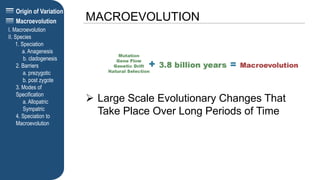
 Large Scale Evolutionary Changes That
Take Place Over Long Periods of Time
Origin of Variation
SPECIATION
I. Macroevolution
II. Species
1. Speciation
a. Anagenesis
b. cladogenesis
2. Barriers
a. prezygotic
b. post zygote
3. Modes of
Specification
a. Allopatric
Sympatric
4. Speciation to
Macroevolution
Macroevolution
 process by which a new species originates
 involves the creation of a population of
organisms that are novel enough to be
classified in their own group
1. Anagenesis
2. Cladogenesis
Origin of Variation
SPECIATION
I. Macroevolution
II. Species
1. Speciation
a. Anagenesis
b. cladogenesis
2. Barriers
a. prezygotic
b. post zygote
3. Modes of
Specification
a. Allopatric
Sympatric
4. Speciation to
Macroevolution
Macroevolution
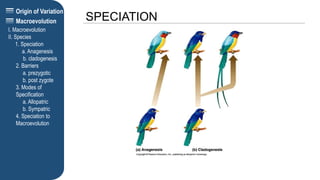
 Anagenesis is the accumulation of
heritable traits in a population, that
transforms that population into a new
species.
 Cladogenesis is branching evolution, in
which a new species arises as a branch of
from the evolutionary tree. The original
species still exists. This process is the
source of biological diversity.
Origin of Variation
SPECIATION
I. Macroevolution
II. Species
1. Speciation
a. Anagenesis
b. cladogenesis
2. Barriers
a. prezygotic
b. post zygote
3. Modes of
Specification
a. Allopatric
b. Sympatric
4. Speciation to
Macroevolution
Macroevolution
Origin of Variation
PREZYGOTIC & POSTZYGOTIC
I. Macroevolution
II. Species
1. Speciation
a. Anagenesis
b. cladogenesis
2. Barriers
a. prezygotic
b. post zygote
3. Modes of
Specification
a. Allopatric
b. Sympatric
4. Speciation to
Macroevolution
Macroevolution
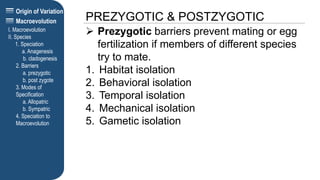
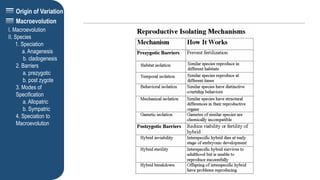
 Prezygotic barriers prevent mating or egg
fertilization if members of different species
try to mate.
1. Habitat isolation
2. Behavioral isolation
3. Temporal isolation
4. Mechanical isolation
5. Gametic isolation
Origin of Variation
PREZYGOTIC
I. Macroevolution
II. Species
1. Speciation
a. Anagenesis
b. cladogenesis
2. Barriers
a. prezygotic
b. post zygote
3. Modes of
Specification
a. Allopatric
b. Sympatric
4. Speciation to
Macroevolution
Macroevolution
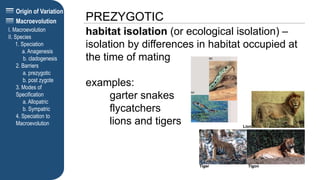
habitat isolation (or ecological isolation) –
isolation by differences in habitat occupied at
the time of mating
examples:
garter snakes
flycatchers
lions and tigers
Origin of Variation
PREZYGOTIC
I. Macroevolution
II. Species
1. Speciation
a. Anagenesis
b. cladogenesis
2. Barriers
a. prezygotic
b. post zygote
3. Modes of
Specification
a. Allopatric
b. Sympatric
4. Speciation to
Macroevolution
Macroevolution
temporal isolation
– isolation by differences in timing of mating;
examples:
mating season in some skunks
flowering time in some plants
mating time in some fruit flies
mating dates in some frogs
Origin of Variation
PREZYGOTIC
I. Macroevolution
II. Species
1. Speciation
a. Anagenesis
b. cladogenesis
2. Barriers
a. prezygotic
b. post zygote
3. Modes of
Specification
a. Allopatric
b. Sympatric
4. Speciation to
Macroevolution
Macroevolution
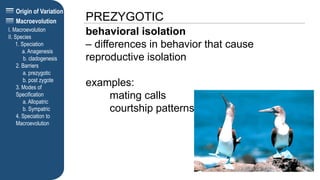
behavioral isolation
– differences in behavior that cause
reproductive isolation
examples:
mating calls
courtship patterns
Origin of Variation
PREZYGOTIC
I. Macroevolution
II. Species
1. Speciation
a. Anagenesis
b. cladogenesis
2. Barriers
a. prezygotic
b. post zygote
3. Modes of
Specification
a. Allopatric
b. Sympatric
4. Speciation to
Macroevolution
Macroevolution
mechanical isolation
– differences in physical structure make
mating impossible
example:
dragonflies may attempt interspecies mating,
but the physical structure of their genitalia
prevents successful mating
Origin of Variation
PREZYGOTIC
I. Macroevolution
II. Species
1. Speciation
a. Anagenesis
b. cladogenesis
2. Barriers
a. prezygotic
b. post zygote
3. Modes of
Specification
a. Allopatric
b. Sympatric
4. Speciation to
Macroevolution
Macroevolution
gametic isolation
– mating occurs, but the sperm and egg can
not fuse
examples:
sperm cannot penetrate the egg of the
different species, such as between sea
urchins species
in plants, often pollen grains do not get
the proper signal to germinate when on a
stigma of a different species
Origin of Variation
POSTZYGOTIC
I. Macroevolution
II. Species
1. Speciation
a. Anagenesis
b. cladogenesis
2. Barriers
a. prezygotic
b. post zygote
3. Modes of
Specification
a. Allopatric
b. Sympatric
4. Speciation to
Macroevolution
Macroevolution
hybrid inviability
-the most common type of postzygotic barrier
-zygote formed from the mating of two
species does not develop normally
-the embryo is aborted, or if development is
completed the offspring is very frail
example:
cross between bullfrog and leopard frog
Origin of Variation
POSTZYGOTIC
I. Macroevolution
II. Species
1. Speciation
a. Anagenesis
b. cladogenesis
2. Barriers
a. prezygotic
b. post zygote
3. Modes of
Specification
a. Allopatric
b. Sympatric
4. Speciation to
Macroevolution
Macroevolution
hybrid sterility
– a zygote of a hybrid proceeds through
normal development, but is reproductively
sterile sometimes due to other barriers such
as behavioral isolation most often due to
Example:
donkey + horse = mule (sterile hybrid)
Origin of Variation
POSTZYGOTIC
I. Macroevolution
II. Species
1. Speciation
a. Anagenesis
b. cladogenesis
2. Barriers
a. prezygotic
b. post zygote
3. Modes of
Specification
a. Allopatric
b. Sympatric
4. Speciation to
Macroevolution
Macroevolution
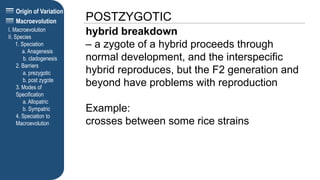
hybrid breakdown
– a zygote of a hybrid proceeds through
normal development, and the interspecific
hybrid reproduces, but the F2 generation and
beyond have problems with reproduction
Example:
crosses between some rice strains
Origin of Variation
I. Macroevolution
II. Species
1. Speciation
a. Anagenesis
b. cladogenesis
2. Barriers
a. prezygotic
b. post zygote
3. Modes of
Specification
a. Allopatric
b. Sympatric
4. Speciation to
Macroevolution
Macroevolution
Origin of Variation
PROCESSES OF SPECIATION
I. Macroevolution
II. Species
1. Speciation
a. Anagenesis
b. cladogenesis
2. Barriers
a. prezygotic
b. post zygote
3. Modes of
Specification
a. Allopatric
b. Sympatric
4. Speciation to
Macroevolution
Macroevolution
 speciation (the evolution of new species)
has two general forms, anagenic and
cladogenic
Origin of Variation
MODES OF SPECIATION
I. Macroevolution
II. Species
1. Speciation
a. Anagenesis
b. cladogenesis
2. Barriers
a. prezygotic
b. post zygote
3. Modes of
Specification
a. Allopatric
b. Sympatric
4. Speciation to
Macroevolution
Macroevolution
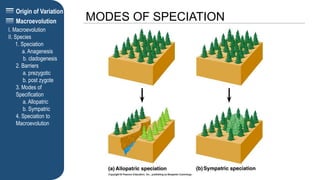
 allopatric speciation – one population
becomes geographically separated from
the rest of the species
 sympatric speciation – a species
achieves reproductive isolation and
evolves in the same geographic location as
its ancestral species
Origin of Variation
MODES OF SPECIATION
I. Macroevolution
II. Species
1. Speciation
a. Anagenesis
b. cladogenesis
2. Barriers
a. prezygotic
b. post zygote
3. Modes of
Specification
a. Allopatric
b. Sympatric
4. Speciation to
Macroevolution
Macroevolution
Origin of Variation
MODES OF SPECIATION
I. Macroevolution
II. Species
1. Speciation
a. Anagenesis
b. cladogenesis
2. Barriers
a. prezygotic
b. post zygote
3. Modes of
Specification
a. Allopatric
b. Sympatric
4. Speciation to
Macroevolution
Macroevolution
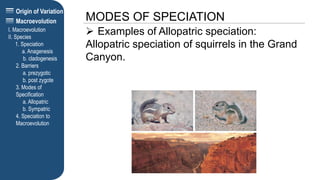
 Examples of Allopatric speciation:
Allopatric speciation of squirrels in the Grand
Canyon.
Origin of Variation
MODELS OF MACROEVOLUTION
I. Macroevolution
II. Species
1. Speciation
a. Anagenesis
b. cladogenesis
2. Barriers
a. prezygotic
b. post zygote
3. Modes of
Specification
a. Allopatric
b. Sympatric
4. Speciation to
Macroevolution
Macroevolution
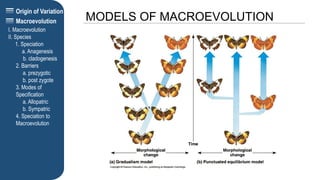
 The Gradualism model suggests that
change is gradual with the accumulation of
unique morphological adaptation.
 The Punctuated Equilibrium model
suggests that rapid change occurs, with a
new species “erupting” from the ancestral
lineage and then staying the same
thereafter.
Origin of Variation
MODELS OF MACROEVOLUTION
I. Macroevolution
II. Species
1. Speciation
a. Anagenesis
b. cladogenesis
2. Barriers
a. prezygotic
b. post zygote
3. Modes of
Specification
a. Allopatric
b. Sympatric
4. Speciation to
Macroevolution
Macroevolution

Ecology-Macroevolution

  • 1.
  • 2.
    Origin of Variation MACROEVOLUTION I.Macroevolution II. Species 1. Speciation a. Anagenesis b. cladogenesis 2. Barriers a. prezygotic b. post zygote 3. Modes of Specification a. Allopatric Sympatric 4. Speciation to Macroevolution Macroevolution  Macroevolution is the origin of new taxonomic groups, as opposed to microevolution, which is genetic variation between generations within a species.  Macroevolution encompasses the grandest trends and transformations in evolution, such as the origin of mammals and the radiation of flowering plants.
  • 3.
    Origin of Variation MACROEVOLUTION I.Macroevolution II. Species 1. Speciation a. Anagenesis b. cladogenesis 2. Barriers a. prezygotic b. post zygote 3. Modes of Specification a. Allopatric Sympatric 4. Speciation to Macroevolution Macroevolution  Large Scale Evolutionary Changes That Take Place Over Long Periods of Time
  • 4.
    Origin of Variation SPECIATION I.Macroevolution II. Species 1. Speciation a. Anagenesis b. cladogenesis 2. Barriers a. prezygotic b. post zygote 3. Modes of Specification a. Allopatric Sympatric 4. Speciation to Macroevolution Macroevolution  process by which a new species originates  involves the creation of a population of organisms that are novel enough to be classified in their own group 1. Anagenesis 2. Cladogenesis
  • 5.
    Origin of Variation SPECIATION I.Macroevolution II. Species 1. Speciation a. Anagenesis b. cladogenesis 2. Barriers a. prezygotic b. post zygote 3. Modes of Specification a. Allopatric Sympatric 4. Speciation to Macroevolution Macroevolution  Anagenesis is the accumulation of heritable traits in a population, that transforms that population into a new species.  Cladogenesis is branching evolution, in which a new species arises as a branch of from the evolutionary tree. The original species still exists. This process is the source of biological diversity.
  • 6.
    Origin of Variation SPECIATION I.Macroevolution II. Species 1. Speciation a. Anagenesis b. cladogenesis 2. Barriers a. prezygotic b. post zygote 3. Modes of Specification a. Allopatric b. Sympatric 4. Speciation to Macroevolution Macroevolution
  • 7.
    Origin of Variation PREZYGOTIC& POSTZYGOTIC I. Macroevolution II. Species 1. Speciation a. Anagenesis b. cladogenesis 2. Barriers a. prezygotic b. post zygote 3. Modes of Specification a. Allopatric b. Sympatric 4. Speciation to Macroevolution Macroevolution  Prezygotic barriers prevent mating or egg fertilization if members of different species try to mate. 1. Habitat isolation 2. Behavioral isolation 3. Temporal isolation 4. Mechanical isolation 5. Gametic isolation
  • 8.
    Origin of Variation PREZYGOTIC I.Macroevolution II. Species 1. Speciation a. Anagenesis b. cladogenesis 2. Barriers a. prezygotic b. post zygote 3. Modes of Specification a. Allopatric b. Sympatric 4. Speciation to Macroevolution Macroevolution habitat isolation (or ecological isolation) – isolation by differences in habitat occupied at the time of mating examples: garter snakes flycatchers lions and tigers
  • 9.
    Origin of Variation PREZYGOTIC I.Macroevolution II. Species 1. Speciation a. Anagenesis b. cladogenesis 2. Barriers a. prezygotic b. post zygote 3. Modes of Specification a. Allopatric b. Sympatric 4. Speciation to Macroevolution Macroevolution temporal isolation – isolation by differences in timing of mating; examples: mating season in some skunks flowering time in some plants mating time in some fruit flies mating dates in some frogs
  • 10.
    Origin of Variation PREZYGOTIC I.Macroevolution II. Species 1. Speciation a. Anagenesis b. cladogenesis 2. Barriers a. prezygotic b. post zygote 3. Modes of Specification a. Allopatric b. Sympatric 4. Speciation to Macroevolution Macroevolution behavioral isolation – differences in behavior that cause reproductive isolation examples: mating calls courtship patterns
  • 11.
    Origin of Variation PREZYGOTIC I.Macroevolution II. Species 1. Speciation a. Anagenesis b. cladogenesis 2. Barriers a. prezygotic b. post zygote 3. Modes of Specification a. Allopatric b. Sympatric 4. Speciation to Macroevolution Macroevolution mechanical isolation – differences in physical structure make mating impossible example: dragonflies may attempt interspecies mating, but the physical structure of their genitalia prevents successful mating
  • 12.
    Origin of Variation PREZYGOTIC I.Macroevolution II. Species 1. Speciation a. Anagenesis b. cladogenesis 2. Barriers a. prezygotic b. post zygote 3. Modes of Specification a. Allopatric b. Sympatric 4. Speciation to Macroevolution Macroevolution gametic isolation – mating occurs, but the sperm and egg can not fuse examples: sperm cannot penetrate the egg of the different species, such as between sea urchins species in plants, often pollen grains do not get the proper signal to germinate when on a stigma of a different species
  • 13.
    Origin of Variation POSTZYGOTIC I.Macroevolution II. Species 1. Speciation a. Anagenesis b. cladogenesis 2. Barriers a. prezygotic b. post zygote 3. Modes of Specification a. Allopatric b. Sympatric 4. Speciation to Macroevolution Macroevolution hybrid inviability -the most common type of postzygotic barrier -zygote formed from the mating of two species does not develop normally -the embryo is aborted, or if development is completed the offspring is very frail example: cross between bullfrog and leopard frog
  • 14.
    Origin of Variation POSTZYGOTIC I.Macroevolution II. Species 1. Speciation a. Anagenesis b. cladogenesis 2. Barriers a. prezygotic b. post zygote 3. Modes of Specification a. Allopatric b. Sympatric 4. Speciation to Macroevolution Macroevolution hybrid sterility – a zygote of a hybrid proceeds through normal development, but is reproductively sterile sometimes due to other barriers such as behavioral isolation most often due to Example: donkey + horse = mule (sterile hybrid)
  • 15.
    Origin of Variation POSTZYGOTIC I.Macroevolution II. Species 1. Speciation a. Anagenesis b. cladogenesis 2. Barriers a. prezygotic b. post zygote 3. Modes of Specification a. Allopatric b. Sympatric 4. Speciation to Macroevolution Macroevolution hybrid breakdown – a zygote of a hybrid proceeds through normal development, and the interspecific hybrid reproduces, but the F2 generation and beyond have problems with reproduction Example: crosses between some rice strains
  • 16.
    Origin of Variation I.Macroevolution II. Species 1. Speciation a. Anagenesis b. cladogenesis 2. Barriers a. prezygotic b. post zygote 3. Modes of Specification a. Allopatric b. Sympatric 4. Speciation to Macroevolution Macroevolution
  • 17.
    Origin of Variation PROCESSESOF SPECIATION I. Macroevolution II. Species 1. Speciation a. Anagenesis b. cladogenesis 2. Barriers a. prezygotic b. post zygote 3. Modes of Specification a. Allopatric b. Sympatric 4. Speciation to Macroevolution Macroevolution  speciation (the evolution of new species) has two general forms, anagenic and cladogenic
  • 18.
    Origin of Variation MODESOF SPECIATION I. Macroevolution II. Species 1. Speciation a. Anagenesis b. cladogenesis 2. Barriers a. prezygotic b. post zygote 3. Modes of Specification a. Allopatric b. Sympatric 4. Speciation to Macroevolution Macroevolution  allopatric speciation – one population becomes geographically separated from the rest of the species  sympatric speciation – a species achieves reproductive isolation and evolves in the same geographic location as its ancestral species
  • 19.
    Origin of Variation MODESOF SPECIATION I. Macroevolution II. Species 1. Speciation a. Anagenesis b. cladogenesis 2. Barriers a. prezygotic b. post zygote 3. Modes of Specification a. Allopatric b. Sympatric 4. Speciation to Macroevolution Macroevolution
  • 20.
    Origin of Variation MODESOF SPECIATION I. Macroevolution II. Species 1. Speciation a. Anagenesis b. cladogenesis 2. Barriers a. prezygotic b. post zygote 3. Modes of Specification a. Allopatric b. Sympatric 4. Speciation to Macroevolution Macroevolution  Examples of Allopatric speciation: Allopatric speciation of squirrels in the Grand Canyon.
  • 21.
    Origin of Variation MODELSOF MACROEVOLUTION I. Macroevolution II. Species 1. Speciation a. Anagenesis b. cladogenesis 2. Barriers a. prezygotic b. post zygote 3. Modes of Specification a. Allopatric b. Sympatric 4. Speciation to Macroevolution Macroevolution  The Gradualism model suggests that change is gradual with the accumulation of unique morphological adaptation.  The Punctuated Equilibrium model suggests that rapid change occurs, with a new species “erupting” from the ancestral lineage and then staying the same thereafter.
  • 22.
    Origin of Variation MODELSOF MACROEVOLUTION I. Macroevolution II. Species 1. Speciation a. Anagenesis b. cladogenesis 2. Barriers a. prezygotic b. post zygote 3. Modes of Specification a. Allopatric b. Sympatric 4. Speciation to Macroevolution Macroevolution

Editor's Notes

  • #2 We are done with microevolution, now I will be talking about macroevolution.
  • #3 So in microevolution, studies are done in gene level, in macroevolution, it deals with the origin of new species.
  • #4 It is a Large Scale Evolutionary Changes That Take Place Over Long Periods of Time. Variations caused by mutation, hene flow, genetic drift, and natural selection happened for 3.8 billions years is the scope of macroevolution.
  • #5 Speciation is a term associated with macroevolution. It is process by which a new species originates. It involves the creation of a population of organisms that are novel enough to be classified in their own group. Species formation are classified into 2. Anagenesis and Cladogenesis
  • #6 Anagenesis is the accumulation of heritable traits in a population, that transforms that population into a new species. And Cladogenesis is branching evolution, in which a new species arises as a branch of from the evolutionary tree. The original species still exists. This process is the source of biological diversity. To further differentiate the two, let us look the ilustration in the next slide.
  • #7 We can we in letter a, anagenesis, that the bird gradually evolve and became a species whereas in letter b, cladogenesis, the bird was still there but there is a new species emerged from the original bird.
  • #8 For a new species to form, there needs to be isolation of some members of a species as a separate population. Forms of isolation, that interfere with breeding include Both prezygotic and postzygotic. Prezygotic barriers prevent mating or egg fertilization if members of different species try to mate. There are 5 types of isolation. Habitat isolation, Behavioral isolation, Temporal isolation, Mechanical isolation, and Gametic isolation.
  • #14 In cases where fertilization takes place, there are postzygotic barriers.
  • #23 In letter a, the buttefly evoled gradually and the change was slow, consistent, and contanst. In letter b, change comes from spurts. There is period of very slow changes and one or few huge changes.