Speciation
M. Hemalatha
Ph.D Scholar
Centre for Plant Breeding and Genetics
Tamil Nadu Agricultural University
Species
• A species is a population of organisms consisting of
similar individuals which can breed together and
produce fertile offspring.
What is speciation?
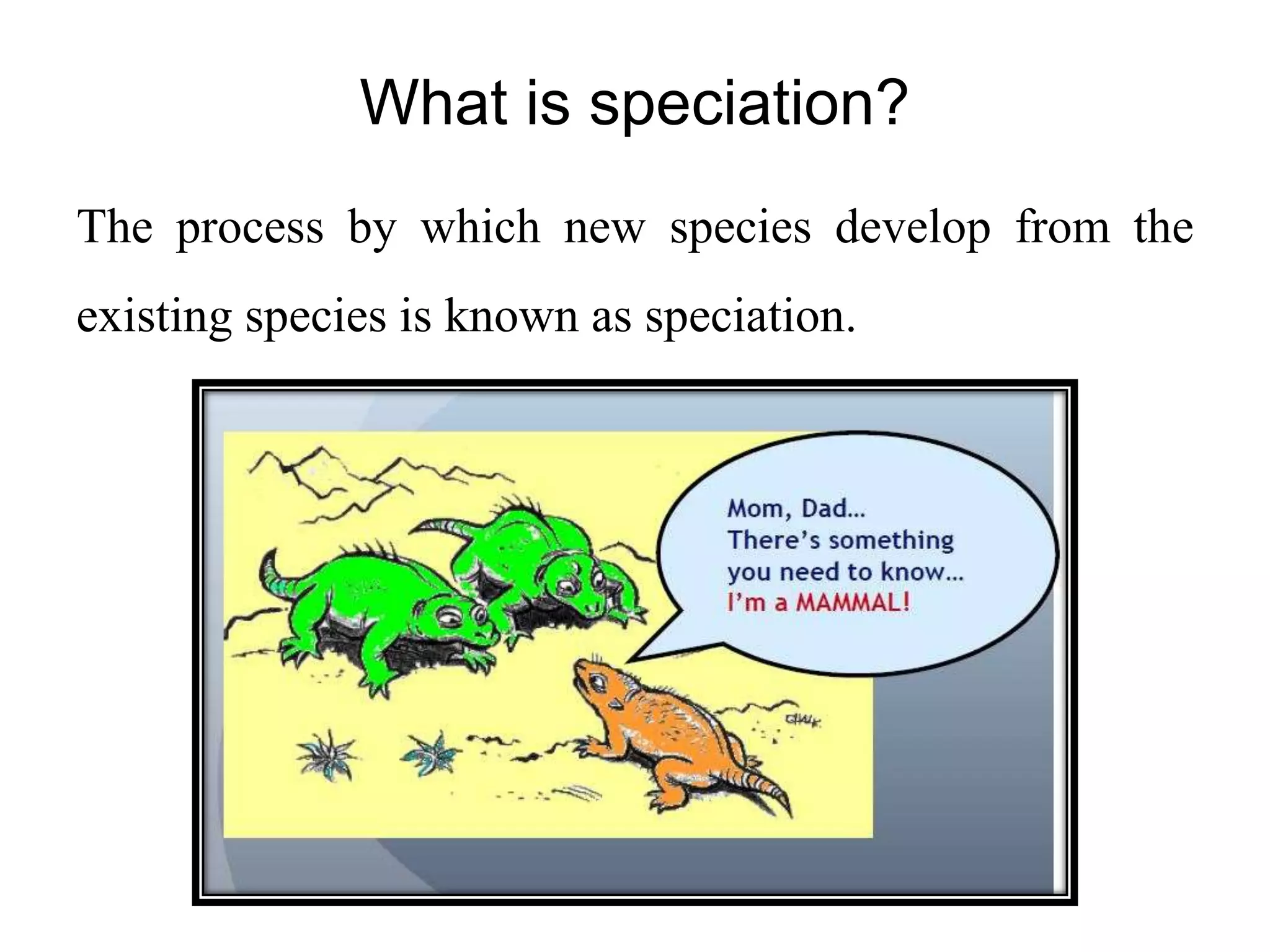
The process by which new species develop from the
existing species is known as speciation.
Factors leading to speciation
• Geographical isolation
• Reproductive isolation
• No flow of genes between separated groups of
population
• Genetic drift
• Variations due to natural selection.
Types of Speciation
• Allopatric Speciation
• Sympatric Speciation
• Parapatric Speciation
• Peripatric Speciation
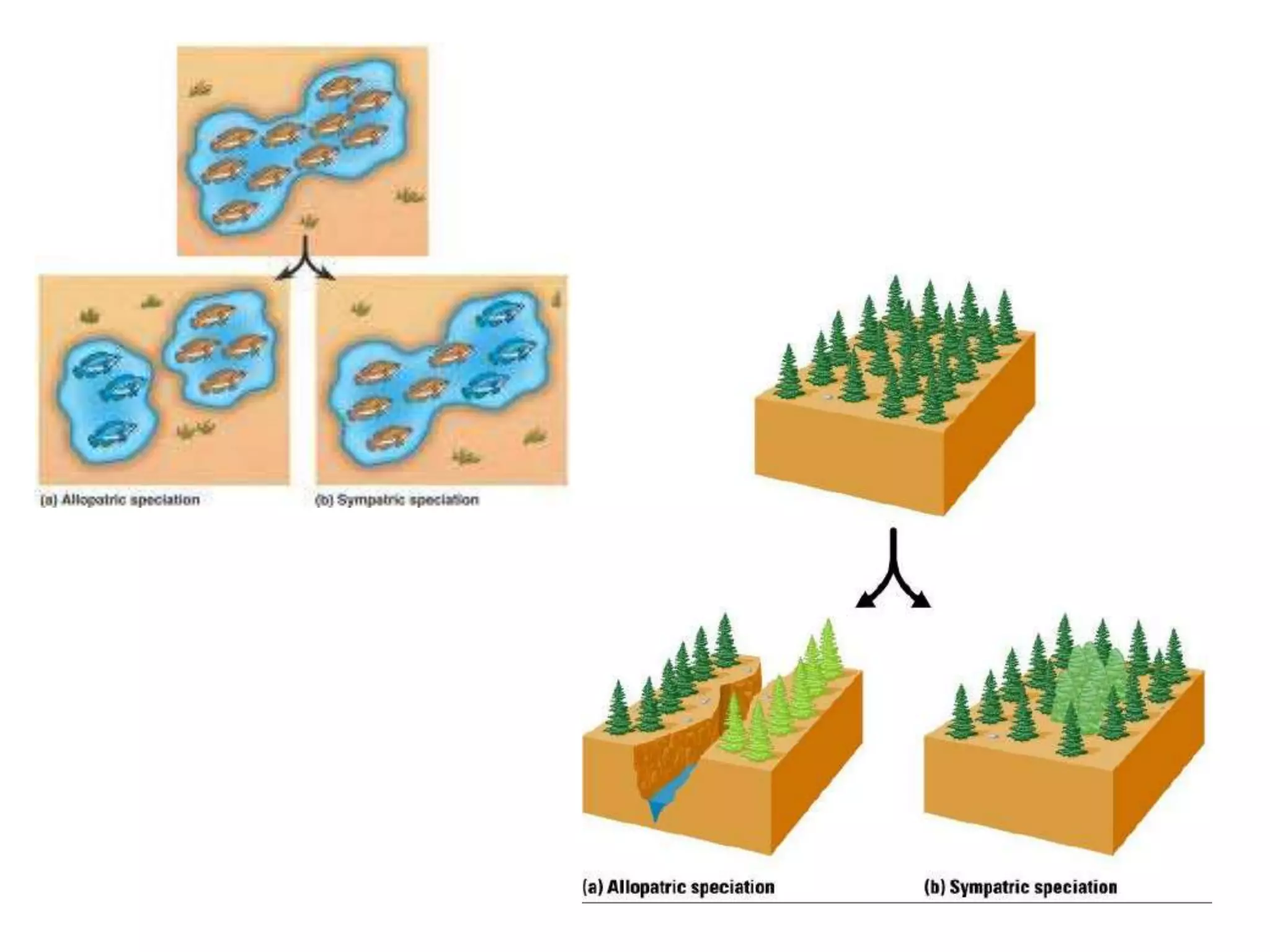
Allopatric Speciation
• It occurs when members of a population become
geographically isolated from one another.
• This may be a result of geographical changes.
• Alternatively, species members may emigrate, resulting
in population separation by dispersal; this is commonly
known as vicariance.
Example of allopatric speciation
• The divergent populations of finches inhabiting the
Galapagos Islands and are known as ‘Darwin’s finches’.
• Galapagos Islands hosted a population of finches - relatively
similar in morphology with slight differences in features such
as body size, color and beak length or shape.
• Different food sources were available for the birds on each of
the different islands, and the differences in beak shape were
an adaption toward acquiring the particular food source.
Sympatric Speciation
• Sympatric speciation is the evolutionary process whereby
species are formed from a single ancestral species while
inhabiting the same geographic area.
• In contrast to allopatric speciation, the distribution ranges of
species which evolve through sympatry may be identical or
they may only overlap.
• Rather than geographic distance prompting a reduction
of gene flow between populations, sympatry occurs when
members of one population make use of a new niche.
Example of Sympatric Speciation
• Apple maggot flies mated only on hawthorn trees, but after
apple trees were introduced into North America, they began to
mate on the apple trees as well.
• Thus, sympatric speciation occurred and new species were
formed when the species of apple maggot flies feeded only on
their respective trees even if they were not geographically
isolated and also if their adult populations looked identical.
Parapatric Speciation
• It is an extremely rare case of speciation that occurs when a population is
continuously distributed within a geographic area without any specific barriers
to gene flow.
• The population does not mate randomly within the population, but rather
individuals mate more commonly with their closest geographic neighbors,
resulting in uneven gene flow.
• Non-random mating may increase the rate of dimorphism within populations, in
which varied morphological forms of the same species are displayed.
• The result of parapatric speciation is one or more distinct sub-populations
(known as ‘sister species’), which have small, continuous overlaps in
their biogeographic range and are genotypically dimorphic.
Example of Parapatric Speciation
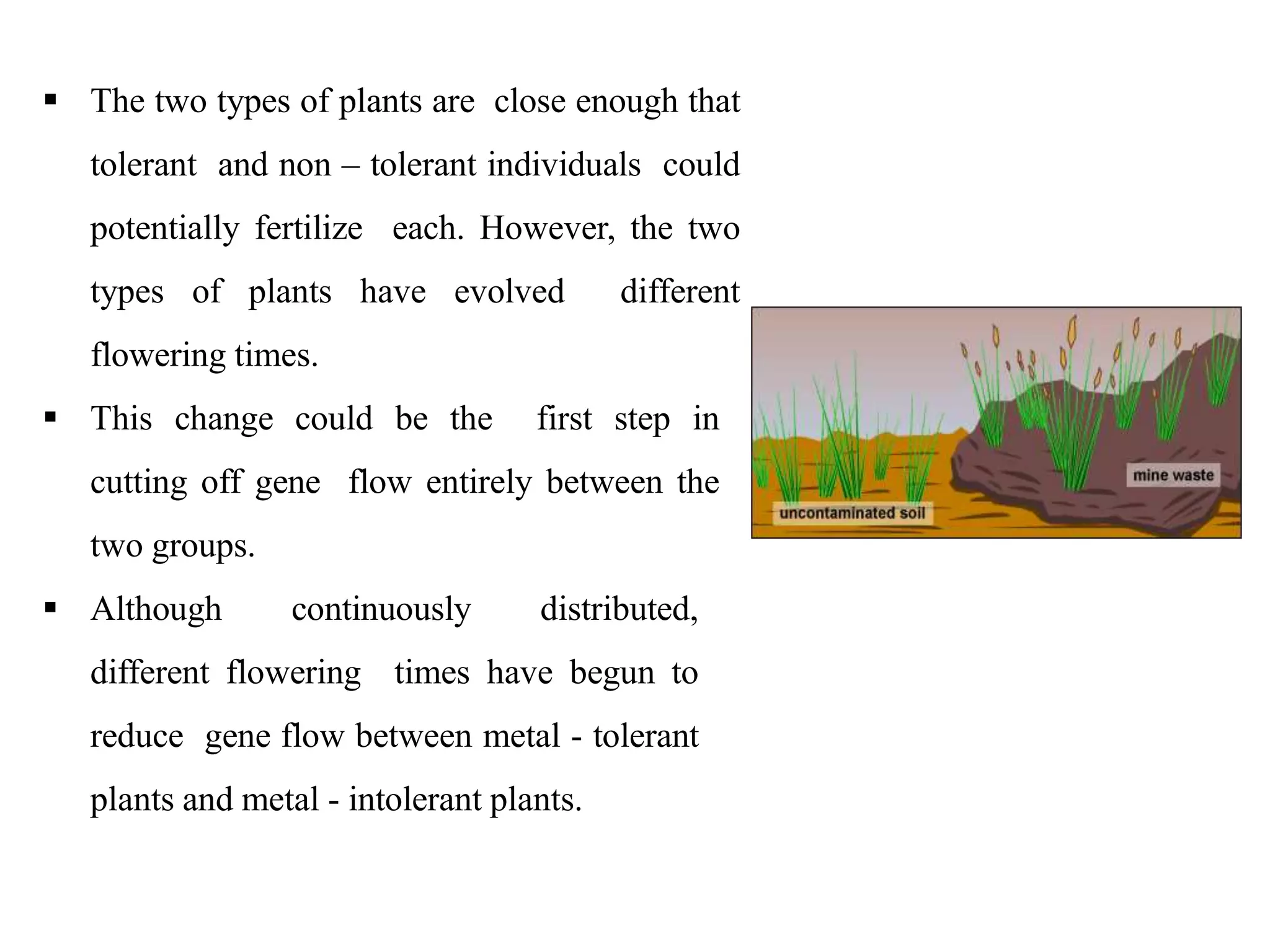
Anthoxanthum odoratum
 Some of these plants live near mines
where the soil has become contaminated
with heavy metals.
 The plants around the mines have
experienced natural selection for
genotypes that are tolerant of heavy
metals.
 Meanwhile, neighboring plants that don’t
live in polluted soil have not undergone
selection for this trait.
 The two types of plants are close enough that
tolerant and non – tolerant individuals could
potentially fertilize each. However, the two
types of plants have evolved different
flowering times.
 This change could be the first step in
cutting off gene flow entirely between the
two groups.
 Although continuously distributed,
different flowering times have begun to
reduce gene flow between metal - tolerant
plants and metal - intolerant plants.
Peripatric Speciation
• Peripatric speciation is a form of allopatric speciation
that occurs when populations that have become isolated
have very few individuals.
• Through this process, the population goes through
a genetic bottleneck.
• Within the small sub-population, organisms which are
able to survive within the new environment may carry
genes that were rare within the main population but that
cause a slight variation to behavior or morphology.
• Through repeated matings, the frequency of these, once
rare, genes increases within the small population. This
is known as the ‘founder effect’.
• Over time, the characteristic that was determined by the
gene becomes fixed within the population, leading to an
isolated species that is evolutionarily distinct from the
main population.
Artificial Speciation
• Artificial speciation is the form of speciation that can be
achieved by the input of human influence.
• By separating populations, and thereby preventing breeding,
or by intentionally breeding individuals with desired
morphological or genotypic traits, humans can create new,
distinct species.
• This is also known as ‘artificial selection’; most modern
domesticated animals and plants have undergone artificial
selection.
Evolution by artificial selection
Hybridization
 Often the hybrid offspring are sterile, but occasionally
they are fertile and are reproductively isolated from their
“parent” species.
 In the latter case, a new species is formed. The sunflower
species was produced by the hybridization of two other
sunflower species.
Hybridization in Sunflowers
Reproductive Isolating Mechanisms
Pre - zygotic mechanism
Pre-pollination
mechanisms
1. Geographical
isolation
2. Ecological isolation
3. Temporal isolation
4. Behavioural isolation
5. Mechanical isolation
Post-pollination
mechanisms
1. Gametophytic
isolation
2. Gametic isoation
Post - zygotic
mechanism
1. Seed
incompatibility
2. Hybrid inviability
3. F1 hybrid sterility
4. F2 hybrid
inviability
5. F2 hybrid sterility
Geographical isolation
• Species occur in different areas.
Ecological isolation
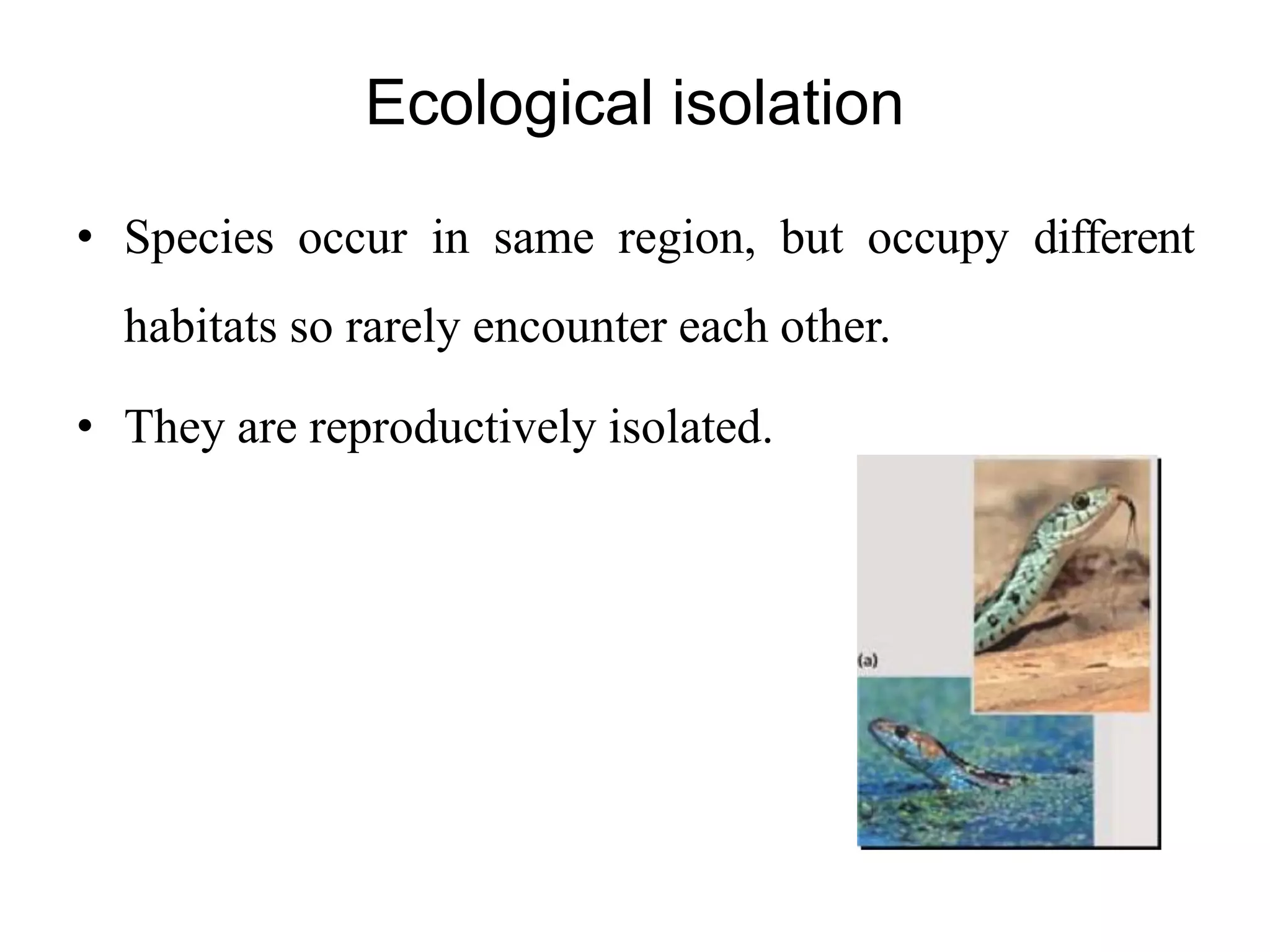
• Species occur in same region, but occupy different
habitats so rarely encounter each other.
• They are reproductively isolated.
Temporal isolation
• Species that breed during different times of day,
different seasons, or different years cannot mix
gametes.
Behavioural isolation
• Unique behavioral patterns & rituals isolate species
Mechanical isolation
• Morphological differences can prevent successful
mating.
Gametic isolation
• Reported in several crop plants
• The pollen tube releases the male gametes into embryo sac, but
gametic or endospermic fusion does not occur
Gametophytic isolation
• Commonest isolating mechanism
• Cross-pollination occurs but the pollen tube fails to germinate
or if germinated it can’t reach and penetrate the embyo sac
Seed incompatibility
• The zygote or even immature embryo is formed but fails to
develop and as such a mature seed is not formed.
• The phenomenonis commonly encountered in cross between
Primula elatior and P. veris.
Hybrid inviability
• Mature seed is formed and manages to germinate but the F1
hybrid dies before the flowering stage is reached.
• The phenomenon is commonly encountered in crosses
between Papaver dubium and P. rhoeas
F1 hybrid sterility
• F1 hybrids are fully viable and reach flowering stage but
flowers may abort or abortion may occur as late as F2 embryo
formation, with the result that the F1 hybrid fails to produce
viable seeds
F2 hybrid inviability or sterility
• F2 hybrid dies much before reaching the flowering stage or
fails to produce seeds.
Rate of speciation
• Does speciation happen gradually or rapidly??
– Gradualism
– Punctuated Equilibrium
Gradualism
• Gradual divergence
over long spans of time
• Big changes occur as
the accumulation of
many small ones
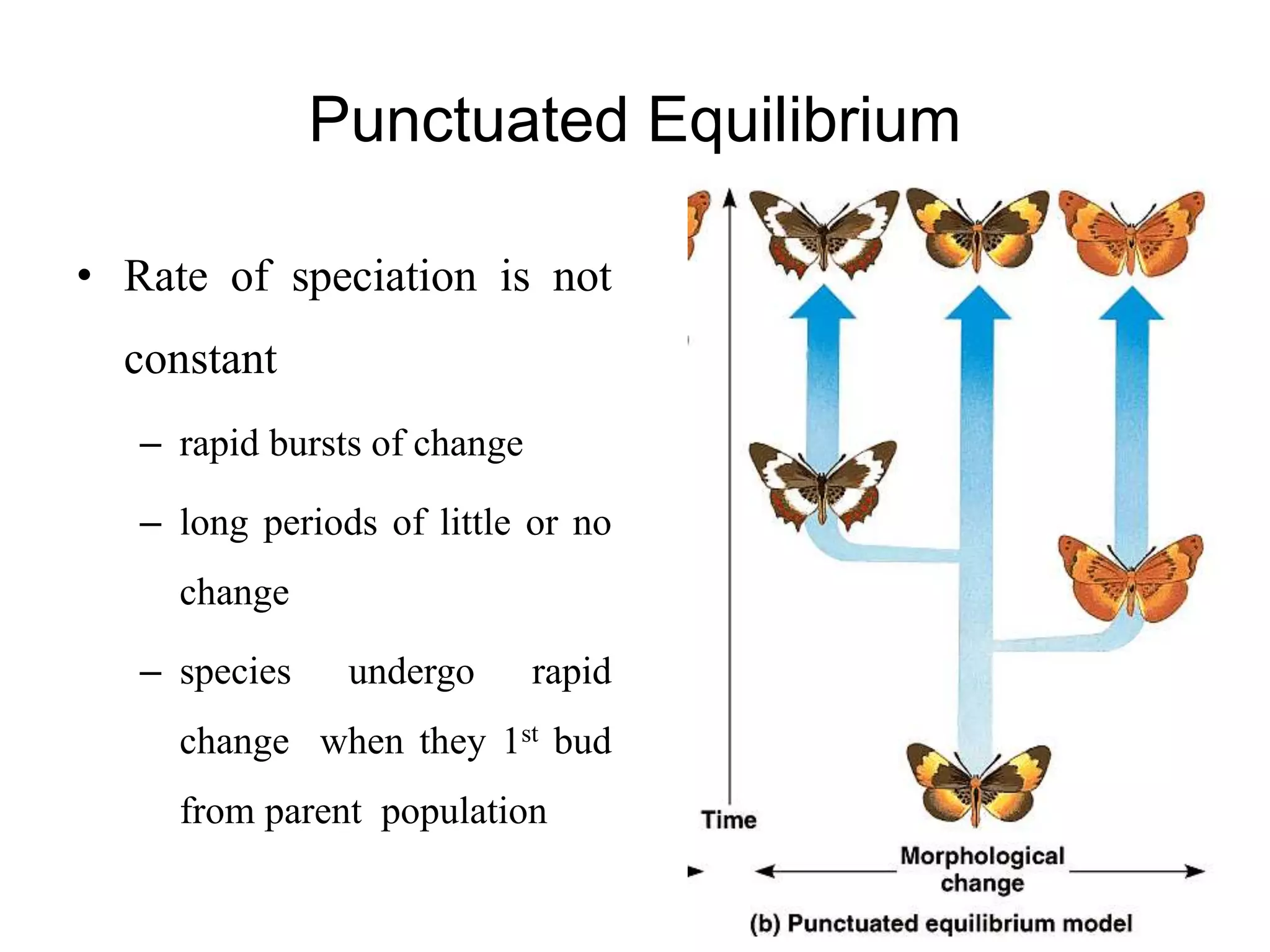
Punctuated Equilibrium
• Rate of speciation is not
constant
– rapid bursts of change
– long periods of little or no
change
– species undergo rapid
change when they 1st bud
from parent population
Speciation and domestication

Speciation and domestication

  • 1.
    Speciation M. Hemalatha Ph.D Scholar Centrefor Plant Breeding and Genetics Tamil Nadu Agricultural University
  • 2.
    Species • A speciesis a population of organisms consisting of similar individuals which can breed together and produce fertile offspring.
  • 3.
    What is speciation? Theprocess by which new species develop from the existing species is known as speciation.
  • 4.
    Factors leading tospeciation • Geographical isolation • Reproductive isolation • No flow of genes between separated groups of population • Genetic drift • Variations due to natural selection.
  • 5.
    Types of Speciation •Allopatric Speciation • Sympatric Speciation • Parapatric Speciation • Peripatric Speciation
  • 6.
    Allopatric Speciation • Itoccurs when members of a population become geographically isolated from one another. • This may be a result of geographical changes. • Alternatively, species members may emigrate, resulting in population separation by dispersal; this is commonly known as vicariance.
  • 7.
    Example of allopatricspeciation • The divergent populations of finches inhabiting the Galapagos Islands and are known as ‘Darwin’s finches’. • Galapagos Islands hosted a population of finches - relatively similar in morphology with slight differences in features such as body size, color and beak length or shape. • Different food sources were available for the birds on each of the different islands, and the differences in beak shape were an adaption toward acquiring the particular food source.
  • 9.
    Sympatric Speciation • Sympatricspeciation is the evolutionary process whereby species are formed from a single ancestral species while inhabiting the same geographic area. • In contrast to allopatric speciation, the distribution ranges of species which evolve through sympatry may be identical or they may only overlap. • Rather than geographic distance prompting a reduction of gene flow between populations, sympatry occurs when members of one population make use of a new niche.
  • 11.
    Example of SympatricSpeciation • Apple maggot flies mated only on hawthorn trees, but after apple trees were introduced into North America, they began to mate on the apple trees as well. • Thus, sympatric speciation occurred and new species were formed when the species of apple maggot flies feeded only on their respective trees even if they were not geographically isolated and also if their adult populations looked identical.
  • 13.
    Parapatric Speciation • Itis an extremely rare case of speciation that occurs when a population is continuously distributed within a geographic area without any specific barriers to gene flow. • The population does not mate randomly within the population, but rather individuals mate more commonly with their closest geographic neighbors, resulting in uneven gene flow. • Non-random mating may increase the rate of dimorphism within populations, in which varied morphological forms of the same species are displayed. • The result of parapatric speciation is one or more distinct sub-populations (known as ‘sister species’), which have small, continuous overlaps in their biogeographic range and are genotypically dimorphic.
  • 14.
    Example of ParapatricSpeciation Anthoxanthum odoratum  Some of these plants live near mines where the soil has become contaminated with heavy metals.  The plants around the mines have experienced natural selection for genotypes that are tolerant of heavy metals.  Meanwhile, neighboring plants that don’t live in polluted soil have not undergone selection for this trait.
  • 15.
     The twotypes of plants are close enough that tolerant and non – tolerant individuals could potentially fertilize each. However, the two types of plants have evolved different flowering times.  This change could be the first step in cutting off gene flow entirely between the two groups.  Although continuously distributed, different flowering times have begun to reduce gene flow between metal - tolerant plants and metal - intolerant plants.
  • 16.
    Peripatric Speciation • Peripatricspeciation is a form of allopatric speciation that occurs when populations that have become isolated have very few individuals. • Through this process, the population goes through a genetic bottleneck. • Within the small sub-population, organisms which are able to survive within the new environment may carry genes that were rare within the main population but that cause a slight variation to behavior or morphology.
  • 17.
    • Through repeatedmatings, the frequency of these, once rare, genes increases within the small population. This is known as the ‘founder effect’. • Over time, the characteristic that was determined by the gene becomes fixed within the population, leading to an isolated species that is evolutionarily distinct from the main population.
  • 21.
    Artificial Speciation • Artificialspeciation is the form of speciation that can be achieved by the input of human influence. • By separating populations, and thereby preventing breeding, or by intentionally breeding individuals with desired morphological or genotypic traits, humans can create new, distinct species. • This is also known as ‘artificial selection’; most modern domesticated animals and plants have undergone artificial selection.
  • 22.
  • 23.
    Hybridization  Often thehybrid offspring are sterile, but occasionally they are fertile and are reproductively isolated from their “parent” species.  In the latter case, a new species is formed. The sunflower species was produced by the hybridization of two other sunflower species.
  • 24.
  • 25.
    Reproductive Isolating Mechanisms Pre- zygotic mechanism Pre-pollination mechanisms 1. Geographical isolation 2. Ecological isolation 3. Temporal isolation 4. Behavioural isolation 5. Mechanical isolation Post-pollination mechanisms 1. Gametophytic isolation 2. Gametic isoation Post - zygotic mechanism 1. Seed incompatibility 2. Hybrid inviability 3. F1 hybrid sterility 4. F2 hybrid inviability 5. F2 hybrid sterility
  • 26.
    Geographical isolation • Speciesoccur in different areas.
  • 27.
    Ecological isolation • Speciesoccur in same region, but occupy different habitats so rarely encounter each other. • They are reproductively isolated.
  • 28.
    Temporal isolation • Speciesthat breed during different times of day, different seasons, or different years cannot mix gametes.
  • 29.
    Behavioural isolation • Uniquebehavioral patterns & rituals isolate species
  • 30.
    Mechanical isolation • Morphologicaldifferences can prevent successful mating.
  • 31.
    Gametic isolation • Reportedin several crop plants • The pollen tube releases the male gametes into embryo sac, but gametic or endospermic fusion does not occur
  • 32.
    Gametophytic isolation • Commonestisolating mechanism • Cross-pollination occurs but the pollen tube fails to germinate or if germinated it can’t reach and penetrate the embyo sac
  • 33.
    Seed incompatibility • Thezygote or even immature embryo is formed but fails to develop and as such a mature seed is not formed. • The phenomenonis commonly encountered in cross between Primula elatior and P. veris.
  • 34.
    Hybrid inviability • Matureseed is formed and manages to germinate but the F1 hybrid dies before the flowering stage is reached. • The phenomenon is commonly encountered in crosses between Papaver dubium and P. rhoeas
  • 35.
    F1 hybrid sterility •F1 hybrids are fully viable and reach flowering stage but flowers may abort or abortion may occur as late as F2 embryo formation, with the result that the F1 hybrid fails to produce viable seeds
  • 36.
    F2 hybrid inviabilityor sterility • F2 hybrid dies much before reaching the flowering stage or fails to produce seeds.
  • 37.
    Rate of speciation •Does speciation happen gradually or rapidly?? – Gradualism – Punctuated Equilibrium
  • 38.
    Gradualism • Gradual divergence overlong spans of time • Big changes occur as the accumulation of many small ones
  • 39.
    Punctuated Equilibrium • Rateof speciation is not constant – rapid bursts of change – long periods of little or no change – species undergo rapid change when they 1st bud from parent population