SPARK SUMMIT
EUROPE2016
Mastering Spark Unit Testing
Theodore Malaska
Blizzard Entertainment, Group TechnicalArchitect
About Me
▪ Ted Malaska
- Architect at Blizzard Ent
- Working on Battle.net
- PSA at Cloudera
- Worked with over 100 companies
- Committed to over a dozen OS Projects
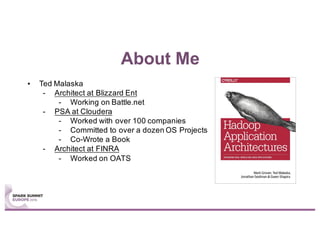
- Co-Wrote a Book
- Architect at FINRA
- Worked on OATS
About Blizzard
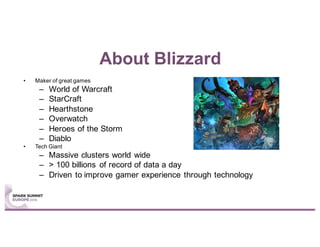
• Maker of great games
– World of Warcraft
– StarCraft
– Hearthstone
– Overwatch
– Heroes of the Storm
– Diablo
• Tech Giant
– Massive clusters world wide
– > 100 billions of record of data a day
– Driven to improve gamer experience through technology
Overview
• Why to run Spark outside of a cluster
• What to test
• Running Local
• Running as a Unit Test
• Data Structures
• Supplying data to Unit Tests
Why to Run Spark Outside of a
Cluster?
• Time
• Trusted Deployment
• Logic
• Money
What to test
• Experiments
• Complex logic
• Samples
• Business generated scenarios
What about Notebooks
• UIs like Zeppelin
• For experimentations
• Quick feedback
• Not for productization
• Lacks IDE Features
Running Local
• A test doesn’t always need to be a unit test
• Running local in your IDE is priceless
Example
• //Get spark context
val sc:SparkContext = if (runLocal) {
val sparkConfig = new SparkConf()
sparkConfig.set("spark.broadcast.compress", "false")
sparkConfig.set("spark.shuffle.compress", "false")
sparkConfig.set("spark.shuffle.spill.compress", "false")
new SparkContext("local[2]", "DataGenerator", sparkConfig)
} else {
val sparkConf = new SparkConf().setAppName("DataGenerator")
new SparkContext(sparkConf)
}
val filterWordSetBc = sc.broadcast(scala.io.Source.fromFile(filterWordFile).getLines.toSet)
val inputRDD = sc.textFile(inputFolder)
val filteredWordCount: RDD[(String, Int)] = filterAndCount(filterWordSetBc, inputRDD)
filteredWordCount.collect().foreach{case(name: String, count: Int) => println(" - " + name + ":" + count)}
Live Demo
Things to Note
• Needed a Spark Context
• Parallelize function
• Separate out testable work from driver code
• Everything is fully debuggable
Now on to Unit Testing
• Just like running local be easier
Example Code
class FilterWordCountSuite extends FunSuite with SharedSparkContext {
test("testFilterWordCount") {
val filterWordSetBc = sc.broadcast(Set[String]("the", "a", "is"))
val inputRDD = sc.parallelize(Array("the cat and the hat", "the car is blue",
"the cat is in a car", "the cat lost his hat"))
val filteredWordCount: RDD[(String, Int)] =
FilterWordCount.filterAndCount(filterWordSetBc, inputRDD)
assert(filteredWordCount.count() == 8)
val map = filteredWordCount.collect().toMap
assert(map.get("cat").getOrElse(0) == 3)
assert(map.get("the").getOrElse(0) == 0)
}
}
Shared Spark Context
trait SharedSparkContext extends BeforeAndAfterAll { self: Suite =>
@transient private var _sc: SparkContext = _
def sc: SparkContext = _sc
var conf = new SparkConf(false)
override def beforeAll() {
_sc = new SparkContext("local[4]", "test", conf)
super.beforeAll()
}
override def afterAll() {
LocalSparkContext.stop(_sc)
_sc = null
super.afterAll()
}
}
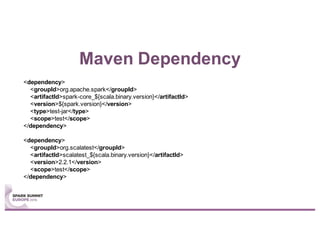
Maven Dependency
<dependency>
<groupId>org.apache.spark</groupId>
<artifactId>spark-core_${scala.binary.version}</artifactId>
<version>${spark.version}</version>
<type>test-jar</type>
<scope>test</scope>
</dependency>
<dependency>
<groupId>org.scalatest</groupId>
<artifactId>scalatest_${scala.binary.version}</artifactId>
<version>2.2.1</version>
<scope>test</scope>
</dependency>
Live Demo
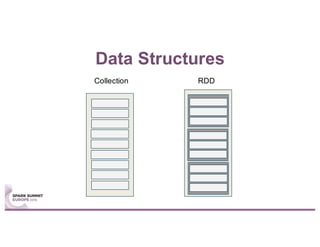
Data Structures
Collection RDD
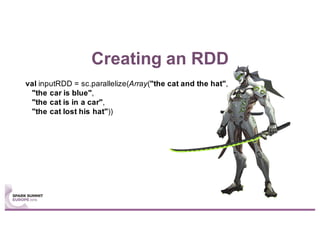
Creating an RDD
val inputRDD = sc.parallelize(Array("the cat and the hat",
"the car is blue",
"the cat is in a car",
"the cat lost his hat"))
Method to Selecting Data
• Developer defined data
• Selected sampling of data from production system
• Generated data from a data generator
– ssCheck
– SparkTestingBase
• Requirement/Business driven selection and generation
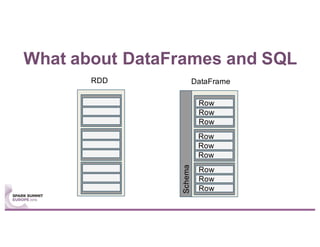
What about DataFrames and SQL
RDD
Row
Row
Row
Row
Row
Row
Row
Row
Row
DataFrame
Schema
How to create a DataFrame
• Code and make a structType
• Take the schema from an existing Table
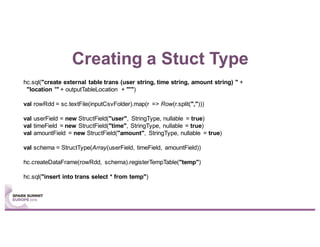
Creating a Stuct Type
hc.sql("create external table trans (user string, time string, amount string) " +
"location '" + outputTableLocation + "'")
val rowRdd = sc.textFile(inputCsvFolder).map(r => Row(r.split(",")))
val userField = new StructField("user", StringType, nullable = true)
val timeField = new StructField("time", StringType, nullable = true)
val amountField = new StructField("amount", StringType, nullable = true)
val schema = StructType(Array(userField, timeField, amountField))
hc.createDataFrame(rowRdd, schema).registerTempTable("temp")
hc.sql("insert into trans select * from temp")
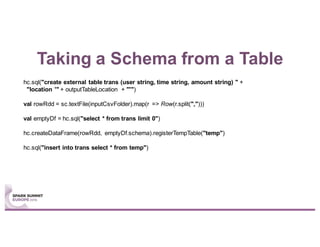
Taking a Schema from a Table
hc.sql("create external table trans (user string, time string, amount string) " +
"location '" + outputTableLocation + "'")
val rowRdd = sc.textFile(inputCsvFolder).map(r => Row(r.split(",")))
val emptyDf = hc.sql("select * from trans limit 0")
hc.createDataFrame(rowRdd, emptyDf.schema).registerTempTable("temp")
hc.sql("insert into trans select * from temp")
What about Nested DataFrames
• hc.sql("create external table trans (" +
" user string," +
" time string," +
" items array<struct<" +
" amount: string " +
">>) " +
"location '" + outputTableLocation + "'")
val rowRdd = sc.parallelize(Array(
Row("bob", 10, Seq(
Row(1, 2, 3, 4)
))
))
Important NOTE
• Spark should be used to bring the big to the small
• In that case more of the logic may be in the small
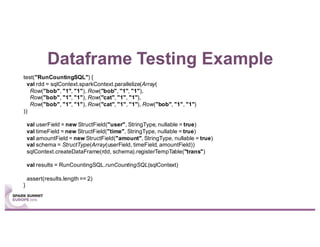
Dataframe Testing Example
test("RunCountingSQL") {
val rdd = sqlContext.sparkContext.parallelize(Array(
Row("bob", "1", "1"), Row("bob", "1", "1"),
Row("bob", "1", "1"), Row("cat", "1", "1"),
Row("bob", "1", "1"), Row("cat", "1", "1"), Row("bob", "1", "1")
))
val userField = new StructField("user", StringType, nullable = true)
val timeField = new StructField("time", StringType, nullable = true)
val amountField = new StructField("amount", StringType, nullable = true)
val schema = StructType(Array(userField, timeField, amountField))
sqlContext.createDataFrame(rdd, schema).registerTempTable("trans")
val results = RunCountingSQL.runCountingSQL(sqlContext)
assert(results.length == 2)
}
What about Hive
• If you are testing Hive.
– Spark will create a Local HMS
– Allows all the creation, deleting, writing
– Make sure you can write to the table location
– Also feel free to delete the metastore folder in-between jobs
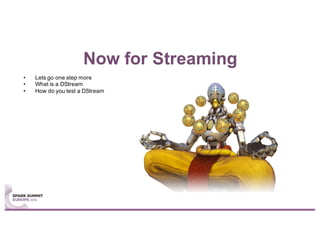
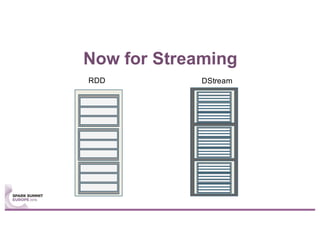
Now for Streaming
• Lets go one step more
• What is a DStream
• How do you test a DStream
Now for Streaming
RDD DStream
TestOperation Example
class StreamFilterWordCount extends TestSuiteBase{
test("mapPartitions") {
assert(numInputPartitions === 2, "Number of input partitions has been changed from 2")
val input = Seq(
Seq("the cat and the hat", "the car is blue"),
Seq("the cat is in a car", "the cat lost his hat"))
val output = Seq(Seq(9), Seq(11))
val operation = (r: DStream[String]) => StreamingWordCount.wordCount(r)
testOperation(input, operation, output)
}
}
What about other things
• MlLib
• GraphX
What about Integration Testing
• MiniClusters
– HBase
– Kafka
– HDFS
– Cassandra
– Many more
Testing True Distributed
• Running on a Dev environment
• Using Docker to spin up environment
• Mini yarn or mesos
SPARK SUMMIT
EUROPE2016
THANK YOU.

Spark Summit EU talk by Ted Malaska

  • 1.
    SPARK SUMMIT EUROPE2016 Mastering SparkUnit Testing Theodore Malaska Blizzard Entertainment, Group TechnicalArchitect
  • 2.
    About Me ▪ TedMalaska - Architect at Blizzard Ent - Working on Battle.net - PSA at Cloudera - Worked with over 100 companies - Committed to over a dozen OS Projects - Co-Wrote a Book - Architect at FINRA - Worked on OATS
  • 3.
    About Blizzard • Makerof great games – World of Warcraft – StarCraft – Hearthstone – Overwatch – Heroes of the Storm – Diablo • Tech Giant – Massive clusters world wide – > 100 billions of record of data a day – Driven to improve gamer experience through technology
  • 4.
    Overview • Why torun Spark outside of a cluster • What to test • Running Local • Running as a Unit Test • Data Structures • Supplying data to Unit Tests
  • 5.
    Why to RunSpark Outside of a Cluster? • Time • Trusted Deployment • Logic • Money
  • 6.
    What to test •Experiments • Complex logic • Samples • Business generated scenarios
  • 7.
    What about Notebooks •UIs like Zeppelin • For experimentations • Quick feedback • Not for productization • Lacks IDE Features
  • 8.
    Running Local • Atest doesn’t always need to be a unit test • Running local in your IDE is priceless
  • 9.
    Example • //Get sparkcontext val sc:SparkContext = if (runLocal) { val sparkConfig = new SparkConf() sparkConfig.set("spark.broadcast.compress", "false") sparkConfig.set("spark.shuffle.compress", "false") sparkConfig.set("spark.shuffle.spill.compress", "false") new SparkContext("local[2]", "DataGenerator", sparkConfig) } else { val sparkConf = new SparkConf().setAppName("DataGenerator") new SparkContext(sparkConf) } val filterWordSetBc = sc.broadcast(scala.io.Source.fromFile(filterWordFile).getLines.toSet) val inputRDD = sc.textFile(inputFolder) val filteredWordCount: RDD[(String, Int)] = filterAndCount(filterWordSetBc, inputRDD) filteredWordCount.collect().foreach{case(name: String, count: Int) => println(" - " + name + ":" + count)}
  • 10.
  • 11.
    Things to Note •Needed a Spark Context • Parallelize function • Separate out testable work from driver code • Everything is fully debuggable
  • 12.
    Now on toUnit Testing • Just like running local be easier
  • 13.
    Example Code class FilterWordCountSuiteextends FunSuite with SharedSparkContext { test("testFilterWordCount") { val filterWordSetBc = sc.broadcast(Set[String]("the", "a", "is")) val inputRDD = sc.parallelize(Array("the cat and the hat", "the car is blue", "the cat is in a car", "the cat lost his hat")) val filteredWordCount: RDD[(String, Int)] = FilterWordCount.filterAndCount(filterWordSetBc, inputRDD) assert(filteredWordCount.count() == 8) val map = filteredWordCount.collect().toMap assert(map.get("cat").getOrElse(0) == 3) assert(map.get("the").getOrElse(0) == 0) } }
  • 14.
    Shared Spark Context traitSharedSparkContext extends BeforeAndAfterAll { self: Suite => @transient private var _sc: SparkContext = _ def sc: SparkContext = _sc var conf = new SparkConf(false) override def beforeAll() { _sc = new SparkContext("local[4]", "test", conf) super.beforeAll() } override def afterAll() { LocalSparkContext.stop(_sc) _sc = null super.afterAll() } }
  • 15.
  • 16.
  • 17.
  • 18.
    Creating an RDD valinputRDD = sc.parallelize(Array("the cat and the hat", "the car is blue", "the cat is in a car", "the cat lost his hat"))
  • 19.
    Method to SelectingData • Developer defined data • Selected sampling of data from production system • Generated data from a data generator – ssCheck – SparkTestingBase • Requirement/Business driven selection and generation
  • 20.
    What about DataFramesand SQL RDD Row Row Row Row Row Row Row Row Row DataFrame Schema
  • 21.
    How to createa DataFrame • Code and make a structType • Take the schema from an existing Table
  • 22.
    Creating a StuctType hc.sql("create external table trans (user string, time string, amount string) " + "location '" + outputTableLocation + "'") val rowRdd = sc.textFile(inputCsvFolder).map(r => Row(r.split(","))) val userField = new StructField("user", StringType, nullable = true) val timeField = new StructField("time", StringType, nullable = true) val amountField = new StructField("amount", StringType, nullable = true) val schema = StructType(Array(userField, timeField, amountField)) hc.createDataFrame(rowRdd, schema).registerTempTable("temp") hc.sql("insert into trans select * from temp")
  • 23.
    Taking a Schemafrom a Table hc.sql("create external table trans (user string, time string, amount string) " + "location '" + outputTableLocation + "'") val rowRdd = sc.textFile(inputCsvFolder).map(r => Row(r.split(","))) val emptyDf = hc.sql("select * from trans limit 0") hc.createDataFrame(rowRdd, emptyDf.schema).registerTempTable("temp") hc.sql("insert into trans select * from temp")
  • 24.
    What about NestedDataFrames • hc.sql("create external table trans (" + " user string," + " time string," + " items array<struct<" + " amount: string " + ">>) " + "location '" + outputTableLocation + "'") val rowRdd = sc.parallelize(Array( Row("bob", 10, Seq( Row(1, 2, 3, 4) )) ))
  • 25.
    Important NOTE • Sparkshould be used to bring the big to the small • In that case more of the logic may be in the small
  • 26.
    Dataframe Testing Example test("RunCountingSQL"){ val rdd = sqlContext.sparkContext.parallelize(Array( Row("bob", "1", "1"), Row("bob", "1", "1"), Row("bob", "1", "1"), Row("cat", "1", "1"), Row("bob", "1", "1"), Row("cat", "1", "1"), Row("bob", "1", "1") )) val userField = new StructField("user", StringType, nullable = true) val timeField = new StructField("time", StringType, nullable = true) val amountField = new StructField("amount", StringType, nullable = true) val schema = StructType(Array(userField, timeField, amountField)) sqlContext.createDataFrame(rdd, schema).registerTempTable("trans") val results = RunCountingSQL.runCountingSQL(sqlContext) assert(results.length == 2) }
  • 27.
    What about Hive •If you are testing Hive. – Spark will create a Local HMS – Allows all the creation, deleting, writing – Make sure you can write to the table location – Also feel free to delete the metastore folder in-between jobs
  • 28.
    Now for Streaming •Lets go one step more • What is a DStream • How do you test a DStream
  • 29.
  • 30.
    TestOperation Example class StreamFilterWordCountextends TestSuiteBase{ test("mapPartitions") { assert(numInputPartitions === 2, "Number of input partitions has been changed from 2") val input = Seq( Seq("the cat and the hat", "the car is blue"), Seq("the cat is in a car", "the cat lost his hat")) val output = Seq(Seq(9), Seq(11)) val operation = (r: DStream[String]) => StreamingWordCount.wordCount(r) testOperation(input, operation, output) } }
  • 31.
    What about otherthings • MlLib • GraphX
  • 32.
    What about IntegrationTesting • MiniClusters – HBase – Kafka – HDFS – Cassandra – Many more
  • 33.
    Testing True Distributed •Running on a Dev environment • Using Docker to spin up environment • Mini yarn or mesos
  • 34.