Origin-Destination Matrix 

Using Mobile Network Data 

with Spark
Dr. Javiera Guedes
Teralytics
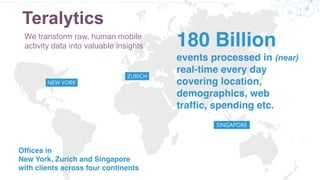
Teralytics
We transform raw, human mobile
activity data into valuable insights
(near)
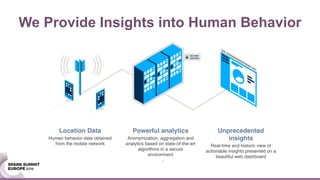
We Provide Insights into Human Behavior
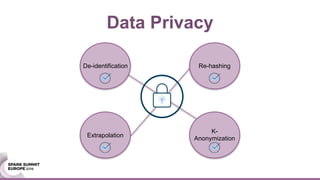
Data Privacy
De-identification Re-hashing
Extrapolation
K-
Anonymization
Problem Overview
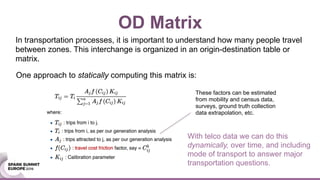
OD Matrix
In transportation processes, it is important to understand how many people travel
between zones. This interchange is organized in an origin-destination table or
matrix.
One approach to statically computing this matrix is:
These factors can be estimated
from mobility and census data,
surveys, ground truth collection
data extrapolation, etc.
With telco data we can do this
dynamically, over time, and including
mode of transport to answer major
transportation questions.
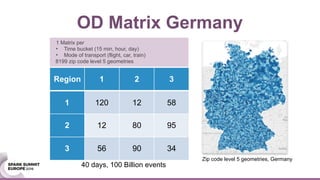
OD Matrix Germany
Zip code level 5 geometries, Germany
Region 1 2 3
1 120 12 58
2 12 80 95
3 56 90 34
1 Matrix per
• Time bucket (15 min, hour, day)
• Mode of transport (flight, car, train)
8199 zip code level 5 geometries
40 days, 100 Billion events
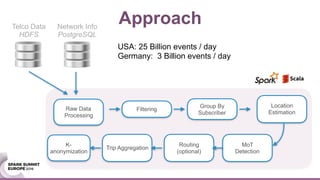
Approach
ApproachTelco Data
HDFS
Network Info
PostgreSQL
USA: 25 Billion events / day
Germany: 3 Billion events / day
Raw Data
Processing
Filtering
Location
Estimation
MoT
Detection
Routing
(optional)
Trip Aggregation
Group By
Subscriber
Scala / Spark
K-
anonymization
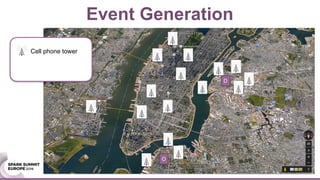
Cell phone tower
Event Generation
O
D
8 AM
9 AM
9:05
8:05
8:20
9:15
9:10
10 AM
10:25
10:05
3 pm
4 pm
4:05
10
pm
10:05
11 pm
O
D
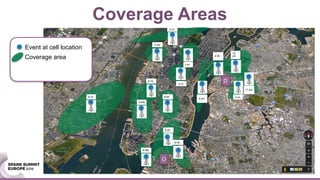
Event at cell location
Coverage area
Coverage Areas
O
D
8 AM
9 AM
9:05
8:20
9:15
9:10
10 AM
10:25
10:05
3 pm
4 pm
4:05
pm
10
pm
10:05
pm
11
pm
8:05
Event at cell location
Event at est. location
Confidence area
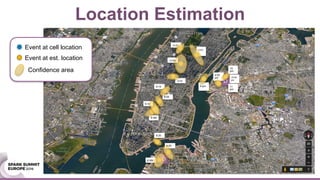
Location Estimation
O
Event at cell location
Location estimation
Most probable route
Alternative route
D
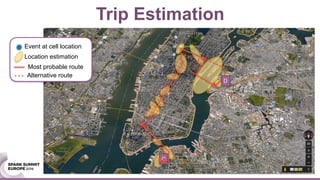
Trip Estimation
O
D
Event at cell location
Location estimation
Most probable route
Subway
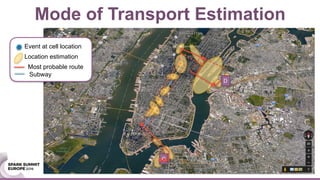
Mode of Transport Estimation
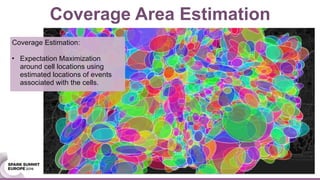
Coverage Estimation:
• Expectation Maximization
around cell locations using
estimated locations of events
associated with the cells.
Coverage Area Estimation
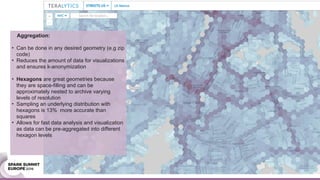
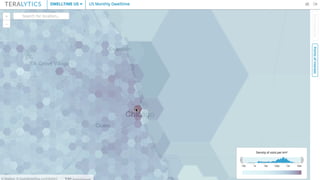
Aggregation:
• Can be done in any desired geometry (e.g zip
code)
• Reduces the amount of data for visualizations
and ensures k-anonymization
• Hexagons are great geometries because
they are space-filling and can be
approximately nested to archive varying
levels of resolution
• Sampling an underlying distribution with
hexagons is 13% more accurate than
squares
• Allows for fast data analysis and visualization
as data can be pre-aggregated into different
hexagon levels
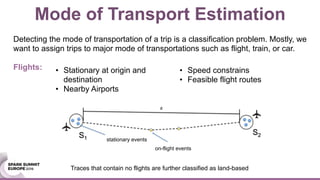
Detecting the mode of transportation of a trip is a classification problem. Mostly, we
want to assign trips to major mode of transportations such as flight, train, or car.
Flights: • Stationary at origin and
destination
• Nearby Airports
• Speed constrains
• Feasible flight routes
stationary events
on-flight events
Traces that contain no flights are further classified as land-based
Mode of Transport Estimation
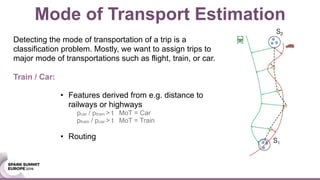
Detecting the mode of transportation of a trip is a
classification problem. Mostly, we want to assign trips to
major mode of transportations such as flight, train, or car.
Train / Car:
• Features derived from e.g. distance to
railways or highways
pcar / ptrain > t MoT = Car
ptrain / pcar > t MoT = Train
• Routing
Mode of Transport Estimation
PRODUCT
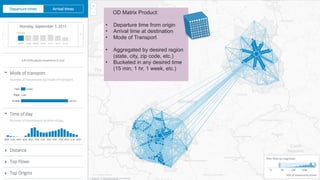
OD Matrix Product:
• Departure time from origin
• Arrival time at destination
• Mode of Transport
• Aggregated by desired region
(state, city, zip code, etc.)
• Bucketed in any desired time
(15 min, 1 hr, 1 week, etc.)
OD Matrix Germany
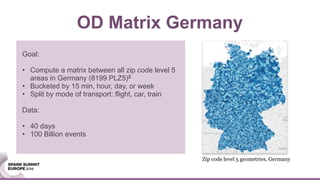
Goal:
• Compute a matrix between all zip code level 5
areas in Germany (8199 PLZ5)2
• Bucketed by 15 min, hour, day, or week
• Split by mode of transport: flight, car, train
Data:
• 40 days
• 100 Billion events
Zip code level 5 geometries, Germany
Extrapolation
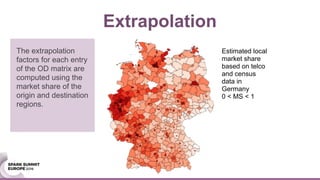
The extrapolation
factors for each entry
of the OD matrix are
computed using the
market share of the
origin and destination
regions.
Estimated local
market share
based on telco
and census
data in
Germany
0 < MS < 1
OD Matrix
Germany
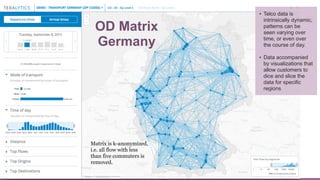
• Telco data is
intrinsically dynamic,
patterns can be
seen varying over
time, or even over
the course of day.
• Data accompanied
by visualizations that
allow customers to
dice and slice the
data for specific
regions
Matrix is k-anonymized,
i.e. all flow with less
than five commuters is
removed.
Validation
We validate out results using several criteria and data sets:
• MoT validation using limited calibration data labeled to measure performance.
• Limited ground truth for train and flight trips from our providers and customers
• Common sense checks, e.g. whether counts are balanced:
OD[i,j] ~ OD[j,i]
Criteria for Validation
precision recall
flights 0.96 0.81
car 0.96 0.88
train 0.95 0.91
Building up a strong network of women in tech — Javiera Guedes — javiera.guedes@teralytics.ch — July 14, 2016 27
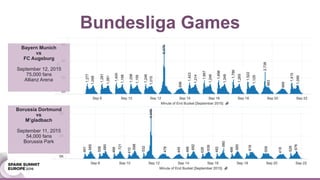
Borussia Dortmund
vs
M’gladbach
September 11, 2015
54,000 fans
Borussia Park
Bayern Munich
vs
FC Augsburg
September 12, 2015
75,000 fans
Allianz Arena
Bundesliga Games
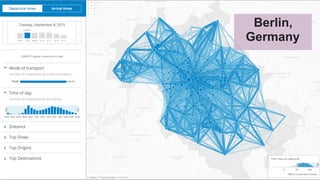
Berlin,
Germany
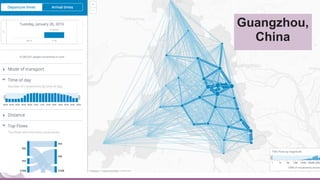
Guangzhou,
China
OD Matrix
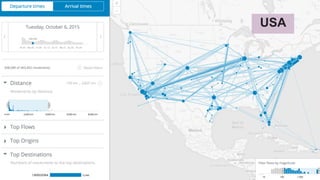
USA
USA
Why Spark
Our production code is written entirely in Scala / Spark:
• Terabyte data sets processed on a single job
• Fast and compatible with Hadoop HDFS and Accumulo
• The domain is easy to parallelize since every trip is independent
Dark Matter Streams | Kavli Institute Stanford University
Why Spark
Our production code is written entirely in Scala / Spark:
• Terabyte data sets processed on a single job
• Fast and compatible with Hadoop HDFS and Accumulo
• The domain is easy to parallelize since every trip is independent
• Natural choice of the map / reduce nature of our algorithmic approach
Spark is used for slicing and dicing data in dashboards
Spark was not our top choice for data visualization dashboard, since only small batches of data
are queried
THANK YOU.
javiera.guedes@teralytics.ch
http://www.teralytics.net

Spark Summit EU talk by Javier Aguedes

  • 1.
    Origin-Destination Matrix 
 UsingMobile Network Data 
 with Spark Dr. Javiera Guedes Teralytics
  • 2.
    Teralytics We transform raw,human mobile activity data into valuable insights (near)
  • 3.
    We Provide Insightsinto Human Behavior
  • 4.
  • 5.
  • 6.
    OD Matrix In transportationprocesses, it is important to understand how many people travel between zones. This interchange is organized in an origin-destination table or matrix. One approach to statically computing this matrix is: These factors can be estimated from mobility and census data, surveys, ground truth collection data extrapolation, etc. With telco data we can do this dynamically, over time, and including mode of transport to answer major transportation questions.
  • 7.
    OD Matrix Germany Zipcode level 5 geometries, Germany Region 1 2 3 1 120 12 58 2 12 80 95 3 56 90 34 1 Matrix per • Time bucket (15 min, hour, day) • Mode of transport (flight, car, train) 8199 zip code level 5 geometries 40 days, 100 Billion events
  • 8.
  • 9.
    ApproachTelco Data HDFS Network Info PostgreSQL USA:25 Billion events / day Germany: 3 Billion events / day Raw Data Processing Filtering Location Estimation MoT Detection Routing (optional) Trip Aggregation Group By Subscriber Scala / Spark K- anonymization
  • 10.
    Cell phone tower EventGeneration O D
  • 11.
    8 AM 9 AM 9:05 8:05 8:20 9:15 9:10 10AM 10:25 10:05 3 pm 4 pm 4:05 10 pm 10:05 11 pm O D Event at cell location Coverage area Coverage Areas
  • 12.
    O D 8 AM 9 AM 9:05 8:20 9:15 9:10 10AM 10:25 10:05 3 pm 4 pm 4:05 pm 10 pm 10:05 pm 11 pm 8:05 Event at cell location Event at est. location Confidence area Location Estimation
  • 13.
    O Event at celllocation Location estimation Most probable route Alternative route D Trip Estimation
  • 14.
    O D Event at celllocation Location estimation Most probable route Subway Mode of Transport Estimation
  • 15.
    Coverage Estimation: • ExpectationMaximization around cell locations using estimated locations of events associated with the cells. Coverage Area Estimation
  • 16.
    Aggregation: • Can bedone in any desired geometry (e.g zip code) • Reduces the amount of data for visualizations and ensures k-anonymization • Hexagons are great geometries because they are space-filling and can be approximately nested to archive varying levels of resolution • Sampling an underlying distribution with hexagons is 13% more accurate than squares • Allows for fast data analysis and visualization as data can be pre-aggregated into different hexagon levels
  • 18.
    Detecting the modeof transportation of a trip is a classification problem. Mostly, we want to assign trips to major mode of transportations such as flight, train, or car. Flights: • Stationary at origin and destination • Nearby Airports • Speed constrains • Feasible flight routes stationary events on-flight events Traces that contain no flights are further classified as land-based Mode of Transport Estimation
  • 19.
    Detecting the modeof transportation of a trip is a classification problem. Mostly, we want to assign trips to major mode of transportations such as flight, train, or car. Train / Car: • Features derived from e.g. distance to railways or highways pcar / ptrain > t MoT = Car ptrain / pcar > t MoT = Train • Routing Mode of Transport Estimation
  • 20.
  • 21.
    OD Matrix Product: •Departure time from origin • Arrival time at destination • Mode of Transport • Aggregated by desired region (state, city, zip code, etc.) • Bucketed in any desired time (15 min, 1 hr, 1 week, etc.)
  • 22.
    OD Matrix Germany Goal: •Compute a matrix between all zip code level 5 areas in Germany (8199 PLZ5)2 • Bucketed by 15 min, hour, day, or week • Split by mode of transport: flight, car, train Data: • 40 days • 100 Billion events Zip code level 5 geometries, Germany
  • 23.
    Extrapolation The extrapolation factors foreach entry of the OD matrix are computed using the market share of the origin and destination regions. Estimated local market share based on telco and census data in Germany 0 < MS < 1
  • 24.
    OD Matrix Germany • Telcodata is intrinsically dynamic, patterns can be seen varying over time, or even over the course of day. • Data accompanied by visualizations that allow customers to dice and slice the data for specific regions Matrix is k-anonymized, i.e. all flow with less than five commuters is removed.
  • 25.
  • 26.
    We validate outresults using several criteria and data sets: • MoT validation using limited calibration data labeled to measure performance. • Limited ground truth for train and flight trips from our providers and customers • Common sense checks, e.g. whether counts are balanced: OD[i,j] ~ OD[j,i] Criteria for Validation precision recall flights 0.96 0.81 car 0.96 0.88 train 0.95 0.91
  • 27.
    Building up astrong network of women in tech — Javiera Guedes — javiera.guedes@teralytics.ch — July 14, 2016 27
  • 28.
    Borussia Dortmund vs M’gladbach September 11,2015 54,000 fans Borussia Park Bayern Munich vs FC Augsburg September 12, 2015 75,000 fans Allianz Arena Bundesliga Games
  • 29.
  • 30.
  • 31.
  • 32.
    Why Spark Our productioncode is written entirely in Scala / Spark: • Terabyte data sets processed on a single job • Fast and compatible with Hadoop HDFS and Accumulo • The domain is easy to parallelize since every trip is independent Dark Matter Streams | Kavli Institute Stanford University
  • 33.
    Why Spark Our productioncode is written entirely in Scala / Spark: • Terabyte data sets processed on a single job • Fast and compatible with Hadoop HDFS and Accumulo • The domain is easy to parallelize since every trip is independent • Natural choice of the map / reduce nature of our algorithmic approach Spark is used for slicing and dicing data in dashboards Spark was not our top choice for data visualization dashboard, since only small batches of data are queried
  • 34.