How to
performance-tune
spark applications in
large clusters
- Omkar Joshi
Omkar Joshi
omkar@uber.com
● Software engineer on Hadoop
Data Platform team
● 2.5 years at Uber
● Architected Object store & NFS
solutions at Hedvig
● Hadoop Yarn committer
● Enjoy gardening & hiking in free
time
01 Hadoop profiler
02 Flame graph
03 Auto tune
04 Storage improvements
05 Cpu / Runtime improvements
06 Efficiency improvements
07 Memory improvements
Agenda
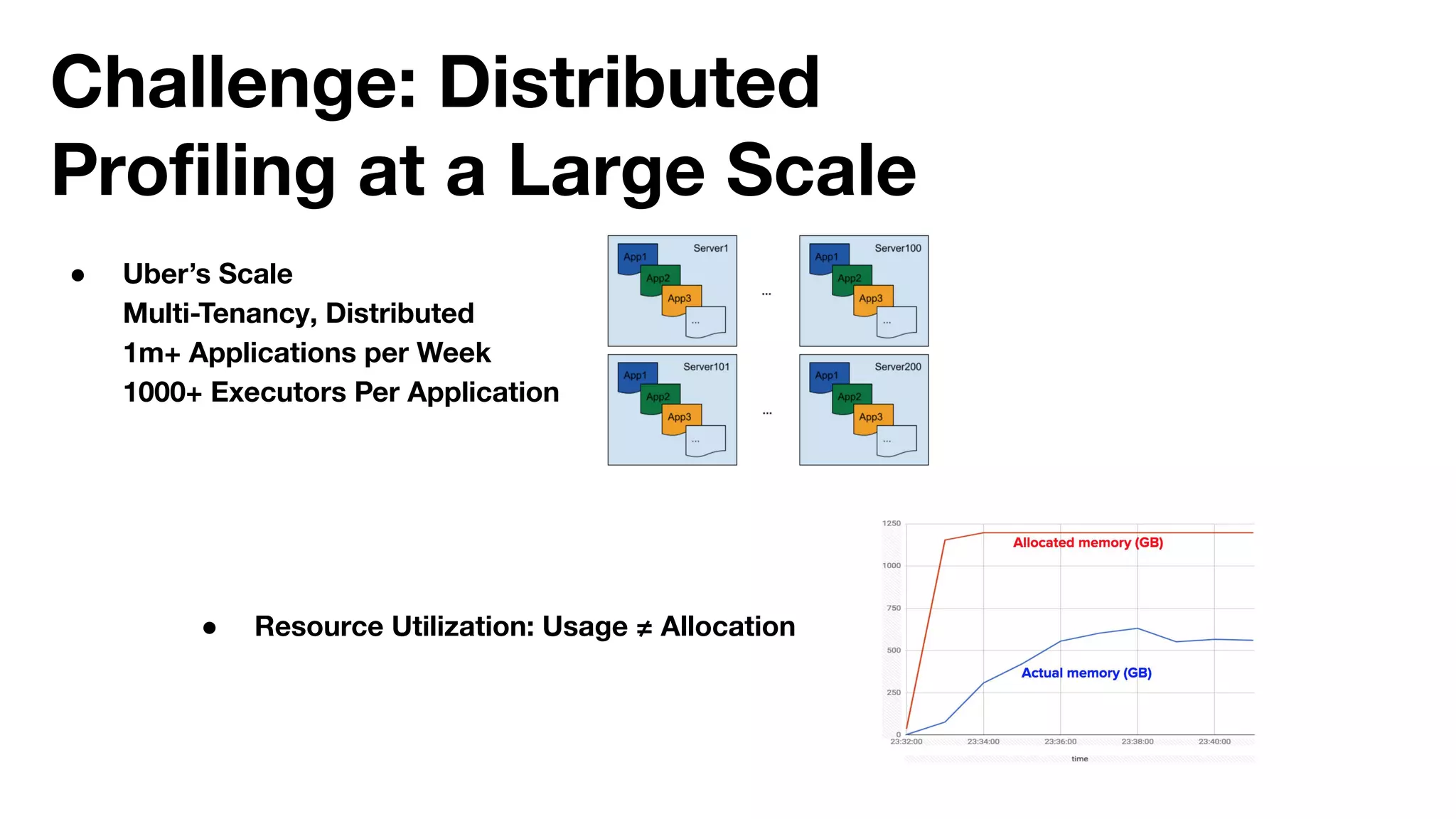
Challenge: Distributed
Profiling at a Large Scale
● Uber’s Scale
Multi-Tenancy, Distributed
1m+ Applications per Week
1000+ Executors Per Application
● Resource Utilization: Usage ≠ Allocation
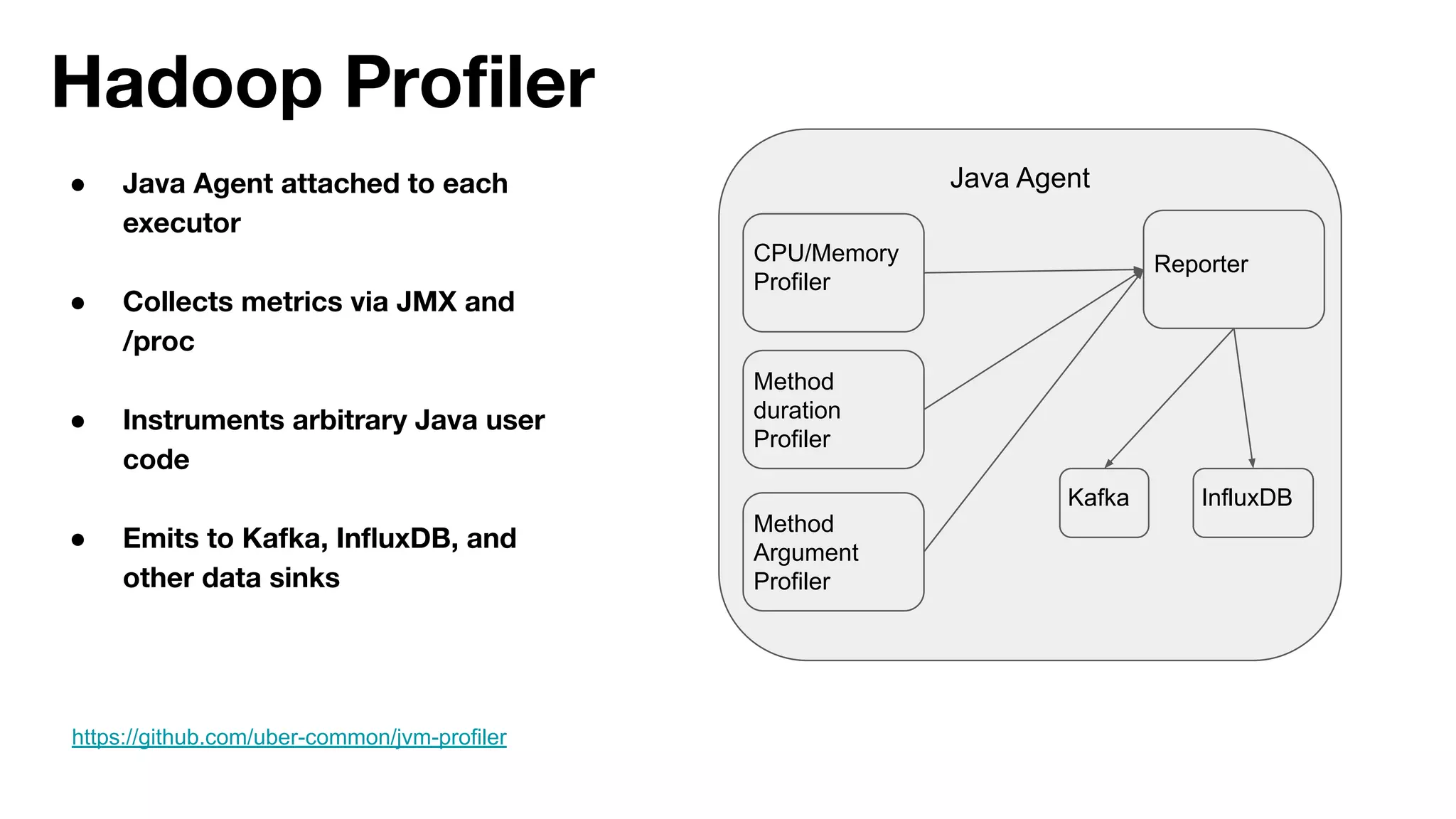
Hadoop Profiler
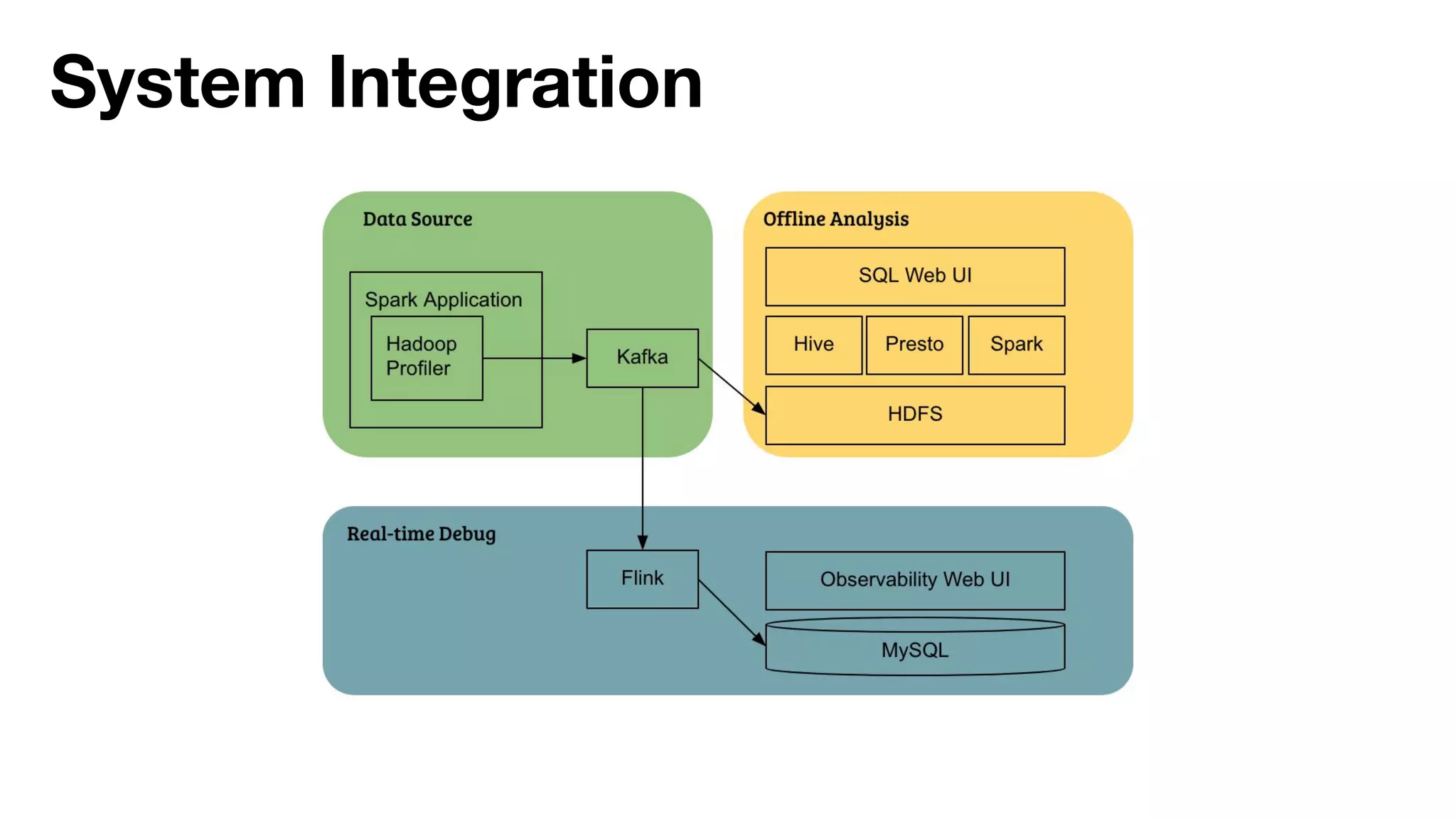
● Java Agent attached to each
executor
● Collects metrics via JMX and
/proc
● Instruments arbitrary Java user
code
● Emits to Kafka, InfluxDB, and
other data sinks
Method
Argument
Profiler
Method
duration
Profiler
CPU/Memory
Profiler
Reporter
Java Agent
Kafka InfluxDB
https://github.com/uber-common/jvm-profiler
System Integration
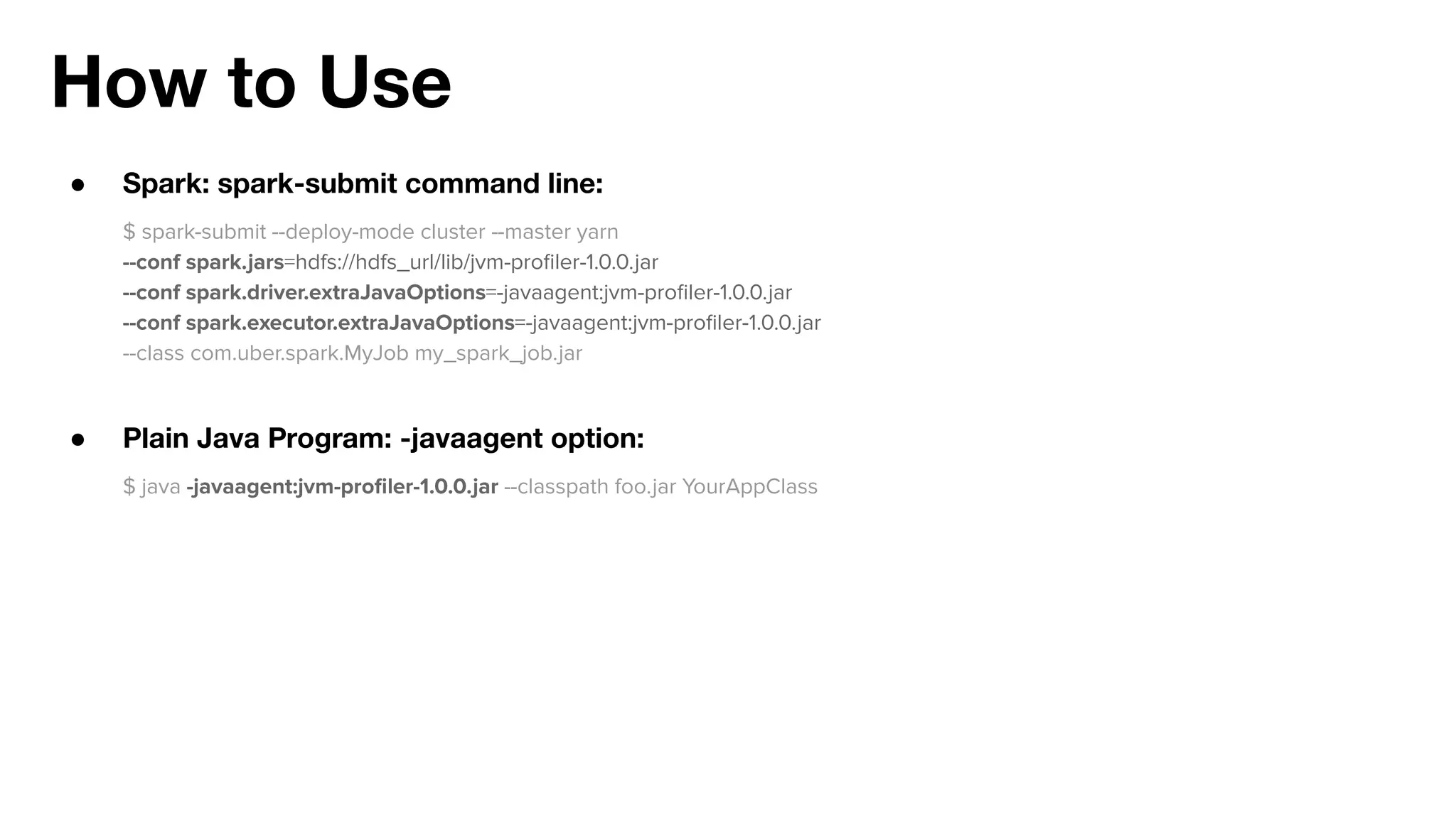
How to Use
● Spark: spark-submit command line:
$ spark-submit --deploy-mode cluster --master yarn
--conf spark.jars=hdfs://hdfs_url/lib/jvm-profiler-1.0.0.jar
--conf spark.driver.extraJavaOptions=-javaagent:jvm-profiler-1.0.0.jar
--conf spark.executor.extraJavaOptions=-javaagent:jvm-profiler-1.0.0.jar
--class com.uber.spark.MyJob my_spark_job.jar
● Plain Java Program: -javaagent option:
$ java -javaagent:jvm-profiler-1.0.0.jar --classpath foo.jar YourAppClass
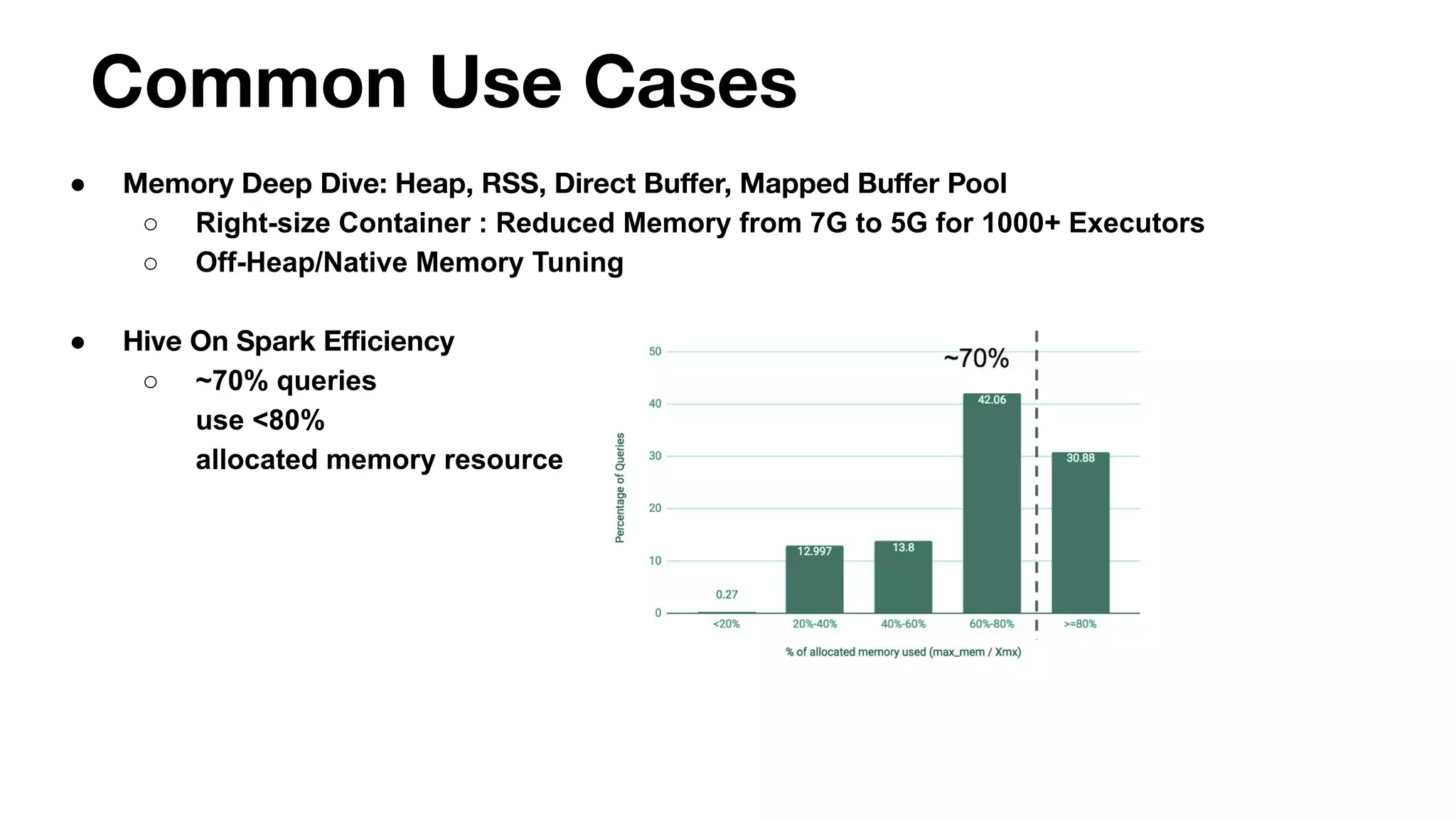
Common Use Cases
● Memory Deep Dive: Heap, RSS, Direct Buffer, Mapped Buffer Pool
○ Right-size Container : Reduced Memory from 7G to 5G for 1000+ Executors
○ Off-Heap/Native Memory Tuning
● Hive On Spark Efficiency
○ ~70% queries
use <80%
allocated memory resource
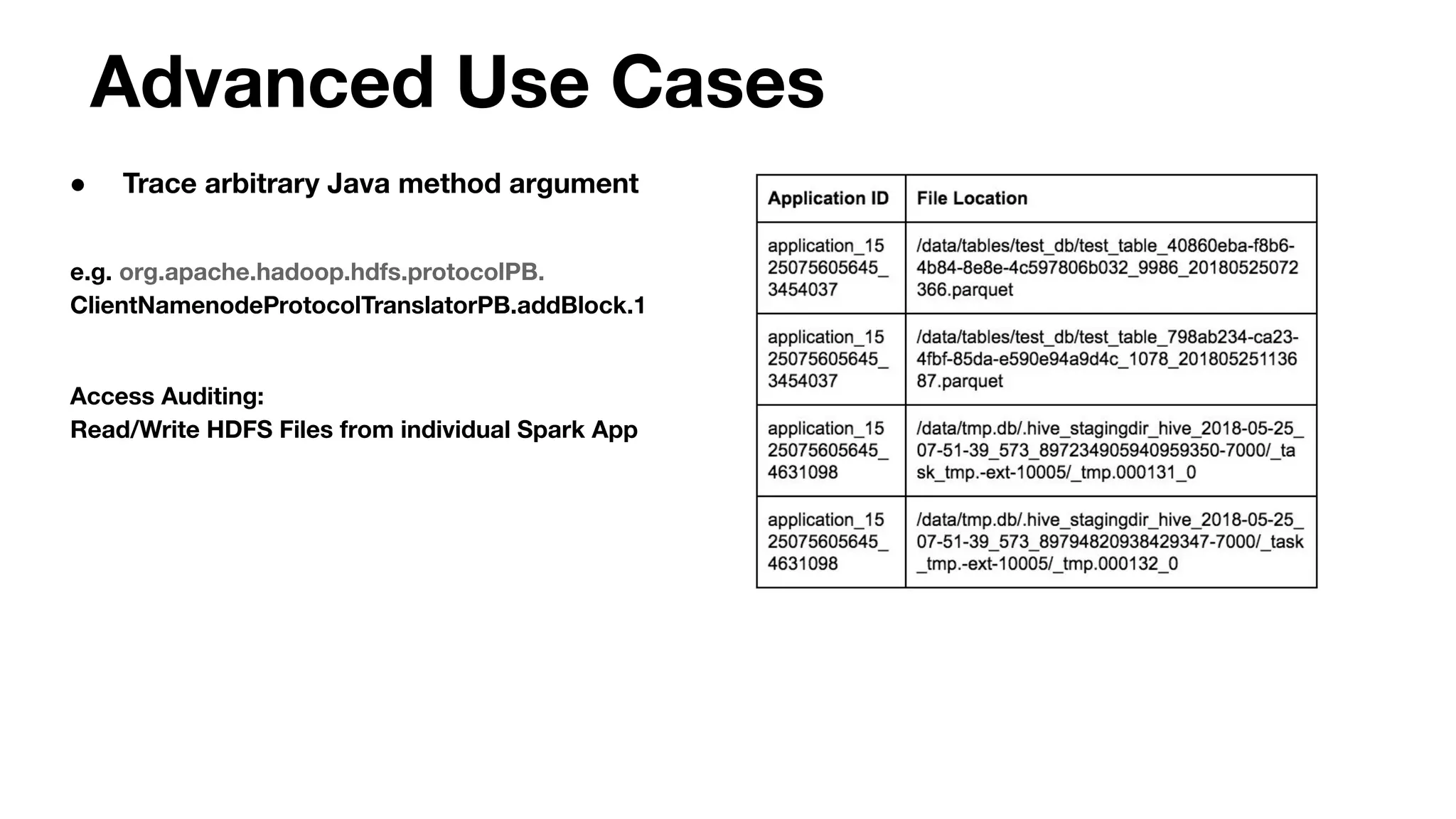
Advanced Use Cases
● Trace arbitrary Java method argument
e.g. org.apache.hadoop.hdfs.protocolPB.
ClientNamenodeProtocolTranslatorPB.addBlock.1
Access Auditing:
Read/Write HDFS Files from individual Spark App
Advanced Use Cases
● Trace arbitrary Java method during
runtime
○ For example:
org.apache.hadoop.hdfs.protocolPB.Client
NamenodeProtocolTranslatorPB.getBlock
Locations
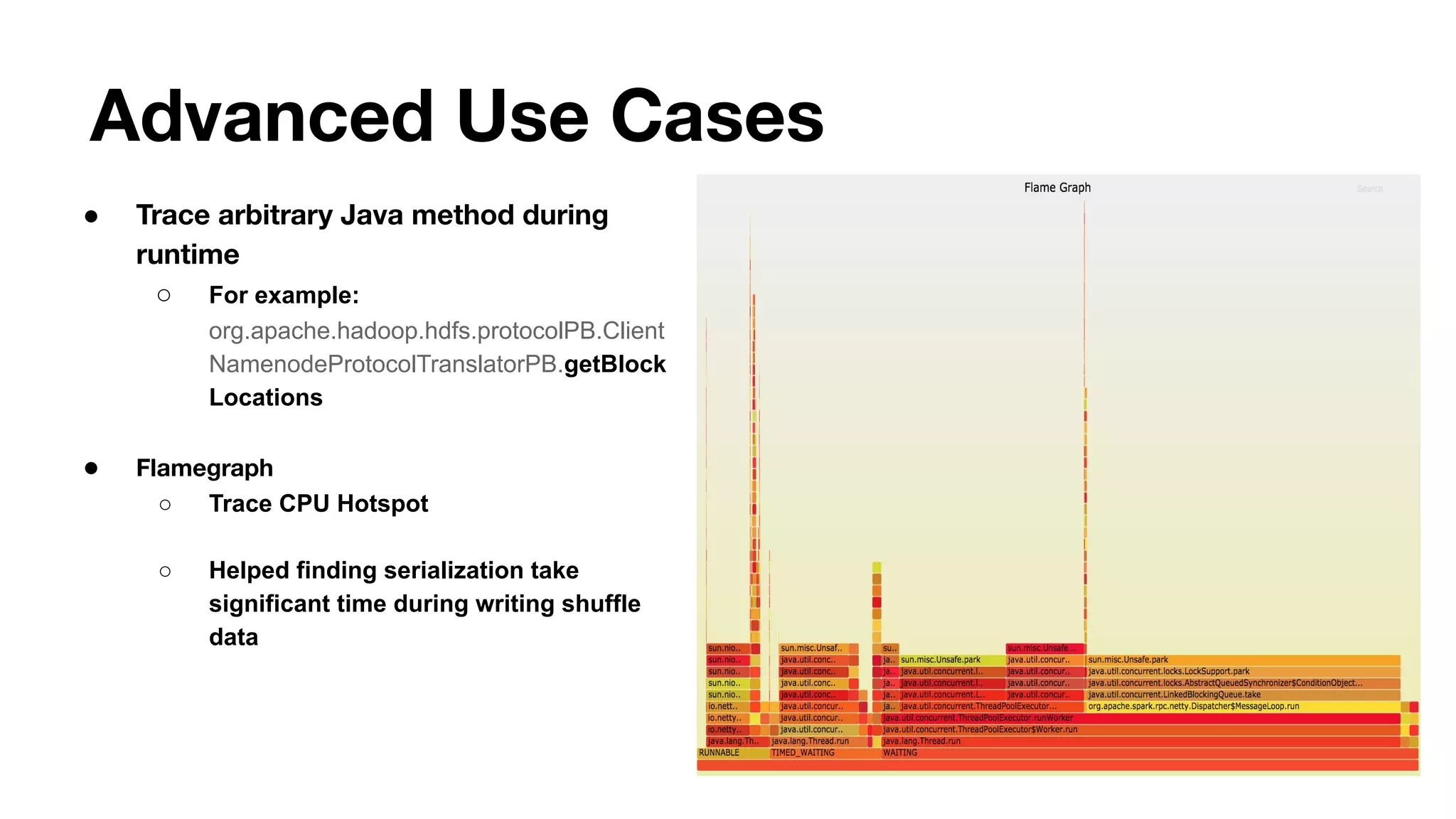
● Flamegraph
○ Trace CPU Hotspot
○ Helped finding serialization take
significant time during writing shuffle
data
Auto Tune (Work in Progress)
● Problem: data scientist using team level Spark conf template
● Known Daily Applications
○ Use historical run to set Spark configurations (memory, vcore, etc.) *
● Ad-hoc Repeated (Daily) Applications
○ Use Machine Learning to predict resource usage
○ Challenge: Feature Engineering
■ Execution Plan
Project [user_id, product_id, price]
Filter (date = 2019-01-31 and product_id = xyz)
UnresolvedRelation datalake.user_purchase
* Done by our colleague Abhishek Modi
Open Sourced in September 2018
https://github.com/uber/marmaray
Blog Post:
https://eng.uber.com/marmaray-hado
op-ingestion-open-source/
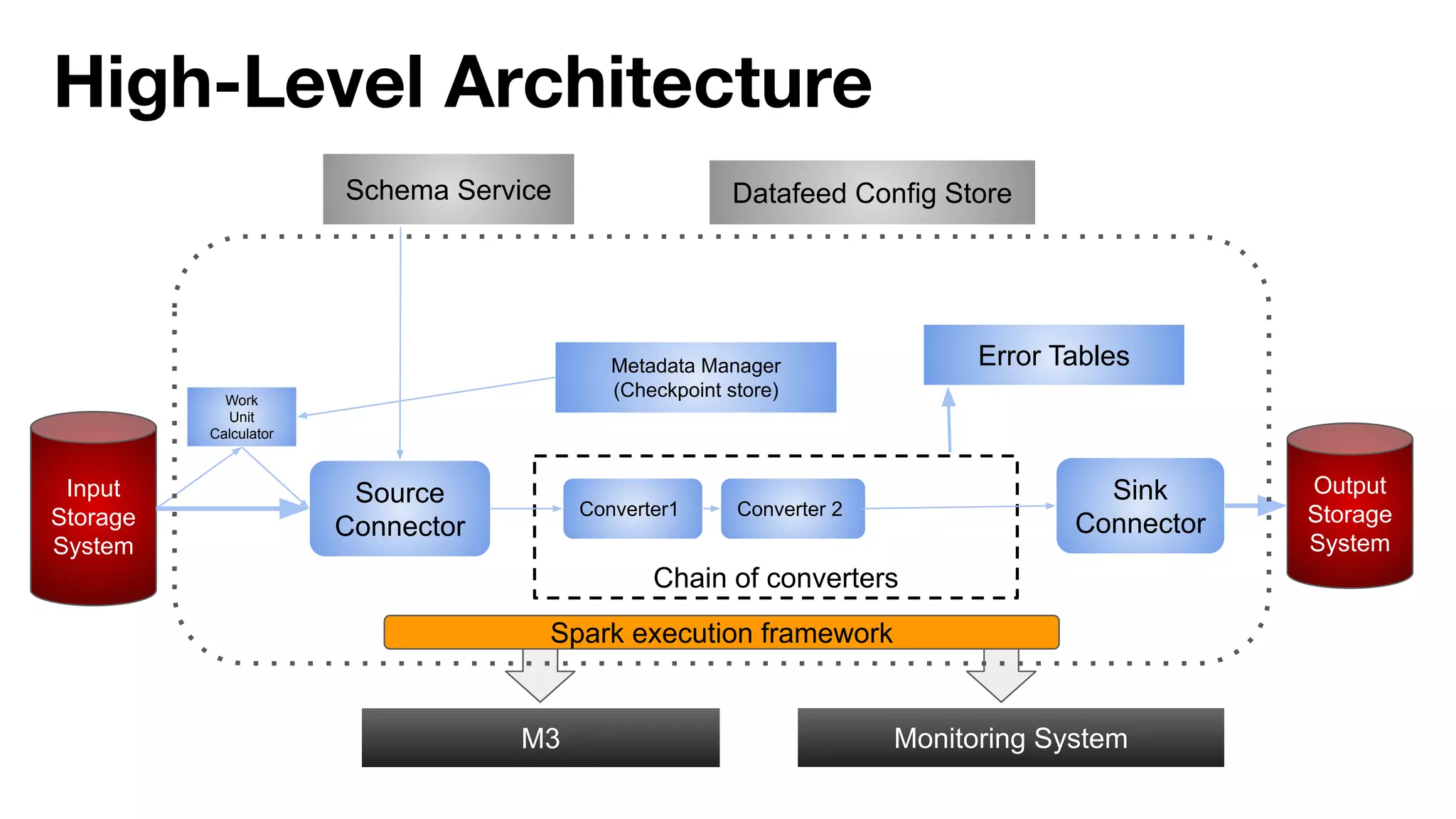
High-Level Architecture
Chain of converters
Schema Service
Input
Storage
System
Source
Connector
M3 Monitoring System
Work
Unit
Calculator
Metadata Manager
(Checkpoint store)
Converter1 Converter 2
Sink
Connector
Output
Storage
System
Error Tables
Datafeed Config Store
Spark execution framework
Spark job
improvements
Storage
improvements
Effective data layout (parquet)
● Parquet uses columnar compression
● Columnar compression savings outperform gz or snappy compression
savings
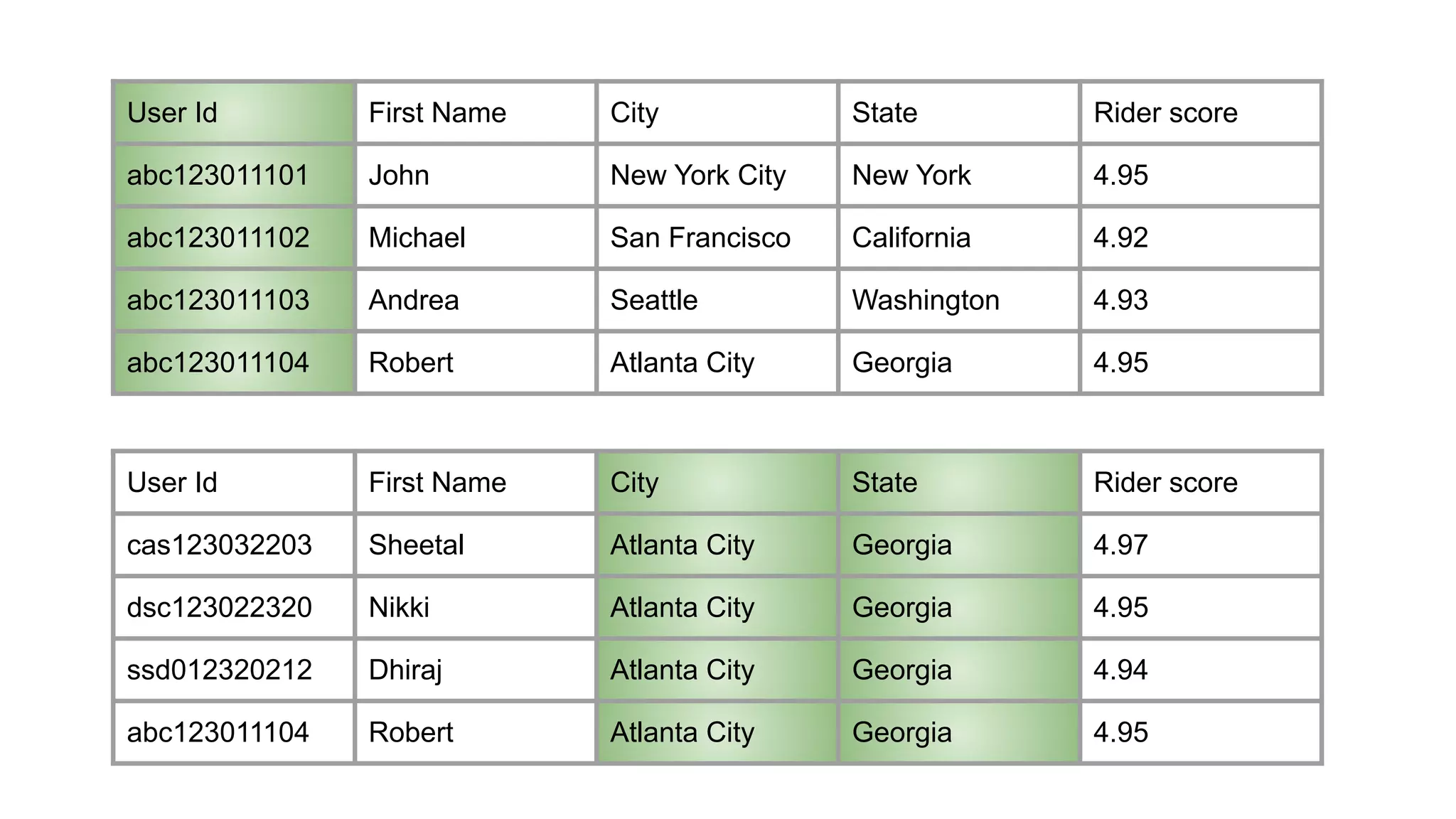
● Align records such that adjacent rows have identical column values
○ Eg. For state column California.
● Sort records with increasing value of cardinality.
● Generalization sometimes is not possible; If it is a framework provide custom
sorting.
User Id First Name City State Rider score
abc123011101 John New York City New York 4.95
abc123011102 Michael San Francisco California 4.92
abc123011103 Andrea Seattle Washington 4.93
abc123011104 Robert Atlanta City Georgia 4.95
User Id First Name City State Rider score
cas123032203 Sheetal Atlanta City Georgia 4.97
dsc123022320 Nikki Atlanta City Georgia 4.95
ssd012320212 Dhiraj Atlanta City Georgia 4.94
abc123011104 Robert Atlanta City Georgia 4.95
CPU / Runtime
improvements
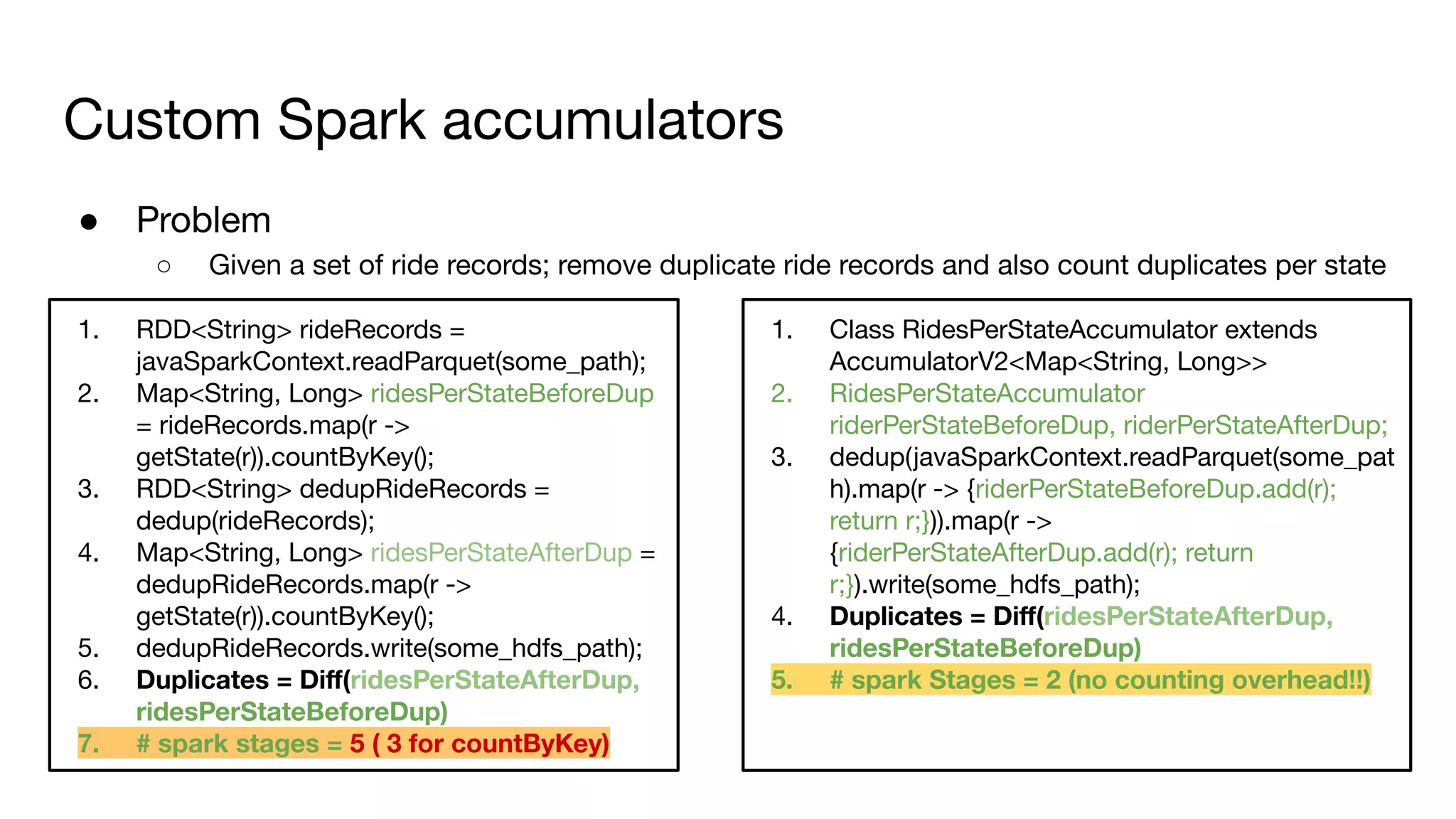
Custom Spark accumulators
● Problem
○ Given a set of ride records; remove duplicate ride records and also count duplicates per state
1. RDD<String> rideRecords =
javaSparkContext.readParquet(some_path);
2. Map<String, Long> ridesPerStateBeforeDup
= rideRecords.map(r ->
getState(r)).countByKey();
3. RDD<String> dedupRideRecords =
dedup(rideRecords);
4. Map<String, Long> ridesPerStateAfterDup =
dedupRideRecords.map(r ->
getState(r)).countByKey();
5. dedupRideRecords.write(some_hdfs_path);
6. Duplicates = Diff(ridesPerStateAfterDup,
ridesPerStateBeforeDup)
7. # spark stages = 5 ( 3 for countByKey)
1. Class RidesPerStateAccumulator extends
AccumulatorV2<Map<String, Long>>
2. RidesPerStateAccumulator
riderPerStateBeforeDup, riderPerStateAfterDup;
3. dedup(javaSparkContext.readParquet(some_pat
h).map(r -> {riderPerStateBeforeDup.add(r);
return r;})).map(r ->
{riderPerStateAfterDup.add(r); return
r;}).write(some_hdfs_path);
4. Duplicates = Diff(ridesPerStateAfterDup,
ridesPerStateBeforeDup)
5. # spark Stages = 2 (no counting overhead!!)
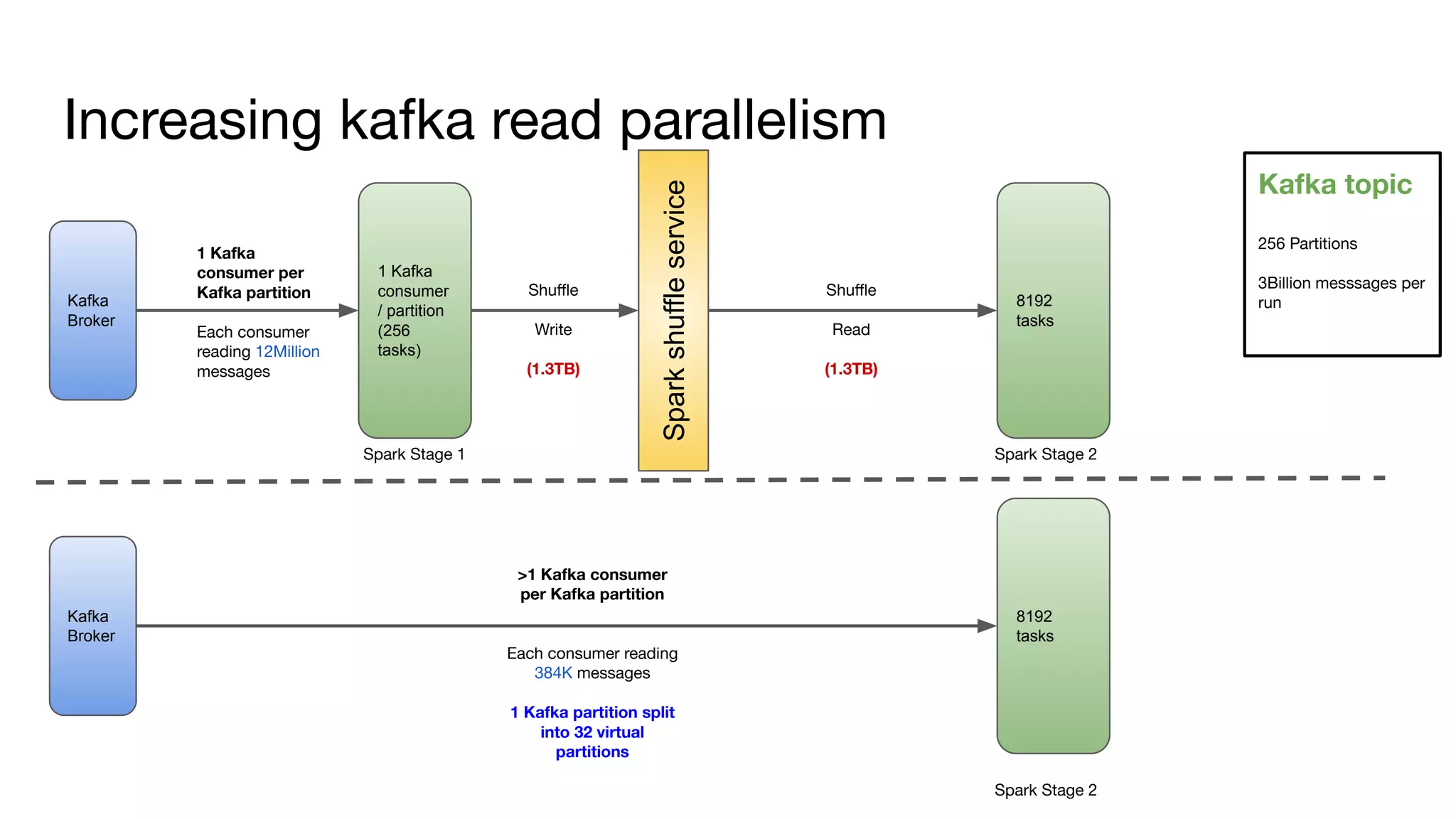
Kafka topic
256 Partitions
3Billion messsages per
run
Increasing kafka read parallelism
Kafka
Broker
1 Kafka
consumer
/ partition
(256
tasks)
1 Kafka
consumer per
Kafka partition
Each consumer
reading 12Million
messages
Spark Stage 1
Sparkshuffleservice
Shuffle
Write
(1.3TB)
Spark Stage 2
8192
tasks
Shuffle
Read
(1.3TB)
Kafka
Broker
>1 Kafka consumer
per Kafka partition
Each consumer reading
384K messages
1 Kafka partition split
into 32 virtual
partitions
Spark Stage 2
8192
tasks
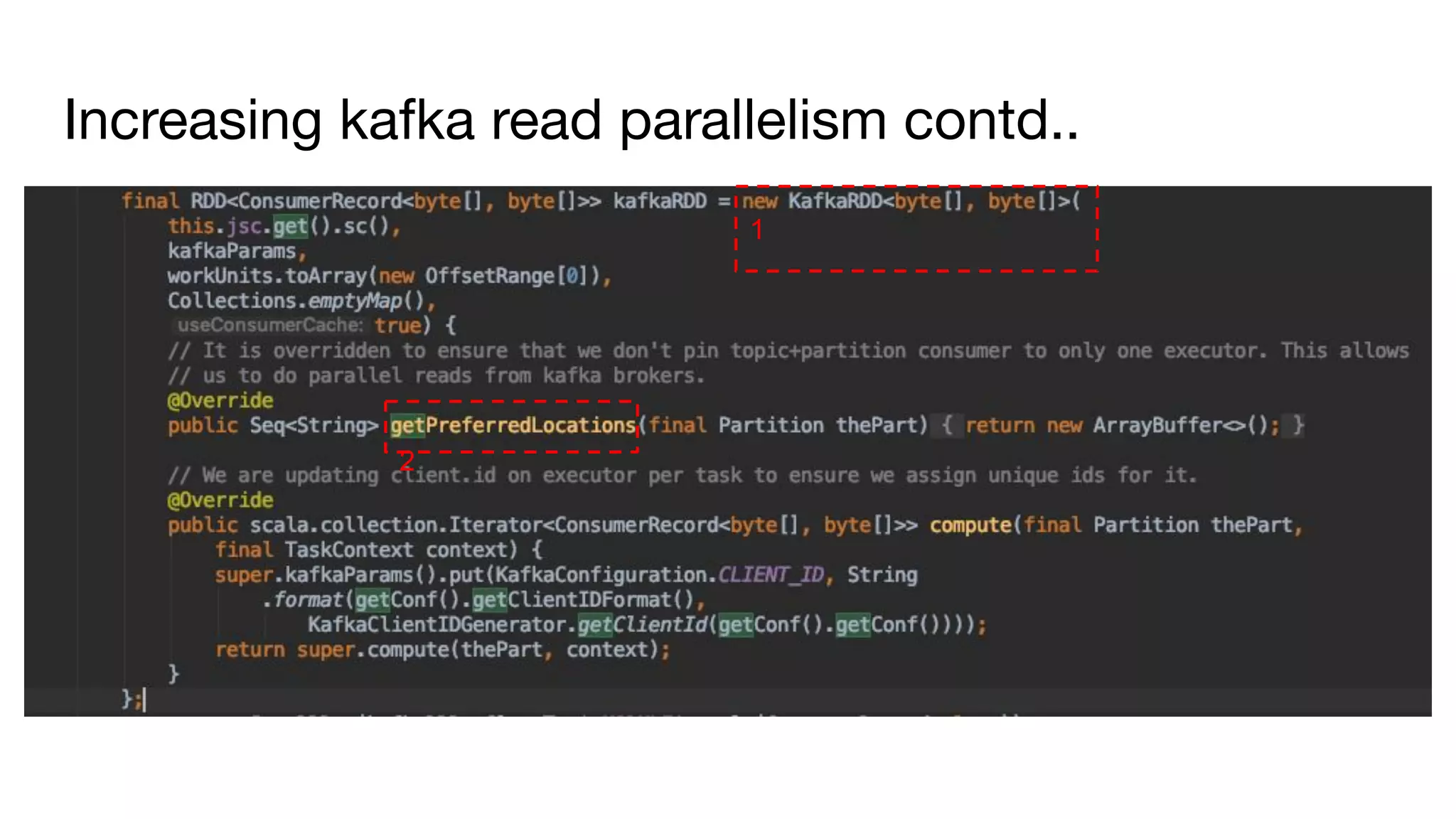
Increasing kafka read parallelism contd..
2
1
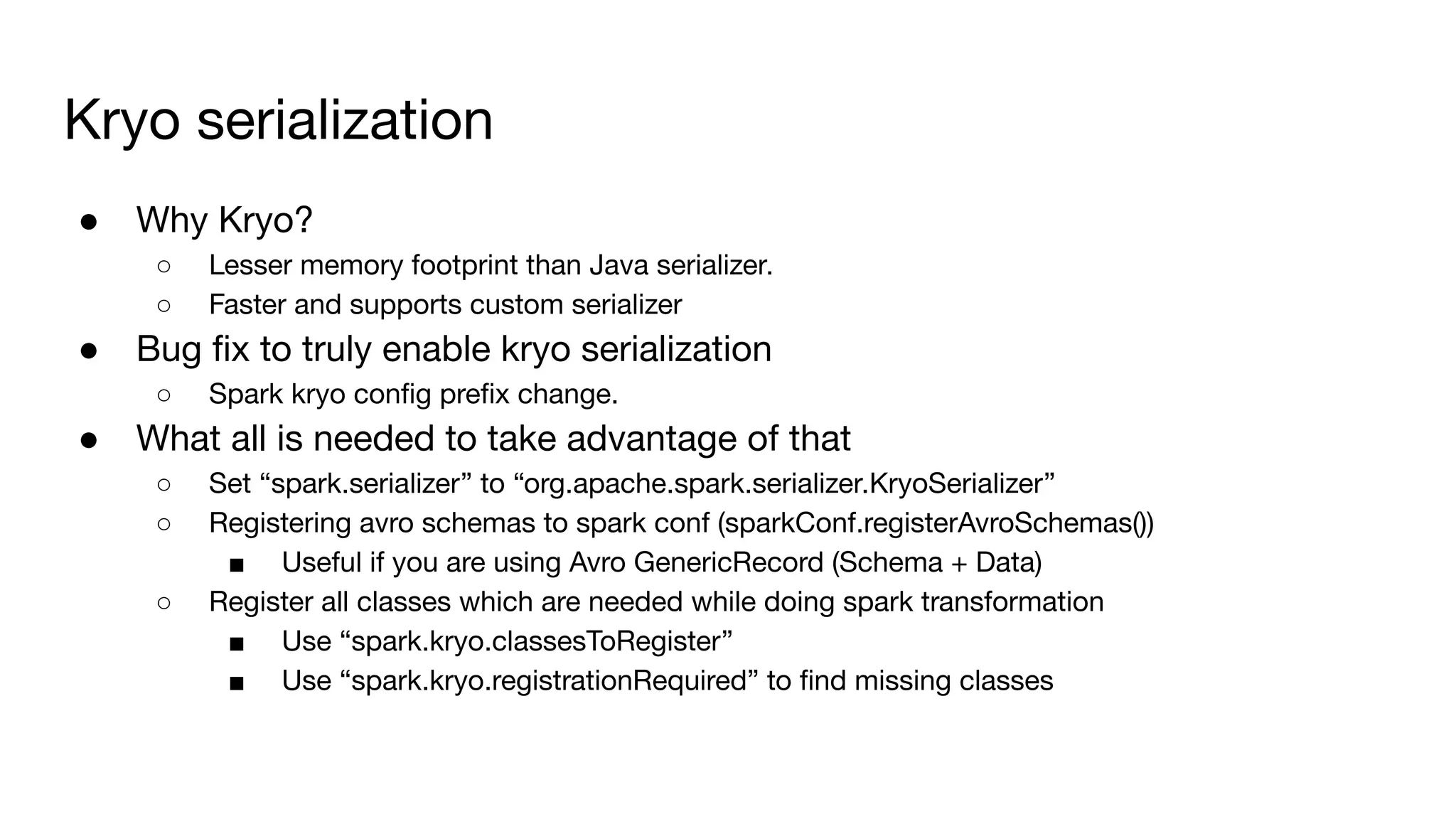
● Why Kryo?
○ Lesser memory footprint than Java serializer.
○ Faster and supports custom serializer
● Bug fix to truly enable kryo serialization
○ Spark kryo config prefix change.
● What all is needed to take advantage of that
○ Set “spark.serializer” to “org.apache.spark.serializer.KryoSerializer”
○ Registering avro schemas to spark conf (sparkConf.registerAvroSchemas())
■ Useful if you are using Avro GenericRecord (Schema + Data)
○ Register all classes which are needed while doing spark transformation
■ Use “spark.kryo.classesToRegister”
■ Use “spark.kryo.registrationRequired” to find missing classes
Kryo serialization
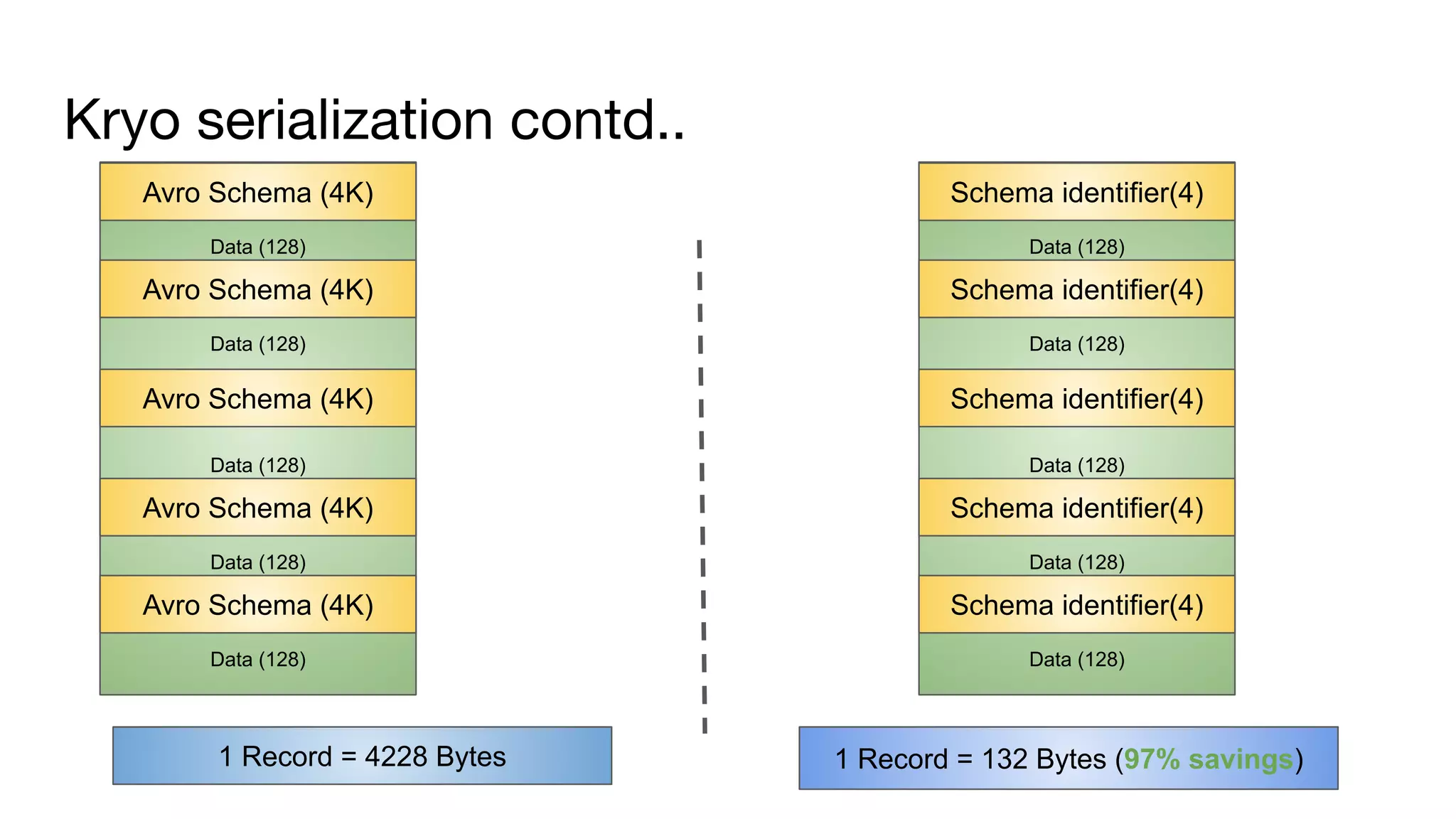
Kryo serialization contd..
Data (128)
Data (128)
Data (128)
Data (128)
Data (128)
Avro Schema (4K)
Avro Schema (4K)
Avro Schema (4K)
Avro Schema (4K)
Avro Schema (4K)
Data (128)
Data (128)
Data (128)
Data (128)
Data (128)
Schema identifier(4)
1 Record = 4228 Bytes 1 Record = 132 Bytes (97% savings)
Reduce ser/deser time by restructuring payload
1. @AllArgsConstructor
2. @Getter
3. private class SparkPayload {
4. private final String sortingKey;
5. // Map with 1000+ entries.
6. private final Map<String, GenericRecord>
data;
7. }
8.
1. @Getter
2. private class SparkPayload {
3. private final String sortingKey;
4. // Map with 1000+ entries.
5. private final byte[] serializedData;
6.
7. public SparkPayload(final String sortingKey,
Map<String, GenericRecord> data) {
8. this.sortingKey = sortingKey;
9. this.serializedData =
KryoSerializer.serialize(data);
10. }
11.
12. public Map<String, GenericRecord> getData() {
13. return
KryoSerializer.deserialize(this.serializedData,
Map.class);
14. }
15. }
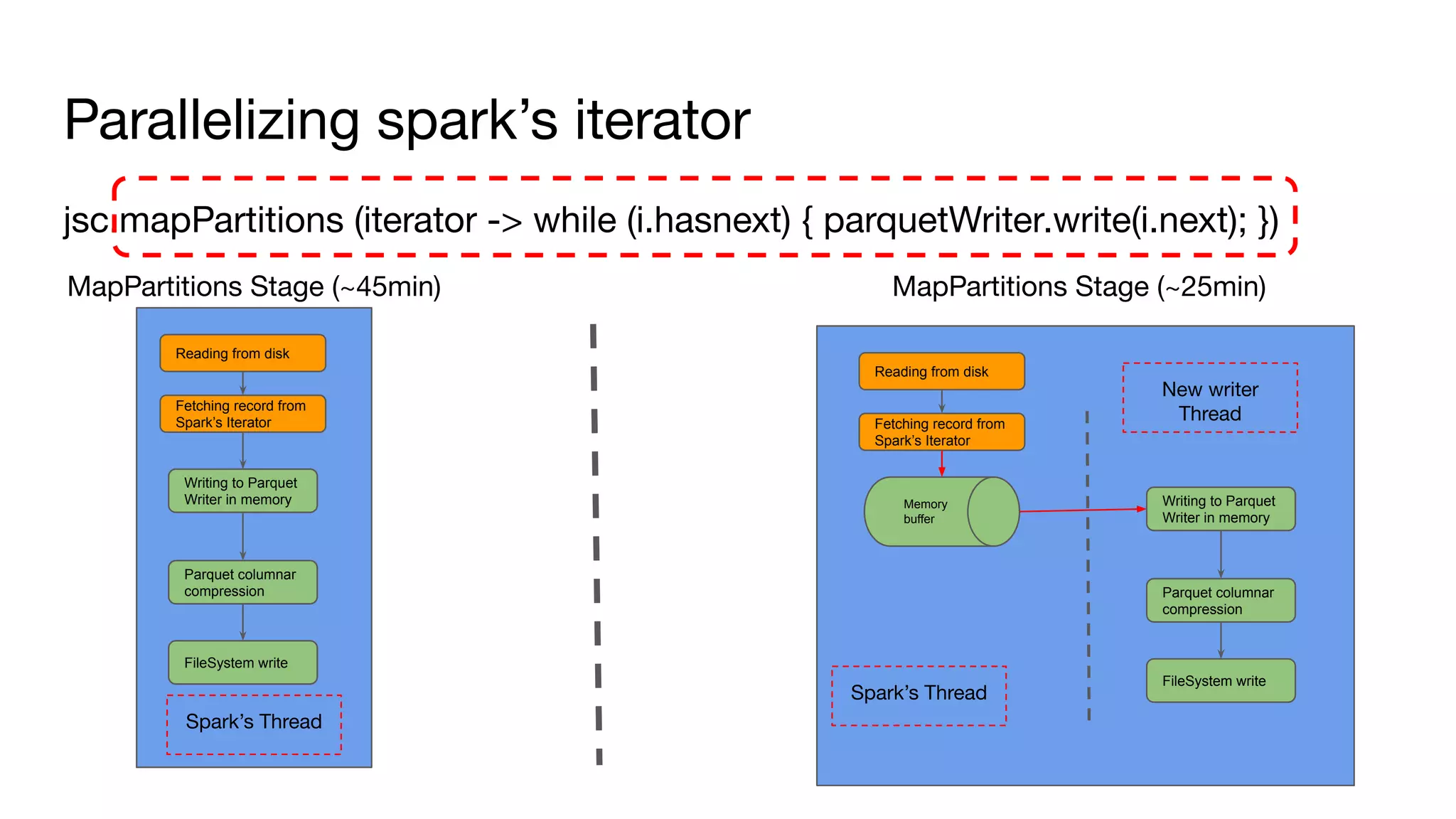
Parallelizing spark’s iterator
jsc.mapPartitions (iterator -> while (i.hasnext) { parquetWriter.write(i.next); })
MapPartitions Stage (~45min) MapPartitions Stage (~25min)
Reading from disk
Fetching record from
Spark’s Iterator
Writing to Parquet
Writer in memory
Parquet columnar
compression
FileSystem write
Reading from disk
Fetching record from
Spark’s Iterator
Writing to Parquet
Writer in memory
Parquet columnar
compression
FileSystem write
Spark’s Thread
New writer
Thread
Memory
buffer
Spark’s Thread
Efficiency
improvements
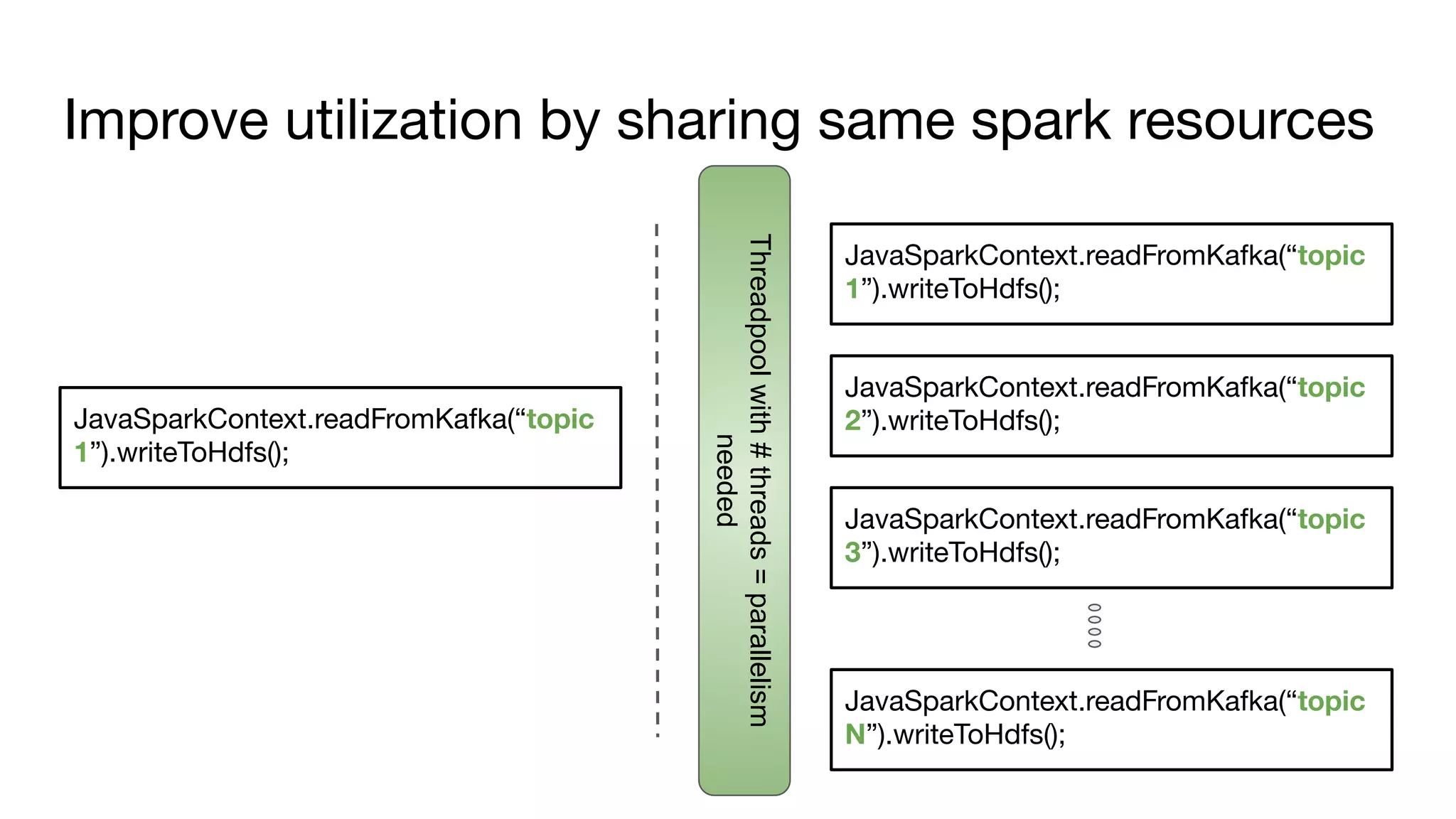
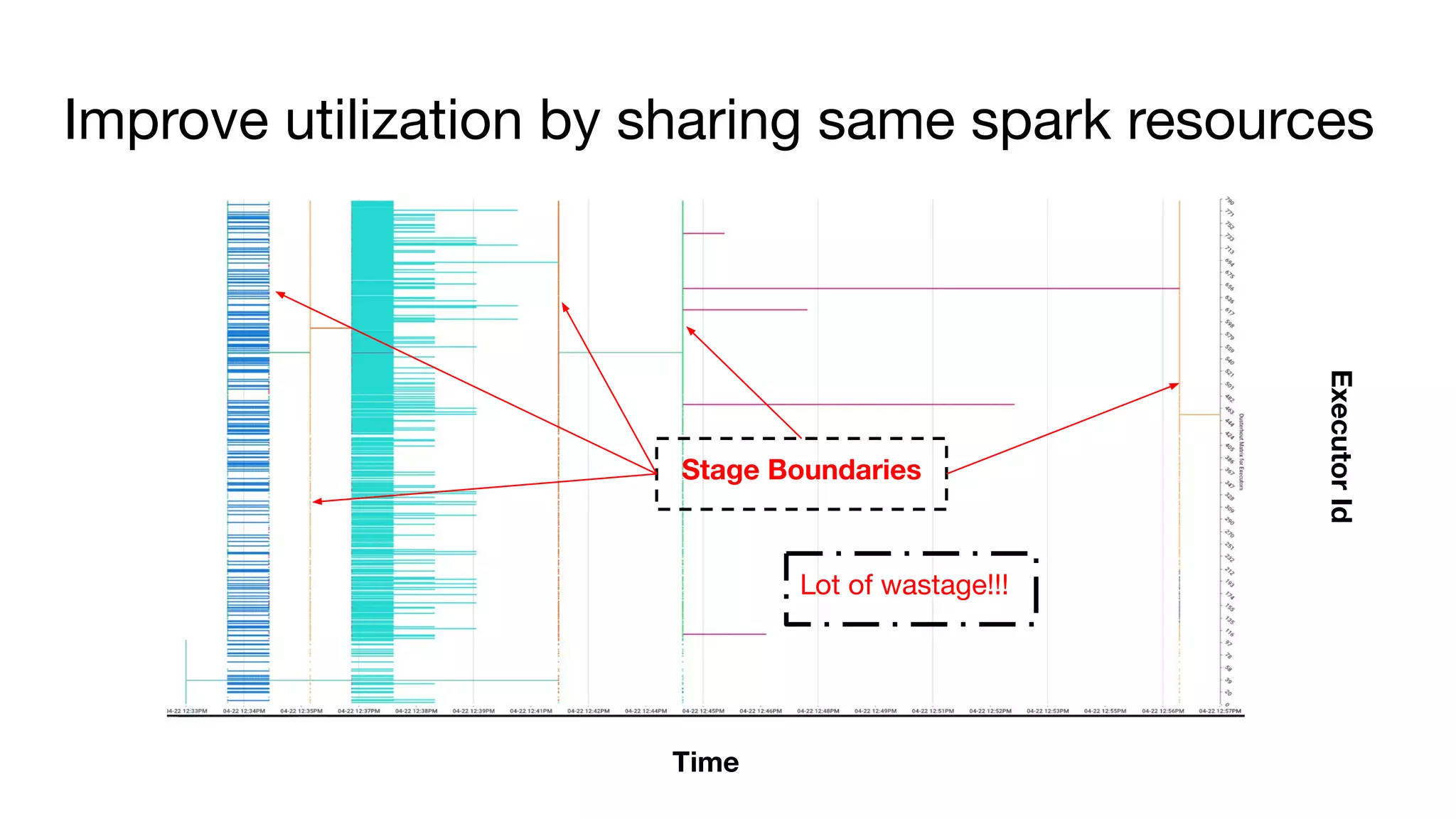
Improve utilization by sharing same spark resources
JavaSparkContext.readFromKafka(“topic
1”).writeToHdfs();
JavaSparkContext.readFromKafka(“topic
1”).writeToHdfs();
JavaSparkContext.readFromKafka(“topic
3”).writeToHdfs();
JavaSparkContext.readFromKafka(“topic
2”).writeToHdfs();
JavaSparkContext.readFromKafka(“topic
N”).writeToHdfs();Threadpoolwith#threads=parallelism
needed
Improve utilization by sharing same spark resources
Time
ExecutorId
Stage Boundaries
Lot of wastage!!!
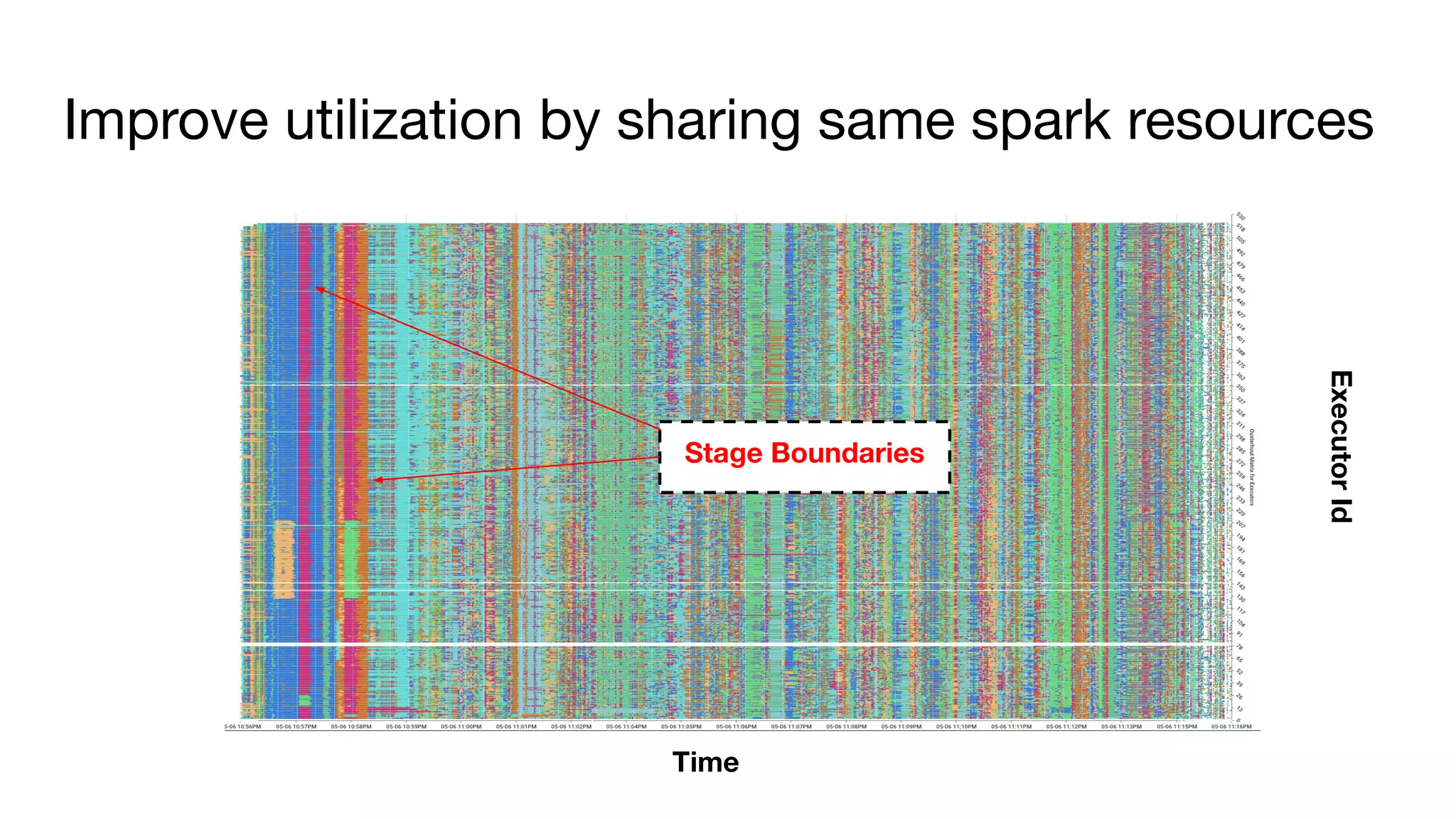
Improve utilization by sharing same spark resources
Time
ExecutorId
Stage Boundaries
Memory
improvements
Off heap memory improvements (work in progress)
● Symptom
○ Container killed by YARN for exceeding memory limits. 10.4 GB of 10.4 GB physical memory used. Consider
boosting spark.yarn.executor.memoryOverhead
● Solution as per stack overflow :)
○ Increase “spark.yarn.executor.memoryOverhead”
○ Result - Huge memory wastage.
● Spark memory distribution
○ Heap & off-heap memory (direct & memory mapped)
● Possible solutions
○ Avoid memory mapping or perform memory mapping chunk by chunk instead of entire file
(4-16MB vs 1GB)
● Current vs Target
○ Current - 7GB [Heap(4gb) + Off-heap(3gb)]
○ Target - 5GB [Heap(4gb) + Off-heap(1gb)] - ~28% memory reduction (per container)
Thank You!!

SF Big Analytics 20191112: How to performance-tune Spark applications in large clusters

  • 1.
    How to performance-tune spark applicationsin large clusters - Omkar Joshi
  • 2.
    Omkar Joshi omkar@uber.com ● Softwareengineer on Hadoop Data Platform team ● 2.5 years at Uber ● Architected Object store & NFS solutions at Hedvig ● Hadoop Yarn committer ● Enjoy gardening & hiking in free time
  • 3.
    01 Hadoop profiler 02Flame graph 03 Auto tune 04 Storage improvements 05 Cpu / Runtime improvements 06 Efficiency improvements 07 Memory improvements Agenda
  • 4.
    Challenge: Distributed Profiling ata Large Scale ● Uber’s Scale Multi-Tenancy, Distributed 1m+ Applications per Week 1000+ Executors Per Application ● Resource Utilization: Usage ≠ Allocation
  • 5.
    Hadoop Profiler ● JavaAgent attached to each executor ● Collects metrics via JMX and /proc ● Instruments arbitrary Java user code ● Emits to Kafka, InfluxDB, and other data sinks Method Argument Profiler Method duration Profiler CPU/Memory Profiler Reporter Java Agent Kafka InfluxDB https://github.com/uber-common/jvm-profiler
  • 6.
  • 7.
    How to Use ●Spark: spark-submit command line: $ spark-submit --deploy-mode cluster --master yarn --conf spark.jars=hdfs://hdfs_url/lib/jvm-profiler-1.0.0.jar --conf spark.driver.extraJavaOptions=-javaagent:jvm-profiler-1.0.0.jar --conf spark.executor.extraJavaOptions=-javaagent:jvm-profiler-1.0.0.jar --class com.uber.spark.MyJob my_spark_job.jar ● Plain Java Program: -javaagent option: $ java -javaagent:jvm-profiler-1.0.0.jar --classpath foo.jar YourAppClass
  • 8.
    Common Use Cases ●Memory Deep Dive: Heap, RSS, Direct Buffer, Mapped Buffer Pool ○ Right-size Container : Reduced Memory from 7G to 5G for 1000+ Executors ○ Off-Heap/Native Memory Tuning ● Hive On Spark Efficiency ○ ~70% queries use <80% allocated memory resource
  • 9.
    Advanced Use Cases ●Trace arbitrary Java method argument e.g. org.apache.hadoop.hdfs.protocolPB. ClientNamenodeProtocolTranslatorPB.addBlock.1 Access Auditing: Read/Write HDFS Files from individual Spark App
  • 10.
    Advanced Use Cases ●Trace arbitrary Java method during runtime ○ For example: org.apache.hadoop.hdfs.protocolPB.Client NamenodeProtocolTranslatorPB.getBlock Locations ● Flamegraph ○ Trace CPU Hotspot ○ Helped finding serialization take significant time during writing shuffle data
  • 11.
    Auto Tune (Workin Progress) ● Problem: data scientist using team level Spark conf template ● Known Daily Applications ○ Use historical run to set Spark configurations (memory, vcore, etc.) * ● Ad-hoc Repeated (Daily) Applications ○ Use Machine Learning to predict resource usage ○ Challenge: Feature Engineering ■ Execution Plan Project [user_id, product_id, price] Filter (date = 2019-01-31 and product_id = xyz) UnresolvedRelation datalake.user_purchase * Done by our colleague Abhishek Modi
  • 12.
    Open Sourced inSeptember 2018 https://github.com/uber/marmaray Blog Post: https://eng.uber.com/marmaray-hado op-ingestion-open-source/
  • 13.
    High-Level Architecture Chain ofconverters Schema Service Input Storage System Source Connector M3 Monitoring System Work Unit Calculator Metadata Manager (Checkpoint store) Converter1 Converter 2 Sink Connector Output Storage System Error Tables Datafeed Config Store Spark execution framework
  • 14.
  • 15.
  • 16.
    Effective data layout(parquet) ● Parquet uses columnar compression ● Columnar compression savings outperform gz or snappy compression savings ● Align records such that adjacent rows have identical column values ○ Eg. For state column California. ● Sort records with increasing value of cardinality. ● Generalization sometimes is not possible; If it is a framework provide custom sorting.
  • 17.
    User Id FirstName City State Rider score abc123011101 John New York City New York 4.95 abc123011102 Michael San Francisco California 4.92 abc123011103 Andrea Seattle Washington 4.93 abc123011104 Robert Atlanta City Georgia 4.95 User Id First Name City State Rider score cas123032203 Sheetal Atlanta City Georgia 4.97 dsc123022320 Nikki Atlanta City Georgia 4.95 ssd012320212 Dhiraj Atlanta City Georgia 4.94 abc123011104 Robert Atlanta City Georgia 4.95
  • 18.
  • 19.
    Custom Spark accumulators ●Problem ○ Given a set of ride records; remove duplicate ride records and also count duplicates per state 1. RDD<String> rideRecords = javaSparkContext.readParquet(some_path); 2. Map<String, Long> ridesPerStateBeforeDup = rideRecords.map(r -> getState(r)).countByKey(); 3. RDD<String> dedupRideRecords = dedup(rideRecords); 4. Map<String, Long> ridesPerStateAfterDup = dedupRideRecords.map(r -> getState(r)).countByKey(); 5. dedupRideRecords.write(some_hdfs_path); 6. Duplicates = Diff(ridesPerStateAfterDup, ridesPerStateBeforeDup) 7. # spark stages = 5 ( 3 for countByKey) 1. Class RidesPerStateAccumulator extends AccumulatorV2<Map<String, Long>> 2. RidesPerStateAccumulator riderPerStateBeforeDup, riderPerStateAfterDup; 3. dedup(javaSparkContext.readParquet(some_pat h).map(r -> {riderPerStateBeforeDup.add(r); return r;})).map(r -> {riderPerStateAfterDup.add(r); return r;}).write(some_hdfs_path); 4. Duplicates = Diff(ridesPerStateAfterDup, ridesPerStateBeforeDup) 5. # spark Stages = 2 (no counting overhead!!)
  • 20.
    Kafka topic 256 Partitions 3Billionmesssages per run Increasing kafka read parallelism Kafka Broker 1 Kafka consumer / partition (256 tasks) 1 Kafka consumer per Kafka partition Each consumer reading 12Million messages Spark Stage 1 Sparkshuffleservice Shuffle Write (1.3TB) Spark Stage 2 8192 tasks Shuffle Read (1.3TB) Kafka Broker >1 Kafka consumer per Kafka partition Each consumer reading 384K messages 1 Kafka partition split into 32 virtual partitions Spark Stage 2 8192 tasks
  • 21.
    Increasing kafka readparallelism contd.. 2 1
  • 22.
    ● Why Kryo? ○Lesser memory footprint than Java serializer. ○ Faster and supports custom serializer ● Bug fix to truly enable kryo serialization ○ Spark kryo config prefix change. ● What all is needed to take advantage of that ○ Set “spark.serializer” to “org.apache.spark.serializer.KryoSerializer” ○ Registering avro schemas to spark conf (sparkConf.registerAvroSchemas()) ■ Useful if you are using Avro GenericRecord (Schema + Data) ○ Register all classes which are needed while doing spark transformation ■ Use “spark.kryo.classesToRegister” ■ Use “spark.kryo.registrationRequired” to find missing classes Kryo serialization
  • 23.
    Kryo serialization contd.. Data(128) Data (128) Data (128) Data (128) Data (128) Avro Schema (4K) Avro Schema (4K) Avro Schema (4K) Avro Schema (4K) Avro Schema (4K) Data (128) Data (128) Data (128) Data (128) Data (128) Schema identifier(4) Schema identifier(4) Schema identifier(4) Schema identifier(4) Schema identifier(4) 1 Record = 4228 Bytes 1 Record = 132 Bytes (97% savings)
  • 24.
    Reduce ser/deser timeby restructuring payload 1. @AllArgsConstructor 2. @Getter 3. private class SparkPayload { 4. private final String sortingKey; 5. // Map with 1000+ entries. 6. private final Map<String, GenericRecord> data; 7. } 8. 1. @Getter 2. private class SparkPayload { 3. private final String sortingKey; 4. // Map with 1000+ entries. 5. private final byte[] serializedData; 6. 7. public SparkPayload(final String sortingKey, Map<String, GenericRecord> data) { 8. this.sortingKey = sortingKey; 9. this.serializedData = KryoSerializer.serialize(data); 10. } 11. 12. public Map<String, GenericRecord> getData() { 13. return KryoSerializer.deserialize(this.serializedData, Map.class); 14. } 15. }
  • 25.
    Parallelizing spark’s iterator jsc.mapPartitions(iterator -> while (i.hasnext) { parquetWriter.write(i.next); }) MapPartitions Stage (~45min) MapPartitions Stage (~25min) Reading from disk Fetching record from Spark’s Iterator Writing to Parquet Writer in memory Parquet columnar compression FileSystem write Reading from disk Fetching record from Spark’s Iterator Writing to Parquet Writer in memory Parquet columnar compression FileSystem write Spark’s Thread New writer Thread Memory buffer Spark’s Thread
  • 26.
  • 27.
    Improve utilization bysharing same spark resources JavaSparkContext.readFromKafka(“topic 1”).writeToHdfs(); JavaSparkContext.readFromKafka(“topic 1”).writeToHdfs(); JavaSparkContext.readFromKafka(“topic 3”).writeToHdfs(); JavaSparkContext.readFromKafka(“topic 2”).writeToHdfs(); JavaSparkContext.readFromKafka(“topic N”).writeToHdfs();Threadpoolwith#threads=parallelism needed
  • 28.
    Improve utilization bysharing same spark resources Time ExecutorId Stage Boundaries Lot of wastage!!!
  • 29.
    Improve utilization bysharing same spark resources Time ExecutorId Stage Boundaries
  • 30.
  • 31.
    Off heap memoryimprovements (work in progress) ● Symptom ○ Container killed by YARN for exceeding memory limits. 10.4 GB of 10.4 GB physical memory used. Consider boosting spark.yarn.executor.memoryOverhead ● Solution as per stack overflow :) ○ Increase “spark.yarn.executor.memoryOverhead” ○ Result - Huge memory wastage. ● Spark memory distribution ○ Heap & off-heap memory (direct & memory mapped) ● Possible solutions ○ Avoid memory mapping or perform memory mapping chunk by chunk instead of entire file (4-16MB vs 1GB) ● Current vs Target ○ Current - 7GB [Heap(4gb) + Off-heap(3gb)] ○ Target - 5GB [Heap(4gb) + Off-heap(1gb)] - ~28% memory reduction (per container)
  • 32.