Sound
• Sound are longitudinal waves
– Also called pressure waves
– created as air pressure oscillates between high
and low pressure
– On a graph:
• Crests show
high pressure
• Troughs show
low pressure
• Sound needs a medium to travel through
– Needs air molecules to vibrate in order for the
energy to get passed along
– Space is silent! No air molecules in space!
Propagate
• All ways waves travel from a single point
– Energy decreases with distance from starting point
Acoustics
• Get dead-spots
– Destructive Interference
– Areas with no or low sound
– Ways to fix
1. Speakers placed in back of auditorium
2. Room built to prevent dead-spots
Loudness
• The high and low pressure of sound
– More energy = louder sound
– Sounds too loud can lead to deafness

• Unit - decibels (dB)
– The decibel scale is a logarithmic scale
• Every +10 dB change means twice as loud
• Every -10 dB change means half as loud
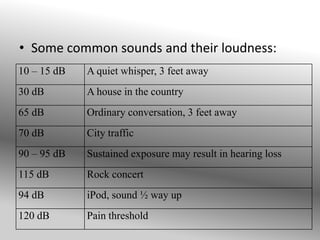
• Some common sounds and their loudness:
10 – 15 dB

A quiet whisper, 3 feet away

30 dB

A house in the country

65 dB

Ordinary conversation, 3 feet away

70 dB

City traffic

90 – 95 dB

Sustained exposure may result in hearing loss

115 dB

Rock concert

94 dB

iPod, sound ½ way up

120 dB

Pain threshold
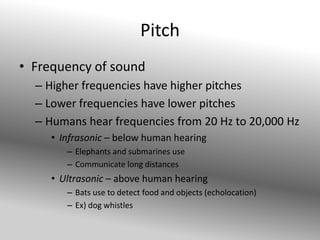
Pitch
• Frequency of sound
– Higher frequencies have higher pitches
– Lower frequencies have lower pitches
– Humans hear frequencies from 20 Hz to 20,000 Hz
• Infrasonic – below human hearing
– Elephants and submarines use
– Communicate long distances

• Ultrasonic – above human hearing
– Bats use to detect food and objects (echolocation)
– Ex) dog whistles
• Some common sounds and their pitch:
• As we get older, we lose our ability to hear
higher frequencies
– Most adults cannot hear frequencies over 15,000 Hz
– Children can often hear to 20,000 Hz
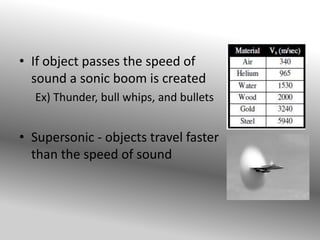
Speed of sound:
• 340 m/s (or 660 mph)
• Changes with:
– Hotter (faster) gases conduct sound faster
– Sounds travel faster in solids
• because the pressure between particles is higher
• If object passes the speed of
sound a sonic boom is created
Ex) Thunder, bull whips, and bullets

• Supersonic - objects travel faster
than the speed of sound
Doppler Effect
• If object is moving relative to an observer, the
sound waves are altered
– The frequency and wavelength are changed
Ex) Passing sirens
Ex) Light used in weather radar

Sound Notes

  • 1.
  • 2.
    • Sound arelongitudinal waves – Also called pressure waves – created as air pressure oscillates between high and low pressure – On a graph: • Crests show high pressure • Troughs show low pressure
  • 3.
    • Sound needsa medium to travel through – Needs air molecules to vibrate in order for the energy to get passed along – Space is silent! No air molecules in space!
  • 4.
    Propagate • All wayswaves travel from a single point – Energy decreases with distance from starting point
  • 5.
    Acoustics • Get dead-spots –Destructive Interference – Areas with no or low sound – Ways to fix 1. Speakers placed in back of auditorium 2. Room built to prevent dead-spots
  • 7.
    Loudness • The highand low pressure of sound – More energy = louder sound – Sounds too loud can lead to deafness • Unit - decibels (dB) – The decibel scale is a logarithmic scale • Every +10 dB change means twice as loud • Every -10 dB change means half as loud
  • 8.
    • Some commonsounds and their loudness: 10 – 15 dB A quiet whisper, 3 feet away 30 dB A house in the country 65 dB Ordinary conversation, 3 feet away 70 dB City traffic 90 – 95 dB Sustained exposure may result in hearing loss 115 dB Rock concert 94 dB iPod, sound ½ way up 120 dB Pain threshold
  • 9.
    Pitch • Frequency ofsound – Higher frequencies have higher pitches – Lower frequencies have lower pitches – Humans hear frequencies from 20 Hz to 20,000 Hz • Infrasonic – below human hearing – Elephants and submarines use – Communicate long distances • Ultrasonic – above human hearing – Bats use to detect food and objects (echolocation) – Ex) dog whistles
  • 10.
    • Some commonsounds and their pitch:
  • 11.
    • As weget older, we lose our ability to hear higher frequencies – Most adults cannot hear frequencies over 15,000 Hz – Children can often hear to 20,000 Hz
  • 12.
    Speed of sound: •340 m/s (or 660 mph) • Changes with: – Hotter (faster) gases conduct sound faster – Sounds travel faster in solids • because the pressure between particles is higher
  • 13.
    • If objectpasses the speed of sound a sonic boom is created Ex) Thunder, bull whips, and bullets • Supersonic - objects travel faster than the speed of sound
  • 14.
    Doppler Effect • Ifobject is moving relative to an observer, the sound waves are altered – The frequency and wavelength are changed Ex) Passing sirens Ex) Light used in weather radar