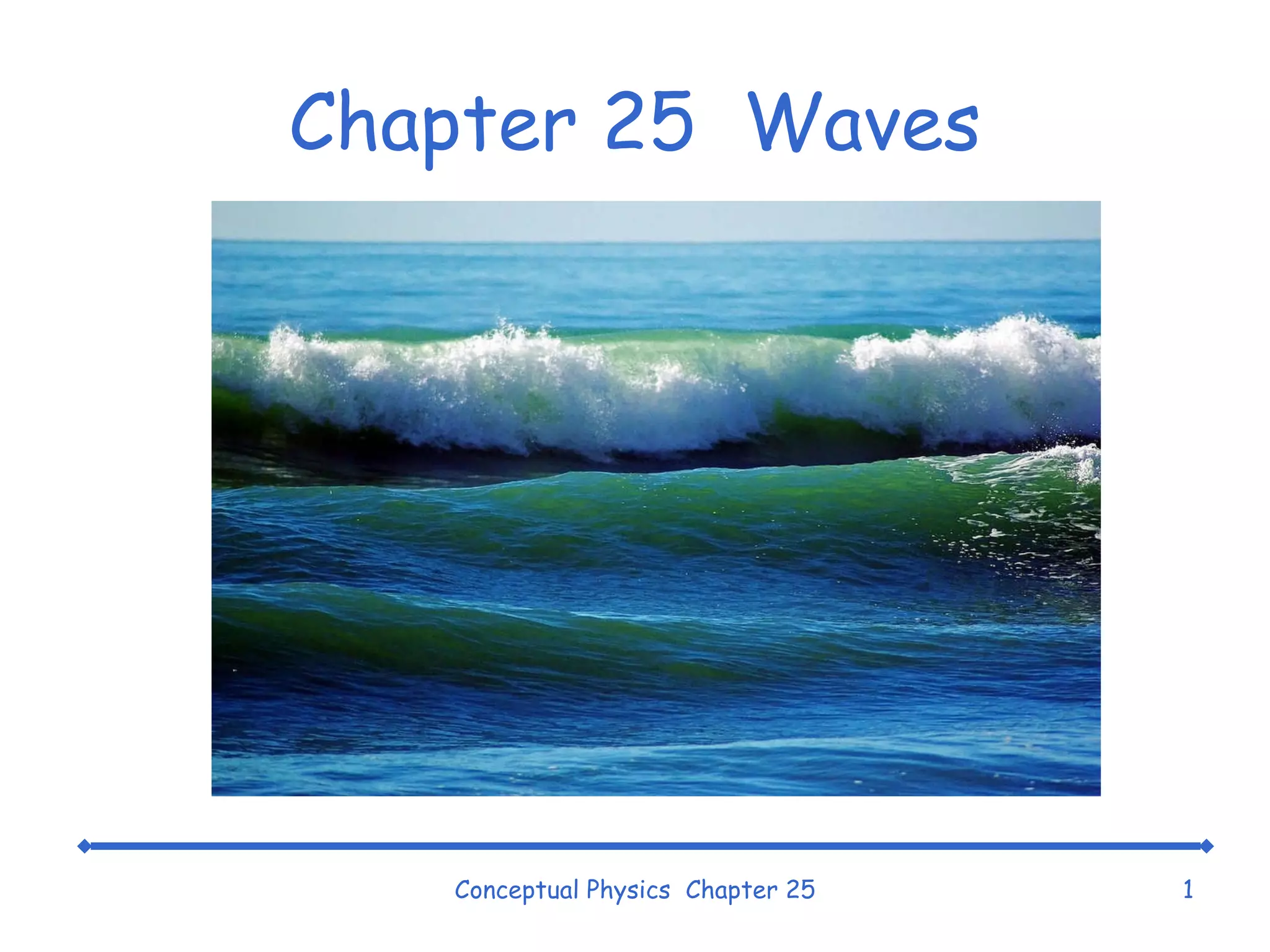
Chapter 25  Waves Conceptual Physics  Chapter 25
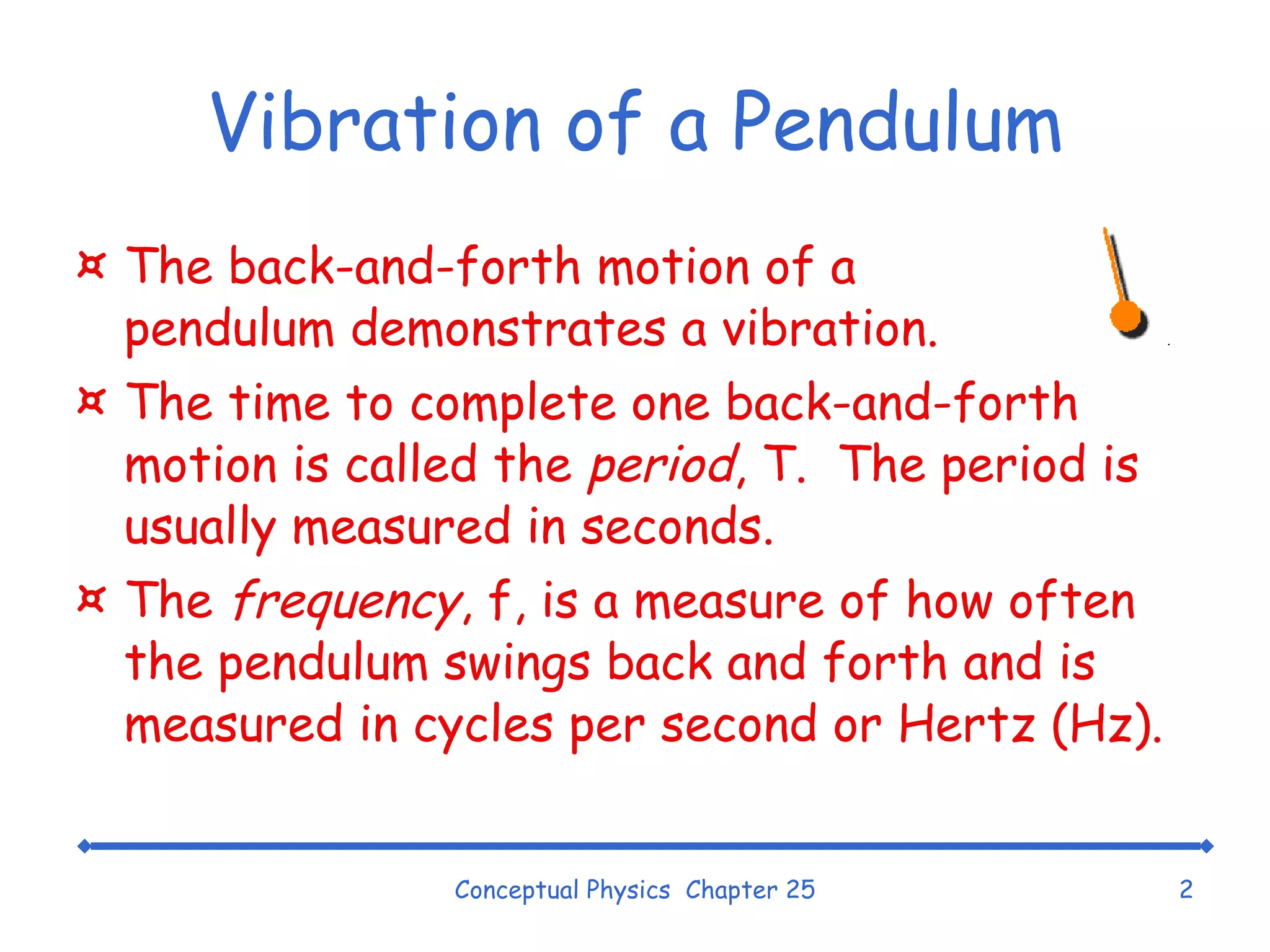
Vibration of a Pendulum The back-and-forth motion of a  pendulum demonstrates a vibration. The time to complete one back-and-forth motion is called the  period , T.  The period is usually measured in seconds. The  frequency , f, is a measure of how often the pendulum swings back and forth and is measured in cycles per second or Hertz (Hz). Conceptual Physics  Chapter 25
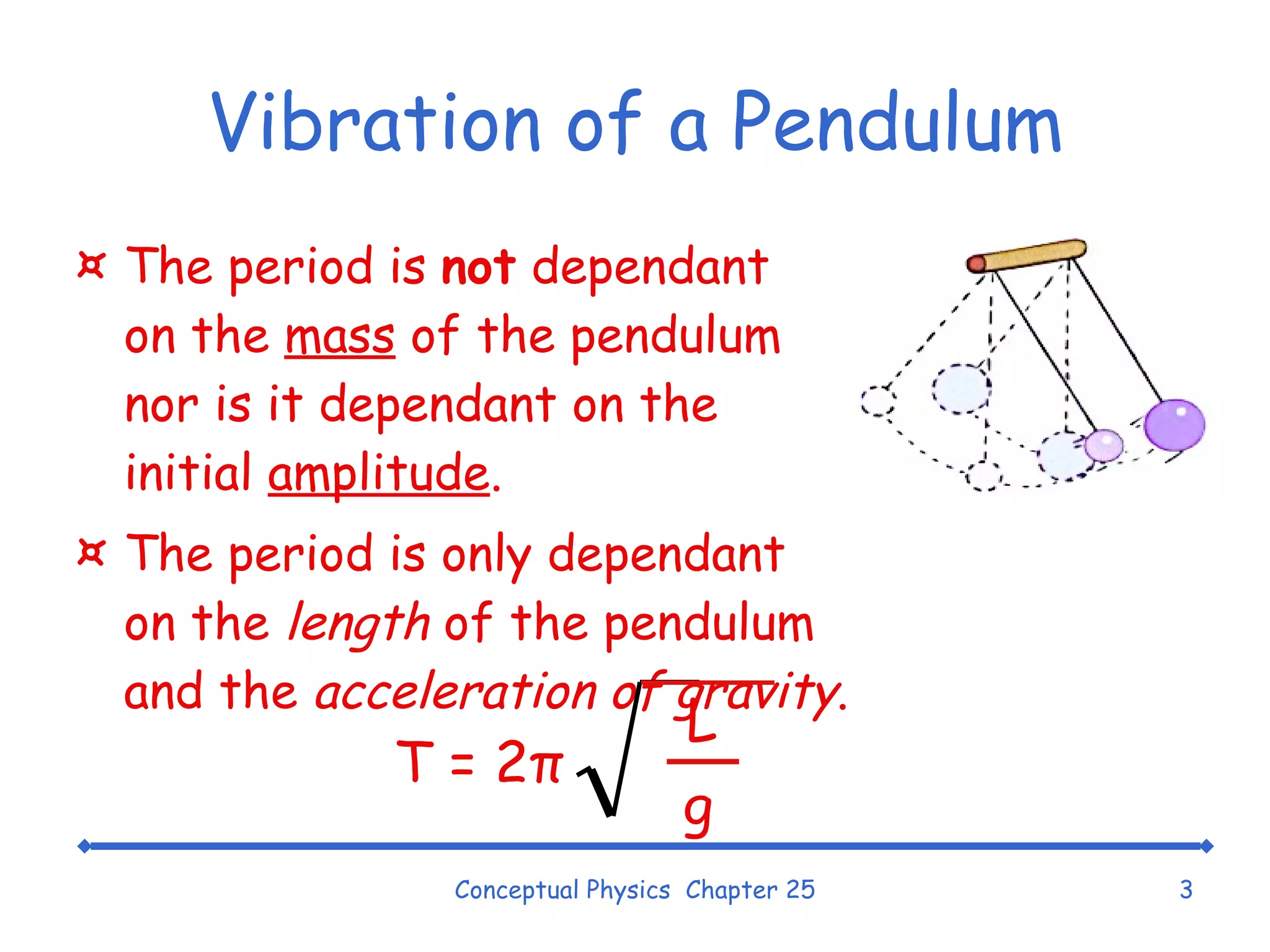
Vibration of a Pendulum The period is  not  dependant on the  mass  of the pendulum nor is it dependant on the initial  amplitude . The period is only dependant  on the  length  of the pendulum  and the  acceleration of gravity . Conceptual Physics  Chapter 25 g L T = 2 π
Question A pendulum completes five back-and-forth cycles in 15 seconds. Conceptual Physics  Chapter 25 What is the period of the pendulum? What is the frequency of the pendulum?
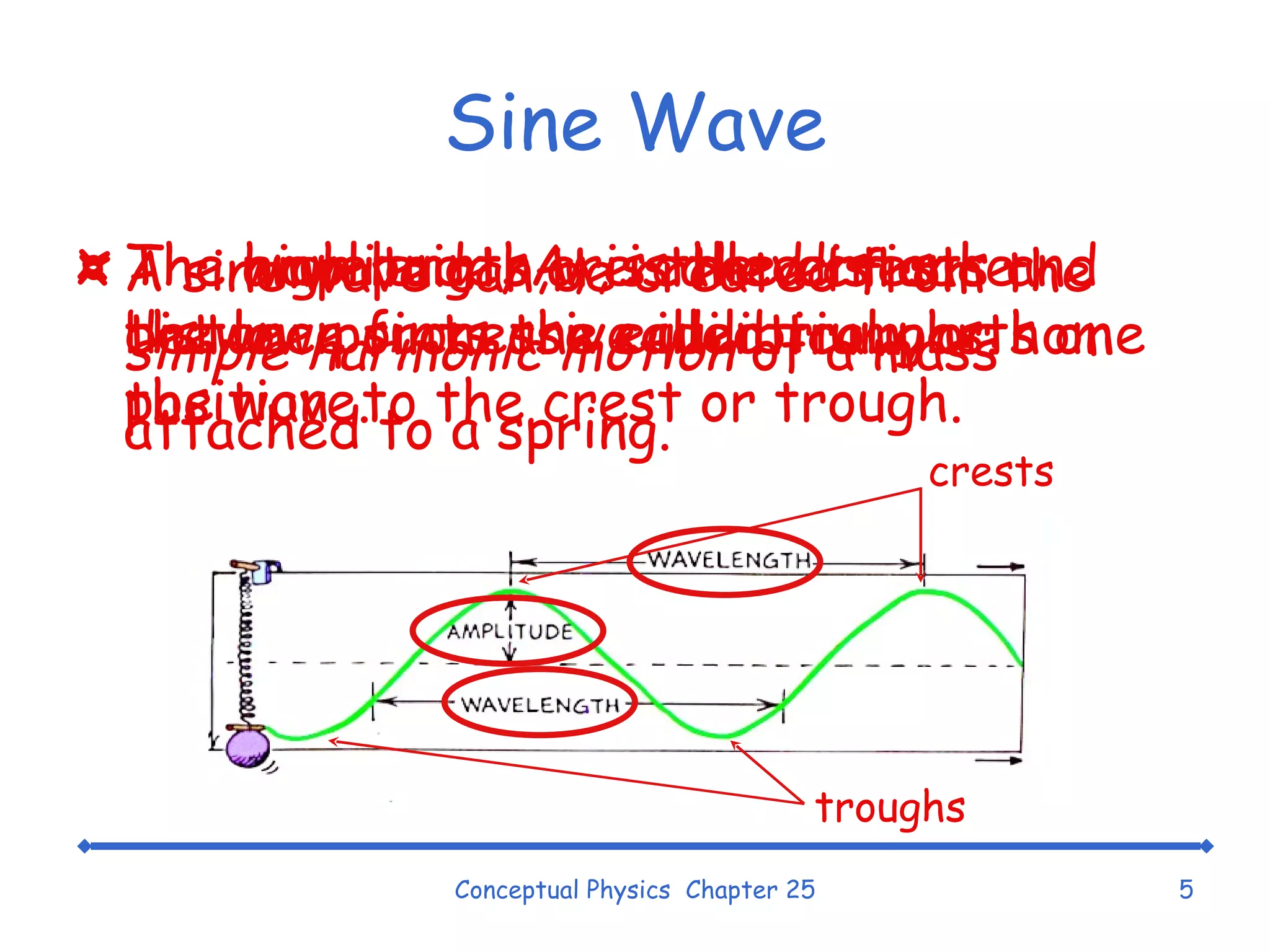
Sine Wave A sine wave can be created from the  simple harmonic motion  of a mass attached to a spring. Conceptual Physics  Chapter 25 The high points are called crests and the low points are called troughs. crests troughs The amplitude, A, is the vertical distance from the equilibrium, or home position, to the crest or trough. The wavelength,  λ , is the distance between successive identical parts on the wave.
Energy Transfer by Waves Waves are a disturbance that travel through a medium. The source of all waves is something that vibrates. The wave carries energy away from the source. The disturbance moves along the medium; the  medium  itself  does not move . The  energy  associated with the wave is dependant on the  amplitude  of the wave. Conceptual Physics  Chapter 25
Classification of Waves All waves can be classified as either  mechanical  waves or  electromagnetic  waves. Mechanical waves rely on a material medium in which to propagate.  E.g., sound waves, water waves, slinky waves. Electromagnetic waves are able to transmit energy through empty space.  E.g., light waves, radio waves, microwaves, X-rays. Our focus in this chapter will be on mechanical waves. Conceptual Physics  Chapter 25
Classification of Waves Another way to classify waves is on the basis of the direction of movement of the individual particles of the medium relative to the direction in which the waves travel. Three notable categories are transverse waves, longitudinal waves and surface waves. Conceptual Physics  Chapter 25
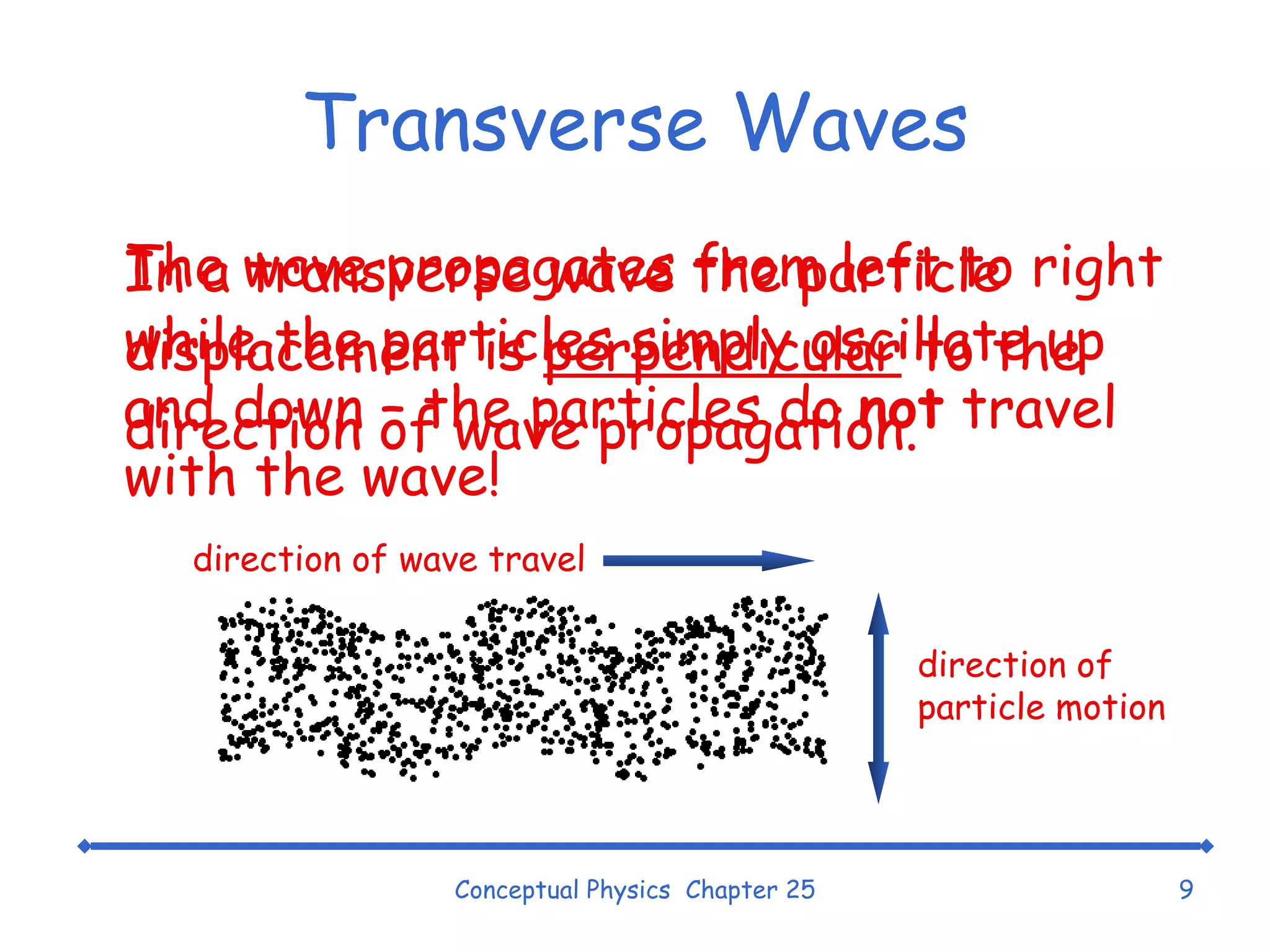
Transverse Waves In a transverse wave the particle displacement is  perpendicular  to the direction of wave propagation.  Conceptual Physics  Chapter 25 direction of wave travel direction of particle motion The wave propagates from left to right while the particles simply oscillate up and down – the particles do  not  travel with the wave!
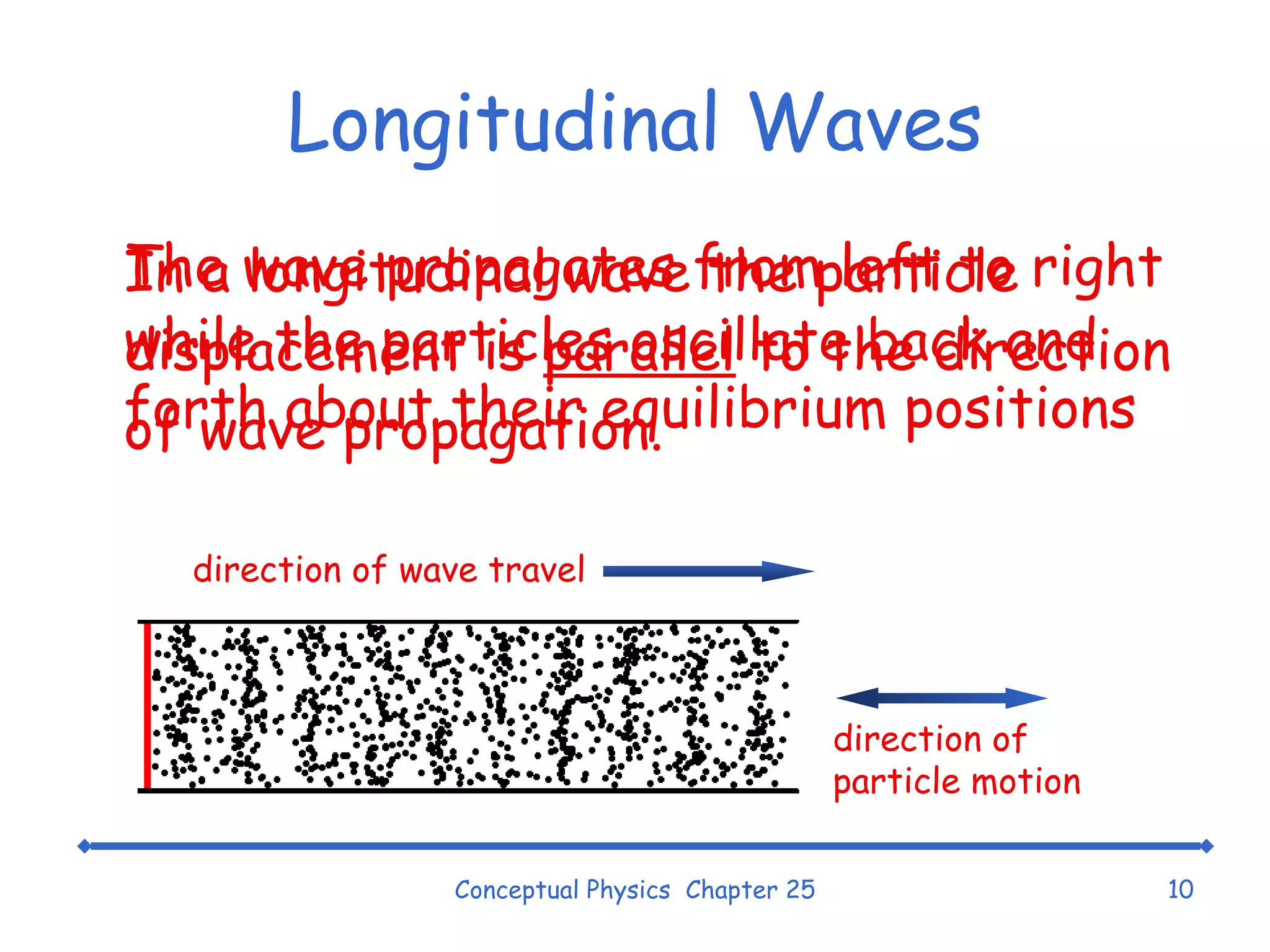
Longitudinal Waves In a longitudinal wave the particle displacement is  parallel  to the direction of wave propagation.  Conceptual Physics  Chapter 25 direction of wave travel direction of particle motion The wave propagates from left to right while the particles oscillate back and forth about their equilibrium positions
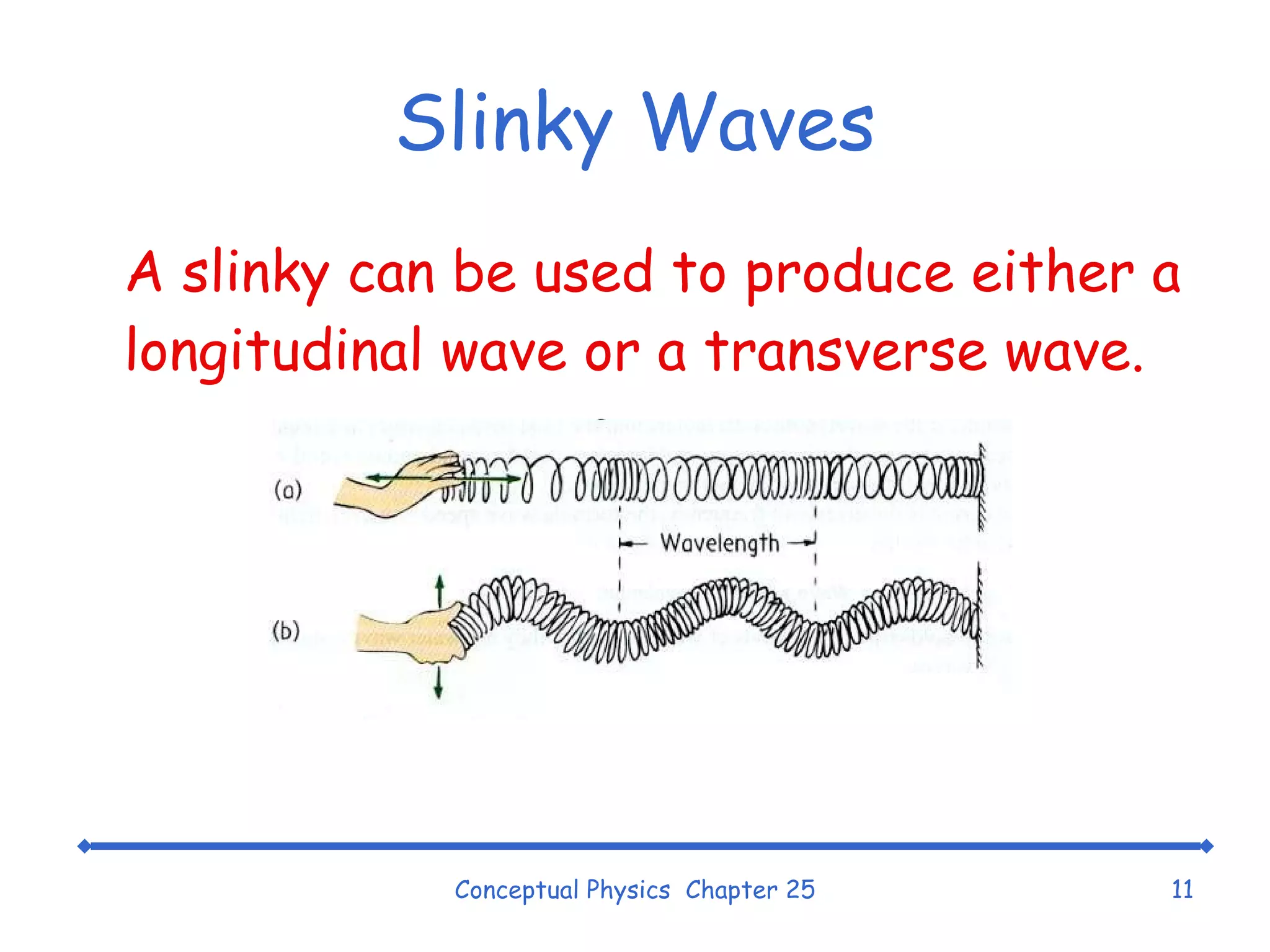
Slinky Waves A slinky can be used to produce either a longitudinal wave or a transverse wave. Conceptual Physics  Chapter 25
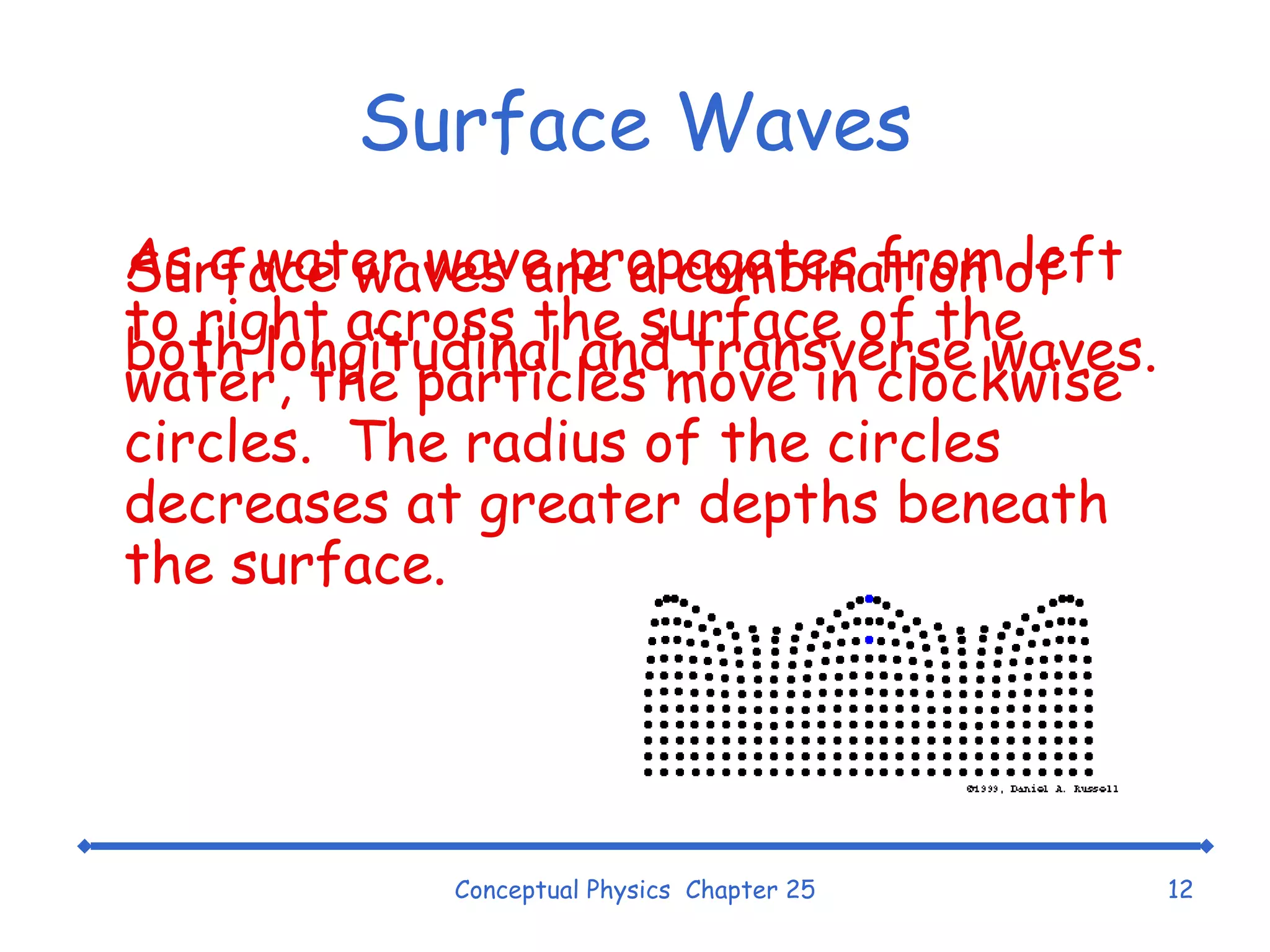
Surface Waves Surface waves are a combination of both longitudinal and transverse waves. Conceptual Physics  Chapter 25 As a water wave propagates from left to right across the surface of the water, the particles move in clockwise circles.  The radius of the circles decreases at greater depths beneath the surface.
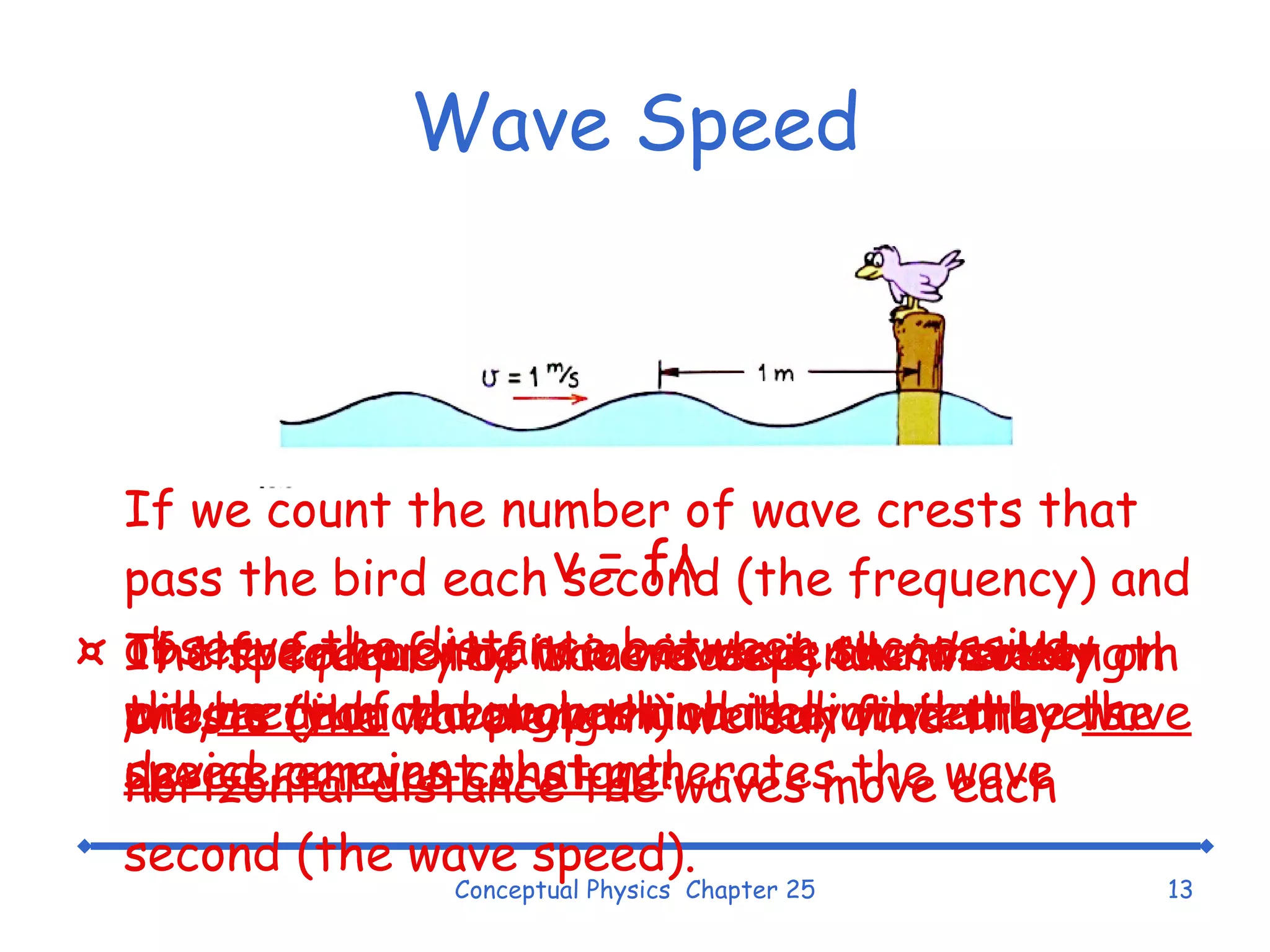
Wave Speed If we count the number of wave crests that pass the bird each second (the frequency) and observe the distance between successive crests (the wavelength) we can find the horizontal distance the waves move each second (the wave speed). Conceptual Physics  Chapter 25 v = f λ The speed of the wave is dependant  solely  on the  medium  through which the wave travels. The frequency of the waves is an  inherent property  of the waves and is dictated by the device or event that generates the wave If the frequency is increased, the wavelength will be reduced proportionately while the  wave speed remains constant !
Interference Unlike matter, multiple waves can occupy the same space at the same time. When waves interact, they generate interference patterns. Within the pattern, wave effects may be increased, decreased or neutralized. Conceptual Physics  Chapter 25
Interference When the waves are  in phase  (crest matches with crest), the waves undergo  constructive  interference and reinforce one another. Conceptual Physics  Chapter 25 When the waves are  out of phase  (crest matches with trough), the waves undergo  destructive  interference and partially or fully cancel one another. Regardless, the interference pattern is temporary.  The waves pass through one another with  no permanent effect  to their amplitude, wavelength, frequency or speed. Run Simulation
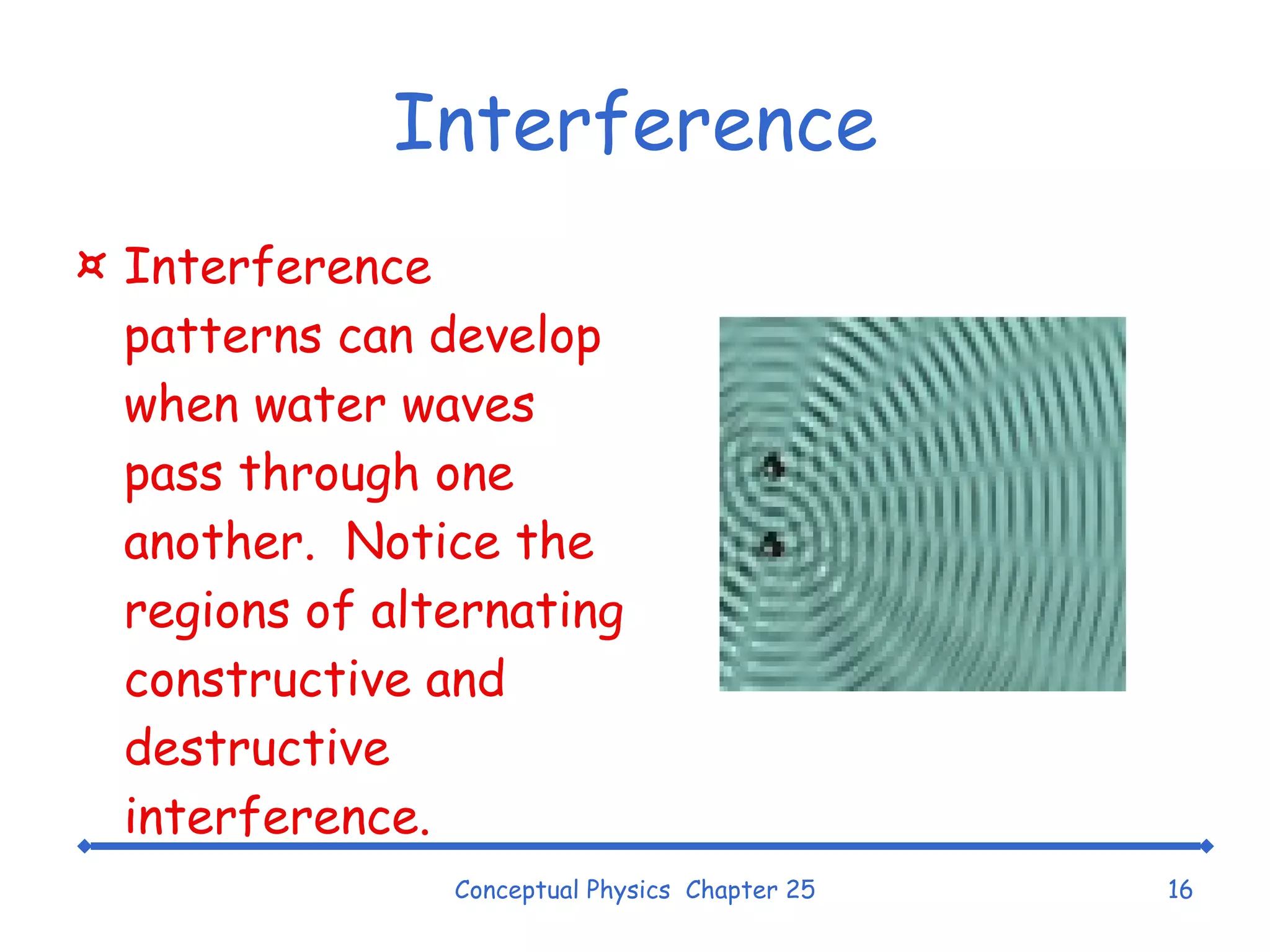
Interference Interference patterns can develop when water waves pass through one another.  Notice the regions of alternating constructive and destructive interference. Conceptual Physics  Chapter 25
Standing Waves A standing wave can be produced as a result of interference between two waves of equal amplitude and wavelength passing through one another. In a standing wave, the  nodes  result from destructive interference.  These nodes remain stationary. The antinodes are points of maximum displacement which result from constructive interference. Nodes are always separated by one-half wavelength. Conceptual Physics  Chapter 25 Run Simulation
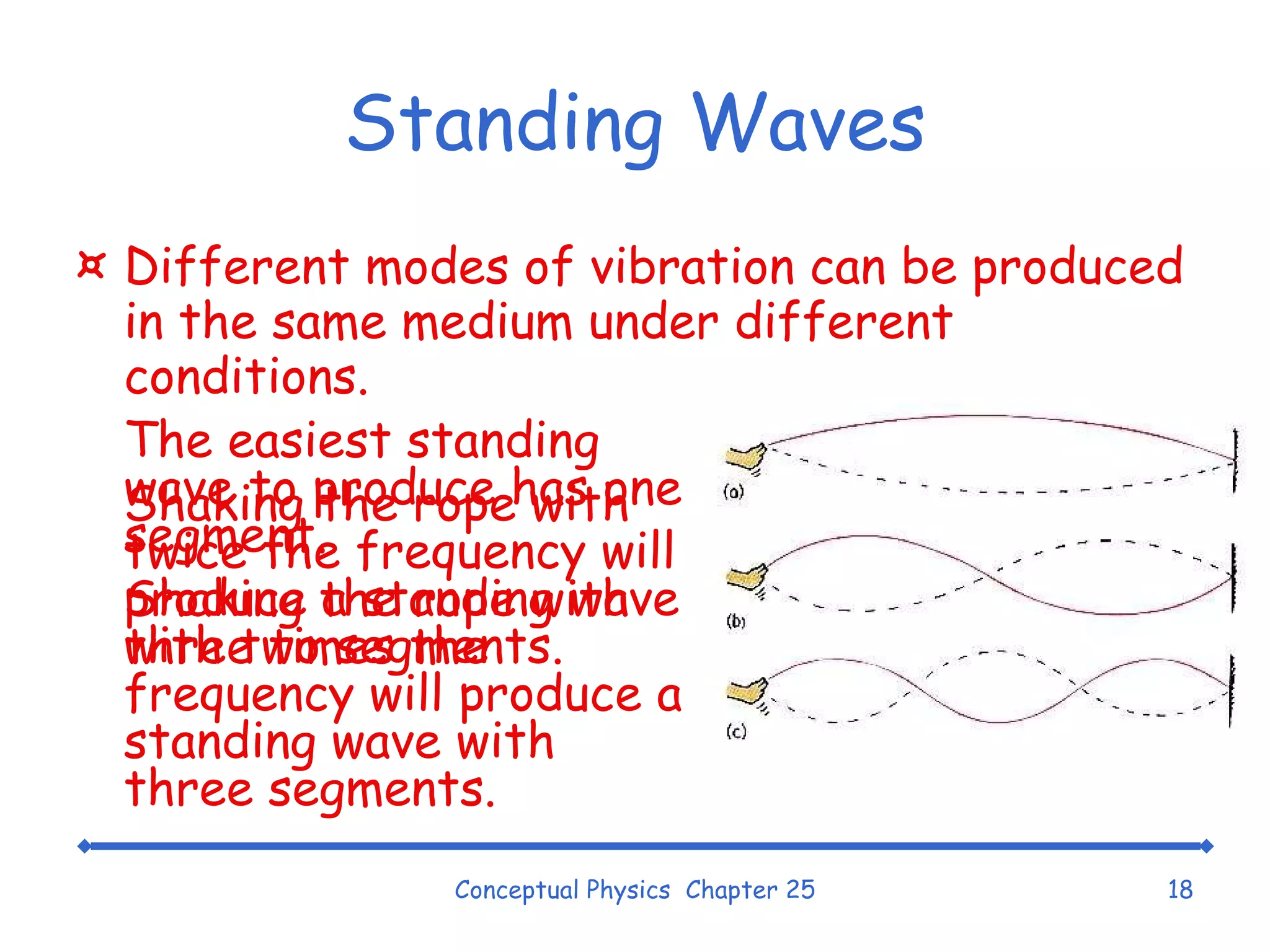
Standing Waves Different modes of vibration can be produced in the same medium under different conditions. Conceptual Physics  Chapter 25 The easiest standing wave to produce has one segment. Shaking the rope with twice the frequency will produce a standing wave with two segments.  Shaking the rope with three times the frequency will produce a standing wave with three segments.
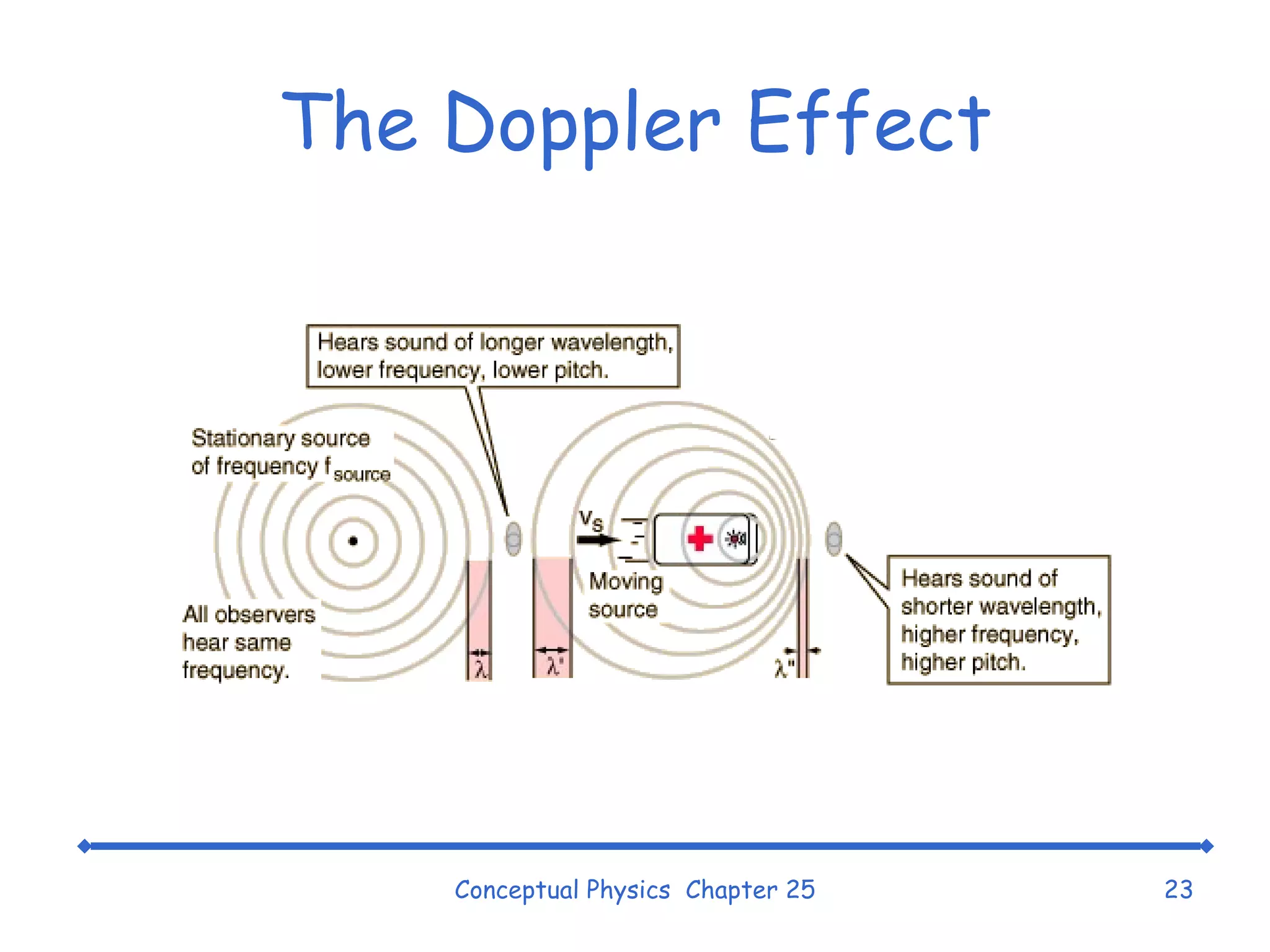
The Doppler Effect The Doppler effect is observed when a wave source is moving relative to the observer of the waves. There is an apparent  upward  shift in frequency for observers towards whom the source is  approaching . There is an apparent  downward  shift in frequency for observers from whom the source is  receding . The Doppler effect can be observed for any type of wave - water wave, sound wave, light wave, etc.  Conceptual Physics  Chapter 25
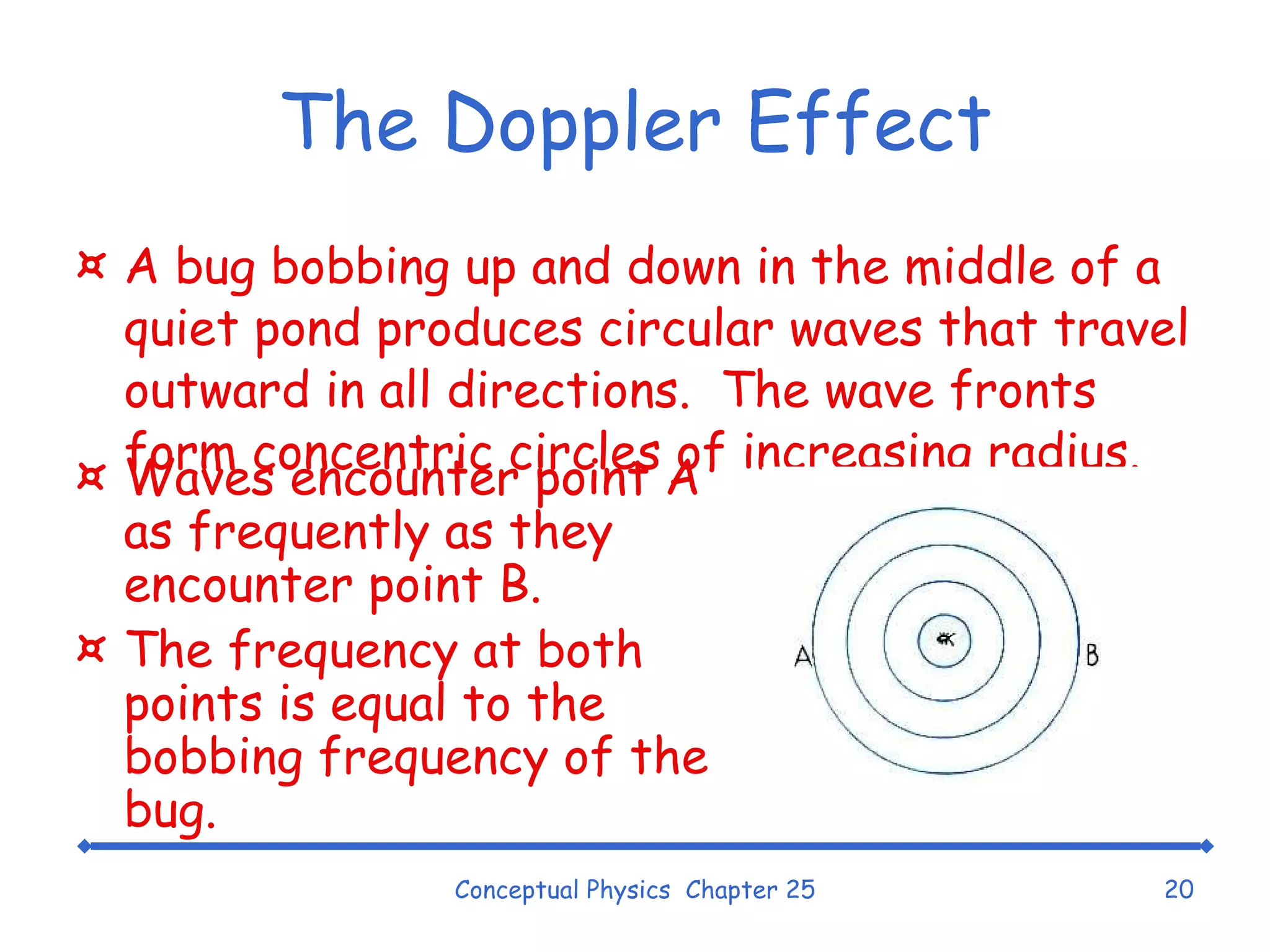
The Doppler Effect A bug bobbing up and down in the middle of a quiet pond produces circular waves that travel outward in all directions.  The wave fronts form concentric circles of increasing radius. Conceptual Physics  Chapter 25 Waves encounter point A as frequently as they encounter point B. The frequency at both points is equal to the bobbing frequency of the bug.
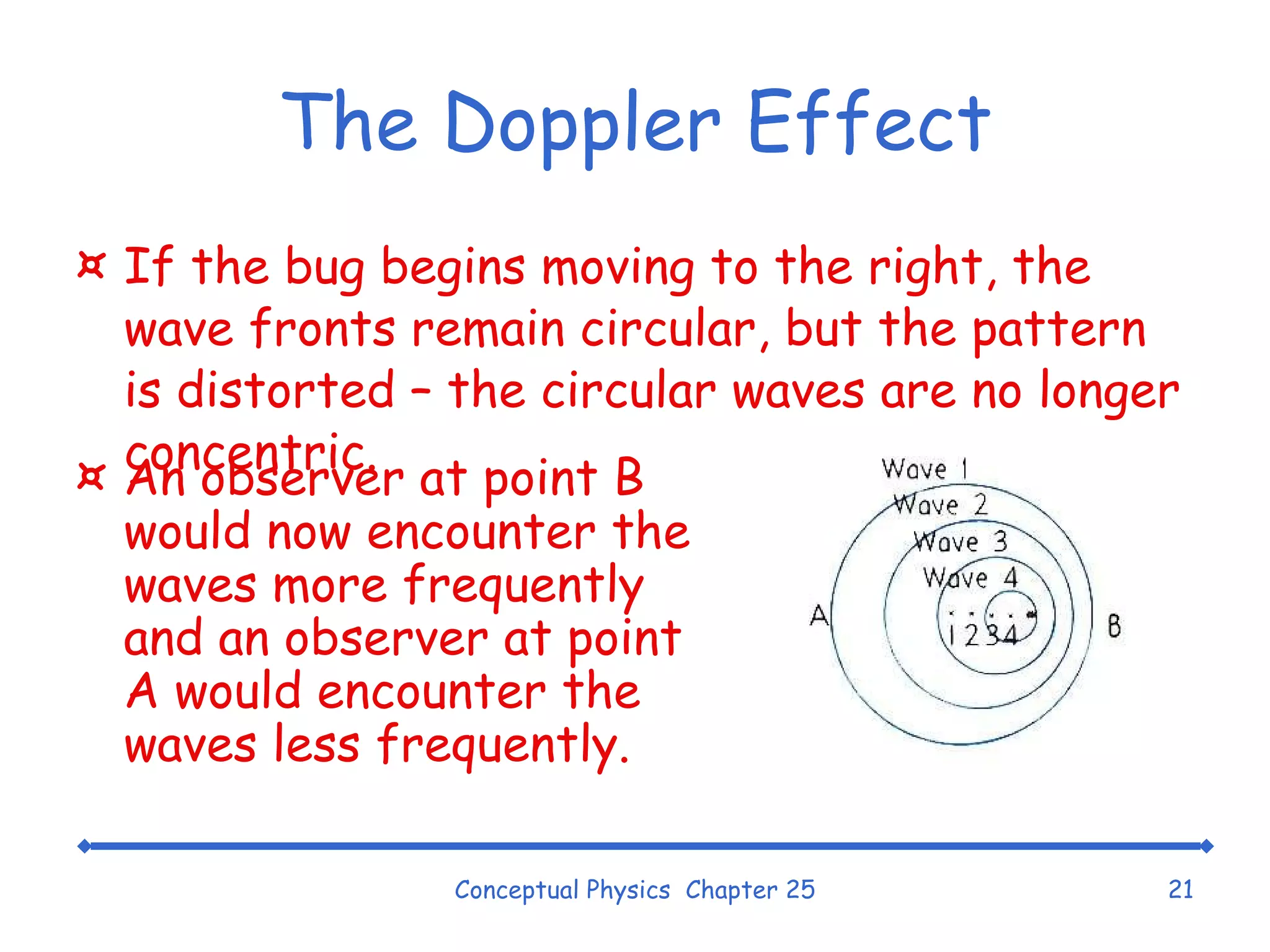
The Doppler Effect If the bug begins moving to the right, the wave fronts remain circular, but the pattern is distorted – the circular waves are no longer concentric. Conceptual Physics  Chapter 25 An observer at point B would now encounter the waves more frequently and an observer at point A would encounter the waves less frequently.
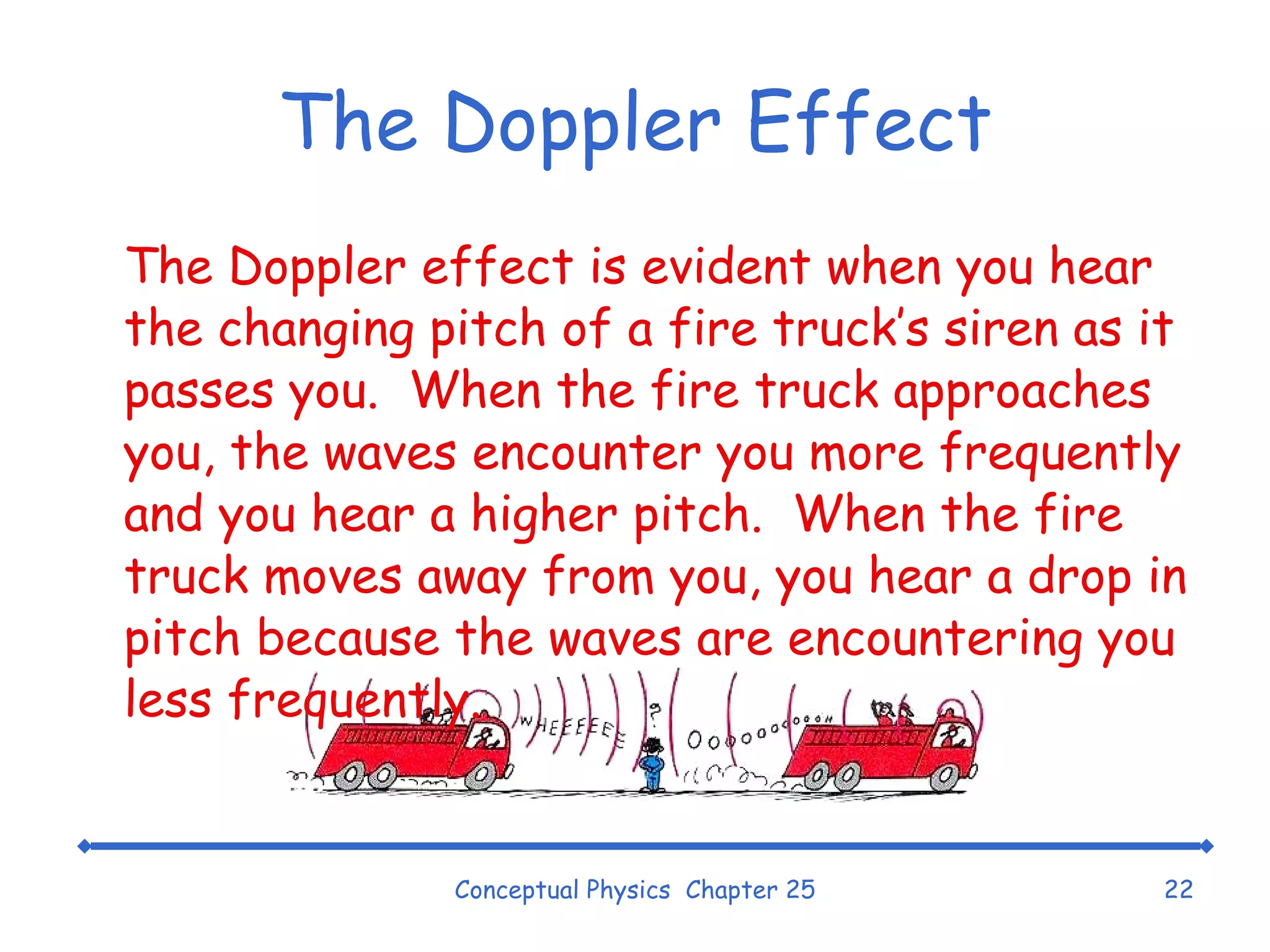
The Doppler Effect The Doppler effect is evident when you hear the changing pitch of a fire truck’s siren as it passes you.  When the fire truck approaches you, the waves encounter you more frequently and you hear a higher pitch.  When the fire truck moves away from you, you hear a drop in pitch because the waves are encountering you less frequently. Conceptual Physics  Chapter 25
The Doppler Effect Conceptual Physics  Chapter 25
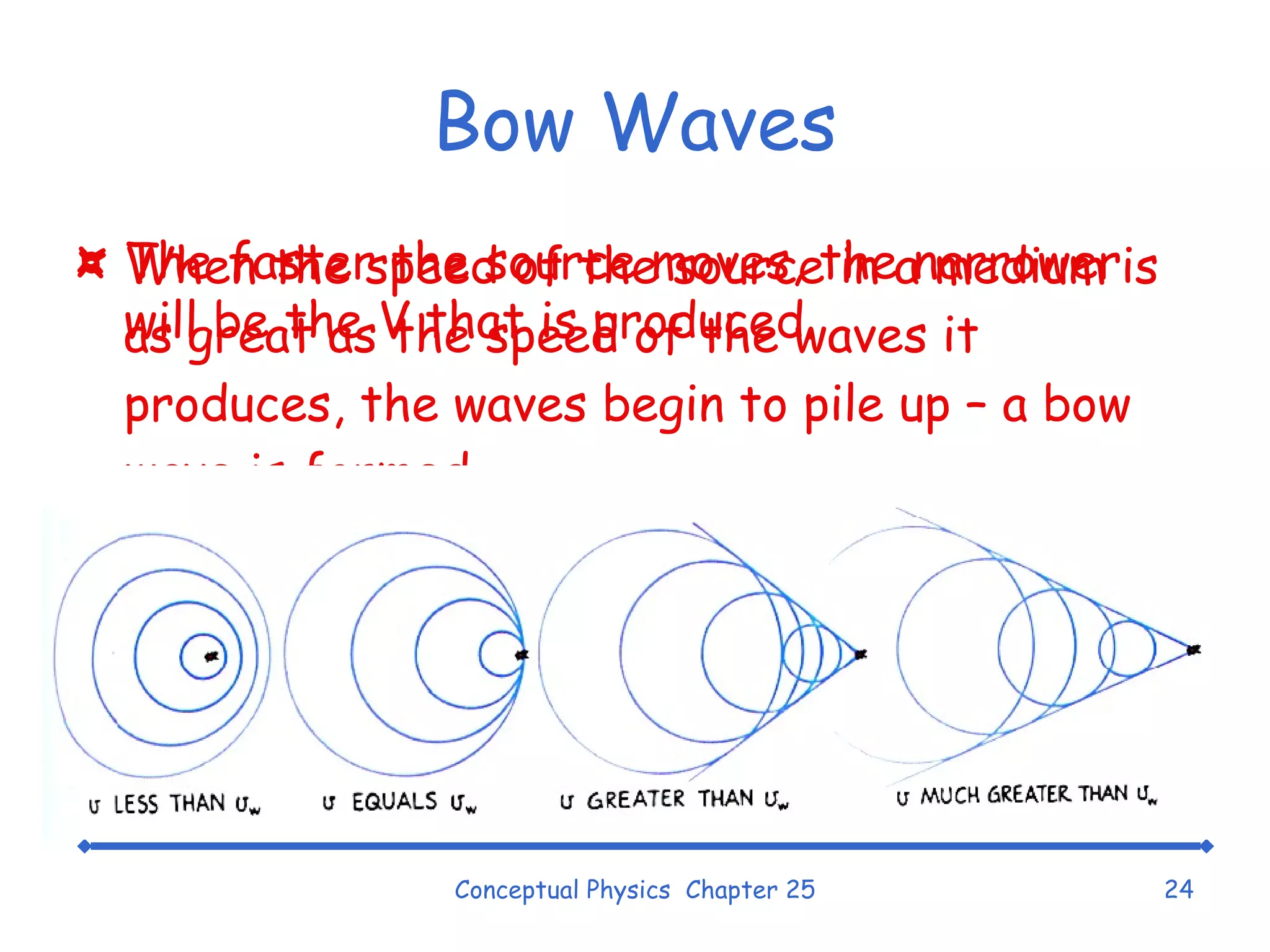
Bow Waves When the speed of the source in a medium is as great as the speed of the waves it produces, the waves begin to pile up – a bow wave is formed. Conceptual Physics  Chapter 25 The faster the source moves, the narrower will be the V that is produced.
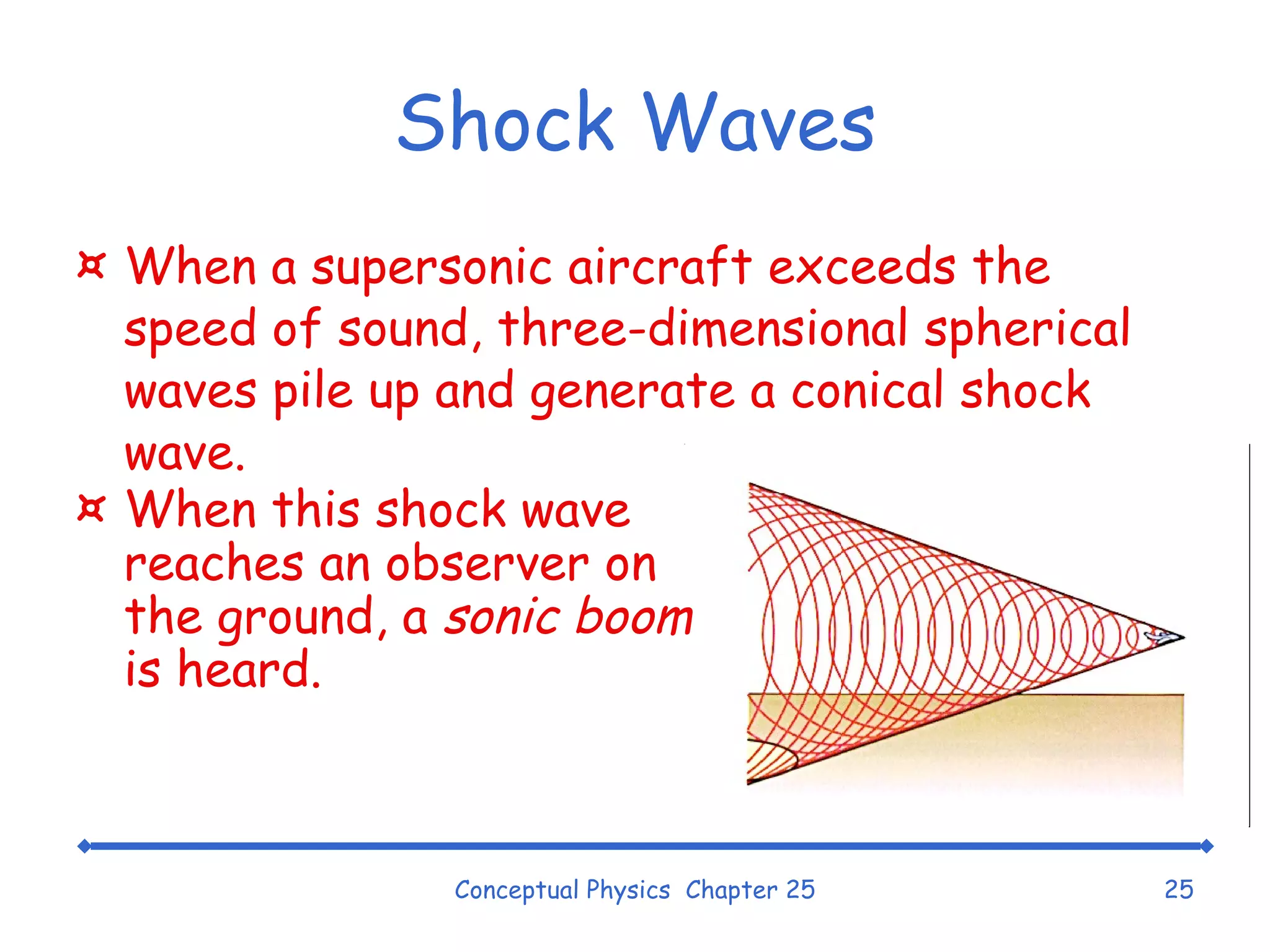
Shock Waves When a supersonic aircraft exceeds the speed of sound, three-dimensional spherical waves pile up and generate a conical shock wave. Conceptual Physics  Chapter 25 When this shock wave reaches an observer on the ground, a  sonic boom  is heard.
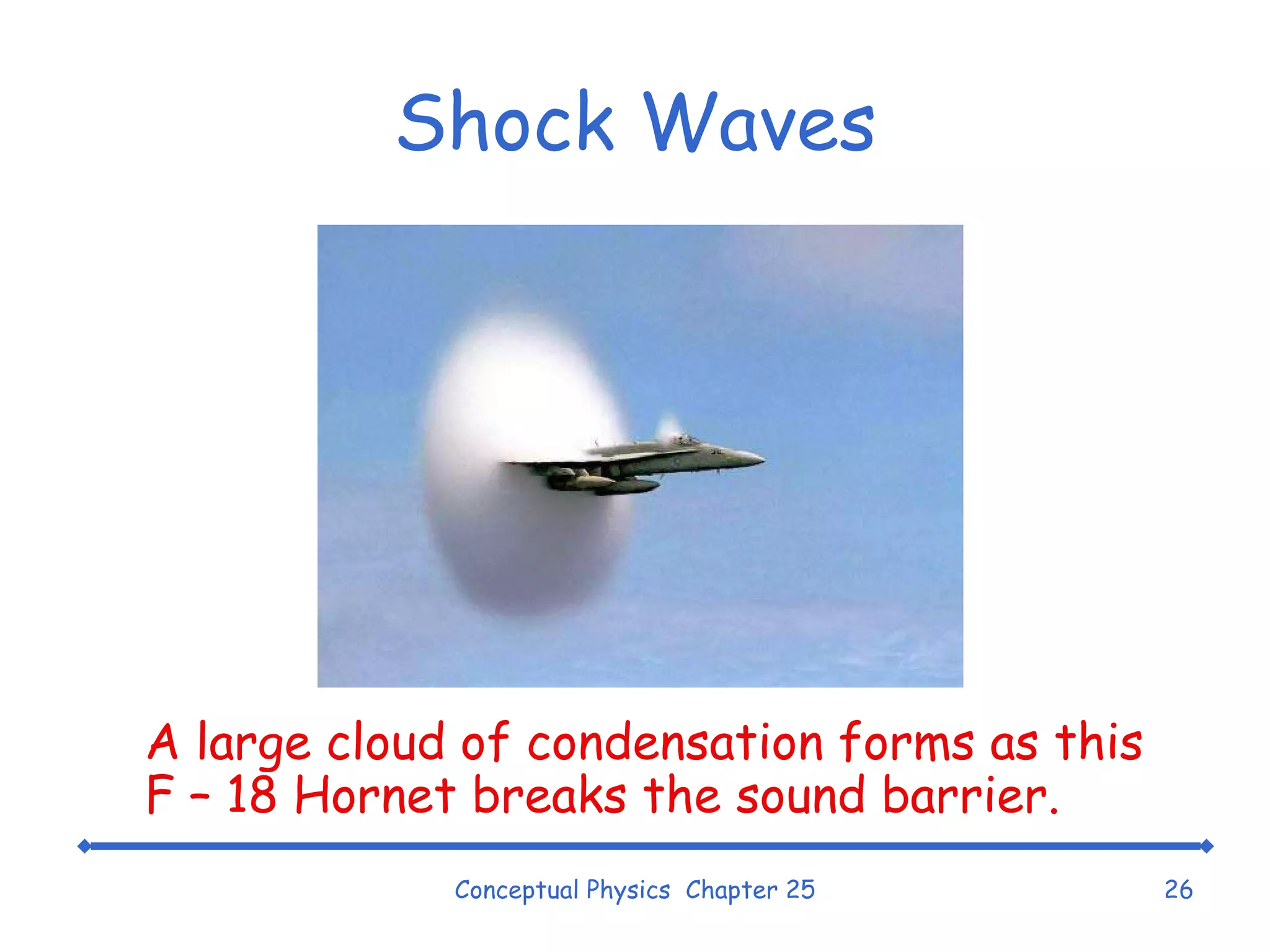
Shock Waves Conceptual Physics  Chapter 25 A large cloud of condensation forms as this F – 18 Hornet breaks the sound barrier.

Chapter 25 waves

  • 1.
    Chapter 25 Waves Conceptual Physics Chapter 25
  • 2.
    Vibration of aPendulum The back-and-forth motion of a pendulum demonstrates a vibration. The time to complete one back-and-forth motion is called the period , T. The period is usually measured in seconds. The frequency , f, is a measure of how often the pendulum swings back and forth and is measured in cycles per second or Hertz (Hz). Conceptual Physics Chapter 25
  • 3.
    Vibration of aPendulum The period is not dependant on the mass of the pendulum nor is it dependant on the initial amplitude . The period is only dependant on the length of the pendulum and the acceleration of gravity . Conceptual Physics Chapter 25 g L T = 2 π
  • 4.
    Question A pendulumcompletes five back-and-forth cycles in 15 seconds. Conceptual Physics Chapter 25 What is the period of the pendulum? What is the frequency of the pendulum?
  • 5.
    Sine Wave Asine wave can be created from the simple harmonic motion of a mass attached to a spring. Conceptual Physics Chapter 25 The high points are called crests and the low points are called troughs. crests troughs The amplitude, A, is the vertical distance from the equilibrium, or home position, to the crest or trough. The wavelength, λ , is the distance between successive identical parts on the wave.
  • 6.
    Energy Transfer byWaves Waves are a disturbance that travel through a medium. The source of all waves is something that vibrates. The wave carries energy away from the source. The disturbance moves along the medium; the medium itself does not move . The energy associated with the wave is dependant on the amplitude of the wave. Conceptual Physics Chapter 25
  • 7.
    Classification of WavesAll waves can be classified as either mechanical waves or electromagnetic waves. Mechanical waves rely on a material medium in which to propagate. E.g., sound waves, water waves, slinky waves. Electromagnetic waves are able to transmit energy through empty space. E.g., light waves, radio waves, microwaves, X-rays. Our focus in this chapter will be on mechanical waves. Conceptual Physics Chapter 25
  • 8.
    Classification of WavesAnother way to classify waves is on the basis of the direction of movement of the individual particles of the medium relative to the direction in which the waves travel. Three notable categories are transverse waves, longitudinal waves and surface waves. Conceptual Physics Chapter 25
  • 9.
    Transverse Waves Ina transverse wave the particle displacement is perpendicular to the direction of wave propagation. Conceptual Physics Chapter 25 direction of wave travel direction of particle motion The wave propagates from left to right while the particles simply oscillate up and down – the particles do not travel with the wave!
  • 10.
    Longitudinal Waves Ina longitudinal wave the particle displacement is parallel to the direction of wave propagation. Conceptual Physics Chapter 25 direction of wave travel direction of particle motion The wave propagates from left to right while the particles oscillate back and forth about their equilibrium positions
  • 11.
    Slinky Waves Aslinky can be used to produce either a longitudinal wave or a transverse wave. Conceptual Physics Chapter 25
  • 12.
    Surface Waves Surfacewaves are a combination of both longitudinal and transverse waves. Conceptual Physics Chapter 25 As a water wave propagates from left to right across the surface of the water, the particles move in clockwise circles. The radius of the circles decreases at greater depths beneath the surface.
  • 13.
    Wave Speed Ifwe count the number of wave crests that pass the bird each second (the frequency) and observe the distance between successive crests (the wavelength) we can find the horizontal distance the waves move each second (the wave speed). Conceptual Physics Chapter 25 v = f λ The speed of the wave is dependant solely on the medium through which the wave travels. The frequency of the waves is an inherent property of the waves and is dictated by the device or event that generates the wave If the frequency is increased, the wavelength will be reduced proportionately while the wave speed remains constant !
  • 14.
    Interference Unlike matter,multiple waves can occupy the same space at the same time. When waves interact, they generate interference patterns. Within the pattern, wave effects may be increased, decreased or neutralized. Conceptual Physics Chapter 25
  • 15.
    Interference When thewaves are in phase (crest matches with crest), the waves undergo constructive interference and reinforce one another. Conceptual Physics Chapter 25 When the waves are out of phase (crest matches with trough), the waves undergo destructive interference and partially or fully cancel one another. Regardless, the interference pattern is temporary. The waves pass through one another with no permanent effect to their amplitude, wavelength, frequency or speed. Run Simulation
  • 16.
    Interference Interference patternscan develop when water waves pass through one another. Notice the regions of alternating constructive and destructive interference. Conceptual Physics Chapter 25
  • 17.
    Standing Waves Astanding wave can be produced as a result of interference between two waves of equal amplitude and wavelength passing through one another. In a standing wave, the nodes result from destructive interference. These nodes remain stationary. The antinodes are points of maximum displacement which result from constructive interference. Nodes are always separated by one-half wavelength. Conceptual Physics Chapter 25 Run Simulation
  • 18.
    Standing Waves Differentmodes of vibration can be produced in the same medium under different conditions. Conceptual Physics Chapter 25 The easiest standing wave to produce has one segment. Shaking the rope with twice the frequency will produce a standing wave with two segments. Shaking the rope with three times the frequency will produce a standing wave with three segments.
  • 19.
    The Doppler EffectThe Doppler effect is observed when a wave source is moving relative to the observer of the waves. There is an apparent upward shift in frequency for observers towards whom the source is approaching . There is an apparent downward shift in frequency for observers from whom the source is receding . The Doppler effect can be observed for any type of wave - water wave, sound wave, light wave, etc. Conceptual Physics Chapter 25
  • 20.
    The Doppler EffectA bug bobbing up and down in the middle of a quiet pond produces circular waves that travel outward in all directions. The wave fronts form concentric circles of increasing radius. Conceptual Physics Chapter 25 Waves encounter point A as frequently as they encounter point B. The frequency at both points is equal to the bobbing frequency of the bug.
  • 21.
    The Doppler EffectIf the bug begins moving to the right, the wave fronts remain circular, but the pattern is distorted – the circular waves are no longer concentric. Conceptual Physics Chapter 25 An observer at point B would now encounter the waves more frequently and an observer at point A would encounter the waves less frequently.
  • 22.
    The Doppler EffectThe Doppler effect is evident when you hear the changing pitch of a fire truck’s siren as it passes you. When the fire truck approaches you, the waves encounter you more frequently and you hear a higher pitch. When the fire truck moves away from you, you hear a drop in pitch because the waves are encountering you less frequently. Conceptual Physics Chapter 25
  • 23.
    The Doppler EffectConceptual Physics Chapter 25
  • 24.
    Bow Waves Whenthe speed of the source in a medium is as great as the speed of the waves it produces, the waves begin to pile up – a bow wave is formed. Conceptual Physics Chapter 25 The faster the source moves, the narrower will be the V that is produced.
  • 25.
    Shock Waves Whena supersonic aircraft exceeds the speed of sound, three-dimensional spherical waves pile up and generate a conical shock wave. Conceptual Physics Chapter 25 When this shock wave reaches an observer on the ground, a sonic boom is heard.
  • 26.
    Shock Waves ConceptualPhysics Chapter 25 A large cloud of condensation forms as this F – 18 Hornet breaks the sound barrier.