Chapter 15 – Sound
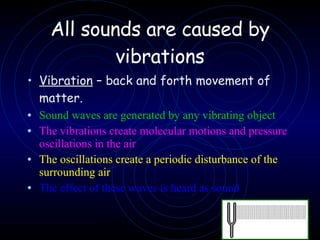
All sounds are caused by vibrations Vibration  – back and forth movement of matter. Sound waves are generated by any vibrating object The vibrations create molecular motions and pressure oscillations in the air The oscillations create a periodic disturbance of the surrounding air The effect of these waves is heard as sound
The human voice comes from vibrations of the vocal cords Air from the lungs is what causes the vocal cords to vibrate The frequency of vibration is controlled by the singer’s muscular tension placed on the cords The human voice uses the throat and mouth cavity as a resonator The Human Voice
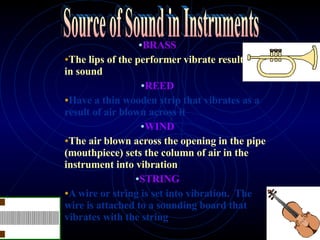
BRASS The lips of the performer vibrate resulting in sound REED Have a thin wooden strip that vibrates as a result of air blown across it WIND The air blown across the opening in the pipe (mouthpiece) sets the column of air in the instrument into vibration   STRING A wire or string is set into vibration.  The wire is attached to a sounding board that vibrates with the string Source of Sound in Instruments
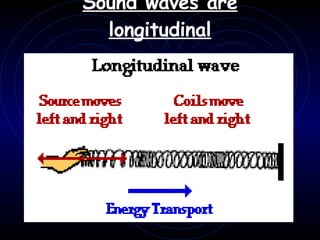
Sound waves are longitudinal  
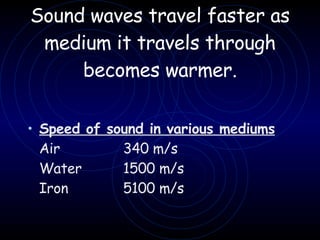
Sound waves travel faster as medium it travels through becomes warmer. Speed of sound in various mediums Air 340 m/s Water 1500 m/s Iron 5100 m/s
Loudness Vs. Intensity Loudness  – perception of the rate at which sound energy enters your ear.   Intensity  – Measurement of amplitude.   Intensity and loudness decreases with distance  
Intensity Decibel  (dB)  Unit of intensity level – compares to lowest possible limit of human hearing Typical intensity levels Breathing 10 dB Whisper  30 dB Loud stereo 90 dB Jet 150 dB  
Sound waves that enter your ear cause the eardrum to vibrate. Intensity levels greater than 90 dB can cause hearing loss. 
Frequency and Pitch   Pitch  – the perception of frequency Humans can detect a wide range of frequencies and  are sensitive to a large range of amplitudes. Humans (hearing) 20-20 000 Hz  Humans (making sounds) 85-1100 Hz Bat 1000 – 120 000 Hz Dog whistle 20 000 – 24 000 Hz   Waves with frequencies greater than 20,000 Hz are called  Ultrasonic.   Waves with frequencies less than 20,000 Hz are called  Subsonic .
Reflection of Sound Waves Echo  – reflected sound wave Follows the Law of Reflection, where the angle of incidence is equal to the angle of reflection. Applications: Sonar  – sound navigation and ranging Ultrasound  – viewing the fetus in the womb.
Diffraction   –  bending of sound waves around barriers (you can hear people in the hallway)  
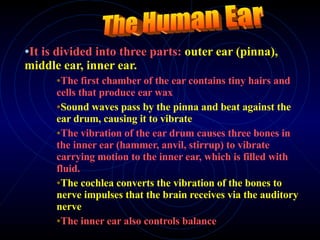
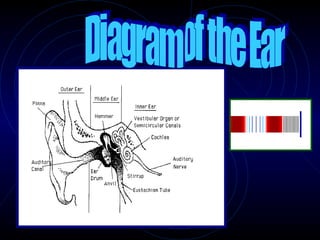
It is divided into three parts:  outer ear (pinna), middle ear, inner ear. The first chamber of the ear contains tiny hairs and cells that produce ear wax Sound waves pass by the pinna and beat against the ear drum, causing it to vibrate The vibration of the ear drum causes three bones in the inner ear (hammer, anvil, stirrup) to vibrate carrying motion to the inner ear, which is filled with fluid. The cochlea converts the vibration of the bones to nerve impulses that the brain receives via the auditory nerve The inner ear also controls balance The Human Ear
Diagram of the Ear
Even though two instruments may be playing the same note, their sounds can differ because each sound contains a number of frequencies with different intensities Timbre :  the quality of a steady musical sound that is the result of a mixture of harmonics present at different intensities Quality of Sound
Music   Shorter strings produce sounds with higher pitch. (higher frequency) Shorter vibrating columns produce higher pitch. (higher frequency) A vibrating surface is responsible for loudness.    
The variation from soft to loud and back to soft is called a beat The number of beats per second corresponds to the difference between frequencies The ability to detect beats depends upon an individual’s hearing and musical training.  The average human ear can distinguish beats up to a frequency of ten beats per second BEAT
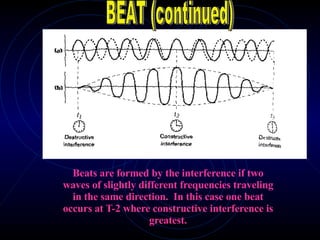
Beats are formed by the interference if two waves of slightly different frequencies traveling in the same direction.  In this case one beat occurs at T-2 where constructive interference is greatest. BEAT (continued)
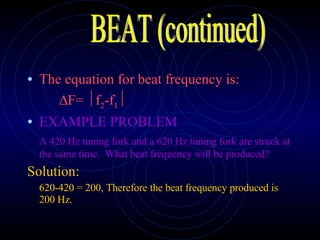
The equation for beat frequency is:  F=  f 2 -f 1  EXAMPLE PROBLEM A 420 Hz tuning fork and a 620 Hz tuning fork are struck at the same time.  What beat frequency will be produced? Solution: 620-420 = 200, Therefore the beat frequency produced is 200 Hz. BEAT (continued)
When two waves differ by more than 7 Hertz, the ear detects a complex wave.  If this resulting sound is: unpleasant- Dissonance pleasant-Consonance Dissonance Vs. Consonance
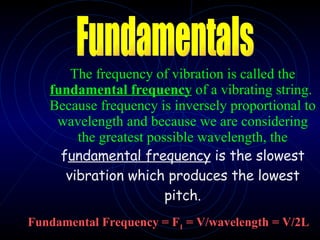
The frequency of vibration is called the  fundamental frequency  of a vibrating string.  Because frequency is inversely proportional to wavelength and because we are considering the greatest possible wavelength, the  f undamental frequency  is the slowest vibration which produces the lowest pitch. Fundamental Frequency = F 1  = V/wavelength = V/2L Fundamentals
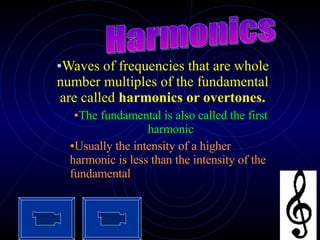
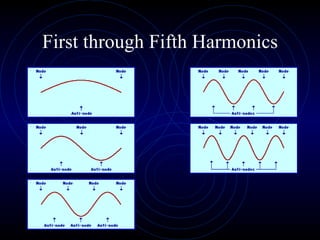
Waves of frequencies that are whole number multiples of the fundamental are called  harmonics or overtones. The fundamental is also called the first harmonic Usually the intensity of a higher harmonic is less than the intensity of the fundamental Harmonics
First through Fifth Harmonics
Consists of a large number of frequencies with no relationship to each other White noise occurs when all frequencies are present in equal amplitudes. The human voice uses the throat and mouth cavity as a resonator The quality of the tone depends on the shape of the resonator NOISE
Acoustics   –  study of how materials influence the production and movement of sound  
Http://peace.saumag.edu/faculty/kardas/courses/GPWeiten/c4sandP/Ear.jpg www.vistahearing,com/how-ear-works.html http://library.thinkquest.org/19537/inter.html www.infoplease.com/ce5/CE048722.html Works Cited
the end

Sound

  • 1.
  • 2.
    All sounds arecaused by vibrations Vibration – back and forth movement of matter. Sound waves are generated by any vibrating object The vibrations create molecular motions and pressure oscillations in the air The oscillations create a periodic disturbance of the surrounding air The effect of these waves is heard as sound
  • 3.
    The human voicecomes from vibrations of the vocal cords Air from the lungs is what causes the vocal cords to vibrate The frequency of vibration is controlled by the singer’s muscular tension placed on the cords The human voice uses the throat and mouth cavity as a resonator The Human Voice
  • 4.
    BRASS The lipsof the performer vibrate resulting in sound REED Have a thin wooden strip that vibrates as a result of air blown across it WIND The air blown across the opening in the pipe (mouthpiece) sets the column of air in the instrument into vibration STRING A wire or string is set into vibration. The wire is attached to a sounding board that vibrates with the string Source of Sound in Instruments
  • 5.
    Sound waves arelongitudinal  
  • 6.
    Sound waves travelfaster as medium it travels through becomes warmer. Speed of sound in various mediums Air 340 m/s Water 1500 m/s Iron 5100 m/s
  • 7.
    Loudness Vs. IntensityLoudness – perception of the rate at which sound energy enters your ear.   Intensity – Measurement of amplitude.   Intensity and loudness decreases with distance  
  • 8.
    Intensity Decibel (dB) Unit of intensity level – compares to lowest possible limit of human hearing Typical intensity levels Breathing 10 dB Whisper 30 dB Loud stereo 90 dB Jet 150 dB  
  • 9.
    Sound waves thatenter your ear cause the eardrum to vibrate. Intensity levels greater than 90 dB can cause hearing loss. 
  • 10.
    Frequency and Pitch  Pitch – the perception of frequency Humans can detect a wide range of frequencies and are sensitive to a large range of amplitudes. Humans (hearing) 20-20 000 Hz Humans (making sounds) 85-1100 Hz Bat 1000 – 120 000 Hz Dog whistle 20 000 – 24 000 Hz   Waves with frequencies greater than 20,000 Hz are called Ultrasonic.   Waves with frequencies less than 20,000 Hz are called Subsonic .
  • 11.
    Reflection of SoundWaves Echo – reflected sound wave Follows the Law of Reflection, where the angle of incidence is equal to the angle of reflection. Applications: Sonar – sound navigation and ranging Ultrasound – viewing the fetus in the womb.
  • 12.
    Diffraction – bending of sound waves around barriers (you can hear people in the hallway)  
  • 13.
    It is dividedinto three parts: outer ear (pinna), middle ear, inner ear. The first chamber of the ear contains tiny hairs and cells that produce ear wax Sound waves pass by the pinna and beat against the ear drum, causing it to vibrate The vibration of the ear drum causes three bones in the inner ear (hammer, anvil, stirrup) to vibrate carrying motion to the inner ear, which is filled with fluid. The cochlea converts the vibration of the bones to nerve impulses that the brain receives via the auditory nerve The inner ear also controls balance The Human Ear
  • 14.
  • 15.
    Even though twoinstruments may be playing the same note, their sounds can differ because each sound contains a number of frequencies with different intensities Timbre : the quality of a steady musical sound that is the result of a mixture of harmonics present at different intensities Quality of Sound
  • 16.
    Music   Shorterstrings produce sounds with higher pitch. (higher frequency) Shorter vibrating columns produce higher pitch. (higher frequency) A vibrating surface is responsible for loudness.    
  • 17.
    The variation fromsoft to loud and back to soft is called a beat The number of beats per second corresponds to the difference between frequencies The ability to detect beats depends upon an individual’s hearing and musical training. The average human ear can distinguish beats up to a frequency of ten beats per second BEAT
  • 18.
    Beats are formedby the interference if two waves of slightly different frequencies traveling in the same direction. In this case one beat occurs at T-2 where constructive interference is greatest. BEAT (continued)
  • 19.
    The equation forbeat frequency is:  F=  f 2 -f 1  EXAMPLE PROBLEM A 420 Hz tuning fork and a 620 Hz tuning fork are struck at the same time. What beat frequency will be produced? Solution: 620-420 = 200, Therefore the beat frequency produced is 200 Hz. BEAT (continued)
  • 20.
    When two wavesdiffer by more than 7 Hertz, the ear detects a complex wave. If this resulting sound is: unpleasant- Dissonance pleasant-Consonance Dissonance Vs. Consonance
  • 21.
    The frequency ofvibration is called the fundamental frequency of a vibrating string. Because frequency is inversely proportional to wavelength and because we are considering the greatest possible wavelength, the f undamental frequency is the slowest vibration which produces the lowest pitch. Fundamental Frequency = F 1 = V/wavelength = V/2L Fundamentals
  • 22.
    Waves of frequenciesthat are whole number multiples of the fundamental are called harmonics or overtones. The fundamental is also called the first harmonic Usually the intensity of a higher harmonic is less than the intensity of the fundamental Harmonics
  • 23.
  • 24.
    Consists of alarge number of frequencies with no relationship to each other White noise occurs when all frequencies are present in equal amplitudes. The human voice uses the throat and mouth cavity as a resonator The quality of the tone depends on the shape of the resonator NOISE
  • 25.
    Acoustics – study of how materials influence the production and movement of sound  
  • 26.
  • 27.