 Location:
 related posteriorly to C3‐C6 vertebral bodies
 in adult, ends at lower border of C6
 Moves vertically and anteroposteriorly during swallowing and
phonation
 Can be moved passively from side to side producing laryngeal
crepitus.
 3 unpaired and 3 paired cartilages
 Unpaired: Thyroid, cricoid and epiglottis
 Paired: Arytenoid, corniculate and cuneiform
 Extrinsic membrane
 Thyrohyoid membrane – pierced by superior laryngeal nerve &
internal laryngeal nerve
 Cricothyroid membrane
 Cricotracheal membrane
 Intrinsic membrane
 Cricovocal membrane
 Quadrangular membrane
 The boundary is formed by the:
 superior border of the epiglottis
 aryepiglottic folds
 cuneiform tubercles
 corniculate tubercles
 interarytenoid notch
interaryten
oid notch
 Laryngeal cavity extends
from laryngeal inlet to the
inferior border of cricoid
cartilage.
 3 compartments:
 Laryngeal vestibule
 Laryngeal ventricle
 Infraglottic cavity
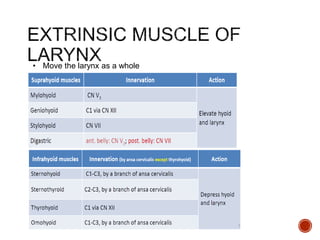
• Move the larynx as a whole
 Move the laryngeal parts – change the length and tension of the
vocal folds & size and shape of the rima glottides.
 Arterial supply:
 Superior and inferior laryngeal aa. (from sup. & inf. thyroid aa.)
 Venous drainage:
 Superior and inferior laryngeal veins
 Lymphatic drainage:
 Superior to VF – superior deep cervical l/n
 Inferior to VF – inferior deep cervical l/n
 Protection of lower airway
 Sphincteric closure of laryngeal opening ( laryngeal inlet, false cord
and true cord )
 Cessation of breathing
 Cough reflex
 Phonation
 Respiration
 Fixation of the chest
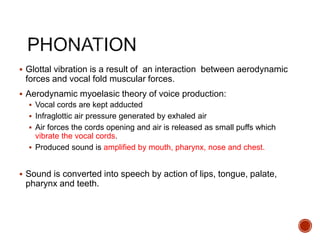
 Glottal vibration is a result of an interaction between aerodynamic
forces and vocal fold muscular forces.
 Aerodynamic myoelasic theory of voice production:
 Vocal cords are kept adducted
 Infraglottic air pressure generated by exhaled air
 Air forces the cords opening and air is released as small puffs which
vibrate the vocal cords.
 Produced sound is amplified by mouth, pharynx, nose and chest.
 Sound is converted into speech by action of lips, tongue, palate,
pharynx and teeth.
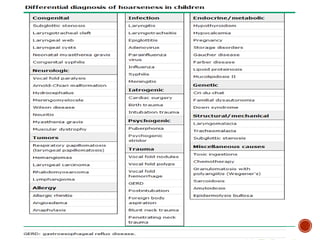
 Hoarseness is defined as roughness of voice resulting from variations
of periodicity and/or intensity of consecutive sound waves.
 For production of normal voice, vocal cords should:
Be able to approximate properly with each other.
Have a proper size and stiffness.
Have an ability to vibrate regularly in response to air column.
 Any condition that interferes with the above functions causes
hoarseness.
Loss of approximation may be seen in vocal cord paralysis or fixation
or a tumour coming in between the vocal cords.
Size of the cord may increase in oedema of the cord or a tumour;
there is a decrease in partial surgical excision or fibrosis.
Stiffness may decrease in paralysis, increase in spastic dysphonia or
fibrosis.
 Cords may not be able to vibrate properly in the presence of
congestion, submucosal haemorrhages, nodule or a polyp.
 Aetiology
The infectious type is more common and usually follows upper
respiratory infection.
To begin with, it is viral in origin but soon bacterial invasion takes
place with Strept. pneumoniae, H. influenzae and haemolytic
streptococci or Staph. aureus. Exanthematous fevers like measles,
chickenpox and whooping cough are also associated with laryngitis
The non-infectious type is due to vocal abuse, allergy, thermal or
chemical burns to larynx due to inhalation or ingestion of various
substances, or laryngeal trauma such as endotracheal intubation.
 Clinical Features
 Symptoms are usually abrupt in onset and consist of:
Hoarseness which may lead to complete loss of voice.
Discomfort or pain in throat, particularly after talking.
Dry, irritating cough which is usually worse at night.
General symptoms of head, cold, rawness or dryness of throat,
malaise and fever if laryngitis has followed viral infection of upper
respiratory tract.
 Laryngeal appearances vary with severity of disease.
 In early stages, there is erythema and oedema of epiglottis,
aryepiglottic folds, arytenoids and ventricular bands, but the vocal
cords appear white and near normal and stand out in contrast to
surrounding mucosa.
 Later, hyperaemia and swelling increase. Vocal cords also become
red and swollen. Subglottic region also gets involved.
 Sticky secretions are seen between the cords and interarytenoid
region.
 In case of vocal abuse, submucosal haemorrhages may be seen in
the vocal cords.
 Treatment
Vocal rest. This is the most important single factor. Use of voice
during acute laryngitis may lead to incomplete or delayed recovery.
Avoidance of smoking and alcohol.
Steam inhalations with oil of eucalyptus or pine are soothing and
loosen viscid secretions.
Cough sedative. To suppress troublesome irritating cough.
Antibiotics. When there is secondary infection with fever and
toxaemia or purulent expectoration.
Analgesics. To relieve local pain and discomfort.
Steroids. Useful in laryngitis following thermal or chemical burns,
 It is an inflammatory condition of the larynx, trachea and bronchi
 Aetiology
Mostly, it is viral infection (parainfluenza type I and II) affecting
children between 6 months to 3 years of age.
Male children are more often affected.
Secondary bacterial infection by Gram positive cocci soon
supervenes.
 Pathology
The loose areolar tissue in the subglottic region swells up and causes
respiratory obstruction and stridor.
This, coupled with thick tenacious secretions and crusts, may
completely occlude the airway.
 Symptom
Disease starts as upper respiratory infection with hoarseness and
croupy cough.
There is fever of 39-40C.
This may be followed by difficulty in breathing and inspiratory type of
stridor.
Respiratory difficulty may gradually increase with signs of upper
airway obstruction, i.e.suprasternal and intercostal recession.
 Treatment
Hospitalisation is often essential because of the increasing difficulty in
breathing.
Antibiotics like ampicillin 50 mg/kg/day in divided doses is effective
against secondary infections due to gram-positive cocci and
H.influenzae.
Humidification helps to soften crusts and tenacious secretions which
block tracheobronchial tree.
Parenteral fluids are essential to combat dehydration.
Steroids, e.g. hydrocortisone 100mg i.v. may be useful to relieve
oedema.
Adrenaline racemic adrenaline administered via a respirator is a
bronchodilator and may relieve dyspnoea and avert tracheostomy.
Intubation/tracheostomy is done, should respiratory obstruction
increase in spite of the above measures.
Tracheostomy is done if intubation is required beyond 72 hours.
Assisted ventilation may be required.
LARYNGEAL DIPHTHERIA
 Aetiology
Mostly, it is secondary to faucial diphtheria affecting
children below 10 years of age.
Incidence of diphtheria in general is declining due to wide-
spread use of immunisation .
 Pathology
 Effects of laryngeal diphtheria are due to:
Formation of a tough pseudomembrane over the larynx and
trachea which may completely obstruct the airway.
Exotoxin liberated by bacteria leading to myocarditis and
various neurological complications.
 Clinical Features
General symptoms. Onset is insidious with low grade fever,
sore throat and malaise but patient is very toxaemic with
tachycardia and thready pulse.
Laryngeal symptoms. Hoarse voice, croupy cough, inspiratory
stridor, increasing dyspnoea with marked upper airway
obstruction.
Greyish white membrane is seen on the tonsil, pharynx and
soft palate. It is adherent and its removal leaves a bleeding
surface . Similar membrane is seen over the larynx and
trachea.
Cervical lymphadenopathy. Characteristic "bull-neck” may be
seen.
 Diagnosis
Laryngeal diphtheria is mostly secondary to faucial diphtheria.
Diagnosis is always clinical but confirmed by smear and culture of
corynebacterium diphtheriae.
 Treatment is started on clinical suspicion.
Diphtheria antitoxin. Dose depends on clinical severity and duration of
illness, and varies from 20,000 to 100,000 units i. v. route as saline
infusion after a test dose. It neutralises free toxin circulating in the
blood.
 Antibacterials. Benzylpenicillin, 500,000 units i.m. every 6 h ours for 6
days, is effective against diphtheria bacilli. Erythromycin can be given
to those who are allergic to penicillin.
Maintenance of airway. Tracheostomy may become essential. Direct
laryngoscopy, removal of diphtheritic membrane and intubation can
be done. Intubation relieves respiratory obstruction and can make
subsequent tracheostomy easy.
Complete bed rest. Complete bed rest for 2-4 weeks is essential to
guard against effects of myocarditis
 Complications
Asphyxia and death due to airway obstruction.
Toxic myocarditis and Circulatory failure.
Palatal paralysis with nasal regurgitation.
Laryngeal and pharyngeal paralysis.
CHRONIC LARYNGITIS
A. CHRONIC LARYNGITIS WITHOUT
HYPERPLASIA
(CHRONIC HYPERAEMIC LARYNGITIS)
 It is a diffuse inflammatory condition symmetrically involving the
whole larynx, i.e. true cords, ventricular bands, interarytenoid
region and root of the epiglottis.
 Aetiology
It may follow incompletely resolved acute simple laryngitis or its
recurrent attacks.
Presence of chronic infection in paranasal sinuses, teeth and
tonsils and the chest are important contributory causes.
Occupational factors, e.g. exposure to dust and fumes such as in
miners, and workers in chemical industry
Smoking and alcohol.
Persistent trauma of cough as in chronic lung disease
Vocal abuse.
 Clinical features
Hoarseness. This is the commonest complain. Voice becomes
easily tired and patient becomes aphonic by the end of the day.
Constant hawking. There is dryness and intermittent tickling in
the throat and patient is compelled to clear the throat
repeatedly.
Discomfort in the throat.
Cough. It is dry and irritating.
Laryngeal examination. There is hyperaemia of laryngeal
structures. Vocal cords appear dull red and rounded. Flecks of
viscid mucus are seen on the vocal cords and interarytenoid
region.
 Treatment
Eliminate infection of upper or lower respiratory tract. Infection in the
sinuses, tonsils, teeth or chronic chest infection (bronchitis,
bronchiectasis, tuberculosis, etc.) should be treated.
Avoidance of irritating factors, e.g. smoking, alcohol or polluted
environment, dust and fumes.
Voice rest and speech therapy. Voice rest has to be prolonged for
weeks or months. Patient should receive training in proper use of
voice.
Steam inhalations. They help to loosen secretions and give relief.
Expectorants. They help to loosen viscid secretions and give relief
from hawking.
B. CHRONIC HYPERTROPHIC
LARYNGITIS
(SYN. CHRONIC HYPERPLASTIC
LARYNGITIS) It may be either a diffuse and symmetrical process or a localised one, the
latter appearing like a tumour of the larynx. Localised variety presents as
dysphonia plica ventricularis, vocal nodules, vocal polyp, Reinke's oedema
and contact ulcer
 Aetiology
Same as discussed under chronic laryngitis without hyperplasia.
 Pathology
Pathological changes start in the glottic region and later may extend to
ventricular bands, base of epiglottis and even subglottis.
Mucosa, submucosa, mucous glands and in later stages intrinsic laryngeal
muscles and joints may be affected.
Initially, there is hyperaemia, oedema and cellular infiltration in the
submucosa.
The pseudostratified ciliated epithelium of respiratory mucosa changes to
squamous type, and squamous epithelium of the vocal cords to hyperplasia
and keratinisation.
The mucous gland suffers hypertrophy at first but later undergo atrophy with
diminished secretion and dryness of larynx.
 Clinical features
This disease mostly affects males (8: 1) in the of 30-50 years.
Hoarseness, constant desire to clear the cough, tiredness of voice,
dry cough and discomfort in throat when the voice has been used for
an extended period of time are the common presenting symptoms.
 Examination. On examination, changes are diffuse and symmetrical.
Laryngeal mucosa, in general, is dusky red and thickened.
Vocal cords appear red and swollen. Their edges lose sharp
demarcation and appear rounded. In late stages, cords become bulky
and irregular giving nodular appearance.
Ventricular bands appear red and swollen and may be mistaken for
prolapse or eversion of the ventricle
Mobility of cords gets impaired due to oedema and infiltration, and
later due to muscular atrophy or arthritis of the cricoarytenoid joint.
Treatment
Conservative. Same as for chronic laryngitis
without hyperplasia.
Surgical. Stripping of vocal cords, removing the
hyperplastic and oedematous mucosa, may be
done in selected cases. Damage to underlying
vocal ligament should be carefully avoided. One
cord is operated at a time.
 It is bilateral symmetrical swelling of the whole of membranous part of
the vocal cords, most often seen in middle-aged men and women.
This is due to oedema of the subepithelial space (Reinke's space) of
the vocal cords.
 Chronic irritation of vocal cords due to misuse of voice, heavy
smoking, chronic sinusitis and laryngopharyngeal reflex are the
probable aetiological factors. It can also occur in myxoedema.
 Clinical Features
Hoarseness is the common symptom. Patient uses false
cords for voice production and this gives him a low
pitched and rough voice.
On indirect laryngoscopy, vocal cords appear as fusiform
swellings with pale translucent look. Ventricular bands
may appear hyperaemic and hypertrophic and may hide
the view of the true cords.
 Treatment
Decortication of the vocal cords, i.e. removal of strip of
epithelium, is done first on one side and 3-4 weeks later
on the other.
Voice rest.
Speech therapy for proper voice production.
 PACHYDERMIA LARYNGIS
 It is a form of chronic hypertrophic laryngitis affecting posterior part of
larynx in the region of interarytenoid and posterior part of the vocal cords.
 Clinically, patient presents with hoarseness or husky voice and irritation
in the throat.
 Indirect laryngoscopy reveals heaping up of red or grey granulation
tissues in the interarytenoid region and posterior thirds of vocal cords; the
latter some times showing ulceration due to constant hammering of vocal
processes as in talking, forming what is called the 'contact ulcer'.
 The condition is bilateral and symmetrical.
 It does not undergo malignant change.
 However, biopsy of the lesion is essential to differentiate the lesion from
carcinoma and tuberculosis.
 Aetiology is uncertain. It is mostly seen in men who indulge in excessive
alcohol and smoking. Other factors are excessive forceful talking and
gastro-oesophageal reflux disease where posterior part of larynx is being
constantly bathed with acid juices from the stomach.
 Treatment is removal of granulation tissue under operating microscope
which may require repetition, control of acid reflux and speech therapy.
 ATROPHIC LARYNGITIS(LARYNGITIS SICCA)
 It is characterised by atrophy of laryngeal mucosa and crust
formation. Condition is often seen in women and is associated with
atrophic rhinitis and pharyngitis.
 Common symptoms include hoarseness of voice which temporarily
improves on coughing and removal of crusts.
 Dry irritating cough and sometimes dyspnoea is due to obstructing
crusts .
 Examination shows atrophic mucosa covered with foul smelling
crusts.
 When crusts have been expelled, mucosa may show excoriation and
bleeding. Crusting may also be seen in the trachea.
 Treatment is elimination of the causative factor and humidification.
Laryngeal sprays with glucose in glycerine or oil of pine are
comforting and help to loosen the crusts. Associated nasal and
pharyngeal conditions will require attention. Expectorants containing
ammonium chloride or iodides also help to loosen the crusts.
BENIGN LESION OF
LARYNX
Non-neoplastic Neoplastic
Solid :
-Vocal nodules
-Vocal polyps
-Contact ulcer
-Intubation granuloma
-Leukoplakia
-Amyloid tumors
-Reinke’s oedema
Cystic :
-Ductal cyst
-Saccular cyst
-Laryngocoele
Squamos papilloma:
-Juvenile type
-Adult-onset type
Chondroma
Hemangioma
Granular cell tumor
Glandular tumor
Rhabdomyosarcoma
Lipoma
Fibroma
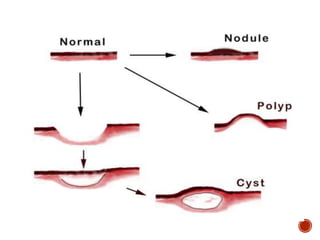
Vocal cord nodule Vocal cord polyp
- Growth of epithelium that covers the
mucosa membrane.
- Polyp growth at vocal cord.
- Callous thickening of vocal cord
lining over time.
- Blistering of vocal cord lining.
- Occurs due to vocal abuse or vocal
misuse.
-Occurs due to :
i) Vocal abuse
ii) Chronic laryngeal allergic reaction
iii) Chronic inhalation of irritants
(industrial fumes & cigarette
smoke)
- The size is smaller, harder and
callous-like growth.
- The size is larger, appear swelling or
bump, stalk-like growth or blister-like
lesion.
- Bilateral of vocal cord. - Mostly unilateral but can be bilateral
of vocal cord.
 Medical therapy:
 - Treat the primary cause (smoking, GERD, hypothyroid).
 - Voice rest, voice therapy (hygiene, reducing vocal abusive
behavior, alter pitch etc).
 Surgical therapy:
 - To remove if the mass is large or have existed for long time (>6
months & didn’t improve with voice therapy).
Etiology
• human papilloma virus (HPV) types 6, 11
 infected during childbirth passage through the cervix or from oral-
genital sexual activities.
Epidemiology
often referred to as recurrent respiratory papillomatosis (RRP)
because of their propensity to recur after surgical removal.
• biphasic distribution
- birth to puberty (juvenile RRP)
- adult onset (20-40 y/o)
COLUMNAR SQUAMOUS
JUNCTION
SINGLE PAPILLOMA MULTIPLE PAPILLOMA
 Postulated to be vertically transmitted during the process of
childbirth.
 Almost all papillomas in the throat are caused by
HPV subtypes [HPV- 6, HPV-11, HPV-16 & HPV-18]. These same
subtypes that appear in the cervix.
 Researchers believe that the throat can be infected during
childbirth passage through the cervix or from oral-genital sexual
activities.
Signs and symptoms of Juvenile RRP :
 Symptomatic after age 6 months.
 Stridor.
 Worsening of the airway obstructive features as the papilloma grows.
Other clinical presentations include cough, pneumonias, and dysphagia.
 Hoarseness without airway obstruction may indicate the small lesion.
 Aphonia or breathy voice  larger glottic lesion.
 A low-pitched, coarse, fluttering voice  subglottic lesion.
 Extra notes :
 Signs of severe airway obstruction include tachypnea, stridor, retractions
(suprasternal, substernal, intracostal), flaring of the nasal ala, and use of
accessory neck or chest muscles.
 Children are often misdiagnosed with asthma, croup, allergies, vocal
nodules, or bronchitis. Recurrent respiratory papillomatosis (RRP) is
misdiagnosed because of its rarity and the slowly progressive nature of
the disease.
 Factors:
 i)Oroanal or orogenital contact is considered a possible mode of virus
transmission.
ii)a latent virus becoming active.
 more localized, single, smaller in size, less aggressive and can recur
after surgical removal but not as aggressive as juvenile.
 common in males in age group of 30-50 years
 Usually arises from anterior half of the vocal cord or anterior
commissure.
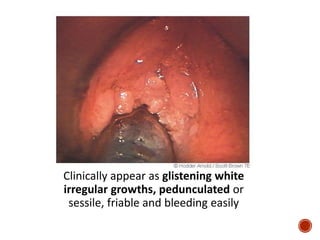
Clinically appear as glistening white
irregular growths, pedunculated or
sessile, friable and bleeding easily
 Medical treatments:
 Acyclovir - To treat herpes virus infection.
 Interferon (IFN)- The produced enzymes block viral replication of RNA
and DNA, thus making less susceptible to viral penetration & prevent
recurrence.
 Surgical treatments:
 Carbon dioxide laser
 Surgical microdebrider - The surgical microdebrider has recently been
used for laryngeal and tracheal papillomas.
MALIGNANT
LESION OF
LARYNX
Laryngeal
Carcinoma
Undifferentiated
carcinoma
Miscellaneous
carcinomas
Adenocarcinoma
Sarcomas
Squamous cell
carcinoma
(85-95%)
Carcinoma in situ
Verrucous, spindle
cell and basaloid
SCC
Risk factors:
- Prolong use of tobacco and alcohol
- Men : female = 2 : 1, increase in women who smoke
- Secondhand smoker
- Laryngeal papillomatosis due to infection with human papilloma virus subtypes 16
& 18.
- Previous radiation to neck for benign lesions or laryngeal papilloma.
- Chronic gastroesophageal reflux (GERD).
- Genetic factors.
- Occupational exposure to asbestos, mustard gas and other chemical or petroleum
products.
Squamous Cell Carcinoma
• Glottic - 59%, involves the true
vocal folds
• Supraglottic - 40%, confined to the
supraglottic area (free border of the
laryngeal epiglottis, false vocal
folds and laryngeal ventricles)
• Subglottic - 1%, extend or arise
more than 10mm below the free
margin of the true vocal fold up to
the inferior border of the cricoid
cartilage.
Supraglottic Tumor Glottic Tumor
Supraglottic tumors may not alter
laryngeal function until they reach
a relatively large size, at which time
airway obstruction may be the
first symptom.
Glottic tumors alter voice quality
early in their development and are
thus often discovered at an early
stage.
The mechanism of swallowing is altered when tumors invade and alter the
physiology of the swallowing muscles. This may lead to either dysphagia
or aspiration.
• hoarseness – progressive & continuous
• stridor
• sore throat
• ear pain
• airway compromise
• aspiration
• persistent cough
Indirect laryngoscopy :
• friable fungating ulcerative masses
• changes in the mucosal color
•multiple areas of central necrosis and exudate surrounding areas of
hyperemia
•
 1) Radiotherapy – Reserved for early lesion.
 2) Surgical treatments :
 Transoral laser microsurgery
 Open partial laryngectomy
 Total laryngectomy
Neurological lesion of
larynx
 It can be unilateral or
bilateral
 Involved:
1. Recurrent laryngeal nerve
2. Superior laryngeal nerve
3. Both (combined or complete
paralysis)
 Surgical iatrogenic injuries - thyroid surgery, anterior cervical disc
surgery, carotid surgery, or chest surgery.
 Malignant invasion of either the vagus or recurrent laryngeal
nerve -skull base tumors, thyroid cancer, lung cancer, esophageal
cancer, and metastases to the mediastinum (often observed with lung
cancer primaries)
 Blunt trauma to the neck or chest.
 Idiopathic -When a clear-cut etiology for the unilateral vocal fold
paralysis (UVFP) is not found, it is classified as.
 Supranuclear: Rare
 Nuclear: involvement of nucleus ambiguus in medulla, usually
associated with other lower cranial nerve paralysis
 High vagal lesions: may be involved at the level of jugular foramen
or parapharyngeal space
 Low vagal trunk or RLN
 Idiopathic: in about 30% of cases
Right Left Both
-Neck trauma
-Benign or malignant
thyroid disease
-Thyroid surgery
-Carcinoma cervical
oesophagus
-Aneurysm of subclavian
artery
-Carcinoma apex right lung
-Tuberculosis of cervical
pleura
-Idiopathic
i) Neck
- Accidental trauma
- Thyroid disease
- Thyroid surgery
- Carcinoma cervical
oesophagus
- Cervical
lymphadenopathy
ii) Mediastinum
- Bronchogenic cancer
- Carcinoma aortic
oesophagus
- Aortic aneurysm
- Mediastinal
lymphadenopathy
- Enlarged neck auricle
- Intrathoracic surgery
- Idiopathic
-Thyroid surgery
-Carcinoma thyroid
-Cancer cervical esophagus
-Cervical lymphadenopathy
•occurs from a dysfunction of the recurrent laryngeal or vagus nerve
- results in ipsilateral paralysis of all intrinsic muscles except cricothyroid
•Vocal cord assumes a median or paramedian position and does not move
laterally on deep inspiration
glottal incompetence
weak or absent
vocal fold vibration
Dysphonia
Dysphagia (liquids)
significant air wasting
sensation of
shortness of breath
and running out of
air during speech
Weak cough
Clinical Features
• Significant muscle tension is often seen in the larynx as a compensatory
mechanism for the glottal gap – patient complaint of pain in the throat after
voice use.
aspiration
• 1/3 of patients asymptomatic
 Medical therapy:
- muscle-nerve transplant
- medialization thyroplasty (moving the paralyzed
vocal cord toward midline)
- injection of a substance to increase the size of the
paralyzed vocal cord
 Voice therapy - pitch alteration
- increase breath support and
loudness
- find the correct position for optimal
voicing
TREATMENTS
 Surgical therapy :
 i) Temporary treatment involves endoscopic injection of a resorbable
material into the affected vocal fold. (Cymetra, hyaluronic acid,
gelfoam)
 ii) Permanent vocal fold surgical treatment can be divided into
vocal fold injection (permanent materials ie fat, fascia, or the
semipermanent calcium hydroxylapatite) and laryngeal framework
surgery.
Preoperatively, the arrow
demonstrates the paralyzed
vocal fold, which is
characteristically foreshortened,
lateralized, and flaccid.
Postoperatively, the image
shows the same vocal fold
following laryngeal framework
surgery. The left vocal fold is
now midline and has improved
length.
 Congenital anomalies of the larynx that cause hoarseness :
 1) Laryngeal webs,
 2) Laryngeal clefts,
 3) Laryngeal cysts
 Caused by failure of resorption of the epithelial layer that
obliterates the laryngeal opening in normal development 
results in incomplete separation of the vocal folds.
 Laryngeal webs also can result from trauma to the airway (eg,
because of intubation, traumatic injury, or prior surgical
manipulation.
 Diagnosis :
 - modified barium swallow
 - laryngopharyngoscopy
Embryologic failure of fusion of the cricoid
cartilage and tracheoesophageal septum.
THANK YOU

Hoarseness year-4

  • 2.
     Location:  relatedposteriorly to C3‐C6 vertebral bodies  in adult, ends at lower border of C6  Moves vertically and anteroposteriorly during swallowing and phonation  Can be moved passively from side to side producing laryngeal crepitus.
  • 3.
     3 unpairedand 3 paired cartilages  Unpaired: Thyroid, cricoid and epiglottis  Paired: Arytenoid, corniculate and cuneiform
  • 6.
     Extrinsic membrane Thyrohyoid membrane – pierced by superior laryngeal nerve & internal laryngeal nerve  Cricothyroid membrane  Cricotracheal membrane  Intrinsic membrane  Cricovocal membrane  Quadrangular membrane
  • 11.
     The boundaryis formed by the:  superior border of the epiglottis  aryepiglottic folds  cuneiform tubercles  corniculate tubercles  interarytenoid notch interaryten oid notch
  • 12.
     Laryngeal cavityextends from laryngeal inlet to the inferior border of cricoid cartilage.  3 compartments:  Laryngeal vestibule  Laryngeal ventricle  Infraglottic cavity
  • 13.
    • Move thelarynx as a whole
  • 14.
     Move thelaryngeal parts – change the length and tension of the vocal folds & size and shape of the rima glottides.
  • 15.
     Arterial supply: Superior and inferior laryngeal aa. (from sup. & inf. thyroid aa.)  Venous drainage:  Superior and inferior laryngeal veins  Lymphatic drainage:  Superior to VF – superior deep cervical l/n  Inferior to VF – inferior deep cervical l/n
  • 17.
     Protection oflower airway  Sphincteric closure of laryngeal opening ( laryngeal inlet, false cord and true cord )  Cessation of breathing  Cough reflex  Phonation  Respiration  Fixation of the chest
  • 18.
     Glottal vibrationis a result of an interaction between aerodynamic forces and vocal fold muscular forces.  Aerodynamic myoelasic theory of voice production:  Vocal cords are kept adducted  Infraglottic air pressure generated by exhaled air  Air forces the cords opening and air is released as small puffs which vibrate the vocal cords.  Produced sound is amplified by mouth, pharynx, nose and chest.  Sound is converted into speech by action of lips, tongue, palate, pharynx and teeth.
  • 20.
     Hoarseness isdefined as roughness of voice resulting from variations of periodicity and/or intensity of consecutive sound waves.  For production of normal voice, vocal cords should: Be able to approximate properly with each other. Have a proper size and stiffness. Have an ability to vibrate regularly in response to air column.  Any condition that interferes with the above functions causes hoarseness. Loss of approximation may be seen in vocal cord paralysis or fixation or a tumour coming in between the vocal cords. Size of the cord may increase in oedema of the cord or a tumour; there is a decrease in partial surgical excision or fibrosis. Stiffness may decrease in paralysis, increase in spastic dysphonia or fibrosis.  Cords may not be able to vibrate properly in the presence of congestion, submucosal haemorrhages, nodule or a polyp.
  • 23.
     Aetiology The infectioustype is more common and usually follows upper respiratory infection. To begin with, it is viral in origin but soon bacterial invasion takes place with Strept. pneumoniae, H. influenzae and haemolytic streptococci or Staph. aureus. Exanthematous fevers like measles, chickenpox and whooping cough are also associated with laryngitis The non-infectious type is due to vocal abuse, allergy, thermal or chemical burns to larynx due to inhalation or ingestion of various substances, or laryngeal trauma such as endotracheal intubation.
  • 24.
     Clinical Features Symptoms are usually abrupt in onset and consist of: Hoarseness which may lead to complete loss of voice. Discomfort or pain in throat, particularly after talking. Dry, irritating cough which is usually worse at night. General symptoms of head, cold, rawness or dryness of throat, malaise and fever if laryngitis has followed viral infection of upper respiratory tract.  Laryngeal appearances vary with severity of disease.  In early stages, there is erythema and oedema of epiglottis, aryepiglottic folds, arytenoids and ventricular bands, but the vocal cords appear white and near normal and stand out in contrast to surrounding mucosa.  Later, hyperaemia and swelling increase. Vocal cords also become red and swollen. Subglottic region also gets involved.  Sticky secretions are seen between the cords and interarytenoid region.  In case of vocal abuse, submucosal haemorrhages may be seen in the vocal cords.
  • 26.
     Treatment Vocal rest.This is the most important single factor. Use of voice during acute laryngitis may lead to incomplete or delayed recovery. Avoidance of smoking and alcohol. Steam inhalations with oil of eucalyptus or pine are soothing and loosen viscid secretions. Cough sedative. To suppress troublesome irritating cough. Antibiotics. When there is secondary infection with fever and toxaemia or purulent expectoration. Analgesics. To relieve local pain and discomfort. Steroids. Useful in laryngitis following thermal or chemical burns,
  • 27.
     It isan inflammatory condition of the larynx, trachea and bronchi  Aetiology Mostly, it is viral infection (parainfluenza type I and II) affecting children between 6 months to 3 years of age. Male children are more often affected. Secondary bacterial infection by Gram positive cocci soon supervenes.
  • 28.
     Pathology The looseareolar tissue in the subglottic region swells up and causes respiratory obstruction and stridor. This, coupled with thick tenacious secretions and crusts, may completely occlude the airway.  Symptom Disease starts as upper respiratory infection with hoarseness and croupy cough. There is fever of 39-40C. This may be followed by difficulty in breathing and inspiratory type of stridor. Respiratory difficulty may gradually increase with signs of upper airway obstruction, i.e.suprasternal and intercostal recession.
  • 30.
     Treatment Hospitalisation isoften essential because of the increasing difficulty in breathing. Antibiotics like ampicillin 50 mg/kg/day in divided doses is effective against secondary infections due to gram-positive cocci and H.influenzae. Humidification helps to soften crusts and tenacious secretions which block tracheobronchial tree. Parenteral fluids are essential to combat dehydration. Steroids, e.g. hydrocortisone 100mg i.v. may be useful to relieve oedema. Adrenaline racemic adrenaline administered via a respirator is a bronchodilator and may relieve dyspnoea and avert tracheostomy. Intubation/tracheostomy is done, should respiratory obstruction increase in spite of the above measures. Tracheostomy is done if intubation is required beyond 72 hours. Assisted ventilation may be required.
  • 31.
    LARYNGEAL DIPHTHERIA  Aetiology Mostly,it is secondary to faucial diphtheria affecting children below 10 years of age. Incidence of diphtheria in general is declining due to wide- spread use of immunisation .  Pathology  Effects of laryngeal diphtheria are due to: Formation of a tough pseudomembrane over the larynx and trachea which may completely obstruct the airway. Exotoxin liberated by bacteria leading to myocarditis and various neurological complications.
  • 32.
     Clinical Features Generalsymptoms. Onset is insidious with low grade fever, sore throat and malaise but patient is very toxaemic with tachycardia and thready pulse. Laryngeal symptoms. Hoarse voice, croupy cough, inspiratory stridor, increasing dyspnoea with marked upper airway obstruction. Greyish white membrane is seen on the tonsil, pharynx and soft palate. It is adherent and its removal leaves a bleeding surface . Similar membrane is seen over the larynx and trachea. Cervical lymphadenopathy. Characteristic "bull-neck” may be seen.
  • 35.
     Diagnosis Laryngeal diphtheriais mostly secondary to faucial diphtheria. Diagnosis is always clinical but confirmed by smear and culture of corynebacterium diphtheriae.  Treatment is started on clinical suspicion. Diphtheria antitoxin. Dose depends on clinical severity and duration of illness, and varies from 20,000 to 100,000 units i. v. route as saline infusion after a test dose. It neutralises free toxin circulating in the blood.  Antibacterials. Benzylpenicillin, 500,000 units i.m. every 6 h ours for 6 days, is effective against diphtheria bacilli. Erythromycin can be given to those who are allergic to penicillin. Maintenance of airway. Tracheostomy may become essential. Direct laryngoscopy, removal of diphtheritic membrane and intubation can be done. Intubation relieves respiratory obstruction and can make subsequent tracheostomy easy. Complete bed rest. Complete bed rest for 2-4 weeks is essential to guard against effects of myocarditis
  • 36.
     Complications Asphyxia anddeath due to airway obstruction. Toxic myocarditis and Circulatory failure. Palatal paralysis with nasal regurgitation. Laryngeal and pharyngeal paralysis.
  • 37.
    CHRONIC LARYNGITIS A. CHRONICLARYNGITIS WITHOUT HYPERPLASIA (CHRONIC HYPERAEMIC LARYNGITIS)  It is a diffuse inflammatory condition symmetrically involving the whole larynx, i.e. true cords, ventricular bands, interarytenoid region and root of the epiglottis.  Aetiology It may follow incompletely resolved acute simple laryngitis or its recurrent attacks. Presence of chronic infection in paranasal sinuses, teeth and tonsils and the chest are important contributory causes. Occupational factors, e.g. exposure to dust and fumes such as in miners, and workers in chemical industry Smoking and alcohol. Persistent trauma of cough as in chronic lung disease Vocal abuse.
  • 38.
     Clinical features Hoarseness.This is the commonest complain. Voice becomes easily tired and patient becomes aphonic by the end of the day. Constant hawking. There is dryness and intermittent tickling in the throat and patient is compelled to clear the throat repeatedly. Discomfort in the throat. Cough. It is dry and irritating. Laryngeal examination. There is hyperaemia of laryngeal structures. Vocal cords appear dull red and rounded. Flecks of viscid mucus are seen on the vocal cords and interarytenoid region.
  • 39.
     Treatment Eliminate infectionof upper or lower respiratory tract. Infection in the sinuses, tonsils, teeth or chronic chest infection (bronchitis, bronchiectasis, tuberculosis, etc.) should be treated. Avoidance of irritating factors, e.g. smoking, alcohol or polluted environment, dust and fumes. Voice rest and speech therapy. Voice rest has to be prolonged for weeks or months. Patient should receive training in proper use of voice. Steam inhalations. They help to loosen secretions and give relief. Expectorants. They help to loosen viscid secretions and give relief from hawking.
  • 40.
    B. CHRONIC HYPERTROPHIC LARYNGITIS (SYN.CHRONIC HYPERPLASTIC LARYNGITIS) It may be either a diffuse and symmetrical process or a localised one, the latter appearing like a tumour of the larynx. Localised variety presents as dysphonia plica ventricularis, vocal nodules, vocal polyp, Reinke's oedema and contact ulcer  Aetiology Same as discussed under chronic laryngitis without hyperplasia.  Pathology Pathological changes start in the glottic region and later may extend to ventricular bands, base of epiglottis and even subglottis. Mucosa, submucosa, mucous glands and in later stages intrinsic laryngeal muscles and joints may be affected. Initially, there is hyperaemia, oedema and cellular infiltration in the submucosa. The pseudostratified ciliated epithelium of respiratory mucosa changes to squamous type, and squamous epithelium of the vocal cords to hyperplasia and keratinisation. The mucous gland suffers hypertrophy at first but later undergo atrophy with diminished secretion and dryness of larynx.
  • 41.
     Clinical features Thisdisease mostly affects males (8: 1) in the of 30-50 years. Hoarseness, constant desire to clear the cough, tiredness of voice, dry cough and discomfort in throat when the voice has been used for an extended period of time are the common presenting symptoms.  Examination. On examination, changes are diffuse and symmetrical. Laryngeal mucosa, in general, is dusky red and thickened. Vocal cords appear red and swollen. Their edges lose sharp demarcation and appear rounded. In late stages, cords become bulky and irregular giving nodular appearance. Ventricular bands appear red and swollen and may be mistaken for prolapse or eversion of the ventricle Mobility of cords gets impaired due to oedema and infiltration, and later due to muscular atrophy or arthritis of the cricoarytenoid joint.
  • 42.
    Treatment Conservative. Same asfor chronic laryngitis without hyperplasia. Surgical. Stripping of vocal cords, removing the hyperplastic and oedematous mucosa, may be done in selected cases. Damage to underlying vocal ligament should be carefully avoided. One cord is operated at a time.
  • 43.
     It isbilateral symmetrical swelling of the whole of membranous part of the vocal cords, most often seen in middle-aged men and women. This is due to oedema of the subepithelial space (Reinke's space) of the vocal cords.  Chronic irritation of vocal cords due to misuse of voice, heavy smoking, chronic sinusitis and laryngopharyngeal reflex are the probable aetiological factors. It can also occur in myxoedema.
  • 44.
     Clinical Features Hoarsenessis the common symptom. Patient uses false cords for voice production and this gives him a low pitched and rough voice. On indirect laryngoscopy, vocal cords appear as fusiform swellings with pale translucent look. Ventricular bands may appear hyperaemic and hypertrophic and may hide the view of the true cords.  Treatment Decortication of the vocal cords, i.e. removal of strip of epithelium, is done first on one side and 3-4 weeks later on the other. Voice rest. Speech therapy for proper voice production.
  • 46.
     PACHYDERMIA LARYNGIS It is a form of chronic hypertrophic laryngitis affecting posterior part of larynx in the region of interarytenoid and posterior part of the vocal cords.  Clinically, patient presents with hoarseness or husky voice and irritation in the throat.  Indirect laryngoscopy reveals heaping up of red or grey granulation tissues in the interarytenoid region and posterior thirds of vocal cords; the latter some times showing ulceration due to constant hammering of vocal processes as in talking, forming what is called the 'contact ulcer'.  The condition is bilateral and symmetrical.  It does not undergo malignant change.  However, biopsy of the lesion is essential to differentiate the lesion from carcinoma and tuberculosis.  Aetiology is uncertain. It is mostly seen in men who indulge in excessive alcohol and smoking. Other factors are excessive forceful talking and gastro-oesophageal reflux disease where posterior part of larynx is being constantly bathed with acid juices from the stomach.  Treatment is removal of granulation tissue under operating microscope which may require repetition, control of acid reflux and speech therapy.
  • 47.
     ATROPHIC LARYNGITIS(LARYNGITISSICCA)  It is characterised by atrophy of laryngeal mucosa and crust formation. Condition is often seen in women and is associated with atrophic rhinitis and pharyngitis.  Common symptoms include hoarseness of voice which temporarily improves on coughing and removal of crusts.  Dry irritating cough and sometimes dyspnoea is due to obstructing crusts .  Examination shows atrophic mucosa covered with foul smelling crusts.  When crusts have been expelled, mucosa may show excoriation and bleeding. Crusting may also be seen in the trachea.  Treatment is elimination of the causative factor and humidification. Laryngeal sprays with glucose in glycerine or oil of pine are comforting and help to loosen the crusts. Associated nasal and pharyngeal conditions will require attention. Expectorants containing ammonium chloride or iodides also help to loosen the crusts.
  • 49.
  • 50.
    Non-neoplastic Neoplastic Solid : -Vocalnodules -Vocal polyps -Contact ulcer -Intubation granuloma -Leukoplakia -Amyloid tumors -Reinke’s oedema Cystic : -Ductal cyst -Saccular cyst -Laryngocoele Squamos papilloma: -Juvenile type -Adult-onset type Chondroma Hemangioma Granular cell tumor Glandular tumor Rhabdomyosarcoma Lipoma Fibroma
  • 52.
    Vocal cord noduleVocal cord polyp - Growth of epithelium that covers the mucosa membrane. - Polyp growth at vocal cord. - Callous thickening of vocal cord lining over time. - Blistering of vocal cord lining. - Occurs due to vocal abuse or vocal misuse. -Occurs due to : i) Vocal abuse ii) Chronic laryngeal allergic reaction iii) Chronic inhalation of irritants (industrial fumes & cigarette smoke) - The size is smaller, harder and callous-like growth. - The size is larger, appear swelling or bump, stalk-like growth or blister-like lesion. - Bilateral of vocal cord. - Mostly unilateral but can be bilateral of vocal cord.
  • 55.
     Medical therapy: - Treat the primary cause (smoking, GERD, hypothyroid).  - Voice rest, voice therapy (hygiene, reducing vocal abusive behavior, alter pitch etc).  Surgical therapy:  - To remove if the mass is large or have existed for long time (>6 months & didn’t improve with voice therapy).
  • 56.
    Etiology • human papillomavirus (HPV) types 6, 11  infected during childbirth passage through the cervix or from oral- genital sexual activities. Epidemiology often referred to as recurrent respiratory papillomatosis (RRP) because of their propensity to recur after surgical removal. • biphasic distribution - birth to puberty (juvenile RRP) - adult onset (20-40 y/o)
  • 57.
  • 58.
     Postulated tobe vertically transmitted during the process of childbirth.  Almost all papillomas in the throat are caused by HPV subtypes [HPV- 6, HPV-11, HPV-16 & HPV-18]. These same subtypes that appear in the cervix.  Researchers believe that the throat can be infected during childbirth passage through the cervix or from oral-genital sexual activities.
  • 59.
    Signs and symptomsof Juvenile RRP :  Symptomatic after age 6 months.  Stridor.  Worsening of the airway obstructive features as the papilloma grows. Other clinical presentations include cough, pneumonias, and dysphagia.  Hoarseness without airway obstruction may indicate the small lesion.  Aphonia or breathy voice  larger glottic lesion.  A low-pitched, coarse, fluttering voice  subglottic lesion.  Extra notes :  Signs of severe airway obstruction include tachypnea, stridor, retractions (suprasternal, substernal, intracostal), flaring of the nasal ala, and use of accessory neck or chest muscles.  Children are often misdiagnosed with asthma, croup, allergies, vocal nodules, or bronchitis. Recurrent respiratory papillomatosis (RRP) is misdiagnosed because of its rarity and the slowly progressive nature of the disease.
  • 60.
     Factors:  i)Oroanalor orogenital contact is considered a possible mode of virus transmission. ii)a latent virus becoming active.  more localized, single, smaller in size, less aggressive and can recur after surgical removal but not as aggressive as juvenile.  common in males in age group of 30-50 years  Usually arises from anterior half of the vocal cord or anterior commissure.
  • 61.
    Clinically appear asglistening white irregular growths, pedunculated or sessile, friable and bleeding easily
  • 62.
     Medical treatments: Acyclovir - To treat herpes virus infection.  Interferon (IFN)- The produced enzymes block viral replication of RNA and DNA, thus making less susceptible to viral penetration & prevent recurrence.  Surgical treatments:  Carbon dioxide laser  Surgical microdebrider - The surgical microdebrider has recently been used for laryngeal and tracheal papillomas.
  • 63.
  • 64.
  • 65.
    Risk factors: - Prolonguse of tobacco and alcohol - Men : female = 2 : 1, increase in women who smoke - Secondhand smoker - Laryngeal papillomatosis due to infection with human papilloma virus subtypes 16 & 18. - Previous radiation to neck for benign lesions or laryngeal papilloma. - Chronic gastroesophageal reflux (GERD). - Genetic factors. - Occupational exposure to asbestos, mustard gas and other chemical or petroleum products.
  • 66.
    Squamous Cell Carcinoma •Glottic - 59%, involves the true vocal folds • Supraglottic - 40%, confined to the supraglottic area (free border of the laryngeal epiglottis, false vocal folds and laryngeal ventricles) • Subglottic - 1%, extend or arise more than 10mm below the free margin of the true vocal fold up to the inferior border of the cricoid cartilage.
  • 67.
    Supraglottic Tumor GlotticTumor Supraglottic tumors may not alter laryngeal function until they reach a relatively large size, at which time airway obstruction may be the first symptom. Glottic tumors alter voice quality early in their development and are thus often discovered at an early stage. The mechanism of swallowing is altered when tumors invade and alter the physiology of the swallowing muscles. This may lead to either dysphagia or aspiration. • hoarseness – progressive & continuous • stridor • sore throat • ear pain • airway compromise • aspiration • persistent cough
  • 68.
    Indirect laryngoscopy : •friable fungating ulcerative masses • changes in the mucosal color •multiple areas of central necrosis and exudate surrounding areas of hyperemia •
  • 69.
     1) Radiotherapy– Reserved for early lesion.  2) Surgical treatments :  Transoral laser microsurgery  Open partial laryngectomy  Total laryngectomy
  • 70.
  • 71.
     It canbe unilateral or bilateral  Involved: 1. Recurrent laryngeal nerve 2. Superior laryngeal nerve 3. Both (combined or complete paralysis)
  • 72.
     Surgical iatrogenicinjuries - thyroid surgery, anterior cervical disc surgery, carotid surgery, or chest surgery.  Malignant invasion of either the vagus or recurrent laryngeal nerve -skull base tumors, thyroid cancer, lung cancer, esophageal cancer, and metastases to the mediastinum (often observed with lung cancer primaries)  Blunt trauma to the neck or chest.  Idiopathic -When a clear-cut etiology for the unilateral vocal fold paralysis (UVFP) is not found, it is classified as.
  • 73.
     Supranuclear: Rare Nuclear: involvement of nucleus ambiguus in medulla, usually associated with other lower cranial nerve paralysis  High vagal lesions: may be involved at the level of jugular foramen or parapharyngeal space  Low vagal trunk or RLN  Idiopathic: in about 30% of cases
  • 74.
    Right Left Both -Necktrauma -Benign or malignant thyroid disease -Thyroid surgery -Carcinoma cervical oesophagus -Aneurysm of subclavian artery -Carcinoma apex right lung -Tuberculosis of cervical pleura -Idiopathic i) Neck - Accidental trauma - Thyroid disease - Thyroid surgery - Carcinoma cervical oesophagus - Cervical lymphadenopathy ii) Mediastinum - Bronchogenic cancer - Carcinoma aortic oesophagus - Aortic aneurysm - Mediastinal lymphadenopathy - Enlarged neck auricle - Intrathoracic surgery - Idiopathic -Thyroid surgery -Carcinoma thyroid -Cancer cervical esophagus -Cervical lymphadenopathy
  • 75.
    •occurs from adysfunction of the recurrent laryngeal or vagus nerve - results in ipsilateral paralysis of all intrinsic muscles except cricothyroid •Vocal cord assumes a median or paramedian position and does not move laterally on deep inspiration
  • 77.
    glottal incompetence weak orabsent vocal fold vibration Dysphonia Dysphagia (liquids) significant air wasting sensation of shortness of breath and running out of air during speech Weak cough Clinical Features • Significant muscle tension is often seen in the larynx as a compensatory mechanism for the glottal gap – patient complaint of pain in the throat after voice use. aspiration • 1/3 of patients asymptomatic
  • 78.
     Medical therapy: -muscle-nerve transplant - medialization thyroplasty (moving the paralyzed vocal cord toward midline) - injection of a substance to increase the size of the paralyzed vocal cord  Voice therapy - pitch alteration - increase breath support and loudness - find the correct position for optimal voicing TREATMENTS
  • 79.
     Surgical therapy:  i) Temporary treatment involves endoscopic injection of a resorbable material into the affected vocal fold. (Cymetra, hyaluronic acid, gelfoam)  ii) Permanent vocal fold surgical treatment can be divided into vocal fold injection (permanent materials ie fat, fascia, or the semipermanent calcium hydroxylapatite) and laryngeal framework surgery.
  • 80.
    Preoperatively, the arrow demonstratesthe paralyzed vocal fold, which is characteristically foreshortened, lateralized, and flaccid. Postoperatively, the image shows the same vocal fold following laryngeal framework surgery. The left vocal fold is now midline and has improved length.
  • 81.
     Congenital anomaliesof the larynx that cause hoarseness :  1) Laryngeal webs,  2) Laryngeal clefts,  3) Laryngeal cysts
  • 82.
     Caused byfailure of resorption of the epithelial layer that obliterates the laryngeal opening in normal development  results in incomplete separation of the vocal folds.  Laryngeal webs also can result from trauma to the airway (eg, because of intubation, traumatic injury, or prior surgical manipulation.
  • 84.
     Diagnosis : - modified barium swallow  - laryngopharyngoscopy
  • 85.
    Embryologic failure offusion of the cricoid cartilage and tracheoesophageal septum.
  • 87.

Editor's Notes

  • #67 Supraglottic tumors - more aggressive in direct extension into the preepiglottic space and lymph node metastasis. The higher incidence of lymphatic spread has to do with the embryologic origin of the region  glottic tumours - poor lymphatic network of the true vocal cords rarely present with regional neck metastases
  • #69 CT scan -chest and liver or brain metastasis suspected -nature and extent of the primary tumor and whether or not it has spread to the lymph nodes, lungs, or liver
  • #76 recurrent laryngeal nerve is responsible for both abduction and adduction of the vocal fold