Some notes on „Gestalt” (This is in no way intended to constitute a proper introduction, but to accompany the selective discussion in class.) 10 February 2010 See also  http://www.learningandteaching.info/learning/gestalt.htm and links from there.
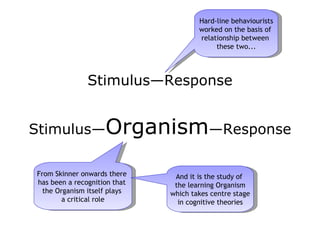
Stimulus—Response Stimulus— Organism —Response  Hard-line behaviourists worked on the basis of  relationship between  these two... From Skinner onwards there  has been a recognition that  the Organism itself plays  a critical role And it is the study of  the learning Organism which takes centre stage in cognitive theories
Although actually pre-dating much behavioural theory, the first cognitive theory was „Gestalt”, associated with Wertheimer and his students Köhler and Koffka. Some of the principles of Gestalt can be teased out through visual illusions...
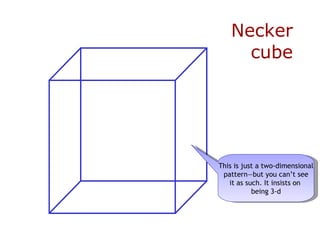
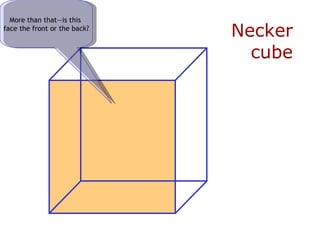
Necker cube This is just a two-dimensional pattern—but you can’t see it as such. It insists on  being 3-d
Necker cube More than that—is this  face the front or the back?
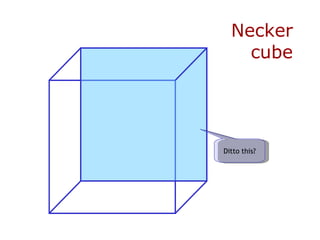
Necker cube Ditto this?
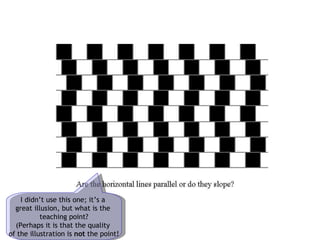
I didn’t use this one; it’s a  great illusion, but what is the  teaching point? (Perhaps it is that the quality  of the illustration is  not  the point!
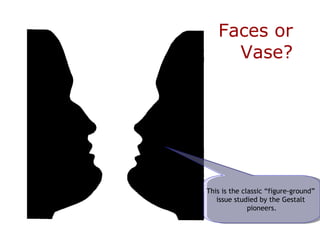
Faces or Vase? This is the classic “figure-ground”  issue studied by the Gestalt  pioneers.
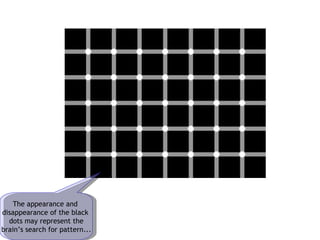
The appearance and  disappearance of the black  dots may represent the brain’s search for pattern...
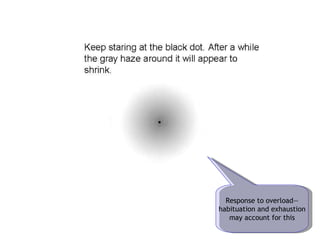
Response to overload— habituation and exhaustion may account for this
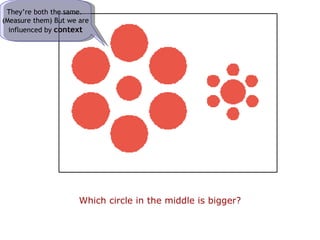
Which circle in the middle is bigger? They’re both the same.  (Measure them) But we are influenced by  context
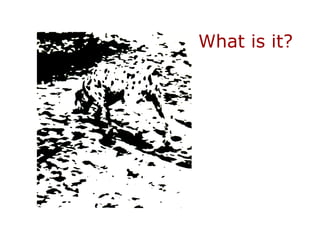
What is it?
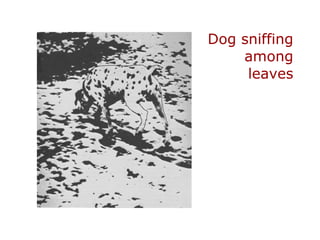
Dog sniffing among leaves
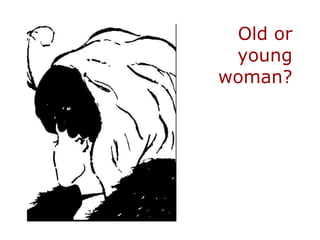
Old or young woman?
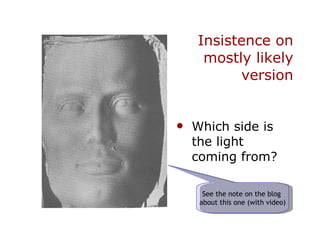
Insistence on mostly likely version Which side is the light coming from? See the note on the blog  about this one (with video)
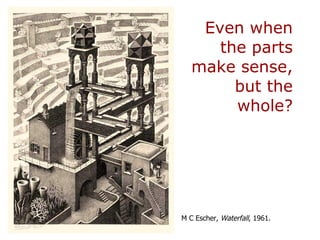
Even when the parts make sense, but the whole? M C Escher,  Waterfall , 1961.
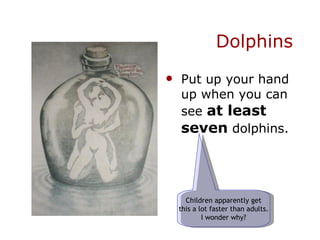
Dolphins Put up your hand up when you can see  at least seven  dolphins. Children apparently get this a lot faster than adults. I wonder why?
Brain insists on finding patterns („Gestalten”) wherever possible. So it is  not neutral  and passive.
Cognitive Theories 1 If it ain't biological, behaviourist or humanist, it's  cognitive . It all starts with  Gestalt  theories [Wertheimer, Köhler and Koffka]: originally theories of perception, Gestalt moved into problem-solving learning. Influenced by  developmental psychology  of Piaget (as amended), focusing on the maturational factors affecting understanding.
Broadly, cognitive theory is interested in  how people understand  material, and thus in; aptitude and capacity to learn  (thus fringing onto psychometrics and testing), and learning  styles  (initially an honorable field of study, now exposed as not even wrong).
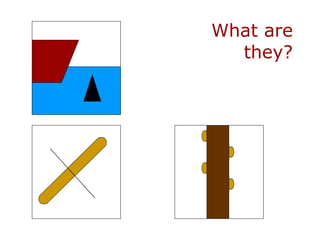
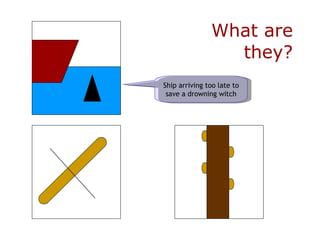
What are they?
What are they? Ship arriving too late to save a drowning witch
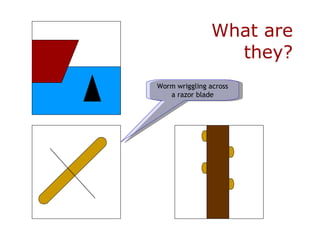
What are they? Worm wriggling across a razor blade
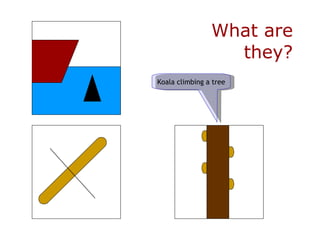
What are they? Koala climbing a tree
 
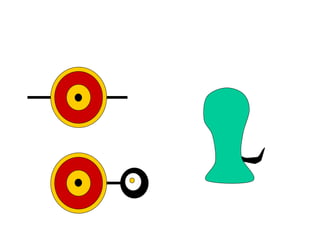
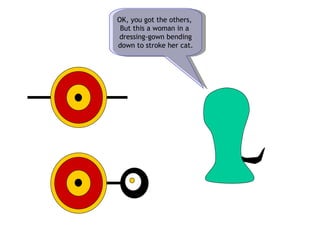
OK, you got the others,  But this a woman in a  dressing-gown bending down to stroke her cat.
Mild tension until everything “falls into place”  (usually indicated by laughter) Active mental work without behavioural action Learning as problem-solving Not just confined to human beings
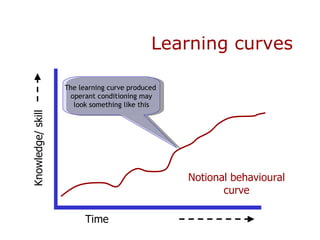
Learning curves Knowledge/ skill Time Notional behavioural curve The learning curve produced  operant conditioning may look something like this
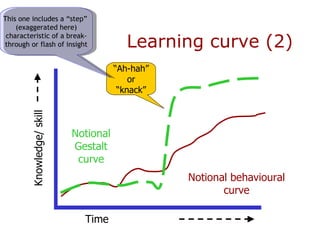
Learning curve (2) Notional Gestalt curve “ Ah-hah” or “ knack” This one includes a “step”  (exaggerated here) characteristic of a break- through or flash of insight Knowledge/ skill Time Notional behavioural curve
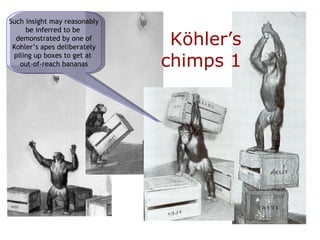
K öhler’s chimps 1 Such insight may reasonably be inferred to be  demonstrated by one of Kohler’s apes deliberately piling up boxes to get at  out-of-reach bananas
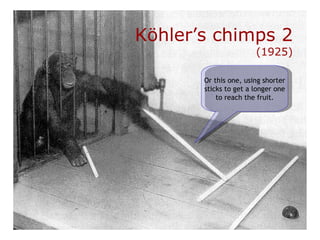
K öhler’s chimps 2 (1925) Or this one, using shorter sticks to get a longer one to reach the fruit.
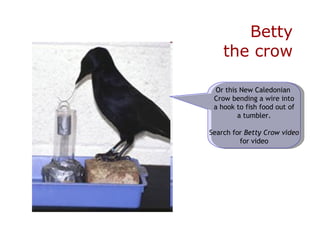
Betty  the crow Or this New Caledonian  Crow bending a wire into a hook to fish food out of a tumbler. Search for  Betty Crow video for video
Can’t leave  mind  out of it. Mind makes meaning Search for patterns („Gestalt”) “ Trial and error” can take place in a purely mental form So need to study mental processes Development “ Intelligence”
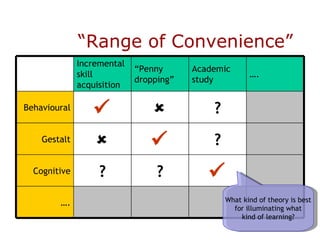
“ Range of Convenience” What kind of theory is best for illuminating what kind of learning? Incremental skill acquisition “ Penny dropping” Academic study … . Behavioural   ? Gestalt   ? Cognitive ? ?  … .
References and Links at   http://www.bedspce.org.uk/mod2/2010/02/10-february-gestalt-etc.html (c) James Atherton 2010

Some notes on Gestalt learning theory

  • 1.
    Some notes on„Gestalt” (This is in no way intended to constitute a proper introduction, but to accompany the selective discussion in class.) 10 February 2010 See also http://www.learningandteaching.info/learning/gestalt.htm and links from there.
  • 2.
    Stimulus—Response Stimulus— Organism—Response Hard-line behaviourists worked on the basis of relationship between these two... From Skinner onwards there has been a recognition that the Organism itself plays a critical role And it is the study of the learning Organism which takes centre stage in cognitive theories
  • 3.
    Although actually pre-datingmuch behavioural theory, the first cognitive theory was „Gestalt”, associated with Wertheimer and his students Köhler and Koffka. Some of the principles of Gestalt can be teased out through visual illusions...
  • 4.
    Necker cube Thisis just a two-dimensional pattern—but you can’t see it as such. It insists on being 3-d
  • 5.
    Necker cube Morethan that—is this face the front or the back?
  • 6.
  • 7.
    I didn’t usethis one; it’s a great illusion, but what is the teaching point? (Perhaps it is that the quality of the illustration is not the point!
  • 8.
    Faces or Vase?This is the classic “figure-ground” issue studied by the Gestalt pioneers.
  • 9.
    The appearance and disappearance of the black dots may represent the brain’s search for pattern...
  • 10.
    Response to overload—habituation and exhaustion may account for this
  • 11.
    Which circle inthe middle is bigger? They’re both the same. (Measure them) But we are influenced by context
  • 12.
  • 13.
  • 14.
  • 15.
    Insistence on mostlylikely version Which side is the light coming from? See the note on the blog about this one (with video)
  • 16.
    Even when theparts make sense, but the whole? M C Escher, Waterfall , 1961.
  • 17.
    Dolphins Put upyour hand up when you can see at least seven dolphins. Children apparently get this a lot faster than adults. I wonder why?
  • 18.
    Brain insists onfinding patterns („Gestalten”) wherever possible. So it is not neutral and passive.
  • 19.
    Cognitive Theories 1If it ain't biological, behaviourist or humanist, it's cognitive . It all starts with Gestalt theories [Wertheimer, Köhler and Koffka]: originally theories of perception, Gestalt moved into problem-solving learning. Influenced by developmental psychology of Piaget (as amended), focusing on the maturational factors affecting understanding.
  • 20.
    Broadly, cognitive theoryis interested in how people understand material, and thus in; aptitude and capacity to learn (thus fringing onto psychometrics and testing), and learning styles (initially an honorable field of study, now exposed as not even wrong).
  • 21.
  • 22.
    What are they?Ship arriving too late to save a drowning witch
  • 23.
    What are they?Worm wriggling across a razor blade
  • 24.
    What are they?Koala climbing a tree
  • 25.
  • 26.
    OK, you gotthe others, But this a woman in a dressing-gown bending down to stroke her cat.
  • 27.
    Mild tension untileverything “falls into place” (usually indicated by laughter) Active mental work without behavioural action Learning as problem-solving Not just confined to human beings
  • 28.
    Learning curves Knowledge/skill Time Notional behavioural curve The learning curve produced operant conditioning may look something like this
  • 29.
    Learning curve (2)Notional Gestalt curve “ Ah-hah” or “ knack” This one includes a “step” (exaggerated here) characteristic of a break- through or flash of insight Knowledge/ skill Time Notional behavioural curve
  • 30.
    K öhler’s chimps1 Such insight may reasonably be inferred to be demonstrated by one of Kohler’s apes deliberately piling up boxes to get at out-of-reach bananas
  • 31.
    K öhler’s chimps2 (1925) Or this one, using shorter sticks to get a longer one to reach the fruit.
  • 32.
    Betty thecrow Or this New Caledonian Crow bending a wire into a hook to fish food out of a tumbler. Search for Betty Crow video for video
  • 33.
    Can’t leave mind out of it. Mind makes meaning Search for patterns („Gestalt”) “ Trial and error” can take place in a purely mental form So need to study mental processes Development “ Intelligence”
  • 34.
    “ Range ofConvenience” What kind of theory is best for illuminating what kind of learning? Incremental skill acquisition “ Penny dropping” Academic study … . Behavioural   ? Gestalt   ? Cognitive ? ?  … .
  • 35.
    References and Linksat http://www.bedspce.org.uk/mod2/2010/02/10-february-gestalt-etc.html (c) James Atherton 2010

Editor's Notes

  • #5 Classic optical “illusion”: you are looking at the cube from above or from below, and switch between them; what is difficult is to see it as a purely two-dimensional pattern.
  • #6 Classic optical “illusion”: you are looking at the cube from above or from below, and switch between them; what is difficult is to see it as a purely two-dimensional pattern.
  • #7 Classic optical “illusion”: you are looking at the cube from above or from below, and switch between them; what is difficult is to see it as a purely two-dimensional pattern.
  • #9 Same again—despite the picture not actually being quite symmetrical. Technically, this is the figure/ground problem. Our brains are trying to decide what is being represented, and what is the background
  • #15 Which do you see? Get students involved in explaining to those who can’t see both. One pattern can become extablished almost to the exclusion of another.
  • #16 This is a concave image: the inside of a mask. The light is coming from the viewer’s right. It is possible to hold this view for a few moments but our minds insist on popping it back the other way as soon as we relax.
  • #19 The preceding examples were contrived
  • #22 Silly interlude: get suggestions! Top left: ship arriving too late to save a drowning witch Bottom left: worm sliding across a razor-blade Bottom right: bear climbing a tree
  • #23 Silly interlude: get suggestions! Top left: ship arriving too late to save a drowning witch Bottom left: worm sliding across a razor-blade Bottom right: bear climbing a tree
  • #24 Silly interlude: get suggestions! Top left: ship arriving too late to save a drowning witch Bottom left: worm sliding across a razor-blade Bottom right: bear climbing a tree
  • #25 Silly interlude: get suggestions! Top left: ship arriving too late to save a drowning witch Bottom left: worm sliding across a razor-blade Bottom right: bear climbing a tree