Chapter 3
Solving System of Linear
Equations
 A system of linear Equations is composed of linear
equations that are aimed at expressing a physical system or
process using linear relationship .
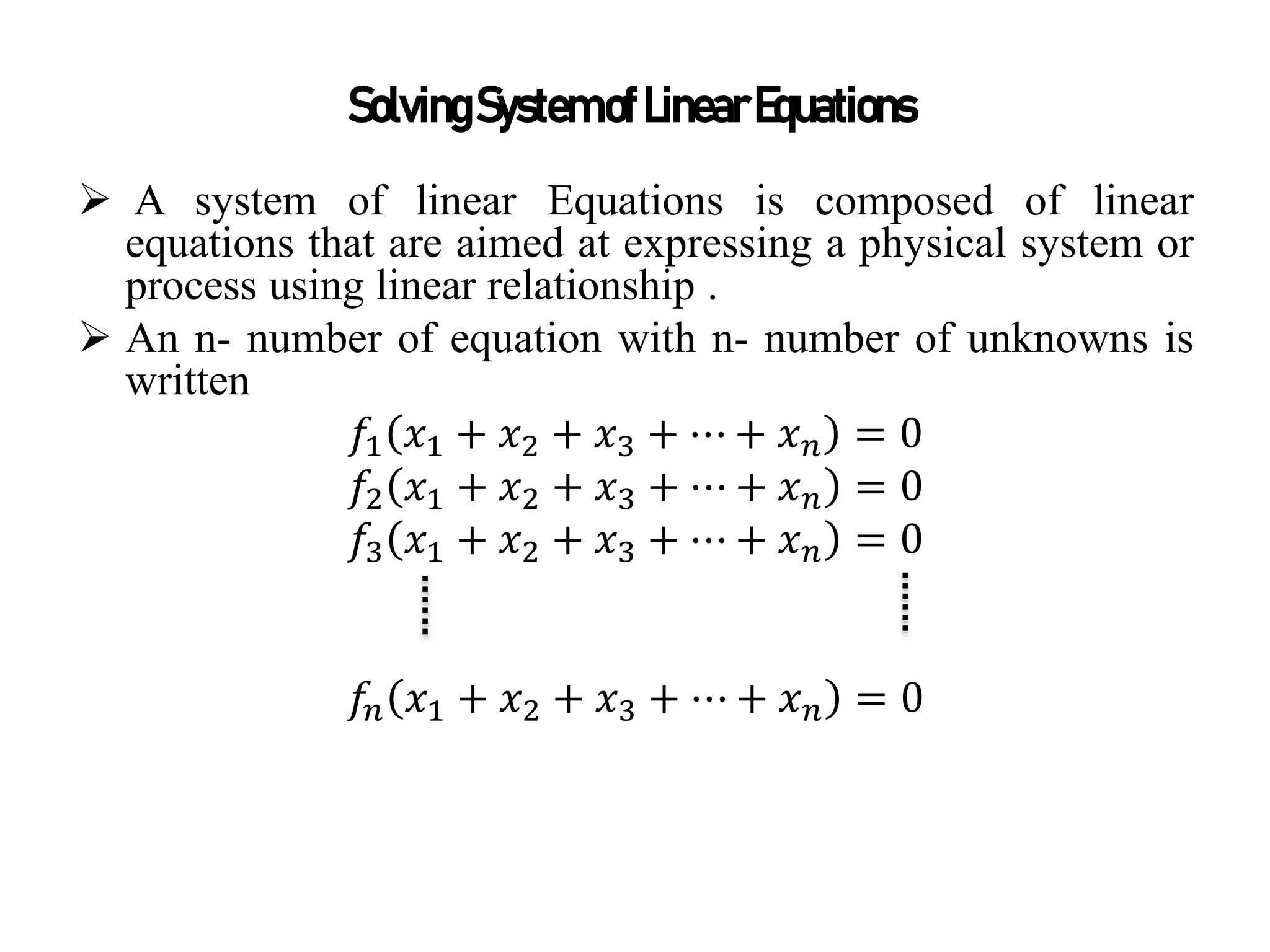
 An n- number of equation with n- number of unknowns is
written
𝑓1 𝑥1 + 𝑥2 + 𝑥3 + ⋯ + 𝑥𝑛 = 0
𝑓2 𝑥1 + 𝑥2 + 𝑥3 + ⋯ + 𝑥𝑛 = 0
𝑓3 𝑥1 + 𝑥2 + 𝑥3 + ⋯ + 𝑥𝑛 = 0
𝑓𝑛 𝑥1 + 𝑥2 + 𝑥3 + ⋯ + 𝑥𝑛 = 0
SolvingSystemofLinearEquations
 A linear equation has a general form of
f(x) = a x + b = 0
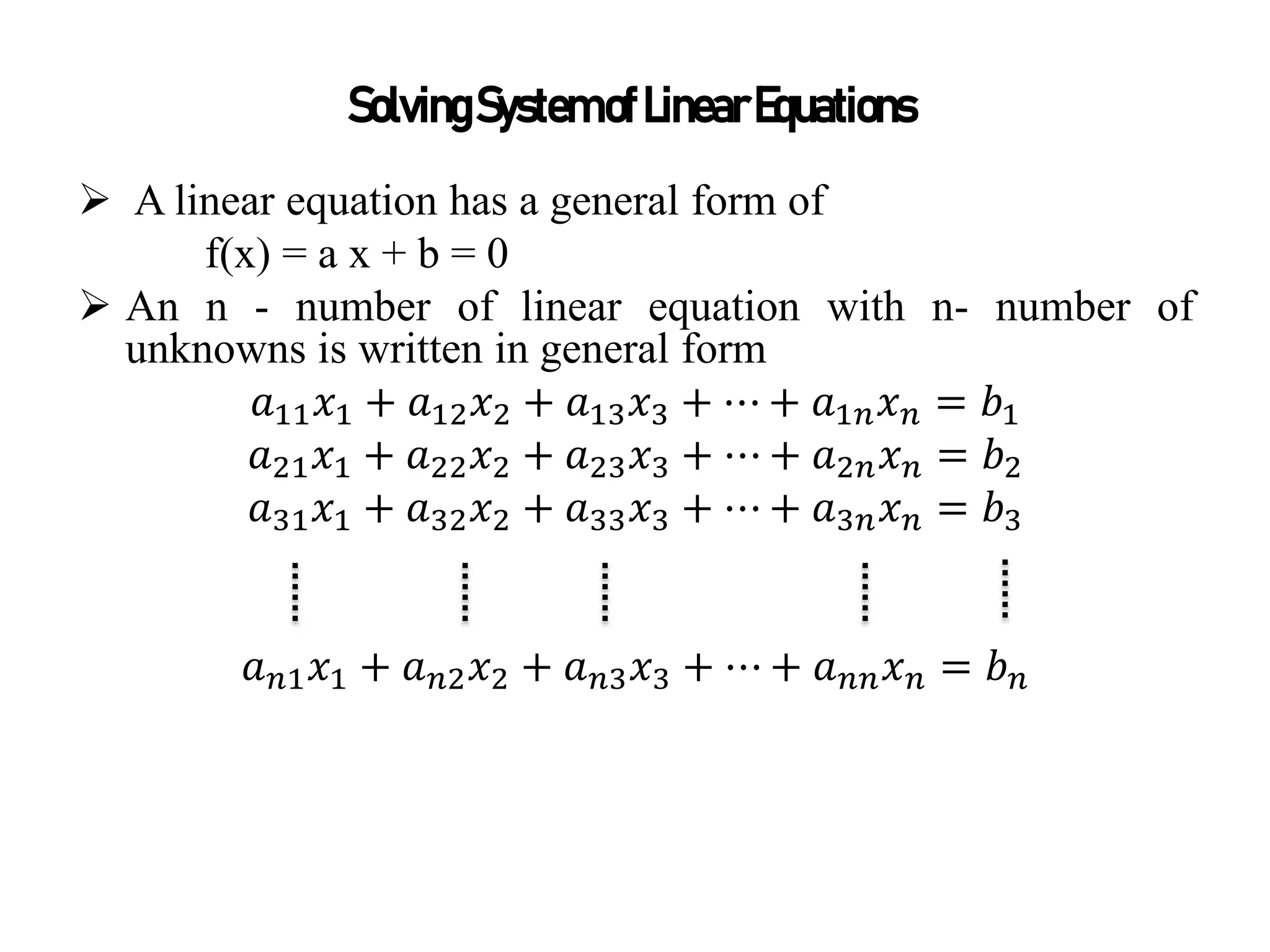
 An n - number of linear equation with n- number of
unknowns is written in general form
𝑎11𝑥1 + 𝑎12𝑥2 + 𝑎13𝑥3 + ⋯ + 𝑎1𝑛𝑥𝑛 = 𝑏1
𝑎21𝑥1 + 𝑎22𝑥2 + 𝑎23𝑥3 + ⋯ + 𝑎2𝑛𝑥𝑛 = 𝑏2
𝑎31𝑥1 + 𝑎32𝑥2 + 𝑎33𝑥3 + ⋯ + 𝑎3𝑛𝑥𝑛 = 𝑏3
𝑎𝑛1𝑥1 + 𝑎𝑛2𝑥2 + 𝑎𝑛3𝑥3 + ⋯ + 𝑎𝑛𝑛𝑥𝑛 = 𝑏𝑛
SolvingSystemofLinearEquations
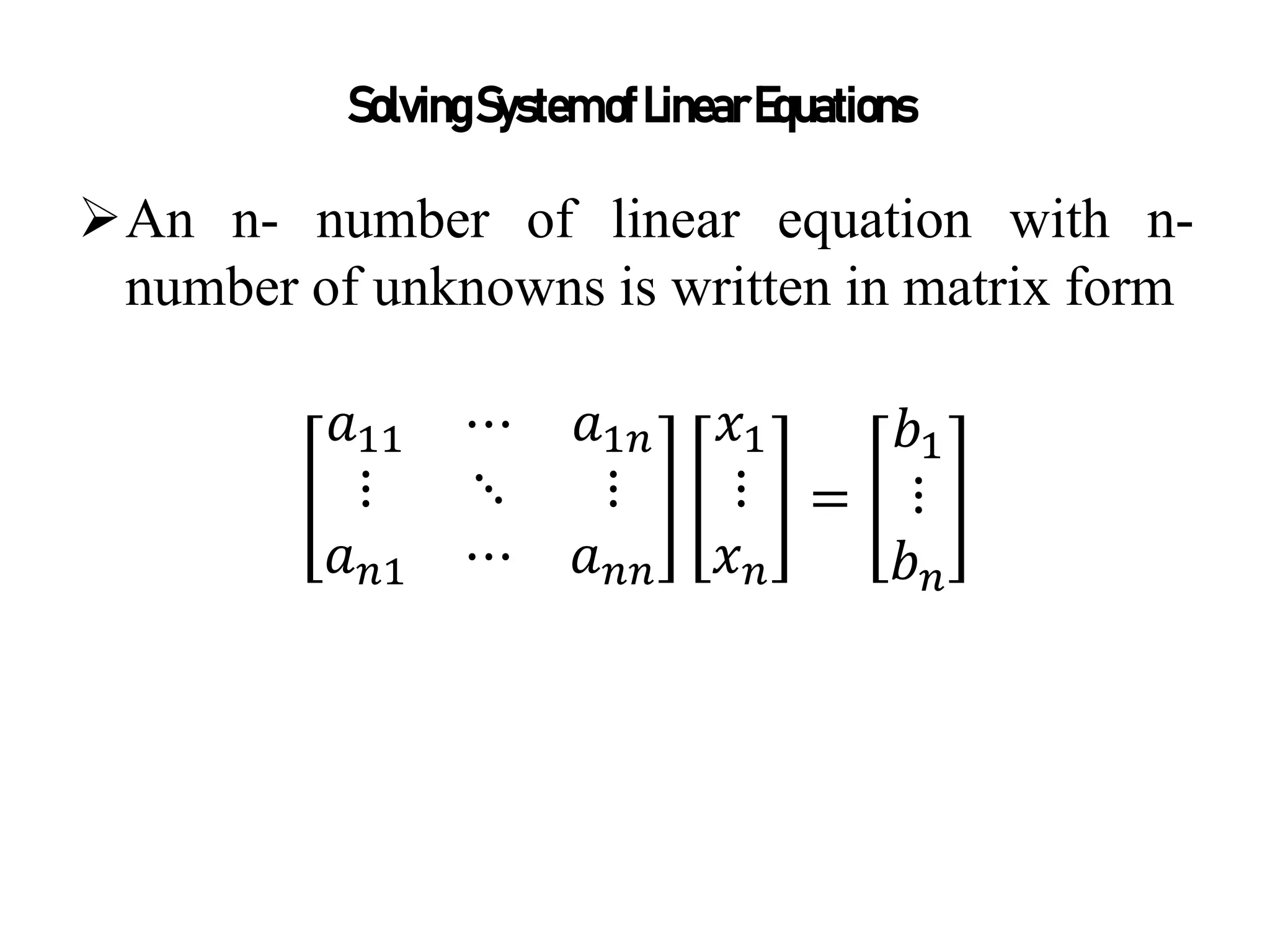
An n- number of linear equation with n-
number of unknowns is written in matrix form
𝑎11 ⋯ 𝑎1𝑛
⋮ ⋱ ⋮
𝑎𝑛1 ⋯ 𝑎𝑛𝑛
𝑥1
⋮
𝑥𝑛
=
𝑏1
⋮
𝑏𝑛
SolvingSystemofLinearEquations
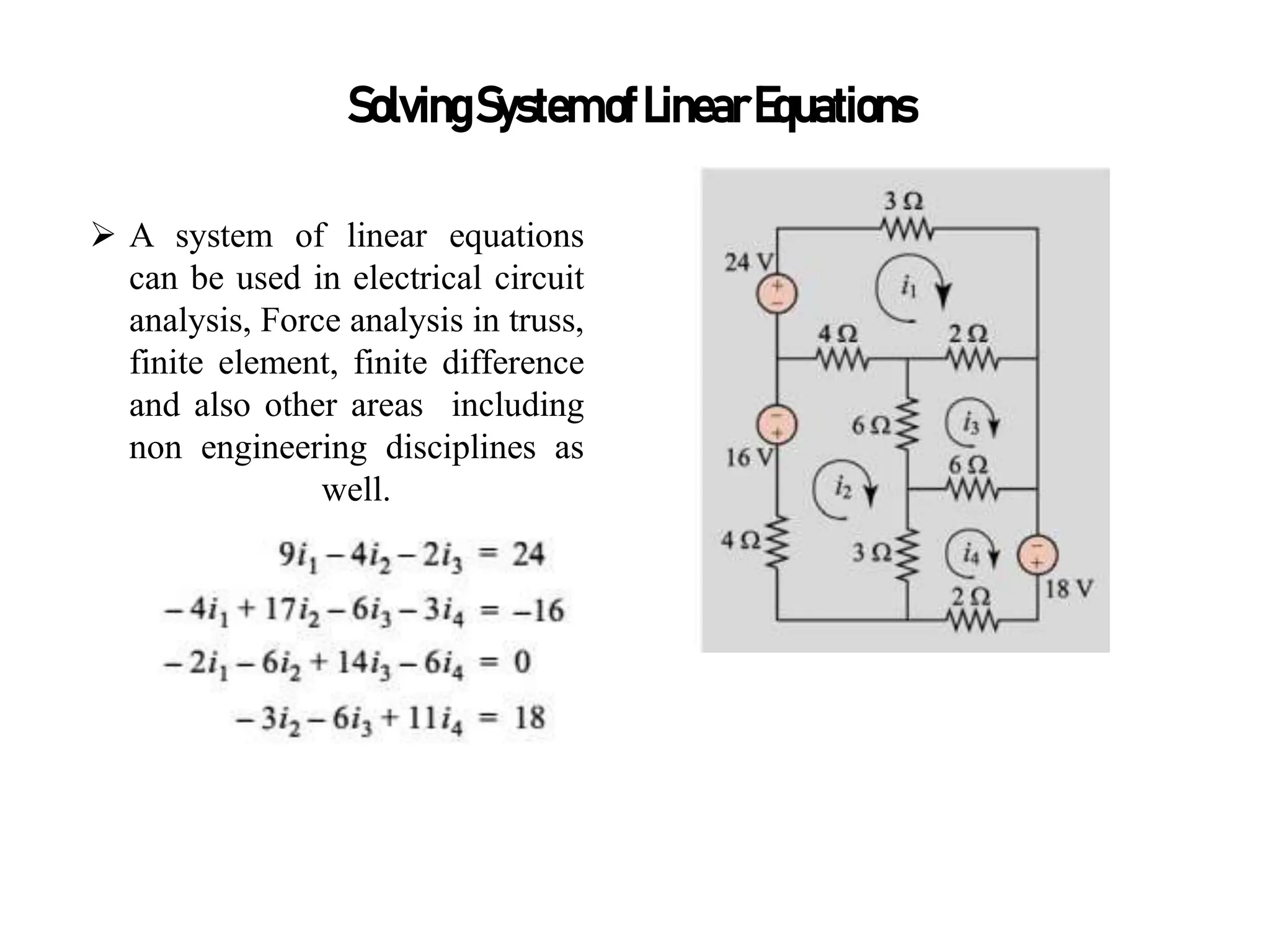
 A system of linear equations
can be used in electrical circuit
analysis, Force analysis in truss,
finite element, finite difference
and also other areas including
non engineering disciplines as
well.
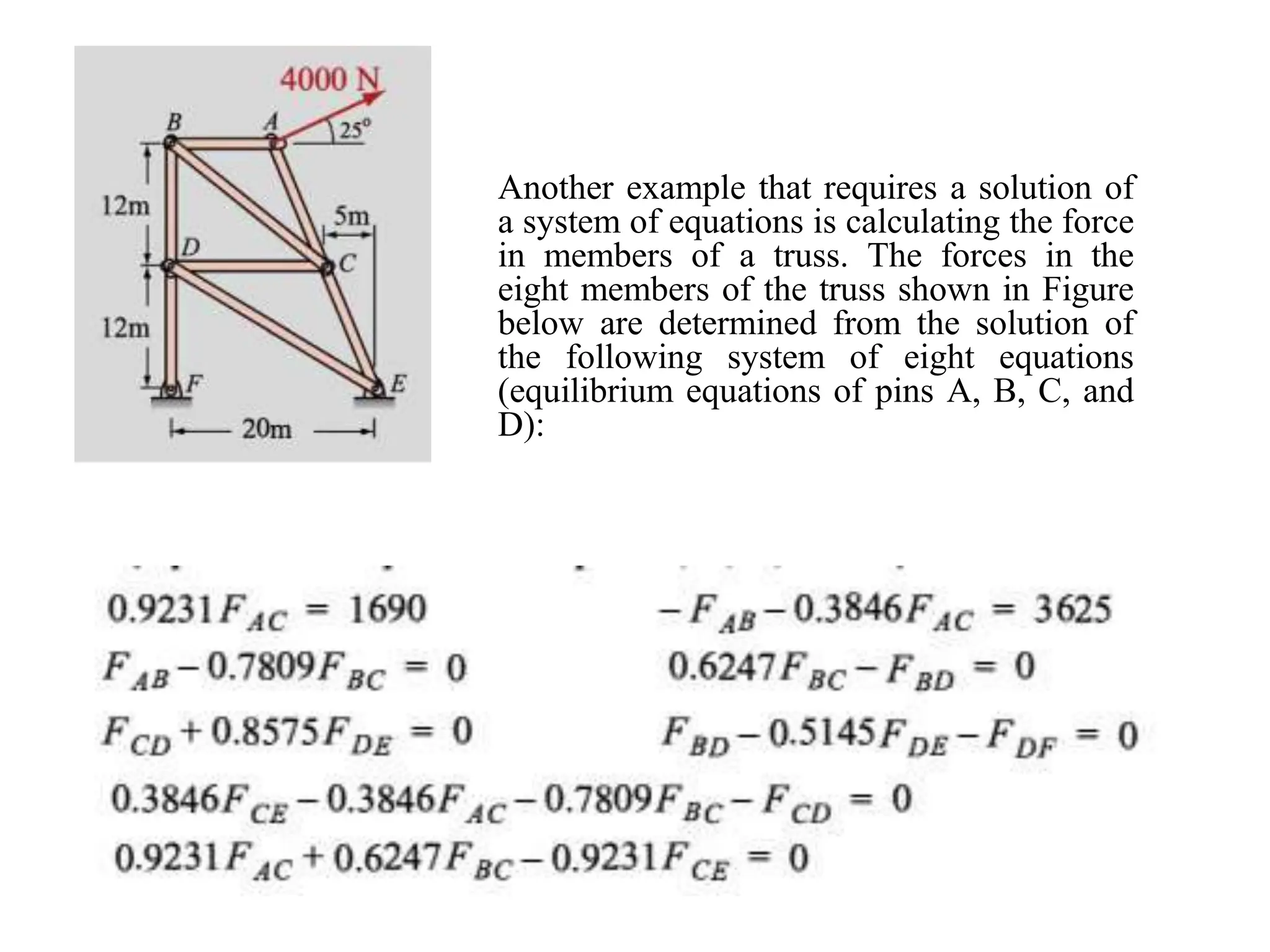
Another example that requires a solution of
a system of equations is calculating the force
in members of a truss. The forces in the
eight members of the truss shown in Figure
below are determined from the solution of
the following system of eight equations
(equilibrium equations of pins A, B, C, and
D):
0 0.9231 0
1
0
0
0
−1
0
0
0
0
−0.3846
0.9231
−0.3846
0
0
−0.7809
0
−0.7809
0.6247
0
0.6247
0
0 0 0
0
0
0
0
0
−1
1
0
0
0
0
0
0
0
0
0
0.3846
−0.9231
0
0
0
0
0
0.8575
0
0
0
0
−0.5145
0
0
0
0
0
0
0
−1
𝐹𝐴𝐵
𝐹𝐴𝐶
𝐹𝐵𝐶
𝐹𝐵𝐷
𝐹𝐶𝐷
𝐹𝐶𝐸
𝐹𝐷𝐸
𝐹𝐷𝐹
=
1690
0
0
0
0
3625
0
0
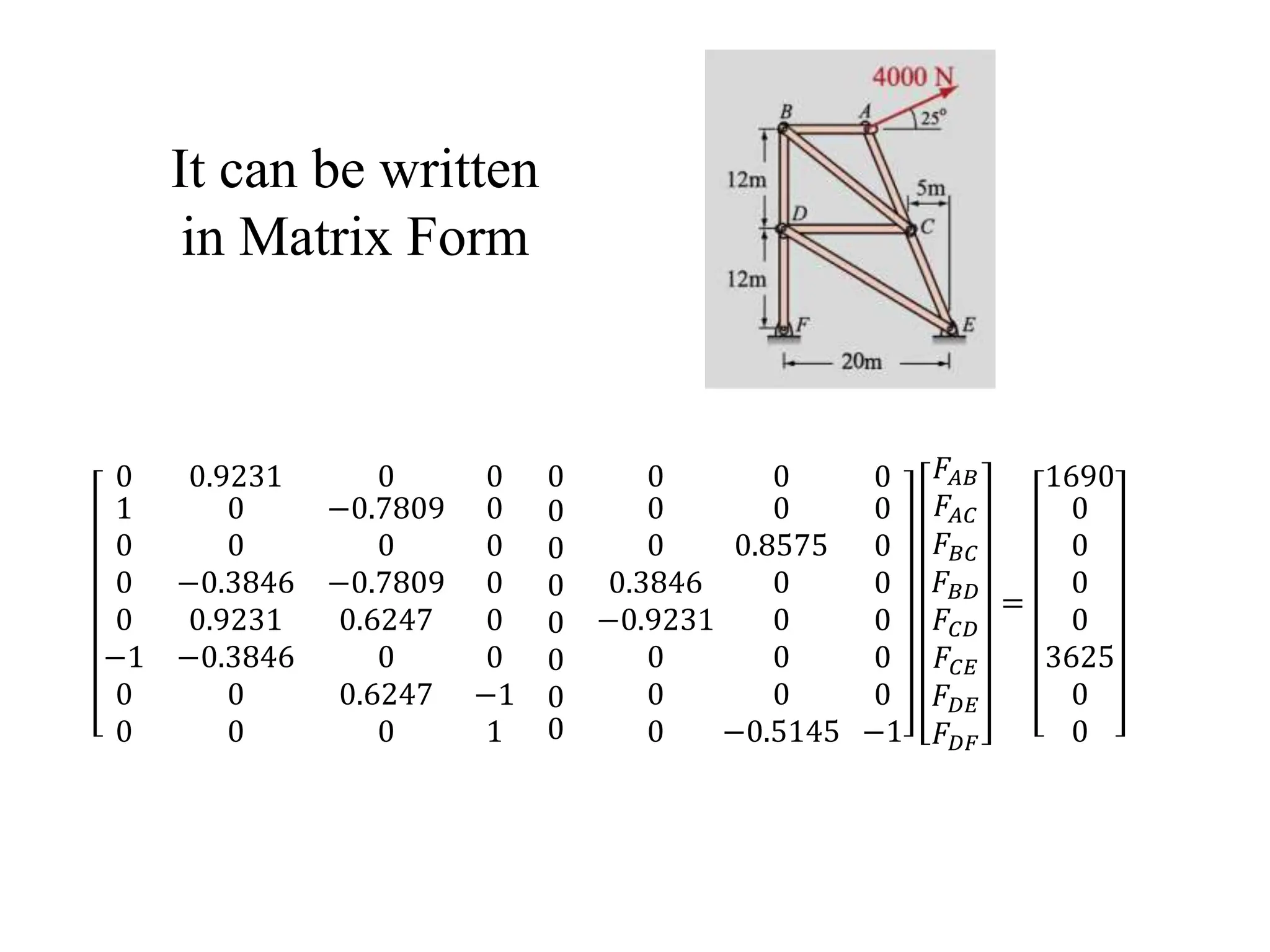
It can be written
in Matrix Form
SolvingSystemofLinearEquations
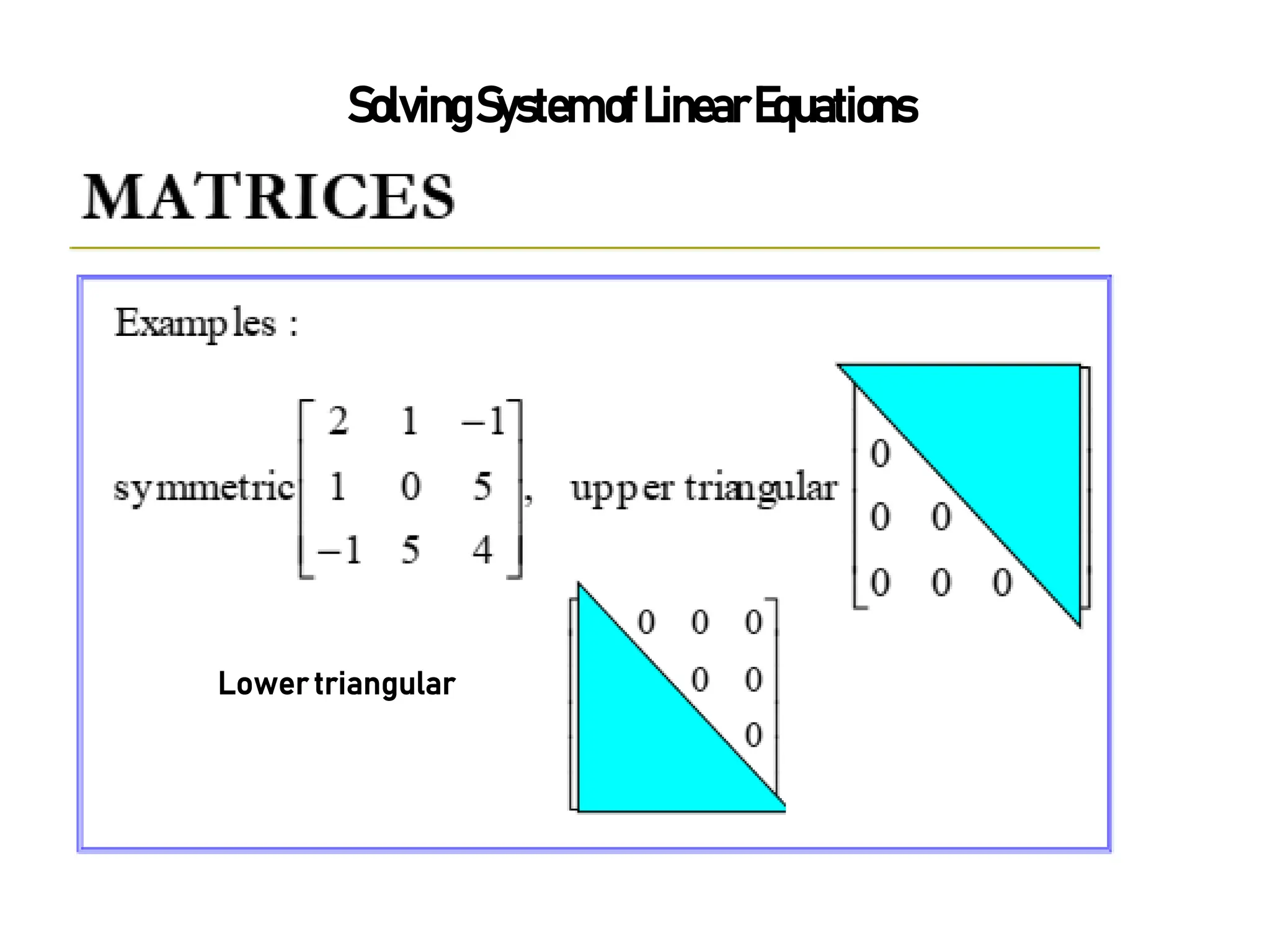
Lower triangular
SolvingSystemofLinearEquations
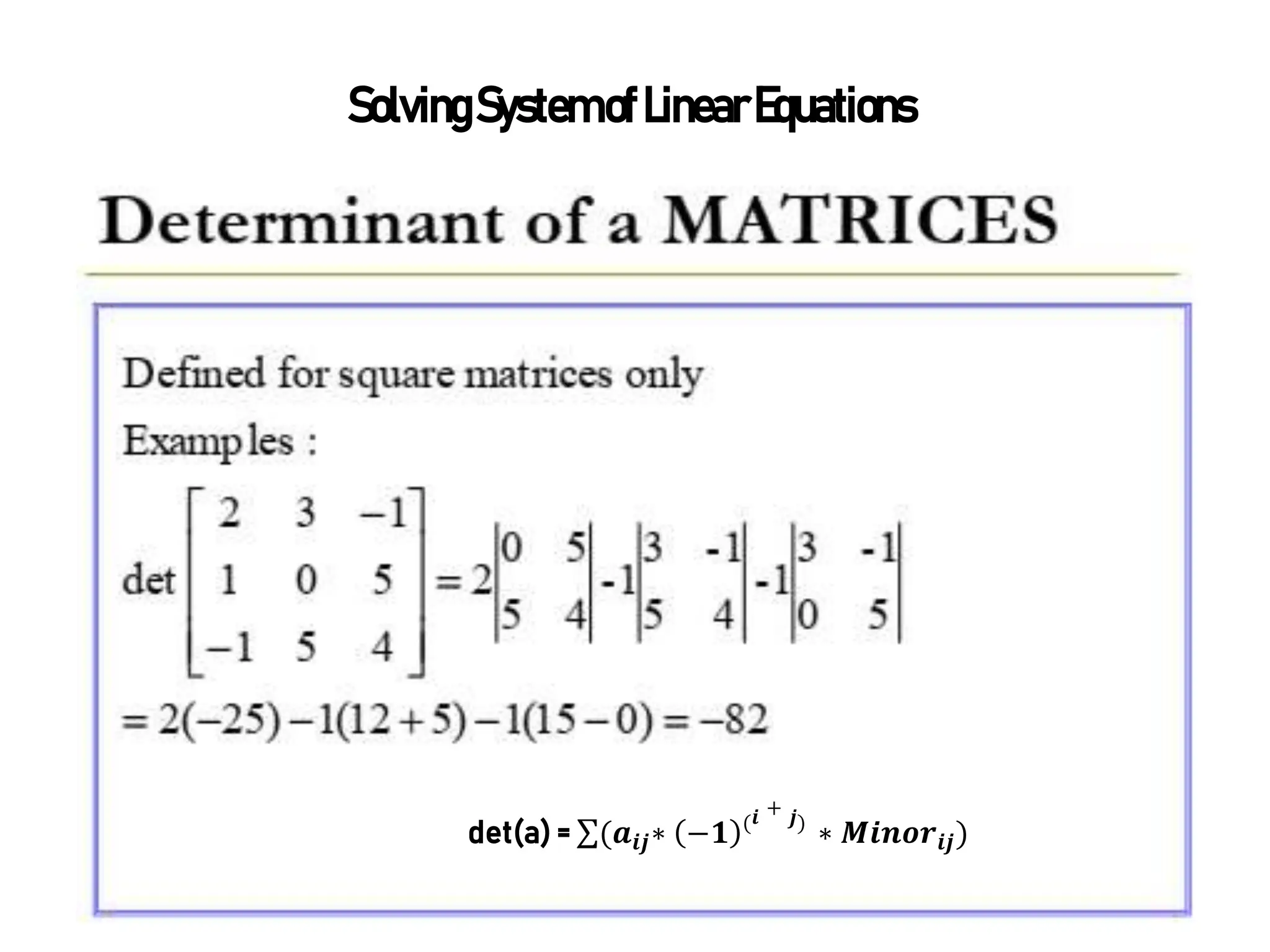
det(a) = (𝒂𝒊𝒋∗ −𝟏
𝒊 + 𝒋
∗ 𝑴𝒊𝒏𝒐𝒓𝒊𝒋)
SolvingSystemofLinearEquations
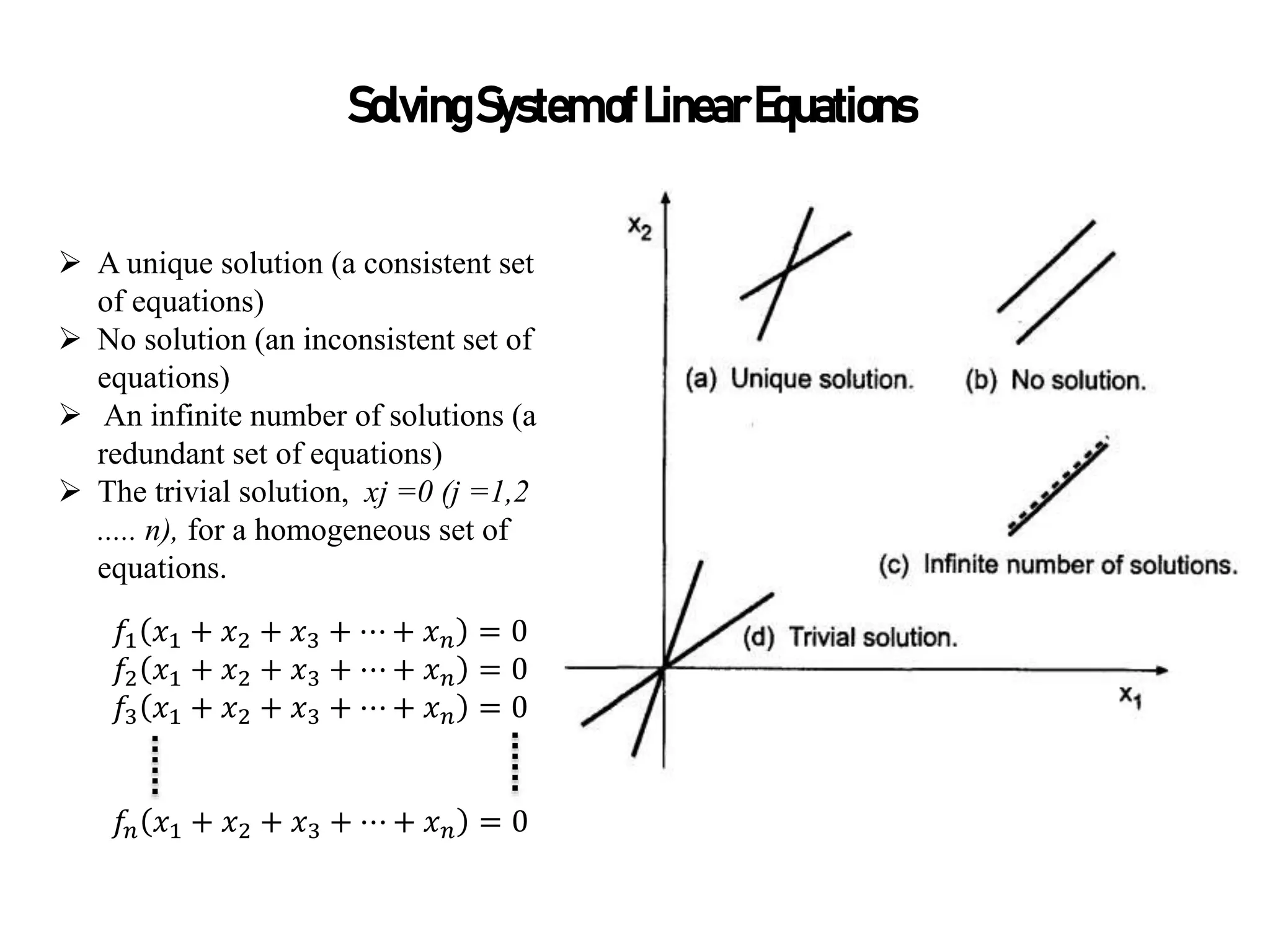
 A unique solution (a consistent set
of equations)
 No solution (an inconsistent set of
equations)
 An infinite number of solutions (a
redundant set of equations)
 The trivial solution, xj =0 (j =1,2
..... n), for a homogeneous set of
equations.
𝑓1 𝑥1 + 𝑥2 + 𝑥3 + ⋯ + 𝑥𝑛 = 0
𝑓2 𝑥1 + 𝑥2 + 𝑥3 + ⋯ + 𝑥𝑛 = 0
𝑓3 𝑥1 + 𝑥2 + 𝑥3 + ⋯ + 𝑥𝑛 = 0
𝑓𝑛 𝑥1 + 𝑥2 + 𝑥3 + ⋯ + 𝑥𝑛 = 0
SolvingSystemofLinearEquations
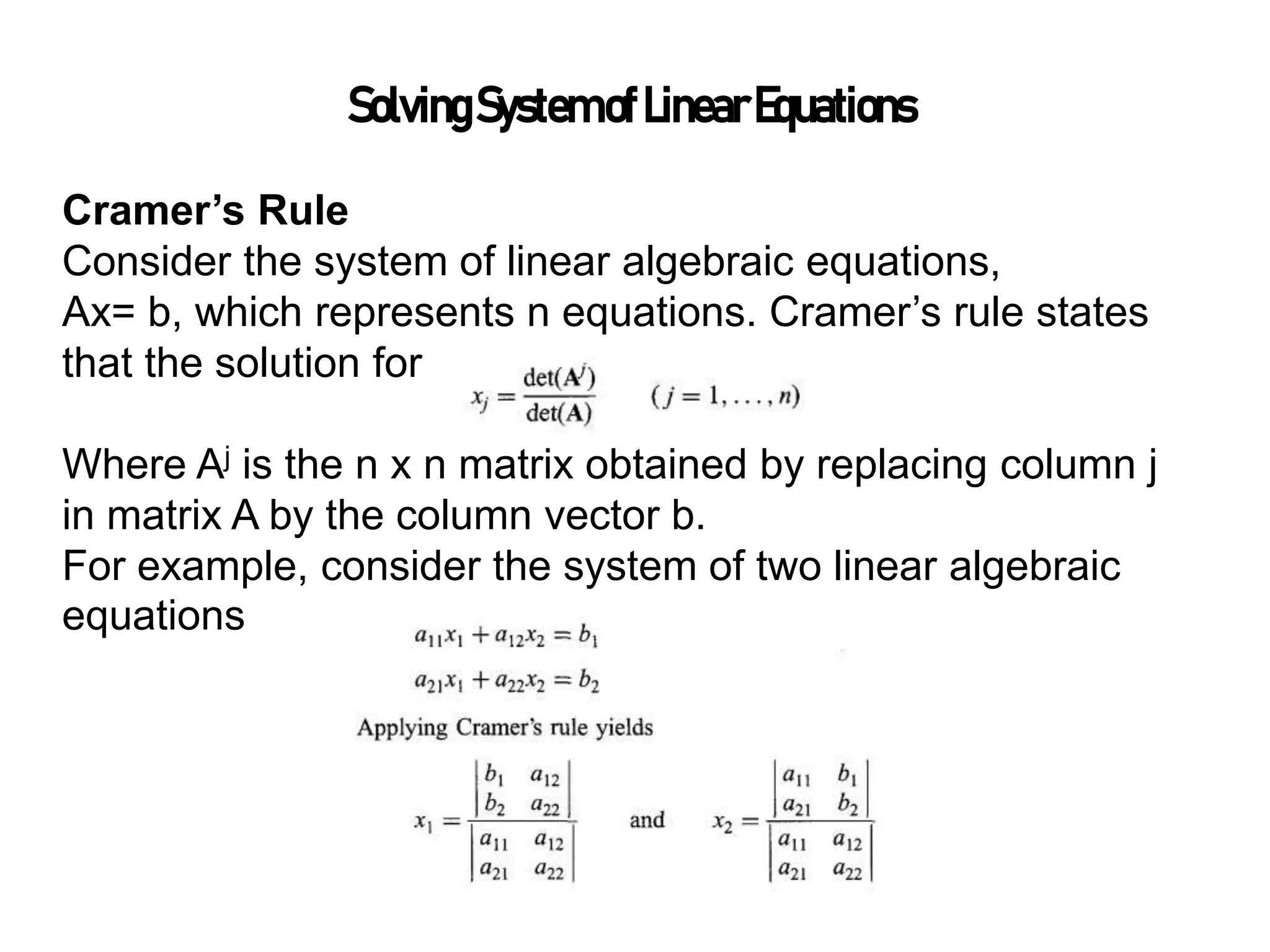
Cramer’s Rule
Consider the system of linear algebraic equations,
Ax= b, which represents n equations. Cramer’s rule states
that the solution for
Where Aj is the n x n matrix obtained by replacing column j
in matrix A by the column vector b.
For example, consider the system of two linear algebraic
equations
SolvingSystemofLinearEquations
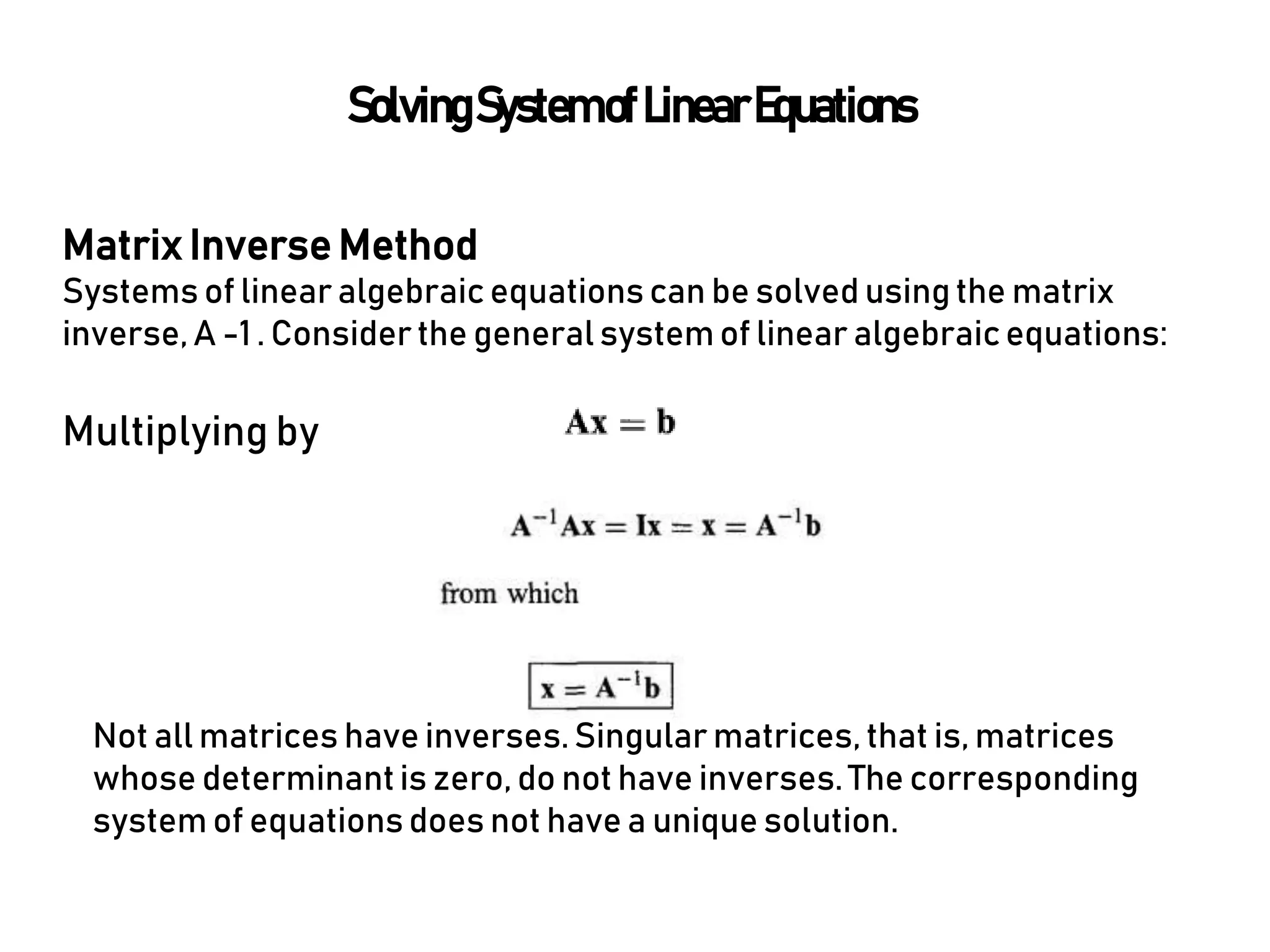
Matrix Inverse Method
Systems of linear algebraic equations can be solved using the matrix
inverse,A -1 . Consider the general system of linear algebraicequations:
Multiplying by
Not all matrices have inverses. Singular matrices, that is, matrices
whose determinantis zero, do not have inverses.The corresponding
system of equations does not have a unique solution.
SolvingSystemofLinearEquations
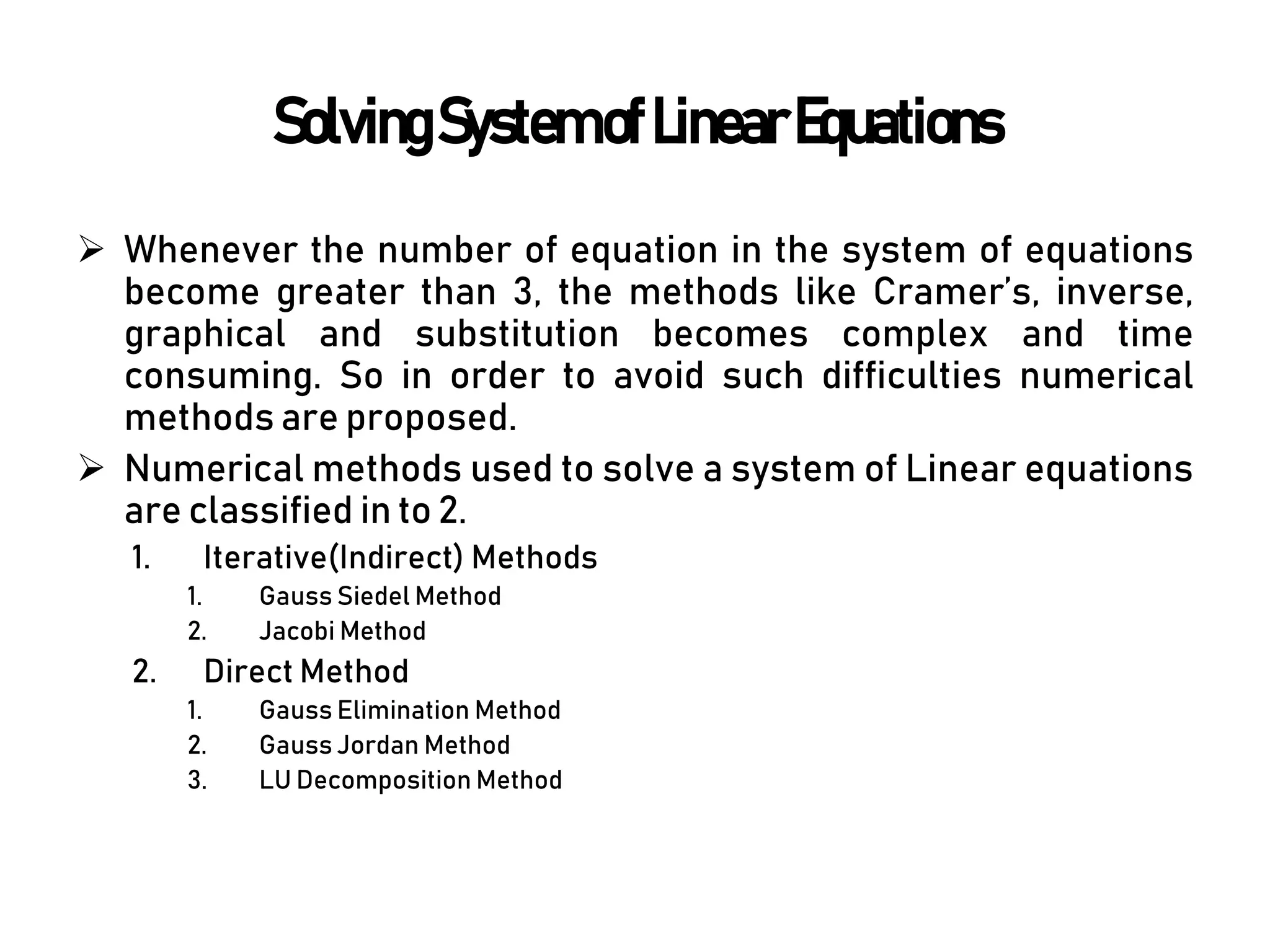
 Whenever the number of equation in the system of equations
become greater than 3, the methods like Cramer’s, inverse,
graphical and substitution becomes complex and time
consuming. So in order to avoid such difficulties numerical
methods are proposed.
 Numerical methods used to solve a system of Linear equations
are classified in to 2.
1. Iterative(Indirect) Methods
1. Gauss Siedel Method
2. Jacobi Method
2. Direct Method
1. Gauss Elimination Method
2. Gauss Jordan Method
3. LU Decomposition Method

Solving a system of Linear Equations for Engineers

  • 1.
    Chapter 3 Solving Systemof Linear Equations
  • 2.
     A systemof linear Equations is composed of linear equations that are aimed at expressing a physical system or process using linear relationship .  An n- number of equation with n- number of unknowns is written 𝑓1 𝑥1 + 𝑥2 + 𝑥3 + ⋯ + 𝑥𝑛 = 0 𝑓2 𝑥1 + 𝑥2 + 𝑥3 + ⋯ + 𝑥𝑛 = 0 𝑓3 𝑥1 + 𝑥2 + 𝑥3 + ⋯ + 𝑥𝑛 = 0 𝑓𝑛 𝑥1 + 𝑥2 + 𝑥3 + ⋯ + 𝑥𝑛 = 0 SolvingSystemofLinearEquations
  • 3.
     A linearequation has a general form of f(x) = a x + b = 0  An n - number of linear equation with n- number of unknowns is written in general form 𝑎11𝑥1 + 𝑎12𝑥2 + 𝑎13𝑥3 + ⋯ + 𝑎1𝑛𝑥𝑛 = 𝑏1 𝑎21𝑥1 + 𝑎22𝑥2 + 𝑎23𝑥3 + ⋯ + 𝑎2𝑛𝑥𝑛 = 𝑏2 𝑎31𝑥1 + 𝑎32𝑥2 + 𝑎33𝑥3 + ⋯ + 𝑎3𝑛𝑥𝑛 = 𝑏3 𝑎𝑛1𝑥1 + 𝑎𝑛2𝑥2 + 𝑎𝑛3𝑥3 + ⋯ + 𝑎𝑛𝑛𝑥𝑛 = 𝑏𝑛 SolvingSystemofLinearEquations
  • 4.
    An n- numberof linear equation with n- number of unknowns is written in matrix form 𝑎11 ⋯ 𝑎1𝑛 ⋮ ⋱ ⋮ 𝑎𝑛1 ⋯ 𝑎𝑛𝑛 𝑥1 ⋮ 𝑥𝑛 = 𝑏1 ⋮ 𝑏𝑛 SolvingSystemofLinearEquations
  • 5.
    SolvingSystemofLinearEquations  A systemof linear equations can be used in electrical circuit analysis, Force analysis in truss, finite element, finite difference and also other areas including non engineering disciplines as well.
  • 6.
    Another example thatrequires a solution of a system of equations is calculating the force in members of a truss. The forces in the eight members of the truss shown in Figure below are determined from the solution of the following system of eight equations (equilibrium equations of pins A, B, C, and D):
  • 7.
    0 0.9231 0 1 0 0 0 −1 0 0 0 0 −0.3846 0.9231 −0.3846 0 0 −0.7809 0 −0.7809 0.6247 0 0.6247 0 00 0 0 0 0 0 0 −1 1 0 0 0 0 0 0 0 0 0 0.3846 −0.9231 0 0 0 0 0 0.8575 0 0 0 0 −0.5145 0 0 0 0 0 0 0 −1 𝐹𝐴𝐵 𝐹𝐴𝐶 𝐹𝐵𝐶 𝐹𝐵𝐷 𝐹𝐶𝐷 𝐹𝐶𝐸 𝐹𝐷𝐸 𝐹𝐷𝐹 = 1690 0 0 0 0 3625 0 0 It can be written in Matrix Form
  • 8.
  • 9.
  • 10.
  • 11.
    SolvingSystemofLinearEquations det(a) = (𝒂𝒊𝒋∗−𝟏 𝒊 + 𝒋 ∗ 𝑴𝒊𝒏𝒐𝒓𝒊𝒋)
  • 12.
  • 13.
    SolvingSystemofLinearEquations  A uniquesolution (a consistent set of equations)  No solution (an inconsistent set of equations)  An infinite number of solutions (a redundant set of equations)  The trivial solution, xj =0 (j =1,2 ..... n), for a homogeneous set of equations. 𝑓1 𝑥1 + 𝑥2 + 𝑥3 + ⋯ + 𝑥𝑛 = 0 𝑓2 𝑥1 + 𝑥2 + 𝑥3 + ⋯ + 𝑥𝑛 = 0 𝑓3 𝑥1 + 𝑥2 + 𝑥3 + ⋯ + 𝑥𝑛 = 0 𝑓𝑛 𝑥1 + 𝑥2 + 𝑥3 + ⋯ + 𝑥𝑛 = 0
  • 14.
    SolvingSystemofLinearEquations Cramer’s Rule Consider thesystem of linear algebraic equations, Ax= b, which represents n equations. Cramer’s rule states that the solution for Where Aj is the n x n matrix obtained by replacing column j in matrix A by the column vector b. For example, consider the system of two linear algebraic equations
  • 15.
    SolvingSystemofLinearEquations Matrix Inverse Method Systemsof linear algebraic equations can be solved using the matrix inverse,A -1 . Consider the general system of linear algebraicequations: Multiplying by Not all matrices have inverses. Singular matrices, that is, matrices whose determinantis zero, do not have inverses.The corresponding system of equations does not have a unique solution.
  • 16.
    SolvingSystemofLinearEquations  Whenever thenumber of equation in the system of equations become greater than 3, the methods like Cramer’s, inverse, graphical and substitution becomes complex and time consuming. So in order to avoid such difficulties numerical methods are proposed.  Numerical methods used to solve a system of Linear equations are classified in to 2. 1. Iterative(Indirect) Methods 1. Gauss Siedel Method 2. Jacobi Method 2. Direct Method 1. Gauss Elimination Method 2. Gauss Jordan Method 3. LU Decomposition Method