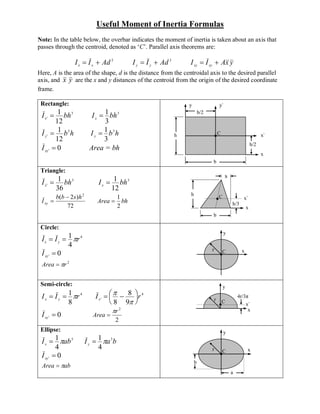
Useful Moment of Inertia Formulas
Note: In the table below, the overbar indicates the moment of inertia is taken about an axis that
passes through the centroid, denoted as ‘C’. Parallel axis theorems are:
2
AdII xx  2
AdII yy  yxAII xyxy 
Here, A is the area of the shape, d is the distance from the centroidal axis to the desired parallel
axis, and yx are the x and y distances of the centroid from the origin of the desired coordinate
frame.
Rectangle:
3
12
1 bhIx 
3
3
1bhIx

hbIy
3
12
1 hbIy
3
3
1
0yx
I Area = bh
Triangle:
3
36
1 bhIx

3
12
1 bhIx 
72
)2( 2
hsbb
Ixy

 bhArea
2
1

Circle:
4
4
1 rII yx 
0yx
I
2
rArea 
Semi-circle:
4
8
1 rII yx
 4
'
9
8
8
rIx 




 


0yxI
2
2
r
Area


Ellipse:
3
4
1 abIx  baIy
3
4
1
0yxI
abArea 
Cr
y
x
a
b
Cr
y
x
4r/3π
x`
Cr
y
x
b
h
x
x`C
h/3
s
y
x
y`
x`
b
h C
b/2
h/2

Inertia formulas

  • 1.
    Useful Moment ofInertia Formulas Note: In the table below, the overbar indicates the moment of inertia is taken about an axis that passes through the centroid, denoted as ‘C’. Parallel axis theorems are: 2 AdII xx  2 AdII yy  yxAII xyxy  Here, A is the area of the shape, d is the distance from the centroidal axis to the desired parallel axis, and yx are the x and y distances of the centroid from the origin of the desired coordinate frame. Rectangle: 3 12 1 bhIx  3 3 1bhIx  hbIy 3 12 1 hbIy 3 3 1 0yx I Area = bh Triangle: 3 36 1 bhIx  3 12 1 bhIx  72 )2( 2 hsbb Ixy   bhArea 2 1  Circle: 4 4 1 rII yx  0yx I 2 rArea  Semi-circle: 4 8 1 rII yx  4 ' 9 8 8 rIx          0yxI 2 2 r Area   Ellipse: 3 4 1 abIx  baIy 3 4 1 0yxI abArea  Cr y x a b Cr y x 4r/3π x` Cr y x b h x x`C h/3 s y x y` x` b h C b/2 h/2