Shahina Akter
Ph.D. Fellow & M.S in Applied Mathematics, DU
B.Sc in Mathematics, DU
Linear Algebra
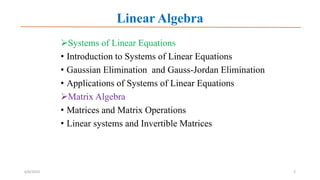
Systems of Linear Equations
• Introduction to Systems of Linear Equations
• Gaussian Elimination and Gauss-Jordan Elimination
• Applications of Systems of Linear Equations
Matrix Algebra
• Matrices and Matrix Operations
• Linear systems and Invertible Matrices
6/6/2023 2
Objectives
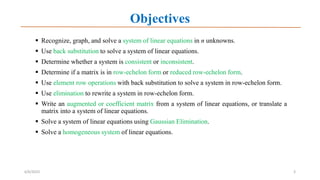
 Recognize, graph, and solve a system of linear equations in n unknowns.
 Use back substitution to solve a system of linear equations.
 Determine whether a system is consistent or inconsistent.
 Determine if a matrix is in row-echelon form or reduced row-echelon form.
 Use element row operations with back substitution to solve a system in row-echelon form.
 Use elimination to rewrite a system in row-echelon form.
 Write an augmented or coefficient matrix from a system of linear equations, or translate a
matrix into a system of linear equations.
 Solve a system of linear equations using Gaussian Elimination.
 Solve a homogeneous system of linear equations.
6/6/2023 3
Introduction
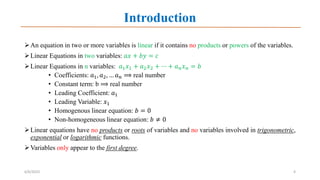
An equation in two or more variables is linear if it contains no products or powers of the variables.
Linear Equations in two variables: 𝑎𝑥 + 𝑏𝑦 = 𝑐
Linear Equations in n variables: 𝑎1𝑥1 + 𝑎2𝑥2 + ⋯ + 𝑎𝑛𝑥𝑛 = 𝑏
• Coefficients: 𝑎1, 𝑎2, … 𝑎𝑛 ⟹ real number
• Constant term: b ⟹ real number
• Leading Coefficient: 𝑎1
• Leading Variable: 𝑥1
• Homogenous linear equation: 𝑏 = 0
• Non-homogeneous linear equation: 𝑏 ≠ 0
Linear equations have no products or roots of variables and no variables involved in trigonometric,
exponential or logarithmic functions.
Variables only appear to the first degree.
6/6/2023 4
Systems of Linear Equations
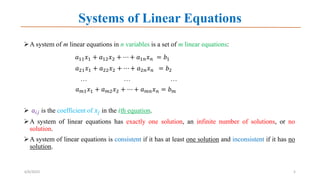
A system of m linear equations in n variables is a set of m linear equations:
𝑎11𝑥1 + 𝑎12𝑥2 + ⋯ + 𝑎1𝑛𝑥𝑛 = 𝑏1
𝑎21𝑥1 + 𝑎22𝑥2 + ⋯ + 𝑎2𝑛𝑥𝑛 = 𝑏2
… … …
𝑎𝑚1𝑥1 + 𝑎𝑚2𝑥2 + ⋯ + 𝑎𝑚𝑛𝑥𝑛 = 𝑏𝑚
 𝑎𝑖𝑗 is the coefficient of 𝑥𝑗 in the 𝑖th equation.
A system of linear equations has exactly one solution, an infinite number of solutions, or no
solution.
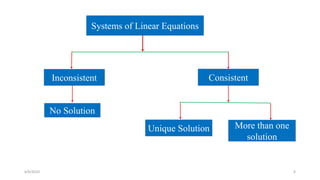
A system of linear equations is consistent if it has at least one solution and inconsistent if it has no
solution.
6/6/2023 5
Systems of Linear Equations
Inconsistent Consistent
No Solution
Unique Solution More than one
solution
6/6/2023 6
Systems With Two Unknowns
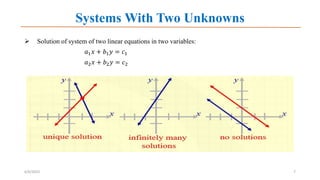
 Solution of system of two linear equations in two variables:
𝑎1𝑥 + 𝑏1𝑦 = 𝑐1
𝑎2𝑥 + 𝑏2𝑦 = 𝑐2
6/6/2023 7
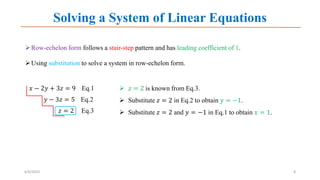
Solving a System of Linear Equations
Row-echelon form follows a stair-step pattern and has leading coefficient of 1.
Using substitution to solve a system in row-echelon form.
6/6/2023 8
𝑥 − 2𝑦 + 3𝑧 = 9 Eq.1
𝑦 − 3𝑧 = 5 Eq.2
𝑧 = 2 Eq.3
 𝑧 = 2 is known from Eq.3.
 Substitute 𝑧 = 2 in Eq.2 to obtain 𝑦 = −1.
 Substitute 𝑧 = 2 and 𝑦 = −1 in Eq.1 to obtain 𝑥 = 1.
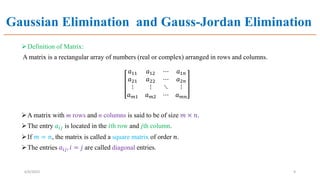
Gaussian Elimination and Gauss-Jordan Elimination
Definition of Matrix:
A matrix is a rectangular array of numbers (real or complex) arranged in rows and columns.
𝑎11 𝑎12 ⋯ 𝑎1𝑛
𝑎21 𝑎22 ⋯ 𝑎2𝑛
⋮ ⋮ ⋱ ⋮
𝑎𝑚1 𝑎𝑚2 ⋯ 𝑎𝑚𝑛
A matrix with m rows and n columns is said to be of size 𝑚 × 𝑛.
The entry 𝑎𝑖𝑗 is located in the 𝑖th row and 𝑗th column.
If 𝑚 = 𝑛, the matrix is called a square matrix of order 𝑛.
The entries 𝑎𝑖𝑗, 𝑖 = 𝑗 are called diagonal entries.
6/6/2023 9
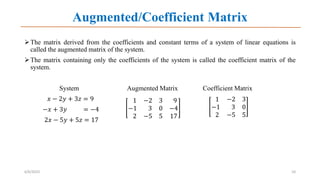
Augmented/Coefficient Matrix
The matrix derived from the coefficients and constant terms of a system of linear equations is
called the augmented matrix of the system.
The matrix containing only the coefficients of the system is called the coefficient matrix of the
system.
System Augmented Matrix Coefficient Matrix
𝑥 − 2𝑦 + 3𝑧 = 9
−𝑥 + 3𝑦 = −4
2𝑥 − 5𝑦 + 5𝑧 = 17
6/6/2023 10
1 −2 3 9
−1 3 0 −4
2 −5 5 17
1 −2 3
−1 3 0
2 −5 5
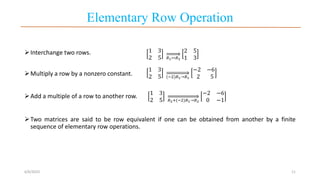
Elementary Row Operation
Interchange two rows.
Multiply a row by a nonzero constant.
Add a multiple of a row to another row. 1 3
2 5 𝑅2+(−2)𝑅1→𝑅2
−2 −6
0 −1
Two matrices are said to be row equivalent if one can be obtained from another by a finite
sequence of elementary row operations.
6/6/2023 11
1 3
2 5 𝑅1↔𝑅2
2 5
1 3
1 3
2 5 (−2)𝑅1→𝑅1
−2 −6
2 5
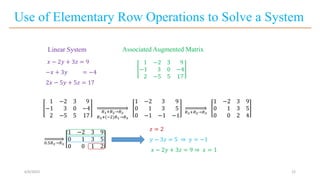
Use of Elementary Row Operations to Solve a System
6/6/2023 12
𝑥 − 2𝑦 + 3𝑧 = 9
−𝑥 + 3𝑦 = −4
2𝑥 − 5𝑦 + 5𝑧 = 17
1 −2 3 9
−1 3 0 −4
2 −5 5 17
Linear System Associated Augmented Matrix
1 −2 3 9
−1 3 0 −4
2 −5 5 17
𝑅1+𝑅2→𝑅2
𝑅3+(−2)𝑅1→𝑅3
1 −2 3 9
0 1 3 5
0 −1 −1 −1
𝑅3+𝑅2→𝑅3
1 −2 3 9
0 1 3 5
0 0 2 4
0.5𝑅3→𝑅3
1 −2 3 9
0 1 3 5
0 0 1 2
𝑧 = 2
𝑦 − 3𝑧 = 5 ⇒ 𝑦 = −1
𝑥 − 2𝑦 + 3𝑧 = 9 ⇒ 𝑥 = 1
Row-Echelon form of a Matrix
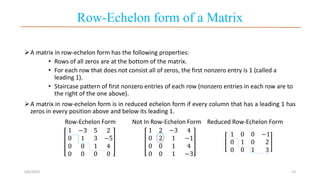
A matrix in row-echelon form has the following properties:
• Rows of all zeros are at the bottom of the matrix.
• For each row that does not consist all of zeros, the first nonzero entry is 1 (called a
leading 1).
• Staircase pattern of first nonzero entries of each row (nonzero entries in each row are to
the right of the one above).
A matrix in row-echelon form is in reduced echelon form if every column that has a leading 1 has
zeros in every position above and below its leading 1.
Row-Echelon Form Not In Row-Echelon Form Reduced Row-Echelon Form
1 −3 5 2
0 1 3 −5
0 0 1 4
0 0 0 0
1 2 −3 4
0 2 1 −1
0 0 1 4
0 0 1 −3
1 0 0 −1
0 1 0 2
0 0 1 3
6/6/2023 13
Gaussian Elimination with Back -Substation
Write the augmented matrix of the system of linear equations.
Use elementary row operations to rewrite the augmented matrix in row-echelon form.
Write the system of linear equations corresponding to the matrix in row-echelon form, and use
back substitution to find the solution.
6/6/2023 14
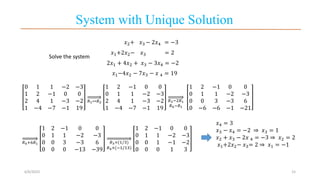
System with Unique Solution
6/6/2023 15
𝑥2+ 𝑥3 − 2𝑥4 = −3
𝑥1+2𝑥2− 𝑥3 = 2
2𝑥1 + 4𝑥2 + 𝑥3 − 3𝑥4 = −2
𝑥1−4𝑥2 − 7𝑥3 − 𝑥 4 = 19
Solve the system
0 1 1 −2 −3
1 2 −1 0 0
2 4 1 −3 −2
1 −4 −7 −1 19
𝑅1↔𝑅2
1 2 −1 0 0
0 1 1 −2 −3
2 4 1 −3 −2
1 −4 −7 −1 19
𝑅3−2𝑅1
𝑅4−𝑅1
1 2 −1 0 0
0 1 1 −2 −3
0 0 3 −3 6
0 −6 −6 −1 −21
𝑅4+6𝑅1
1 2 −1 0 0
0 1 1 −2 −3
0 0 3 −3 6
0 0 0 −13 −39
𝑅3×(1/3)
𝑅4×(−1/13)
1 2 −1 0 0
0 1 1 −2 −3
0 0 1 −1 −2
0 0 0 1 3
𝑥4 = 3
𝑥3 − 𝑥4 = −2 ⇒ 𝑥3 = 1
𝑥2 + 𝑥3 − 2𝑥 4 = −3 ⇒ 𝑥2 = 2
𝑥1+2𝑥2− 𝑥3= 2 ⇒ 𝑥1 = −1
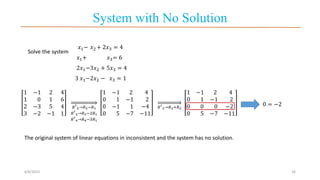
System with No Solution
6/6/2023 16
Solve the system
𝑥1− 𝑥2 + 2𝑥3 = 4
𝑥1+ 𝑥3= 6
2𝑥1−3𝑥2 + 5𝑥3 = 4
3 𝑥1−2𝑥2 − 𝑥3 = 1
1 −1 2 4
1 0 1 6
2 −3 5 4
3 −2 −1 1
𝑅′
2→𝑅2−𝑅1
𝑅′
3→𝑅3−2𝑅1
𝑅′
4→𝑅4−3𝑅1
1 −1 2 4
0 1 −1 2
0 −1 1 −4
0 5 −7 −11
𝑅′
3→𝑅3+𝑅2
1 −1 2 4
0 1 −1 2
0 0 0 −2
0 5 −7 −11
0 = −2
The original system of linear equations in inconsistent and the system has no solution.
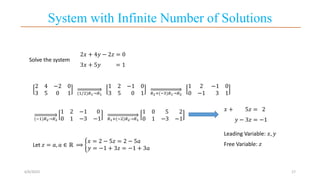
System with Infinite Number of Solutions
6/6/2023 17
Solve the system
2𝑥 + 4𝑦 − 2𝑧 = 0
3𝑥 + 5𝑦 = 1
2 4 −2 0
3 5 0 1 (1/2)𝑅1→𝑅1
1 2 −1 0
3 5 0 1 𝑅2+(−3)𝑅1→𝑅2
1 2 −1 0
0 −1 3 1
(−1)𝑅2→𝑅2
1 2 −1 0
0 1 −3 −1 𝑅1+(−2)𝑅2→𝑅1
1 0 5 2
0 1 −3 −1
𝑥 + 5𝑧 = 2
𝑦 − 3𝑧 = −1
Leading Variable: 𝑥, 𝑦
Free Variable: 𝑧
Let 𝑧 = 𝑎, 𝑎 ∈ ℝ ⟹
𝑥 = 2 − 5𝑧 = 2 − 5𝑎
𝑦 = −1 + 3𝑧 = −1 + 3𝑎
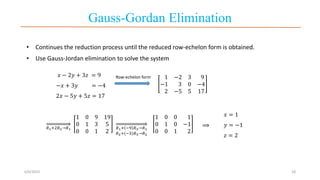
Gauss-Gordan Elimination
6/6/2023 18
𝑥 − 2𝑦 + 3𝑧 = 9
−𝑥 + 3𝑦 = −4
2𝑥 − 5𝑦 + 5𝑧 = 17
⟹
𝑥 = 1
𝑦 = −1
𝑧 = 2
• Continues the reduction process until the reduced row-echelon form is obtained.
• Use Gauss-Jordan elimination to solve the system
1 −2 3 9
−1 3 0 −4
2 −5 5 17
𝑅1+2𝑅2→𝑅1
1 0 9 19
0 1 3 5
0 0 1 2
𝑅1+ −9 𝑅3→𝑅1
𝑅2+(−3)𝑅3→𝑅2
1 0 0 1
0 1 0 −1
0 0 1 2
Row-echelon form
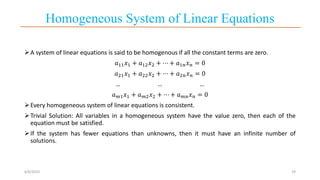
Homogeneous System of Linear Equations
A system of linear equations is said to be homogenous if all the constant terms are zero.
𝑎11𝑥1 + 𝑎12𝑥2 + ⋯ + 𝑎1𝑛𝑥𝑛 = 0
𝑎21𝑥1 + 𝑎22𝑥2 + ⋯ + 𝑎2𝑛𝑥𝑛 = 0
… … …
𝑎𝑚1𝑥1 + 𝑎𝑚2𝑥2 + ⋯ + 𝑎𝑚𝑛𝑥𝑛 = 0
Every homogeneous system of linear equations is consistent.
Trivial Solution: All variables in a homogeneous system have the value zero, then each of the
equation must be satisfied.
If the system has fewer equations than unknowns, then it must have an infinite number of
solutions.
6/6/2023 19
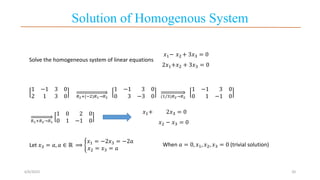
Solution of Homogenous System
6/6/2023 20
Solve the homogeneous system of linear equations
𝑥1− 𝑥2 + 3𝑥3 = 0
2𝑥1+𝑥2 + 3𝑥3 = 0
1 −1 3 0
2 1 3 0 𝑅2+(−2)𝑅1→𝑅2
1 −1 3 0
0 3 −3 0 (1/3)𝑅2→𝑅2
1 −1 3 0
0 1 −1 0
𝑅1+𝑅2→𝑅1
1 0 2 0
0 1 −1 0
𝑥1+ 2𝑥3 = 0
𝑥2 − 𝑥3 = 0
Let 𝑥3 = 𝑎, 𝑎 ∈ ℝ ⟹
𝑥1 = −2𝑥3 = −2𝑎
𝑥2 = 𝑥3 = 𝑎
When 𝑎 = 0, 𝑥1, 𝑥2, 𝑥3 = 0 (trivial solution)
Applications of System of Linear Equations
6/6/2023 21

LINEAR EQUATION.pptx

  • 1.
    Shahina Akter Ph.D. Fellow& M.S in Applied Mathematics, DU B.Sc in Mathematics, DU
  • 2.
    Linear Algebra Systems ofLinear Equations • Introduction to Systems of Linear Equations • Gaussian Elimination and Gauss-Jordan Elimination • Applications of Systems of Linear Equations Matrix Algebra • Matrices and Matrix Operations • Linear systems and Invertible Matrices 6/6/2023 2
  • 3.
    Objectives  Recognize, graph,and solve a system of linear equations in n unknowns.  Use back substitution to solve a system of linear equations.  Determine whether a system is consistent or inconsistent.  Determine if a matrix is in row-echelon form or reduced row-echelon form.  Use element row operations with back substitution to solve a system in row-echelon form.  Use elimination to rewrite a system in row-echelon form.  Write an augmented or coefficient matrix from a system of linear equations, or translate a matrix into a system of linear equations.  Solve a system of linear equations using Gaussian Elimination.  Solve a homogeneous system of linear equations. 6/6/2023 3
  • 4.
    Introduction An equation intwo or more variables is linear if it contains no products or powers of the variables. Linear Equations in two variables: 𝑎𝑥 + 𝑏𝑦 = 𝑐 Linear Equations in n variables: 𝑎1𝑥1 + 𝑎2𝑥2 + ⋯ + 𝑎𝑛𝑥𝑛 = 𝑏 • Coefficients: 𝑎1, 𝑎2, … 𝑎𝑛 ⟹ real number • Constant term: b ⟹ real number • Leading Coefficient: 𝑎1 • Leading Variable: 𝑥1 • Homogenous linear equation: 𝑏 = 0 • Non-homogeneous linear equation: 𝑏 ≠ 0 Linear equations have no products or roots of variables and no variables involved in trigonometric, exponential or logarithmic functions. Variables only appear to the first degree. 6/6/2023 4
  • 5.
    Systems of LinearEquations A system of m linear equations in n variables is a set of m linear equations: 𝑎11𝑥1 + 𝑎12𝑥2 + ⋯ + 𝑎1𝑛𝑥𝑛 = 𝑏1 𝑎21𝑥1 + 𝑎22𝑥2 + ⋯ + 𝑎2𝑛𝑥𝑛 = 𝑏2 … … … 𝑎𝑚1𝑥1 + 𝑎𝑚2𝑥2 + ⋯ + 𝑎𝑚𝑛𝑥𝑛 = 𝑏𝑚  𝑎𝑖𝑗 is the coefficient of 𝑥𝑗 in the 𝑖th equation. A system of linear equations has exactly one solution, an infinite number of solutions, or no solution. A system of linear equations is consistent if it has at least one solution and inconsistent if it has no solution. 6/6/2023 5
  • 6.
    Systems of LinearEquations Inconsistent Consistent No Solution Unique Solution More than one solution 6/6/2023 6
  • 7.
    Systems With TwoUnknowns  Solution of system of two linear equations in two variables: 𝑎1𝑥 + 𝑏1𝑦 = 𝑐1 𝑎2𝑥 + 𝑏2𝑦 = 𝑐2 6/6/2023 7
  • 8.
    Solving a Systemof Linear Equations Row-echelon form follows a stair-step pattern and has leading coefficient of 1. Using substitution to solve a system in row-echelon form. 6/6/2023 8 𝑥 − 2𝑦 + 3𝑧 = 9 Eq.1 𝑦 − 3𝑧 = 5 Eq.2 𝑧 = 2 Eq.3  𝑧 = 2 is known from Eq.3.  Substitute 𝑧 = 2 in Eq.2 to obtain 𝑦 = −1.  Substitute 𝑧 = 2 and 𝑦 = −1 in Eq.1 to obtain 𝑥 = 1.
  • 9.
    Gaussian Elimination andGauss-Jordan Elimination Definition of Matrix: A matrix is a rectangular array of numbers (real or complex) arranged in rows and columns. 𝑎11 𝑎12 ⋯ 𝑎1𝑛 𝑎21 𝑎22 ⋯ 𝑎2𝑛 ⋮ ⋮ ⋱ ⋮ 𝑎𝑚1 𝑎𝑚2 ⋯ 𝑎𝑚𝑛 A matrix with m rows and n columns is said to be of size 𝑚 × 𝑛. The entry 𝑎𝑖𝑗 is located in the 𝑖th row and 𝑗th column. If 𝑚 = 𝑛, the matrix is called a square matrix of order 𝑛. The entries 𝑎𝑖𝑗, 𝑖 = 𝑗 are called diagonal entries. 6/6/2023 9
  • 10.
    Augmented/Coefficient Matrix The matrixderived from the coefficients and constant terms of a system of linear equations is called the augmented matrix of the system. The matrix containing only the coefficients of the system is called the coefficient matrix of the system. System Augmented Matrix Coefficient Matrix 𝑥 − 2𝑦 + 3𝑧 = 9 −𝑥 + 3𝑦 = −4 2𝑥 − 5𝑦 + 5𝑧 = 17 6/6/2023 10 1 −2 3 9 −1 3 0 −4 2 −5 5 17 1 −2 3 −1 3 0 2 −5 5
  • 11.
    Elementary Row Operation Interchangetwo rows. Multiply a row by a nonzero constant. Add a multiple of a row to another row. 1 3 2 5 𝑅2+(−2)𝑅1→𝑅2 −2 −6 0 −1 Two matrices are said to be row equivalent if one can be obtained from another by a finite sequence of elementary row operations. 6/6/2023 11 1 3 2 5 𝑅1↔𝑅2 2 5 1 3 1 3 2 5 (−2)𝑅1→𝑅1 −2 −6 2 5
  • 12.
    Use of ElementaryRow Operations to Solve a System 6/6/2023 12 𝑥 − 2𝑦 + 3𝑧 = 9 −𝑥 + 3𝑦 = −4 2𝑥 − 5𝑦 + 5𝑧 = 17 1 −2 3 9 −1 3 0 −4 2 −5 5 17 Linear System Associated Augmented Matrix 1 −2 3 9 −1 3 0 −4 2 −5 5 17 𝑅1+𝑅2→𝑅2 𝑅3+(−2)𝑅1→𝑅3 1 −2 3 9 0 1 3 5 0 −1 −1 −1 𝑅3+𝑅2→𝑅3 1 −2 3 9 0 1 3 5 0 0 2 4 0.5𝑅3→𝑅3 1 −2 3 9 0 1 3 5 0 0 1 2 𝑧 = 2 𝑦 − 3𝑧 = 5 ⇒ 𝑦 = −1 𝑥 − 2𝑦 + 3𝑧 = 9 ⇒ 𝑥 = 1
  • 13.
    Row-Echelon form ofa Matrix A matrix in row-echelon form has the following properties: • Rows of all zeros are at the bottom of the matrix. • For each row that does not consist all of zeros, the first nonzero entry is 1 (called a leading 1). • Staircase pattern of first nonzero entries of each row (nonzero entries in each row are to the right of the one above). A matrix in row-echelon form is in reduced echelon form if every column that has a leading 1 has zeros in every position above and below its leading 1. Row-Echelon Form Not In Row-Echelon Form Reduced Row-Echelon Form 1 −3 5 2 0 1 3 −5 0 0 1 4 0 0 0 0 1 2 −3 4 0 2 1 −1 0 0 1 4 0 0 1 −3 1 0 0 −1 0 1 0 2 0 0 1 3 6/6/2023 13
  • 14.
    Gaussian Elimination withBack -Substation Write the augmented matrix of the system of linear equations. Use elementary row operations to rewrite the augmented matrix in row-echelon form. Write the system of linear equations corresponding to the matrix in row-echelon form, and use back substitution to find the solution. 6/6/2023 14
  • 15.
    System with UniqueSolution 6/6/2023 15 𝑥2+ 𝑥3 − 2𝑥4 = −3 𝑥1+2𝑥2− 𝑥3 = 2 2𝑥1 + 4𝑥2 + 𝑥3 − 3𝑥4 = −2 𝑥1−4𝑥2 − 7𝑥3 − 𝑥 4 = 19 Solve the system 0 1 1 −2 −3 1 2 −1 0 0 2 4 1 −3 −2 1 −4 −7 −1 19 𝑅1↔𝑅2 1 2 −1 0 0 0 1 1 −2 −3 2 4 1 −3 −2 1 −4 −7 −1 19 𝑅3−2𝑅1 𝑅4−𝑅1 1 2 −1 0 0 0 1 1 −2 −3 0 0 3 −3 6 0 −6 −6 −1 −21 𝑅4+6𝑅1 1 2 −1 0 0 0 1 1 −2 −3 0 0 3 −3 6 0 0 0 −13 −39 𝑅3×(1/3) 𝑅4×(−1/13) 1 2 −1 0 0 0 1 1 −2 −3 0 0 1 −1 −2 0 0 0 1 3 𝑥4 = 3 𝑥3 − 𝑥4 = −2 ⇒ 𝑥3 = 1 𝑥2 + 𝑥3 − 2𝑥 4 = −3 ⇒ 𝑥2 = 2 𝑥1+2𝑥2− 𝑥3= 2 ⇒ 𝑥1 = −1
  • 16.
    System with NoSolution 6/6/2023 16 Solve the system 𝑥1− 𝑥2 + 2𝑥3 = 4 𝑥1+ 𝑥3= 6 2𝑥1−3𝑥2 + 5𝑥3 = 4 3 𝑥1−2𝑥2 − 𝑥3 = 1 1 −1 2 4 1 0 1 6 2 −3 5 4 3 −2 −1 1 𝑅′ 2→𝑅2−𝑅1 𝑅′ 3→𝑅3−2𝑅1 𝑅′ 4→𝑅4−3𝑅1 1 −1 2 4 0 1 −1 2 0 −1 1 −4 0 5 −7 −11 𝑅′ 3→𝑅3+𝑅2 1 −1 2 4 0 1 −1 2 0 0 0 −2 0 5 −7 −11 0 = −2 The original system of linear equations in inconsistent and the system has no solution.
  • 17.
    System with InfiniteNumber of Solutions 6/6/2023 17 Solve the system 2𝑥 + 4𝑦 − 2𝑧 = 0 3𝑥 + 5𝑦 = 1 2 4 −2 0 3 5 0 1 (1/2)𝑅1→𝑅1 1 2 −1 0 3 5 0 1 𝑅2+(−3)𝑅1→𝑅2 1 2 −1 0 0 −1 3 1 (−1)𝑅2→𝑅2 1 2 −1 0 0 1 −3 −1 𝑅1+(−2)𝑅2→𝑅1 1 0 5 2 0 1 −3 −1 𝑥 + 5𝑧 = 2 𝑦 − 3𝑧 = −1 Leading Variable: 𝑥, 𝑦 Free Variable: 𝑧 Let 𝑧 = 𝑎, 𝑎 ∈ ℝ ⟹ 𝑥 = 2 − 5𝑧 = 2 − 5𝑎 𝑦 = −1 + 3𝑧 = −1 + 3𝑎
  • 18.
    Gauss-Gordan Elimination 6/6/2023 18 𝑥− 2𝑦 + 3𝑧 = 9 −𝑥 + 3𝑦 = −4 2𝑥 − 5𝑦 + 5𝑧 = 17 ⟹ 𝑥 = 1 𝑦 = −1 𝑧 = 2 • Continues the reduction process until the reduced row-echelon form is obtained. • Use Gauss-Jordan elimination to solve the system 1 −2 3 9 −1 3 0 −4 2 −5 5 17 𝑅1+2𝑅2→𝑅1 1 0 9 19 0 1 3 5 0 0 1 2 𝑅1+ −9 𝑅3→𝑅1 𝑅2+(−3)𝑅3→𝑅2 1 0 0 1 0 1 0 −1 0 0 1 2 Row-echelon form
  • 19.
    Homogeneous System ofLinear Equations A system of linear equations is said to be homogenous if all the constant terms are zero. 𝑎11𝑥1 + 𝑎12𝑥2 + ⋯ + 𝑎1𝑛𝑥𝑛 = 0 𝑎21𝑥1 + 𝑎22𝑥2 + ⋯ + 𝑎2𝑛𝑥𝑛 = 0 … … … 𝑎𝑚1𝑥1 + 𝑎𝑚2𝑥2 + ⋯ + 𝑎𝑚𝑛𝑥𝑛 = 0 Every homogeneous system of linear equations is consistent. Trivial Solution: All variables in a homogeneous system have the value zero, then each of the equation must be satisfied. If the system has fewer equations than unknowns, then it must have an infinite number of solutions. 6/6/2023 19
  • 20.
    Solution of HomogenousSystem 6/6/2023 20 Solve the homogeneous system of linear equations 𝑥1− 𝑥2 + 3𝑥3 = 0 2𝑥1+𝑥2 + 3𝑥3 = 0 1 −1 3 0 2 1 3 0 𝑅2+(−2)𝑅1→𝑅2 1 −1 3 0 0 3 −3 0 (1/3)𝑅2→𝑅2 1 −1 3 0 0 1 −1 0 𝑅1+𝑅2→𝑅1 1 0 2 0 0 1 −1 0 𝑥1+ 2𝑥3 = 0 𝑥2 − 𝑥3 = 0 Let 𝑥3 = 𝑎, 𝑎 ∈ ℝ ⟹ 𝑥1 = −2𝑥3 = −2𝑎 𝑥2 = 𝑥3 = 𝑎 When 𝑎 = 0, 𝑥1, 𝑥2, 𝑥3 = 0 (trivial solution)
  • 21.
    Applications of Systemof Linear Equations 6/6/2023 21