1
1.1
© 2016 Pearson Education, Ltd.
Linear Equations
in Linear Algebra
SYSTEMS OF
LINEAR EQUATIONS
Slide 1.1- 1
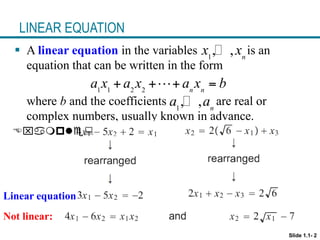
LINEAR EQUATION
 A linear equation in the variables is an
equation that can be written in the form
where b and the coefficients are real or
complex numbers, usually known in advance.
x1
,… ,xn
a1
,… ,an
Example:
Not linear:
Slide 1.1- 2
Linear equation
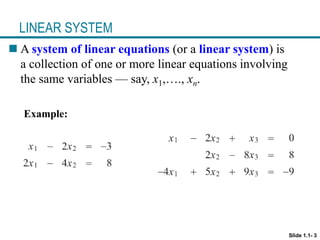
LINEAR SYSTEM
 A system of linear equations (or a linear system) is
a collection of one or more linear equations involving
the same variables — say, x1,…., xn.
Example:
Slide 1.1- 3
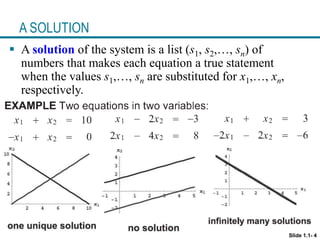
A SOLUTION
 A solution of the system is a list (s1, s2,…, sn) of
numbers that makes each equation a true statement
when the values s1,…, sn are substituted for x1,…, xn,
respectively.
Slide 1.1- 4
Slide 1.1- 5
© 2016 Pearson Education, Ltd.
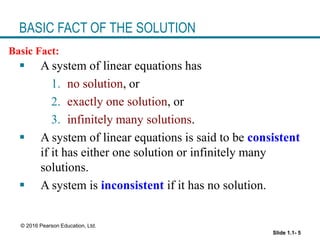
BASIC FACT OF THE SOLUTION
 A system of linear equations has
1. no solution, or
2. exactly one solution, or
3. infinitely many solutions.
 A system of linear equations is said to be consistent
if it has either one solution or infinitely many
solutions.
 A system is inconsistent if it has no solution.
Basic Fact:
Slide 1.1- 7
© 2016 Pearson Education, Ltd.
LINEAR EQUATION
 The solution set:
The set of all possible solutions of a linear system.
 Equivalent systems:
Two linear systems with the same solution set.
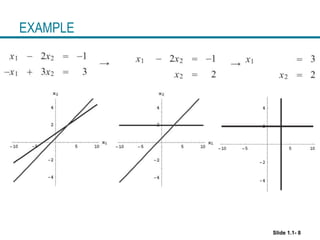
EXAMPLE
Slide 1.1- 8
Slide 1.1- 9
MATRIX NOTATION
 The essential information of a linear system can be
recorded compactly in a rectangular array called a
matrix.
Slide 1.1- 10
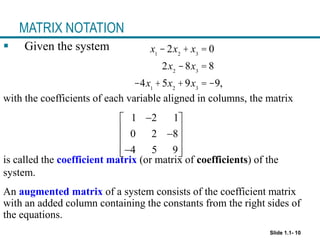
MATRIX NOTATION
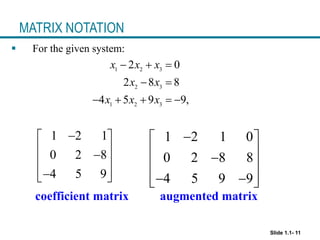
 Given the system
with the coefficients of each variable aligned in columns, the matrix
is called the coefficient matrix (or matrix of coefficients) of the
system.
1 2 1
0 2 8
4 5 9

 
 

 

 
 
x1
- 2x2
+ x3
= 0
2x2
-8x3
= 8
-4x1
+5x2
+9x3
= -9,
An augmented matrix of a system consists of the coefficient matrix
with an added column containing the constants from the right sides of
the equations.
Slide 1.1- 11
MATRIX NOTATION
 For the given system:
coefficient matrix augmented matrix
1 2 1
0 2 8
4 5 9

 
 

 

 
 
1 2 3
2 3
1 2 3
2 0
2 8 8
4 5 9 9,
x x x
x x
x x x
  
 
    
1 2 1 0
0 2 8 8
4 5 9 9

 
 

 
 
 
 
Slide 1.1- 12
© 2016 Pearson Education, Ltd.
MATRIX SIZE
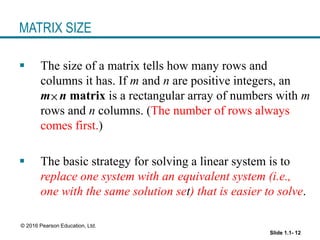
 The size of a matrix tells how many rows and
columns it has. If m and n are positive integers, an
m n matrix is a rectangular array of numbers with m
rows and n columns. (The number of rows always
comes first.)
 The basic strategy for solving a linear system is to
replace one system with an equivalent system (i.e.,
one with the same solution set) that is easier to solve.

Slide 1.1- 13
© 2016 Pearson Education, Ltd.
SOLVING SYSTEM OF EQUATIONS
 Example 1: Solve the given system of equations.
----(1)
----(2)
----(3)
 Solution: The elimination procedure is shown here
with and without matrix notation, and the results are
placed side by side for comparison.
1 2 3
2 3
1 2 3
2 0
2 8 8
4 5 9 9
x x x
x x
x x x
  
 
    
Slide 1.1- 14
© 2016 Pearson Education, Ltd.
SOLVING SYSTEM OF EQUATIONS
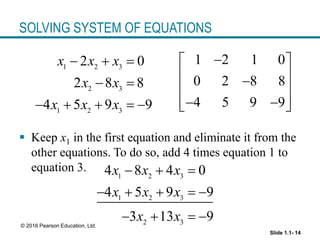
 Keep x1 in the first equation and eliminate it from the
other equations. To do so, add 4 times equation 1 to
equation 3.
1 2 3
2 3
1 2 3
2 0
2 8 8
4 5 9 9
x x x
x x
x x x
  
 
    
1 2 1 0
0 2 8 8
4 5 9 9

 
 

 
 
 
 
1 2 3
1 2 3
2 3
4 8 4 0
4 5 9 9
3 13 9
x x x
x x x
x x
  
    
   
Slide 1.1- 15
© 2016 Pearson Education, Ltd.
SOLVING SYSTEM OF EQUATIONS
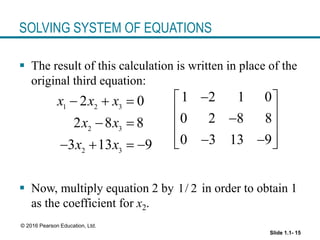
 The result of this calculation is written in place of the
original third equation:
 Now, multiply equation 2 by in order to obtain 1
as the coefficient for x2.
1 2 3
2 3
2 3
2 0
2 8 8
3 13 9
x x x
x x
x x
  
 
   
1 2 1 0
0 2 8 8
0 3 13 9

 
 

 
 
 
 
1/ 2
Slide 1.1- 16
© 2016 Pearson Education, Ltd.
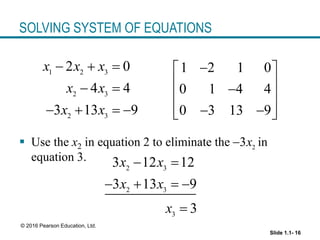
SOLVING SYSTEM OF EQUATIONS
 Use the x2 in equation 2 to eliminate the in
equation 3.
1 2 3
2 3
2 3
2 0
4 4
3 13 9
x x x
x x
x x
  
 
   
1 2 1 0
0 1 4 4
0 3 13 9

 
 

 
 
 
 
2
3x

2 3
2 3
3
3 12 12
3 13 9
3
x x
x x
x
 
   

Slide 1.1- 17
© 2016 Pearson Education, Ltd.
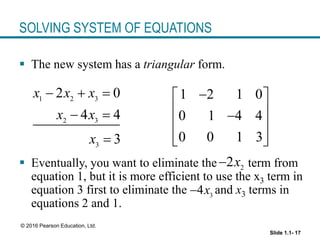
SOLVING SYSTEM OF EQUATIONS
 The new system has a triangular form.
 Eventually, you want to eliminate the term from
equation 1, but it is more efficient to use the x3 term in
equation 3 first to eliminate the and x3 terms in
equations 2 and 1.
1 2 3
2 3
3
2 0
4 4
3
x x x
x x
x
  
 

1 2 1 0
0 1 4 4
0 0 1 3

 
 

 
 
 
2
2x

3
4x

Slide 1.1- 18
© 2016 Pearson Education, Ltd.
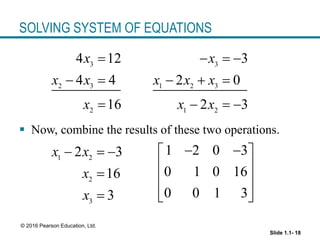
SOLVING SYSTEM OF EQUATIONS
3
2 3
2
4 12
4 4
16
x
x x
x

 

 Now, combine the results of these two operations.
3
1 2 3
1 2
3
2 0
2 3
x
x x x
x x
  
  
  
1 2
2
3
2 3
16
3
x x
x
x
  


1 2 0 3
0 1 0 16
0 0 1 3
 
 
 
 
 
 
Slide 1.1- 19
© 2016 Pearson Education, Ltd.
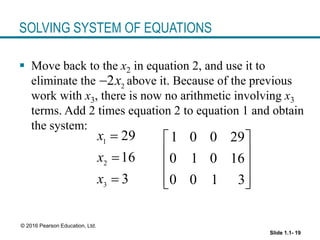
SOLVING SYSTEM OF EQUATIONS
 Move back to the x2 in equation 2, and use it to
eliminate the above it. Because of the previous
work with x3, there is now no arithmetic involving x3
terms. Add 2 times equation 2 to equation 1 and obtain
the system:
1
2
3
29
16
3
x
x
x



1 0 0 29
0 1 0 16
0 0 1 3
 
 
 
 
 
2
2x

Slide 1.1- 20
© 2016 Pearson Education, Ltd.
SOLVING SYSTEM OF EQUATIONS
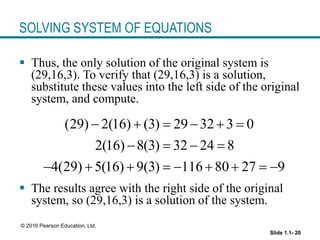
 Thus, the only solution of the original system is
(29,16,3). To verify that (29,16,3) is a solution,
substitute these values into the left side of the original
system, and compute.
 The results agree with the right side of the original
system, so (29,16,3) is a solution of the system.
(29) 2(16) (3) 29 32 3 0
2(16) 8(3) 32 24 8
4(29) 5(16) 9(3) 116 80 27 9
     
   
        
Slide 1.1- 21
© 2016 Pearson Education, Ltd.
ELEMENTARY ROW OPERATIONS
 Elementary row operations:
1. (Replacement) Replace one row by the sum of
itself and a multiple of another row.
2. (Interchange) Interchange two rows.
3. (Scaling) Multiply all entries in a row by a
nonzero constant.
 Two matrices are called row equivalent if there is a
sequence of elementary row operations that
transforms one matrix into the other.
Slide 1.1- 22
© 2016 Pearson Education, Ltd.
ELEMENTARY ROW OPERATIONS
 It is important to note that row operations are
reversible.
 If the augmented matrices of two linear systems are
row equivalent, then the two systems have the same
solution set.
Slide 1.1- 23
© 2016 Pearson Education, Ltd.
EXISTENCE AND UNIQUENESS OF
THE SOLUTION OF A LINEAR SYSTEM
 Two fundamental questions about a linear system
are as follows:
1. Is the system consistent; that is, does at least
one solution exist?
2. If a solution exists, is it the only one; that is, is
the solution unique?
Slide 1.1- 24
© 2016 Pearson Education, Ltd.
EXISTENCE AND UNIQUENESS OF
THE SOLUTION OF A LINEAR SYSTEM
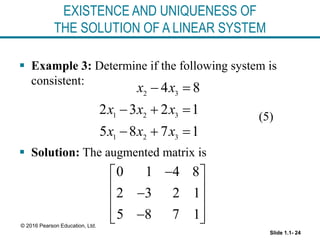
 Example 3: Determine if the following system is
consistent:
(5)
 Solution: The augmented matrix is
2 3
1 2 3
1 2 3
4 8
2 3 2 1
5 8 7 1
x x
x x x
x x x
 
  
  
0 1 4 8
2 3 2 1
5 8 7 1

 
 

 

 
 
Slide 1.1- 25
© 2016 Pearson Education, Ltd.
EXISTENCE AND UNIQUENESS OF
THE SOLUTION OF A LINEAR SYSTEM
 To obtain an x1 in in the first equation, interchange rows
1 and 2:
 To eliminate the 5x1 term in the third equation, add
times row 1 to row 3.
(6)
2 3 2 1
0 1 4 8
5 8 7 1

 
 

 

 
 
5/ 2

2 3 2 1
0 1 4 8
0 1/ 2 2 3/ 2

 
 

 
 
 
 
Slide 1.1- 26
© 2016 Pearson Education, Ltd.
EXISTENCE AND UNIQUENESS OF
THE SOLUTION OF A LINEAR SYSTEM
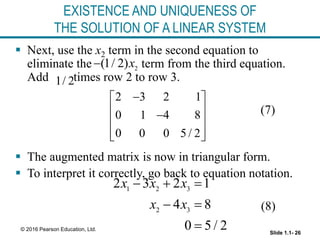
 Next, use the x2 term in the second equation to
eliminate the term from the third equation.
Add times row 2 to row 3.
(7)
 The augmented matrix is now in triangular form.
 To interpret it correctly, go back to equation notation.
(8)
2
(1/ 2)x

1/ 2
2 3 2 1
0 1 4 8
0 0 0 5 / 2

 
 

 
 
 
1 2 3
2 3
2 3 2 1
4 8
0 5 / 2
x x x
x x
  
 

Slide 1.1- 27
© 2016 Pearson Education, Ltd.
EXISTENCE AND UNIQUENESS OF
THE SOLUTION OF A LINEAR SYSTEM
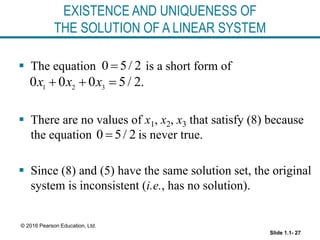
 The equation is a short form of
 There are no values of x1, x2, x3 that satisfy (8) because
the equation is never true.
 Since (8) and (5) have the same solution set, the original
system is inconsistent (i.e., has no solution).
0 5/ 2

1 2 3
0 0 0 5/ 2.
x x x
  
0 5/ 2

HOMEWORK ASSIGNMENTS
 EXERCISES 1.1, Page 10
 4.
 16.
 25.
Slide 1.2- 28

lay_linalg5_01_01.pptx

  • 1.
    1 1.1 © 2016 PearsonEducation, Ltd. Linear Equations in Linear Algebra SYSTEMS OF LINEAR EQUATIONS Slide 1.1- 1
  • 2.
    LINEAR EQUATION  Alinear equation in the variables is an equation that can be written in the form where b and the coefficients are real or complex numbers, usually known in advance. x1 ,… ,xn a1 ,… ,an Example: Not linear: Slide 1.1- 2 Linear equation
  • 3.
    LINEAR SYSTEM  Asystem of linear equations (or a linear system) is a collection of one or more linear equations involving the same variables — say, x1,…., xn. Example: Slide 1.1- 3
  • 4.
    A SOLUTION  Asolution of the system is a list (s1, s2,…, sn) of numbers that makes each equation a true statement when the values s1,…, sn are substituted for x1,…, xn, respectively. Slide 1.1- 4
  • 5.
    Slide 1.1- 5 ©2016 Pearson Education, Ltd. BASIC FACT OF THE SOLUTION  A system of linear equations has 1. no solution, or 2. exactly one solution, or 3. infinitely many solutions.  A system of linear equations is said to be consistent if it has either one solution or infinitely many solutions.  A system is inconsistent if it has no solution. Basic Fact:
  • 6.
    Slide 1.1- 7 ©2016 Pearson Education, Ltd. LINEAR EQUATION  The solution set: The set of all possible solutions of a linear system.  Equivalent systems: Two linear systems with the same solution set.
  • 7.
  • 8.
    Slide 1.1- 9 MATRIXNOTATION  The essential information of a linear system can be recorded compactly in a rectangular array called a matrix.
  • 9.
    Slide 1.1- 10 MATRIXNOTATION  Given the system with the coefficients of each variable aligned in columns, the matrix is called the coefficient matrix (or matrix of coefficients) of the system. 1 2 1 0 2 8 4 5 9              x1 - 2x2 + x3 = 0 2x2 -8x3 = 8 -4x1 +5x2 +9x3 = -9, An augmented matrix of a system consists of the coefficient matrix with an added column containing the constants from the right sides of the equations.
  • 10.
    Slide 1.1- 11 MATRIXNOTATION  For the given system: coefficient matrix augmented matrix 1 2 1 0 2 8 4 5 9              1 2 3 2 3 1 2 3 2 0 2 8 8 4 5 9 9, x x x x x x x x           1 2 1 0 0 2 8 8 4 5 9 9              
  • 11.
    Slide 1.1- 12 ©2016 Pearson Education, Ltd. MATRIX SIZE  The size of a matrix tells how many rows and columns it has. If m and n are positive integers, an m n matrix is a rectangular array of numbers with m rows and n columns. (The number of rows always comes first.)  The basic strategy for solving a linear system is to replace one system with an equivalent system (i.e., one with the same solution set) that is easier to solve. 
  • 12.
    Slide 1.1- 13 ©2016 Pearson Education, Ltd. SOLVING SYSTEM OF EQUATIONS  Example 1: Solve the given system of equations. ----(1) ----(2) ----(3)  Solution: The elimination procedure is shown here with and without matrix notation, and the results are placed side by side for comparison. 1 2 3 2 3 1 2 3 2 0 2 8 8 4 5 9 9 x x x x x x x x          
  • 13.
    Slide 1.1- 14 ©2016 Pearson Education, Ltd. SOLVING SYSTEM OF EQUATIONS  Keep x1 in the first equation and eliminate it from the other equations. To do so, add 4 times equation 1 to equation 3. 1 2 3 2 3 1 2 3 2 0 2 8 8 4 5 9 9 x x x x x x x x           1 2 1 0 0 2 8 8 4 5 9 9               1 2 3 1 2 3 2 3 4 8 4 0 4 5 9 9 3 13 9 x x x x x x x x            
  • 14.
    Slide 1.1- 15 ©2016 Pearson Education, Ltd. SOLVING SYSTEM OF EQUATIONS  The result of this calculation is written in place of the original third equation:  Now, multiply equation 2 by in order to obtain 1 as the coefficient for x2. 1 2 3 2 3 2 3 2 0 2 8 8 3 13 9 x x x x x x x          1 2 1 0 0 2 8 8 0 3 13 9               1/ 2
  • 15.
    Slide 1.1- 16 ©2016 Pearson Education, Ltd. SOLVING SYSTEM OF EQUATIONS  Use the x2 in equation 2 to eliminate the in equation 3. 1 2 3 2 3 2 3 2 0 4 4 3 13 9 x x x x x x x          1 2 1 0 0 1 4 4 0 3 13 9               2 3x  2 3 2 3 3 3 12 12 3 13 9 3 x x x x x       
  • 16.
    Slide 1.1- 17 ©2016 Pearson Education, Ltd. SOLVING SYSTEM OF EQUATIONS  The new system has a triangular form.  Eventually, you want to eliminate the term from equation 1, but it is more efficient to use the x3 term in equation 3 first to eliminate the and x3 terms in equations 2 and 1. 1 2 3 2 3 3 2 0 4 4 3 x x x x x x       1 2 1 0 0 1 4 4 0 0 1 3             2 2x  3 4x 
  • 17.
    Slide 1.1- 18 ©2016 Pearson Education, Ltd. SOLVING SYSTEM OF EQUATIONS 3 2 3 2 4 12 4 4 16 x x x x      Now, combine the results of these two operations. 3 1 2 3 1 2 3 2 0 2 3 x x x x x x          1 2 2 3 2 3 16 3 x x x x      1 2 0 3 0 1 0 16 0 0 1 3            
  • 18.
    Slide 1.1- 19 ©2016 Pearson Education, Ltd. SOLVING SYSTEM OF EQUATIONS  Move back to the x2 in equation 2, and use it to eliminate the above it. Because of the previous work with x3, there is now no arithmetic involving x3 terms. Add 2 times equation 2 to equation 1 and obtain the system: 1 2 3 29 16 3 x x x    1 0 0 29 0 1 0 16 0 0 1 3           2 2x 
  • 19.
    Slide 1.1- 20 ©2016 Pearson Education, Ltd. SOLVING SYSTEM OF EQUATIONS  Thus, the only solution of the original system is (29,16,3). To verify that (29,16,3) is a solution, substitute these values into the left side of the original system, and compute.  The results agree with the right side of the original system, so (29,16,3) is a solution of the system. (29) 2(16) (3) 29 32 3 0 2(16) 8(3) 32 24 8 4(29) 5(16) 9(3) 116 80 27 9                   
  • 20.
    Slide 1.1- 21 ©2016 Pearson Education, Ltd. ELEMENTARY ROW OPERATIONS  Elementary row operations: 1. (Replacement) Replace one row by the sum of itself and a multiple of another row. 2. (Interchange) Interchange two rows. 3. (Scaling) Multiply all entries in a row by a nonzero constant.  Two matrices are called row equivalent if there is a sequence of elementary row operations that transforms one matrix into the other.
  • 21.
    Slide 1.1- 22 ©2016 Pearson Education, Ltd. ELEMENTARY ROW OPERATIONS  It is important to note that row operations are reversible.  If the augmented matrices of two linear systems are row equivalent, then the two systems have the same solution set.
  • 22.
    Slide 1.1- 23 ©2016 Pearson Education, Ltd. EXISTENCE AND UNIQUENESS OF THE SOLUTION OF A LINEAR SYSTEM  Two fundamental questions about a linear system are as follows: 1. Is the system consistent; that is, does at least one solution exist? 2. If a solution exists, is it the only one; that is, is the solution unique?
  • 23.
    Slide 1.1- 24 ©2016 Pearson Education, Ltd. EXISTENCE AND UNIQUENESS OF THE SOLUTION OF A LINEAR SYSTEM  Example 3: Determine if the following system is consistent: (5)  Solution: The augmented matrix is 2 3 1 2 3 1 2 3 4 8 2 3 2 1 5 8 7 1 x x x x x x x x         0 1 4 8 2 3 2 1 5 8 7 1             
  • 24.
    Slide 1.1- 25 ©2016 Pearson Education, Ltd. EXISTENCE AND UNIQUENESS OF THE SOLUTION OF A LINEAR SYSTEM  To obtain an x1 in in the first equation, interchange rows 1 and 2:  To eliminate the 5x1 term in the third equation, add times row 1 to row 3. (6) 2 3 2 1 0 1 4 8 5 8 7 1              5/ 2  2 3 2 1 0 1 4 8 0 1/ 2 2 3/ 2              
  • 25.
    Slide 1.1- 26 ©2016 Pearson Education, Ltd. EXISTENCE AND UNIQUENESS OF THE SOLUTION OF A LINEAR SYSTEM  Next, use the x2 term in the second equation to eliminate the term from the third equation. Add times row 2 to row 3. (7)  The augmented matrix is now in triangular form.  To interpret it correctly, go back to equation notation. (8) 2 (1/ 2)x  1/ 2 2 3 2 1 0 1 4 8 0 0 0 5 / 2             1 2 3 2 3 2 3 2 1 4 8 0 5 / 2 x x x x x      
  • 26.
    Slide 1.1- 27 ©2016 Pearson Education, Ltd. EXISTENCE AND UNIQUENESS OF THE SOLUTION OF A LINEAR SYSTEM  The equation is a short form of  There are no values of x1, x2, x3 that satisfy (8) because the equation is never true.  Since (8) and (5) have the same solution set, the original system is inconsistent (i.e., has no solution). 0 5/ 2  1 2 3 0 0 0 5/ 2. x x x    0 5/ 2 
  • 27.
    HOMEWORK ASSIGNMENTS  EXERCISES1.1, Page 10  4.  16.  25. Slide 1.2- 28