Production of Nano Magnetic Materials:
BALL MILLING METHOD
PRESENTED BY: M.Ali Raza
SUPERVISED BY: DR. Ajaz-un-Nabi
Roll No: 230939
MPhil Physics (Nanotechnology)
Table of contents:
1. Synthesis of Nano Materials(Techniques)
2. Ball Milling
 History
 Definition
 Ball milling process
 Construction
 Parameters
 Types
3. Applications of Ball milling
4. Characterization
5. Conclusion
Synthesis of Nano Materials
Top-Down Approach
Breakdown of large materials
 Carving or sculpting-
Wide size distribution
 Less control over size, shape,
composition
 More defects, contamination
Bottom-Up Approach
 Assembly of single atoms,
molecules
 Precise control over size, shape,
composition
Fewer defects, homogenous
composition
Narrow size distribution
 More straightforward, precise
synthesis
History of Ball Milling
.
 Invented in 1870 by Friedrich Fischer
 Initially used for grinding cement and
coal
 Later adapted for mechanical alloying
and nanomaterial synthesis
BALL MILLING
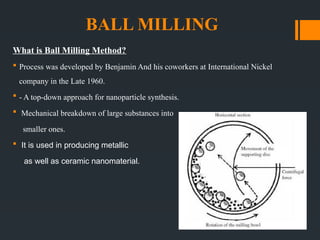
What is Ball Milling Method?
 Process was developed by Benjamin And his coworkers at International Nickel
company in the Late 1960.
 - A top-down approach for nanoparticle synthesis.
 Mechanical breakdown of large substances into
smaller ones.
 It is used in producing metallic
as well as ceramic nanomaterial.
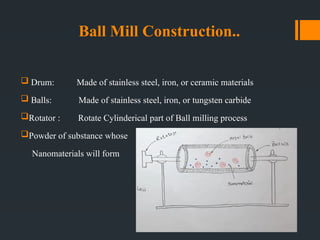
Ball Mill Construction..
 Drum: Made of stainless steel, iron, or ceramic materials
 Balls: Made of stainless steel, iron, or tungsten carbide
Rotator : Rotate Cylinderical part of Ball milling process
Powder of substance whose
Nanomaterials will form
Working of Ball Milling
.
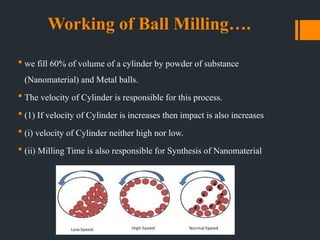
 we fill 60% of volume of a cylinder by powder of substance
(Nanomaterial) and Metal balls.
 The velocity of Cylinder is responsible for this process.
 (1) If velocity of Cylinder is increases then impact is also increases
 (i) velocity of Cylinder neither high nor low.
 (ii) Milling Time is also responsible for Synthesis of Nanomaterial
Ball Milling Parameters..
 Ball size and material
 Rotation speed: Approx (31.94) rev per min
 Milling time 100-150 hrs
 Ball-to-material mass ratio 10:1 to 20:1
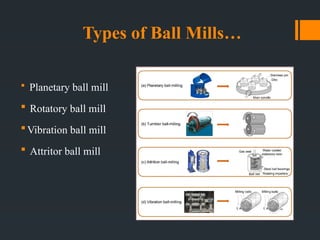
Types of Ball Mills

 Planetary ball mill
 Rotatory ball mill
Vibration ball mill
 Attritor ball mill
Applications of Ball Milling..
 Synthesis of metal oxides
 Synthesis of ceramics
 Synthesis of polymers
 Synthesis of magnetic materials
Characterization of Nanomaterial's
 X-ray diffraction (XRD)
 Transmission electron microscopy (TEM)
 Scanning electron microscopy (SEM)
 Dynamic light scattering (DLS)
Advantages Disadvantages
Can be used dry or wet
 High efficiency
Versatility
 Scalability
 Optimal milling parameters
 Bulky size
 Energy consumption
 Contamination
 Limited control over
particle shape and size
distribution
 Noise
 Slow process
Conclusion
Summary:
Ball milling is a cost-effective and efficient method for synthesizing
nanomaterial.
Future outlook:
Continued research and development to overcome challenges and improve
properties.
Ball milling method for nanomaterials synthesis

Ball milling method for nanomaterials synthesis

  • 2.
    Production of NanoMagnetic Materials: BALL MILLING METHOD PRESENTED BY: M.Ali Raza SUPERVISED BY: DR. Ajaz-un-Nabi Roll No: 230939 MPhil Physics (Nanotechnology)
  • 3.
    Table of contents: 1.Synthesis of Nano Materials(Techniques) 2. Ball Milling  History  Definition  Ball milling process  Construction  Parameters  Types 3. Applications of Ball milling 4. Characterization 5. Conclusion
  • 4.
    Synthesis of NanoMaterials Top-Down Approach Breakdown of large materials  Carving or sculpting- Wide size distribution  Less control over size, shape, composition  More defects, contamination Bottom-Up Approach  Assembly of single atoms, molecules  Precise control over size, shape, composition Fewer defects, homogenous composition Narrow size distribution  More straightforward, precise synthesis
  • 5.
    History of BallMilling
.  Invented in 1870 by Friedrich Fischer  Initially used for grinding cement and coal  Later adapted for mechanical alloying and nanomaterial synthesis
  • 6.
    BALL MILLING What isBall Milling Method?  Process was developed by Benjamin And his coworkers at International Nickel company in the Late 1960.  - A top-down approach for nanoparticle synthesis.  Mechanical breakdown of large substances into smaller ones.  It is used in producing metallic as well as ceramic nanomaterial.
  • 7.
    Ball Mill Construction.. Drum: Made of stainless steel, iron, or ceramic materials  Balls: Made of stainless steel, iron, or tungsten carbide Rotator : Rotate Cylinderical part of Ball milling process Powder of substance whose Nanomaterials will form
  • 8.
    Working of BallMilling
.  we fill 60% of volume of a cylinder by powder of substance (Nanomaterial) and Metal balls.  The velocity of Cylinder is responsible for this process.  (1) If velocity of Cylinder is increases then impact is also increases  (i) velocity of Cylinder neither high nor low.  (ii) Milling Time is also responsible for Synthesis of Nanomaterial
  • 9.
    Ball Milling Parameters.. Ball size and material  Rotation speed: Approx (31.94) rev per min  Milling time 100-150 hrs  Ball-to-material mass ratio 10:1 to 20:1
  • 10.
    Types of BallMills
  Planetary ball mill  Rotatory ball mill Vibration ball mill  Attritor ball mill
  • 11.
    Applications of BallMilling..  Synthesis of metal oxides  Synthesis of ceramics  Synthesis of polymers  Synthesis of magnetic materials
  • 12.
    Characterization of Nanomaterial's X-ray diffraction (XRD)  Transmission electron microscopy (TEM)  Scanning electron microscopy (SEM)  Dynamic light scattering (DLS)
  • 13.
    Advantages Disadvantages Can beused dry or wet  High efficiency Versatility  Scalability  Optimal milling parameters  Bulky size  Energy consumption  Contamination  Limited control over particle shape and size distribution  Noise  Slow process
  • 14.
    Conclusion Summary: Ball milling isa cost-effective and efficient method for synthesizing nanomaterial. Future outlook: Continued research and development to overcome challenges and improve properties.