Indian Institute of Technology Goa
Research Progress presentation on
Synthesis and Classification of Nanostructured
materials
Presented By:
XYZ
Ph.D.
Department of Materials Engineering
Doctoral Advisor:
XYZ,
Assistant Professor
School of Chemical and Materials Science
Content
 Nanostructures materials and Its Classification
 Synthesis methods
Top-down approach
Bottom-up approach
 Hydrothermal/Solvothermal method
 Sol-gel methods
 Literature review
Nanostructured materials
• The term “nanostructure” is used for materials with at least one dimension in
the range of 1–100 nm.
Classification of Nanostructured materials
1) Zero-dimensional (0D) nanostructures
• all dimensions below 100nm
• nanoparticles, nanospheres, quantum dots and nanodots
2) One-dimensional (1D) nanostructures
• only two dimension below 100nm
• nanotubes, nanorods, nanobelts, nanoneedles, nanoribbons and nanowires,
nanofibers
3) Two-dimensional (2D) nanostructures
• only one dimension below 100nm
• thin films, nanocoatings, nanolayers nanoprisms, nanoplates, nanosheets,
nanowalls, and nanodisks
4) Three-dimensional (3D) nanostructures
• all three dimensions above 100nm
• nanoballs, nanocoils, nanocones, nanopillers, nanoflower
Synthesis of Nanostructured Materials
 Top-down approach
• nanostructured materials are derived by reducing bulk materials into the
desired nanometer size materials by mechanical milling, lithography,
etching etc.
 Bottom-up approach
• nanostructured material is obtained from the atomic or molecular level and
gradually assembled until the desired structure is formed.
Top Down Approach Bottom Up Approach
Sputtering technique Hydrothermal and solvothermal
Lithography processes Sol–gel technique
Etching Chemical vapour deposition
Mechanical Milling Electrochemical deposition
Laser pyrolysis
Hydrothermal and solvothermal techniques
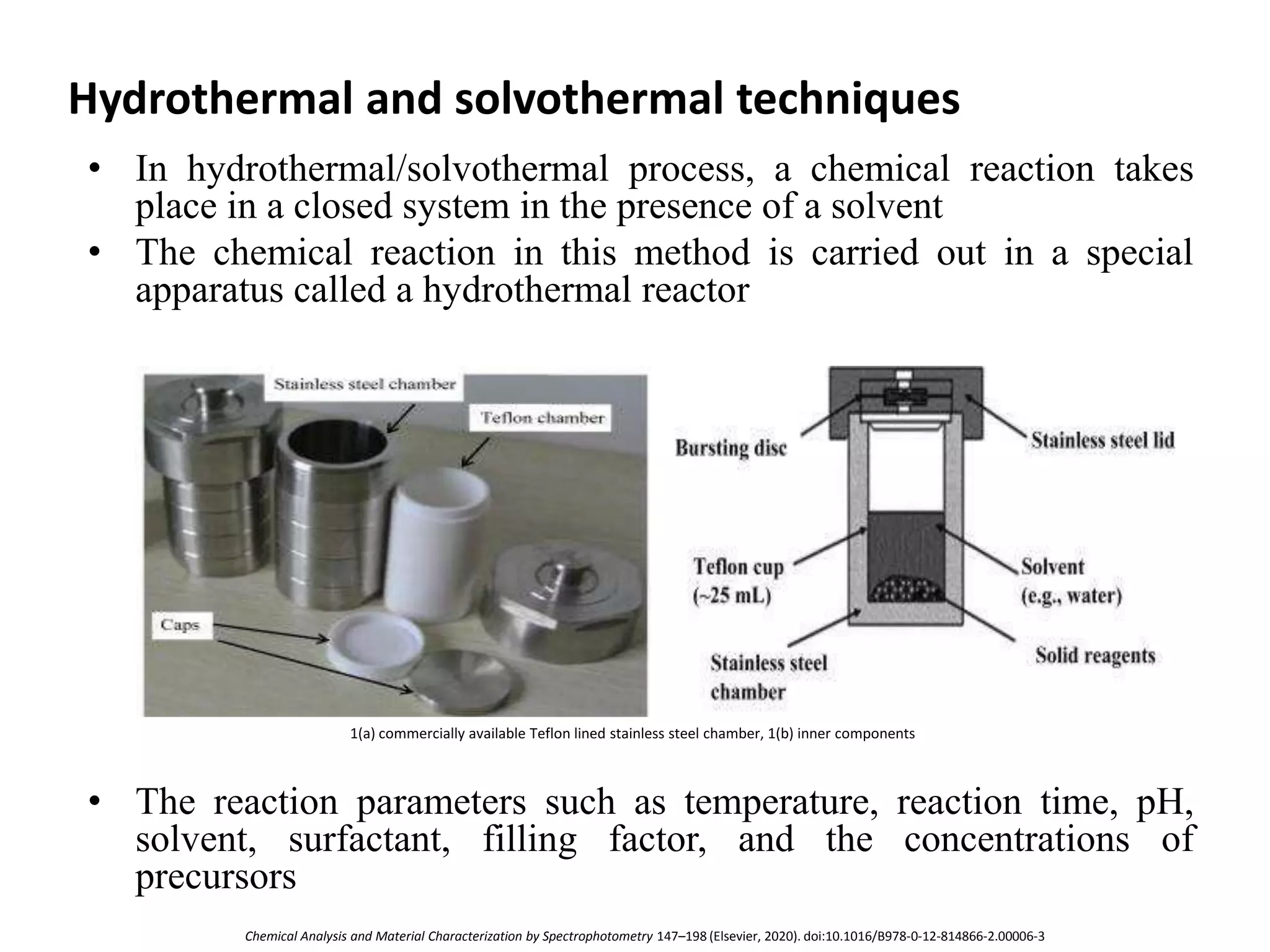
• In hydrothermal/solvothermal process, a chemical reaction takes
place in a closed system in the presence of a solvent
• The chemical reaction in this method is carried out in a special
apparatus called a hydrothermal reactor
• The reaction parameters such as temperature, reaction time, pH,
solvent, surfactant, filling factor, and the concentrations of
precursors
1(a) commercially available Teflon lined stainless steel chamber, 1(b) inner components
Chemical Analysis and Material Characterization by Spectrophotometry 147–198 (Elsevier, 2020). doi:10.1016/B978-0-12-814866-2.00006-3
Yu et al. investigate surfactant's role in tungsten oxide and its hydrates with
different morphologies
Figure 1. SEM image of the synthesized compound under different conditions;
1(a, b). Irregular shape
particles with no
surfactant [50-100nm],
1(c, d). Nanorods structure
in presence of K2SO4
[length-5μm, dimensions-
60-90nm]
1(e, f). Square
shape nanoplates in the
presence of oxalic acid (OA)
[edge length-300nm,
thickness-40nm]
1(g, h). 3D hierarchical
architectures in the presence
of higher OA
Ref: Phys. E Low-dimensional Syst. Nanostructures 79, 127–132 (2016)
Sol-gel technique
• In this technique, the molecular precursor is dissolved in solvent to form
sol and the sol is converted into a gel
• The following steps involved sol-gel method;
a) hydrolysis of the precursor and solvents
b) polycondensation reaction takes place
c) Drying
d) Calcination
• The morphology and dimensions of the final product depend on various factors
such as type of solvent, precursor nature, hydrolysis rate, pH, and temperature
Schematic of different stages of sol-gel process
pH=3, 70nm diameter pH=5, 100nm diameter pH=11, 200nm diameter
TEM images for samples with different pH value
Ref: AIP Conference Proceedings 1787, 050011 (2016).
• Lee et al. synthesized the ZnO nanoparticles by sol-gel method and studied pH's
effect on the particles sizes.
• smaller size nanoparticles obtained at lower pH precursor
Literature review based on these techniques
Compound Morphology Raw Materials Conditions Techniques Ref
.
Co3O4 a) Nanobelts
b) Nanoparticles
Co5(OH)6(CO3)2.nH2O, NH3.H2O,
and deionized water
a) 12h at 180℃
b) 12h at 140℃
Hydrothermal/solvot
hermal method
[1]
ZnO a) 3D flower like
b) 2D nanosheets
c) 1D nanorods
d) 0D spherical shape
Zn(NO3)2.6H2O (0.5M) and NaOH
(5M), and distilled water
a) 2h at [125-150]℃
b) 2h at [100-125]℃
c) 5h at 120℃
d) 2h at 150℃
Hydrothermal
method
[2]
ZnS Nanoparticles ZnSO4.5H2O, Na2S.7H2O, and
deionized water
12h at 220℃ Hydrothermal
method
[3]
TiO2 Nanowires TiO2 powder (Degussa P25), NaOH
(15M)
72h at 170℃ Hydrothermal
method
[4]
ZnO Nanoparticles Zn(CH3CO2)2 (Zinc acetate), citric
acid
2days (sol.)
3days dried (for powder
formation)
Sol-gel method [5]
ZnO Nanorods Zinc Acetate Dihydrate
(Zn(CH3COO)2.2H2O), NaOH,
Ethanol (CH2COOH) and distilled
water.
Few hour Sol-gel method [6]
Reference
1. Sun, L., Li, H., Ren, L. & Hu, C. Synthesis of Co3O4 nanostructures using a
solvothermal approach. Solid State Sci. 11, 108–112 (2009).
2. Mohan, S., Vellakkat, M., Aravind, A. & U, R. Hydrothermal synthesis and
characterization of Zinc Oxide nanoparticles of various shapes under different
reaction conditions. Nano Express 1, 030028 (2020).
3. Hoa, T. T. Q., Vu, L. Van, Canh, T. D. & Long, N. N. Preparation of ZnS
nanoparticles by hydrothermal method. J. Phys. Conf. Ser. 187, 012081 (2009).
4. Półrolniczak, P. & Walkowiak, M. Titanium dioxide high aspect ratio
nanoparticle hydrothermal synthesis optimization. Open Chem. 13, 75–81
(2015).
5. Lee, K., Guan, B. H., Zaid, H. M., Soleimani, H. & Ching, D. L. C. Impact of
pH on zinc oxide particle size by using sol-gel process. in AIP Conference
Proceedings 1787, 050011 (2016).
6. Hasnidawani, J. N. et al. Synthesis of ZnO Nanostructures Using Sol-Gel
Method. Procedia Chem. 19, 211–216 (2016).
Thank You.

Synthesis and Classification of Nanostructured materials.pptx

  • 1.
    Indian Institute ofTechnology Goa Research Progress presentation on Synthesis and Classification of Nanostructured materials Presented By: XYZ Ph.D. Department of Materials Engineering Doctoral Advisor: XYZ, Assistant Professor School of Chemical and Materials Science
  • 2.
    Content  Nanostructures materialsand Its Classification  Synthesis methods Top-down approach Bottom-up approach  Hydrothermal/Solvothermal method  Sol-gel methods  Literature review
  • 3.
    Nanostructured materials • Theterm “nanostructure” is used for materials with at least one dimension in the range of 1–100 nm. Classification of Nanostructured materials 1) Zero-dimensional (0D) nanostructures • all dimensions below 100nm • nanoparticles, nanospheres, quantum dots and nanodots 2) One-dimensional (1D) nanostructures • only two dimension below 100nm • nanotubes, nanorods, nanobelts, nanoneedles, nanoribbons and nanowires, nanofibers 3) Two-dimensional (2D) nanostructures • only one dimension below 100nm • thin films, nanocoatings, nanolayers nanoprisms, nanoplates, nanosheets, nanowalls, and nanodisks 4) Three-dimensional (3D) nanostructures • all three dimensions above 100nm • nanoballs, nanocoils, nanocones, nanopillers, nanoflower
  • 4.
    Synthesis of NanostructuredMaterials  Top-down approach • nanostructured materials are derived by reducing bulk materials into the desired nanometer size materials by mechanical milling, lithography, etching etc.  Bottom-up approach • nanostructured material is obtained from the atomic or molecular level and gradually assembled until the desired structure is formed. Top Down Approach Bottom Up Approach Sputtering technique Hydrothermal and solvothermal Lithography processes Sol–gel technique Etching Chemical vapour deposition Mechanical Milling Electrochemical deposition Laser pyrolysis
  • 5.
    Hydrothermal and solvothermaltechniques • In hydrothermal/solvothermal process, a chemical reaction takes place in a closed system in the presence of a solvent • The chemical reaction in this method is carried out in a special apparatus called a hydrothermal reactor • The reaction parameters such as temperature, reaction time, pH, solvent, surfactant, filling factor, and the concentrations of precursors 1(a) commercially available Teflon lined stainless steel chamber, 1(b) inner components Chemical Analysis and Material Characterization by Spectrophotometry 147–198 (Elsevier, 2020). doi:10.1016/B978-0-12-814866-2.00006-3
  • 6.
    Yu et al.investigate surfactant's role in tungsten oxide and its hydrates with different morphologies Figure 1. SEM image of the synthesized compound under different conditions; 1(a, b). Irregular shape particles with no surfactant [50-100nm], 1(c, d). Nanorods structure in presence of K2SO4 [length-5μm, dimensions- 60-90nm] 1(e, f). Square shape nanoplates in the presence of oxalic acid (OA) [edge length-300nm, thickness-40nm] 1(g, h). 3D hierarchical architectures in the presence of higher OA Ref: Phys. E Low-dimensional Syst. Nanostructures 79, 127–132 (2016)
  • 7.
    Sol-gel technique • Inthis technique, the molecular precursor is dissolved in solvent to form sol and the sol is converted into a gel • The following steps involved sol-gel method; a) hydrolysis of the precursor and solvents b) polycondensation reaction takes place c) Drying d) Calcination • The morphology and dimensions of the final product depend on various factors such as type of solvent, precursor nature, hydrolysis rate, pH, and temperature Schematic of different stages of sol-gel process
  • 8.
    pH=3, 70nm diameterpH=5, 100nm diameter pH=11, 200nm diameter TEM images for samples with different pH value Ref: AIP Conference Proceedings 1787, 050011 (2016). • Lee et al. synthesized the ZnO nanoparticles by sol-gel method and studied pH's effect on the particles sizes. • smaller size nanoparticles obtained at lower pH precursor
  • 9.
    Literature review basedon these techniques Compound Morphology Raw Materials Conditions Techniques Ref . Co3O4 a) Nanobelts b) Nanoparticles Co5(OH)6(CO3)2.nH2O, NH3.H2O, and deionized water a) 12h at 180℃ b) 12h at 140℃ Hydrothermal/solvot hermal method [1] ZnO a) 3D flower like b) 2D nanosheets c) 1D nanorods d) 0D spherical shape Zn(NO3)2.6H2O (0.5M) and NaOH (5M), and distilled water a) 2h at [125-150]℃ b) 2h at [100-125]℃ c) 5h at 120℃ d) 2h at 150℃ Hydrothermal method [2] ZnS Nanoparticles ZnSO4.5H2O, Na2S.7H2O, and deionized water 12h at 220℃ Hydrothermal method [3] TiO2 Nanowires TiO2 powder (Degussa P25), NaOH (15M) 72h at 170℃ Hydrothermal method [4] ZnO Nanoparticles Zn(CH3CO2)2 (Zinc acetate), citric acid 2days (sol.) 3days dried (for powder formation) Sol-gel method [5] ZnO Nanorods Zinc Acetate Dihydrate (Zn(CH3COO)2.2H2O), NaOH, Ethanol (CH2COOH) and distilled water. Few hour Sol-gel method [6]
  • 10.
    Reference 1. Sun, L.,Li, H., Ren, L. & Hu, C. Synthesis of Co3O4 nanostructures using a solvothermal approach. Solid State Sci. 11, 108–112 (2009). 2. Mohan, S., Vellakkat, M., Aravind, A. & U, R. Hydrothermal synthesis and characterization of Zinc Oxide nanoparticles of various shapes under different reaction conditions. Nano Express 1, 030028 (2020). 3. Hoa, T. T. Q., Vu, L. Van, Canh, T. D. & Long, N. N. Preparation of ZnS nanoparticles by hydrothermal method. J. Phys. Conf. Ser. 187, 012081 (2009). 4. Półrolniczak, P. & Walkowiak, M. Titanium dioxide high aspect ratio nanoparticle hydrothermal synthesis optimization. Open Chem. 13, 75–81 (2015). 5. Lee, K., Guan, B. H., Zaid, H. M., Soleimani, H. & Ching, D. L. C. Impact of pH on zinc oxide particle size by using sol-gel process. in AIP Conference Proceedings 1787, 050011 (2016). 6. Hasnidawani, J. N. et al. Synthesis of ZnO Nanostructures Using Sol-Gel Method. Procedia Chem. 19, 211–216 (2016).
  • 11.