SOLID WASTE
MANAGEMENT
PRESENTED BY
ANUSMITA GHOSH
(17/BBT/38)
ANKITA KALITA
(17/BBT/49)
CONTENT
• INTRODUCTION TO WASTE
• TYPES OF WASTE
• INTRODUCTION TO SOLID WASTE MANAGEMENT
• WASTE MANAGEMENT CONCEPT – 3R’s
• SOURCES AND TYPES OF SOLID WASTE
• DIPOSAL METHODS
• PROBLEMS
• CURRENT STATUS
• INITATIVE TAKEN
• CONCLUSION
• REFERENCE
INTRODUCTION TO WASTE
Waste is defined as something one does not want
anymore and wants to throw away.
Waste is any substance which is discarded after primary
use, or is worthless, defective and of no use.
WASTE MANAGEMENT
Waste management are the activities and actions
required to manage waste from its inception to its final
disposal. This includes the collection, transport,
treatment and disposal of waste, together with
monitoring and regulation of the waste management
process.
TYPES OF WASTE
• Municipal waste includes household
waste, commercial waste, and demolition
waste.
• Hazardous waste includes industrial waste
• Biomedical waste includes clinical waste.
• Special hazardous waste includes radioactive
waste, explosive waste, and electronic
waste (e-waste).
SOLID WASTE
Solid waste is defined as non-liquid, non-soluble materials
ranging from municipal garbage to industrial wastes that
contains complex and hazardous substances.
It includes – Garbage, Rubbish, Sewage treatment residues,
discarded materials, etc.
SOLID WASTE MANAGEMENT
Solid-waste management is the collecting, treating, and
disposing of solid material that is discarded as it has no longer
useful.
Improper disposal of municipal solid waste can create
unhygienic conditions which in turn can lead to pollution of
the environment and to outbreaks of vector-borne diseases.
WASTE MANAGEMENT CONCEPT
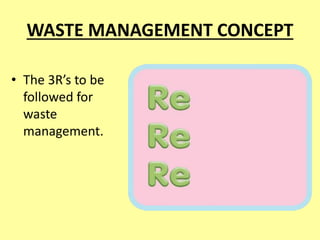
• The 3R’s to be
followed for
waste
management.
Reduce
• The concept of reducing what is
produced and what is consumed is
essential to the waste hierarchy.
• If there is less waste, then there is
less to recycle or reuse.
• Disposal goods like paper plate,
paper napkins, metal spoons, etc.
• Recovery of one ton paper can
save 17 trees
Reuse
• Reuse of items like old jars
and pots.
• Reuse of newspaper,
envelopes, waste paper.
• Reuse of old books, old
clothes, old electric
equipment, rechargeable
batteries.
Recycle
• The last stage of the waste
hierarchy is to recycle. To
recycle something means to
transform again into a raw
material that can be shaped
into a new item.
• Using of shopping bags made
of cloth or jute which can be
used over and over.
SOURCES AND TYPES OF SOLID
WASTE
SOURCES TYPES OF WASTE
Residential Food waste, plastics, woods, glass,
textiles, etc
Industrial Housekeeping waste, hazardous
wastes, ashes, food wastes, etc
Commercial Paper, cardboard, plastics, glass,
metals, etc
Municipal service Street sweeping, wastes from parks,
beaches, tree trimming, etc
Agriculture Spoiled food waste, agricultural waste,
hazardous wastes like pesticides, etc
DISPOSAL METHODS
Solid waste disposal management is usually
referred to the process of collecting and
treating solid wastes to change them into a
valuable resource.
The per capita daily solid waste produced
ranges between 0.25-2.5kg in different
countries.
Some of the techniques are as follows~
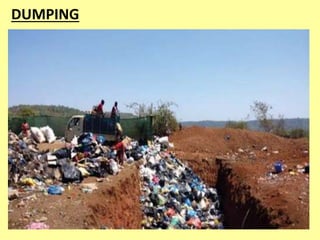
 Dumping
 Solid waste sanitary land fills
 Incineration method
 Composting process
 Manure pits
 Burial
DUMPING
INCINERATION
MAGNITUDE OF PROBLEMS IN
INDIA
• Per capita waste generation is increasing by
1.3% per annum.
• Yearly increase in waste generation is around
5% annually.
• India produces 42.0 million tons of municipal
solid waste annually at present.
• Crude dumping of waste in most of the cities.
CURRENT STATUS
• Storage of waste at source is lacking.
• Domestic waste is thrown on streets.
• Trade waste on roads.
• Construction debris are left unattended.
• Biomedical waste is disposed in municipal waste
stream.
• Industrial waste disposed of in open areas.
• Street sweeping is not done everyday.
• Waste transportation is done in open vehicles.
INITIATIVE TAKEN
• BHANGIDARI SCHEME IN DELHI
The Delhi government instituted the
BHANGIDARI SCHEME for ensuring a compulsory
segregation of waste at the household level
from January 1, 2004.
• BANGALORE AGENDA TASK FORCE(BATF)
The safai karamcharis pick up the collected
waste and transport it to the composting site on
the city's outskirts.
• MUMBAI INITIATIVE
Under the dynamic leadership of Ms.Kunti Oza,
Clean Mumbai Foundation has taken up solid
waste management with the help of corporate
sector.
A collection system had been organized and the
wet garbage is taken to selected sites in parks
that would have composting pits .
• SWACHH BHARAT ABHIYAN
Prime minister of India, Narendra Modi launched the
SWACHH BHARAT ABHIYAN or Clean India Mission on
the birth anniversary of Mahatma Gandhi on
October 2, 2014 at Rajghat in New Delhi.
India's biggest ever cleanliness drive.
Around three million government employees and
school and college students of India participated in
the event in it's initial phase.
The mission is estimated to cost around 62,009
crores.
CONCLUSION
• The menace of solid waste in many sectors has
become a monstrous reality.
• Although India has the most comprehensive
Municipal Solid Waste Rules, 2000, it is just a
directive on paper without any enforcement and
implementation.
• Resource agencies, like NGOs, are also
cooperating in this process but in small amount.
• The government should implement to educate
and inform people about such projects.
REFERRENCE
• Textbook of Environmental Biotechnology by P. K.
Mohapatra.
• https://www.britannica.com/technology/solid-
waste-management
• http://scholar.google.co.in/scholar?q=solid+wast
e+management&hl=en&as_sdt=0&as_vis=1&oi=s
cholart
• https://www.conserve-energy-
future.com/sources-effects-methods-of-solid-
waste-management.php
THANK YOU

solid waste management

  • 1.
    SOLID WASTE MANAGEMENT PRESENTED BY ANUSMITAGHOSH (17/BBT/38) ANKITA KALITA (17/BBT/49)
  • 2.
    CONTENT • INTRODUCTION TOWASTE • TYPES OF WASTE • INTRODUCTION TO SOLID WASTE MANAGEMENT • WASTE MANAGEMENT CONCEPT – 3R’s • SOURCES AND TYPES OF SOLID WASTE • DIPOSAL METHODS • PROBLEMS • CURRENT STATUS • INITATIVE TAKEN • CONCLUSION • REFERENCE
  • 3.
    INTRODUCTION TO WASTE Wasteis defined as something one does not want anymore and wants to throw away. Waste is any substance which is discarded after primary use, or is worthless, defective and of no use. WASTE MANAGEMENT Waste management are the activities and actions required to manage waste from its inception to its final disposal. This includes the collection, transport, treatment and disposal of waste, together with monitoring and regulation of the waste management process.
  • 4.
    TYPES OF WASTE •Municipal waste includes household waste, commercial waste, and demolition waste. • Hazardous waste includes industrial waste • Biomedical waste includes clinical waste. • Special hazardous waste includes radioactive waste, explosive waste, and electronic waste (e-waste).
  • 5.
    SOLID WASTE Solid wasteis defined as non-liquid, non-soluble materials ranging from municipal garbage to industrial wastes that contains complex and hazardous substances. It includes – Garbage, Rubbish, Sewage treatment residues, discarded materials, etc. SOLID WASTE MANAGEMENT Solid-waste management is the collecting, treating, and disposing of solid material that is discarded as it has no longer useful. Improper disposal of municipal solid waste can create unhygienic conditions which in turn can lead to pollution of the environment and to outbreaks of vector-borne diseases.
  • 6.
    WASTE MANAGEMENT CONCEPT •The 3R’s to be followed for waste management.
  • 7.
    Reduce • The conceptof reducing what is produced and what is consumed is essential to the waste hierarchy. • If there is less waste, then there is less to recycle or reuse. • Disposal goods like paper plate, paper napkins, metal spoons, etc. • Recovery of one ton paper can save 17 trees
  • 8.
    Reuse • Reuse ofitems like old jars and pots. • Reuse of newspaper, envelopes, waste paper. • Reuse of old books, old clothes, old electric equipment, rechargeable batteries.
  • 9.
    Recycle • The laststage of the waste hierarchy is to recycle. To recycle something means to transform again into a raw material that can be shaped into a new item. • Using of shopping bags made of cloth or jute which can be used over and over.
  • 10.
    SOURCES AND TYPESOF SOLID WASTE SOURCES TYPES OF WASTE Residential Food waste, plastics, woods, glass, textiles, etc Industrial Housekeeping waste, hazardous wastes, ashes, food wastes, etc Commercial Paper, cardboard, plastics, glass, metals, etc Municipal service Street sweeping, wastes from parks, beaches, tree trimming, etc Agriculture Spoiled food waste, agricultural waste, hazardous wastes like pesticides, etc
  • 11.
    DISPOSAL METHODS Solid wastedisposal management is usually referred to the process of collecting and treating solid wastes to change them into a valuable resource. The per capita daily solid waste produced ranges between 0.25-2.5kg in different countries. Some of the techniques are as follows~  Dumping  Solid waste sanitary land fills  Incineration method  Composting process  Manure pits  Burial
  • 12.
  • 14.
  • 18.
    MAGNITUDE OF PROBLEMSIN INDIA • Per capita waste generation is increasing by 1.3% per annum. • Yearly increase in waste generation is around 5% annually. • India produces 42.0 million tons of municipal solid waste annually at present. • Crude dumping of waste in most of the cities.
  • 19.
    CURRENT STATUS • Storageof waste at source is lacking. • Domestic waste is thrown on streets. • Trade waste on roads. • Construction debris are left unattended. • Biomedical waste is disposed in municipal waste stream. • Industrial waste disposed of in open areas. • Street sweeping is not done everyday. • Waste transportation is done in open vehicles.
  • 20.
    INITIATIVE TAKEN • BHANGIDARISCHEME IN DELHI The Delhi government instituted the BHANGIDARI SCHEME for ensuring a compulsory segregation of waste at the household level from January 1, 2004. • BANGALORE AGENDA TASK FORCE(BATF) The safai karamcharis pick up the collected waste and transport it to the composting site on the city's outskirts.
  • 21.
    • MUMBAI INITIATIVE Underthe dynamic leadership of Ms.Kunti Oza, Clean Mumbai Foundation has taken up solid waste management with the help of corporate sector. A collection system had been organized and the wet garbage is taken to selected sites in parks that would have composting pits .
  • 22.
    • SWACHH BHARATABHIYAN Prime minister of India, Narendra Modi launched the SWACHH BHARAT ABHIYAN or Clean India Mission on the birth anniversary of Mahatma Gandhi on October 2, 2014 at Rajghat in New Delhi. India's biggest ever cleanliness drive. Around three million government employees and school and college students of India participated in the event in it's initial phase. The mission is estimated to cost around 62,009 crores.
  • 23.
    CONCLUSION • The menaceof solid waste in many sectors has become a monstrous reality. • Although India has the most comprehensive Municipal Solid Waste Rules, 2000, it is just a directive on paper without any enforcement and implementation. • Resource agencies, like NGOs, are also cooperating in this process but in small amount. • The government should implement to educate and inform people about such projects.
  • 24.
    REFERRENCE • Textbook ofEnvironmental Biotechnology by P. K. Mohapatra. • https://www.britannica.com/technology/solid- waste-management • http://scholar.google.co.in/scholar?q=solid+wast e+management&hl=en&as_sdt=0&as_vis=1&oi=s cholart • https://www.conserve-energy- future.com/sources-effects-methods-of-solid- waste-management.php
  • 25.