Presented By:-
Vikas Sharma, Vivek Dubey, Nobert D’souza, Suraj, Mairazul, Sk
Ahmad.
TOPICS
Introduction.
Sources.
Types.
Waste produced in India every
year.
Effect.
Steps involve in SWM.
Problems and Solutions.
Graphs.
SOLID
WASTE
• Solid Waste – objects or particles that
accumulate on the site where they are
produced.
• Solid wastes are any discarded or
abandoned materials. Solid wastes can be
solid, liquid, semi-solid or containerized
gaseous material.
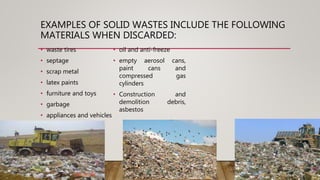
EXAMPLES OF SOLID WASTES INCLUDE THE FOLLOWING
MATERIALS WHEN DISCARDED:
• waste tires
• septage
• scrap metal
• latex paints
• furniture and toys
• garbage
• appliances and vehicles
• oil and anti-freeze
• empty aerosol cans,
paint cans and
compressed gas
cylinders
• Construction and
demolition debris,
asbestos
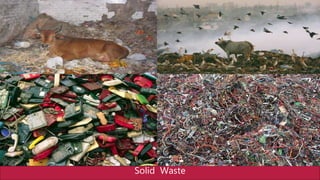
Solid Waste
SOURCES OF URBAN WASTES
Urban wastes include the following wastes:
• Domestic wastes containing a variety of materials thrown out from homes
Ex: Food waste, Cloth, Waste paper, Glass bottles, Polythene bags, Waste metals, etc.
• Commercial wastes: It includes wastes coming out from shops, markets, hotels, offices,
institutions, etc.
Ex: Waste paper, packaging material, cans, bottle, polythene bags, etc.
• Construction wastes: It includes wastes of construction materials.
Ex: Wood, Concrete, Debris, etc.
• Biomedical wastes: It includes mostly waste organic materials
Ex: Anatomical wastes, Infectious wastes, etc.
TYPE OF SOLID WASTE
Urban wastes are classified into:
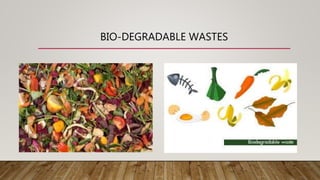
• Bio-degradable wastes - Those wastes that can be degraded by micro organisms
are called bio-degradable wastes
Ex: Food, vegetables, tea leaves, dry leaves, etc.
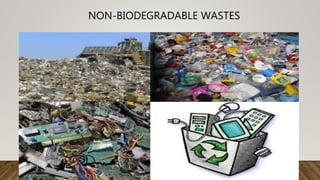
• Non-biodegradable wastes: Urban solid waste materials that cannot be degraded
by micro organisms are called non-biodegradable wastes.
Ex: Polythene bags, scrap materials, glass bottles, etc.
BIO-DEGRADABLE WASTES
NON-BIODEGRADABLE WASTES
WASTE PRODUCED IN INDIA EVERY YEAR
SOLID WASTE IN INDIA
• 7.2 million tones of hazardous waste
• One Sq. km of additional landfill area every-year
• Rs 1600 crore for treatment & disposal of these
wastes
• In addition to this industries discharge about 150
million tones of high volume low hazard waste every
year, which is mostly dumped on open low lying land
areas.
GROWTH OF SOLID WASTE IN INDIA
• Waste is growing by leaps & bounds
• In 1981-91, population of Mumbai increased from 8.2
million to 12.3 million
• During the same period, municipal solid waste has
grown from 3200 tones to 5355 tone, an increase of
67%
• Waste collection is very low for all Indian cities
• City like Bangalore produces 2000 tones of waste per
annum, the ever increasing waste has put pressure on
hygienic condition of the city
WASTE COLLECTION IN INDIA
• Primarily by the city municipality
-No gradation of waste product eg bio-degradable, glasses, polybags, paper
shreds etc.
-Dumps these wastes to the city outskirts
• Local raddiwala / kabadiwala (Rag pickers)
-Collecting small iron pieces by magnets
-Collecting glass bottles
-Collecting paper for recycling
• MCD- Sophisticated DWM (Delhi Waste Management) vehicle
EFFECT OF SOLID WASTE IN NATURE
Due to :-
• improper disposal of solid .
• Industrial solid.
• Toxic substances
• Burning of industrial or domestic wastes
HAZARDOUS / TOXIC WASTE & DUMPING SITE
• Industrialized countries have waste management problems
• Developed countries have strict environment regulation norms
• Most attractive option for them- to dump into developing
countries
STEPS INVOLVED IN SOLID WASTE MANAGEMENT:
Two important steps involved in solid waste management are:
• Reduce, Reuse and Recycle of Raw Materials
• Discarding wastes
Reduce - If usage of raw materials is reduced, the generation of waste also gets reduced
Reuse - Refillable containers that are discarded after use can be reused
Rubber rings can be made from discarded cycle tubes and this reduces waste generation
during manufacture of rubber bands.
Recycle- Recycling is the reprocessing of discarded materials into new useful products
Ex: Old aluminium cans and glass bottles are melted and recast into new cans and bottles
Preparation of cellulose insulation from paper
Preparation of automobile body and construction material from steel cans
This method (Reduce, Reuse & Recycle), i.e., 3R's help save money, energy, raw materials and reduces
pollution.
CONTINUE :-
• DISCARDING WASTES:
The following methods are adopted for discarding wastes:
• Landfill
• Incineration and
• Composting
PROBLEMS IN DEALING WITH SOLID
WASTE
• Unawareness
• Collection of waste
• Technological interventions
• Institutions & regulatory framework
• Absence of mandatory standards for waste reduction
• Market action for waste reduction
RECYCLING NOT A SOLUTION TO ALL
PROBLEMS!
Recycling is not a solution to managing every kind of waste material
For many items recycling technologies are unavailable or unsafe
In some cases, cost of recycling is too high.
SOLUTION
• Waste Reduction: Stop Throwing Things Out
• Waste of one could be input or raw material for others.
• Use of recyclable materials.
• Spreading awareness about waste product.
• Use 3R.
TERI PROJECTIONS ON WASTE GENERATION IN
INDIA
Solid waste management

Solid waste management

  • 1.
    Presented By:- Vikas Sharma,Vivek Dubey, Nobert D’souza, Suraj, Mairazul, Sk Ahmad.
  • 2.
    TOPICS Introduction. Sources. Types. Waste produced inIndia every year. Effect. Steps involve in SWM. Problems and Solutions. Graphs.
  • 3.
    SOLID WASTE • Solid Waste– objects or particles that accumulate on the site where they are produced. • Solid wastes are any discarded or abandoned materials. Solid wastes can be solid, liquid, semi-solid or containerized gaseous material.
  • 4.
    EXAMPLES OF SOLIDWASTES INCLUDE THE FOLLOWING MATERIALS WHEN DISCARDED: • waste tires • septage • scrap metal • latex paints • furniture and toys • garbage • appliances and vehicles • oil and anti-freeze • empty aerosol cans, paint cans and compressed gas cylinders • Construction and demolition debris, asbestos
  • 5.
  • 6.
    SOURCES OF URBANWASTES Urban wastes include the following wastes: • Domestic wastes containing a variety of materials thrown out from homes Ex: Food waste, Cloth, Waste paper, Glass bottles, Polythene bags, Waste metals, etc. • Commercial wastes: It includes wastes coming out from shops, markets, hotels, offices, institutions, etc. Ex: Waste paper, packaging material, cans, bottle, polythene bags, etc. • Construction wastes: It includes wastes of construction materials. Ex: Wood, Concrete, Debris, etc. • Biomedical wastes: It includes mostly waste organic materials Ex: Anatomical wastes, Infectious wastes, etc.
  • 7.
    TYPE OF SOLIDWASTE Urban wastes are classified into: • Bio-degradable wastes - Those wastes that can be degraded by micro organisms are called bio-degradable wastes Ex: Food, vegetables, tea leaves, dry leaves, etc. • Non-biodegradable wastes: Urban solid waste materials that cannot be degraded by micro organisms are called non-biodegradable wastes. Ex: Polythene bags, scrap materials, glass bottles, etc.
  • 8.
  • 9.
  • 10.
    WASTE PRODUCED ININDIA EVERY YEAR
  • 11.
    SOLID WASTE ININDIA • 7.2 million tones of hazardous waste • One Sq. km of additional landfill area every-year • Rs 1600 crore for treatment & disposal of these wastes • In addition to this industries discharge about 150 million tones of high volume low hazard waste every year, which is mostly dumped on open low lying land areas.
  • 12.
    GROWTH OF SOLIDWASTE IN INDIA • Waste is growing by leaps & bounds • In 1981-91, population of Mumbai increased from 8.2 million to 12.3 million • During the same period, municipal solid waste has grown from 3200 tones to 5355 tone, an increase of 67% • Waste collection is very low for all Indian cities • City like Bangalore produces 2000 tones of waste per annum, the ever increasing waste has put pressure on hygienic condition of the city
  • 13.
    WASTE COLLECTION ININDIA • Primarily by the city municipality -No gradation of waste product eg bio-degradable, glasses, polybags, paper shreds etc. -Dumps these wastes to the city outskirts • Local raddiwala / kabadiwala (Rag pickers) -Collecting small iron pieces by magnets -Collecting glass bottles -Collecting paper for recycling • MCD- Sophisticated DWM (Delhi Waste Management) vehicle
  • 14.
    EFFECT OF SOLIDWASTE IN NATURE Due to :- • improper disposal of solid . • Industrial solid. • Toxic substances • Burning of industrial or domestic wastes
  • 15.
    HAZARDOUS / TOXICWASTE & DUMPING SITE • Industrialized countries have waste management problems • Developed countries have strict environment regulation norms • Most attractive option for them- to dump into developing countries
  • 16.
    STEPS INVOLVED INSOLID WASTE MANAGEMENT: Two important steps involved in solid waste management are: • Reduce, Reuse and Recycle of Raw Materials • Discarding wastes Reduce - If usage of raw materials is reduced, the generation of waste also gets reduced Reuse - Refillable containers that are discarded after use can be reused Rubber rings can be made from discarded cycle tubes and this reduces waste generation during manufacture of rubber bands. Recycle- Recycling is the reprocessing of discarded materials into new useful products Ex: Old aluminium cans and glass bottles are melted and recast into new cans and bottles Preparation of cellulose insulation from paper Preparation of automobile body and construction material from steel cans This method (Reduce, Reuse & Recycle), i.e., 3R's help save money, energy, raw materials and reduces pollution.
  • 17.
    CONTINUE :- • DISCARDINGWASTES: The following methods are adopted for discarding wastes: • Landfill • Incineration and • Composting
  • 19.
    PROBLEMS IN DEALINGWITH SOLID WASTE • Unawareness • Collection of waste • Technological interventions • Institutions & regulatory framework • Absence of mandatory standards for waste reduction • Market action for waste reduction
  • 20.
    RECYCLING NOT ASOLUTION TO ALL PROBLEMS! Recycling is not a solution to managing every kind of waste material For many items recycling technologies are unavailable or unsafe In some cases, cost of recycling is too high.
  • 21.
    SOLUTION • Waste Reduction:Stop Throwing Things Out • Waste of one could be input or raw material for others. • Use of recyclable materials. • Spreading awareness about waste product. • Use 3R.
  • 22.
    TERI PROJECTIONS ONWASTE GENERATION IN INDIA