Ms. G. Yamuna ME.,
Assistant Professor
Department of Civil Engineering
SMVEC
 This course should enable the students to
 ● Impart knowledge on sources and generation of municipal
solid waste.
 ● Gain adequate knowledge in reduction and recycle of waste.
 ● Understand the concept of collection methods and routes.
 ● Gain knowledge about the transport method of municipal
solid waste
 ● Impart knowledge of disposal method of waste.
 After completion of the course, the students will be able to
CO 1 - Understand the nature and characteristics of
municipal solid wastes.(K2)
CO 2 - Understand the concept of reduction, reuse and
recycling of waste. (K4)
CO 3 - Plan and design systems for storage, collection,
transport, processing and disposal of municipal solid
Waste.(K3)
CO 4 - Understand the issues on solid waste management
from an integrated source.(K4)
CO 5 - Design and operate sanitary landfill.(K5)
KNOWLEDGE LEVEL: K1 – Remember, K2 –
Understand, K3 – Apply, K4 – Analyze and K5 – Evaluate
UNIT I SOURCES AND CHARACTERISTICS (9 Hrs)
Sources and types of municipal solid wastes- Public health and environmental impacts of improper disposal of
solid wastes- sampling and characterization of wastes - factors affecting waste generation rate and
characteristics –functional Elements of solid waste management – Requirements and salient features of Solid
waste management rules (2016) -Role of public and NGO‟s- Public Private participation – Elements of
integrated Municipal Solid Waste Management Plan.
UNIT II SOURCE REDUCTION, WASTE STORAGE AND RECYCLING (8 Hrs)
Waste Management Hierarchy –3R-Reduction, Reuse and Recycling - source reduction of waste – On-site
storage methods – Effect of storage, materials used for containers – segregation of solid wastes – Public health
and economic aspects of open storage – case studies under Indian conditions – Recycling of Plastics, and
Construction/Demolition wastes.
UNIT III COLLECTION AND TRANSFER OF WASTES (8 Hrs)
Methods of Residential and commercial waste collection – Collection vehicles – Manpower – Collection routes –
Analysis of waste collection systems; Transfer stations –location, operation and maintenance- options under
Indian conditions – Field problems- solving.
UNIT IV PROCESSING OF WASTES (12 Hrs)
Objective(s) of waste processing – Physical Processing techniques and Equipment; Resource recovery from solid
waste -composting and biomethanation; Thermal processing options – case studies under Indian conditions.
UNIT V WASTE DISPOSAL (8 Hrs)
Land disposal of solid waste- Sanitary landfills – site selection- design and operation of sanitary landfills –
Landfill liners– Management of leachate and landfill gas- Landfill bioreactor – Dumpsite Rehabilitation.
 William A. Worrell, P. AarneVesilind (2012) Solid Waste
Engineering, Cengage Learning, 2012.
 John Pitchel (2014), Waste Management Practices-
Municipal, Hazardous and industrial – CRC Press,Taylor
and Francis, New York.
 George Tchobanoglouset.al., “Integrated Solid Waste
Management”, McGraw-Hill Publishers, 1993.
 B.Bilitewski, G.HardHe, K.Marek, A.Weissbach, and
H.Boeddicker, “Waste Management”, Springer, 1994.
 CPHEEO (2014), “Manual on Municipal Solid waste
management, Central Public Health and Environmental
Engineering Organization. Government of India, New Delhi.
 George Tchobanoglous and FrankKreith (2002).Handbook of
Solid waste management, McGraw Hill, New York.
 Manual on Municipal Solid Waste Management, CPHEEO,
Ministry of Urban Development, Government of India, New
Delhi, 2000
 R.E.Landreth and P.A.Rebers, “Municipal Solid Wastes –
problems and Solutions”, Lewis Publishers, 1997.
 https://nptel.ac.in/courses/105/108/105108075/
 https://nptel.ac.in/courses/105/103/105103097/
 https://nptel.ac.in/courses/105/101/105101201/
Sources and types of municipal solid wastes- Public
health and environmental impacts of improper
disposal of solid wastes- sampling and
characterization of wastes - factors affecting waste
generation rate and characteristics –functional
Elements of solid waste management –
Requirements and salient features of Solid waste
management rules (2016) -Role of public and
NGO‟s- Public Private participation – Elements of
integrated Municipal Solid Waste Management
Plan.
 Waste refers to the items that we discard because we
don’t need them. A lot of waste is in the form of trash
or garbage.
 Trash is solid waste such as paper, card boxes, and so
on. Garbage, on the other hand, refers to waste that
comes from your kitchen or bathroom.
 Waste comes from all kinds of sources, including
individuals, homes, schools, offices, hospitals,
industries.
 It also comes in infinite sizes, from something small
like a rusty razor blade to something large like the
body of an old truck.
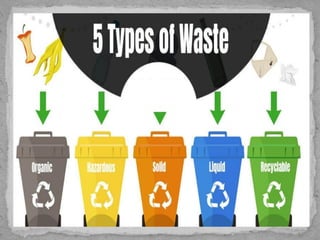
1. Liquid waste
2. Solid Waste
3. Organic Waste
4. Recyclable Waste
5. Hazardous Waste
1. Liquid waste
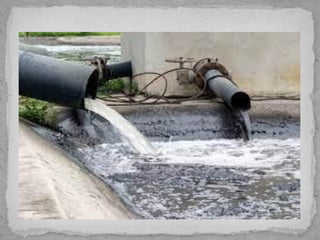
 Liquid waste refers to all grease, oil, sludges, wash water, waste
detergents and dirty water that have been thrown away.
 They are hazardous and poisonous to our environment and are
found in industries as well as households.
 Wastewater, as it is often called, is any waste that exists in liquid
form.
 There are two categories of liquid waste: non-point and point
source waste.
 Manufactured liquid wastes are called point source, and non-point
source wastes occur naturally in our environment.
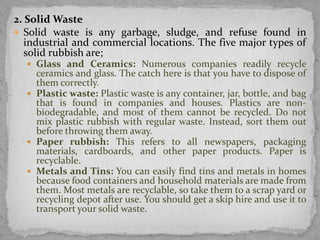
2. Solid Waste
 Solid waste is any garbage, sludge, and refuse found in
industrial and commercial locations. The five major types of
solid rubbish are;
 Glass and Ceramics: Numerous companies readily recycle
ceramics and glass. The catch here is that you have to dispose of
them correctly.
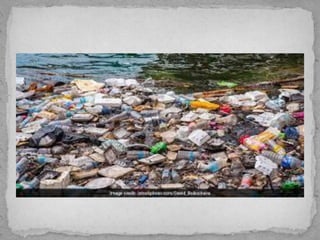
 Plastic waste: Plastic waste is any container, jar, bottle, and bag
that is found in companies and houses. Plastics are non-
biodegradable, and most of them cannot be recycled. Do not
mix plastic rubbish with regular waste. Instead, sort them out
before throwing them away.
 Paper rubbish: This refers to all newspapers, packaging
materials, cardboards, and other paper products. Paper is
recyclable.
 Metals and Tins: You can easily find tins and metals in homes
because food containers and household materials are made from
them. Most metals are recyclable, so take them to a scrap yard or
recycling depot after use. You should get a skip hire and use it to
transport your solid waste.
3. Organic Waste
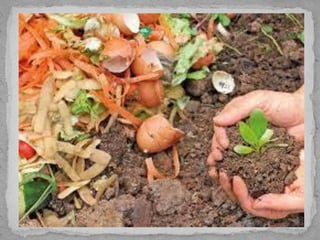
 Organic waste refers to rotten meat, garden and food
waste.
 This type of rubbish is commonly found in homes.
With time, they decompose and turn into manure by
the action of microorganisms on them.
 But be careful; you should not dispose of them
anywhere you like.
 When decomposing, organic waste produces methane,
so, it must not be thrown away with regular waste.
 Instead, get a green bin and dispose of this type of
waste properly.
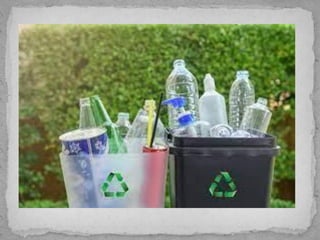
4. Recyclable Waste
 All discarded items like metals, furniture, organic
waste that can be recycled fall under this category.
 Not all items are recyclable, so you have to be careful
when putting things into the recycle bin.
 If you are not sure whether an item is recyclable or not,
then check the item’s packaging.
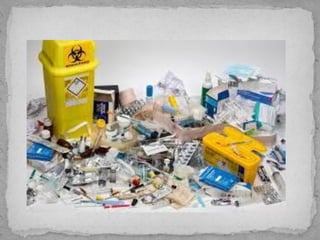
5. Hazardous Waste
 Hazardous waste includes flammable, corrosive, toxic
and reactive materials.
 In a nutshell, they are wastes that pose a significant or
potential threat to our environment.
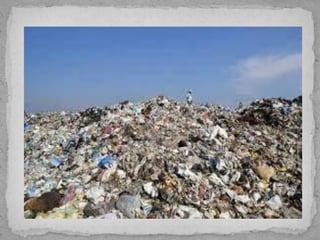
 Solid waste refers to the range of garbage materials—
arising from animal and human activities—that are
discarded as unwanted and useless.
 Solid waste is generated from industrial, residential, and
commercial activities in a given area, and may be handled
in a variety of ways.
 As such, landfills are typically classified as sanitary,
municipal, construction and demolition, or industrial
waste sites.
 Municipal Solid Waste (MSW)—more commonly known as
trash or garbage—consists of everyday items we use and
then throw away, such as product packaging, grass
clippings, furniture, clothing, bottles, food scraps,
newspapers, appliances, paint, and batteries.
 This comes from our homes, schools, hospitals, and
businesses.
 Solid waste management is a term that is used to refer to
the process of collecting and treating solid wastes.
 It also offers solutions for recycling items that do not
belong to garbage or trash.
 As long as people have been living in settlements and
residential areas, garbage or solid waste has been an issue.
 Waste management is all about how solid waste can be
changed and used as a valuable resource.
 Solid waste management should be embraced by each and
every household, including the business owners across the
world.
 The industrialization has brought a lot of good things and
bad things as well.
 One of the adverse effects of industrialization is the
creation of solid waste.
 Every day, tonnes of solid waste are disposed of at various
landfill sites. This waste comes from homes, offices,
industries and various other agricultural related activities.
 These landfill sites produce foul smell if waste is not stored
and treated properly. It can pollute the surrounding air and
can seriously affect the health of humans, wildlife and our
environment.
The following are major sources of solid waste:
1. Residential
 Residences and homes where people live are some of
the major sources of solid waste. The garbage from
these places includes food wastes, plastics, paper,
glass, leather, cardboard, metals, yard wastes, ashes
and special wastes like bulky household items such as
electronics, tires, batteries, old mattresses and used
oil.
 Most homes have garbage bins where they can throw
away their solid wastes in and later, the bin is emptied
by a garbage collecting firm or person for treatment.
2. Industrial
 Industries are known to be one of the biggest contributors
to solid waste. They include light and heavy manufacturing
industries, construction sites, fabrication plants, canning
plants, power and chemical plants.
 These industries produce solid waste in the form of
housekeeping wastes, food wastes, packaging wastes,
ashes, construction and demolition materials, special
wastes, medical wastes as well as other hazardous wastes.
3. Commercial
 Commercial facilities and buildings are yet another
source of solid waste today. Commercial buildings and
facilities, in this case, refer to hotels, markets,
restaurants, godowns, stores and office buildings.
 Some of the solid wastes generated from these places
include plastics, food wastes, metals, paper, glass,
wood, cardboard materials, special wastes and other
hazardous wastes.
4. Institutional
 The institutional centers like schools, colleges, prisons,
military barracks and other government centers also
produce solid waste. Some of the common solid wastes
obtained from these places include glass, rubber
waste, plastics, food wastes, wood, paper, metals,
cardboard materials, electronics as well as various
hazardous wastes.
5. Construction and Demolition Areas
 Construction and demolition sites also contribute to
the solid waste problem. Construction sites include
new construction sites for buildings and roads, road
repair sites, building renovation sites and building
demolition sites.
 Some of the solid wastes produced in these places
include steel materials, concrete, wood, plastics,
rubber, copper wires, dirt and glass.
6. Municipal Services
 The urban centers also contribute immensely to the
solid waste crisis in most countries today. Some of the
solid waste brought about by the municipal services
include street cleaning, wastes from parks and
beaches, wastewater treatment plants, landscaping
wastes and wastes from recreational areas, including
sludge.
7. Treatment Plants and Sites
 Heavy and light manufacturing plants also produce
solid waste. They include refineries, power plants,
processing plants, mineral extraction plants and
chemical plants.
 Among the wastes produced by these plants, there are
industrial process wastes, unwanted specification
products, plastics, metal parts, just to mention a few.
8. Agriculture
 Crop farms, orchards, dairies, vineyards and feedlots
are also sources of solid wastes. Among the wastes they
produce are agricultural wastes, spoiled food, pesticide
containers and other hazardous materials.
9. Biomedical
 This refers to hospitals and biomedical equipment and
chemical manufacturing firms. In hospitals, there are
different types of solid wastes produced.
 Some of these solid wastes include syringes, bandages,
used gloves, drugs, paper, plastics, food wastes and
chemicals. All these require proper disposal or else
they will cause a huge problem for the environment
and the people in these facilities.
Classification of wastes based on types, i.e., physical,
chemical, and biological characteristics of wastes, is as
follows
(i) Garbage:
 This refers to animal and vegetable wastes resulting
from the handling, sale, storage, preparation,
cooking and serving of food. Garbage comprising
these wastes contains putrescible (rotting) organic
matter, which produces an unbearable odour and
attracts rats and other vermin. It, therefore, requires
special attention in storage, handling and disposal.
(ii) Ashes and residues:
 These are substances remaining from the
burning of wood, coal, charcoal, coke and other
combustible materials for cooking and heating in houses,
institutions and small industrial establishments.
When produced in large quantities, as in power-generation
plants and factories, these are classified as industrial wastes.
Ashes consist of fine powdery residue, cinders and clinker often
mixed with small pieces of metal and glass. Since ashes and
residues are almost entirely inorganic, they are valuable in
landfills.
(iii) Combustible and non-combustible wastes:
 These consist of wastes generated from
households, institutions, commercial activities, etc.,
excluding food wastes and other highly putrescible
material. Typically, while combustible material consists of
paper, cardboard, textile, rubber, garden trimmings, etc.,
non-combustible material consists of such items as glass,
crockery, tin and aluminum cans, ferrous and non-ferrous
material and dirt.
(iv) Bulky wastes:
 These include large household
appliances such as refrigerators, washing machines,
furniture, crates, vehicle parts, tyres, wood, trees
and branches. Since these household wastes cannot
be accommodated in normal storage containers,
they require a special collection mechanism.
(v) Street wastes:
 These refer to wastes that are collected
from streets, walkways, alleys, parks and vacant
plots, and include paper, cardboard, plastics, dirt,
leaves and other vegetable matter. Littering in
public places is indeed a widespread and acute
problem in many countries including India.
(vi) Construction and demolition wastes:
 These are wastes generated as a result of
construction, refurbishment, repair and
demolition of houses, commercial buildings and
other structures. They consist mainly of stones, concrete,
bricks, lumber, roofing and plumbing materials, heating
systems and electrical wires and parts of the general
municipal waste stream.
(vii) Hazardous wastes:
 Hazardous wastes are those defined as wastes
of industrial, institutional or consumer origin that are
potentially dangerous either immediately or over a
period of time to human beings and the environment.
Typical examples of hazardous wastes are empty containers
of solvents, paints and pesticides, which are frequently
mixed with municipal wastes and become part of the urban
waste stream. Certain hazardous wastes may cause
explosions in incinerators and fires at landfill sites.
(vii) Treatment Plant wastes:
 The solid and semi-solid wastes from water,
wastewater and industrial treatment facilities are
included in this classification. The specific characteristics
may vary depending upon the nature of treatment process.
(viii) Agricultural wastes:
 Wastes and residues resulting from diverse
agricultural activities such as,
 Planting and harvesting of crops
 Production of milk
 Production of animals for slaughter
 These are collectively called Agricultural wastes.
1. Litter Surroundings
 Due to improper waste disposal systems, particularly by
municipal waste management teams, wastes heap up and
become a menace. While people clean their homes and places of
work, they litter their surroundings, which affect the
environment and the community.
2. Impact on Human Health
 Improper waste disposal can affect the health of the population
living nearby the polluted area or landfills. The health of waste
disposal workers and other employees involved with these
landfill facilities are also at a greater risk.
 Exposure to wastes that handled improperly can cause skin
irritations, respiratory problems, blood infections, growth
problems, and even reproductive issues.
3. Disease-causing Pests
 This type of dumping of waste materials forces
biodegradable materials to rot and decompose under
improper, unhygienic and uncontrolled conditions.
 After a few days of decomposition, a foul smell is
produced, and it becomes a breeding ground for
different types of disease-causing insects as well as
infectious organisms. On top of that, it also spoils the
aesthetic value of the area.
4. Environmental Problems
 Solid wastes from industries are a source of toxic
metals, hazardous wastes, and chemicals. When
released to the environment, the solid wastes can
cause biological and physicochemical problems to the
environment that may affect or alter the productivity
of the soils in that particular area.
5. Soil and Groundwater Pollution
 Toxic materials and chemicals may seep into the soil and
pollute the groundwater.
 During the process of collecting solid waste, hazardous
wastes usually mix with ordinary garbage and other
flammable wastes making the disposal process even harder
and risky.
6. Emission of Toxic Gases
 When hazardous wastes like pesticides, batteries
containing lead, mercury or zinc, cleaning solvents,
radioactive materials, e-waste and plastics mixed up
with paper and other non-toxic scraps are burned they
produce dioxins, furans, polychlorinated biphenyls,
and other gases. These toxic gases have the potential of
causing various diseases, including cancer.
7. Impact on Land and Aquatic Animals
 Our carelessness with our waste and garbage also
affects animals, and they suffer the effects of pollution
caused by improperly disposed of wastes and rubbish.
 Consuming styrofoam and cigarette butts have been
known to cause deaths in marine animals. Animals are
also at risk of poisoning while consuming grasses near
contaminated areas or landfills as the toxins seep into
the soil.
 SAMPLING - the action or process of taking samples
of waste for analysis
 CHARACTERIZATION - Waste characterization
data is collected by taking samples of waste and
sorting it into material types like newspaper and
aluminum cans, and weighing each type.
OR
 Waste characterization is the term used for the process
of determining the chemical, biological and physical
characteristics as well as the quantity, mass flow rates,
strengths (in terms of concentration), and discharge
schedule of a wastewater stream, air discharge or solid
waste stream.
 MSW consists of a wide range of materials that vary depending on the
community and its consumers` income, lifestyle and its degree of
industrialization.
 Direct Sampling
 Method 1
 Method 2
 Material Flows
 Surveys
 Multipliers for Projecting Waste Quantities
 Direct Sampling
 Direct sampling is useful on a small scale for
obtaining information about MSW composition.
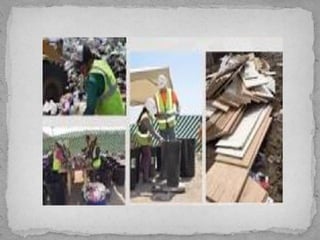
 Method 1: The direct sampling method involves
physically sampling and sorting MSW at the source of
generation. Although MSW can be extremely
heterogeneous, direct sampling is one of the more accurate
characterization methods. In order to make accurate
judgments as to composition, sorting and analysis should
be conducted in several randomly selected locations within
the community. Waste sampling from single-and multi-
family homes, commercial establishments (restaurants and
businesses), and institutions (schools, hospitals) is
encouraged, as these inputs create local variations.
 Method 2: Another direct sampling approach is to sample
the waste after it has arrived at a centralized collection
point or a tipping (i.e., unloading) area. This may include
a transfer station or disposal facility. Whether at the source or
a disposal facility, the degree of sorting is a function of the
number of product categories desired
 One disadvantage of direct sampling programs based
on a limited number of samples is, that data may be
misleading if unexpected circumstances occurred during the
sampling period. These circumstances could include the
delivery of infrequent and exotic wastes, a severe wet or dry
season, or errors in sampling methods. Such errors will be
added when a small number of samples are collected to
represent the community waste stream. Sampling studies do
not provide accurate information about trends unless they are
performed in a consistent manner over a long period of time.
Another disadvantage of direct sampling is that it would be
prohibitively expensive for making estimates on a national
scale.
 Material Flows
 Another approach to determining waste composition
is to assess material flows. This method is useful for
estimating waste stream composition and trends on a
regional basis. The U.S. EPA uses materials flow estimation
for the compilation of waste data for the United States. The
methodology is based on production data (by weight) for
materials and products in the waste stream. For a particular
municipality, inputs and outputs are recorded and
compared. For example, if a community purchases 500 000
aluminum beverage cans in 1 week, it can be expected that
about 500 000 aluminum cans will end up in the waste
stream sometime soon afterward. This model is, of course,
an oversimplification; and one must also consider that the
community is an open system having numerous imports
and exports (U.S. EPA, 1999).
 Surveys
 Waste quantity and composition can be estimated
by distributing questionnaires to producers of the
waste. This system typically applies to generators of
commercial and industrial wastes, and does not work
effectively for domestic sources. A questionnaire is
distributed to companies in an area, with detailed
questions concerning the quantities of waste generated and
its composition. Waste types may be listed in relation to
product or material categories; for example, a county
building may be asked to quantify the laser-quality office
paper and mixed, colored papers boxes. In many cases,
however, companies do not maintain accurate records of
the amount of waste generated. Data on composition may
also be difficult to obtain due to concerns over the release
of company and proprietary information.
 Multipliers for Projecting Waste Quantities
 Waste generation multipliers are used for
estimating waste quantities from sources in a
particular region. These multipliers express the
relationship between the amount of waste
produced and an identifiable parameter, for
example a household or a specific industry. The value
of the multiplier is based upon surveys, published
data, and direct sampling for an area. For example,
Agricultural multipliers may be formulated based on
the number and type of livestock and the total land
area available for grazing. Industrial waste multipliers
may be based on the number of employees at a facility.
The population of the area in question is multiplied by
the appropriate value to obtain an estimate of waste
production.
Method of Sampling:
 Solid waste is very heterogeneous in nature and its
composition varies with place and time even samples
obtained from the same place on the same day, but
different time may show totally different
characteristics.
 Due to this the method by which the sample is
collected and the number of samples collected is
critical large number of sample results in water
resources, while less number of samples diminish.
Collection of samples:
 In India major collections sites are identified which are covering
a larger size of population. Based on the type of area, sampling
points are distributed uniformly all over the study area.
 The sampling points are further classified based on economic
status such as high, middle, and low income group.
 About 10 kg of MSW is collected from 10 points from outside and
inside of the solid waste heap.
 The total quality of waste collected is thoroughly mixed and then
reduced by method of quartering till a samples of such a size is
obtained which can be handled in the laboratory.
 Sample collected for physical and chemical analysis are doubled
bagged in plastic bags, sealed and sent to the laboratory for
analysis each sample being 10 to 12 kg.
 In ASTM the truckload to be analyzed to be represent as closely
as possible the average as possible the average production of
refuse in the community.
 Once the load has been selected, a methodology for producing a
sample enough to be analyzed but big enough to be statistically
representative of the MSW must be established.
 The most frequently used methodology for determining
the number of samples required in order to achieve
statistical validity is the American Society for Testing and
Materials (ASTM) standard test for determination of
composition.
 Typically, a 90% confidence level is adequate for most
studies.
 As a crude first estimate, sorting and analyzing more than
2000lb (90kg) in each sample would have statistical
advantage.
 To obtain representative 2000lb (90kg) samples, ASTM
recommends quartering and coning. Quartering is the
separation of a truck of waste into successive quarters, after
thoroughly mixing the contents.
 The samples are the coned again and quartered until 90kg.
 The greater the precision, the greater will be the number of
samples analyzed.
 Factors that influence the quantity of wastes generated
include geographic location, season of the year,
frequency of collection, use of home grinders, the
habits and economic status of the people, the extent of
salvage and recycle operations, legislation and public
attitudes. All these factors are important in planning
for solid waste management and they are discussed
below,
 Geographic location:
 The influence of geographic location is related
primarily to the different climates that can
influence both the amount of certain types of
solid wastes generated and the collection
operation. For example, in the warmer southern areas
where the growing season is considerably longer than
in the northern areas. Because of the variations in the
quantities of certain types of solid wastes generated
under varying climates, special studies should be
conducted when such information will have a
significant impact on the system.
 Season of the year:
 The quantities of certain types of solid wastes are also
affected by the season the year. For example, the
quantities of food wastes are affected by the growing
season for vegetables and fruits.
 Frequency of collection:
 In general, it has been observed that where
unlimited collection service is provided, more wastes
are collected. For example if homeowner is limited to one
or two containers per week, he or she may, because of
limited container capacity, store newspapers or other
materials in the garage or storage area; with unlimited
service, the homeowner would tend to throw them away. In
this situation the quantity of wastes generated may actually
be the same, but the quantity collected is considerably
different.
 Use of home grinders:
 While the use of home grinders definitely
reduces the quantity of food wastes collected, it is
not clear whether they affect quantities of wastes
generated. Because the use of home grinders varies
widely, the effects of their use must be evaluated
separately in each situation.
 Characteristics of population:
 It has been observed that the characteristics of the
population influence the quantity of solid waste
generated. For example, quantities of yard waste
generated on a per capita basis are considerably
greater in many of the wealthier neighborhoods
than in other parts of the town.
 Extent of salvage and recycling:
 The existence of salvage and recycling operations
within a community definitely affects the quantity of
wastes collected. In a area if there are recycling
options available then there will be a consistent
reduction in the generation of solid wastes.
 Legislation:
 Perhaps the most important factor affecting the
generation of certain types of wastes is the existence
of local, state and federal regulations concerning
the use and disposal of specific materials. for
example, Legislation dealing with packaging and
beverage container materials.
 Public attitudes:
 Significant reduction in the quantities of solid
wastes that are generated will occur when and if
people are willing to change their habits and
lifestyle to conserve national resources and to
reduce economic burdens associated with the
management of solid wastes.
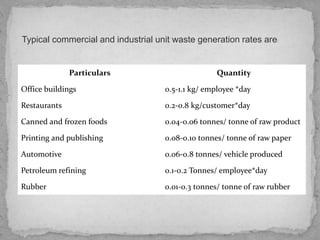
Particulars Quantity
Office buildings 0.5-1.1 kg/ employee *day
Restaurants 0.2-0.8 kg/customer*day
Canned and frozen foods 0.04-0.06 tonnes/ tonne of raw product
Printing and publishing 0.08-0.10 tonnes/ tonne of raw paper
Automotive 0.06-0.8 tonnes/ vehicle produced
Petroleum refining 0.1-0.2 Tonnes/ employee*day
Rubber 0.01-0.3 tonnes/ tonne of raw rubber
Typical commercial and industrial unit waste generation rates are:
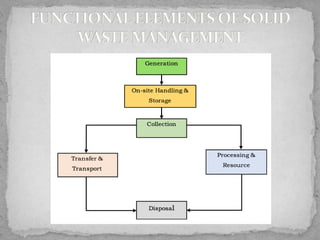
 The point of generation to final disposal can be grouped
into the six functional elements: (a) waste generation; (b)
waste handling and sorting, storage, and processing at the
source; (c) collection; (d) sorting, processing and
transformation; (e) transfer and transport; and (f) disposal.
The inter-relationship between the elements is identified
in the figure shown above.
 Waste Generation:
 Waste generation encompasses activities in which
materials are identified as no longer being of value (in
their present form) and are either thrown away or
gathered together for disposal. Waste generation is, at
present, an activity that is not very controllable. In the
future, however, more control is likely to be exercised
over the generation of wastes. Reduction of waste at
source, although not controlled by solid waste
managers, is now included in system evaluations as a
method of limiting the quantity of waste generated.
 Waste Handling, Sorting, Storage, and Processing at
the Source:
 The second of the six functional elements in the solid waste
management system is waste handling, sorting, storage,
and processing at the source. Waste handling and sorting
involves the activities associated with management of
wastes until they are placed in storage containers for
collection. Handling also encompasses the movement of
loaded containers to the point of collection. Sorting of
waste components is an important step in the handling and
storage of solid waste at the source. For example, the best
place to separate waste materials for reuse and recycling is
at the source of generation. Households are becoming
more aware of the importance of separating newspaper and
cardboard, bottles/glass, kitchen wastes and ferrous and
non-ferrous materials.
 On-site storage is of primary importance because of
public health concerns and aesthetic consideration.
Unsightly makeshift containers and even open ground
storage, both of which are undesirable, are often seen
at many residential and commercial sites. The cost of
providing storage for solid wastes at the source is
normally borne by the household in the case of
individuals, or by the management of commercial and
industrial properties. Processing at the source involves
activities such as backyard waste composting.
 Collection:
 The functional element of collection, includes not only
the gathering of solid wastes and recyclable materials,
but also the transport of these materials, after
collection, to the location where the collection vehicle
is emptied. This location may be a materials
processing facility, a transfer station, or a landfill
disposal site.
 Sorting, Processing and Transformation of Solid
Waste:
 The sorting, processing and transformation of solid waste
materials is the fourth of the functional elements. The
recovery of sorted materials, processing of solid waste and
transformation of solid waste that occurs primarily in
locations away from the source of waste generation are
encompassed by this functional element. Sorting of
commingled (mixed) wastes usually occurs at a materials
recovery facility, transfer stations, combustion facilities,
and disposal sites. Sorting often includes the separation of
bulky items, separation of waste components by size using
screens, manual separation of waste components, and
separation of ferrous and non-ferrous metals. Waste
processing is undertaken to recover conversion products
and energy. The organic fraction of Municipal Solid Waste
(MSW) can be transformed by a variety of biological and
thermal processes.
 The most commonly used biological transformation
process is aerobic composting. The most commonly used
thermal transformation process is incineration. Waste
transformation is undertaken to reduce the volume,
weight, size or toxicity of waste without resource recovery.
Transformation may be done by a variety of mechanical (eg
shredding), thermal (e.g. incineration without energy
recovery) or chemical (e.g. encapsulation) techniques.
 Transfer and Transport:
 The functional element of transfer and transport
involves two steps: (i) the transfer of wastes from the
smaller collection vehicle to the larger transport
equipment and (ii) the subsequent transport of the
wastes, usually over long distances, to a processing or
disposal site. The transfer usually takes place at a
transfer station.
 Disposal:
 The final functional element in the solid waste
management system is disposal. Today the disposal of
wastes by landfilling or uncontrolled dumping is the
ultimate fate of all solid wastes, whether they are
residential wastes collected and transported directly to a
landfill site, residual materials from Materials Recovery
Facilities (MRFs), residue from the combustion of solid
waste, rejects of composting, or other substances from
various solid waste-processing facilities. A municipal solid
waste landfill plant is an engineered facility used for
disposing of solid wastes on land or within the earth’s
mantle without creating nuisance or hazard to public
health or safety, such as breeding of rodents and insects
and contamination of groundwater.
 The Municipal Solid Waste (Management and Handling)
Rules, 2000 were notified in the year 2000 and came into
force on September 25, 2000. However, post the
suggestions of the public, the set of rules were updated in
the areas of plastic, e-waste, biomedical, hazardous and
construction and demolition waste management rules.
Later the Government notified Solid Waste Management
Rules, 2016 in the year 2016.
 The new set of rules are now not only applicable in
Municipal Areas but have also included urban
agglomerations, census towns, notified industrial
townships, and also areas which fall under the control and
direction of Indian Railways, Airports, Special economic
zones, Places of Pilgrimage, Religious and Historical
importance, and Organizations under the conduct of State
and Central Government.
Salient features of Solid Waste Management
Rules, 2016
 The Rules are now applicable beyond Municipal areas and extend to
urban agglomerations, census towns, notified industrial townships,
areas under the control of Indian Railways, airports, airbase, Port and
harbour, defence establishments, special economic zones, State and
Central government organizations, places of pilgrims, religious &
historical importance.
 The source segregation of waste has been mandated to channelize
the waste to wealth by recovery, reuse and recycle.
 Responsibilities of Generators have been introduced to segregate
waste in to three streams, Wet (Biodegradable), Dry (Plastic, Paper,
metal, wood, etc.) and domestic hazardous wastes (diapers, napkins,
empty containers of cleaning agents, mosquito repellents, etc.) and
handover segregated wastes to authorized rag-pickers or waste
collectors or local bodies.
 Integration of waste pickers/ rag pickers and waste dealers/
Kabadiwalas in the formal system should be done by State
Governments, and Self Help Group, or any other group to be formed.
 No person should throw, burn, or bury the solid waste generated
by him, on streets, open public spaces outside his premises, or in
the drain, or water bodies.
 Generator will have to pay ‘User Fee’ to waste collector and for
‘Spot Fine’ for Littering and Non-segregation.
 Used sanitary waste like diapers, sanitary pads should be
wrapped securely in pouches provided by manufacturers or
brand owners of these products or in a suitable wrapping
material and shall place the same in the bin meant for dry waste
/ non- bio-degradable waste.
 The concept of partnership in Swachh Bharat has been
introduced. Bulk and institutional generators, market
associations, event organizers and hotels and restaurants have
been made directly responsible for segregation and sorting the
waste and manage in partnership with local bodies.
 All hotels and restaurants should segregate biodegradable waste
and set up a system of collection or follow the system of
collection set up by local body to ensure that such food waste is
utilized for composting /bio-methanation.
 All Resident Welfare and market Associations, Gated
communities and institution with an area >5,000 sq. m
should segregate waste at source- in to valuable dry waste
like plastic, tin, glass, paper, etc. and handover recyclable
material to either the authorized waste pickers or the
authorized recyclers, or to the urban local body.
 The bio-degradable waste should be processed, treated
and disposed of through composting or bio-methanation
within the premises as far as possible. The residual waste
shall be given to the waste collectors or agency as directed
by the local authority.
 New townships and Group Housing Societies have been
made responsible to develop in-house waste handling, and
processing arrangements for bio-degradable waste.
 Every street vendor should keep suitable containers for storage of
waste generated during the course of his activity such as food
waste, disposable plates, cups, cans, wrappers, coconut shells,
leftover food, vegetables, fruits etc. and deposit such waste at
waste storage depot or container or vehicle as notified by the
local authority.
 The developers of Special Economic Zone, industrial estate,
industrial park to earmark at least 5% of the total area of the plot
or minimum 5 plots/ sheds for recovery and recycling facility.
 All manufacturers of disposable products such as tin, glass,
plastics packaging etc. or brand owners who introduce such
products in the market shall provide necessary financial
assistance to local authorities for the establishment of waste
management system.
 All such brand owners who sale or market their products in such
packaging material which are non-biodegradable should put in
place a system to collect back the packaging waste generated due
to their production.
 Manufacturers or Brand Owners or marketing companies
of sanitary napkins and diapers should explore the
possibility of using all recyclable materials in their
products or they shall provide a pouch or wrapper for
disposal of each napkin or diapers along with the packet
of their sanitary products.
 All such manufacturers, brand owners or marketing
companies should educate the masses for wrapping and
disposal of their products.
 All industrial units using fuel and located within 100 km
from a solid waste based RDF plant shall make
arrangements within six months from the date of
notification of these rules to replace at least 5 % of their
fuel requirement by RDF so produced.
 Non-recyclable waste having calorific value of 1500
K/cal/kg or more shall not be disposed of on landfills and
shall only be utilized for generating energy either or
through refuse derived fuel or by giving away as feed stock
for preparing refuse derived fuel.
 High calorific wastes shall be used for co-processing in
cement or thermal power plants.
 Construction and demolition waste should be stored,
separately disposed off, as per the Construction and
Demolition Waste Management Rules, 2016
 Horticulture waste and garden waste generated from his
premises should be disposed as per the directions of local
authority.
 An event, or gathering organiser of more than 100 persons
at any licensed/ unlicensed place, should ensure
segregation of waste at source and handing over of
segregated waste to waste collector or agency, as specified
by local authority.
 Special provision for management of solid waste in hilly
areas:- Construction of landfill on the hill shall be avoided.
A transfer station at a suitable enclosed location shall be
setup to collect residual waste from the processing facility
and inert waste. Suitable land shall be identified in the
plain areas, down the hill, within 25 kilometers for setting
up sanitary landfill. The residual waste from the transfer
station shall be disposed off at this sanitary landfill.
 In case of non-availability of such land, efforts shall be
made to set up regional sanitary landfill for the inert and
residual waste.
ROLE OF PUBLIC
 Public participation for waste collection process is directly proportional to
municipal solid waste management in effective manner.
 Public involvement and their attitude depending towards individual
household waste management will be results positive or negative sign of
indication.
 Individual difference is differing from people to people and also their
attitude.
 Waste management at root level was much important thing to make hygienic
and healthy condition of environment around us.
 Creating healthy life is difficult job for stake holders – Municipalities, NGO’s,
civic agencies and rag pickers are has play vital role in making successful
dream of clean environment.
 Apart from stakeholders, public involvement and their positive attitude are
more helpful to managing waste and educate the neighbourhood public for
individual responsibilities of everyone.
 Conducting awareness program related to waste management and adverse
effect of improper management will make difference and easy to understands
the concept.
 ROLE OF NGO‟s
 The private sector can play an important role in construction, operation,
and maintenance of treatment and disposal facility, NGOs can play an
important role in:
 organizing rag-pickers/waste collectors for door-to-door collection
and segregation of waste
 creating public awareness for storage of organic and recyclable waste
separately at source and handing over the waste to the waste collector
 promoting recycling of waste and decentralized treatment of waste
involving community
 Rag-pickers could be involved in door-to-door
collection of municipal solid waste as well as
recyclable waste so that they could get a user fee
for collecting waste from the doorstep and derive
additional income from sale of recyclables.
There is a potential of recovering at least 15 per
cent of the waste generated in the country which
could be more than 15,000 MT per day providing
employment opportunities to about 5,00,000 rag-
pickers in the country. Despite immense potential
in big cities in this area, NGO/CBO participation is
still on a very small scale.
 The Self-Employed Women’s Association (SEWA)
has taken up the task of door-to-door waste collection
in Vejalpur and Gandhinagar cities near Ahmedabad
and providing employment to over 500 rag-pickers.
Similarly, the Centre for Development Communication
in Jaipur has taken up the work of primary
collection and transportation of waste involving
half a dozen cities covering population of over a
million.
 Exnora which initially introduced the concept of
door to- door collection on cost recovery basis in
India has been playing an important role in Chennai
and Bangalore with community participation.
Sustainability of this service can be ensured through
user charges levied on beneficiary households, shops,
and establishments.
 Public-Private Partnership (PPP) describes a government
service or private business venture which is funded and
operated through a partnership of government and one or
more private sector companies.
 These schemes are sometimes referred to as PPP, P3 or P3.
 PPP typically involves a contract between a public sector
authority and a private party, in which the private party
provides a public service or project and assumes substantial
financial, technical and operational risk in the project.
Public and private sector roles
 The private sector can correct the management failures
encountered in a state-run system and provide the
technical skills often lacking in the public sector.
 In best-case scenarios, private operators have qualified
staff and appropriate production resources, while still
being flexibly organized.
 Since costs cannot be fully covered by the fees collected
from users, calling on specific service providers (for
collecting waste, operating a waste transfer plant, or
technical landfill center) is more widespread than the
appointment of a large-scale private operator covering
the entire sector.
 PPPs involving a build-operate-transfer contract are the
most common; these involve a system of direct payment to
the private operator by public authorities, based on a
management cost per metric ton.
 This rate not only covers operating costs but also, in some
cases, investment in initial infrastructure and upgrading
works.
 As it is difficult for municipalities in developing countries
to pay private operators enough to cover the cost of all
waste management services, the central government often
has to provide additional funding.
 The private network is therefore split between primary
collection, organized by a very active informal service, and
the rest of the waste management chain, where one can
find global corporations as well as local operators, some of
whom are from the informal sector.
Advantages of PPP
The advantages of PPP include:
 Access to private sector finance
 Efficiency advantages from using private sector skills
and from transferring risk to the private sector
 Potentially increased transparency
 Enlargement of focus from only creating an asset to
delivery of a service, including maintenance of the
infrastructure asset during its operating lifetime
 This broadened focus creates incentives to reduce the
full life-cycle costs (ie, construction costs and
operating costs)
 All of these provide strong reasons in favour of using
PPPs in India and elsewhere.
Functional Elements of Integrated Solid Waste
Management
 The four components or functional elements of ISWM
include source reduction, recycling and composting,
waste transportation and landfilling. These waste
management activities can be undertaken either in
interactively or hierarchically.
 Source Reduction, also known as waste prevention, aims at
reducing unnecessary waste generation. Source reduction
strategies may include a variety of approaches, such as:
 products that are designed for recycling, durable, sustainable
goods and, where possible, in concentrated form.
 reusable products, including reusable packaging, as reuse and
increasingly becomes an important component of the circular
economy.
 refurbishing of goods to prolong product life, another
important element of the circular economy model.
 redesign of goods and utilize less or no packaging.
 reduction of food spoilage and waste through better attention
to food processing and storage
 avoidance of goods that don’t last long and can’t be reused or
recycled, such as Halloween decorations.
 Waste source reduction helps us to lessen waste handling,
transportation, and disposal costs and eventually reduces
methane generation.
 Recycling and Composting are crucial phases in the
entire ISWM process. Recycling includes the
accumulation, sorting and recovering of recyclable and
reusable materials, as well as the reprocessing of
recyclables to produce new products. Composting, a
component of organics recycling, involves the
accumulation of organic waste and converting it into
soil additives. Both recycling and composting wastes
have a number of economic benefits such as they
create job opportunities in addition to diverting
material from the waste stream to generate cost-
effective sources of material for further use. Both
recycling and composting also significantly contribute
to the reduction of greenhouse gas emissions.
 Waste Transportation is another waste management
activity that must be integrated systematically with
other waste management activities to ensure smooth
and efficient waste management. Typically this
includes the collection of waste from curb side and
businesses, as well as from transfer stations where
waste may be concentrated and reloaded onto other
vehicles for delivery to the landfill.
 Waste Disposal, in particular through the use of
landfills and combustion, are the activities undertaken
to manage waste materials that are not recycled. The
most common way of managing these wastes is
through landfills, which must be properly designed,
well-constructed and systematically managed.
Municipal Solid Waste Management

Municipal Solid Waste Management

  • 1.
    Ms. G. YamunaME., Assistant Professor Department of Civil Engineering SMVEC
  • 2.
     This courseshould enable the students to  ● Impart knowledge on sources and generation of municipal solid waste.  ● Gain adequate knowledge in reduction and recycle of waste.  ● Understand the concept of collection methods and routes.  ● Gain knowledge about the transport method of municipal solid waste  ● Impart knowledge of disposal method of waste.
  • 3.
     After completionof the course, the students will be able to CO 1 - Understand the nature and characteristics of municipal solid wastes.(K2) CO 2 - Understand the concept of reduction, reuse and recycling of waste. (K4) CO 3 - Plan and design systems for storage, collection, transport, processing and disposal of municipal solid Waste.(K3) CO 4 - Understand the issues on solid waste management from an integrated source.(K4) CO 5 - Design and operate sanitary landfill.(K5) KNOWLEDGE LEVEL: K1 – Remember, K2 – Understand, K3 – Apply, K4 – Analyze and K5 – Evaluate
  • 4.
    UNIT I SOURCESAND CHARACTERISTICS (9 Hrs) Sources and types of municipal solid wastes- Public health and environmental impacts of improper disposal of solid wastes- sampling and characterization of wastes - factors affecting waste generation rate and characteristics –functional Elements of solid waste management – Requirements and salient features of Solid waste management rules (2016) -Role of public and NGO‟s- Public Private participation – Elements of integrated Municipal Solid Waste Management Plan. UNIT II SOURCE REDUCTION, WASTE STORAGE AND RECYCLING (8 Hrs) Waste Management Hierarchy –3R-Reduction, Reuse and Recycling - source reduction of waste – On-site storage methods – Effect of storage, materials used for containers – segregation of solid wastes – Public health and economic aspects of open storage – case studies under Indian conditions – Recycling of Plastics, and Construction/Demolition wastes. UNIT III COLLECTION AND TRANSFER OF WASTES (8 Hrs) Methods of Residential and commercial waste collection – Collection vehicles – Manpower – Collection routes – Analysis of waste collection systems; Transfer stations –location, operation and maintenance- options under Indian conditions – Field problems- solving. UNIT IV PROCESSING OF WASTES (12 Hrs) Objective(s) of waste processing – Physical Processing techniques and Equipment; Resource recovery from solid waste -composting and biomethanation; Thermal processing options – case studies under Indian conditions. UNIT V WASTE DISPOSAL (8 Hrs) Land disposal of solid waste- Sanitary landfills – site selection- design and operation of sanitary landfills – Landfill liners– Management of leachate and landfill gas- Landfill bioreactor – Dumpsite Rehabilitation.
  • 5.
     William A.Worrell, P. AarneVesilind (2012) Solid Waste Engineering, Cengage Learning, 2012.  John Pitchel (2014), Waste Management Practices- Municipal, Hazardous and industrial – CRC Press,Taylor and Francis, New York.  George Tchobanoglouset.al., “Integrated Solid Waste Management”, McGraw-Hill Publishers, 1993.  B.Bilitewski, G.HardHe, K.Marek, A.Weissbach, and H.Boeddicker, “Waste Management”, Springer, 1994.
  • 6.
     CPHEEO (2014),“Manual on Municipal Solid waste management, Central Public Health and Environmental Engineering Organization. Government of India, New Delhi.  George Tchobanoglous and FrankKreith (2002).Handbook of Solid waste management, McGraw Hill, New York.  Manual on Municipal Solid Waste Management, CPHEEO, Ministry of Urban Development, Government of India, New Delhi, 2000  R.E.Landreth and P.A.Rebers, “Municipal Solid Wastes – problems and Solutions”, Lewis Publishers, 1997.
  • 7.
  • 8.
    Sources and typesof municipal solid wastes- Public health and environmental impacts of improper disposal of solid wastes- sampling and characterization of wastes - factors affecting waste generation rate and characteristics –functional Elements of solid waste management – Requirements and salient features of Solid waste management rules (2016) -Role of public and NGO‟s- Public Private participation – Elements of integrated Municipal Solid Waste Management Plan.
  • 9.
     Waste refersto the items that we discard because we don’t need them. A lot of waste is in the form of trash or garbage.  Trash is solid waste such as paper, card boxes, and so on. Garbage, on the other hand, refers to waste that comes from your kitchen or bathroom.  Waste comes from all kinds of sources, including individuals, homes, schools, offices, hospitals, industries.  It also comes in infinite sizes, from something small like a rusty razor blade to something large like the body of an old truck.
  • 10.
    1. Liquid waste 2.Solid Waste 3. Organic Waste 4. Recyclable Waste 5. Hazardous Waste
  • 11.
    1. Liquid waste Liquid waste refers to all grease, oil, sludges, wash water, waste detergents and dirty water that have been thrown away.  They are hazardous and poisonous to our environment and are found in industries as well as households.  Wastewater, as it is often called, is any waste that exists in liquid form.  There are two categories of liquid waste: non-point and point source waste.  Manufactured liquid wastes are called point source, and non-point source wastes occur naturally in our environment.
  • 13.
    2. Solid Waste Solid waste is any garbage, sludge, and refuse found in industrial and commercial locations. The five major types of solid rubbish are;  Glass and Ceramics: Numerous companies readily recycle ceramics and glass. The catch here is that you have to dispose of them correctly.  Plastic waste: Plastic waste is any container, jar, bottle, and bag that is found in companies and houses. Plastics are non- biodegradable, and most of them cannot be recycled. Do not mix plastic rubbish with regular waste. Instead, sort them out before throwing them away.  Paper rubbish: This refers to all newspapers, packaging materials, cardboards, and other paper products. Paper is recyclable.  Metals and Tins: You can easily find tins and metals in homes because food containers and household materials are made from them. Most metals are recyclable, so take them to a scrap yard or recycling depot after use. You should get a skip hire and use it to transport your solid waste.
  • 15.
    3. Organic Waste Organic waste refers to rotten meat, garden and food waste.  This type of rubbish is commonly found in homes. With time, they decompose and turn into manure by the action of microorganisms on them.  But be careful; you should not dispose of them anywhere you like.  When decomposing, organic waste produces methane, so, it must not be thrown away with regular waste.  Instead, get a green bin and dispose of this type of waste properly.
  • 17.
    4. Recyclable Waste All discarded items like metals, furniture, organic waste that can be recycled fall under this category.  Not all items are recyclable, so you have to be careful when putting things into the recycle bin.  If you are not sure whether an item is recyclable or not, then check the item’s packaging.
  • 19.
    5. Hazardous Waste Hazardous waste includes flammable, corrosive, toxic and reactive materials.  In a nutshell, they are wastes that pose a significant or potential threat to our environment.
  • 22.
     Solid wasterefers to the range of garbage materials— arising from animal and human activities—that are discarded as unwanted and useless.  Solid waste is generated from industrial, residential, and commercial activities in a given area, and may be handled in a variety of ways.  As such, landfills are typically classified as sanitary, municipal, construction and demolition, or industrial waste sites.
  • 24.
     Municipal SolidWaste (MSW)—more commonly known as trash or garbage—consists of everyday items we use and then throw away, such as product packaging, grass clippings, furniture, clothing, bottles, food scraps, newspapers, appliances, paint, and batteries.  This comes from our homes, schools, hospitals, and businesses.
  • 25.
     Solid wastemanagement is a term that is used to refer to the process of collecting and treating solid wastes.  It also offers solutions for recycling items that do not belong to garbage or trash.  As long as people have been living in settlements and residential areas, garbage or solid waste has been an issue.  Waste management is all about how solid waste can be changed and used as a valuable resource.  Solid waste management should be embraced by each and every household, including the business owners across the world.  The industrialization has brought a lot of good things and bad things as well.  One of the adverse effects of industrialization is the creation of solid waste.
  • 26.
     Every day,tonnes of solid waste are disposed of at various landfill sites. This waste comes from homes, offices, industries and various other agricultural related activities.  These landfill sites produce foul smell if waste is not stored and treated properly. It can pollute the surrounding air and can seriously affect the health of humans, wildlife and our environment.
  • 27.
    The following aremajor sources of solid waste: 1. Residential  Residences and homes where people live are some of the major sources of solid waste. The garbage from these places includes food wastes, plastics, paper, glass, leather, cardboard, metals, yard wastes, ashes and special wastes like bulky household items such as electronics, tires, batteries, old mattresses and used oil.  Most homes have garbage bins where they can throw away their solid wastes in and later, the bin is emptied by a garbage collecting firm or person for treatment.
  • 28.
    2. Industrial  Industriesare known to be one of the biggest contributors to solid waste. They include light and heavy manufacturing industries, construction sites, fabrication plants, canning plants, power and chemical plants.  These industries produce solid waste in the form of housekeeping wastes, food wastes, packaging wastes, ashes, construction and demolition materials, special wastes, medical wastes as well as other hazardous wastes.
  • 29.
    3. Commercial  Commercialfacilities and buildings are yet another source of solid waste today. Commercial buildings and facilities, in this case, refer to hotels, markets, restaurants, godowns, stores and office buildings.  Some of the solid wastes generated from these places include plastics, food wastes, metals, paper, glass, wood, cardboard materials, special wastes and other hazardous wastes.
  • 30.
    4. Institutional  Theinstitutional centers like schools, colleges, prisons, military barracks and other government centers also produce solid waste. Some of the common solid wastes obtained from these places include glass, rubber waste, plastics, food wastes, wood, paper, metals, cardboard materials, electronics as well as various hazardous wastes.
  • 31.
    5. Construction andDemolition Areas  Construction and demolition sites also contribute to the solid waste problem. Construction sites include new construction sites for buildings and roads, road repair sites, building renovation sites and building demolition sites.  Some of the solid wastes produced in these places include steel materials, concrete, wood, plastics, rubber, copper wires, dirt and glass.
  • 32.
    6. Municipal Services The urban centers also contribute immensely to the solid waste crisis in most countries today. Some of the solid waste brought about by the municipal services include street cleaning, wastes from parks and beaches, wastewater treatment plants, landscaping wastes and wastes from recreational areas, including sludge.
  • 33.
    7. Treatment Plantsand Sites  Heavy and light manufacturing plants also produce solid waste. They include refineries, power plants, processing plants, mineral extraction plants and chemical plants.  Among the wastes produced by these plants, there are industrial process wastes, unwanted specification products, plastics, metal parts, just to mention a few. 8. Agriculture  Crop farms, orchards, dairies, vineyards and feedlots are also sources of solid wastes. Among the wastes they produce are agricultural wastes, spoiled food, pesticide containers and other hazardous materials.
  • 34.
    9. Biomedical  Thisrefers to hospitals and biomedical equipment and chemical manufacturing firms. In hospitals, there are different types of solid wastes produced.  Some of these solid wastes include syringes, bandages, used gloves, drugs, paper, plastics, food wastes and chemicals. All these require proper disposal or else they will cause a huge problem for the environment and the people in these facilities.
  • 35.
    Classification of wastesbased on types, i.e., physical, chemical, and biological characteristics of wastes, is as follows (i) Garbage:  This refers to animal and vegetable wastes resulting from the handling, sale, storage, preparation, cooking and serving of food. Garbage comprising these wastes contains putrescible (rotting) organic matter, which produces an unbearable odour and attracts rats and other vermin. It, therefore, requires special attention in storage, handling and disposal.
  • 36.
    (ii) Ashes andresidues:  These are substances remaining from the burning of wood, coal, charcoal, coke and other combustible materials for cooking and heating in houses, institutions and small industrial establishments. When produced in large quantities, as in power-generation plants and factories, these are classified as industrial wastes. Ashes consist of fine powdery residue, cinders and clinker often mixed with small pieces of metal and glass. Since ashes and residues are almost entirely inorganic, they are valuable in landfills. (iii) Combustible and non-combustible wastes:  These consist of wastes generated from households, institutions, commercial activities, etc., excluding food wastes and other highly putrescible material. Typically, while combustible material consists of paper, cardboard, textile, rubber, garden trimmings, etc., non-combustible material consists of such items as glass, crockery, tin and aluminum cans, ferrous and non-ferrous material and dirt.
  • 37.
    (iv) Bulky wastes: These include large household appliances such as refrigerators, washing machines, furniture, crates, vehicle parts, tyres, wood, trees and branches. Since these household wastes cannot be accommodated in normal storage containers, they require a special collection mechanism. (v) Street wastes:  These refer to wastes that are collected from streets, walkways, alleys, parks and vacant plots, and include paper, cardboard, plastics, dirt, leaves and other vegetable matter. Littering in public places is indeed a widespread and acute problem in many countries including India.
  • 38.
    (vi) Construction anddemolition wastes:  These are wastes generated as a result of construction, refurbishment, repair and demolition of houses, commercial buildings and other structures. They consist mainly of stones, concrete, bricks, lumber, roofing and plumbing materials, heating systems and electrical wires and parts of the general municipal waste stream. (vii) Hazardous wastes:  Hazardous wastes are those defined as wastes of industrial, institutional or consumer origin that are potentially dangerous either immediately or over a period of time to human beings and the environment. Typical examples of hazardous wastes are empty containers of solvents, paints and pesticides, which are frequently mixed with municipal wastes and become part of the urban waste stream. Certain hazardous wastes may cause explosions in incinerators and fires at landfill sites.
  • 39.
    (vii) Treatment Plantwastes:  The solid and semi-solid wastes from water, wastewater and industrial treatment facilities are included in this classification. The specific characteristics may vary depending upon the nature of treatment process. (viii) Agricultural wastes:  Wastes and residues resulting from diverse agricultural activities such as,  Planting and harvesting of crops  Production of milk  Production of animals for slaughter  These are collectively called Agricultural wastes.
  • 40.
    1. Litter Surroundings Due to improper waste disposal systems, particularly by municipal waste management teams, wastes heap up and become a menace. While people clean their homes and places of work, they litter their surroundings, which affect the environment and the community. 2. Impact on Human Health  Improper waste disposal can affect the health of the population living nearby the polluted area or landfills. The health of waste disposal workers and other employees involved with these landfill facilities are also at a greater risk.  Exposure to wastes that handled improperly can cause skin irritations, respiratory problems, blood infections, growth problems, and even reproductive issues.
  • 41.
    3. Disease-causing Pests This type of dumping of waste materials forces biodegradable materials to rot and decompose under improper, unhygienic and uncontrolled conditions.  After a few days of decomposition, a foul smell is produced, and it becomes a breeding ground for different types of disease-causing insects as well as infectious organisms. On top of that, it also spoils the aesthetic value of the area.
  • 42.
    4. Environmental Problems Solid wastes from industries are a source of toxic metals, hazardous wastes, and chemicals. When released to the environment, the solid wastes can cause biological and physicochemical problems to the environment that may affect or alter the productivity of the soils in that particular area.
  • 43.
    5. Soil andGroundwater Pollution  Toxic materials and chemicals may seep into the soil and pollute the groundwater.  During the process of collecting solid waste, hazardous wastes usually mix with ordinary garbage and other flammable wastes making the disposal process even harder and risky.
  • 44.
    6. Emission ofToxic Gases  When hazardous wastes like pesticides, batteries containing lead, mercury or zinc, cleaning solvents, radioactive materials, e-waste and plastics mixed up with paper and other non-toxic scraps are burned they produce dioxins, furans, polychlorinated biphenyls, and other gases. These toxic gases have the potential of causing various diseases, including cancer.
  • 45.
    7. Impact onLand and Aquatic Animals  Our carelessness with our waste and garbage also affects animals, and they suffer the effects of pollution caused by improperly disposed of wastes and rubbish.  Consuming styrofoam and cigarette butts have been known to cause deaths in marine animals. Animals are also at risk of poisoning while consuming grasses near contaminated areas or landfills as the toxins seep into the soil.
  • 46.
     SAMPLING -the action or process of taking samples of waste for analysis  CHARACTERIZATION - Waste characterization data is collected by taking samples of waste and sorting it into material types like newspaper and aluminum cans, and weighing each type. OR  Waste characterization is the term used for the process of determining the chemical, biological and physical characteristics as well as the quantity, mass flow rates, strengths (in terms of concentration), and discharge schedule of a wastewater stream, air discharge or solid waste stream.
  • 48.
     MSW consistsof a wide range of materials that vary depending on the community and its consumers` income, lifestyle and its degree of industrialization.  Direct Sampling  Method 1  Method 2  Material Flows  Surveys  Multipliers for Projecting Waste Quantities
  • 49.
     Direct Sampling Direct sampling is useful on a small scale for obtaining information about MSW composition.
  • 50.
     Method 1:The direct sampling method involves physically sampling and sorting MSW at the source of generation. Although MSW can be extremely heterogeneous, direct sampling is one of the more accurate characterization methods. In order to make accurate judgments as to composition, sorting and analysis should be conducted in several randomly selected locations within the community. Waste sampling from single-and multi- family homes, commercial establishments (restaurants and businesses), and institutions (schools, hospitals) is encouraged, as these inputs create local variations.
  • 51.
     Method 2:Another direct sampling approach is to sample the waste after it has arrived at a centralized collection point or a tipping (i.e., unloading) area. This may include a transfer station or disposal facility. Whether at the source or a disposal facility, the degree of sorting is a function of the number of product categories desired  One disadvantage of direct sampling programs based on a limited number of samples is, that data may be misleading if unexpected circumstances occurred during the sampling period. These circumstances could include the delivery of infrequent and exotic wastes, a severe wet or dry season, or errors in sampling methods. Such errors will be added when a small number of samples are collected to represent the community waste stream. Sampling studies do not provide accurate information about trends unless they are performed in a consistent manner over a long period of time. Another disadvantage of direct sampling is that it would be prohibitively expensive for making estimates on a national scale.
  • 52.
     Material Flows Another approach to determining waste composition is to assess material flows. This method is useful for estimating waste stream composition and trends on a regional basis. The U.S. EPA uses materials flow estimation for the compilation of waste data for the United States. The methodology is based on production data (by weight) for materials and products in the waste stream. For a particular municipality, inputs and outputs are recorded and compared. For example, if a community purchases 500 000 aluminum beverage cans in 1 week, it can be expected that about 500 000 aluminum cans will end up in the waste stream sometime soon afterward. This model is, of course, an oversimplification; and one must also consider that the community is an open system having numerous imports and exports (U.S. EPA, 1999).
  • 53.
     Surveys  Wastequantity and composition can be estimated by distributing questionnaires to producers of the waste. This system typically applies to generators of commercial and industrial wastes, and does not work effectively for domestic sources. A questionnaire is distributed to companies in an area, with detailed questions concerning the quantities of waste generated and its composition. Waste types may be listed in relation to product or material categories; for example, a county building may be asked to quantify the laser-quality office paper and mixed, colored papers boxes. In many cases, however, companies do not maintain accurate records of the amount of waste generated. Data on composition may also be difficult to obtain due to concerns over the release of company and proprietary information.
  • 54.
     Multipliers forProjecting Waste Quantities  Waste generation multipliers are used for estimating waste quantities from sources in a particular region. These multipliers express the relationship between the amount of waste produced and an identifiable parameter, for example a household or a specific industry. The value of the multiplier is based upon surveys, published data, and direct sampling for an area. For example, Agricultural multipliers may be formulated based on the number and type of livestock and the total land area available for grazing. Industrial waste multipliers may be based on the number of employees at a facility. The population of the area in question is multiplied by the appropriate value to obtain an estimate of waste production.
  • 55.
    Method of Sampling: Solid waste is very heterogeneous in nature and its composition varies with place and time even samples obtained from the same place on the same day, but different time may show totally different characteristics.  Due to this the method by which the sample is collected and the number of samples collected is critical large number of sample results in water resources, while less number of samples diminish.
  • 56.
    Collection of samples: In India major collections sites are identified which are covering a larger size of population. Based on the type of area, sampling points are distributed uniformly all over the study area.  The sampling points are further classified based on economic status such as high, middle, and low income group.  About 10 kg of MSW is collected from 10 points from outside and inside of the solid waste heap.  The total quality of waste collected is thoroughly mixed and then reduced by method of quartering till a samples of such a size is obtained which can be handled in the laboratory.  Sample collected for physical and chemical analysis are doubled bagged in plastic bags, sealed and sent to the laboratory for analysis each sample being 10 to 12 kg.  In ASTM the truckload to be analyzed to be represent as closely as possible the average as possible the average production of refuse in the community.  Once the load has been selected, a methodology for producing a sample enough to be analyzed but big enough to be statistically representative of the MSW must be established.
  • 57.
     The mostfrequently used methodology for determining the number of samples required in order to achieve statistical validity is the American Society for Testing and Materials (ASTM) standard test for determination of composition.  Typically, a 90% confidence level is adequate for most studies.  As a crude first estimate, sorting and analyzing more than 2000lb (90kg) in each sample would have statistical advantage.  To obtain representative 2000lb (90kg) samples, ASTM recommends quartering and coning. Quartering is the separation of a truck of waste into successive quarters, after thoroughly mixing the contents.  The samples are the coned again and quartered until 90kg.  The greater the precision, the greater will be the number of samples analyzed.
  • 58.
     Factors thatinfluence the quantity of wastes generated include geographic location, season of the year, frequency of collection, use of home grinders, the habits and economic status of the people, the extent of salvage and recycle operations, legislation and public attitudes. All these factors are important in planning for solid waste management and they are discussed below,
  • 59.
     Geographic location: The influence of geographic location is related primarily to the different climates that can influence both the amount of certain types of solid wastes generated and the collection operation. For example, in the warmer southern areas where the growing season is considerably longer than in the northern areas. Because of the variations in the quantities of certain types of solid wastes generated under varying climates, special studies should be conducted when such information will have a significant impact on the system.
  • 60.
     Season ofthe year:  The quantities of certain types of solid wastes are also affected by the season the year. For example, the quantities of food wastes are affected by the growing season for vegetables and fruits.  Frequency of collection:  In general, it has been observed that where unlimited collection service is provided, more wastes are collected. For example if homeowner is limited to one or two containers per week, he or she may, because of limited container capacity, store newspapers or other materials in the garage or storage area; with unlimited service, the homeowner would tend to throw them away. In this situation the quantity of wastes generated may actually be the same, but the quantity collected is considerably different.
  • 61.
     Use ofhome grinders:  While the use of home grinders definitely reduces the quantity of food wastes collected, it is not clear whether they affect quantities of wastes generated. Because the use of home grinders varies widely, the effects of their use must be evaluated separately in each situation.  Characteristics of population:  It has been observed that the characteristics of the population influence the quantity of solid waste generated. For example, quantities of yard waste generated on a per capita basis are considerably greater in many of the wealthier neighborhoods than in other parts of the town.
  • 62.
     Extent ofsalvage and recycling:  The existence of salvage and recycling operations within a community definitely affects the quantity of wastes collected. In a area if there are recycling options available then there will be a consistent reduction in the generation of solid wastes.  Legislation:  Perhaps the most important factor affecting the generation of certain types of wastes is the existence of local, state and federal regulations concerning the use and disposal of specific materials. for example, Legislation dealing with packaging and beverage container materials.
  • 63.
     Public attitudes: Significant reduction in the quantities of solid wastes that are generated will occur when and if people are willing to change their habits and lifestyle to conserve national resources and to reduce economic burdens associated with the management of solid wastes.
  • 64.
    Particulars Quantity Office buildings0.5-1.1 kg/ employee *day Restaurants 0.2-0.8 kg/customer*day Canned and frozen foods 0.04-0.06 tonnes/ tonne of raw product Printing and publishing 0.08-0.10 tonnes/ tonne of raw paper Automotive 0.06-0.8 tonnes/ vehicle produced Petroleum refining 0.1-0.2 Tonnes/ employee*day Rubber 0.01-0.3 tonnes/ tonne of raw rubber Typical commercial and industrial unit waste generation rates are:
  • 66.
     The pointof generation to final disposal can be grouped into the six functional elements: (a) waste generation; (b) waste handling and sorting, storage, and processing at the source; (c) collection; (d) sorting, processing and transformation; (e) transfer and transport; and (f) disposal. The inter-relationship between the elements is identified in the figure shown above.
  • 67.
     Waste Generation: Waste generation encompasses activities in which materials are identified as no longer being of value (in their present form) and are either thrown away or gathered together for disposal. Waste generation is, at present, an activity that is not very controllable. In the future, however, more control is likely to be exercised over the generation of wastes. Reduction of waste at source, although not controlled by solid waste managers, is now included in system evaluations as a method of limiting the quantity of waste generated.
  • 68.
     Waste Handling,Sorting, Storage, and Processing at the Source:  The second of the six functional elements in the solid waste management system is waste handling, sorting, storage, and processing at the source. Waste handling and sorting involves the activities associated with management of wastes until they are placed in storage containers for collection. Handling also encompasses the movement of loaded containers to the point of collection. Sorting of waste components is an important step in the handling and storage of solid waste at the source. For example, the best place to separate waste materials for reuse and recycling is at the source of generation. Households are becoming more aware of the importance of separating newspaper and cardboard, bottles/glass, kitchen wastes and ferrous and non-ferrous materials.
  • 69.
     On-site storageis of primary importance because of public health concerns and aesthetic consideration. Unsightly makeshift containers and even open ground storage, both of which are undesirable, are often seen at many residential and commercial sites. The cost of providing storage for solid wastes at the source is normally borne by the household in the case of individuals, or by the management of commercial and industrial properties. Processing at the source involves activities such as backyard waste composting.
  • 70.
     Collection:  Thefunctional element of collection, includes not only the gathering of solid wastes and recyclable materials, but also the transport of these materials, after collection, to the location where the collection vehicle is emptied. This location may be a materials processing facility, a transfer station, or a landfill disposal site.
  • 71.
     Sorting, Processingand Transformation of Solid Waste:  The sorting, processing and transformation of solid waste materials is the fourth of the functional elements. The recovery of sorted materials, processing of solid waste and transformation of solid waste that occurs primarily in locations away from the source of waste generation are encompassed by this functional element. Sorting of commingled (mixed) wastes usually occurs at a materials recovery facility, transfer stations, combustion facilities, and disposal sites. Sorting often includes the separation of bulky items, separation of waste components by size using screens, manual separation of waste components, and separation of ferrous and non-ferrous metals. Waste processing is undertaken to recover conversion products and energy. The organic fraction of Municipal Solid Waste (MSW) can be transformed by a variety of biological and thermal processes.
  • 72.
     The mostcommonly used biological transformation process is aerobic composting. The most commonly used thermal transformation process is incineration. Waste transformation is undertaken to reduce the volume, weight, size or toxicity of waste without resource recovery. Transformation may be done by a variety of mechanical (eg shredding), thermal (e.g. incineration without energy recovery) or chemical (e.g. encapsulation) techniques.
  • 73.
     Transfer andTransport:  The functional element of transfer and transport involves two steps: (i) the transfer of wastes from the smaller collection vehicle to the larger transport equipment and (ii) the subsequent transport of the wastes, usually over long distances, to a processing or disposal site. The transfer usually takes place at a transfer station.
  • 74.
     Disposal:  Thefinal functional element in the solid waste management system is disposal. Today the disposal of wastes by landfilling or uncontrolled dumping is the ultimate fate of all solid wastes, whether they are residential wastes collected and transported directly to a landfill site, residual materials from Materials Recovery Facilities (MRFs), residue from the combustion of solid waste, rejects of composting, or other substances from various solid waste-processing facilities. A municipal solid waste landfill plant is an engineered facility used for disposing of solid wastes on land or within the earth’s mantle without creating nuisance or hazard to public health or safety, such as breeding of rodents and insects and contamination of groundwater.
  • 75.
     The MunicipalSolid Waste (Management and Handling) Rules, 2000 were notified in the year 2000 and came into force on September 25, 2000. However, post the suggestions of the public, the set of rules were updated in the areas of plastic, e-waste, biomedical, hazardous and construction and demolition waste management rules. Later the Government notified Solid Waste Management Rules, 2016 in the year 2016.  The new set of rules are now not only applicable in Municipal Areas but have also included urban agglomerations, census towns, notified industrial townships, and also areas which fall under the control and direction of Indian Railways, Airports, Special economic zones, Places of Pilgrimage, Religious and Historical importance, and Organizations under the conduct of State and Central Government.
  • 76.
    Salient features ofSolid Waste Management Rules, 2016  The Rules are now applicable beyond Municipal areas and extend to urban agglomerations, census towns, notified industrial townships, areas under the control of Indian Railways, airports, airbase, Port and harbour, defence establishments, special economic zones, State and Central government organizations, places of pilgrims, religious & historical importance.  The source segregation of waste has been mandated to channelize the waste to wealth by recovery, reuse and recycle.  Responsibilities of Generators have been introduced to segregate waste in to three streams, Wet (Biodegradable), Dry (Plastic, Paper, metal, wood, etc.) and domestic hazardous wastes (diapers, napkins, empty containers of cleaning agents, mosquito repellents, etc.) and handover segregated wastes to authorized rag-pickers or waste collectors or local bodies.  Integration of waste pickers/ rag pickers and waste dealers/ Kabadiwalas in the formal system should be done by State Governments, and Self Help Group, or any other group to be formed.
  • 77.
     No personshould throw, burn, or bury the solid waste generated by him, on streets, open public spaces outside his premises, or in the drain, or water bodies.  Generator will have to pay ‘User Fee’ to waste collector and for ‘Spot Fine’ for Littering and Non-segregation.  Used sanitary waste like diapers, sanitary pads should be wrapped securely in pouches provided by manufacturers or brand owners of these products or in a suitable wrapping material and shall place the same in the bin meant for dry waste / non- bio-degradable waste.  The concept of partnership in Swachh Bharat has been introduced. Bulk and institutional generators, market associations, event organizers and hotels and restaurants have been made directly responsible for segregation and sorting the waste and manage in partnership with local bodies.  All hotels and restaurants should segregate biodegradable waste and set up a system of collection or follow the system of collection set up by local body to ensure that such food waste is utilized for composting /bio-methanation.
  • 78.
     All ResidentWelfare and market Associations, Gated communities and institution with an area >5,000 sq. m should segregate waste at source- in to valuable dry waste like plastic, tin, glass, paper, etc. and handover recyclable material to either the authorized waste pickers or the authorized recyclers, or to the urban local body.  The bio-degradable waste should be processed, treated and disposed of through composting or bio-methanation within the premises as far as possible. The residual waste shall be given to the waste collectors or agency as directed by the local authority.  New townships and Group Housing Societies have been made responsible to develop in-house waste handling, and processing arrangements for bio-degradable waste.
  • 79.
     Every streetvendor should keep suitable containers for storage of waste generated during the course of his activity such as food waste, disposable plates, cups, cans, wrappers, coconut shells, leftover food, vegetables, fruits etc. and deposit such waste at waste storage depot or container or vehicle as notified by the local authority.  The developers of Special Economic Zone, industrial estate, industrial park to earmark at least 5% of the total area of the plot or minimum 5 plots/ sheds for recovery and recycling facility.  All manufacturers of disposable products such as tin, glass, plastics packaging etc. or brand owners who introduce such products in the market shall provide necessary financial assistance to local authorities for the establishment of waste management system.  All such brand owners who sale or market their products in such packaging material which are non-biodegradable should put in place a system to collect back the packaging waste generated due to their production.
  • 80.
     Manufacturers orBrand Owners or marketing companies of sanitary napkins and diapers should explore the possibility of using all recyclable materials in their products or they shall provide a pouch or wrapper for disposal of each napkin or diapers along with the packet of their sanitary products.  All such manufacturers, brand owners or marketing companies should educate the masses for wrapping and disposal of their products.  All industrial units using fuel and located within 100 km from a solid waste based RDF plant shall make arrangements within six months from the date of notification of these rules to replace at least 5 % of their fuel requirement by RDF so produced.
  • 81.
     Non-recyclable wastehaving calorific value of 1500 K/cal/kg or more shall not be disposed of on landfills and shall only be utilized for generating energy either or through refuse derived fuel or by giving away as feed stock for preparing refuse derived fuel.  High calorific wastes shall be used for co-processing in cement or thermal power plants.  Construction and demolition waste should be stored, separately disposed off, as per the Construction and Demolition Waste Management Rules, 2016  Horticulture waste and garden waste generated from his premises should be disposed as per the directions of local authority.
  • 82.
     An event,or gathering organiser of more than 100 persons at any licensed/ unlicensed place, should ensure segregation of waste at source and handing over of segregated waste to waste collector or agency, as specified by local authority.  Special provision for management of solid waste in hilly areas:- Construction of landfill on the hill shall be avoided. A transfer station at a suitable enclosed location shall be setup to collect residual waste from the processing facility and inert waste. Suitable land shall be identified in the plain areas, down the hill, within 25 kilometers for setting up sanitary landfill. The residual waste from the transfer station shall be disposed off at this sanitary landfill.  In case of non-availability of such land, efforts shall be made to set up regional sanitary landfill for the inert and residual waste.
  • 83.
    ROLE OF PUBLIC Public participation for waste collection process is directly proportional to municipal solid waste management in effective manner.  Public involvement and their attitude depending towards individual household waste management will be results positive or negative sign of indication.  Individual difference is differing from people to people and also their attitude.  Waste management at root level was much important thing to make hygienic and healthy condition of environment around us.  Creating healthy life is difficult job for stake holders – Municipalities, NGO’s, civic agencies and rag pickers are has play vital role in making successful dream of clean environment.  Apart from stakeholders, public involvement and their positive attitude are more helpful to managing waste and educate the neighbourhood public for individual responsibilities of everyone.  Conducting awareness program related to waste management and adverse effect of improper management will make difference and easy to understands the concept.
  • 84.
     ROLE OFNGO‟s  The private sector can play an important role in construction, operation, and maintenance of treatment and disposal facility, NGOs can play an important role in:  organizing rag-pickers/waste collectors for door-to-door collection and segregation of waste  creating public awareness for storage of organic and recyclable waste separately at source and handing over the waste to the waste collector  promoting recycling of waste and decentralized treatment of waste involving community
  • 85.
     Rag-pickers couldbe involved in door-to-door collection of municipal solid waste as well as recyclable waste so that they could get a user fee for collecting waste from the doorstep and derive additional income from sale of recyclables. There is a potential of recovering at least 15 per cent of the waste generated in the country which could be more than 15,000 MT per day providing employment opportunities to about 5,00,000 rag- pickers in the country. Despite immense potential in big cities in this area, NGO/CBO participation is still on a very small scale.
  • 86.
     The Self-EmployedWomen’s Association (SEWA) has taken up the task of door-to-door waste collection in Vejalpur and Gandhinagar cities near Ahmedabad and providing employment to over 500 rag-pickers. Similarly, the Centre for Development Communication in Jaipur has taken up the work of primary collection and transportation of waste involving half a dozen cities covering population of over a million.
  • 87.
     Exnora whichinitially introduced the concept of door to- door collection on cost recovery basis in India has been playing an important role in Chennai and Bangalore with community participation. Sustainability of this service can be ensured through user charges levied on beneficiary households, shops, and establishments.
  • 88.
     Public-Private Partnership(PPP) describes a government service or private business venture which is funded and operated through a partnership of government and one or more private sector companies.  These schemes are sometimes referred to as PPP, P3 or P3.  PPP typically involves a contract between a public sector authority and a private party, in which the private party provides a public service or project and assumes substantial financial, technical and operational risk in the project.
  • 89.
    Public and privatesector roles  The private sector can correct the management failures encountered in a state-run system and provide the technical skills often lacking in the public sector.  In best-case scenarios, private operators have qualified staff and appropriate production resources, while still being flexibly organized.  Since costs cannot be fully covered by the fees collected from users, calling on specific service providers (for collecting waste, operating a waste transfer plant, or technical landfill center) is more widespread than the appointment of a large-scale private operator covering the entire sector.
  • 90.
     PPPs involvinga build-operate-transfer contract are the most common; these involve a system of direct payment to the private operator by public authorities, based on a management cost per metric ton.  This rate not only covers operating costs but also, in some cases, investment in initial infrastructure and upgrading works.  As it is difficult for municipalities in developing countries to pay private operators enough to cover the cost of all waste management services, the central government often has to provide additional funding.  The private network is therefore split between primary collection, organized by a very active informal service, and the rest of the waste management chain, where one can find global corporations as well as local operators, some of whom are from the informal sector.
  • 91.
    Advantages of PPP Theadvantages of PPP include:  Access to private sector finance  Efficiency advantages from using private sector skills and from transferring risk to the private sector  Potentially increased transparency  Enlargement of focus from only creating an asset to delivery of a service, including maintenance of the infrastructure asset during its operating lifetime  This broadened focus creates incentives to reduce the full life-cycle costs (ie, construction costs and operating costs)  All of these provide strong reasons in favour of using PPPs in India and elsewhere.
  • 94.
    Functional Elements ofIntegrated Solid Waste Management  The four components or functional elements of ISWM include source reduction, recycling and composting, waste transportation and landfilling. These waste management activities can be undertaken either in interactively or hierarchically.
  • 95.
     Source Reduction,also known as waste prevention, aims at reducing unnecessary waste generation. Source reduction strategies may include a variety of approaches, such as:  products that are designed for recycling, durable, sustainable goods and, where possible, in concentrated form.  reusable products, including reusable packaging, as reuse and increasingly becomes an important component of the circular economy.  refurbishing of goods to prolong product life, another important element of the circular economy model.  redesign of goods and utilize less or no packaging.  reduction of food spoilage and waste through better attention to food processing and storage  avoidance of goods that don’t last long and can’t be reused or recycled, such as Halloween decorations.  Waste source reduction helps us to lessen waste handling, transportation, and disposal costs and eventually reduces methane generation.
  • 96.
     Recycling andComposting are crucial phases in the entire ISWM process. Recycling includes the accumulation, sorting and recovering of recyclable and reusable materials, as well as the reprocessing of recyclables to produce new products. Composting, a component of organics recycling, involves the accumulation of organic waste and converting it into soil additives. Both recycling and composting wastes have a number of economic benefits such as they create job opportunities in addition to diverting material from the waste stream to generate cost- effective sources of material for further use. Both recycling and composting also significantly contribute to the reduction of greenhouse gas emissions.
  • 97.
     Waste Transportationis another waste management activity that must be integrated systematically with other waste management activities to ensure smooth and efficient waste management. Typically this includes the collection of waste from curb side and businesses, as well as from transfer stations where waste may be concentrated and reloaded onto other vehicles for delivery to the landfill.
  • 98.
     Waste Disposal,in particular through the use of landfills and combustion, are the activities undertaken to manage waste materials that are not recycled. The most common way of managing these wastes is through landfills, which must be properly designed, well-constructed and systematically managed.