
WASTE
MANAGEMENT
46 PRAFULLA KHAROTE
49 RAJESH KOLKONDI
What is Waste Management









It is the collection, transport, processing, recycling or disposal,
and monitoring of waste materials.
It is also carried out to recover resources from it.
It can involve solid, liquid, gaseous or radioactive substances,
with different methods and fields of expertise for each.
The term usually relates to materials produced by human
activity, and is generally undertaken to reduce their effect on
health, the environment or aesthetics.
It practices differ for developed and developing nations, for
urban and rural areas, and for residential and industrial
producers.
Management for non-hazardous waste residential and
institutional waste in metropolitan areas is usually the
responsibility of local government authorities, while
management for non-hazardous commercial and industrial
waste is usually the responsibility of the generator.
Waste management concepts


Waste hierarchy



Extended producer responsibility



Polluter pays principle
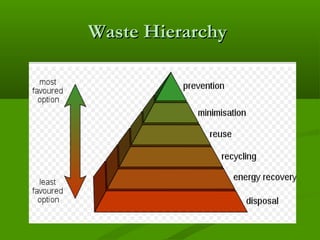
Waste Hierarchy
Extended Producer
Responsibility




Extended Producer Responsibility (EPR) is a strategy
designed to promote the integration of all costs
associated with products throughout their life cycle
(including end-of-life disposal costs) into the market
price of the product.
Extended producer responsibility is meant to impose
accountability over the entire lifecycle of products and
packaging introduced to the market. This means that
firms which manufacture, import and/or sell products
are required to be responsible for the products after
their useful life as well as during manufacture.
Polluter Pays Principle




Polluter Pays Principle is a principle where the
polluting party pays for the impact caused to the
environment.
With respect to waste management, this
generally refers to the requirement for a waste
generator to pay for appropriate disposal of the
waste.
Waste Minimisation






It is the process and the policy of reducing the amount
of waste produced by a person or a society.
Waste minimisation involves efforts to minimise
resource and energy use during manufacture.
Waste minimisation usually requires knowledge of the
production process, cradle-to-grave analysis (the
tracking of materials from their extraction to their
return to earth) and detailed knowledge of the
composition of the waste.
Waste Disposal Hierarchy

Reduce

Recycle

Reuse
Methods of disposal








Integrated waste management
Landfill
Incineration
Recycling
Sustainability
Biological reprocessing
Energy recovery
Rethinking Waste






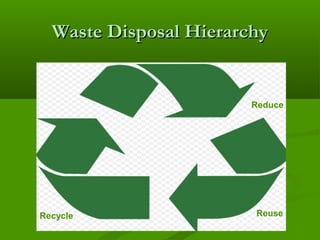
Reduce - to buy less and use less. Incorporates common sense
ideas like turning off the lights, rain barrels, and taking shorter
showers, but also plays a part in Composting/Grasscycling
(transportation energy is reduced), low-flow toilets, and
programmable thermostats. Includes the terms Re-think,
Precycle, Carpool, Efficient, and Environmental Footprint.
Reuse - elements of the discarded item are used again. Initiatives
include Hand-Me-Downs, Garage Sales, Quilting, Travel Mugs,
and Composting (nutrients). Includes the terms Laundry, Repair,
Regift, and Upcycle.
Recycle - discards are separated into materials that may be
incorporated into new products. This is different from Reuse in
that energy is used to change the physical properties of the
material. Initiatives include Composting, Beverage Container
Deposits and buying products with a high content of postconsumer material.
Rethinking Waste






Generate - capturing useful material for waste to
energy programs. Includes Methane Collection,
Gasification and Digestion, and the term Recover.
Incinerate - high temperature destruction of material.
Differs from Gasification in that oxygen is used; differs
from burning in that high temperatures consume
material efficiently and emissions are controlled.
Devastate - to discard into the natural environment, or
to "trash" the planet. Includes Litter, Burn Barrels,
Unnecessary Vehicle Idling, and Dumping discards
onto land or into water.
Market in India





The Waste Management market is valued at INR 10 bn
in 2008 and is expected to reach INR 27 bn in 2013.
Market of waste management comprises of four
segments municipal waste, electronic waste, biomedical
waste and industrial waste which is done on contract
basis.
In most cities it is done by rag pickers, small- time
contractors and municipalities
Trends and Characteristics







Increasing urbanization
Metros and other cities major contributors of
Waste
Initiatives taken at Corporate Level
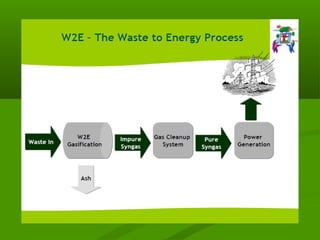
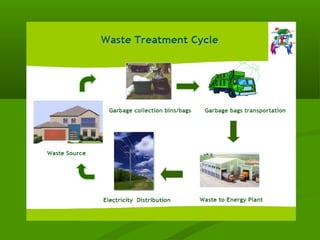
Increasing interest in waste-to-energy projects
Urban Local Bodies (ULBs) approaching capital
markets
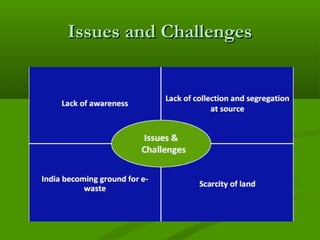
Issues and Challenges
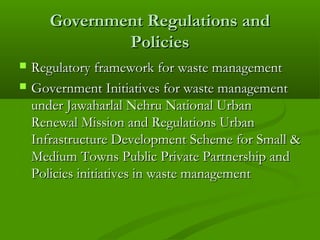
Government Regulations and
Policies



Regulatory framework for waste management
Government Initiatives for waste management
under Jawaharlal Nehru National Urban
Renewal Mission and Regulations Urban
Infrastructure Development Scheme for Small &
Medium Towns Public Private Partnership and
Policies initiatives in waste management
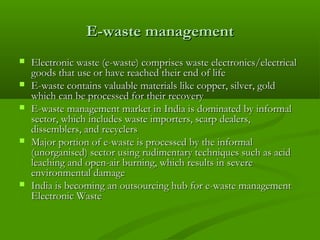
E-waste management








Electronic waste (e-waste) comprises waste electronics/electrical
goods that use or have reached their end of life
E-waste contains valuable materials like copper, silver, gold
which can be processed for their recovery
E-waste management market in India is dominated by informal
sector, which includes waste importers, scarp dealers,
dissemblers, and recyclers
Major portion of e-waste is processed by the informal
(unorganised) sector using rudimentary techniques such as acid
leaching and open-air burning, which results in severe
environmental damage
India is becoming an outsourcing hub for e-waste management
Electronic Waste
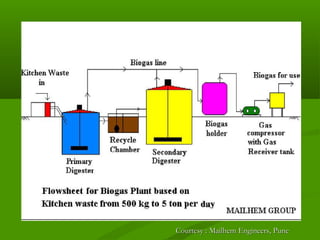
Courtesy : Mailhem Engineers, Pune
Environmental Benefits Derived From
W2e Project








Alternative energy produced from local waste to
increase energy security
Beneficial use of waste avoids necessity of long
distance transport to landfill thereby saving cost
and energy
Significant reduction in emission of greenhouse
gases and particulates per MW generated
Generates carbon credits
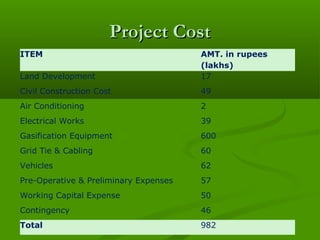
Project Cost
ITEM
Land Development

AMT. in rupees
(lakhs)
17

Civil Construction Cost

49

Air Conditioning

2

Electrical Works

39

Gasification Equipment

600

Grid Tie & Cabling

60

Vehicles

62

Pre-Operative & Preliminary Expenses

57

Working Capital Expense

50

Contingency

46

Total

982
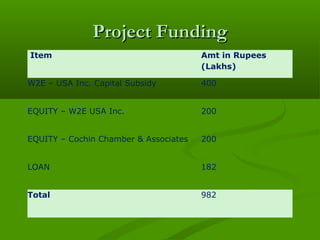
Project Funding
Item

Amt in Rupees
(Lakhs)

W2E – USA Inc. Capital Subsidy

400

EQUITY – W2E USA Inc.

200

EQUITY – Cochin Chamber & Associates

200

LOAN

182

Total

982
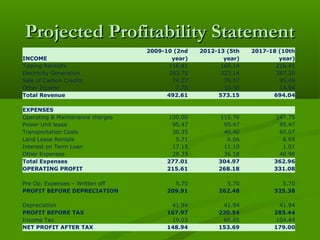
Projected Profitability Statement
2009-10 (2nd
year)
116.81
293.75
74.27
7.78
492.61

2012-13 (5th
year)
160.14
323.14
79.57
10.30
573.15

2017-18 (10th
year)
216.41
367.20
95.49
14.94
694.04

EXPENSES
Operating & Maintenance charges
Power Unit lease
Transportation Costs
Land Lease Rentals
Interest on Term Loan
Other Expenses
Total Expenses
OPERATING PROFIT

100.00
95.47
30.35
5.71
17.15
28.33
277.01
215.61

115.76
95.47
40.40
6.06
11.10
36.18
304.97
268.18

147.75
95.47
65.07
6.69
1.01
46.98
362.96
331.08

Pre Op. Expenses – Written off
PROFIT BEFORE DEPRECIATION

5.70
209.91

5.70
262.48

5.70
325.38

Depreciation
PROFIT BEFORE TAX
Income Tax
NET PROFIT AFTER TAX

41.94
167.97
19.03
148.94

41.94
220.54
66.85
153.69

41.94
283.44
104.44
179.00

INCOME
Tipping Receipts
Electricity Generation
Sale of Carbon Credits
Other Income
Total Revenue
Thank You

Waste Management

  • 1.
  • 2.
    What is WasteManagement       It is the collection, transport, processing, recycling or disposal, and monitoring of waste materials. It is also carried out to recover resources from it. It can involve solid, liquid, gaseous or radioactive substances, with different methods and fields of expertise for each. The term usually relates to materials produced by human activity, and is generally undertaken to reduce their effect on health, the environment or aesthetics. It practices differ for developed and developing nations, for urban and rural areas, and for residential and industrial producers. Management for non-hazardous waste residential and institutional waste in metropolitan areas is usually the responsibility of local government authorities, while management for non-hazardous commercial and industrial waste is usually the responsibility of the generator.
  • 3.
    Waste management concepts  Wastehierarchy  Extended producer responsibility  Polluter pays principle
  • 4.
  • 5.
    Extended Producer Responsibility   Extended ProducerResponsibility (EPR) is a strategy designed to promote the integration of all costs associated with products throughout their life cycle (including end-of-life disposal costs) into the market price of the product. Extended producer responsibility is meant to impose accountability over the entire lifecycle of products and packaging introduced to the market. This means that firms which manufacture, import and/or sell products are required to be responsible for the products after their useful life as well as during manufacture.
  • 6.
    Polluter Pays Principle   PolluterPays Principle is a principle where the polluting party pays for the impact caused to the environment. With respect to waste management, this generally refers to the requirement for a waste generator to pay for appropriate disposal of the waste.
  • 7.
    Waste Minimisation    It isthe process and the policy of reducing the amount of waste produced by a person or a society. Waste minimisation involves efforts to minimise resource and energy use during manufacture. Waste minimisation usually requires knowledge of the production process, cradle-to-grave analysis (the tracking of materials from their extraction to their return to earth) and detailed knowledge of the composition of the waste.
  • 8.
  • 9.
    Methods of disposal        Integratedwaste management Landfill Incineration Recycling Sustainability Biological reprocessing Energy recovery
  • 10.
    Rethinking Waste    Reduce -to buy less and use less. Incorporates common sense ideas like turning off the lights, rain barrels, and taking shorter showers, but also plays a part in Composting/Grasscycling (transportation energy is reduced), low-flow toilets, and programmable thermostats. Includes the terms Re-think, Precycle, Carpool, Efficient, and Environmental Footprint. Reuse - elements of the discarded item are used again. Initiatives include Hand-Me-Downs, Garage Sales, Quilting, Travel Mugs, and Composting (nutrients). Includes the terms Laundry, Repair, Regift, and Upcycle. Recycle - discards are separated into materials that may be incorporated into new products. This is different from Reuse in that energy is used to change the physical properties of the material. Initiatives include Composting, Beverage Container Deposits and buying products with a high content of postconsumer material.
  • 11.
    Rethinking Waste    Generate -capturing useful material for waste to energy programs. Includes Methane Collection, Gasification and Digestion, and the term Recover. Incinerate - high temperature destruction of material. Differs from Gasification in that oxygen is used; differs from burning in that high temperatures consume material efficiently and emissions are controlled. Devastate - to discard into the natural environment, or to "trash" the planet. Includes Litter, Burn Barrels, Unnecessary Vehicle Idling, and Dumping discards onto land or into water.
  • 12.
    Market in India    TheWaste Management market is valued at INR 10 bn in 2008 and is expected to reach INR 27 bn in 2013. Market of waste management comprises of four segments municipal waste, electronic waste, biomedical waste and industrial waste which is done on contract basis. In most cities it is done by rag pickers, small- time contractors and municipalities
  • 13.
    Trends and Characteristics      Increasingurbanization Metros and other cities major contributors of Waste Initiatives taken at Corporate Level Increasing interest in waste-to-energy projects Urban Local Bodies (ULBs) approaching capital markets
  • 14.
  • 15.
    Government Regulations and Policies   Regulatoryframework for waste management Government Initiatives for waste management under Jawaharlal Nehru National Urban Renewal Mission and Regulations Urban Infrastructure Development Scheme for Small & Medium Towns Public Private Partnership and Policies initiatives in waste management
  • 16.
    E-waste management      Electronic waste(e-waste) comprises waste electronics/electrical goods that use or have reached their end of life E-waste contains valuable materials like copper, silver, gold which can be processed for their recovery E-waste management market in India is dominated by informal sector, which includes waste importers, scarp dealers, dissemblers, and recyclers Major portion of e-waste is processed by the informal (unorganised) sector using rudimentary techniques such as acid leaching and open-air burning, which results in severe environmental damage India is becoming an outsourcing hub for e-waste management Electronic Waste
  • 18.
    Courtesy : MailhemEngineers, Pune
  • 21.
    Environmental Benefits DerivedFrom W2e Project     Alternative energy produced from local waste to increase energy security Beneficial use of waste avoids necessity of long distance transport to landfill thereby saving cost and energy Significant reduction in emission of greenhouse gases and particulates per MW generated Generates carbon credits
  • 23.
    Project Cost ITEM Land Development AMT.in rupees (lakhs) 17 Civil Construction Cost 49 Air Conditioning 2 Electrical Works 39 Gasification Equipment 600 Grid Tie & Cabling 60 Vehicles 62 Pre-Operative & Preliminary Expenses 57 Working Capital Expense 50 Contingency 46 Total 982
  • 24.
    Project Funding Item Amt inRupees (Lakhs) W2E – USA Inc. Capital Subsidy 400 EQUITY – W2E USA Inc. 200 EQUITY – Cochin Chamber & Associates 200 LOAN 182 Total 982
  • 25.
    Projected Profitability Statement 2009-10(2nd year) 116.81 293.75 74.27 7.78 492.61 2012-13 (5th year) 160.14 323.14 79.57 10.30 573.15 2017-18 (10th year) 216.41 367.20 95.49 14.94 694.04 EXPENSES Operating & Maintenance charges Power Unit lease Transportation Costs Land Lease Rentals Interest on Term Loan Other Expenses Total Expenses OPERATING PROFIT 100.00 95.47 30.35 5.71 17.15 28.33 277.01 215.61 115.76 95.47 40.40 6.06 11.10 36.18 304.97 268.18 147.75 95.47 65.07 6.69 1.01 46.98 362.96 331.08 Pre Op. Expenses – Written off PROFIT BEFORE DEPRECIATION 5.70 209.91 5.70 262.48 5.70 325.38 Depreciation PROFIT BEFORE TAX Income Tax NET PROFIT AFTER TAX 41.94 167.97 19.03 148.94 41.94 220.54 66.85 153.69 41.94 283.44 104.44 179.00 INCOME Tipping Receipts Electricity Generation Sale of Carbon Credits Other Income Total Revenue
  • 27.