SOLID WASTE MANAGEMENT
BCV515C
o Solid waste:
Solid waste are non liquid waste araising from human and
animal activities that are normally solid and that are discarded
as useless or unwanted .It predominately include food waste
,yard waste container and product packaging and other
miscelleous inorganic waste from residential ,commerial
,institution and industrial source.
o Solid waste management:
The discipline associated with the control of generation ,storage ,
collection , transfer and transport, processing and disposal of solidwaste in
amanner ie in accordance with best principle s of public health , economic
engineering ,conservation, aesthetics and other environmental consideration
and that is also responsible to public attitude
NECESSITY OF SOLID WASTE MANAGEMENT
 Public Health Protection
Proper waste management reduces the risk of disease transmission by minimizing exposure to
harmful pathogens present in waste.
 Environmental Protection
Proper disposal and treatment prevent soil, water, and air pollution caused by leachate and
harmful emissions from waste.
 Aesthetic and Community Well-Being
Clean and well-managed waste areas contribute to the overall aesthetics of communities,
enhancing residents' quality of life.
 Economic Benefits
The waste management sector generates jobs in collection, recycling, processing, and education.
Reducing waste through recycling and composting can lower disposal costs and create economic
opportunities from recovered materials.
 Social Impact
Well-managed waste contributes to cleaner neighborhood, improving the overall quality of life for
residents.
 Climate Change Mitigation
Proper waste management strategies, such as composting and recycling, help reduce methane
emissions from landfills, contributing to climate change mitigation efforts.
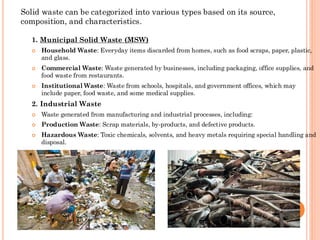
1. Municipal Solid Waste (MSW)
 Household Waste: Everyday items discarded from homes, such as food scraps, paper, plastic,
and glass.
 Commercial Waste: Waste generated by businesses, including packaging, office supplies, and
food waste from restaurants.
 Institutional Waste: Waste from schools, hospitals, and government offices, which may
include paper, food waste, and some medical supplies.
2. Industrial Waste
 Waste generated from manufacturing and industrial processes, including:
 Production Waste: Scrap materials, by-products, and defective products.
 Hazardous Waste: Toxic chemicals, solvents, and heavy metals requiring special handling and
disposal.
Solid waste can be categorized into various types based on its source,
composition, and characteristics.
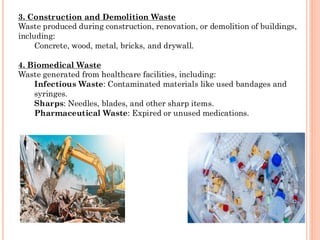
3. Construction and Demolition Waste
Waste produced during construction, renovation, or demolition of buildings,
including:
Concrete, wood, metal, bricks, and drywall.
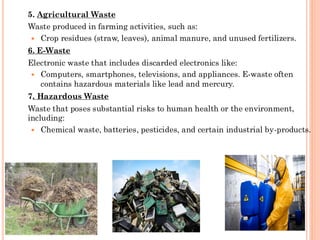
4. Biomedical Waste
Waste generated from healthcare facilities, including:
Infectious Waste: Contaminated materials like used bandages and
syringes.
Sharps: Needles, blades, and other sharp items.
Pharmaceutical Waste: Expired or unused medications.
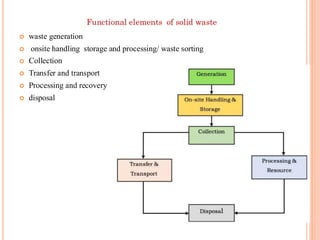
5. Agricultural Waste
Waste produced in farming activities, such as:
 Crop residues (straw, leaves), animal manure, and unused fertilizers.
6. E-Waste
Electronic waste that includes discarded electronics like:
 Computers, smartphones, televisions, and appliances. E-waste often
contains hazardous materials like lead and mercury.
7. Hazardous Waste
Waste that poses substantial risks to human health or the environment,
including:
 Chemical waste, batteries, pesticides, and certain industrial by-products.
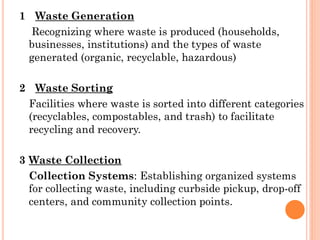
Functional elements of solid waste
 waste generation
 onsite handling storage and processing/ waste sorting
 Collection
 Transfer and transport
 Processing and recovery
 disposal
1 Waste Generation
Recognizing where waste is produced (households,
businesses, institutions) and the types of waste
generated (organic, recyclable, hazardous)
2 Waste Sorting
Facilities where waste is sorted into different categories
(recyclables, compostables, and trash) to facilitate
recycling and recovery.
3 Waste Collection
Collection Systems: Establishing organized systems
for collecting waste, including curbside pickup, drop-off
centers, and community collection points.
4 Transportation
Vehicle Selection: Using appropriate vehicles for transporting
different types of waste (e.g., compaction trucks for MSW,
specialized trucks for hazardous waste).
Route Optimization: Planning routes to reduce travel time and
fuel consumption while ensuring timely waste pickup.
5 Processing and recovery
Recycling: Processing recyclable materials to create new
products, reducing the need for virgin resources.
Composting: Biological decomposition of organic waste to create
compost, enriching soil and reducing landfill use.
Incineration: Burning waste to reduce volume and potentially
generate energy, while controlling emissions.
Anaerobic Digestion: Breaking down organic material in the
absence of oxygen to produce biogas, which can be used for energy.
6
6. Disposal
There are several methods of waste disposal, including:
1 Sanitary landfills
Waste is thrown into a landfill that has a protective lining to prevent
toxins from entering the water.
2 Incineration
Waste is burned to turn it into base components, which can reduce
waste volume by up to 90%.
3 Composting
Organic waste is decomposed by leaving it in a pit for a long time, and
the compost can be used as plant manure.
4 Cat holes
Choose a spot that is at least 200 feet (about 70 adult steps) away
from water sources to prevent contamination and cleanliness.
:
The global perspective on solid waste management reveals
significant challenges and opportunities, shaped by rapid urbanization,
population growth, and varying levels of infrastructure and technology
across different regions. Here’s an overview
1. Current Trends
 Urbanization: As more people move to cities, the volume of solid waste
generated increases. Urban areas account for a significant proportion of
global waste production.
 Waste Generation Rates: The World Bank estimates that global waste
generation will increase from 2.01 billion tons in 2016 to 3.4 billion tons by
2050.
 2. Challenges
 Inadequate Infrastructure: Many developing countries lack the
necessary infrastructure for effective waste collection, recycling, and
disposal. This leads to illegal dumping and environmental pollution.
 Limited Recycling Rates: Despite the potential for recycling, many
regions struggle with low rates due to a lack of public awareness,
economic incentives, and proper facilities.
 Health Risks: Poor waste management practices can lead to
health hazards, including exposure to hazardous waste and
increased disease transmission.
 Climate Change: Landfills are significant sources of
methane, a potent greenhouse gas. Ineffective waste
management contributes to climate change.
 3. Best Practices and Innovations
 Integrated Waste Management: A holistic approach that
includes reduction, reuse, recycling, composting, and safe
disposal. This model is gaining traction globally.
 Circular Economy: Emphasizing resource efficiency, where
waste is viewed as a resource to be reused or recycled,
minimizing the need for new raw materials.
 Technology Integration: Innovations such as waste-to-
energy plants, advanced recycling technologies, and digital
waste management systems are emerging to improve
efficiency.
 4. Policy and Regulation
 Global Agreements: International frameworks, such as the Paris
Agreement and the Sustainable Development Goals (SDGs), emphasize
waste reduction and sustainable management practices.
 National Policies: Many countries are implementing stricter
regulations and incentives to promote recycling and reduce waste,
including bans on single-use plastics.
 5. Community Engagement
 Public Awareness Campaigns: Education and awareness initiatives
are crucial for changing behaviors around waste generation and disposal.
 Participatory Approaches: Involving communities in decision-making
processes fosters a sense of ownership and responsibility toward waste
management.
 6. Regional Perspectives
Developed Countries: Generally have more advanced waste
management systems with higher recycling rates but still face
challenges in managing e-waste and hazardous materials.
Developing Countries: Often struggle with basic waste
management services, leading to environmental and health
issues, but may be more open to innovative community-based
solutions.
POLICIES AND LEGISLATIVE FRAME WORKS IN
SOLID WASTE MANAGEMENT
Solid waste management (SWM) in India is governed by a
variety of policies and legislative frameworks aimed at
ensuring effective waste management practices across the
country. Here’s a detailed overview:
 National Policy on Solid Waste Management (2000):
 Aimed at providing a framework for the management of municipal
solid waste in urban areas.
 Focuses on reducing waste generation, promoting recycling, and
enhancing public participation.
 Swachh Bharat Mission (2014):
 Launched to improve sanitation and waste management in urban
and rural areas.
 Promotes waste segregation at the source, cleanliness, and
sanitation initiatives.
 National Waste Management Policy:
 Proposed framework to address all types of waste, including
solid, liquid, and hazardous waste.
 Aims to integrate waste management into urban planning and
promote sustainable practices.
Legislative Frameworks
 Municipal Solid Waste (Management and Handling)
Rules (2000):
 Mandates municipal authorities to manage solid waste effectively.
 Requires waste segregation, collection, storage, transportation,
processing, and disposal.
 Solid Waste Management Rules (2016):
 Revised regulations that emphasize waste segregation at the source,
composting, and recycling.
 Introduces Extended Producer Responsibility (EPR) for managing
plastic waste.
 Mandates the preparation of a solid waste management plan by local
authorities.
 Plastic Waste Management Rules (2016):
 Focuses on the management of plastic waste through reduction,
recycling, and reuse.
 Sets guidelines for producers, importers, and brand owners regarding
plastic packaging.
Bio-Medical Waste Management Rules (2016):
 Governs the handling, treatment, and disposal of
biomedical waste to ensure public health and
environmental safety.
 Requires healthcare facilities to segregate and treat
biomedical waste appropriately.
Hazardous and Other Wastes (Management and
Transboundary Movement) Rules (2016):
 Regulates the management and disposal of hazardous
waste, including solid waste that contains hazardous
components.
Environmental Protection Act (1986):
 Provides a broader legal framework for environmental
protection, including provisions related to waste
management
STAKEHOLDER ROLES IN SOLID WASTE
MANAGEMENT
1. Government Authorities
 Central and State Governments: Formulate policies,
regulations, and guidelines for waste management. They
oversee implementation and provide funding.
 Local Authorities: Municipalities and urban local bodies
are responsible for the collection, segregation, and disposal
of waste within their jurisdictions.
2. Waste Generators
 Households: Responsible for proper segregation of waste
at the source (e.g., separating wet and dry waste).
 Businesses: Commercial establishments must follow
regulations for waste management and report on waste
generation.
 3. Waste Collectors and Transporters
 Municipal Workers: Involved in the collection and
transportation of waste to processing or disposal sites.
 Private Contractors: Some municipalities outsource waste
collection and transport to private companies.
 4. Recycling and Processing Facilities
 Material Recovery Facilities: Process recyclable
materials, sorting and preparing them for recycling.
 Composting Plants: Convert organic waste into compost
through aerobic decomposition.
 5. Non-Governmental Organizations (NGOs)
 Advocacy and Awareness: Raise awareness about waste
management practices and promote community
engagement.
 Education: Conduct workshops and training programs to
inform the public about proper waste disposal and recycling.
6 .Community Groups
 Local Residents’ Associations: Mobilize community members
to participate in waste management initiatives and promote best
practices.
 Volunteer Groups: Organize clean-up drives and awareness
campaigns.
7. Educational Institutions
 Research and Innovation: Conduct studies and develop new
technologies or practices for effective waste management.
 Curriculum Development: Educate students on sustainability
and waste management practices.
8. Businesses and Industries
 Corporate Social Responsibility (CSR): Engage in
initiatives to reduce waste generation and promote recycling.
 Extended Producer Responsibility (EPR): Take
responsibility for the lifecycle of their products, including waste
management.
9 Regulatory Bodies
 Environmental Agencies: Monitor compliance with waste
management regulations and enforce penalties for violations.
 Health Departments: Ensure that waste management
practices do not pose health risks to the public.
10. The General Public
 Participation: Individuals can contribute by practicing
waste segregation, recycling, and participating in community
initiatives.
 Feedback: Provide input on local waste management
practices and policies.
Government initiatives on solid waste management
Government initiatives on solid waste management often
focus on reducing waste, promoting recycling, and improving
waste disposal methods. Here are some common actions:
 Waste Segregation: Encouraging people to separate waste
at home into categories like organic, recyclable, and non-
recyclable.
 Recycling Programs: Setting up systems to collect and
process materials like plastic, paper, and metal so they can
be reused.
 Landfills and Waste-to-Energy Plants: Building better
landfills or waste-to-energy facilities where waste is either
safely buried or converted into energy.
 Public Awareness Campaigns: Educating citizens
about the importance of reducing waste, reusing materials,
and recycling.
 Plastic Bans: Banning or limiting the use of single-use
plastics to reduce waste.
 Incentives for Businesses: Offering tax breaks or other
benefits to businesses that adopt eco-friendly waste
management practices.
 Integrated Solid Waste Management (ISWM)
It is a comprehensive approach to managing waste that
focuses on reducing its impact on the environment and
human health. It combines different methods of handling
waste in an efficient and sustainable way. Here are the key
components:
 Waste Prevention/Reduction: Minimizing the amount of
waste generated by promoting eco-friendly products,
reducing packaging, and encouraging people to use less.
 Recycling and Reuse: Collecting and processing
materials like paper, plastic, glass, and metals so they can
be reused, reducing the need for new resources.
 Composting: Turning organic waste (like food scraps and
yard waste) into compost, which can be used as a natural
fertilizer for plants.
.
 Waste Treatment: Using methods like incineration
(burning waste to generate energy) or other processes to
reduce the volume of waste before disposal.
 Disposal: Safely disposing of the remaining waste in
properly managed landfills or waste-to-energy facilities
 The 3R's in solid waste management stand for Reduce,
Reuse, and Recycle. These principles help minimize the
amount of waste we create and its impact on the environment.
Here's what each one means:
Reduce
 Definition: Reducing refers to cutting down the amount of
waste produced in the first place. It is the most effective way to
manage waste since it prevents waste generation at its source.
 Examples:
 Using less packaging material in product manufacturing.
 Opting for digital receipts instead of printed ones.
 Purchasing products with a longer lifespan or opting for higher-
quality items that do not need frequent replacement.
 Environmental Impact: Reducing waste helps in conserving
natural resources, lowering energy consumption, and
minimizing pollution.
Reuse
 Definition: Reuse involves using items more than once in
their original form instead of discarding them after a
single use. This can delay their entry into the waste
stream and prolong the item's useful life.
 Examples:
 Reusing glass jars for storage instead of buying new
containers.
 Donating clothes or appliances that are still functional.
 Refilling water bottles or repurposing old furniture.
 Environmental Impact: Reusing products reduces the
need for new products, thus conserving resources, reducing
emissions from manufacturing, and minimizing waste.
Recycle
 Definition: Recycling involves converting waste materials
into new products or raw materials. This process reduces
the need for virgin materials and diverts waste from
landfills or incineration.
 Examples:
 Recycling paper, plastics, metals, and glass to produce
new products.
 Turning organic waste into compost for agricultural or
gardening use.
 Using construction and demolition waste in new building
materials.
 Environmental Impact: Recycling conserves resources,
saves energy, reduces greenhouse gas emissions, and
lowers the volume of waste in landfills.
MODULE 2
WASTE GENERATION AND
CHARACTERIZATION
Factors affecting Waste generation rate
Source Reduction & Recycling Activities
Public Attitudes and Legislation
Geographic location and physical factors on
generation of Solid waste
1. Source Reduction & Recycling Activities
Source Reduction: This involves minimizing waste
before it is created. Practices include designing products
that use fewer materials, last longer, or are easier to
repair. When businesses and consumers adopt source
reduction strategies, less waste is generated from the
outset.
Recycling Activities: Effective recycling programs
encourage the recovery of materials, reducing the amount
of waste that ends up in landfills. When communities
have strong recycling initiatives, people are more likely to
recycle, which decreases the overall waste generated.
 2. Public Attitudes and Legislation
 Public Attitudes: Community awareness and attitudes
toward waste management significantly influence waste
generation. If people are educated about the benefits of
reducing and recycling waste, they are more likely to
engage in those practices, leading to lower waste
generation rates.
 Legislation: Government policies and regulations play
a crucial role. Laws that promote recycling, impose
penalties for excessive waste, or provide incentives for
waste reduction can lead to significant decreases in
waste generation. For example, bans on single-use
plastics can directly reduce the amount of waste
produced
 3. Geographic Location and Physical Factors on
generation of Solid waste
 Geographic Location: Urban areas often generate more
waste per capita than rural areas due to higher population
densities and consumption patterns. Access to waste
management services also varies by location, impacting
waste generation.
 Physical Factors: Local climate and geography can affect
waste generation. For instance, regions with more outdoor
events or tourism may produce more waste during peak
seasons. Additionally, the availability of land for waste
disposal can influence how much waste is generated and
managed
PHYSICAL COMPOSITION OR PROPERTIES
 In solid waste management, understanding the physical
composition and properties of waste is essential for
effective handling, treatment, and disposal. Here’s an
overview of key physical properties:
 Specific Weight
 Moisture Content
 Particle Size and Distribution
 Field Capacity
 Permeability of Compacted Waste
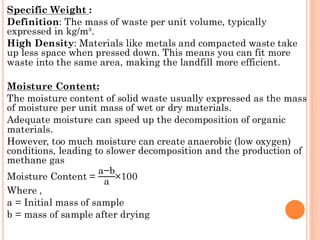
Specific Weight :
Definition: The mass of waste per unit volume, typically
expressed in kg/m³.
High Density: Materials like metals and compacted waste take
up less space when pressed down. This means you can fit more
waste into the same area, making the landfill more efficient.
Moisture Content:
The moisture content of solid waste usually expressed as the mass
of moisture per unit mass of wet or dry materials.
Adequate moisture can speed up the decomposition of organic
materials.
However, too much moisture can create anaerobic (low oxygen)
conditions, leading to slower decomposition and the production of
methane gas
Moisture Content =
a−b
a
×100
Where ,
a = Initial mass of sample
b = mass of sample after drying
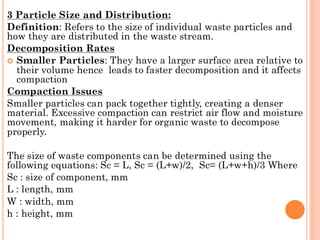
3 Particle Size and Distribution:
Definition: Refers to the size of individual waste particles and
how they are distributed in the waste stream.
Decomposition Rates
 Smaller Particles: They have a larger surface area relative to
their volume hence leads to faster decomposition and it affects
compaction
Compaction Issues
Smaller particles can pack together tightly, creating a denser
material. Excessive compaction can restrict air flow and moisture
movement, making it harder for organic waste to decompose
properly.
The size of waste components can be determined using the
following equations: Sc = L, Sc = (L+w)/2, Sc= (L+w+h)/3 Where
Sc : size of component, mm
L : length, mm
W : width, mm
h : height, mm
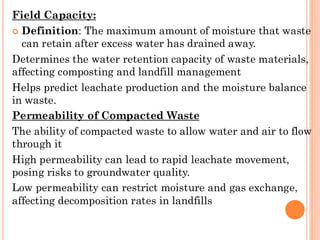
Field Capacity:
 Definition: The maximum amount of moisture that waste
can retain after excess water has drained away.
Determines the water retention capacity of waste materials,
affecting composting and landfill management
Helps predict leachate production and the moisture balance
in waste.
Permeability of Compacted Waste
The ability of compacted waste to allow water and air to flow
through it
High permeability can lead to rapid leachate movement,
posing risks to groundwater quality.
Low permeability can restrict moisture and gas exchange,
affecting decomposition rates in landfills
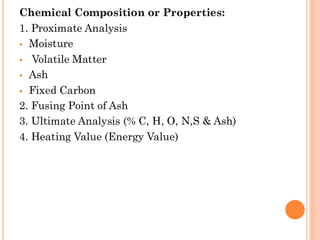
Chemical Composition or Properties:
1. Proximate Analysis
▪ Moisture
▪ Volatile Matter
▪ Ash
▪ Fixed Carbon
2. Fusing Point of Ash
3. Ultimate Analysis (% C, H, O, N,S & Ash)
4. Heating Value (Energy Value)
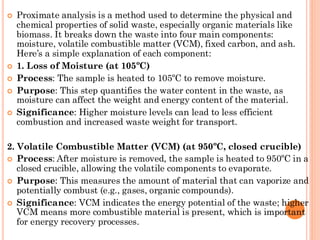
 Proximate analysis is a method used to determine the physical and
chemical properties of solid waste, especially organic materials like
biomass. It breaks down the waste into four main components:
moisture, volatile combustible matter (VCM), fixed carbon, and ash.
Here’s a simple explanation of each component:
 1. Loss of Moisture (at 105ºC)
 Process: The sample is heated to 105ºC to remove moisture.
 Purpose: This step quantifies the water content in the waste, as
moisture can affect the weight and energy content of the material.
 Significance: Higher moisture levels can lead to less efficient
combustion and increased waste weight for transport.
2. Volatile Combustible Matter (VCM) (at 950ºC, closed crucible)
 Process: After moisture is removed, the sample is heated to 950ºC in a
closed crucible, allowing the volatile components to evaporate.
 Purpose: This measures the amount of material that can vaporize and
potentially combust (e.g., gases, organic compounds).
 Significance: VCM indicates the energy potential of the waste; higher
VCM means more combustible material is present, which is important
for energy recovery processes.
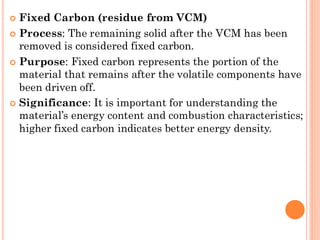
 Fixed Carbon (residue from VCM)
 Process: The remaining solid after the VCM has been
removed is considered fixed carbon.
 Purpose: Fixed carbon represents the portion of the
material that remains after the volatile components have
been driven off.
 Significance: It is important for understanding the
material’s energy content and combustion characteristics;
higher fixed carbon indicates better energy density.
 Ash (at 950ºC, open crucible)
 Process: The sample is further heated in an open crucible
at 950ºC to burn off all combustible materials, leaving
behind inorganic residues.
 Purpose: This measures the total ash content, which
consists of non-combustible minerals (like silica, calcium,
and metals).
 Significance: Ash content affects the overall energy
output and can indicate potential environmental impacts
(e.g., heavy metals) and the need for special handling or
disposal methods.
The biological properties of solid waste are vital for
developing effective waste management practices. By
understanding decomposition rates, microbial
activity, nutrient content, and other biological factors,
waste managers can implement strategies like composting
and anaerobic digestion to transform organic waste into
valuable resources while minimizing environmental
impact.
BIOLOGICAL PROPERTIES
 1. Decomposition Rate
Refers to how quickly organic materials break down into
simpler substances. Factors influencing this rate include
moisture, temperature, oxygen levels, and the nature of the
waste
 2. Microbial Activity
Bacteria, fungi, and other microorganisms play a crucial role
in the decomposition process. Different types of
microorganisms thrive in varying conditions (aerobic vs.
anaerobic)
 3. Nutrient Content
Contains essential nutrients (nitrogen, phosphorus,
potassium) beneficial for soil health and plant growth
 Pathogen Presence
Some organic waste may contain harmful microorganisms.
Proper management (like composting at high temperatures)
can reduce or eliminate these pathogens, making the end
product safe for use.
 5. Odor Production
Volatile Organic Compounds (VOCs): During
decomposition, organic materials can produce odors.
Anaerobic conditions, in particular, lead to the production of
methane and other gases, which can be unpleasant
 6. Moisture Content
 Importance of Moisture: Adequate moisture is
necessary for microbial activity and decomposition.
However, excess moisture can lead to anaerobic conditions,
slowing decomposition and increasing odors
 7. Temperature Regulation
Thermophilic Decomposition: Higher
temperatures (usually between 55-70°C or 130-
160°F) during composting can enhance microbial
activity and pathogen destruction
 Maintaining optimal temperatures helps promote
faster decomposition and nutrient stabilization.
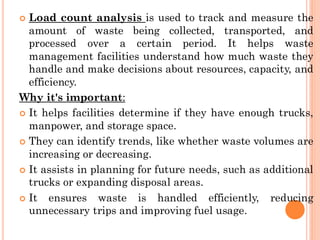
Methods to estimate the quantity of waste generated
 load count analysis
 Weight volume analysis
 Material balance analysis
 Load count analysis is used to track and measure the
amount of waste being collected, transported, and
processed over a certain period. It helps waste
management facilities understand how much waste they
handle and make decisions about resources, capacity, and
efficiency.
Why it's important:
 It helps facilities determine if they have enough trucks,
manpower, and storage space.
 They can identify trends, like whether waste volumes are
increasing or decreasing.
 It assists in planning for future needs, such as additional
trucks or expanding disposal areas.
 It ensures waste is handled efficiently, reducing
unnecessary trips and improving fuel usage.
Weight-volume analysis in solid waste management is a method
used to understand both the weight (how heavy) and the volume (how
much space it takes up) of the waste being collected, transported, or
processed.
Why it’s important:
 Storage and Transport: Weight and volume both matter when
planning how much waste can be transported by trucks or stored at a
landfill. For example, a truck may fill up with light but bulky waste
(like paper or plastics) before reaching its weight limit.
 Cost Management: Weight affects disposal costs, as some facilities
charge based on how heavy the waste is. Volume helps in
understanding how much space is needed in landfills or processing
plants.
 Efficiency: By knowing the weight and volume, waste management
teams can optimize truck routes, reduce trips, and improve fuel
efficiency.
 Recycling: Different materials have different weights and volumes,
so understanding these can help with sorting and recycling processes.
For example, compacting bulky materials reduces volume but not
weight, making it easier to transport
Measuring Weight
Weighbridges (Truck Scales)
Garbage trucks are weighed when they are empty and again
after they are loaded with waste. The difference between the
two weights gives the weight of the waste collected.
Measuring Volume
The volume of waste is often estimated based on the size of the
containers or the truck's capacity. For example, a garbage truck
may have a capacity of 20 cubic yards (or 15 cubic meters), and
the waste is estimated based on how full the truck is.
Once the weight and volume are measured, the weight-to-
volume ratio (density) can be calculated. This tells how much
a specific volume of waste weighs, which is helpful for planning
storage and transport. For example, heavier waste (like
construction debris) will have a higher weight-to-volume ratio
compared to lighter waste (like plastics or paper).
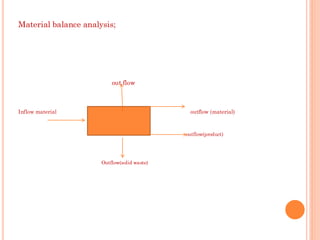
Material balance analysis;
out flow
Inflow material outflow (material)
• outflow(product)
Outflow(solid waste)
 Material balance analysis in solid waste management is
like tracking all the waste coming into and going out of a
system (like a landfill or recycling plant). It helps us see
how much waste is:
 Collected: The total amount of waste we gather.
 Processed: How much is recycled, composted, or
treated.
 Disposed: How much goes to a landfill or is incinerated.
 Byproducts: Any useful products like compost or
energy generated from waste.
 In this case, the material balance would look like:
 Input: 100 tons of waste generated.
 Output: 55 tons of recycled/composted material and
energy.
 Residue: 28 tons of waste landfilled.
 Losses: Gaseous emissions from incineration.
MODULE 3
STORAGE, COLLECTION & TRANSPORTATION OF
WASTE
 Methods of storage
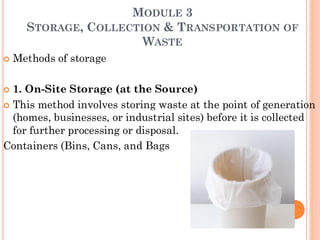
 1. On-Site Storage (at the Source)
 This method involves storing waste at the point of generation
(homes, businesses, or industrial sites) before it is collected
for further processing or disposal.
Containers (Bins, Cans, and Bags
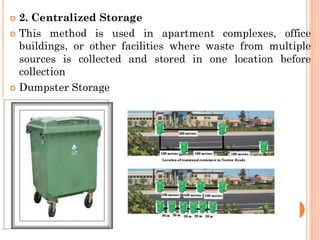
 2. Centralized Storage
 This method is used in apartment complexes, office
buildings, or other facilities where waste from multiple
sources is collected and stored in one location before
collection
 Dumpster Storage
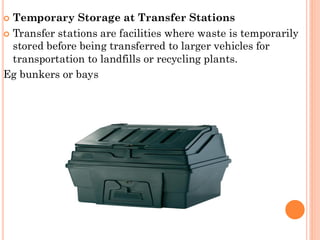
 Temporary Storage at Transfer Stations
 Transfer stations are facilities where waste is temporarily
stored before being transferred to larger vehicles for
transportation to landfills or recycling plants.
Eg bunkers or bays
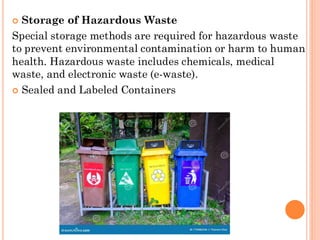
 Storage of Hazardous Waste
Special storage methods are required for hazardous waste
to prevent environmental contamination or harm to human
health. Hazardous waste includes chemicals, medical
waste, and electronic waste (e-waste).
 Sealed and Labeled Containers
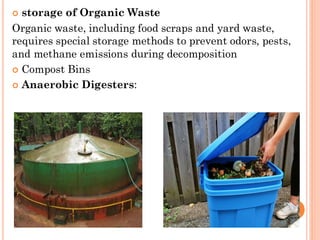
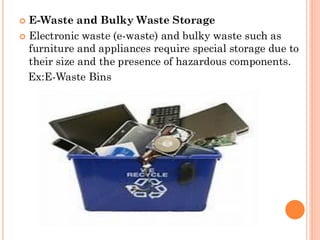
 storage of Organic Waste
Organic waste, including food scraps and yard waste,
requires special storage methods to prevent odors, pests,
and methane emissions during decomposition
 Compost Bins
 Anaerobic Digesters:
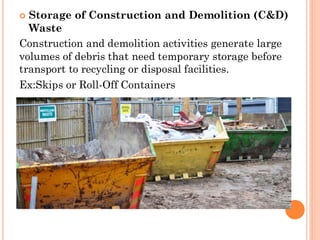
 E-Waste and Bulky Waste Storage
 Electronic waste (e-waste) and bulky waste such as
furniture and appliances require special storage due to
their size and the presence of hazardous components.
Ex:E-Waste Bins
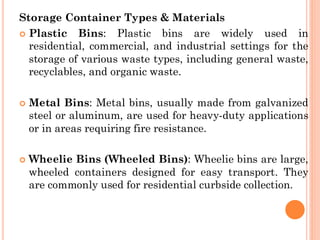
 Storage of Construction and Demolition (C&D)
Waste
Construction and demolition activities generate large
volumes of debris that need temporary storage before
transport to recycling or disposal facilities.
Ex:Skips or Roll-Off Containers
Storage Container Types & Materials
 Plastic Bins: Plastic bins are widely used in
residential, commercial, and industrial settings for the
storage of various waste types, including general waste,
recyclables, and organic waste.
 Metal Bins: Metal bins, usually made from galvanized
steel or aluminum, are used for heavy-duty applications
or in areas requiring fire resistance.
 Wheelie Bins (Wheeled Bins): Wheelie bins are large,
wheeled containers designed for easy transport. They
are commonly used for residential curbside collection.
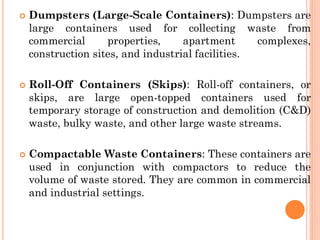
 Dumpsters (Large-Scale Containers): Dumpsters are
large containers used for collecting waste from
commercial properties, apartment complexes,
construction sites, and industrial facilities.
 Roll-Off Containers (Skips): Roll-off containers, or
skips, are large open-topped containers used for
temporary storage of construction and demolition (C&D)
waste, bulky waste, and other large waste streams.
 Compactable Waste Containers: These containers are
used in conjunction with compactors to reduce the
volume of waste stored. They are common in commercial
and industrial settings.
 Specialized Containers for Hazardous Waste
Specialized containers are used for storing hazardous
materials like chemicals, batteries, medical waste, or e-
waste to ensure safety and prevent contamination.
 Biodegradable Bags and Compostable Containers
Biodegradab le bags and compostable containers are used
for storing organic waste that will eventually be
composted.
Types of Collection Service
The Various types of collection service are
 1. Municipal Collection service / Residential collection
service
A. From low rise detached dwellings
B. From low and medium rise apartment
C. From high rise apartment
 2. Commercial and Industrial collection service
 Municipal Collection service / Residential collection
service
Collection service varies depending upon the type of
dwelling unit, collection for low rise detached dwellings
and collection for medium and high rise apartments are
considered separately.
The most common types of residential services in various
parts of the country include
Curb – is used for low rise detached dwelling. This is a
manual type of collection system where in the waste are
collected in a curb on a collection day and the containers
are returned back to their storage location until the next
collection.
 2. Alley - are part of the basic layout of a city or a given
residential area. Alleys are storage of container used for
solid waste collection.
 Set out – Set back – Containers are set out from the
owners property and set back after being emptied by
additional crew.
 4. Set out – this service is essentially the same as set-out
& set-back, except that the home owner is responsible
for returning the container back their storage location.
 5. Backyard Carrying – The collection crew is
responsible for entering the owners property and
removing the waste from their storage location.
 2. Commercial and Industrial collection service
 Both manual and mechanical means are used to
collect waste from commercial and industrial areas. To
avoid traffic congestion during the day time, solid waste
from commercial establishment in many cities are
collected in the late evening and early morning.
 Where manual collection is used, Wastes are put in
plastic bags, cardboard boxes and other disposable
containers that are placed at curbs for collection
 The Collection services provided to large apartment
buildings, residential complexes, commercial and
industrial areas are provided to theses centers on the
use of movable containers, stationery containers, and
large stationery compactors.
 Compactors are of the type that can be used to
compress materials into large containers.
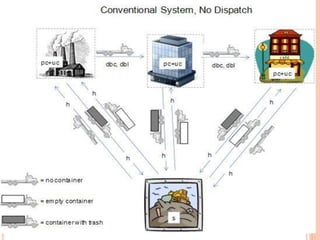
 Types of Collection Systems
Based on the mode of operation, collection systems are
classified in to two categories:
1 Hauled container systems
2. Stationery container systems
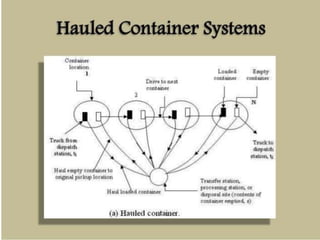
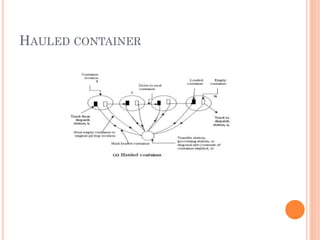
Hauled Container system
Collection system in which the containers used for the
storage of waste are hauled to the processing, transfer or
disposal site, emptied and returned to either their original
location or some other location are defined as hauled
container system.
The collector is responsible for driving the vehicle, loading
the containers and emptying the contents of containers at
disposal site
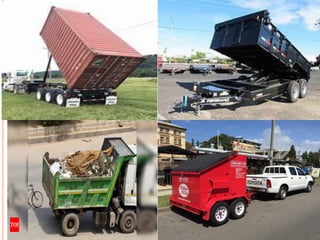
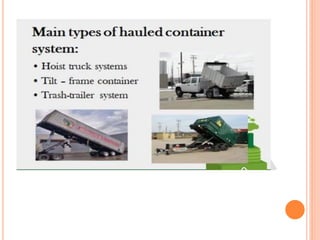
There are two main types of hauled container systems
1. Tilt Frame container
2. Trash-trailors
 Systems that use tilt frame loaded vehicles often called drop
boxes are ideally suited for collection of all types of solid
waste and rubbish from locations where generation rates
warrants the use of large containers. Because of large
volume that can be hauled, the use of tilt frame hauled
container systems has become widespread, especially among
private services.
 Trash trailers are better for collection of especially heavy
rubbish such as sand, timber and metal scrap and
often are used for collection of demolition waste at
construction sites
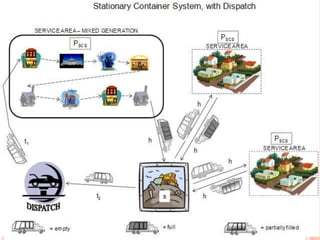
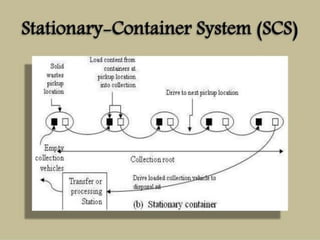
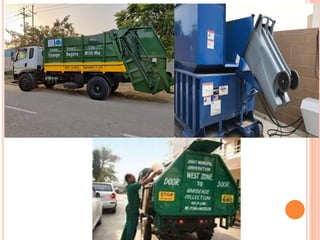
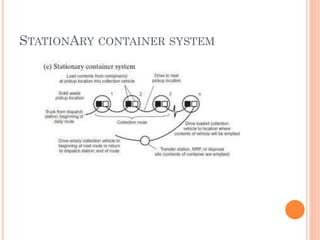
 2. Stationery Collection system
Collection system in which the container used for the
storage of waste remains at the point of waste generation,
except when moved for collection are defined as stationery
container system.
There are two main types of stationery container systems
1. Those in which self loading compactors used
2. Those in which manually loaded vehicles are used.
TYPES OF COLLECTION VEHICLES
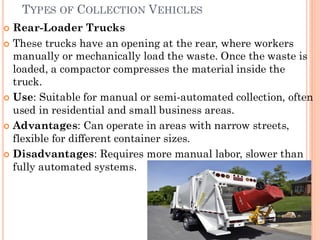
 Rear-Loader Trucks
 These trucks have an opening at the rear, where workers
manually or mechanically load the waste. Once the waste is
loaded, a compactor compresses the material inside the
truck.
 Use: Suitable for manual or semi-automated collection, often
used in residential and small business areas.
 Advantages: Can operate in areas with narrow streets,
flexible for different container sizes.
 Disadvantages: Requires more manual labor, slower than
fully automated systems.
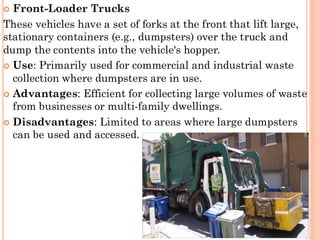
 Front-Loader Trucks
These vehicles have a set of forks at the front that lift large,
stationary containers (e.g., dumpsters) over the truck and
dump the contents into the vehicle's hopper.
 Use: Primarily used for commercial and industrial waste
collection where dumpsters are in use.
 Advantages: Efficient for collecting large volumes of waste
from businesses or multi-family dwellings.
 Disadvantages: Limited to areas where large dumpsters
can be used and accessed.
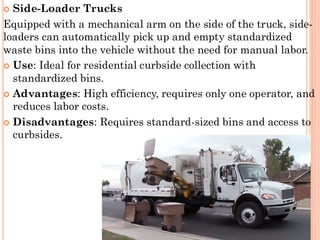
 Side-Loader Trucks
Equipped with a mechanical arm on the side of the truck, side-
loaders can automatically pick up and empty standardized
waste bins into the vehicle without the need for manual labor.
 Use: Ideal for residential curbside collection with
standardized bins.
 Advantages: High efficiency, requires only one operator, and
reduces labor costs.
 Disadvantages: Requires standard-sized bins and access to
curbsides.
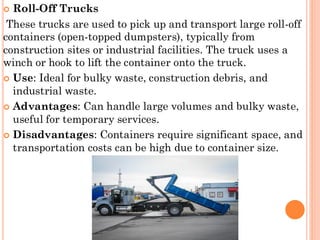
 Roll-Off Trucks
These trucks are used to pick up and transport large roll-off
containers (open-topped dumpsters), typically from
construction sites or industrial facilities. The truck uses a
winch or hook to lift the container onto the truck.
 Use: Ideal for bulky waste, construction debris, and
industrial waste.
 Advantages: Can handle large volumes and bulky waste,
useful for temporary services.
 Disadvantages: Containers require significant space, and
transportation costs can be high due to container size.
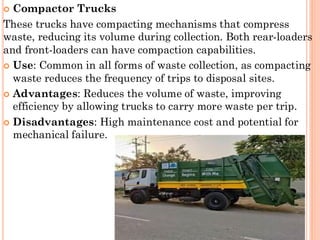
 Compactor Trucks
These trucks have compacting mechanisms that compress
waste, reducing its volume during collection. Both rear-loaders
and front-loaders can have compaction capabilities.
 Use: Common in all forms of waste collection, as compacting
waste reduces the frequency of trips to disposal sites.
 Advantages: Reduces the volume of waste, improving
efficiency by allowing trucks to carry more waste per trip.
 Disadvantages: High maintenance cost and potential for
mechanical failure.
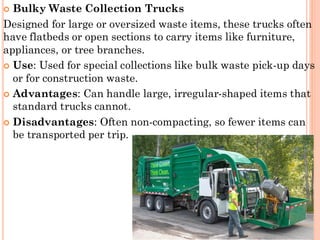
 Bulky Waste Collection Trucks
Designed for large or oversized waste items, these trucks often
have flatbeds or open sections to carry items like furniture,
appliances, or tree branches.
 Use: Used for special collections like bulk waste pick-up days
or for construction waste.
 Advantages: Can handle large, irregular-shaped items that
standard trucks cannot.
 Disadvantages: Often non-compacting, so fewer items can
be transported per trip.
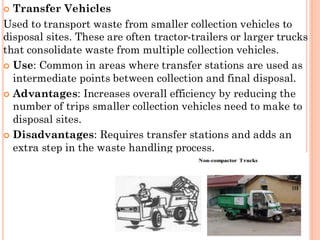
 Transfer Vehicles
Used to transport waste from smaller collection vehicles to
disposal sites. These are often tractor-trailers or larger trucks
that consolidate waste from multiple collection vehicles.
 Use: Common in areas where transfer stations are used as
intermediate points between collection and final disposal.
 Advantages: Increases overall efficiency by reducing the
number of trips smaller collection vehicles need to make to
disposal sites.
 Disadvantages: Requires transfer stations and adds an
extra step in the waste handling process.
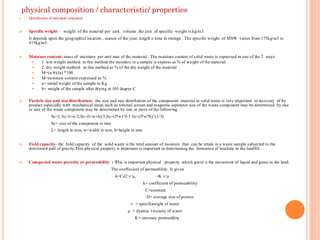
physical composition / characteristic/ properties
 Identification of indivdual component
 Specific weight - weight of the material per unit volume .the unit of specific weight is kg/m3.
It depends upon the geographicl location , season of the year, length o time in storage . The specific weight of MSW varies from 175kg/m3 to
415kg/m3.
 Moisture content- mass of moisture per unit mas of the material . The moisture content of solid waste is expressed in one of the 2 ways
 1. wet weight method: in this method the moisture in a sample is express as % of weight of the material
 2. dry weight method: in this method as % of the dry weight of the material
 M=(a-b)/(a) *100
 M=moisture content expressed as %
 a= initial weight of the sample in Kg
 b= weight of the sample after drying at 105 degree C
 Particle size and size distribution- the size and size distribution of the component material in solid waste is very important in recovery of by
product especially with mechanical mean such as tommel screen and magnetic seperator size of the waste component may be determined by one
or size of the waste component may be determined by one or more of the following
Sc=l, Sc=l+w/2,Sc=(l+w+h)/3,Sc=(l*w)^0.5 Sc=(l*w*h)^(1/3)
Sc= size of the component in mm
L= length in mm, w=width in mm, h=height in mm
 Field capacity- the feild capacity of the solid waste is the total amount of moisture that can be retain in a waste sample subjected to the
downward pull of gravity.This physical property is important is important in determining the formation of leachate in the landfill.
 Compacted waste porosity or permeability : This is important physical property which gover n the movement of liquid and gases in the land.
The coeffecient of permeability. Is given
k=Cd2 ѵ/µ, =K ѵ/µ
k= coefficient of permeabiliity
C=constant
D= average size of porous
ѵ = specifiweight of water
µ = dyamic viscosity of water
K= intrensic permeablity
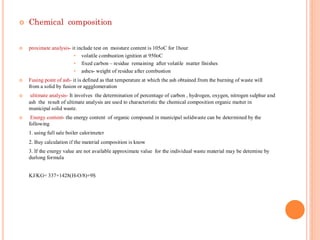
 Chemical composition
 proximate analysis- it include test on moisture content is 105oC for 1hour
• volatile combustion ignition at 950oC
• fixed carbon – residue remaining after volatile matter finishes
• ashes- weight of residue after combustion
 Fusing point of ash- it is defined as that temperature at which the ash obtained from the burning of waste will
from a solid by fusion or aggglomeration
 ultimate analysis- It involves the determination of percentage of carbon , hydrogen, oxygen, nitrogen sulphur and
ash the result of ultimate analysis are used to characteristic the chemical composition organic matter in
municipal solid waste.
 Energy content- the energy content of organic compound in municipal solidwaste can be determined by the
following
1. using full sale boiler calorimeter
2. Buy calculation if the material composition is know
3. If the energy value are not available approximate value for the individual waste material may be detemine by
durlong formula
KJ/KG= 337+1428(H-O/8)+9S
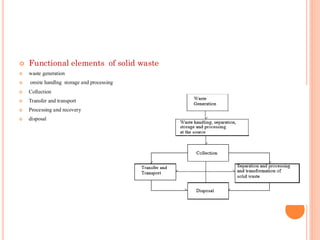
 Functional elements of solid waste
 waste generation
 onsite handlng storage and processing
 Collection
 Transfer and transport
 Processing and recovery
 disposal
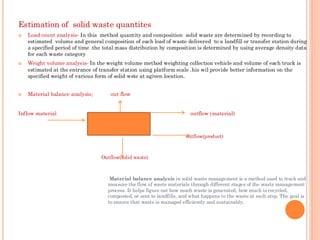
Estimation of solid waste quantites
 Load count analysis- In this method quantity and composition solid waste are determined by recording to
estimated volume and general composition of each load of waste delivered to a landfill or transfer station during
a specified period of time .the total mass distribution by composition is determined by using average density data
for each waste category
 Weight volume analysis- In the weight volume method weighting collection vehicle and volume of each truck is
estimated at the entrance of transfer station using platform scale .his wil provide better information on the
specified weight of various form of solid wste at agiven location.
 Material balance analysis; out flow
Inflow material outflow (material)
• outflow(product)
Outflow(solid waste)
Material balance analysis in solid waste management is a method used to track and
measure the flow of waste materials through different stages of the waste management
process. It helps figure out how much waste is generated, how much is recycled,
composted, or sent to landfills, and what happens to the waste at each step. The goal is
to ensure that waste is managed efficiently and sustainably.
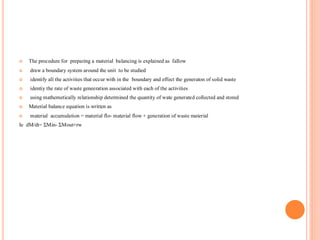
 The procedure for preparing a material balancing is explained as fallow
 draw a boundary system around the unit to be studied
 identify all the activities that occur with in the boundary and effect the generaton of solid waste
 identiy the rate of waste geneeration associated with each of the activities
 using mathemetically relationship determined the quantity of wate generated collected and stored
 Material balance equation is written as
 material accumulation = material flo- material flow + generation of waste material
Ie dM/dt= ƩMin- ƩMout+rw
 Collection of solid waste:
 collection of separated and unseperated solid waste in a urban area is diffcult and complex
because of the generation of residential , commerical industria facilities street, parks and even
solidwaste take place in every home , apartment vacant area . The mushroom like development of
suburbs a and satelite town all over te country has further complicated the collection.
 Type of collection service
1.municipal collection service
a from low rise detached dwelling
b. From low and medium rise apartment
c. From high rise apartment
2. commerical – industrial facilities
The most common tpes of residential service use in avrious part of the country
1.Curb
2.alley
3 setout- setback
4. setout
5.Backyard carrying
HAULED CONTAINER
STATIONARY CONTAINER SYSTEM
TRANSFER MEAN AND METHOD [
TRANSPORT METHOD]
 Motor vehicle transport
 Rail road transport
 Water transport- barrages, scows and special boards have been used in past
 Pneumatic- low pressure vaccum conduit transport system most common application in the transport of waste
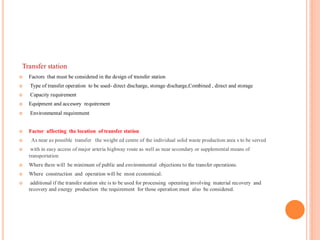
Transfer station
 Factors that must be considered in the design of transfer station
 Type of transfer operation to be used- direct discharge, storage discharge,Combined , direct and storage
 Capacity requirement
 Equipment and accesory requirement
 Environmental requirement
 Factor affecting the location of transfer station
 As near as possible transfer the weight ed centre of the individual solid waste production area s to be served
 with in easy access of major arteria highway route as well as near secondary or supplemental means of
transportation
 Where there will be minimum of public and environmental objections to the transfer operations.
 Where construction and operation will be most economical.
 additional if the transfer station site is to be used for processing operating involving material recovery and
recovery and energy production the requirement for those operation must also be considered.
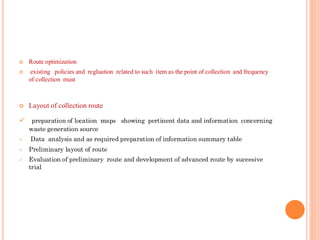
 Route optimization
 existing policies and regluation related to such item as the point of collection and frequency
of collection must
 Layout of collection route
✓ preparation of location maps showing pertinent data and information concerning
waste generation source
✓ Data analysis and as required preparation of information summary table
✓ Preliminary layout of route
✓ Evaluation of preliminary route and development of advanced route by suceesive
trial
 Module -2
PROCESSING TECHNIQUE
 we discussed conventional and engineered waste disposal options, and also mentioned that
through proper processing, we would be able to recover resource and energy from wastes.
In Unit 5, we will explain some of the important techniques used for processing solid
wastes for the recovery of materials, and their design criteria. The processing techniques
we will be discussing in this Unit include mechanical and chemical volume reduction,
component separation, and drying and dewatering.
 completing this Unit, you should be able to: identify the purpose of waste processing; explain the
processing techniques for reducing the volume and size of wastes; carry out separation of various
components; discuss the need for dewatering and drying of wastes; assess technical viability of
various processing tec
 PURPOSE OF PROCESSING The processing of wastes helps in achieving the best possible
benefit from every functional element of the solid waste management (SWM) system and,
therefore, requires proper selection of techniques and equipment for every element.
Accordingly, the wastes that are considered suitable for further use need to be paid special
attention in terms of processing, in order that we could derive maximum economical value
from them. The purposes of processing, essentially, are (Tchobanoglous et al., 1993):
 (i) Improving efficiency of SWM system: Various processing techniques are available to
improve the efficiency of SWM system. For example, before waste papers are reused, they
are usually baled to reduce transporting and storage volume requirements. In some cases,
wastes are baled to reduce the haul costs at disposal site, where solid wastes are compacted
to use the available land effectively. If solid wastes are to be transported hydraulically and
pneumatically, some form of shredding is also required. Shredding is also used to improve
the efficiency of the disposal site. Unit 5: Waste Processing Techniques 199
 (ii) Recovering material for reuse: Usually, materials having a market, when present in
wastes in sufficient quantity to justify their separation, are most amenable to recovery and
recycling. Materials that can be recovered from solid wastes include paper, cardboard,
plastic, glass, ferrous metal, aluminium and other residual metals. (We will discuss some of
the recovery techniques later in Section 5.3.)
 (iii) Recovering conversion products and energy: Combustible organic materials can be
converted to intermediate products and ultimately to usable energy. This can be done either
through incineration, pyrolysis, composting or bio-digestion. Initially, the combustible
organic matter is separated from the other solid waste components. Once separated,
further processing like shredding and drying is necessary before the waste material can be
used for power generation. (We will explain these energy recovery techniques in Units 7
and 8.) Having described the need for waste processing, we now discuss how waste
processing is actually carried out. 5
 Mechanical volume and size reduction is an
important factor in the development and
operation of any SWM system. The main purpose
is to reduce the volume (amount) and size of
waste, as compared to its original form, and
produce waste of uniform size. We will discuss
the processes involved in volume and size
reduction along with their selection criteria,
equipment requirement, design consideration,
etc., in Subsections 5.2.1 and 5.2.2.
 Volume reduction or compaction Volume reduction or
compaction refers to densifying wastes in order to
reduce their volume. Some of the benefits of
compaction include: reduction in the quantity of
materials to be handled at the disposal site; improved
efficiency of collection and disposal of wastes;
increased life of landfills; Economically viable waste
management system. However, note the following
disadvantages associated with compaction: poor
quality of recyclable materials sorted out of
compaction vehicle; difficulty in segregation or sorting
(since the various recyclable materials are mixed and
compressed in lumps); Bio-degradable materials (e.g.,
leftover food, fruits and vegetables) destroy the value
of paper and plastic material.
 E
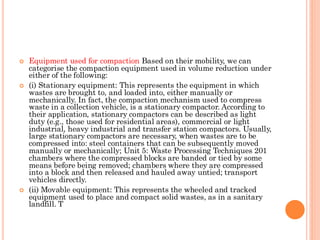
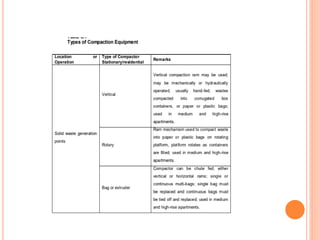
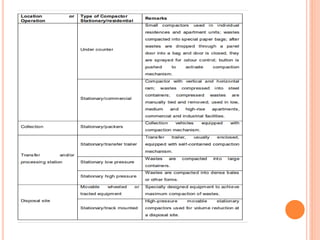
 Equipment used for compaction Based on their mobility, we can
categorise the compaction equipment used in volume reduction under
either of the following:
 (i) Stationary equipment: This represents the equipment in which
wastes are brought to, and loaded into, either manually or
mechanically. In fact, the compaction mechanism used to compress
waste in a collection vehicle, is a stationary compactor. According to
their application, stationary compactors can be described as light
duty (e.g., those used for residential areas), commercial or light
industrial, heavy industrial and transfer station compactors. Usually,
large stationary compactors are necessary, when wastes are to be
compressed into: steel containers that can be subsequently moved
manually or mechanically; Unit 5: Waste Processing Techniques 201
chambers where the compressed blocks are banded or tied by some
means before being removed; chambers where they are compressed
into a block and then released and hauled away untied; transport
vehicles directly.
 (ii) Movable equipment: This represents the wheeled and tracked
equipment used to place and compact solid wastes, as in a sanitary
landfill. T
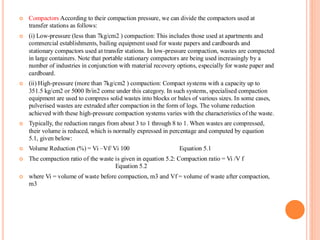
 Compactors According to their compaction pressure, we can divide the compactors used at
transfer stations as follows:
 (i) Low-pressure (less than 7kg/cm2 ) compaction: This includes those used at apartments and
commercial establishments, bailing equipment used for waste papers and cardboards and
stationary compactors used at transfer stations. In low-pressure compaction, wastes are compacted
in large containers. Note that portable stationary compactors are being used increasingly by a
number of industries in conjunction with material recovery options, especially for waste paper and
cardboard.
 (ii) High-pressure (more than 7kg/cm2 ) compaction: Compact systems with a capacity up to
351.5 kg/cm2 or 5000 lb/in2 come under this category. In such systems, specialised compaction
equipment are used to compress solid wastes into blocks or bales of various sizes. In some cases,
pulverised wastes are extruded after compaction in the form of logs. The volume reduction
achieved with these high-pressure compaction systems varies with the characteristics of the waste.
 Typically, the reduction ranges from about 3 to 1 through 8 to 1. When wastes are compressed,
their volume is reduced, which is normally expressed in percentage and computed by equation
5.1, given below:
 Volume Reduction (%) = Vi –Vf/ Vi 100 Equation 5.1
 The compaction ratio of the waste is given in equation 5.2: Compaction ratio = Vi /V f
Equation 5.2
 where Vi = volume of waste before compaction, m3 and Vf = volume of waste after compaction,
m3

Solid waste management of civil engineering

  • 1.
  • 3.
    o Solid waste: Solidwaste are non liquid waste araising from human and animal activities that are normally solid and that are discarded as useless or unwanted .It predominately include food waste ,yard waste container and product packaging and other miscelleous inorganic waste from residential ,commerial ,institution and industrial source. o Solid waste management: The discipline associated with the control of generation ,storage , collection , transfer and transport, processing and disposal of solidwaste in amanner ie in accordance with best principle s of public health , economic engineering ,conservation, aesthetics and other environmental consideration and that is also responsible to public attitude
  • 4.
    NECESSITY OF SOLIDWASTE MANAGEMENT  Public Health Protection Proper waste management reduces the risk of disease transmission by minimizing exposure to harmful pathogens present in waste.  Environmental Protection Proper disposal and treatment prevent soil, water, and air pollution caused by leachate and harmful emissions from waste.  Aesthetic and Community Well-Being Clean and well-managed waste areas contribute to the overall aesthetics of communities, enhancing residents' quality of life.  Economic Benefits The waste management sector generates jobs in collection, recycling, processing, and education. Reducing waste through recycling and composting can lower disposal costs and create economic opportunities from recovered materials.  Social Impact Well-managed waste contributes to cleaner neighborhood, improving the overall quality of life for residents.  Climate Change Mitigation Proper waste management strategies, such as composting and recycling, help reduce methane emissions from landfills, contributing to climate change mitigation efforts.
  • 5.
    1. Municipal SolidWaste (MSW)  Household Waste: Everyday items discarded from homes, such as food scraps, paper, plastic, and glass.  Commercial Waste: Waste generated by businesses, including packaging, office supplies, and food waste from restaurants.  Institutional Waste: Waste from schools, hospitals, and government offices, which may include paper, food waste, and some medical supplies. 2. Industrial Waste  Waste generated from manufacturing and industrial processes, including:  Production Waste: Scrap materials, by-products, and defective products.  Hazardous Waste: Toxic chemicals, solvents, and heavy metals requiring special handling and disposal. Solid waste can be categorized into various types based on its source, composition, and characteristics.
  • 6.
    3. Construction andDemolition Waste Waste produced during construction, renovation, or demolition of buildings, including: Concrete, wood, metal, bricks, and drywall. 4. Biomedical Waste Waste generated from healthcare facilities, including: Infectious Waste: Contaminated materials like used bandages and syringes. Sharps: Needles, blades, and other sharp items. Pharmaceutical Waste: Expired or unused medications.
  • 7.
    5. Agricultural Waste Wasteproduced in farming activities, such as:  Crop residues (straw, leaves), animal manure, and unused fertilizers. 6. E-Waste Electronic waste that includes discarded electronics like:  Computers, smartphones, televisions, and appliances. E-waste often contains hazardous materials like lead and mercury. 7. Hazardous Waste Waste that poses substantial risks to human health or the environment, including:  Chemical waste, batteries, pesticides, and certain industrial by-products.
  • 8.
    Functional elements ofsolid waste  waste generation  onsite handling storage and processing/ waste sorting  Collection  Transfer and transport  Processing and recovery  disposal
  • 9.
    1 Waste Generation Recognizingwhere waste is produced (households, businesses, institutions) and the types of waste generated (organic, recyclable, hazardous) 2 Waste Sorting Facilities where waste is sorted into different categories (recyclables, compostables, and trash) to facilitate recycling and recovery. 3 Waste Collection Collection Systems: Establishing organized systems for collecting waste, including curbside pickup, drop-off centers, and community collection points.
  • 10.
    4 Transportation Vehicle Selection:Using appropriate vehicles for transporting different types of waste (e.g., compaction trucks for MSW, specialized trucks for hazardous waste). Route Optimization: Planning routes to reduce travel time and fuel consumption while ensuring timely waste pickup. 5 Processing and recovery Recycling: Processing recyclable materials to create new products, reducing the need for virgin resources. Composting: Biological decomposition of organic waste to create compost, enriching soil and reducing landfill use. Incineration: Burning waste to reduce volume and potentially generate energy, while controlling emissions. Anaerobic Digestion: Breaking down organic material in the absence of oxygen to produce biogas, which can be used for energy. 6
  • 11.
    6. Disposal There areseveral methods of waste disposal, including: 1 Sanitary landfills Waste is thrown into a landfill that has a protective lining to prevent toxins from entering the water. 2 Incineration Waste is burned to turn it into base components, which can reduce waste volume by up to 90%. 3 Composting Organic waste is decomposed by leaving it in a pit for a long time, and the compost can be used as plant manure. 4 Cat holes Choose a spot that is at least 200 feet (about 70 adult steps) away from water sources to prevent contamination and cleanliness.
  • 12.
    : The global perspectiveon solid waste management reveals significant challenges and opportunities, shaped by rapid urbanization, population growth, and varying levels of infrastructure and technology across different regions. Here’s an overview 1. Current Trends  Urbanization: As more people move to cities, the volume of solid waste generated increases. Urban areas account for a significant proportion of global waste production.  Waste Generation Rates: The World Bank estimates that global waste generation will increase from 2.01 billion tons in 2016 to 3.4 billion tons by 2050.  2. Challenges  Inadequate Infrastructure: Many developing countries lack the necessary infrastructure for effective waste collection, recycling, and disposal. This leads to illegal dumping and environmental pollution.  Limited Recycling Rates: Despite the potential for recycling, many regions struggle with low rates due to a lack of public awareness, economic incentives, and proper facilities.
  • 13.
     Health Risks:Poor waste management practices can lead to health hazards, including exposure to hazardous waste and increased disease transmission.  Climate Change: Landfills are significant sources of methane, a potent greenhouse gas. Ineffective waste management contributes to climate change.  3. Best Practices and Innovations  Integrated Waste Management: A holistic approach that includes reduction, reuse, recycling, composting, and safe disposal. This model is gaining traction globally.  Circular Economy: Emphasizing resource efficiency, where waste is viewed as a resource to be reused or recycled, minimizing the need for new raw materials.  Technology Integration: Innovations such as waste-to- energy plants, advanced recycling technologies, and digital waste management systems are emerging to improve efficiency.
  • 14.
     4. Policyand Regulation  Global Agreements: International frameworks, such as the Paris Agreement and the Sustainable Development Goals (SDGs), emphasize waste reduction and sustainable management practices.  National Policies: Many countries are implementing stricter regulations and incentives to promote recycling and reduce waste, including bans on single-use plastics.  5. Community Engagement  Public Awareness Campaigns: Education and awareness initiatives are crucial for changing behaviors around waste generation and disposal.  Participatory Approaches: Involving communities in decision-making processes fosters a sense of ownership and responsibility toward waste management.
  • 15.
     6. RegionalPerspectives Developed Countries: Generally have more advanced waste management systems with higher recycling rates but still face challenges in managing e-waste and hazardous materials. Developing Countries: Often struggle with basic waste management services, leading to environmental and health issues, but may be more open to innovative community-based solutions.
  • 16.
    POLICIES AND LEGISLATIVEFRAME WORKS IN SOLID WASTE MANAGEMENT Solid waste management (SWM) in India is governed by a variety of policies and legislative frameworks aimed at ensuring effective waste management practices across the country. Here’s a detailed overview:  National Policy on Solid Waste Management (2000):  Aimed at providing a framework for the management of municipal solid waste in urban areas.  Focuses on reducing waste generation, promoting recycling, and enhancing public participation.  Swachh Bharat Mission (2014):  Launched to improve sanitation and waste management in urban and rural areas.  Promotes waste segregation at the source, cleanliness, and sanitation initiatives.
  • 17.
     National WasteManagement Policy:  Proposed framework to address all types of waste, including solid, liquid, and hazardous waste.  Aims to integrate waste management into urban planning and promote sustainable practices.
  • 18.
    Legislative Frameworks  MunicipalSolid Waste (Management and Handling) Rules (2000):  Mandates municipal authorities to manage solid waste effectively.  Requires waste segregation, collection, storage, transportation, processing, and disposal.  Solid Waste Management Rules (2016):  Revised regulations that emphasize waste segregation at the source, composting, and recycling.  Introduces Extended Producer Responsibility (EPR) for managing plastic waste.  Mandates the preparation of a solid waste management plan by local authorities.  Plastic Waste Management Rules (2016):  Focuses on the management of plastic waste through reduction, recycling, and reuse.  Sets guidelines for producers, importers, and brand owners regarding plastic packaging.
  • 19.
    Bio-Medical Waste ManagementRules (2016):  Governs the handling, treatment, and disposal of biomedical waste to ensure public health and environmental safety.  Requires healthcare facilities to segregate and treat biomedical waste appropriately. Hazardous and Other Wastes (Management and Transboundary Movement) Rules (2016):  Regulates the management and disposal of hazardous waste, including solid waste that contains hazardous components. Environmental Protection Act (1986):  Provides a broader legal framework for environmental protection, including provisions related to waste management
  • 20.
    STAKEHOLDER ROLES INSOLID WASTE MANAGEMENT 1. Government Authorities  Central and State Governments: Formulate policies, regulations, and guidelines for waste management. They oversee implementation and provide funding.  Local Authorities: Municipalities and urban local bodies are responsible for the collection, segregation, and disposal of waste within their jurisdictions. 2. Waste Generators  Households: Responsible for proper segregation of waste at the source (e.g., separating wet and dry waste).  Businesses: Commercial establishments must follow regulations for waste management and report on waste generation.
  • 21.
     3. WasteCollectors and Transporters  Municipal Workers: Involved in the collection and transportation of waste to processing or disposal sites.  Private Contractors: Some municipalities outsource waste collection and transport to private companies.  4. Recycling and Processing Facilities  Material Recovery Facilities: Process recyclable materials, sorting and preparing them for recycling.  Composting Plants: Convert organic waste into compost through aerobic decomposition.  5. Non-Governmental Organizations (NGOs)  Advocacy and Awareness: Raise awareness about waste management practices and promote community engagement.  Education: Conduct workshops and training programs to inform the public about proper waste disposal and recycling.
  • 22.
    6 .Community Groups Local Residents’ Associations: Mobilize community members to participate in waste management initiatives and promote best practices.  Volunteer Groups: Organize clean-up drives and awareness campaigns. 7. Educational Institutions  Research and Innovation: Conduct studies and develop new technologies or practices for effective waste management.  Curriculum Development: Educate students on sustainability and waste management practices. 8. Businesses and Industries  Corporate Social Responsibility (CSR): Engage in initiatives to reduce waste generation and promote recycling.  Extended Producer Responsibility (EPR): Take responsibility for the lifecycle of their products, including waste management.
  • 23.
    9 Regulatory Bodies Environmental Agencies: Monitor compliance with waste management regulations and enforce penalties for violations.  Health Departments: Ensure that waste management practices do not pose health risks to the public. 10. The General Public  Participation: Individuals can contribute by practicing waste segregation, recycling, and participating in community initiatives.  Feedback: Provide input on local waste management practices and policies.
  • 24.
    Government initiatives onsolid waste management Government initiatives on solid waste management often focus on reducing waste, promoting recycling, and improving waste disposal methods. Here are some common actions:  Waste Segregation: Encouraging people to separate waste at home into categories like organic, recyclable, and non- recyclable.  Recycling Programs: Setting up systems to collect and process materials like plastic, paper, and metal so they can be reused.  Landfills and Waste-to-Energy Plants: Building better landfills or waste-to-energy facilities where waste is either safely buried or converted into energy.
  • 25.
     Public AwarenessCampaigns: Educating citizens about the importance of reducing waste, reusing materials, and recycling.  Plastic Bans: Banning or limiting the use of single-use plastics to reduce waste.  Incentives for Businesses: Offering tax breaks or other benefits to businesses that adopt eco-friendly waste management practices.
  • 26.
     Integrated SolidWaste Management (ISWM) It is a comprehensive approach to managing waste that focuses on reducing its impact on the environment and human health. It combines different methods of handling waste in an efficient and sustainable way. Here are the key components:  Waste Prevention/Reduction: Minimizing the amount of waste generated by promoting eco-friendly products, reducing packaging, and encouraging people to use less.  Recycling and Reuse: Collecting and processing materials like paper, plastic, glass, and metals so they can be reused, reducing the need for new resources.  Composting: Turning organic waste (like food scraps and yard waste) into compost, which can be used as a natural fertilizer for plants. .
  • 27.
     Waste Treatment:Using methods like incineration (burning waste to generate energy) or other processes to reduce the volume of waste before disposal.  Disposal: Safely disposing of the remaining waste in properly managed landfills or waste-to-energy facilities
  • 28.
     The 3R'sin solid waste management stand for Reduce, Reuse, and Recycle. These principles help minimize the amount of waste we create and its impact on the environment. Here's what each one means: Reduce  Definition: Reducing refers to cutting down the amount of waste produced in the first place. It is the most effective way to manage waste since it prevents waste generation at its source.  Examples:  Using less packaging material in product manufacturing.  Opting for digital receipts instead of printed ones.  Purchasing products with a longer lifespan or opting for higher- quality items that do not need frequent replacement.  Environmental Impact: Reducing waste helps in conserving natural resources, lowering energy consumption, and minimizing pollution.
  • 29.
    Reuse  Definition: Reuseinvolves using items more than once in their original form instead of discarding them after a single use. This can delay their entry into the waste stream and prolong the item's useful life.  Examples:  Reusing glass jars for storage instead of buying new containers.  Donating clothes or appliances that are still functional.  Refilling water bottles or repurposing old furniture.  Environmental Impact: Reusing products reduces the need for new products, thus conserving resources, reducing emissions from manufacturing, and minimizing waste.
  • 30.
    Recycle  Definition: Recyclinginvolves converting waste materials into new products or raw materials. This process reduces the need for virgin materials and diverts waste from landfills or incineration.  Examples:  Recycling paper, plastics, metals, and glass to produce new products.  Turning organic waste into compost for agricultural or gardening use.  Using construction and demolition waste in new building materials.  Environmental Impact: Recycling conserves resources, saves energy, reduces greenhouse gas emissions, and lowers the volume of waste in landfills.
  • 31.
    MODULE 2 WASTE GENERATIONAND CHARACTERIZATION Factors affecting Waste generation rate Source Reduction & Recycling Activities Public Attitudes and Legislation Geographic location and physical factors on generation of Solid waste
  • 32.
    1. Source Reduction& Recycling Activities Source Reduction: This involves minimizing waste before it is created. Practices include designing products that use fewer materials, last longer, or are easier to repair. When businesses and consumers adopt source reduction strategies, less waste is generated from the outset. Recycling Activities: Effective recycling programs encourage the recovery of materials, reducing the amount of waste that ends up in landfills. When communities have strong recycling initiatives, people are more likely to recycle, which decreases the overall waste generated.
  • 33.
     2. PublicAttitudes and Legislation  Public Attitudes: Community awareness and attitudes toward waste management significantly influence waste generation. If people are educated about the benefits of reducing and recycling waste, they are more likely to engage in those practices, leading to lower waste generation rates.  Legislation: Government policies and regulations play a crucial role. Laws that promote recycling, impose penalties for excessive waste, or provide incentives for waste reduction can lead to significant decreases in waste generation. For example, bans on single-use plastics can directly reduce the amount of waste produced
  • 34.
     3. GeographicLocation and Physical Factors on generation of Solid waste  Geographic Location: Urban areas often generate more waste per capita than rural areas due to higher population densities and consumption patterns. Access to waste management services also varies by location, impacting waste generation.  Physical Factors: Local climate and geography can affect waste generation. For instance, regions with more outdoor events or tourism may produce more waste during peak seasons. Additionally, the availability of land for waste disposal can influence how much waste is generated and managed
  • 35.
    PHYSICAL COMPOSITION ORPROPERTIES  In solid waste management, understanding the physical composition and properties of waste is essential for effective handling, treatment, and disposal. Here’s an overview of key physical properties:  Specific Weight  Moisture Content  Particle Size and Distribution  Field Capacity  Permeability of Compacted Waste
  • 36.
    Specific Weight : Definition:The mass of waste per unit volume, typically expressed in kg/m³. High Density: Materials like metals and compacted waste take up less space when pressed down. This means you can fit more waste into the same area, making the landfill more efficient. Moisture Content: The moisture content of solid waste usually expressed as the mass of moisture per unit mass of wet or dry materials. Adequate moisture can speed up the decomposition of organic materials. However, too much moisture can create anaerobic (low oxygen) conditions, leading to slower decomposition and the production of methane gas Moisture Content = a−b a ×100 Where , a = Initial mass of sample b = mass of sample after drying
  • 37.
    3 Particle Sizeand Distribution: Definition: Refers to the size of individual waste particles and how they are distributed in the waste stream. Decomposition Rates  Smaller Particles: They have a larger surface area relative to their volume hence leads to faster decomposition and it affects compaction Compaction Issues Smaller particles can pack together tightly, creating a denser material. Excessive compaction can restrict air flow and moisture movement, making it harder for organic waste to decompose properly. The size of waste components can be determined using the following equations: Sc = L, Sc = (L+w)/2, Sc= (L+w+h)/3 Where Sc : size of component, mm L : length, mm W : width, mm h : height, mm
  • 38.
    Field Capacity:  Definition:The maximum amount of moisture that waste can retain after excess water has drained away. Determines the water retention capacity of waste materials, affecting composting and landfill management Helps predict leachate production and the moisture balance in waste. Permeability of Compacted Waste The ability of compacted waste to allow water and air to flow through it High permeability can lead to rapid leachate movement, posing risks to groundwater quality. Low permeability can restrict moisture and gas exchange, affecting decomposition rates in landfills
  • 39.
    Chemical Composition orProperties: 1. Proximate Analysis ▪ Moisture ▪ Volatile Matter ▪ Ash ▪ Fixed Carbon 2. Fusing Point of Ash 3. Ultimate Analysis (% C, H, O, N,S & Ash) 4. Heating Value (Energy Value)
  • 40.
     Proximate analysisis a method used to determine the physical and chemical properties of solid waste, especially organic materials like biomass. It breaks down the waste into four main components: moisture, volatile combustible matter (VCM), fixed carbon, and ash. Here’s a simple explanation of each component:  1. Loss of Moisture (at 105ºC)  Process: The sample is heated to 105ºC to remove moisture.  Purpose: This step quantifies the water content in the waste, as moisture can affect the weight and energy content of the material.  Significance: Higher moisture levels can lead to less efficient combustion and increased waste weight for transport. 2. Volatile Combustible Matter (VCM) (at 950ºC, closed crucible)  Process: After moisture is removed, the sample is heated to 950ºC in a closed crucible, allowing the volatile components to evaporate.  Purpose: This measures the amount of material that can vaporize and potentially combust (e.g., gases, organic compounds).  Significance: VCM indicates the energy potential of the waste; higher VCM means more combustible material is present, which is important for energy recovery processes.
  • 41.
     Fixed Carbon(residue from VCM)  Process: The remaining solid after the VCM has been removed is considered fixed carbon.  Purpose: Fixed carbon represents the portion of the material that remains after the volatile components have been driven off.  Significance: It is important for understanding the material’s energy content and combustion characteristics; higher fixed carbon indicates better energy density.
  • 42.
     Ash (at950ºC, open crucible)  Process: The sample is further heated in an open crucible at 950ºC to burn off all combustible materials, leaving behind inorganic residues.  Purpose: This measures the total ash content, which consists of non-combustible minerals (like silica, calcium, and metals).  Significance: Ash content affects the overall energy output and can indicate potential environmental impacts (e.g., heavy metals) and the need for special handling or disposal methods.
  • 43.
    The biological propertiesof solid waste are vital for developing effective waste management practices. By understanding decomposition rates, microbial activity, nutrient content, and other biological factors, waste managers can implement strategies like composting and anaerobic digestion to transform organic waste into valuable resources while minimizing environmental impact. BIOLOGICAL PROPERTIES
  • 44.
     1. DecompositionRate Refers to how quickly organic materials break down into simpler substances. Factors influencing this rate include moisture, temperature, oxygen levels, and the nature of the waste  2. Microbial Activity Bacteria, fungi, and other microorganisms play a crucial role in the decomposition process. Different types of microorganisms thrive in varying conditions (aerobic vs. anaerobic)  3. Nutrient Content Contains essential nutrients (nitrogen, phosphorus, potassium) beneficial for soil health and plant growth
  • 45.
     Pathogen Presence Someorganic waste may contain harmful microorganisms. Proper management (like composting at high temperatures) can reduce or eliminate these pathogens, making the end product safe for use.  5. Odor Production Volatile Organic Compounds (VOCs): During decomposition, organic materials can produce odors. Anaerobic conditions, in particular, lead to the production of methane and other gases, which can be unpleasant  6. Moisture Content  Importance of Moisture: Adequate moisture is necessary for microbial activity and decomposition. However, excess moisture can lead to anaerobic conditions, slowing decomposition and increasing odors
  • 46.
     7. TemperatureRegulation Thermophilic Decomposition: Higher temperatures (usually between 55-70°C or 130- 160°F) during composting can enhance microbial activity and pathogen destruction  Maintaining optimal temperatures helps promote faster decomposition and nutrient stabilization.
  • 47.
    Methods to estimatethe quantity of waste generated  load count analysis  Weight volume analysis  Material balance analysis
  • 48.
     Load countanalysis is used to track and measure the amount of waste being collected, transported, and processed over a certain period. It helps waste management facilities understand how much waste they handle and make decisions about resources, capacity, and efficiency. Why it's important:  It helps facilities determine if they have enough trucks, manpower, and storage space.  They can identify trends, like whether waste volumes are increasing or decreasing.  It assists in planning for future needs, such as additional trucks or expanding disposal areas.  It ensures waste is handled efficiently, reducing unnecessary trips and improving fuel usage.
  • 49.
    Weight-volume analysis insolid waste management is a method used to understand both the weight (how heavy) and the volume (how much space it takes up) of the waste being collected, transported, or processed. Why it’s important:  Storage and Transport: Weight and volume both matter when planning how much waste can be transported by trucks or stored at a landfill. For example, a truck may fill up with light but bulky waste (like paper or plastics) before reaching its weight limit.  Cost Management: Weight affects disposal costs, as some facilities charge based on how heavy the waste is. Volume helps in understanding how much space is needed in landfills or processing plants.  Efficiency: By knowing the weight and volume, waste management teams can optimize truck routes, reduce trips, and improve fuel efficiency.  Recycling: Different materials have different weights and volumes, so understanding these can help with sorting and recycling processes. For example, compacting bulky materials reduces volume but not weight, making it easier to transport
  • 50.
    Measuring Weight Weighbridges (TruckScales) Garbage trucks are weighed when they are empty and again after they are loaded with waste. The difference between the two weights gives the weight of the waste collected. Measuring Volume The volume of waste is often estimated based on the size of the containers or the truck's capacity. For example, a garbage truck may have a capacity of 20 cubic yards (or 15 cubic meters), and the waste is estimated based on how full the truck is. Once the weight and volume are measured, the weight-to- volume ratio (density) can be calculated. This tells how much a specific volume of waste weighs, which is helpful for planning storage and transport. For example, heavier waste (like construction debris) will have a higher weight-to-volume ratio compared to lighter waste (like plastics or paper).
  • 51.
    Material balance analysis; outflow Inflow material outflow (material) • outflow(product) Outflow(solid waste)
  • 52.
     Material balanceanalysis in solid waste management is like tracking all the waste coming into and going out of a system (like a landfill or recycling plant). It helps us see how much waste is:  Collected: The total amount of waste we gather.  Processed: How much is recycled, composted, or treated.  Disposed: How much goes to a landfill or is incinerated.  Byproducts: Any useful products like compost or energy generated from waste.
  • 53.
     In thiscase, the material balance would look like:  Input: 100 tons of waste generated.  Output: 55 tons of recycled/composted material and energy.  Residue: 28 tons of waste landfilled.  Losses: Gaseous emissions from incineration.
  • 54.
    MODULE 3 STORAGE, COLLECTION& TRANSPORTATION OF WASTE  Methods of storage  1. On-Site Storage (at the Source)  This method involves storing waste at the point of generation (homes, businesses, or industrial sites) before it is collected for further processing or disposal. Containers (Bins, Cans, and Bags
  • 55.
     2. CentralizedStorage  This method is used in apartment complexes, office buildings, or other facilities where waste from multiple sources is collected and stored in one location before collection  Dumpster Storage
  • 56.
     Temporary Storageat Transfer Stations  Transfer stations are facilities where waste is temporarily stored before being transferred to larger vehicles for transportation to landfills or recycling plants. Eg bunkers or bays
  • 57.
     Storage ofHazardous Waste Special storage methods are required for hazardous waste to prevent environmental contamination or harm to human health. Hazardous waste includes chemicals, medical waste, and electronic waste (e-waste).  Sealed and Labeled Containers
  • 58.
     storage ofOrganic Waste Organic waste, including food scraps and yard waste, requires special storage methods to prevent odors, pests, and methane emissions during decomposition  Compost Bins  Anaerobic Digesters:
  • 59.
     E-Waste andBulky Waste Storage  Electronic waste (e-waste) and bulky waste such as furniture and appliances require special storage due to their size and the presence of hazardous components. Ex:E-Waste Bins
  • 60.
     Storage ofConstruction and Demolition (C&D) Waste Construction and demolition activities generate large volumes of debris that need temporary storage before transport to recycling or disposal facilities. Ex:Skips or Roll-Off Containers
  • 61.
    Storage Container Types& Materials  Plastic Bins: Plastic bins are widely used in residential, commercial, and industrial settings for the storage of various waste types, including general waste, recyclables, and organic waste.  Metal Bins: Metal bins, usually made from galvanized steel or aluminum, are used for heavy-duty applications or in areas requiring fire resistance.  Wheelie Bins (Wheeled Bins): Wheelie bins are large, wheeled containers designed for easy transport. They are commonly used for residential curbside collection.
  • 62.
     Dumpsters (Large-ScaleContainers): Dumpsters are large containers used for collecting waste from commercial properties, apartment complexes, construction sites, and industrial facilities.  Roll-Off Containers (Skips): Roll-off containers, or skips, are large open-topped containers used for temporary storage of construction and demolition (C&D) waste, bulky waste, and other large waste streams.  Compactable Waste Containers: These containers are used in conjunction with compactors to reduce the volume of waste stored. They are common in commercial and industrial settings.
  • 63.
     Specialized Containersfor Hazardous Waste Specialized containers are used for storing hazardous materials like chemicals, batteries, medical waste, or e- waste to ensure safety and prevent contamination.  Biodegradable Bags and Compostable Containers Biodegradab le bags and compostable containers are used for storing organic waste that will eventually be composted.
  • 64.
    Types of CollectionService The Various types of collection service are  1. Municipal Collection service / Residential collection service A. From low rise detached dwellings B. From low and medium rise apartment C. From high rise apartment  2. Commercial and Industrial collection service
  • 65.
     Municipal Collectionservice / Residential collection service Collection service varies depending upon the type of dwelling unit, collection for low rise detached dwellings and collection for medium and high rise apartments are considered separately. The most common types of residential services in various parts of the country include Curb – is used for low rise detached dwelling. This is a manual type of collection system where in the waste are collected in a curb on a collection day and the containers are returned back to their storage location until the next collection.
  • 66.
     2. Alley- are part of the basic layout of a city or a given residential area. Alleys are storage of container used for solid waste collection.  Set out – Set back – Containers are set out from the owners property and set back after being emptied by additional crew.  4. Set out – this service is essentially the same as set-out & set-back, except that the home owner is responsible for returning the container back their storage location.  5. Backyard Carrying – The collection crew is responsible for entering the owners property and removing the waste from their storage location.
  • 67.
     2. Commercialand Industrial collection service  Both manual and mechanical means are used to collect waste from commercial and industrial areas. To avoid traffic congestion during the day time, solid waste from commercial establishment in many cities are collected in the late evening and early morning.  Where manual collection is used, Wastes are put in plastic bags, cardboard boxes and other disposable containers that are placed at curbs for collection  The Collection services provided to large apartment buildings, residential complexes, commercial and industrial areas are provided to theses centers on the use of movable containers, stationery containers, and large stationery compactors.  Compactors are of the type that can be used to compress materials into large containers.
  • 68.
     Types ofCollection Systems Based on the mode of operation, collection systems are classified in to two categories: 1 Hauled container systems 2. Stationery container systems
  • 73.
    Hauled Container system Collectionsystem in which the containers used for the storage of waste are hauled to the processing, transfer or disposal site, emptied and returned to either their original location or some other location are defined as hauled container system. The collector is responsible for driving the vehicle, loading the containers and emptying the contents of containers at disposal site There are two main types of hauled container systems 1. Tilt Frame container 2. Trash-trailors
  • 75.
     Systems thatuse tilt frame loaded vehicles often called drop boxes are ideally suited for collection of all types of solid waste and rubbish from locations where generation rates warrants the use of large containers. Because of large volume that can be hauled, the use of tilt frame hauled container systems has become widespread, especially among private services.  Trash trailers are better for collection of especially heavy rubbish such as sand, timber and metal scrap and often are used for collection of demolition waste at construction sites
  • 76.
     2. StationeryCollection system Collection system in which the container used for the storage of waste remains at the point of waste generation, except when moved for collection are defined as stationery container system. There are two main types of stationery container systems 1. Those in which self loading compactors used 2. Those in which manually loaded vehicles are used.
  • 78.
    TYPES OF COLLECTIONVEHICLES  Rear-Loader Trucks  These trucks have an opening at the rear, where workers manually or mechanically load the waste. Once the waste is loaded, a compactor compresses the material inside the truck.  Use: Suitable for manual or semi-automated collection, often used in residential and small business areas.  Advantages: Can operate in areas with narrow streets, flexible for different container sizes.  Disadvantages: Requires more manual labor, slower than fully automated systems.
  • 79.
     Front-Loader Trucks Thesevehicles have a set of forks at the front that lift large, stationary containers (e.g., dumpsters) over the truck and dump the contents into the vehicle's hopper.  Use: Primarily used for commercial and industrial waste collection where dumpsters are in use.  Advantages: Efficient for collecting large volumes of waste from businesses or multi-family dwellings.  Disadvantages: Limited to areas where large dumpsters can be used and accessed.
  • 80.
     Side-Loader Trucks Equippedwith a mechanical arm on the side of the truck, side- loaders can automatically pick up and empty standardized waste bins into the vehicle without the need for manual labor.  Use: Ideal for residential curbside collection with standardized bins.  Advantages: High efficiency, requires only one operator, and reduces labor costs.  Disadvantages: Requires standard-sized bins and access to curbsides.
  • 81.
     Roll-Off Trucks Thesetrucks are used to pick up and transport large roll-off containers (open-topped dumpsters), typically from construction sites or industrial facilities. The truck uses a winch or hook to lift the container onto the truck.  Use: Ideal for bulky waste, construction debris, and industrial waste.  Advantages: Can handle large volumes and bulky waste, useful for temporary services.  Disadvantages: Containers require significant space, and transportation costs can be high due to container size.
  • 82.
     Compactor Trucks Thesetrucks have compacting mechanisms that compress waste, reducing its volume during collection. Both rear-loaders and front-loaders can have compaction capabilities.  Use: Common in all forms of waste collection, as compacting waste reduces the frequency of trips to disposal sites.  Advantages: Reduces the volume of waste, improving efficiency by allowing trucks to carry more waste per trip.  Disadvantages: High maintenance cost and potential for mechanical failure.
  • 83.
     Bulky WasteCollection Trucks Designed for large or oversized waste items, these trucks often have flatbeds or open sections to carry items like furniture, appliances, or tree branches.  Use: Used for special collections like bulk waste pick-up days or for construction waste.  Advantages: Can handle large, irregular-shaped items that standard trucks cannot.  Disadvantages: Often non-compacting, so fewer items can be transported per trip.
  • 84.
     Transfer Vehicles Usedto transport waste from smaller collection vehicles to disposal sites. These are often tractor-trailers or larger trucks that consolidate waste from multiple collection vehicles.  Use: Common in areas where transfer stations are used as intermediate points between collection and final disposal.  Advantages: Increases overall efficiency by reducing the number of trips smaller collection vehicles need to make to disposal sites.  Disadvantages: Requires transfer stations and adds an extra step in the waste handling process.
  • 85.
    physical composition /characteristic/ properties  Identification of indivdual component  Specific weight - weight of the material per unit volume .the unit of specific weight is kg/m3. It depends upon the geographicl location , season of the year, length o time in storage . The specific weight of MSW varies from 175kg/m3 to 415kg/m3.  Moisture content- mass of moisture per unit mas of the material . The moisture content of solid waste is expressed in one of the 2 ways  1. wet weight method: in this method the moisture in a sample is express as % of weight of the material  2. dry weight method: in this method as % of the dry weight of the material  M=(a-b)/(a) *100  M=moisture content expressed as %  a= initial weight of the sample in Kg  b= weight of the sample after drying at 105 degree C  Particle size and size distribution- the size and size distribution of the component material in solid waste is very important in recovery of by product especially with mechanical mean such as tommel screen and magnetic seperator size of the waste component may be determined by one or size of the waste component may be determined by one or more of the following Sc=l, Sc=l+w/2,Sc=(l+w+h)/3,Sc=(l*w)^0.5 Sc=(l*w*h)^(1/3) Sc= size of the component in mm L= length in mm, w=width in mm, h=height in mm  Field capacity- the feild capacity of the solid waste is the total amount of moisture that can be retain in a waste sample subjected to the downward pull of gravity.This physical property is important is important in determining the formation of leachate in the landfill.  Compacted waste porosity or permeability : This is important physical property which gover n the movement of liquid and gases in the land. The coeffecient of permeability. Is given k=Cd2 ѵ/µ, =K ѵ/µ k= coefficient of permeabiliity C=constant D= average size of porous ѵ = specifiweight of water µ = dyamic viscosity of water K= intrensic permeablity
  • 86.
     Chemical composition proximate analysis- it include test on moisture content is 105oC for 1hour • volatile combustion ignition at 950oC • fixed carbon – residue remaining after volatile matter finishes • ashes- weight of residue after combustion  Fusing point of ash- it is defined as that temperature at which the ash obtained from the burning of waste will from a solid by fusion or aggglomeration  ultimate analysis- It involves the determination of percentage of carbon , hydrogen, oxygen, nitrogen sulphur and ash the result of ultimate analysis are used to characteristic the chemical composition organic matter in municipal solid waste.  Energy content- the energy content of organic compound in municipal solidwaste can be determined by the following 1. using full sale boiler calorimeter 2. Buy calculation if the material composition is know 3. If the energy value are not available approximate value for the individual waste material may be detemine by durlong formula KJ/KG= 337+1428(H-O/8)+9S
  • 87.
     Functional elementsof solid waste  waste generation  onsite handlng storage and processing  Collection  Transfer and transport  Processing and recovery  disposal
  • 88.
    Estimation of solidwaste quantites  Load count analysis- In this method quantity and composition solid waste are determined by recording to estimated volume and general composition of each load of waste delivered to a landfill or transfer station during a specified period of time .the total mass distribution by composition is determined by using average density data for each waste category  Weight volume analysis- In the weight volume method weighting collection vehicle and volume of each truck is estimated at the entrance of transfer station using platform scale .his wil provide better information on the specified weight of various form of solid wste at agiven location.  Material balance analysis; out flow Inflow material outflow (material) • outflow(product) Outflow(solid waste) Material balance analysis in solid waste management is a method used to track and measure the flow of waste materials through different stages of the waste management process. It helps figure out how much waste is generated, how much is recycled, composted, or sent to landfills, and what happens to the waste at each step. The goal is to ensure that waste is managed efficiently and sustainably.
  • 89.
     The procedurefor preparing a material balancing is explained as fallow  draw a boundary system around the unit to be studied  identify all the activities that occur with in the boundary and effect the generaton of solid waste  identiy the rate of waste geneeration associated with each of the activities  using mathemetically relationship determined the quantity of wate generated collected and stored  Material balance equation is written as  material accumulation = material flo- material flow + generation of waste material Ie dM/dt= ƩMin- ƩMout+rw
  • 90.
     Collection ofsolid waste:  collection of separated and unseperated solid waste in a urban area is diffcult and complex because of the generation of residential , commerical industria facilities street, parks and even solidwaste take place in every home , apartment vacant area . The mushroom like development of suburbs a and satelite town all over te country has further complicated the collection.  Type of collection service 1.municipal collection service a from low rise detached dwelling b. From low and medium rise apartment c. From high rise apartment 2. commerical – industrial facilities The most common tpes of residential service use in avrious part of the country 1.Curb 2.alley 3 setout- setback 4. setout 5.Backyard carrying
  • 91.
  • 92.
  • 95.
    TRANSFER MEAN ANDMETHOD [ TRANSPORT METHOD]  Motor vehicle transport  Rail road transport  Water transport- barrages, scows and special boards have been used in past  Pneumatic- low pressure vaccum conduit transport system most common application in the transport of waste
  • 96.
    Transfer station  Factorsthat must be considered in the design of transfer station  Type of transfer operation to be used- direct discharge, storage discharge,Combined , direct and storage  Capacity requirement  Equipment and accesory requirement  Environmental requirement  Factor affecting the location of transfer station  As near as possible transfer the weight ed centre of the individual solid waste production area s to be served  with in easy access of major arteria highway route as well as near secondary or supplemental means of transportation  Where there will be minimum of public and environmental objections to the transfer operations.  Where construction and operation will be most economical.  additional if the transfer station site is to be used for processing operating involving material recovery and recovery and energy production the requirement for those operation must also be considered.
  • 97.
     Route optimization existing policies and regluation related to such item as the point of collection and frequency of collection must  Layout of collection route ✓ preparation of location maps showing pertinent data and information concerning waste generation source ✓ Data analysis and as required preparation of information summary table ✓ Preliminary layout of route ✓ Evaluation of preliminary route and development of advanced route by suceesive trial
  • 98.
  • 99.
    PROCESSING TECHNIQUE  wediscussed conventional and engineered waste disposal options, and also mentioned that through proper processing, we would be able to recover resource and energy from wastes. In Unit 5, we will explain some of the important techniques used for processing solid wastes for the recovery of materials, and their design criteria. The processing techniques we will be discussing in this Unit include mechanical and chemical volume reduction, component separation, and drying and dewatering.  completing this Unit, you should be able to: identify the purpose of waste processing; explain the processing techniques for reducing the volume and size of wastes; carry out separation of various components; discuss the need for dewatering and drying of wastes; assess technical viability of various processing tec
  • 100.
     PURPOSE OFPROCESSING The processing of wastes helps in achieving the best possible benefit from every functional element of the solid waste management (SWM) system and, therefore, requires proper selection of techniques and equipment for every element. Accordingly, the wastes that are considered suitable for further use need to be paid special attention in terms of processing, in order that we could derive maximum economical value from them. The purposes of processing, essentially, are (Tchobanoglous et al., 1993):  (i) Improving efficiency of SWM system: Various processing techniques are available to improve the efficiency of SWM system. For example, before waste papers are reused, they are usually baled to reduce transporting and storage volume requirements. In some cases, wastes are baled to reduce the haul costs at disposal site, where solid wastes are compacted to use the available land effectively. If solid wastes are to be transported hydraulically and pneumatically, some form of shredding is also required. Shredding is also used to improve the efficiency of the disposal site. Unit 5: Waste Processing Techniques 199  (ii) Recovering material for reuse: Usually, materials having a market, when present in wastes in sufficient quantity to justify their separation, are most amenable to recovery and recycling. Materials that can be recovered from solid wastes include paper, cardboard, plastic, glass, ferrous metal, aluminium and other residual metals. (We will discuss some of the recovery techniques later in Section 5.3.)  (iii) Recovering conversion products and energy: Combustible organic materials can be converted to intermediate products and ultimately to usable energy. This can be done either through incineration, pyrolysis, composting or bio-digestion. Initially, the combustible organic matter is separated from the other solid waste components. Once separated, further processing like shredding and drying is necessary before the waste material can be used for power generation. (We will explain these energy recovery techniques in Units 7 and 8.) Having described the need for waste processing, we now discuss how waste processing is actually carried out. 5
  • 101.
     Mechanical volumeand size reduction is an important factor in the development and operation of any SWM system. The main purpose is to reduce the volume (amount) and size of waste, as compared to its original form, and produce waste of uniform size. We will discuss the processes involved in volume and size reduction along with their selection criteria, equipment requirement, design consideration, etc., in Subsections 5.2.1 and 5.2.2.
  • 102.
     Volume reductionor compaction Volume reduction or compaction refers to densifying wastes in order to reduce their volume. Some of the benefits of compaction include: reduction in the quantity of materials to be handled at the disposal site; improved efficiency of collection and disposal of wastes; increased life of landfills; Economically viable waste management system. However, note the following disadvantages associated with compaction: poor quality of recyclable materials sorted out of compaction vehicle; difficulty in segregation or sorting (since the various recyclable materials are mixed and compressed in lumps); Bio-degradable materials (e.g., leftover food, fruits and vegetables) destroy the value of paper and plastic material.  E
  • 103.
     Equipment usedfor compaction Based on their mobility, we can categorise the compaction equipment used in volume reduction under either of the following:  (i) Stationary equipment: This represents the equipment in which wastes are brought to, and loaded into, either manually or mechanically. In fact, the compaction mechanism used to compress waste in a collection vehicle, is a stationary compactor. According to their application, stationary compactors can be described as light duty (e.g., those used for residential areas), commercial or light industrial, heavy industrial and transfer station compactors. Usually, large stationary compactors are necessary, when wastes are to be compressed into: steel containers that can be subsequently moved manually or mechanically; Unit 5: Waste Processing Techniques 201 chambers where the compressed blocks are banded or tied by some means before being removed; chambers where they are compressed into a block and then released and hauled away untied; transport vehicles directly.  (ii) Movable equipment: This represents the wheeled and tracked equipment used to place and compact solid wastes, as in a sanitary landfill. T
  • 106.
     Compactors Accordingto their compaction pressure, we can divide the compactors used at transfer stations as follows:  (i) Low-pressure (less than 7kg/cm2 ) compaction: This includes those used at apartments and commercial establishments, bailing equipment used for waste papers and cardboards and stationary compactors used at transfer stations. In low-pressure compaction, wastes are compacted in large containers. Note that portable stationary compactors are being used increasingly by a number of industries in conjunction with material recovery options, especially for waste paper and cardboard.  (ii) High-pressure (more than 7kg/cm2 ) compaction: Compact systems with a capacity up to 351.5 kg/cm2 or 5000 lb/in2 come under this category. In such systems, specialised compaction equipment are used to compress solid wastes into blocks or bales of various sizes. In some cases, pulverised wastes are extruded after compaction in the form of logs. The volume reduction achieved with these high-pressure compaction systems varies with the characteristics of the waste.  Typically, the reduction ranges from about 3 to 1 through 8 to 1. When wastes are compressed, their volume is reduced, which is normally expressed in percentage and computed by equation 5.1, given below:  Volume Reduction (%) = Vi –Vf/ Vi 100 Equation 5.1  The compaction ratio of the waste is given in equation 5.2: Compaction ratio = Vi /V f Equation 5.2  where Vi = volume of waste before compaction, m3 and Vf = volume of waste after compaction, m3