Topics to Learn
◦Sources and Composition; generation-
Rates
◦ Collection of waste; separation-Transfer
and transport of waste
◦ Treatment and disposal options
◦ Landfill
◦ Bio-mining-Incineration
◦ Biomedical waste-Source, generation
and classification
◦ Waste management and reduction
techniques
3.
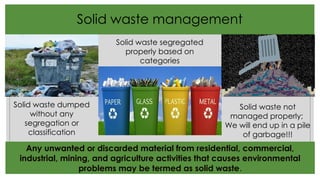
Solid waste management
Solidwaste dumped
without any
segregation or
classification
Solid waste segregated
properly based on
categories
Solid waste not
managed properly;
We will end up in a pile
of garbage!!!
Any unwanted or discarded material from residential, commercial,
industrial, mining, and agriculture activities that causes environmental
problems may be termed as solid waste.
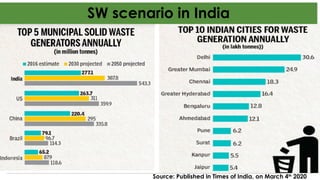
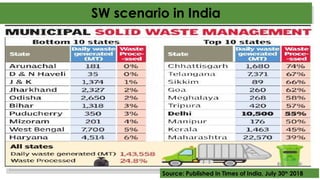
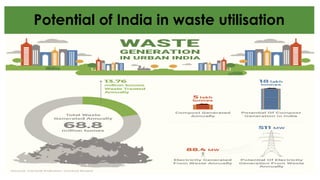
SW scenario inIndia
Source: Published in Times of India, July 30th
2018
6.
6
Major highlights ofthe new SWM Rules, 2016
◦Segregation at source
◦Collection and disposal of sanitary waste
◦Collect Back scheme for packaging waste
◦User fees for collection
◦Waste processing and treatment
◦Promoting use of compost
◦Promotion of waste to energy
◦Revision of parameters and existing standards
7.
Challenges related tosolid waste management
in India
• Inefficient Waste Management by ULBs:
• Difficulties in the decision making and the proper budgeting
• Mostly understaffed or unskilled staff
• Most of the financial budgets are utilized in the waste dumping practices.
• Municipal bodies hire private contractors to pick up and dispose of garbage in
order to earn profits.
• Lack of Segregation of Waste:
• Lack of awareness among a large section of the population regarding the
segregation of house hold wastes
• Failing to segregate trade waste properly ends up mixed in landfills.
• Waste items like food scraps, paper, plastic and liquid waste mix and decompose,
releasing run-off into the soil and harmful gas into the atmosphere.
8.
Challenges related tosolid waste management
in India
• Unsustainable Packaging:
• Online retail and food delivery apps, contribute to the rise in plastic waste used as
packaging.
• E-Commerce companies contribute excess use of plastic packaging
• No disposal instructions included with packaged products.
• Lack of Data Collection Mechanism:
• Time series data or panel data in connection with solid or liquid waste is lacking. Difficulty
in analysing the economy of waste management.
• Huge difficulty for private entities to understand the relationship between cost and
benefits of the waste management policies and enter into the market.
• Rising Rural-Urban Conflicts:
• Unruly and illegal dumping f waste impact the environment of the village and induce
many health hazards giving rise to urban-rural conflict.
9.
Recent Government initiatives
TheSWM sector has seen positive changes during the past decade.
Swachha Bharat Mission – Urban (SBM-U): With the enactment of new rules, it started
door-to-door collection, segregation at source, etc.
Swaccha Survekshan: An annual survey of cleanliness, hygiene and sanitation in cities
and towns across India. It launched as a part of the SBM-U under the Ministry of Housing
and Urban Affairs (MoHUA). It gives star ratings to garbage-free cities and towns on
several factors.
Swachhata Hi Sewa Campaign: for ensuring cleanliness through the various stakeholders’
engagement in the “Jan Andolan” (National Movement).
SWM is also a part of the National Mission on Sustainable Habitat (2010), which is one of
the eights missions under the National Action Plan for Climate Change (NAPCC) and
addresses sustainability concerns associated with habitats, primarily urban areas.
Extended Producer Responsibility: under E-waste and Plastic Waste Management Rules,
2016
10.
Recent Government initiatives
CompostBanao, Compost Apnao Campaign: a multi-media campaign launched
by MoHUAon waste-to-compost under SBM-(U). The aim is to encourage people to
convert their kitchen waste into compost to be used as fertilizer and to reduce the
amount of waste getting to landfill sites.
Collection and disposal of Sanitary Waste under new rules: The standing committee on
urban development revealed that 2,000 tonnes of sanitary waste is generated in India a
day.
Promotion of Waste to Energy: Ministry of new and Renewable Energy (MNRE) launched
Program on Energy from Urban, Industrial, Agricultural waste/residues and Municipal Solid
Waste to promote setting up of Waste-to-Energy projects and to provide central
financial assistance.
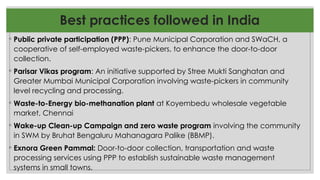
Best practices followedin India
◦ Public private participation (PPP): Pune Municipal Corporation and SWaCH, a
cooperative of self-employed waste-pickers, to enhance the door-to-door
collection.
◦ Parisar Vikas program: An initiative supported by Stree Mukti Sanghatan and
Greater Mumbai Municipal Corporation involving waste-pickers in community
level recycling and processing.
◦ Waste-to-Energy bio-methanation plant at Koyembedu wholesale vegetable
market, Chennai
◦ Wake-up Clean-up Campaign and zero waste program involving the community
in SWM by Bruhat Bengaluru Mahanagara Palike (BBMP).
◦ Exnora Green Pammal: Door-to-door collection, transportation and waste
processing services using PPP to establish sustainable waste management
systems in small towns.
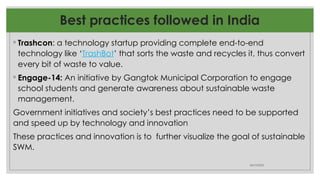
13.
◦ Trashcon: atechnology startup providing complete end-to-end
technology like ‘TrashBot’ that sorts the waste and recycles it, thus convert
every bit of waste to value.
◦ Engage-14: An initiative by Gangtok Municipal Corporation to engage
school students and generate awareness about sustainable waste
management.
Government initiatives and society’s best practices need to be supported
and speed up by technology and innovation
These practices and innovation is to further visualize the goal of sustainable
SWM.
06/10/2025
Best practices followed in India
14.
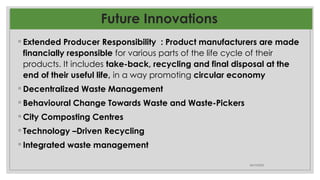
Future Innovations
◦ ExtendedProducer Responsibility : Product manufacturers are made
financially responsible for various parts of the life cycle of their
products. It includes take-back, recycling and final disposal at the
end of their useful life, in a way promoting circular economy
◦ Decentralized Waste Management
◦ Behavioural Change Towards Waste and Waste-Pickers
◦ City Composting Centres
◦ Technology –Driven Recycling
◦ Integrated waste management
06/10/2025
15.
Innovation and Opportunitieswithin the SWM
sector
◦ Smart Waste Management: Digitization in waste collection, real time monitoring of
collection and disposal operations, efficient assessment mechanism
◦ Circular Economy integrated waste management
◦ Public Private Partnership: ULB’s and city planners should work with private trash and
recycling companies to design impactful programs.
◦ Novel and pragmatic techniques for waste management: pneumatic waste collection,
decentralized treatment plants
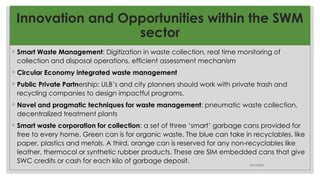
◦ Smart waste corporation for collection: a set of three ‘smart’ garbage cans provided for
free to every home. Green can is for organic waste. The blue can take in recyclables, like
paper, plastics and metals. A third, orange can is reserved for any non-recyclables like
leather, thermocol or synthetic rubber products. These are SIM embedded cans that give
SWC credits or cash for each kilo of garbage deposit. 06/10/2025
16.
16
Waste is aresource which is out of
place
Find it, segregate it, Process it
18
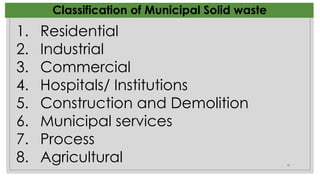
1. Residential
2. Industrial
3.Commercial
4. Hospitals/ Institutions
5. Construction and Demolition
6. Municipal services
7. Process
8. Agricultural
Classification of Municipal Solid waste
19.
Basic terminologies usedin Solid waste
Management
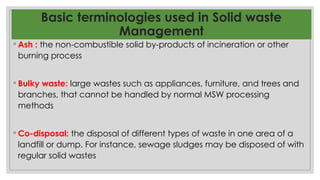
◦ Ash : the non-combustible solid by-products of incineration or other
burning process
◦ Bulky waste: large wastes such as appliances, furniture, and trees and
branches, that cannot be handled by normal MSW processing
methods
◦ Co-disposal: the disposal of different types of waste in one area of a
landfill or dump. For instance, sewage sludges may be disposed of with
regular solid wastes
20.
◦ Biodegradable material: any organic material that can be broken
down by microorganisms into simpler, more stable compounds. Most
organic wastes (e.g., food, paper) are biodegradable
◦ Compost : the material resulting from composting. also called humus, is
a soil conditioner and in some instances is used as a fertilizer
◦ Composting : biological decomposition of solid organic materials by
bacteria, fungi, and other organisms into a soil-like product.
◦ Putrescible : subject to decomposition or decay. Usually used in
reference to food wastes and other organic wastes that decay quickly
21.
◦ Garbage :Putrescent organic matter such as kitchen or food scraps
◦ Rubbish/trash: a broad category of dry goods including boxes, bottles,
tin cans, or virtually anything made from wood, metal, glass, and cloth,
could be transformed into new consumer products through a variety of
reclamation methods
◦ Refuse : Both rubbish and garbage; all kinds of wastes in solid state
except excreta from residential, commercial and industrial area
◦ Refuse-derived fuel (RDF) : fuel produced from MSW that has undergone
processing. Processing can include separation of recyclables and non-
combustible materials, shredding, size reduction, and pelletizing
23.
◦ Disposal :the final handling of solid waste, following collection,
processing, or incineration. Disposal most often means placement of
wastes in a dump or a landfill
◦ Environmental impact assessment (EIA) : an evaluation designed to
identify and predict the impact of an action or a project on the
environment and human health and well-being. Can include risk
assessment as a component, along with economic and land use
assessment
◦ Environmental risk assessment (EnRA) : an evaluation of the interactions
of agents, humans, and ecological resources. Comprised of human
health risk assessment and ecological risk assessment, typically
evaluating the probabilities and magnitudes of harm that could come
from environmental contaminants.
24.
◦ Landfilling :the final disposal of solid waste by placing it in a controlled
fashion in a place intended to be permanent. The Source Book uses this
term for both controlled dumps and sanitary landfills
◦ Leachate : liquid that has seeped through a landfill or a compost pile
and has accumulated bacteria and other possibly harmful dissolved or
suspended materials
◦ MSW : municipal solid waste
◦ MSWM : municipal solid waste management
25.
◦ Waste-to-energy (WTE)plant : a facility that uses solid waste materials
(processed or raw) to produce energy. WTE plants include incinerators
that produce steam for district heating or industrial use, or that
generate electricity; they also include facilities that convert landfill gas
to electricity
26.
26
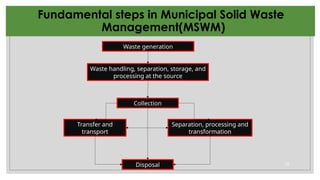
Solid Waste Management
Disposal
Wastehandling, separation, storage, and
processing at the source
Separation, processing and
transformation
Transfer and
transport
Collection
Waste generation
Fundamental steps in Municipal Solid Waste
Management(MSWM)
27.
TYPES OF COLLECTIONSYSTEMS
Hauled Container System (HCS):
- Container is hauled to disposal sites, emptied, and
returned to original location or some other location
- Suitable for areas were higher waste generation
- Types:
◦ Hoist truck : 2 - 10 m3
◦ Tilt frame container: 10 - 40 m3
-
◦ Trash trailer - for heavy, bulky rubbish (construction, commercial,
usually open top container);
◦ 2 crew per vehicle.
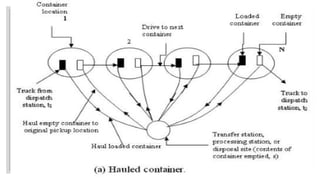
◦ Collection systemsin which the containers used for the storage of wastes are hauled to the
processing, transfer or disposal site, emptied and returned to either their original location or some
other location are defined as hauled container systems.
◦ There are two main types of hauled container systems:
◦ Hoist Truck
◦ Tilt frame container,
◦ Trash-trailer.
◦ The collector is responsible for driving the vehicle, loading full containers and unloading empty
containers and emptying the contents of the container at the disposal site. In some cases, for safety
reasons, both a driver and helper are used.
◦ Systems that use tilt frame loaded vehicles and large containers, often called drop boxes are
ideally suited for the collection of all types of solid waste and rubbish from locations where the
generation rate warrants the use of large containers.
◦ The application of trash-trailers is similar to that of frame container systems. Trash trailers are better
for the collection of especially heavy rubbish and often are used for the collection of demolition
wastes at construction sites.
31.
TYPES OF COLLECTIONSYSTEMS
Stationary Container Systems:
- the container used to store waste remain at the point of generation;
except when moved to curb or other location to be emptied.
- Types include:
- Mechanically-loaded system
- Manually-loaded collection vehicle
- Used for residential/commercial sites.
- Vehicle w/ internal compaction mechanism or un-compacted
33.
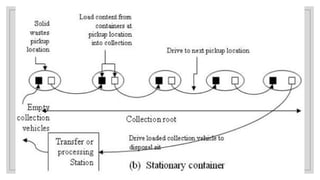
◦ Container systemsin which the containers used for the storage of wastes remain at
the point of waste generation, except when moved for collection are defined as
stationary container system
◦ Labour requirements for mechanically loaded stationary container systems are
essentially the same as for hauled container system.
◦ There are two main types of stationary container systems:
◦ Self loading compactors
◦ Manually loaded vehicles
◦ Container size and utilization are not as critical in stationary container systems using
self loading collection vehicles equipped with a compaction mechanism as they
are in hauled container system.
◦ Trips to the disposal site, transfer station or processing station are made after the
contents of number of containers have been collected and compacted and the
collection vehicle is full. This system is used for the collection of all types of wastes.
34.
◦ Pick Up:depends on the type of collection system
◦ HCS: refers to time spent driving to the next container after empty container has
been deposited, time spent picking up the loaded container, and the time
required to redeposit the container after its contents have been emptied
◦ SCS: time spent loading the collection vehicle(from the first container to the last
container)
◦ Haul : Depends on collection system used
◦ HCS: Time required to reach the location where the contents of the container
would be emptied (transfer station, MRF or disposal site) and also the time for
travel to redeposit the empty container.
◦ It does not include any time at the location or at site
◦ SCS: time taken to reach the location and time taken to reach the transfer station
or MRF to deposit the waste
◦ At Site: At Site: time spent at the location during the process of unloading
◦ Off Route: time spent for all unproductive activities wrt collection operation
Activities
35.
Costs in SWCollection Systems:
i. Capital Costs (i.e. depreciation costs for vehicles,
garages, administrative services).
ii. Interest costs of debt (to acquire /construct
facilities/equip.)
iii. Costs (i.e., labor, parts, oil, tires) of repairing and
maintaining facility/equip.).
iv. Employee benefits (pension, etc.).
v. Cost of temporary employees (short-term needs).
36.
Costs in SWCollection Systems(Cont.):
vi. Overhead costs (executives, supporting staff).
vii. Costs associated with budgeting, accounting,
and report activities.
viii. Costs associated with billing and collecting user
charges.
ix. Liability and damage claims.
x. Insurance premiums (personnel, facilities, and
equipments).
40
◦ Physical
◦ Specificweight, Moisture content, Particle size and size distribution,
Field capacity, Compacted waste porosity (permeability)
◦ Chemical
Important in evaluating alternative processes and recovery options
◦ Proximate analysis, Fusing point of ash, Ultimate analysis (major
elements), Energy content
◦ Biological
Important in considering organic fractions Corresponding to
◦ Biodegradability
◦ Production of odor
Properties of a Solid waste
41.
41
Treatment Processes
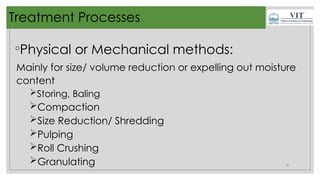
◦Physical orMechanical methods:
Mainly for size/ volume reduction or expelling out moisture
content
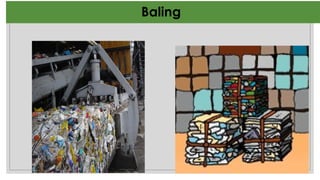
Storing, Baling
Compaction
Size Reduction/ Shredding
Pulping
Roll Crushing
Granulating
42.
Equipments Used
◦Hammer Mills: To minimize scrap automobiles,
construction, commercial and paper waste
◦Impact crushers : Constructional debris
◦Chippers : Plant debris, dead or cut trees
◦Cascade Mills : Grinding and rolling action
◦Rasp Mills : Treatment of wastes in compositing
facility
◦Jaw crushers : Hard and Brittle material
45
Treatment Processes
◦Thermal Methods:
Thewastes are subjected to high temperature, and
processed to form stabilized and inert residue
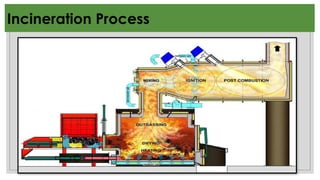
Incineration
Pyrolysis
Gasification
Refuse Derived Fuel from the wastes can be a good fuel to
thermal reactors
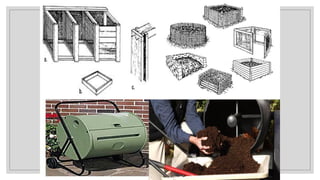
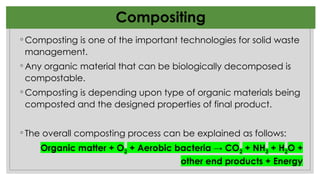
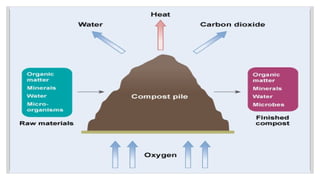
◦ Composting isone of the important technologies for solid waste
management.
◦ Any organic material that can be biologically decomposed is
compostable.
◦ Composting is depending upon type of organic materials being
composted and the designed properties of final product.
◦ The overall composting process can be explained as follows:
Organic matter + O2 + Aerobic bacteria → CO2 + NH3 + H2O +
other end products + Energy
Compositing
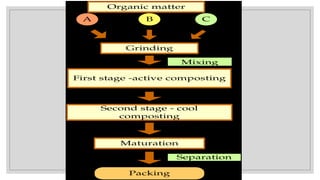
52.
Organic matter
A BC
Grinding
Mixing
First stage -active composting
Second stage - cool
composting
Maturation
Separation
Packing
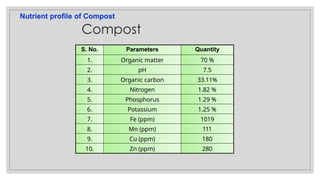
Benefits of Compost
•Compost improves the quality of soil, and for this reason it is considered as a
soil conditioner.
• It contains a variety of the basic nutrients required for healthy growth of plants
• In addition to, nitrogen, phosphorous, and potassium, certain micronutrients
viz. manganese, copper, iron, and zinc also found in compost which helps
them to control diseases and insects.
• Compost improves the structure and texture of the soil enable them to retain
nutrients, moisture, and air for the betterment of growth of plants.
Compost
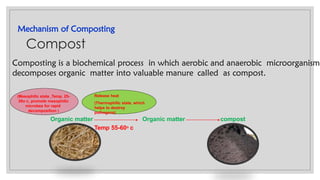
Mechanism of Composting
Compostingis a biochemical process in which aerobic and anaerobic microorganism
decomposes organic matter into valuable manure called as compost.
Organic matter
Release heat
(Thermophilic state, which
helps to destroy
pathogens)
Organic matter compost
(Mesophilic state ,Temp. 25-
30o c, promote mesophilic
microbes for rapid
decomposition )
Compost
Temp 55-60o c
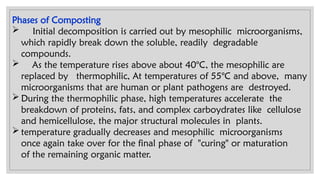
Phases of Composting
Initial decomposition is carried out by mesophilic microorganisms,
which rapidly break down the soluble, readily degradable
compounds.
As the temperature rises above about 40°C, the mesophilic are
replaced by thermophilic, At temperatures of 55°C and above, many
microorganisms that are human or plant pathogens are destroyed.
During the thermophilic phase, high temperatures accelerate the
breakdown of proteins, fats, and complex carboydrates like cellulose
and hemicellulose, the major structural molecules in plants.
temperature gradually decreases and mesophilic microorganisms
once again take over for the final phase of "curing" or maturation
of the remaining organic matter.
59.
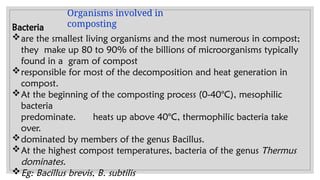
Organisms involved in
composting
Bacteria
arethe smallest living organisms and the most numerous in compost;
they make up 80 to 90% of the billions of microorganisms typically
found in a gram of compost
responsible for most of the decomposition and heat generation in
compost.
At the beginning of the composting process (0-40°C), mesophilic
bacteria
predominate. heats up above 40°C, thermophilic bacteria take
over.
dominated by members of the genus Bacillus.
At the highest compost temperatures, bacteria of the genus Thermus
dominates.
Eg: Bacillus brevis, B. subtilis
60.
Actinomycetes
characteristic earthysmell of soil is caused by actinomycetes.
organisms that resemble fungi but actually are filamentous bacteria.
play an important role in degrading complex organics such as cellulose, lignin, chitin, and
proteins.
Their enzymes enable them to chemically break down tough debris such as
woody stems, bark, or newspaper.
Some species appear during the thermophilic phase, and others become important during the
cooler curing phase.
Eg: Actinobifida chromogena, Microbispora bispora
Fungi
they are responsible for the decomposition of many complex plant polymers in soil and
compost.
they break down tough debris, enabling bacteria to continue the
decomposition process once most of the cellulose has been exhausted.
Fungal species are numerous during both mesophilic and thermophilic phases of
composting.
Most fungi live in the outer layer of compost when temperatures are high.
Eg: Aspergillus fumigatus, Humicola grisea
61.
Protozoa
Protozoa areone-celled microscopic animals.
They are found in water droplets in compost but play a relatively minor role in
decomposition
Rotifers
Rotifers are microscopic multicellular organisms also found in films of water in the compost.
They feed on organic matter and also ingest bacteria and fungi.
Earthworms
Earthworms are the most important of the large physical decomposers in a compost pile.
Earthworms ingest organic matter and digest it with the help of tiny stones
in their gizzards.
The worms leave dark, fertile castings behind. A worm can produce its weight in
castings each day.
These castings are rich in plant nutrients such as nitrogen, calcium,
magnesium, and phosphorus that might otherwise be unavailable to plants.
62.
Materials for composting:
Foodand drink industry waste;
Paper, card, timber and other biodegradable waste;
Household waste;
Organic sludge including sewage;
Agricultural waste.
: Wastes from meat, dairy products, and eggs
should not be used in household compost:
they attract unwanted vermin;
they do not appropriately decompose in the
time required.
63.
63
◦Porosity (Free Volume)
◦Freeair space
◦Moisture content
◦Oxygen requirement
◦Temperature
◦C/N, C/P
, C/S ratio
◦pH
Controlling Parameters for Compositing
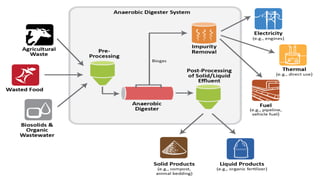
Mechanism of AnaerobicDigestion
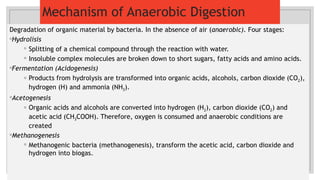
Degradation of organic material by bacteria. In the absence of air (anaerobic). Four stages:
◦Hydrolisis
◦ Splitting of a chemical compound through the reaction with water.
◦ Insoluble complex molecules are broken down to short sugars, fatty acids and amino acids.
◦Fermentation (Acidogenesis)
◦ Products from hydrolysis are transformed into organic acids, alcohols, carbon dioxide (CO2),
hydrogen (H) and ammonia (NH3).
◦Acetogenesis
◦ Organic acids and alcohols are converted into hydrogen (H2), carbon dioxide (CO2) and
acetic acid (CH3COOH). Therefore, oxygen is consumed and anaerobic conditions are
created
◦Methanogenesis
◦ Methanogenic bacteria (methanogenesis), transform the acetic acid, carbon dioxide and
hydrogen into biogas.
Examples: Biogas Appliances
ChangMai
M. WAFLER
Mini biogas generator
Large
combined
heat and
power (CHP)
Cogeneration
plant
Biogas
boiler
Biogas lamp
Biogas
cooking
stove
http://www.power.alstom.com/home/new_plants/steam/products/
steam_turbines/references/_files/file_40796_97389.jpg
71.
71
Ultimate Disposal
◦ Solidwastes that are collected and are of no
further use
◦ The residual matter remaining after solid
wastes have been processed
◦ The residual matter remaining after the
recovery of energy
◦ Secured land filling or deep well injection in
case of industrial (hazardous ) waste.
72.
Open Dumping
Compost (14%)
98% 30%
7.0
Transfer Station
(Compaction)
Resource Recovery
Transfer Station
SANITARY LANDFILL
NH4
Ground Water
16.0
Recyclable Inorganic & Others Organic
56%
MSW Management
Scientific Dumping
OPEN GROUND
73.
Solid waste disposal: Hazardous waste
◦After treatment, the hazardous wastes are converted into
suitable form for disposal.
◦Immobilization, stabilization, fixation, and solidification are
some of the popularly used techniques for preparation of
waste for disposal.
◦Land disposal techniques include
◦•Landfills,
◦•Surface impediment
◦•Underground injection wells.
◦•Land farming
06/10/2025
Types of solidwastes Typical waste generators Source
Food wastes, paper, cardboard,
plastics, textiles, leather, yard wastes,
wood, glass, metals, ashes, special
wastes (e.g., bulky items, consumer
electronics, white goods, batteries, oil,
tires), and household hazardous wastes
Single and multifamily
dwellings
Residential
Housekeeping wastes, packaging, food
wastes, construction and demolition
materials, hazardous wastes, ashes,
special wastes
Light and heavy
manufacturing, fabrication,
construction sites, power
and chemical plants
Industrial
All of the above should be included as “municipal solid waste.”
Classification of Solid waste
78.
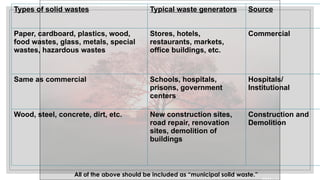
Types of solidwastes Typical waste generators Source
Paper, cardboard, plastics, wood,
food wastes, glass, metals, special
wastes, hazardous wastes
Stores, hotels,
restaurants, markets,
office buildings, etc.
Commercial
Same as commercial Schools, hospitals,
prisons, government
centers
Hospitals/
Institutional
Wood, steel, concrete, dirt, etc. New construction sites,
road repair, renovation
sites, demolition of
buildings
Construction and
Demolition
All of the above should be included as “municipal solid waste.”
79.
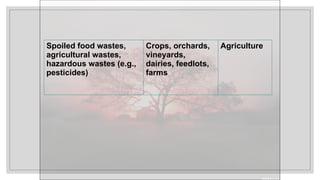
Types of solidwastes Typical waste
generators
Source
Street sweepings;
landscape and tree
trimmings; general wastes
from parks, beaches, and
other recreational areas;
sludge
Street cleaning,
landscaping, parks,
beaches, other
recreational areas,
water and
wastewater
treatment plants
Municipal
services
Industrial process wastes,
scrap materials, off-
specification products,
slag, tailings
Heavy and light
manufacturing,
refineries, chemical
plants, power
plants, mineral
extraction and
processing
Process
All of the above should be included as “municipal solid waste.”
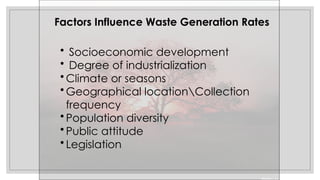
• Socioeconomic development
•Degree of industrialization
• Climate or seasons
• Geographical locationCollection
frequency
• Population diversity
• Public attitude
• Legislation
Factors Influence Waste Generation Rates
82.
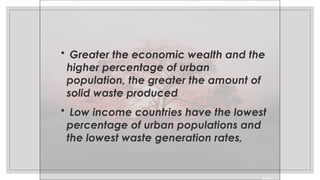
• Greater theeconomic wealth and the
higher percentage of urban
population, the greater the amount of
solid waste produced
• Low income countries have the lowest
percentage of urban populations and
the lowest waste generation rates,
◦ 1. Airtightchamber, filled with green waste
◦ 2. Anaerobic digestion takes place
◦ 3. Sludge settles on the bottom
◦ 4. Gas bubbles to the top where it is collected
◦ Reaction temperature is > 35 to 55 °C: mesophilic or
thermophilic range
◦ Either continuous or in batch mode:
◦ Batch: filled and left for digestion; After the hydraulic
retention time (HRT) emptied and filled again for a
new cycle
◦ Continuously-stirred tank reactor (CSTR): continuous
in/out flow and mixing
◦ Plug-flow reactor: the sludge moves through the
reactor much like a train to a tunnel, with a velocity
corresponding to the minimal HRT
◦ The liquid phase can be re-circulated to maintain optimal
moisture conditions
90.
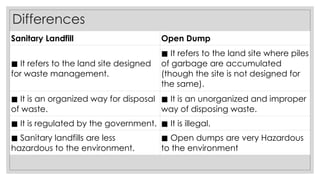
Differences
Sanitary Landfill OpenDump
◼ It refers to the land site designed
for waste management.
◼ It refers to the land site where piles
of garbage are accumulated
(though the site is not designed for
the same).
◼ It is an organized way for disposal
of waste.
◼ It is an unorganized and improper
way of disposing waste.
◼ It is regulated by the government. ◼ It is illegal.
◼ Sanitary landfills are less
hazardous to the environment.
◼ Open dumps are very Hazardous
to the environment
91.
Differences
The whole processis carefully
monitored, thus preventing foul
odor. As a result, pests are avoided.
◼ No monitoring is involved, which
results in foul odor. This attracts rats,
rodents, and other pests.
◼ A sanitary landfill is bigger as
compared to a dump area.
◼ An open dump is smaller than a
landfill.
◼ Leachate collection and other
treatment systems, as well as liners
are involved.
◼ No treatment systems or liners are
involved.
◼ Setting up a landfill requires a
fixed type of location. That is, while
choosing the location, certain
factors need to be considered for
maximum level of protection. For
example, it has to be away from a
residential area.
◼ An open dump can be located
anywhere
92.
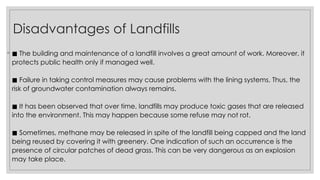
Disadvantages of Landfills
◦◼ The building and maintenance of a landfill involves a great amount of work. Moreover, it
protects public health only if managed well.
Failure in taking control measures may cause problems with the lining systems. Thus, the
◼
risk of groundwater contamination always remains.
It has been observed that over time, landfills may produce toxic gases that are released
◼
into the environment. This may happen because some refuse may not rot.
Sometimes, methane may be released in spite of the landfill being capped and the land
◼
being reused by covering it with greenery. One indication of such an occurrence is the
presence of circular patches of dead grass. This can be very dangerous as an explosion
may take place.
93.
Digital Assignment 2deadline 10th
October
◦ Awareness creation : Check with Vitians
a) What do they know about emerging wastes?
b) What all types of EW are produced by us?
c) How can it be rectified?
Video/ppt presentation
Group 1: Marine pollution due to plastic
Group 2: Glass waste
Group 3: Agricultural Waste
Group 4: PCPs Personal care protective waste
06/10/2025
Editor's Notes
#7 There are around 3700 urban local bodies with 100 corporations, 1500 municipal councils and 2100 nagar panchayats, besides 56 cantonment boards—a kind of extra-constitutional body.
#9 national level campaign by the Government of India covering 4041 statutory towns to clean the streets, roads and infrastructure of the country.
Main focuss on
Biodegradable waste management
Plastic waste management
Grey water management
Feacal sludge management
Swaccha survekshan: capturing the initiatives of cities for the overall welfare and well-being of Sanitation workers.
#63 40% moisture – degradation will proceed at a slow rate (under 25 -30% it stops);
> 65% moisture - О2 distributes very difficult in the biomass (anaerobic conditions established)
#72 The chaotic landfills act as a ticking bomb and could create havoc by catching fire anytime. The mountain of waste catches fire when it surmounts the saturation point and no longer withstands the heat due to pilling up of waste.
The health problems related to various emissions from landfills include high PM10 exposure, breathing problems, bacterial infections, asthma, elevated cardiovascular risk, and other infections. In India scenario, open dumps are highly prevailing which causes the breeding of mosquitoes, flies, rats, cockroach, and other pests. Some diseases are very common in the population living near the landfill site such as plague, histoplasmosis, murine typhus, malaria, dengue, West Nile fever, etc. as they are caused by the pests breeding in the landfills. Besides potential health hazards, there are concerns regarding the flow of toxins in the food chain of birds and animals, fires and explosions, vegetation damage, unpleasant odour, landfill settlement, groundwater pollution, air pollution and global warming.
“The methane released from landfills has a great global warming potential which is 23 times greater than that of the same amount of carbon dioxide” – (EIA, 2003)
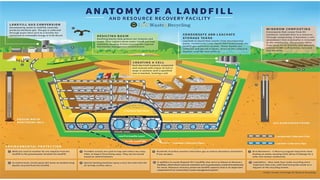
#75 Layer 1: The Liner System
The bottom of a modern landfill is typically lined with compacted clay dense enough to prevent liquids from penetrating it. On top of the clay, landfill engineers install a liner made of high-density plastic for added protection.
Layer 2: The Drainage System
Some waste produces liquid as it decomposes. And as rain and snow filter through a landfill, it can carry other contaminants to the bottom. Perforated pipes are installed on top of the liner to collect these liquids—known as leachate—and funnel them to treatment facilities, either onsite or at wastewater treatment plants.
Layer 3: The Gas Collection System
Waste naturally produces methane as it decomposes and when methane is released into the atmosphere, it contributes to global warming. But methane is also the main component of natural gas. Modern landfills work to turn methane into power using gas extraction wells that pipe it to treatment areas and then to plants that will turn it into electricity or other forms of energy.
Layer 4: The Trash Itself
In the main area of the landfill, trash is delivered and then compacted to take up less room. Every day, the new trash is covered with a layer of dirt which helps contain odors and deter pests.




















![Examples: Small-scale digesters
http://colli239.fts.educ.msu.edu/wp-content/uploads/2009/05/biotech2007cc.j
pg
[Accessed: 04.06.2010]
Source: F. HEEB
http://images01.olx.in/ui/4/96/20
/67509620_1-Install-biotech-portab
le-biogas-plants-and-convert-food-
waste-to-biogas-Vazhuthacaud.jpg
[Accessed: 04.06.2010]
http://www.open2.net/
blogs/media/blogs/
Biogas_plant_Kerala.jpg
Household
floating-drum
digesters
Portable
reactors form
the Indian
NGO BIOTECH](https://image.slidesharecdn.com/module2-1-250610103508-e1e2fcc5/85/water-waste-mangement-module-2-pptx-pptx-68-320.jpg)
![69
Examples: Large-scale digesters
http://www.klima-sucht-schutz.de/mitmachen/klima-quiz/lexikon.ht
ml
[]Accessed: 04.06.2010
Source: BRUYN (2006) Source: BRUYN (2006)
Source: BRUYN (2006)](https://image.slidesharecdn.com/module2-1-250610103508-e1e2fcc5/85/water-waste-mangement-module-2-pptx-pptx-69-320.jpg)