PREPARATION OF
ALCOHOL
Prepared by –
•Uddeepana barpujari
(17/BBT/03)
•Nikita Medhi
(17/BBT/21)
•Debajit Atreya
CONTENTS –
Introduction
Raw materials & it’s treatment
Biosynthetic pathway
Production Process
Fermentation
Sources
Application
References
Introduction
Alcohol is any organic compound in which the hydroxyl functional
group (-OH) is bound to a saturated carbon atom. The term alcohol originally
referred to the primary alcohol ethanol (ethyl alcohol),which is used as a drug
and is the main alcohol present in alcohol beverages.
Rhazes (854CE -925CE),was a Persian polymath ,physician , alchemist and
philosopher who discovered numerous compounds and chemicals including
“alcohol” by developing several chemical instruments and methods of
distillation.
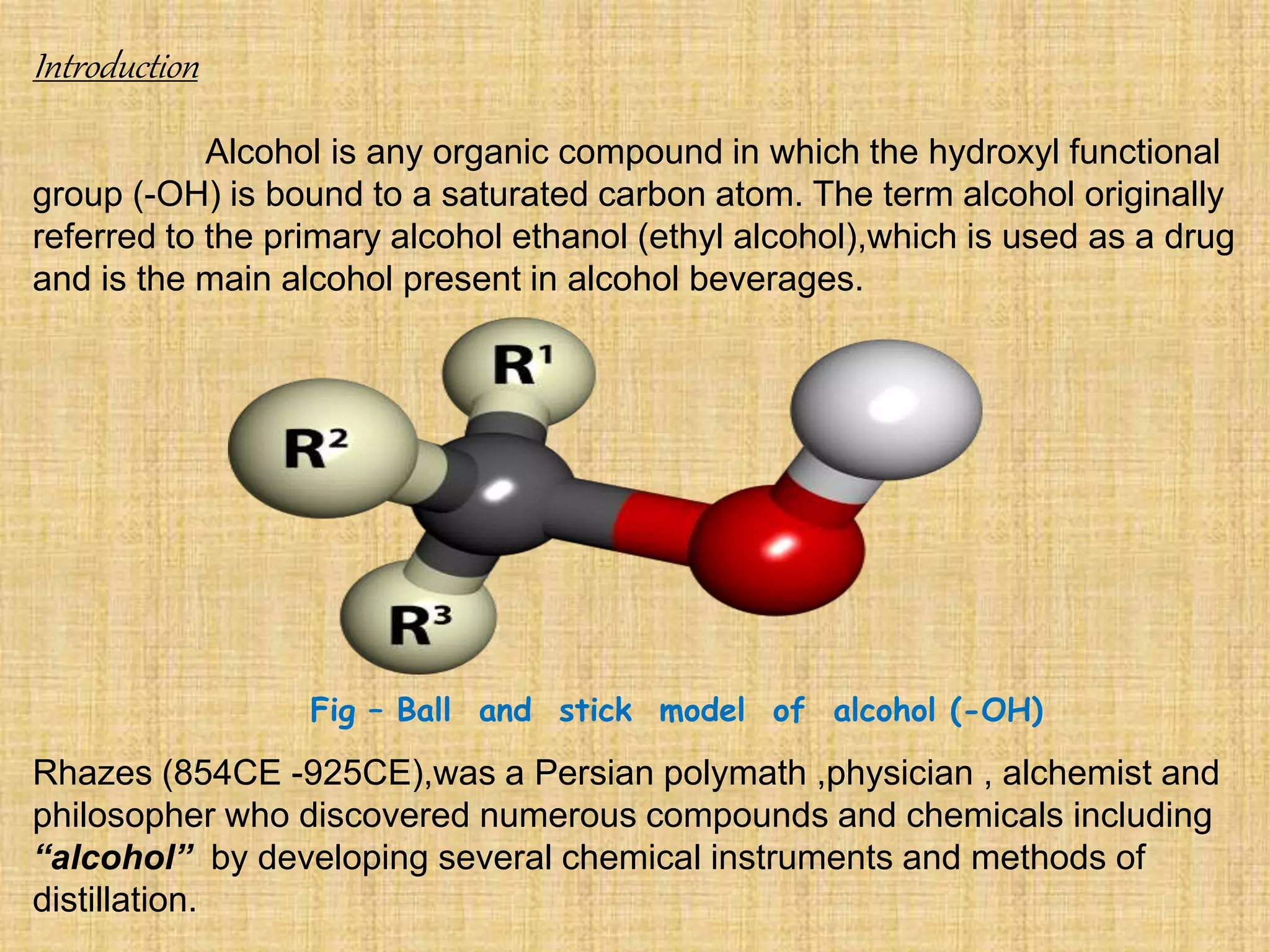
Fig – Ball and stick model of alcohol (-OH)
Alcohol : structure and types
An alcohol is often called with the name of the corresponding alkyl group
followed by the word “alcohol”, methyl alcohol , ethyl alcohol , n-propyl
alcohol .
Alcohols are classified into primary (gen. formula : RCH2OH) , secondary
(sec-,s-) (gen. formula : RR’CHOH) and tertiary( tert-, t-)(gen. formula :
RR’R”COH) based upon the numbers of carbon atoms connected to the
carbon atom that bears the hydroxyl functional group.
Ethanol , which is also called alcohol , ethyl alcohol and drinking alcohol is
a simple volatile, flammable, colourless liquid alcohol having chemical
formula C2H5OH.
Fig:- structure of ethanol / drinking
Raw materials and micro-organisms
Micro-organisms:-- i)Yeast (Saccharomyces cerevisae,Saccharomyces ellipsoideus,
Kluyueromyces fragiles )
ii) bacteria ( Zymononas mobilis , Candidas pseudotropicales ,
Candidas utilis )
Raw materials:-- i)Sugary materials (e.g.:- molasses , sucrose , glucose etc.)
ii)Starchy materials (e.g.:- wheat , rice , maize , potato etc.)
iii) Cellulosic materials (e.g.:- agricultural waste , wood etc.)
PRE-TREATMENT of raw materials --
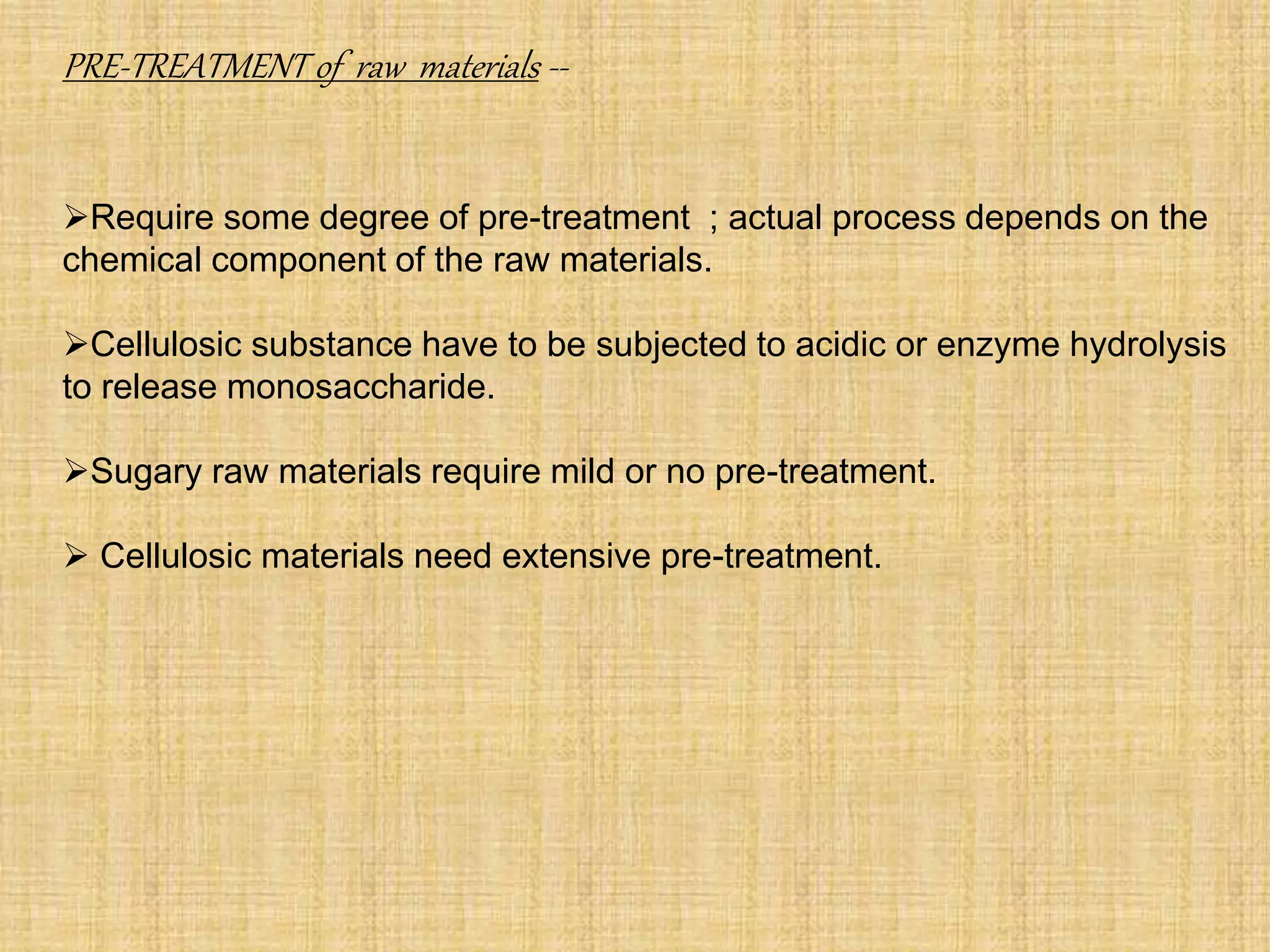
Require some degree of pre-treatment ; actual process depends on the
chemical component of the raw materials.
Cellulosic substance have to be subjected to acidic or enzyme hydrolysis
to release monosaccharide.
Sugary raw materials require mild or no pre-treatment.
 Cellulosic materials need extensive pre-treatment.
Biosynthetic pathway
STARCH
GLUCOSE
PYRUVATE
ACETALDEHYDE
ETHANOL
Hydrolysis
Glycolysis
Pyruvate
decarboxyla
se
Alcohol
dehydrogenas
e
CO
2
Aerobic
condition
Anaerobic
condition
The sequence of enzymatic
steps in the synthesis of specific
end-product in a living organism.
UNDER AEROBIC CONDITION :-
Excess glucose content in the medium,
the micro-organism grow well without
producing alcohol.
UNDER ANAEROBIC
CONDITION :-
Excess glucose content in the medium
,the growth slows down and alcohol
production occurs.
Regulation of synthesis
Ethanol at high concentration in the medium inhibits it’s own
biosynthesis when yeast is used.
Growth of yeast stops at 5% ethanol concentration (v/v in
water).Yeast are sensitive to inhibition by endogenously synthesized
ethanol and not to the ethanol added to the medium. So , bacteria
Zymononas mobilis is used because of it’s tolerance over a high
concentration of alcohol ( up to 13%)
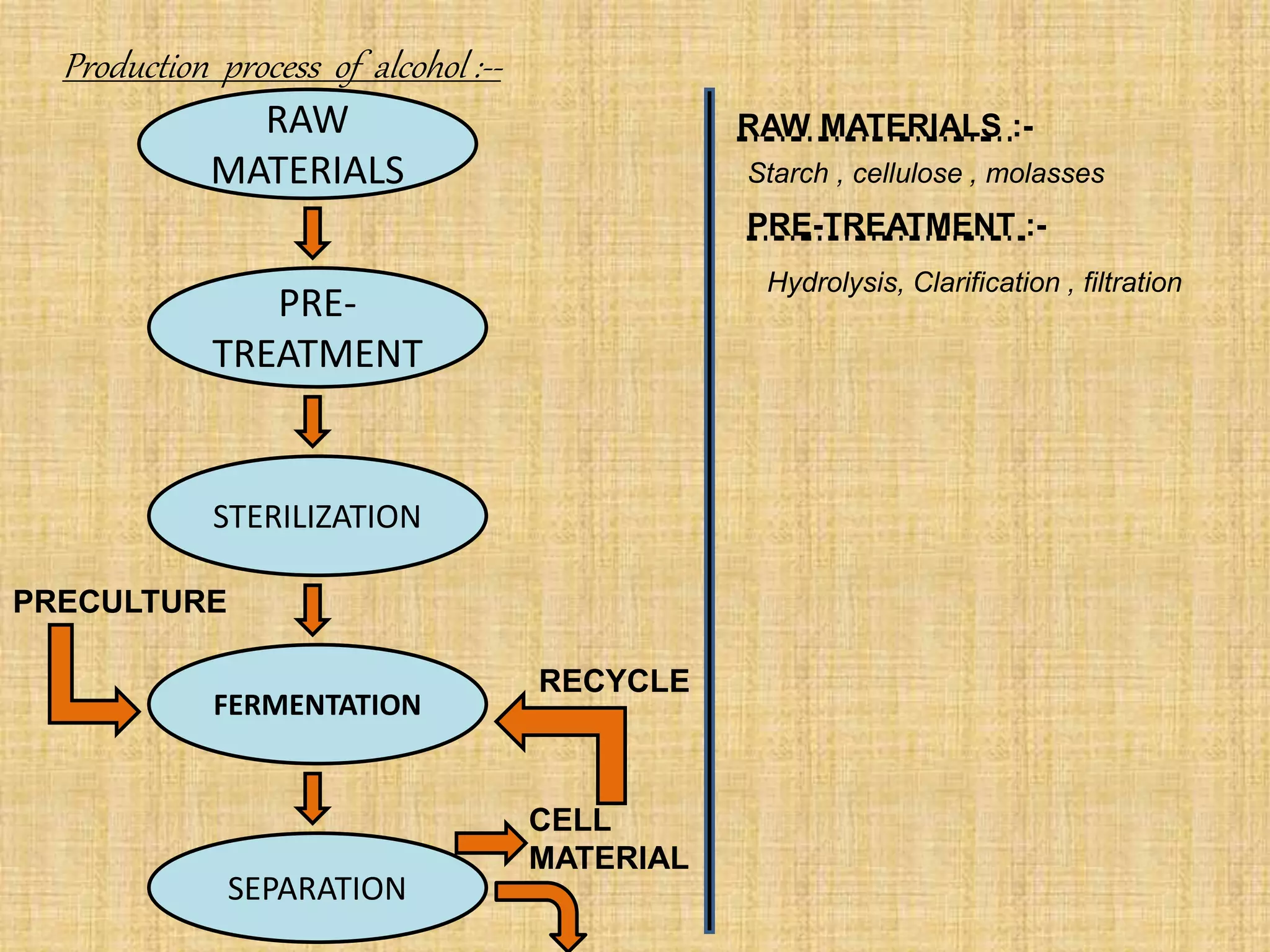
Production process of alcohol :--
RAW
MATERIALS
PRE-
TREATMENT
STERILIZATION
FERMENTATION
SEPARATION
PRECULTURE
CELL
MATERIAL
RECYCLE
RAW MATERIALS :-
Starch , cellulose , molasses
PRE-TREATMENT :-
Hydrolysis, Clarification , filtration
Production process of alcohol :--
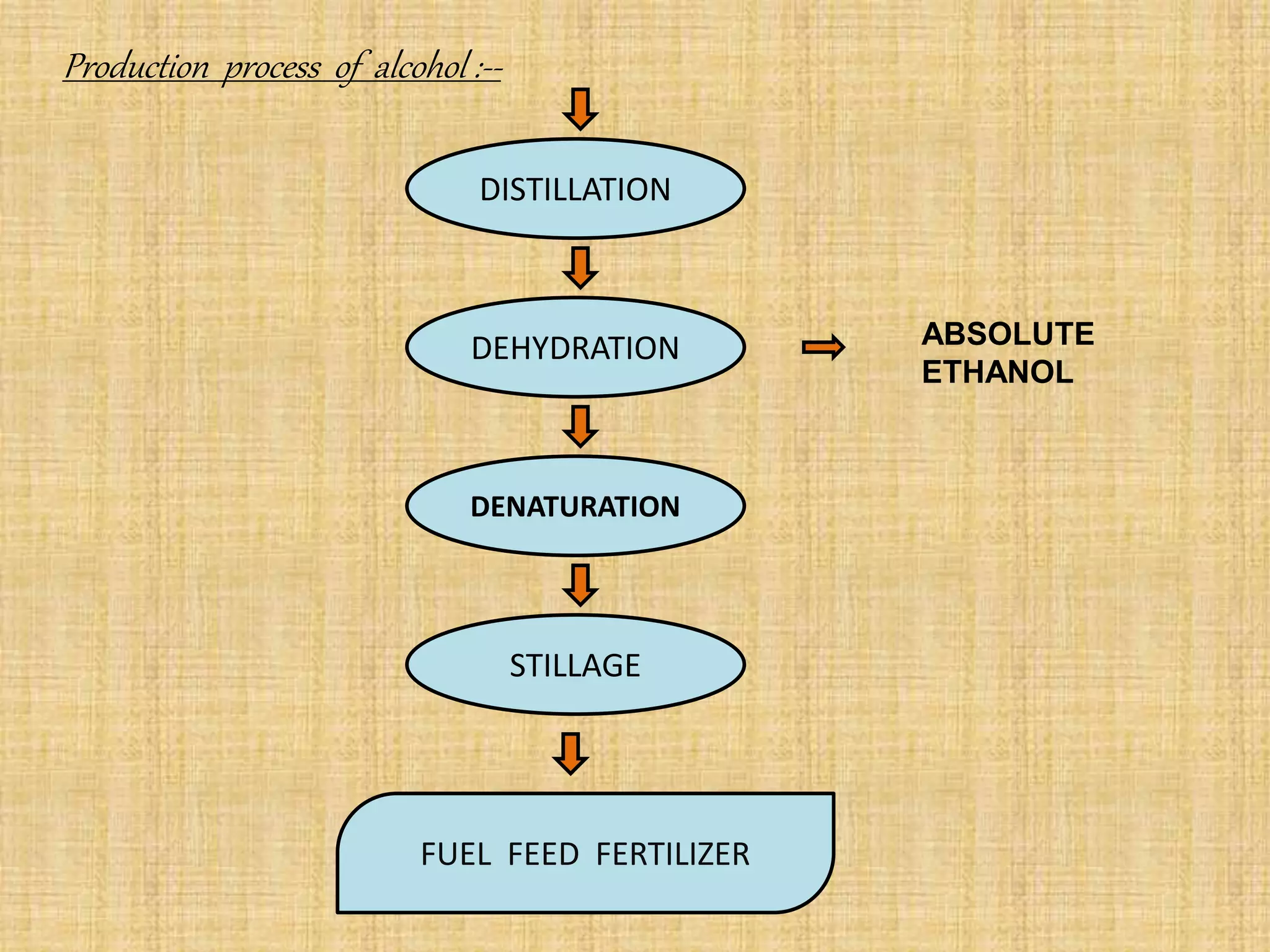
DISTILLATION
DEHYDRATION ABSOLUTE
ETHANOL
DENATURATION
STILLAGE
FUEL FEED FERTILIZER
APPLICATION of alcohol :--
ALCOHOLIC BEVERAGES
Contains 3 – 40% alcohol by volume
Produced and consumed by humans since pre-historic times.
Natural fermentation produces trace amounts of alcohol such
as 2-methyl-2-butanol and Ỿ- hydroxybutyric acid .
ANTIFREEZE
It commonly includes a 50% v/v ( by volume ) solution of
ethylene glycol in water.
MEDICAL
Can be used as an antiseptic to disinfect the skin before
injections are given , often along with iodine.
Ethanol based soaps and gels (hand senitizers) are most
common in restaurants as they don’t require drying due to the
volatility of the compound.
APPLICATION of alcohol :--
ALCOHOL FUEL
Some alcohols , mainly ethanol and methanol , can be used as
fuel .
Fuel performance can be increased in forced induction internal
combustion engines by injecting alcohol into the air intake .
PRESERVATIVE
Often used as a preservative for biological specimens in the
fields of science and medicine.
SOLVENT
They have applications in industry and science as reagents or
solvents.
Because of it’s relatively low toxicity , ethanol can be used as a
solvent in medical drugs , perfumes , and vegetable essences
such as vanilla.
in organic synthesis , alcohols serve as versatile
intermediates.
reference :--
Websites –
• www.wikipedia.org/wiki/alcohol
• www.softschool.com/science/alcohol-preparation
• www.edu.pe.ca/gray/class_pages/application-of-alcohol
Book –
 ELEMENTS OF BIOTECHNOLOGY ( SECOND EDITION )
RASTOGI PUBLICATIONS , MEERUT , INDIA
By P.K. GUPTA
Preparation  of alcohol

Preparation of alcohol

  • 1.
    PREPARATION OF ALCOHOL Prepared by– •Uddeepana barpujari (17/BBT/03) •Nikita Medhi (17/BBT/21) •Debajit Atreya
  • 2.
    CONTENTS – Introduction Raw materials& it’s treatment Biosynthetic pathway Production Process Fermentation Sources Application References
  • 3.
    Introduction Alcohol is anyorganic compound in which the hydroxyl functional group (-OH) is bound to a saturated carbon atom. The term alcohol originally referred to the primary alcohol ethanol (ethyl alcohol),which is used as a drug and is the main alcohol present in alcohol beverages. Rhazes (854CE -925CE),was a Persian polymath ,physician , alchemist and philosopher who discovered numerous compounds and chemicals including “alcohol” by developing several chemical instruments and methods of distillation. Fig – Ball and stick model of alcohol (-OH)
  • 4.
    Alcohol : structureand types An alcohol is often called with the name of the corresponding alkyl group followed by the word “alcohol”, methyl alcohol , ethyl alcohol , n-propyl alcohol . Alcohols are classified into primary (gen. formula : RCH2OH) , secondary (sec-,s-) (gen. formula : RR’CHOH) and tertiary( tert-, t-)(gen. formula : RR’R”COH) based upon the numbers of carbon atoms connected to the carbon atom that bears the hydroxyl functional group. Ethanol , which is also called alcohol , ethyl alcohol and drinking alcohol is a simple volatile, flammable, colourless liquid alcohol having chemical formula C2H5OH. Fig:- structure of ethanol / drinking
  • 5.
    Raw materials andmicro-organisms Micro-organisms:-- i)Yeast (Saccharomyces cerevisae,Saccharomyces ellipsoideus, Kluyueromyces fragiles ) ii) bacteria ( Zymononas mobilis , Candidas pseudotropicales , Candidas utilis ) Raw materials:-- i)Sugary materials (e.g.:- molasses , sucrose , glucose etc.) ii)Starchy materials (e.g.:- wheat , rice , maize , potato etc.) iii) Cellulosic materials (e.g.:- agricultural waste , wood etc.)
  • 6.
    PRE-TREATMENT of rawmaterials -- Require some degree of pre-treatment ; actual process depends on the chemical component of the raw materials. Cellulosic substance have to be subjected to acidic or enzyme hydrolysis to release monosaccharide. Sugary raw materials require mild or no pre-treatment.  Cellulosic materials need extensive pre-treatment.
  • 7.
    Biosynthetic pathway STARCH GLUCOSE PYRUVATE ACETALDEHYDE ETHANOL Hydrolysis Glycolysis Pyruvate decarboxyla se Alcohol dehydrogenas e CO 2 Aerobic condition Anaerobic condition The sequenceof enzymatic steps in the synthesis of specific end-product in a living organism. UNDER AEROBIC CONDITION :- Excess glucose content in the medium, the micro-organism grow well without producing alcohol. UNDER ANAEROBIC CONDITION :- Excess glucose content in the medium ,the growth slows down and alcohol production occurs.
  • 8.
    Regulation of synthesis Ethanolat high concentration in the medium inhibits it’s own biosynthesis when yeast is used. Growth of yeast stops at 5% ethanol concentration (v/v in water).Yeast are sensitive to inhibition by endogenously synthesized ethanol and not to the ethanol added to the medium. So , bacteria Zymononas mobilis is used because of it’s tolerance over a high concentration of alcohol ( up to 13%)
  • 9.
    Production process ofalcohol :-- RAW MATERIALS PRE- TREATMENT STERILIZATION FERMENTATION SEPARATION PRECULTURE CELL MATERIAL RECYCLE RAW MATERIALS :- Starch , cellulose , molasses PRE-TREATMENT :- Hydrolysis, Clarification , filtration
  • 10.
    Production process ofalcohol :-- DISTILLATION DEHYDRATION ABSOLUTE ETHANOL DENATURATION STILLAGE FUEL FEED FERTILIZER
  • 11.
    APPLICATION of alcohol:-- ALCOHOLIC BEVERAGES Contains 3 – 40% alcohol by volume Produced and consumed by humans since pre-historic times. Natural fermentation produces trace amounts of alcohol such as 2-methyl-2-butanol and Ỿ- hydroxybutyric acid . ANTIFREEZE It commonly includes a 50% v/v ( by volume ) solution of ethylene glycol in water. MEDICAL Can be used as an antiseptic to disinfect the skin before injections are given , often along with iodine. Ethanol based soaps and gels (hand senitizers) are most common in restaurants as they don’t require drying due to the volatility of the compound.
  • 12.
    APPLICATION of alcohol:-- ALCOHOL FUEL Some alcohols , mainly ethanol and methanol , can be used as fuel . Fuel performance can be increased in forced induction internal combustion engines by injecting alcohol into the air intake . PRESERVATIVE Often used as a preservative for biological specimens in the fields of science and medicine. SOLVENT They have applications in industry and science as reagents or solvents. Because of it’s relatively low toxicity , ethanol can be used as a solvent in medical drugs , perfumes , and vegetable essences such as vanilla. in organic synthesis , alcohols serve as versatile intermediates.
  • 13.
    reference :-- Websites – •www.wikipedia.org/wiki/alcohol • www.softschool.com/science/alcohol-preparation • www.edu.pe.ca/gray/class_pages/application-of-alcohol Book –  ELEMENTS OF BIOTECHNOLOGY ( SECOND EDITION ) RASTOGI PUBLICATIONS , MEERUT , INDIA By P.K. GUPTA