
Course title :Software Project Management
CSE-221
• Submitted By: • Submitted To
Name: Istiaque Ahmed Shuvo
Id:141311057
5th batch ,5th semester
Sec-B
Dept. Of Cse
Varendra University,rajshahi
Name: Meraj Ali
Lecturer,
CSE, Varendra University
What is Project?
• An activity with specific goals which takes place over a finite period of
time.
• Distinct Characteristics:
 1) Temporary (Definite beginning & Definite end i.e., limited time
scale)
 2) Unique (End result i.e., product or service is different in some
distinguishing way from all other products & services)
 3) Tasks, Aims, Purpose
• Examples:
 Creating a new product i.e., building, vehicle, or facility
 Developing a new service i.e., change in structure, staffing or style of
an organization, developing or adopting new information system, running
a campaign for political office or implementing a new business strategy
or procedure.
What is project Management?
• Art (strategic competency) of maximizing probability that a project
delivers its goal in time, to budget and at the required quality.
• Science to apply knowledge, skills, tools & techniques to achieve project
objectives.
• Processes/phases to achieve objectives could be;
 Initiating
 Planning
 Executing
 Controlling
 Closing
What is management?
• Planning
• Organizing
 Staffing
• Leading
 Innovating
 Coaching
 Mentoring
• Controlling
 Directing
 Monitoring
 Representing
• Assurance
Managing the Project
Start on the right foot
Maintain momentum
Track progress
Make smart decisions
Conduct a postmortem analysis
What is software project
management?
• An umbrella activity within software engineering.
• Has four P’s
 People – Organized & effective, highly
motivated and coordinated team to do quality
work and to achieve effective communication.
 Product – Product requirements from
customer, portioned and position for work.a
 Process – Roadmap adopted to the people &
problem.
 Project – Organized to get succeed.
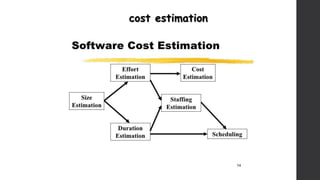
cost estimation
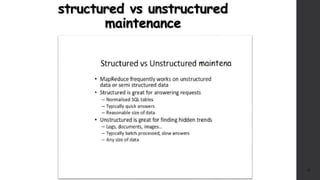
structured vs unstructured
maintenance
10
11
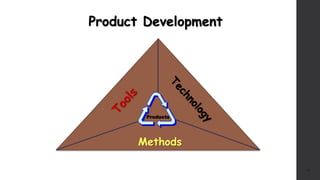
Methods
Product Development
Products
Software Project Manager
• A software project manager is a
person who undertakes the
responsibility of executing the
software project. Software
project manager is thoroughly
aware of all the phases of SDLC
that the software would go
through.
His responsibilities include –
1) Act as project leader
2) Lesion with stakeholders
3) Managing human resources
4) Setting up reporting hierarchy etc.
5) Defining and setting up project scope
6) Managing project management activities
7) Monitoring progress and performance
8) Risk analysis at every phase
9) Take necessary step to avoid or come out of problems
10)Act as project spokesperson
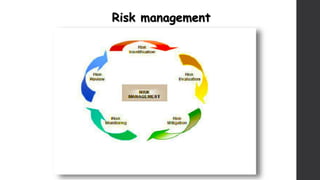
Risk management
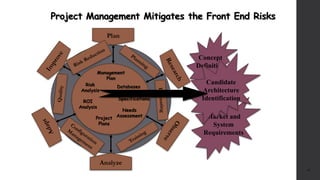
Project Management Mitigates the Front End Risks
14
Concept
Definition
Needs
Assessment
Plan
Project
Plans
Specifications
Databases
ROI
Analysis
Risk
Analysis
Analyze
Management
Plan
Market and
System
Requirements
Candidate
Architecture
Identification
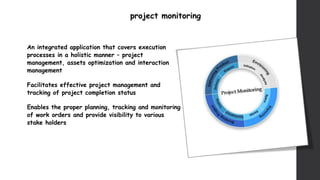
project monitoring
An integrated application that covers execution
processes in a holistic manner – project
management, assets optimization and interaction
management
Facilitates effective project management and
tracking of project completion status
Enables the proper planning, tracking and monitoring
of work orders and provide visibility to various
stake holders
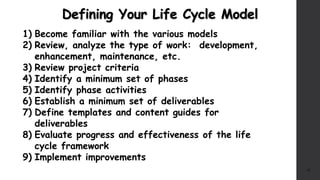
Defining Your Life Cycle Model
16
1) Become familiar with the various models
2) Review, analyze the type of work: development,
enhancement, maintenance, etc.
3) Review project criteria
4) Identify a minimum set of phases
5) Identify phase activities
6) Establish a minimum set of deliverables
7) Define templates and content guides for
deliverables
8) Evaluate progress and effectiveness of the life
cycle framework
9) Implement improvements
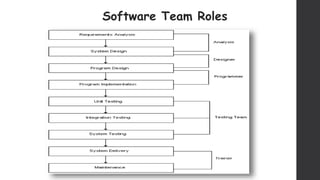
Software Team Roles
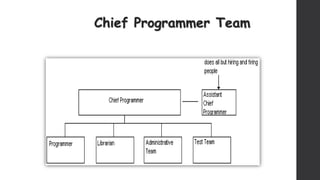
Chief Programmer Team
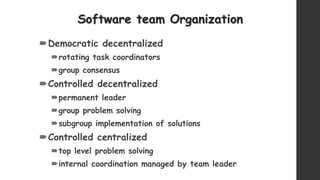
Software team Organization
Democratic decentralized
rotating task coordinators
group consensus
Controlled decentralized
permanent leader
group problem solving
subgroup implementation of solutions
Controlled centralized
top level problem solving
internal coordination managed by team leader
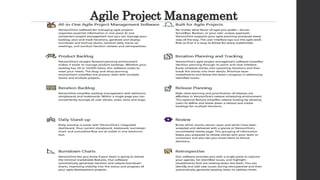
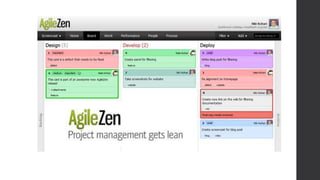
Agile Project Management
Agile xp
•Eliminating Waste
•Amplifying Learning
•Deciding as Late as Possible
•Delivering as Fast as Possible
•Empowering the Team
•Building Integrity In
•Seeing the Whole
Scrum
•Planning Game
•Small Releases
•Customer Acceptance Tests
•Simple Design
•Pair Programming
•Test-Driven Development
•Refactoring
•Continuous Integration
•Collective Code Ownership
•Coding Standards
•Metaphor
•Sustainable Pace
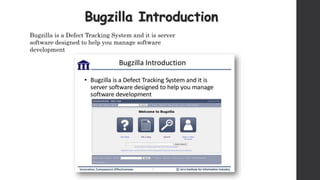
Bugzilla Introduction
Bugzilla is a Defect Tracking System and it is server
software designed to help you manage software
development
Bugzilla Features
• Excellent security to protect confidentiality
• Optimized database structure for increased
performance and scalability
• Integrated email capabilities
• Comprehensive permissions system
• Editable user profiles and comprehensive
email preferences
• Proven under fire as Mozilla's bug tracking
system
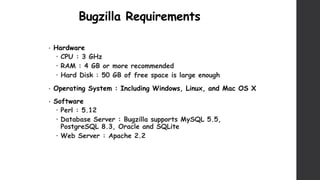
Bugzilla Requirements
• Hardware
 CPU : 3 GHz
 RAM : 4 GB or more recommended
 Hard Disk : 50 GB of free space is large enough
• Operating System : Including Windows, Linux, and Mac OS X
• Software
 Perl : 5.12
 Database Server : Bugzilla supports MySQL 5.5,
PostgreSQL 8.3, Oracle and SQLite
 Web Server : Apache 2.2
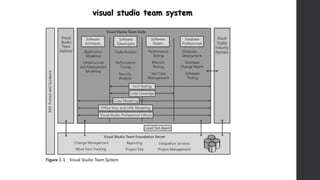
visual studio team system
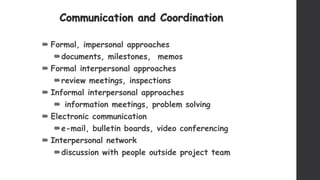
Communication and Coordination
 Formal, impersonal approaches
documents, milestones, memos
 Formal interpersonal approaches
review meetings, inspections
 Informal interpersonal approaches
 information meetings, problem solving
 Electronic communication
e-mail, bulletin boards, video conferencing
 Interpersonal network
discussion with people outside project team
Critical Practices
Formal risk management
Empirical cost and schedule estimation
Metric-based project management
Earned value tracking
Defect tracking against quality targets
People-aware program management
Life Cycle – Good and Bad
31
Pros: Cons:
THE starting point for
defining you life cycle
Too much process
Contains all the life
cycle supports you
would need
Contains more than
you may reasonably
use
Is a process for
defining your life
cycle
Is not in and of itself
a life cycle to
implement
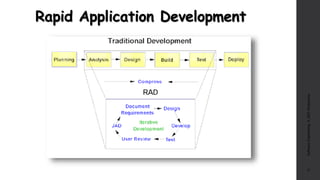
Rapid Application Development
SoftwareEngineering:A2003Perspective
32
RAD – Good/Bad
33
Pros: Cons:
Lots of user
interaction
Users intimately
involved
Early proof of
concept
Needs maturity of
tools and process
Incremental building Increased overhead if
too many prototypes
Tight delivery control
Poorly set
expectations
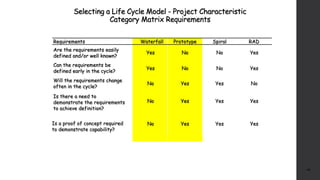
Selecting a Life Cycle Model - Project Characteristic
Category Matrix Requirements
34
Requirements Waterfall Prototype Spiral RAD
Are the requirements easily
defined and/or well known?
Yes No No Yes
Can the requirements be
defined early in the cycle?
Yes No No Yes
Will the requirements change
often in the cycle?
No Yes Yes No
Is there a need to
demonstrate the requirements
to achieve definition?
No Yes Yes Yes
Is a proof of concept required
to demonstrate capability?
No Yes Yes Yes
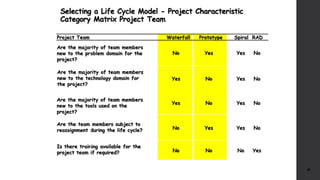
Selecting a Life Cycle Model - Project Characteristic
Category Matrix Project Team
35
Project Team Waterfall Prototype Spiral RAD
Are the majority of team members
new to the problem domain for the
project?
No Yes Yes No
Yes No Yes No
Yes No Yes No
Are the team members subject to
reassignment during the life cycle? No Yes Yes No
Is there training available for the
project team if required? No No No Yes
Are the majority of team members
new to the technology domain for
the project?
Are the majority of team members
new to the tools used on the
project?
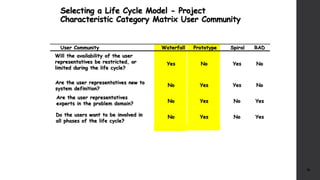
Selecting a Life Cycle Model - Project
Characteristic Category Matrix User Community
36
User Community Waterfall Prototype Spiral RAD
Will the availability of the user
representatives be restricted, or
limited during the life cycle?
Yes No Yes No
Are the user representatives new to
system definition?
No Yes Yes No
Are the user representatives
experts in the problem domain? No Yes No Yes
Do the users want to be involved in
all phases of the life cycle?
No Yes No Yes
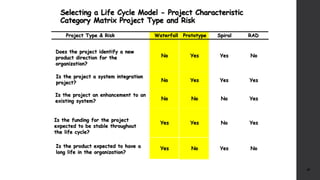
Selecting a Life Cycle Model - Project Characteristic
Category Matrix Project Type and Risk
37
Project Type & Risk Waterfall Prototype Spiral RAD
Does the project identify a new
product direction for the
organization?
No Yes Yes No
Is the project a system integration
project? No Yes Yes Yes
Is the project an enhancement to an
existing system? No No No Yes
Is the funding for the project
expected to be stable throughout
the life cycle?
Yes Yes No Yes
Is the product expected to have a
long life in the organization?
Yes No Yes No
Thanks to all

software project management

  • 2.
    Course title :SoftwareProject Management CSE-221 • Submitted By: • Submitted To Name: Istiaque Ahmed Shuvo Id:141311057 5th batch ,5th semester Sec-B Dept. Of Cse Varendra University,rajshahi Name: Meraj Ali Lecturer, CSE, Varendra University
  • 4.
    What is Project? •An activity with specific goals which takes place over a finite period of time. • Distinct Characteristics:  1) Temporary (Definite beginning & Definite end i.e., limited time scale)  2) Unique (End result i.e., product or service is different in some distinguishing way from all other products & services)  3) Tasks, Aims, Purpose • Examples:  Creating a new product i.e., building, vehicle, or facility  Developing a new service i.e., change in structure, staffing or style of an organization, developing or adopting new information system, running a campaign for political office or implementing a new business strategy or procedure.
  • 5.
    What is projectManagement? • Art (strategic competency) of maximizing probability that a project delivers its goal in time, to budget and at the required quality. • Science to apply knowledge, skills, tools & techniques to achieve project objectives. • Processes/phases to achieve objectives could be;  Initiating  Planning  Executing  Controlling  Closing
  • 6.
    What is management? •Planning • Organizing  Staffing • Leading  Innovating  Coaching  Mentoring • Controlling  Directing  Monitoring  Representing • Assurance
  • 7.
    Managing the Project Starton the right foot Maintain momentum Track progress Make smart decisions Conduct a postmortem analysis
  • 8.
    What is softwareproject management? • An umbrella activity within software engineering. • Has four P’s  People – Organized & effective, highly motivated and coordinated team to do quality work and to achieve effective communication.  Product – Product requirements from customer, portioned and position for work.a  Process – Roadmap adopted to the people & problem.  Project – Organized to get succeed.
  • 9.
  • 10.
  • 11.
  • 12.
    Software Project Manager •A software project manager is a person who undertakes the responsibility of executing the software project. Software project manager is thoroughly aware of all the phases of SDLC that the software would go through. His responsibilities include – 1) Act as project leader 2) Lesion with stakeholders 3) Managing human resources 4) Setting up reporting hierarchy etc. 5) Defining and setting up project scope 6) Managing project management activities 7) Monitoring progress and performance 8) Risk analysis at every phase 9) Take necessary step to avoid or come out of problems 10)Act as project spokesperson
  • 13.
  • 14.
    Project Management Mitigatesthe Front End Risks 14 Concept Definition Needs Assessment Plan Project Plans Specifications Databases ROI Analysis Risk Analysis Analyze Management Plan Market and System Requirements Candidate Architecture Identification
  • 15.
    project monitoring An integratedapplication that covers execution processes in a holistic manner – project management, assets optimization and interaction management Facilitates effective project management and tracking of project completion status Enables the proper planning, tracking and monitoring of work orders and provide visibility to various stake holders
  • 16.
    Defining Your LifeCycle Model 16 1) Become familiar with the various models 2) Review, analyze the type of work: development, enhancement, maintenance, etc. 3) Review project criteria 4) Identify a minimum set of phases 5) Identify phase activities 6) Establish a minimum set of deliverables 7) Define templates and content guides for deliverables 8) Evaluate progress and effectiveness of the life cycle framework 9) Implement improvements
  • 17.
  • 18.
  • 19.
    Software team Organization Democraticdecentralized rotating task coordinators group consensus Controlled decentralized permanent leader group problem solving subgroup implementation of solutions Controlled centralized top level problem solving internal coordination managed by team leader
  • 20.
  • 22.
    Agile xp •Eliminating Waste •AmplifyingLearning •Deciding as Late as Possible •Delivering as Fast as Possible •Empowering the Team •Building Integrity In •Seeing the Whole
  • 23.
    Scrum •Planning Game •Small Releases •CustomerAcceptance Tests •Simple Design •Pair Programming •Test-Driven Development •Refactoring •Continuous Integration •Collective Code Ownership •Coding Standards •Metaphor •Sustainable Pace
  • 24.
    Bugzilla Introduction Bugzilla isa Defect Tracking System and it is server software designed to help you manage software development
  • 25.
    Bugzilla Features • Excellentsecurity to protect confidentiality • Optimized database structure for increased performance and scalability • Integrated email capabilities • Comprehensive permissions system • Editable user profiles and comprehensive email preferences • Proven under fire as Mozilla's bug tracking system
  • 26.
    Bugzilla Requirements • Hardware CPU : 3 GHz  RAM : 4 GB or more recommended  Hard Disk : 50 GB of free space is large enough • Operating System : Including Windows, Linux, and Mac OS X • Software  Perl : 5.12  Database Server : Bugzilla supports MySQL 5.5, PostgreSQL 8.3, Oracle and SQLite  Web Server : Apache 2.2
  • 27.
  • 29.
    Communication and Coordination Formal, impersonal approaches documents, milestones, memos  Formal interpersonal approaches review meetings, inspections  Informal interpersonal approaches  information meetings, problem solving  Electronic communication e-mail, bulletin boards, video conferencing  Interpersonal network discussion with people outside project team
  • 30.
    Critical Practices Formal riskmanagement Empirical cost and schedule estimation Metric-based project management Earned value tracking Defect tracking against quality targets People-aware program management
  • 31.
    Life Cycle –Good and Bad 31 Pros: Cons: THE starting point for defining you life cycle Too much process Contains all the life cycle supports you would need Contains more than you may reasonably use Is a process for defining your life cycle Is not in and of itself a life cycle to implement
  • 32.
  • 33.
    RAD – Good/Bad 33 Pros:Cons: Lots of user interaction Users intimately involved Early proof of concept Needs maturity of tools and process Incremental building Increased overhead if too many prototypes Tight delivery control Poorly set expectations
  • 34.
    Selecting a LifeCycle Model - Project Characteristic Category Matrix Requirements 34 Requirements Waterfall Prototype Spiral RAD Are the requirements easily defined and/or well known? Yes No No Yes Can the requirements be defined early in the cycle? Yes No No Yes Will the requirements change often in the cycle? No Yes Yes No Is there a need to demonstrate the requirements to achieve definition? No Yes Yes Yes Is a proof of concept required to demonstrate capability? No Yes Yes Yes
  • 35.
    Selecting a LifeCycle Model - Project Characteristic Category Matrix Project Team 35 Project Team Waterfall Prototype Spiral RAD Are the majority of team members new to the problem domain for the project? No Yes Yes No Yes No Yes No Yes No Yes No Are the team members subject to reassignment during the life cycle? No Yes Yes No Is there training available for the project team if required? No No No Yes Are the majority of team members new to the technology domain for the project? Are the majority of team members new to the tools used on the project?
  • 36.
    Selecting a LifeCycle Model - Project Characteristic Category Matrix User Community 36 User Community Waterfall Prototype Spiral RAD Will the availability of the user representatives be restricted, or limited during the life cycle? Yes No Yes No Are the user representatives new to system definition? No Yes Yes No Are the user representatives experts in the problem domain? No Yes No Yes Do the users want to be involved in all phases of the life cycle? No Yes No Yes
  • 37.
    Selecting a LifeCycle Model - Project Characteristic Category Matrix Project Type and Risk 37 Project Type & Risk Waterfall Prototype Spiral RAD Does the project identify a new product direction for the organization? No Yes Yes No Is the project a system integration project? No Yes Yes Yes Is the project an enhancement to an existing system? No No No Yes Is the funding for the project expected to be stable throughout the life cycle? Yes Yes No Yes Is the product expected to have a long life in the organization? Yes No Yes No
  • 38.

Editor's Notes