CSC426: SOFTWARE ENGINEERING
AJAYI, O. O.
(Lecturer, CSC Dept., AAU Akungba-Akoko, Ondo State, Nigeria)
07056433798 / 08137044500 / 08113699553
1
PART 1 CONT’D
i. Time to Market
ii. Object Oriented App
iii. User Desktop Computing
iv. GUI
v. Networking
vi. Open Source
vii.Economics
viii.Newer and Faster Development Models
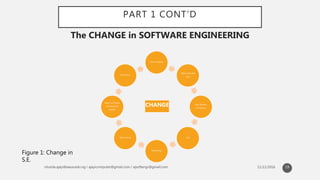
The CHANGE in SOFTWARE ENGINEERING
2
PART 1 CONT’D
i. Time to Market:
This described the time taken to conceive a project
idea, transform the idea to a systemic form and
deliver the project.
This change is enhanced with modern techniques
of reviewing and testing software.
Also, the advent of memory technology has jettison
the need for rigorous and time-wasting code
optimizing process.
The CHANGE in SOFTWARE ENGINEERING
3
PART 1 CONT’D
i. Discuss strategies/ways by which your
application can beat other competitors to the
market.
Under Topic Exercise (UTE) I
4
PART 1 CONT’D
ii. Object Oriented App:
With the birth of object-oriented
software, developers now have access to
rich library and reusable
artifacts/components, which in a great
measure reduces time taken for their app
to land in market.
The CHANGE in SOFTWARE ENGINEERING
5
PART 1 CONT’D
i. Pick any choice object-oriented
language and discuss its features as
well as its shortcoming as a language.
ii. As notable in the previous slide, OO
contributes largely in terms of library
repository. Demonstrate the use of
library resources in the OO language
selected in (i).
UTE II
6
PART 1 CONT’D
iii. User Desktop Computing
With the proliferations of different
desktop applications/software, software
developers can now concentrate on
building sophisticated and more complex
applications as users can on their own
develop simple, common and domestic
applications with the various freely
available desktop apps.
The CHANGE in SOFTWARE ENGINEERING
7
PART 1 CONT’D
i. Decide on any desktop app and
develop a simple but sensible app.
ii. Document every step of the app’s
design and execution/implementation
flow to prove originality of authorship
UTE III
8
PART 1 CONT’D
iv. GUI
Gone are those days when DOS-based
apps when reigning. Now, the table has
turned, windows-based apps are on the
streets. This has greatly enhanced the
embracement of software and has
resulted into higher yields for
practitioners.
The CHANGE in SOFTWARE ENGINEERING
9
PART 1 CONT’D
i. Many event-driven and graphical
programming languages exist.
Demonstrate the advantage of
creating a user-friendly and easy
navigation in app, using such
language.
UTE IV
10
PART 1 CONT’D
v. Networking
With the advent of internet and rapid
increase in the level of networking across
organizations, users have no ‘headache’
of feedbacking the developer on every
simple ‘problem/challenge’ encountered
as enquiries can be made online to trace
the problem and access info for probable
solution.
The CHANGE in SOFTWARE ENGINEERING
11
PART 1 CONT’D
i. Develop a simple ‘Online
Troubleshooting App’ for feedbacking
clients on program error such as
‘library not found….’.
UTE V
12
PART 1 CONT’D
vi. Open Source
Aside offering resources in terms of
library, solution etc., open source
platform also affords enhancement to
solution by giving rooms for other
authors/developers to contribute to the
efficiency and robustness of apps.
The CHANGE in SOFTWARE ENGINEERING
13
PART 1 CONT’D
i. Access any open source platform,
modify any available educational
software to suit your taste.
ii. Report and document the accessed
platform as well as the functional app,
library or codes accessed, as the case
may be.
UTE VI
14
PART 1 CONT’D
vii. Economics
A technology-driven society enhances the
acceptance of software application. The
witnessed rampant usage of mobile
technology has also led to high rate of
mobile app development.
The CHANGE in SOFTWARE ENGINEERING
15
PART 1 CONT’D
i. Bring up a short term paper titled:
‘Analyzing the impact of technology
on software evolution and
embracement’.
ii. Develop a mobile demo app, capable
of catching the attention of a novice
or new comers to this field of
computing.
UTE VII
16
PART 1 CONT’D
viii. Newer and Faster Development
Models
No doubt, Water Fall Model presents lots
of advantages over Evolutionary Model.
Howbeit some of the major setbacks in
the models include time to market and
lack of adequate validation process. This
has however given birth to new and faster
software development model including
modified waterfall model with
appropriate validations.
The CHANGE in SOFTWARE ENGINEERING
17
PART 1 CONT’D
i. Criticize the Waterfall Model.
UTE VIII
18
PART 1 CONT’D
Time to Market
Object Oriented
App
User Desktop
Computing
GUI
Networking
Open Source
Newer and Faster
Development
Models
Economics
The CHANGE in SOFTWARE ENGINEERING
CHANGE
Figure 1: Change in
S.E.
19
PART 1 CONT’D
1. Pfleeger, S. L. on Software Engineering:
Theory and Practice, 4th Edition.
2. Sommerville, I. Software Engineering,
10th Edition.
3. Pressman, R. S. and Maxim, B. R.
Software Engineering: A Practitioner’s
Approach, 8th Edition.
REFERENCES
20

CSC426 - Software Engineering Lecture Note Cont'd

  • 1.
    CSC426: SOFTWARE ENGINEERING AJAYI,O. O. (Lecturer, CSC Dept., AAU Akungba-Akoko, Ondo State, Nigeria) 07056433798 / 08137044500 / 08113699553 1
  • 2.
    PART 1 CONT’D i.Time to Market ii. Object Oriented App iii. User Desktop Computing iv. GUI v. Networking vi. Open Source vii.Economics viii.Newer and Faster Development Models The CHANGE in SOFTWARE ENGINEERING 2
  • 3.
    PART 1 CONT’D i.Time to Market: This described the time taken to conceive a project idea, transform the idea to a systemic form and deliver the project. This change is enhanced with modern techniques of reviewing and testing software. Also, the advent of memory technology has jettison the need for rigorous and time-wasting code optimizing process. The CHANGE in SOFTWARE ENGINEERING 3
  • 4.
    PART 1 CONT’D i.Discuss strategies/ways by which your application can beat other competitors to the market. Under Topic Exercise (UTE) I 4
  • 5.
    PART 1 CONT’D ii.Object Oriented App: With the birth of object-oriented software, developers now have access to rich library and reusable artifacts/components, which in a great measure reduces time taken for their app to land in market. The CHANGE in SOFTWARE ENGINEERING 5
  • 6.
    PART 1 CONT’D i.Pick any choice object-oriented language and discuss its features as well as its shortcoming as a language. ii. As notable in the previous slide, OO contributes largely in terms of library repository. Demonstrate the use of library resources in the OO language selected in (i). UTE II 6
  • 7.
    PART 1 CONT’D iii.User Desktop Computing With the proliferations of different desktop applications/software, software developers can now concentrate on building sophisticated and more complex applications as users can on their own develop simple, common and domestic applications with the various freely available desktop apps. The CHANGE in SOFTWARE ENGINEERING 7
  • 8.
    PART 1 CONT’D i.Decide on any desktop app and develop a simple but sensible app. ii. Document every step of the app’s design and execution/implementation flow to prove originality of authorship UTE III 8
  • 9.
    PART 1 CONT’D iv.GUI Gone are those days when DOS-based apps when reigning. Now, the table has turned, windows-based apps are on the streets. This has greatly enhanced the embracement of software and has resulted into higher yields for practitioners. The CHANGE in SOFTWARE ENGINEERING 9
  • 10.
    PART 1 CONT’D i.Many event-driven and graphical programming languages exist. Demonstrate the advantage of creating a user-friendly and easy navigation in app, using such language. UTE IV 10
  • 11.
    PART 1 CONT’D v.Networking With the advent of internet and rapid increase in the level of networking across organizations, users have no ‘headache’ of feedbacking the developer on every simple ‘problem/challenge’ encountered as enquiries can be made online to trace the problem and access info for probable solution. The CHANGE in SOFTWARE ENGINEERING 11
  • 12.
    PART 1 CONT’D i.Develop a simple ‘Online Troubleshooting App’ for feedbacking clients on program error such as ‘library not found….’. UTE V 12
  • 13.
    PART 1 CONT’D vi.Open Source Aside offering resources in terms of library, solution etc., open source platform also affords enhancement to solution by giving rooms for other authors/developers to contribute to the efficiency and robustness of apps. The CHANGE in SOFTWARE ENGINEERING 13
  • 14.
    PART 1 CONT’D i.Access any open source platform, modify any available educational software to suit your taste. ii. Report and document the accessed platform as well as the functional app, library or codes accessed, as the case may be. UTE VI 14
  • 15.
    PART 1 CONT’D vii.Economics A technology-driven society enhances the acceptance of software application. The witnessed rampant usage of mobile technology has also led to high rate of mobile app development. The CHANGE in SOFTWARE ENGINEERING 15
  • 16.
    PART 1 CONT’D i.Bring up a short term paper titled: ‘Analyzing the impact of technology on software evolution and embracement’. ii. Develop a mobile demo app, capable of catching the attention of a novice or new comers to this field of computing. UTE VII 16
  • 17.
    PART 1 CONT’D viii.Newer and Faster Development Models No doubt, Water Fall Model presents lots of advantages over Evolutionary Model. Howbeit some of the major setbacks in the models include time to market and lack of adequate validation process. This has however given birth to new and faster software development model including modified waterfall model with appropriate validations. The CHANGE in SOFTWARE ENGINEERING 17
  • 18.
    PART 1 CONT’D i.Criticize the Waterfall Model. UTE VIII 18
  • 19.
    PART 1 CONT’D Timeto Market Object Oriented App User Desktop Computing GUI Networking Open Source Newer and Faster Development Models Economics The CHANGE in SOFTWARE ENGINEERING CHANGE Figure 1: Change in S.E. 19
  • 20.
    PART 1 CONT’D 1.Pfleeger, S. L. on Software Engineering: Theory and Practice, 4th Edition. 2. Sommerville, I. Software Engineering, 10th Edition. 3. Pressman, R. S. and Maxim, B. R. Software Engineering: A Practitioner’s Approach, 8th Edition. REFERENCES 20