Presentation Title
• PPTTemplate.net
SDLC
Presented by – Manohar Prasad
Software Development Life Cycle
SDLC by Manohar Prasad
Slide Title
• Make Effective Presentations
• Using Awesome Backgrounds
• Engage your Audience
• Capture Audience Attention
Agenda:
• Introduction
• SDLC Overview
• SDLC Phases
• SDLC Flow
• SDLC Model
• Waterfall Model
• Agile Model
• Conclusion
SDLC by Manohar Prasad
Slide Title
• Make Effective Presentations
• Using Awesome Backgrounds
• Engage your Audience
• Capture Audience Attention
Introduction:
• The SDLC is a framework that describes
the activities performed at each stage of a
software development project.
• SDLC process is used by the software industry
to design, develop and test high quality
software. It aims to produce the quality
software that meets or exceeds customer
expectations, reaches completion within time
and budget.
SDLC by Manohar Prasad
Slide Title
• Product A
• Feature 1
• Feature 2
• Feature 3
• Feature 4
• Product B
• Feature 1
• Feature 2
• Feature 3
• Feature 4
• ISO/IEC 12207 is an international standard for
software life-cycle processes. It aims to be the
standard that defines all the tasks required for
developing and maintaining software.
• Software Engineering Process Technology
Company, (SEPT) is a firm specializing in meeting
the software process standards information needs
of the professional community, particularly
concerning ISO/IEC 12207.
• International Electrotechnical Commission (IEC)
• International Organization for Standardization (ISO)
• For more info visit http://www.12207.com/
SDLC by Manohar Prasad
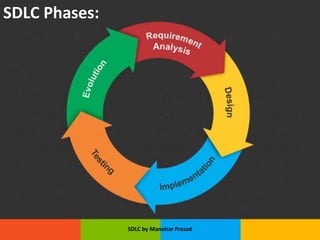
SDLC Phases:
SDLC by Manohar Prasad
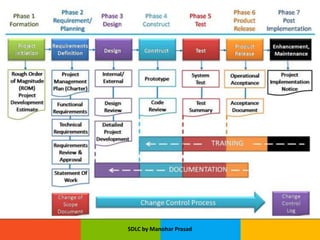
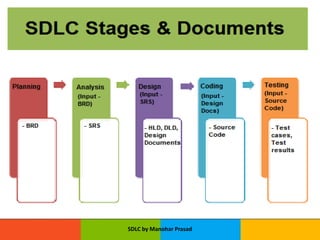
SDLC Phases
1. Planning and Requirements Analysis
2. Defining Requirements
3. Designing the Software
4. Building or Developing the Software
5. Testing the Software
6. Deployment and Maintenance
SDLC by Manohar Prasad
1. Planning & Requirement Analysis
Requirement analysis is the most important and
fundamental stage in SDLC.
It is performed by the senior members of the
team with inputs from all the stakeholders and
domain experts or SMEs in the industry.
Planning for the quality assurance requirements
and identification of the risks associated with the
project is also done at this stage.
SDLC by Manohar Prasad
Requirements Analysis
• Business Requirements
• Stakeholder Requirements
• Solution Requirements
Functional Requirements
Non-functional Requirements
• Transition Requirements
SDLC by Manohar Prasad
2. Defining Requirements
Once the requirement analysis is done the next
step is to clearly define and document the
software requirements and get them approved
from the project stakeholders.
This is done through ‘SRS’ – Software
Requirement Specification document which
consists of all the product requirements to be
designed and developed during the project life
cycle.
SDLC by Manohar Prasad
Defining Requirements
• Enterprise Analysis
• Business Analysis Planning & Monitoring
• Elicitation
• Requirements Analysis
• Requirements Management & Communication
• Solution Assessment & Validation
SDLC by Manohar Prasad
3. Designing the Software
• Based on the requirements specified in SRS,
usually more than one design approach for the
product architecture is proposed and
documented in a DDS - Design Document
Specification.
• This DDS is reviewed by all the stakeholders
and based on various parameters as risk
assessment, design modularity , budget and time
constraints , the best design approach is selected
for the software.
SDLC by Manohar Prasad
4. Developing the Software
• In this stage of SDLC the actual development
starts and the product is built. The programming
code is generated as per DDS during this stage.
• Developers have to follow the coding guidelines
defined by their organization and programming
tools like compilers, interpreters, debuggers etc
are used to generate and implement the code.
SDLC by Manohar Prasad
5. Testing the Software
• This stage is usually a subset of all the stages as
in the modern SDLC models, the testing
activities are mostly involved in all the stages of
SDLC.
• However this stage refers to the testing only
that stage of the software where defects are
reported, tracked, fixed and retested, until the
software reaches the quality standards defined
in the SRS.
SDLC by Manohar Prasad
6. Deployment and Maintenance
• Once the software is tested and no bugs or
errors are reported then it is deployed.
• Then based on the feedback, the software may
be released as it is or with suggested
enhancements in the target segment.
• After the software is deployed then its
maintenance starts.
SDLC by Manohar Prasad
SDLC Models
To help understand and implement the SDLC
phases various SDLC models have been created by
software development experts, universities, and
standards organizations.
SDLC by Manohar Prasad
Reasons for Using SDLC Models
• Provides the base for project planning, estimating
& scheduling.
• Provides framework for standard set of
terminologies, activities & deliverables.
• Provides mechanism for project tracking &
control.
• Increases visibility of project progress to all
stakeholders.
SDLC by Manohar Prasad
Advantages of Choosing an Appropriate SDLC
• Increased development speed
• Increased product quality
• Improved tracking & control
• Improved client relations
• Decreased project risk
• Decreased project management overhead
SDLC by Manohar Prasad
SDLC Models
• Waterfall Model
• Iterative Model
• Spiral Model
• Agile Model
• V – Model
• Big Bang Model
SDLC by Manohar Prasad
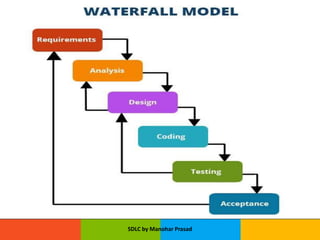
Waterfall Model
• Oldest and most well-known SDLC model.
• Follows a sequential step-by-step process from
requirements analysis to maintenance.
• Systems that have well-defined and understood
requirements are a good fit for the Waterfall
Model.
SDLC by Manohar Prasad
Waterfall Model: Strengths
• Easy to understand, easy to use
• Provides structure to inexperienced staff
• Milestones are well understood
• Sets requirements stability
• Good for management control (plan, staff, track)
• Works well when quality is more important than
cost or schedule
SDLC by Manohar Prasad
Waterfall Model: Weaknesses
• All requirements must be fully specified upfront
• Deliverables created for each phase are considered
frozen – inhibits flexibility
• Can give a false impression of progress
• Does not reflect problem-solving nature of
software development – iterations of phases
• Integration is one big bang at the end
• Little opportunity for customer to preview the
system (until it may be too late)
SDLC by Manohar Prasad
When to use the Waterfall Model
• Requirements are very well known
• Product definition is stable
• Technology is understood
• New version of an existing software/product
• Porting an existing product to a new platform
SDLC by Manohar Prasad
Agile Model
• Agile model believes that every project needs to
be handled differently and the existing methods
need to be tailored to best suit the project
requirements.
• In agile the tasks are divided to time boxes (small
time frames) to deliver specific features for a
release.
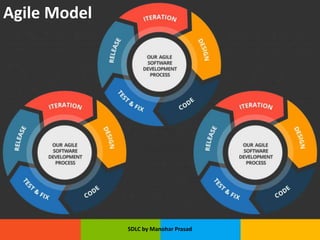
• Iterative approach is taken and working software
build is delivered after each iteration. Each build is
incremental in terms of features; the final build
holds all the features required by the customer.
SDLC by Manohar Prasad
Agile Model
SDLC by Manohar Prasad
Agile Model
• Speed up or bypass one or more life cycle
phases
• Usually less formal and reduced scope
• Used for time-critical applications
• Used in organizations that employ disciplined
methods
SDLC by Manohar Prasad
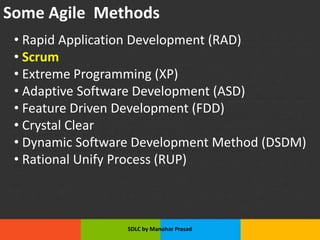
Some Agile Methods
• Rapid Application Development (RAD)
• Scrum
• Extreme Programming (XP)
• Adaptive Software Development (ASD)
• Feature Driven Development (FDD)
• Crystal Clear
• Dynamic Software Development Method (DSDM)
• Rational Unify Process (RUP)
SDLC by Manohar Prasad
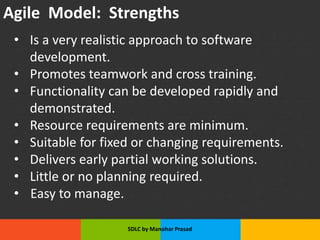
Agile Model: Strengths
• Is a very realistic approach to software
development.
• Promotes teamwork and cross training.
• Functionality can be developed rapidly and
demonstrated.
• Resource requirements are minimum.
• Suitable for fixed or changing requirements.
• Delivers early partial working solutions.
• Little or no planning required.
• Easy to manage.
SDLC by Manohar Prasad
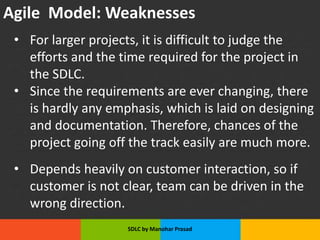
Agile Model: Weaknesses
• For larger projects, it is difficult to judge the
efforts and the time required for the project in
the SDLC.
• Since the requirements are ever changing, there
is hardly any emphasis, which is laid on designing
and documentation. Therefore, chances of the
project going off the track easily are much more.
• Depends heavily on customer interaction, so if
customer is not clear, team can be driven in the
wrong direction.
SDLC by Manohar Prasad
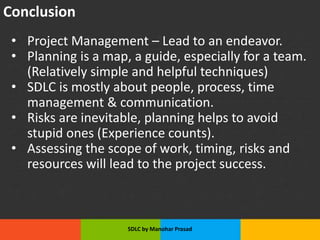
Conclusion
• Project Management – Lead to an endeavor.
• Planning is a map, a guide, especially for a team.
(Relatively simple and helpful techniques)
• SDLC is mostly about people, process, time
management & communication.
• Risks are inevitable, planning helps to avoid
stupid ones (Experience counts).
• Assessing the scope of work, timing, risks and
resources will lead to the project success.
SDLC by Manohar Prasad
“Risks are Essential in Achievements,
Luck is an Element of Success”
Quote of the Day……
SDLC by Manohar Prasad
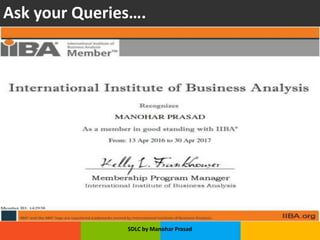
Ask your Queries….
SDLC by Manohar Prasad

Software Development Life Cycle

  • 1.
    Presentation Title • PPTTemplate.net SDLC Presentedby – Manohar Prasad Software Development Life Cycle SDLC by Manohar Prasad
  • 2.
    Slide Title • MakeEffective Presentations • Using Awesome Backgrounds • Engage your Audience • Capture Audience Attention Agenda: • Introduction • SDLC Overview • SDLC Phases • SDLC Flow • SDLC Model • Waterfall Model • Agile Model • Conclusion SDLC by Manohar Prasad
  • 3.
    Slide Title • MakeEffective Presentations • Using Awesome Backgrounds • Engage your Audience • Capture Audience Attention Introduction: • The SDLC is a framework that describes the activities performed at each stage of a software development project. • SDLC process is used by the software industry to design, develop and test high quality software. It aims to produce the quality software that meets or exceeds customer expectations, reaches completion within time and budget. SDLC by Manohar Prasad
  • 4.
    Slide Title • ProductA • Feature 1 • Feature 2 • Feature 3 • Feature 4 • Product B • Feature 1 • Feature 2 • Feature 3 • Feature 4 • ISO/IEC 12207 is an international standard for software life-cycle processes. It aims to be the standard that defines all the tasks required for developing and maintaining software. • Software Engineering Process Technology Company, (SEPT) is a firm specializing in meeting the software process standards information needs of the professional community, particularly concerning ISO/IEC 12207. • International Electrotechnical Commission (IEC) • International Organization for Standardization (ISO) • For more info visit http://www.12207.com/ SDLC by Manohar Prasad
  • 5.
    SDLC Phases: SDLC byManohar Prasad
  • 6.
    SDLC Phases 1. Planningand Requirements Analysis 2. Defining Requirements 3. Designing the Software 4. Building or Developing the Software 5. Testing the Software 6. Deployment and Maintenance SDLC by Manohar Prasad
  • 7.
    1. Planning &Requirement Analysis Requirement analysis is the most important and fundamental stage in SDLC. It is performed by the senior members of the team with inputs from all the stakeholders and domain experts or SMEs in the industry. Planning for the quality assurance requirements and identification of the risks associated with the project is also done at this stage. SDLC by Manohar Prasad
  • 8.
    Requirements Analysis • BusinessRequirements • Stakeholder Requirements • Solution Requirements Functional Requirements Non-functional Requirements • Transition Requirements SDLC by Manohar Prasad
  • 9.
    2. Defining Requirements Oncethe requirement analysis is done the next step is to clearly define and document the software requirements and get them approved from the project stakeholders. This is done through ‘SRS’ – Software Requirement Specification document which consists of all the product requirements to be designed and developed during the project life cycle. SDLC by Manohar Prasad
  • 10.
    Defining Requirements • EnterpriseAnalysis • Business Analysis Planning & Monitoring • Elicitation • Requirements Analysis • Requirements Management & Communication • Solution Assessment & Validation SDLC by Manohar Prasad
  • 11.
    3. Designing theSoftware • Based on the requirements specified in SRS, usually more than one design approach for the product architecture is proposed and documented in a DDS - Design Document Specification. • This DDS is reviewed by all the stakeholders and based on various parameters as risk assessment, design modularity , budget and time constraints , the best design approach is selected for the software. SDLC by Manohar Prasad
  • 12.
    4. Developing theSoftware • In this stage of SDLC the actual development starts and the product is built. The programming code is generated as per DDS during this stage. • Developers have to follow the coding guidelines defined by their organization and programming tools like compilers, interpreters, debuggers etc are used to generate and implement the code. SDLC by Manohar Prasad
  • 13.
    5. Testing theSoftware • This stage is usually a subset of all the stages as in the modern SDLC models, the testing activities are mostly involved in all the stages of SDLC. • However this stage refers to the testing only that stage of the software where defects are reported, tracked, fixed and retested, until the software reaches the quality standards defined in the SRS. SDLC by Manohar Prasad
  • 14.
    6. Deployment andMaintenance • Once the software is tested and no bugs or errors are reported then it is deployed. • Then based on the feedback, the software may be released as it is or with suggested enhancements in the target segment. • After the software is deployed then its maintenance starts. SDLC by Manohar Prasad
  • 15.
  • 16.
  • 17.
    SDLC Models To helpunderstand and implement the SDLC phases various SDLC models have been created by software development experts, universities, and standards organizations. SDLC by Manohar Prasad
  • 18.
    Reasons for UsingSDLC Models • Provides the base for project planning, estimating & scheduling. • Provides framework for standard set of terminologies, activities & deliverables. • Provides mechanism for project tracking & control. • Increases visibility of project progress to all stakeholders. SDLC by Manohar Prasad
  • 19.
    Advantages of Choosingan Appropriate SDLC • Increased development speed • Increased product quality • Improved tracking & control • Improved client relations • Decreased project risk • Decreased project management overhead SDLC by Manohar Prasad
  • 20.
    SDLC Models • WaterfallModel • Iterative Model • Spiral Model • Agile Model • V – Model • Big Bang Model SDLC by Manohar Prasad
  • 21.
  • 22.
    Waterfall Model • Oldestand most well-known SDLC model. • Follows a sequential step-by-step process from requirements analysis to maintenance. • Systems that have well-defined and understood requirements are a good fit for the Waterfall Model. SDLC by Manohar Prasad
  • 23.
    Waterfall Model: Strengths •Easy to understand, easy to use • Provides structure to inexperienced staff • Milestones are well understood • Sets requirements stability • Good for management control (plan, staff, track) • Works well when quality is more important than cost or schedule SDLC by Manohar Prasad
  • 24.
    Waterfall Model: Weaknesses •All requirements must be fully specified upfront • Deliverables created for each phase are considered frozen – inhibits flexibility • Can give a false impression of progress • Does not reflect problem-solving nature of software development – iterations of phases • Integration is one big bang at the end • Little opportunity for customer to preview the system (until it may be too late) SDLC by Manohar Prasad
  • 25.
    When to usethe Waterfall Model • Requirements are very well known • Product definition is stable • Technology is understood • New version of an existing software/product • Porting an existing product to a new platform SDLC by Manohar Prasad
  • 26.
    Agile Model • Agilemodel believes that every project needs to be handled differently and the existing methods need to be tailored to best suit the project requirements. • In agile the tasks are divided to time boxes (small time frames) to deliver specific features for a release. • Iterative approach is taken and working software build is delivered after each iteration. Each build is incremental in terms of features; the final build holds all the features required by the customer. SDLC by Manohar Prasad
  • 27.
    Agile Model SDLC byManohar Prasad
  • 28.
    Agile Model • Speedup or bypass one or more life cycle phases • Usually less formal and reduced scope • Used for time-critical applications • Used in organizations that employ disciplined methods SDLC by Manohar Prasad
  • 29.
    Some Agile Methods •Rapid Application Development (RAD) • Scrum • Extreme Programming (XP) • Adaptive Software Development (ASD) • Feature Driven Development (FDD) • Crystal Clear • Dynamic Software Development Method (DSDM) • Rational Unify Process (RUP) SDLC by Manohar Prasad
  • 30.
    Agile Model: Strengths •Is a very realistic approach to software development. • Promotes teamwork and cross training. • Functionality can be developed rapidly and demonstrated. • Resource requirements are minimum. • Suitable for fixed or changing requirements. • Delivers early partial working solutions. • Little or no planning required. • Easy to manage. SDLC by Manohar Prasad
  • 31.
    Agile Model: Weaknesses •For larger projects, it is difficult to judge the efforts and the time required for the project in the SDLC. • Since the requirements are ever changing, there is hardly any emphasis, which is laid on designing and documentation. Therefore, chances of the project going off the track easily are much more. • Depends heavily on customer interaction, so if customer is not clear, team can be driven in the wrong direction. SDLC by Manohar Prasad
  • 32.
    Conclusion • Project Management– Lead to an endeavor. • Planning is a map, a guide, especially for a team. (Relatively simple and helpful techniques) • SDLC is mostly about people, process, time management & communication. • Risks are inevitable, planning helps to avoid stupid ones (Experience counts). • Assessing the scope of work, timing, risks and resources will lead to the project success. SDLC by Manohar Prasad
  • 33.
    “Risks are Essentialin Achievements, Luck is an Element of Success” Quote of the Day…… SDLC by Manohar Prasad
  • 34.
    Ask your Queries…. SDLCby Manohar Prasad
  • 35.