SOFTWARE PROJECT
MANAGEMENT
BY
PAWAN KUMAR(1NT17IS121)
N ADITYA NAYAK(1NT17IS099)
WHAT IS PROJECT?
A project is a group of tasks that need to complete to reach a clear result. A project also
defines as a set of inputs and outputs which are required to achieve a goal. Projects can
vary from simple to difficult and can be operated by one person or a hundred.
Projects usually described and approved by a project manager or team executive. They
go beyond their expectations and objects, and it's up to the team to handle logistics and
complete the project on time. For good project development, some teams split the
project into specific tasks so they can manage responsibility and utilize team strengths.
WHAT IS SOFTWARE PROJECT
MANAGEMENT?
Software project management is an art and discipline of planning and supervising
software projects. It is a sub-discipline of software project management in which
software projects planned, implemented, monitored and controlled.
It is a procedure of managing, allocating and timing resources to develop computer
software that fulfills requirements.
In software Project Management, the client and the developers need to know the length,
period and cost of the project.
WHY IS SOFTWARE PROJECT
MANAGEMENT IMPORTANT?
• Strategic Alignment
• Leadership
• Clear Focus & Objectives
• Realistic Project Planning
• Quality Control
• Risk Management
• Managing and Learning from Success and Failure
ADVANTAGES OF SOFTWARE
PROJECT MANAGEMENT
It helps in planning of software development.
Implementation of software development is made easy.
Monitoring and controlling are aspects of software project management.
It overall manages to save time and cost for software development.
DIS-ADVANTAGES OF SOFTWARE
PROJECT MANAGEMENT
It might make the tasks too complex to be understood easily and will also have a larger
audience than required.
It can be a costly affair to buy good-quality project management software.
Some people in the group might have some difficulty learning the software.
ROLES AND RESPONSIBILITY
Planning: This means putting together the blueprint for the entire project from ideation
to fruition. It will define the scope, allocate necessary resources, propose the timeline,
delineate the plan for execution, lay out a communication strategy, and indicate the
steps necessary for testing and maintenance.
Leading: A software project manager will need to assemble and lead the project team,
which likely will consist of developers, analysts, testers, graphic designers, and technical
writers. This requires excellent communication, people and leadership skills.
ROLES AND RESPONSIBILITY
Execution: The project manager will participate in and supervise the successful
execution of each stage of the project. This includes monitoring progress, frequent team
check-ins and creating status reports.
Time management: Staying on schedule is crucial to the successful completion of any
project, but it’s particularly challenging when it comes to managing software projects
because changes to the original plan are almost certain to occur as the project evolves.
Software project managers must be experts in risk management and contingency
planning to ensure forward progress when roadblocks or changes occur.
ROLES AND RESPONSIBILITY
Budget: Like traditional project managers, software project managers are tasked with
creating a budget for a project, and then sticking to it as closely as possible, moderating
spend and re-allocating funds when necessary.
Maintenance: Software project management typically encourages constant product
testing in order to discover and fix bugs early, adjust the end product to the customer’s
needs, and keep the project on target. The software project manager is responsible for
ensuring proper and consistent testing, evaluation and fixes are being made.
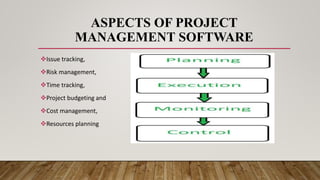
ASPECTS OF PROJECT
MANAGEMENT SOFTWARE
Issue tracking,
Risk management,
Time tracking,
Project budgeting and
Cost management,
Resources planning
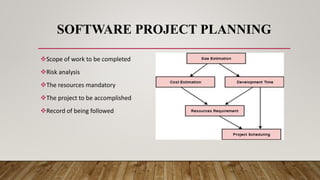
SOFTWARE PROJECT PLANNING
Scope of work to be completed
Risk analysis
The resources mandatory
The project to be accomplished
Record of being followed
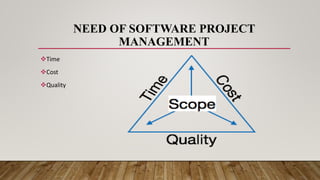
NEED OF SOFTWARE PROJECT
MANAGEMENT
Time
Cost
Quality
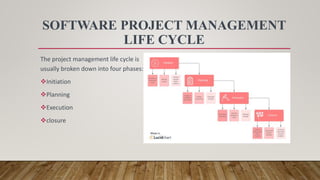
SOFTWARE PROJECT MANAGEMENT
LIFE CYCLE
The project management life cycle is
usually broken down into four phases:
Initiation
Planning
Execution
closure
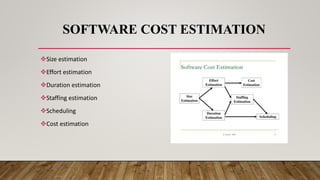
SOFTWARE COST ESTIMATION
Size estimation
Effort estimation
Duration estimation
Staffing estimation
Scheduling
Cost estimation
Software project management

Software project management

  • 1.
  • 2.
    WHAT IS PROJECT? Aproject is a group of tasks that need to complete to reach a clear result. A project also defines as a set of inputs and outputs which are required to achieve a goal. Projects can vary from simple to difficult and can be operated by one person or a hundred. Projects usually described and approved by a project manager or team executive. They go beyond their expectations and objects, and it's up to the team to handle logistics and complete the project on time. For good project development, some teams split the project into specific tasks so they can manage responsibility and utilize team strengths.
  • 3.
    WHAT IS SOFTWAREPROJECT MANAGEMENT? Software project management is an art and discipline of planning and supervising software projects. It is a sub-discipline of software project management in which software projects planned, implemented, monitored and controlled. It is a procedure of managing, allocating and timing resources to develop computer software that fulfills requirements. In software Project Management, the client and the developers need to know the length, period and cost of the project.
  • 4.
    WHY IS SOFTWAREPROJECT MANAGEMENT IMPORTANT? • Strategic Alignment • Leadership • Clear Focus & Objectives • Realistic Project Planning • Quality Control • Risk Management • Managing and Learning from Success and Failure
  • 5.
    ADVANTAGES OF SOFTWARE PROJECTMANAGEMENT It helps in planning of software development. Implementation of software development is made easy. Monitoring and controlling are aspects of software project management. It overall manages to save time and cost for software development.
  • 6.
    DIS-ADVANTAGES OF SOFTWARE PROJECTMANAGEMENT It might make the tasks too complex to be understood easily and will also have a larger audience than required. It can be a costly affair to buy good-quality project management software. Some people in the group might have some difficulty learning the software.
  • 7.
    ROLES AND RESPONSIBILITY Planning:This means putting together the blueprint for the entire project from ideation to fruition. It will define the scope, allocate necessary resources, propose the timeline, delineate the plan for execution, lay out a communication strategy, and indicate the steps necessary for testing and maintenance. Leading: A software project manager will need to assemble and lead the project team, which likely will consist of developers, analysts, testers, graphic designers, and technical writers. This requires excellent communication, people and leadership skills.
  • 8.
    ROLES AND RESPONSIBILITY Execution:The project manager will participate in and supervise the successful execution of each stage of the project. This includes monitoring progress, frequent team check-ins and creating status reports. Time management: Staying on schedule is crucial to the successful completion of any project, but it’s particularly challenging when it comes to managing software projects because changes to the original plan are almost certain to occur as the project evolves. Software project managers must be experts in risk management and contingency planning to ensure forward progress when roadblocks or changes occur.
  • 9.
    ROLES AND RESPONSIBILITY Budget:Like traditional project managers, software project managers are tasked with creating a budget for a project, and then sticking to it as closely as possible, moderating spend and re-allocating funds when necessary. Maintenance: Software project management typically encourages constant product testing in order to discover and fix bugs early, adjust the end product to the customer’s needs, and keep the project on target. The software project manager is responsible for ensuring proper and consistent testing, evaluation and fixes are being made.
  • 10.
    ASPECTS OF PROJECT MANAGEMENTSOFTWARE Issue tracking, Risk management, Time tracking, Project budgeting and Cost management, Resources planning
  • 11.
    SOFTWARE PROJECT PLANNING Scopeof work to be completed Risk analysis The resources mandatory The project to be accomplished Record of being followed
  • 12.
    NEED OF SOFTWAREPROJECT MANAGEMENT Time Cost Quality
  • 13.
    SOFTWARE PROJECT MANAGEMENT LIFECYCLE The project management life cycle is usually broken down into four phases: Initiation Planning Execution closure
  • 14.
    SOFTWARE COST ESTIMATION Sizeestimation Effort estimation Duration estimation Staffing estimation Scheduling Cost estimation