Computer Graphics
Presentation
Course Code: CSE 421 Date: 27 July, 2017
Presentation Topic: 3D Printing Technology
Presented by –
Mohammad Kasedullah
ID: 141311042
and Istiaque Ahmed Shuvo
ID: 141311057
11th Semester (5th Batch)
Department of CSE,
Varendra University, Rajshahi
Presented to –
Bipul Mohanto
Lecturer
Department of CSE,
Varendra University, Rajshahi
1
Index
 Slide 01 : Cover Slide
 Slide 02 : Index
 Slide 03 : Introduction
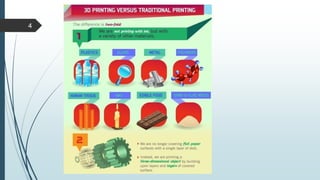
 Slide 04 : 3D Printing vs. Traditional Printing
 Slide 05 : How it works?
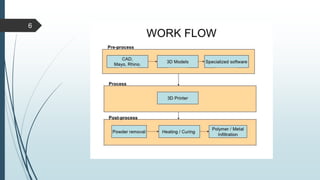
 Slide 06 : Workflow
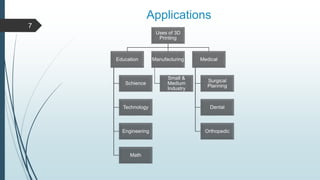
 Slide 07 : Applications
 Slide 08 : Industry Growth
 Slide 09 : Challenges
 Slide 10 : A Visual Treat
2
Introduction
 What is 3D Printing ?
 3D printing or additive manufacturing is a process of making three dimensional
solid objects from a digital file.
 The creation of a 3D printed object is achieved using additive processes.
 In an additive process an object is created by laying down successive layers of
material until the entire object is created.
3
4
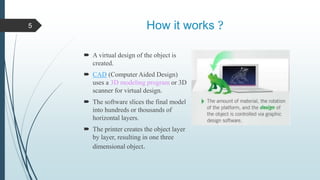
How it works ?
 A virtual design of the object is
created.
 CAD (Computer Aided Design)
uses a 3D modeling program or 3D
scanner for virtual design.
 The software slices the final model
into hundreds or thousands of
horizontal layers.
 The printer creates the object layer
by layer, resulting in one three
dimensional object.
5
6
Applications
Uses of 3D
Printing
Education
Schience
Technology
Engineering
Math
Manufacturing
Small &
Medium
Industry
Medical
Surgical
Planning
Dental
Orthopedic
7
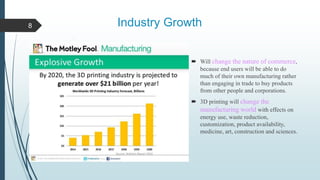
Industry Growth
 Will change the nature of commerce,
because end users will be able to do
much of their own manufacturing rather
than engaging in trade to buy products
from other people and corporations.
 3D printing will change the
manufacturing world with effects on
energy use, waste reduction,
customization, product availability,
medicine, art, construction and sciences.
8
Challenges
 Inability to easily print in multiple materials on the same machine: Particularly
plastic, metal and conductive materials. The colours are a touch dull and matt finish only.
 A decent standard for model designs: The current standard STL files have some
limitations. A new standard has come through– the AMF file format, which solves many of
the limitations of STL, but at this stage it is not as widely used.
 Speed: Printing is s…l…o…w. It takes a long time to build even the smallest piece. Most
videos you see are sped up or cut so you are not sitting there for an hour while you build a
medium sized toy for children.
 Cost: While the price of personal printers have come downwards tremendously in recent
years, some even reaching only a hundred dollars, the materials used to 3D print are still
quite costly.
9
A Visual Treat
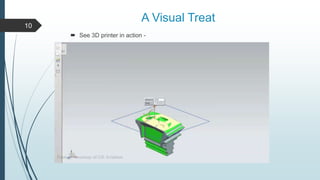
 See 3D printer in action -
10
That was all.
Thank you.
11

Computer Graphics Presentation

  • 1.
    Computer Graphics Presentation Course Code:CSE 421 Date: 27 July, 2017 Presentation Topic: 3D Printing Technology Presented by – Mohammad Kasedullah ID: 141311042 and Istiaque Ahmed Shuvo ID: 141311057 11th Semester (5th Batch) Department of CSE, Varendra University, Rajshahi Presented to – Bipul Mohanto Lecturer Department of CSE, Varendra University, Rajshahi 1
  • 2.
    Index  Slide 01: Cover Slide  Slide 02 : Index  Slide 03 : Introduction  Slide 04 : 3D Printing vs. Traditional Printing  Slide 05 : How it works?  Slide 06 : Workflow  Slide 07 : Applications  Slide 08 : Industry Growth  Slide 09 : Challenges  Slide 10 : A Visual Treat 2
  • 3.
    Introduction  What is3D Printing ?  3D printing or additive manufacturing is a process of making three dimensional solid objects from a digital file.  The creation of a 3D printed object is achieved using additive processes.  In an additive process an object is created by laying down successive layers of material until the entire object is created. 3
  • 4.
  • 5.
    How it works?  A virtual design of the object is created.  CAD (Computer Aided Design) uses a 3D modeling program or 3D scanner for virtual design.  The software slices the final model into hundreds or thousands of horizontal layers.  The printer creates the object layer by layer, resulting in one three dimensional object. 5
  • 6.
  • 7.
  • 8.
    Industry Growth  Willchange the nature of commerce, because end users will be able to do much of their own manufacturing rather than engaging in trade to buy products from other people and corporations.  3D printing will change the manufacturing world with effects on energy use, waste reduction, customization, product availability, medicine, art, construction and sciences. 8
  • 9.
    Challenges  Inability toeasily print in multiple materials on the same machine: Particularly plastic, metal and conductive materials. The colours are a touch dull and matt finish only.  A decent standard for model designs: The current standard STL files have some limitations. A new standard has come through– the AMF file format, which solves many of the limitations of STL, but at this stage it is not as widely used.  Speed: Printing is s…l…o…w. It takes a long time to build even the smallest piece. Most videos you see are sped up or cut so you are not sitting there for an hour while you build a medium sized toy for children.  Cost: While the price of personal printers have come downwards tremendously in recent years, some even reaching only a hundred dollars, the materials used to 3D print are still quite costly. 9
  • 10.
    A Visual Treat See 3D printer in action - 10
  • 11.