University Institute of Information Technology (UIIT),
PMAS-Arid Agriculture University (AAUR), Rawalpindi
Introduction to Software Project Management
BSIT-6
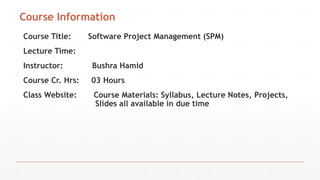
Course Information
Course Title: Software Project Management (SPM)
Lecture Time:
Instructor: Bushra Hamid
Course Cr. Hrs: 03 Hours
Class Website: Course Materials: Syllabus, Lecture Notes, Projects,
Slides all available in due time
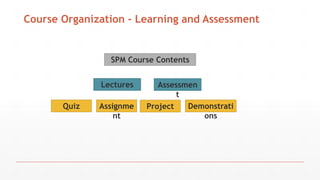
Course Organization - Learning and Assessment
SPM Course Contents
Lectures Assessmen
t
Quiz Assignme
nt
Project Demonstrati
ons
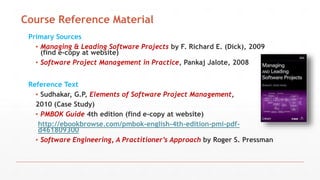
Course Reference Material
Primary Sources
▪ Managing & Leading Software Projects by F. Richard E. (Dick), 2009
(find e-copy at website)
▪ Software Project Management in Practice, Pankaj Jalote, 2008
Reference Text
▪ Sudhakar, G.P, Elements of Software Project Management,
2010 (Case Study)
▪ PMBOK Guide 4th edition (find e-copy at website)
http://ebookbrowse.com/pmbok-english-4th-edition-pmi-pdf-
d461809300
▪ Software Engineering, A Practitioner’s Approach by Roger S. Pressman
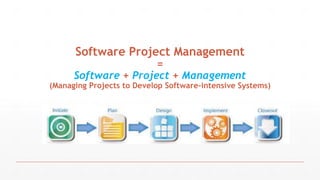
Software Project Management
=
Software + Project + Management
(Managing Projects to Develop Software-intensive Systems)
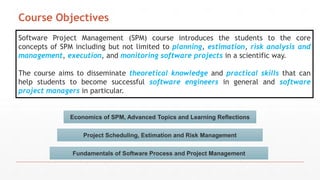
Course Objectives
Software Project Management (SPM) course introduces the students to the core
concepts of SPM including but not limited to planning, estimation, risk analysis and
management, execution, and monitoring software projects in a scientific way.
The course aims to disseminate theoretical knowledge and practical skills that can
help students to become successful software engineers in general and software
project managers in particular.
Fundamentals of Software Process and Project Management
Project Scheduling, Estimation and Risk Management
Economics of SPM, Advanced Topics and Learning Reflections
Do and Do not in the Lecture
Do
- Participate and contribute!
- Argue and counter-argue
- Basically, do whatever that promotes
discussion and learning regarding SPM and beyond
Do not
- Compromise class discipline (chats, off-line discussions)
- Be late, however if you are late do inform me
- Use mobile phones
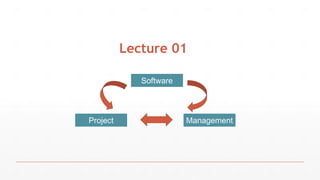
Lecture 01
Software
Project Management
Lecture Agenda
▪ What is Software Project Management (SPM)
▪ Why Software Project Management
▪ Major Activities of Software Project Management
▪ Function of Effective of Management
▪ Factors of Successful SPM
▪ Professional Bodies & Introduction to PMI - PMBOK
▪ Course Contents, Learning Expectations and Outcomes
▪ Software can be considered a product of engineering just like an
airplane, automobile, television, or an other object that requires a
high degree of skill to turn a raw material into a usable product.
▪ But software is developed or engineered, not manufactured! No
wear-out
▪ Software is a set of programs or data combined with its
documentation which is helpful or even needed to run the
application. (Hesse et al. 1984)
What is Software?
What is Software?
Software can be of different types:
- System software - Application software
- Engineering / Scientific software - Embedded software
- Product-line software - Web-applications
- Information system - Medical software
- Telecommunication software - Dependable software i.e.
Different Taxonomies?
Each type is exhibiting different characteristics e.g. Safety is more critical for Dependable
Software
This is one Facet of Project Situation
Stakeholders, Project Size, Team Expertise, Environmental & Organizational
Factors, infrastructure, Budget & Time. Level of information is available etc.
What is a Project?
▪ Project Management Institute (PMI) definition: A
project is a planned piece of work that has a specific
purpose, to create a unique product or service.
A project is characterized as follows:
• a one-time effort is planned
• starting and ending dates are prescribed
• a project team is assembled
• schedule and budget are allocated
• well-defined objectives are established
• activities are defined, roles are identified,
responsibilities are assigned, and authority is delegated
Software projects are temporary
organizational units
What is a Project?
▪ Temporary
▪ It means that every project has a definite beginning and definite end
▪ End is reached when project’s objectives have been achieved OR it is
clear that objective will not be met. The project is terminated in such a
situation
▪ The term temporary does not apply to a project’s product or service
(which is a lasting result)
▪ Unique
▪ It means that the product or service is different in some
distinguishing way from all similar products or services
What is a Project?
▪ Projects may involve a single person or thousands
▪ Projects may be completed in hours, several months or years
▪ Examples of projects; different situation
▪ Developing a new product or service
▪ Designing a new vehicle
▪ Constructing a building
▪ Running a campaign for political office
▪ Implementing a new business procedure or process
▪ And so on …
What is a Project?
Are Projects cancelled sometime before achieving the
objective...?
Management – an overview
▪ Managers: the group of individuals who make decisions about how a
business is run.
▪ A stream of decision and actions to achieve goal(s) efficiently and
effectively.
▪ Management is the process of designing and maintaining an environment
in which individuals, working together in groups, efficiently [and
effectively] accomplish selected aims.
What is Management?
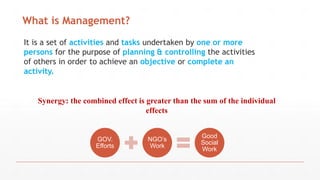
It is a set of activities and tasks undertaken by one or more
persons for the purpose of planning & controlling the activities
of others in order to achieve an objective or complete an
activity.
Synergy: the combined effect is greater than the sum of the individual
effects
GOV.
Efforts
NGO’s
Work
Good
Social
Work
Management – an overview
▪ Effectiveness and Efficiency
▪ Effectiveness: The achievement of objectives
▪ Efficiency: The achievement of ends with least amount of resources
▪ Managing is concerned with productivity
▪ “Productivity” ?
▪ Productivity = outputs/inputs
▪ Productivity can be increased by
▪ Using “same” amount of resource but more output
▪ Using less resources but giving “same” output
▪ Using less resources but more output
▪ Business vs non-business
Five Core Functions of Management - I
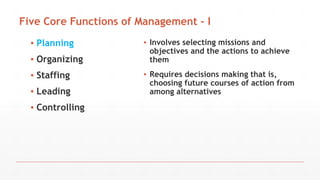
▪ Planning
▪ Organizing
▪ Staffing
▪ Leading
▪ Controlling
▪ Involves selecting missions and
objectives and the actions to achieve
them
▪ Requires decisions making that is,
choosing future courses of action from
among alternatives
Five Core Functions of Management - II
▪ Planning
▪ Organizing
▪ Staffing
▪ Leading
▪ Controlling
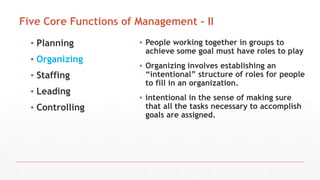
▪ People working together in groups to
achieve some goal must have roles to play
▪ Organizing involves establishing an
“intentional” structure of roles for people
to fill in an organization.
▪ intentional in the sense of making sure
that all the tasks necessary to accomplish
goals are assigned.
Five Core Functions of Management - III
▪ Planning
▪ Organizing
▪ Staffing
▪ Leading
▪ Controlling
▪ Involves filling, and keeping filled the positions in the
organization structure.
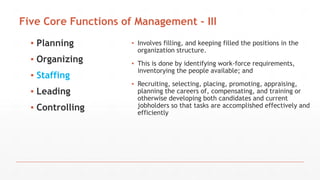
▪ This is done by identifying work-force requirements,
inventorying the people available; and
▪ Recruiting, selecting, placing, promoting, appraising,
planning the careers of, compensating, and training or
otherwise developing both candidates and current
jobholders so that tasks are accomplished effectively and
efficiently
Five Core Functions of Management - IV
▪ Planning
▪ Organizing
▪ Staffing
▪ Leading
▪ Controlling
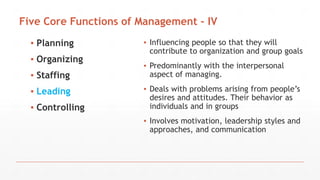
▪ Influencing people so that they will
contribute to organization and group goals
▪ Predominantly with the interpersonal
aspect of managing.
▪ Deals with problems arising from people’s
desires and attitudes. Their behavior as
individuals and in groups
▪ Involves motivation, leadership styles and
approaches, and communication
Five Core Functions of Management - V
▪ Planning
▪ Organizing
▪ Staffing
▪ Leading
▪ Controlling
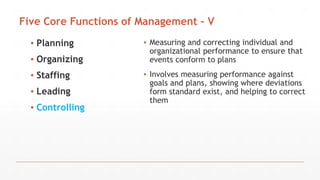
▪ Measuring and correcting individual and
organizational performance to ensure that
events conform to plans
▪ Involves measuring performance against
goals and plans, showing where deviations
form standard exist, and helping to correct
them
Project Management
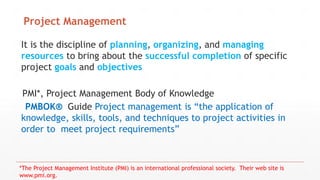
It is the discipline of planning, organizing, and managing
resources to bring about the successful completion of specific
project goals and objectives
PMI*, Project Management Body of Knowledge
PMBOK® Guide Project management is “the application of
knowledge, skills, tools, and techniques to project activities in
order to meet project requirements”
*The Project Management Institute (PMI) is an international professional society. Their web site is
www.pmi.org.
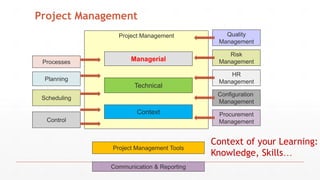
Context of your Learning:
Knowledge, Skills…
Project Management
Processes
Project Management Tools
Context
Managerial
Technical
Communication & Reporting
Planning
Scheduling
Control
Quality
Management
Risk
Management
HR
Management
Configuration
Management
Procurement
Management
Project Management
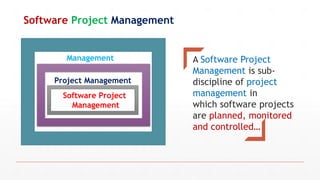
Software Project Management
A Software Project
Management is sub-
discipline of project
management in
which software projects
are planned, monitored
and controlled…
Management
Project Management
Software Project
Management
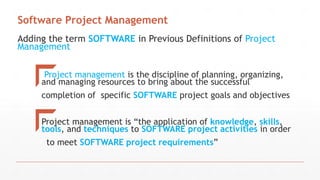
Adding the term SOFTWARE in Previous Definitions of Project
Management
Project management is the discipline of planning, organizing,
and managing resources to bring about the successful
completion of specific SOFTWARE project goals and objectives
Project management is “the application of knowledge, skills,
tools, and techniques to SOFTWARE project activities in order
to meet SOFTWARE project requirements”
Software Project Management
▪ Software development is a complex undertaking particularly when it
involves many people working over a relatively long time.
▪ Hence software development projects need to be managed.
▪ Everyone involved “manages” to some extent, but the scope of
management activities varies for every person.
Software Project Management
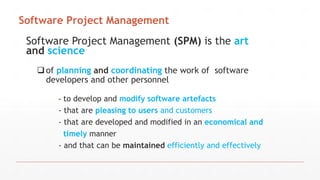
Software Project Management (SPM) is the art
and science
of planning and coordinating the work of software
developers and other personnel
- to develop and modify software artefacts
- that are pleasing to users and customers
- that are developed and modified in an economical and
timely manner
- and that can be maintained efficiently and effectively
Software Project Management
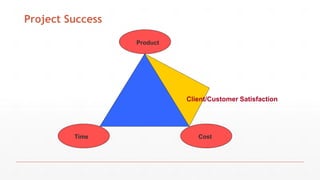
Project Success Factors
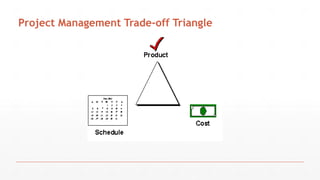
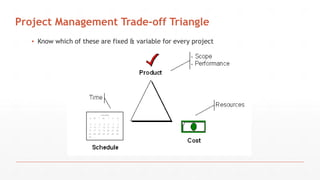
Project Management Trade-off Triangle
▪ Know which of these are fixed & variable for every project
Project Success
Cost
Product
Time
Client/Customer Satisfaction
Introduction to Project Management Bodies
Project Management
▪ Professional Bodies
▪ Professional Organizations
▪ Project Management Institute (PMI)*
▪ Software Engineering Institute (SEI)
▪ IEEE Software Engineering Group.
▪ Certifications (offered by PMI)
▪ PMP (Project Management Professional)
▪ CAPM (Certified Associate in Project Management)
▪ PMBOK – Project Management Body of Knowledge, published by PMI
▪ Tools
▪ MS Project
▪ Primavera Project Manager
*The Project Management Institute (PMI) is an international professional society. Their web site is www.pmi.org.
PMI * - PMBOK
▪ The Project Management Body of Knowledge (PMBOK) is a collection
of processes and knowledge areas generally accepted as best practice
within the project management discipline.
▪ Generally accepted means that it is applicable to most of the projects
most of the time.
▪ IMP: Guidance for project management in all fields in general
however it is not specific to any engineering domain i.e. chemical,
system, software engineering or civil
▪ It is an internationally recognized standard (IEEE Std 1490-2003).
▪ PMBOK recognizes 5 basic process groups and 9 knowledge
areas typical of almost all projects.
▪ The five basic process groups are:
▪ Initiating
▪ Planning
▪ Executing
▪ Monitoring and Controlling
▪ Closing
PMBOK
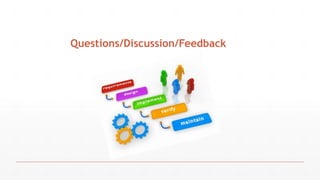
Questions/Discussion/Feedback

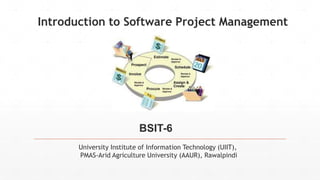
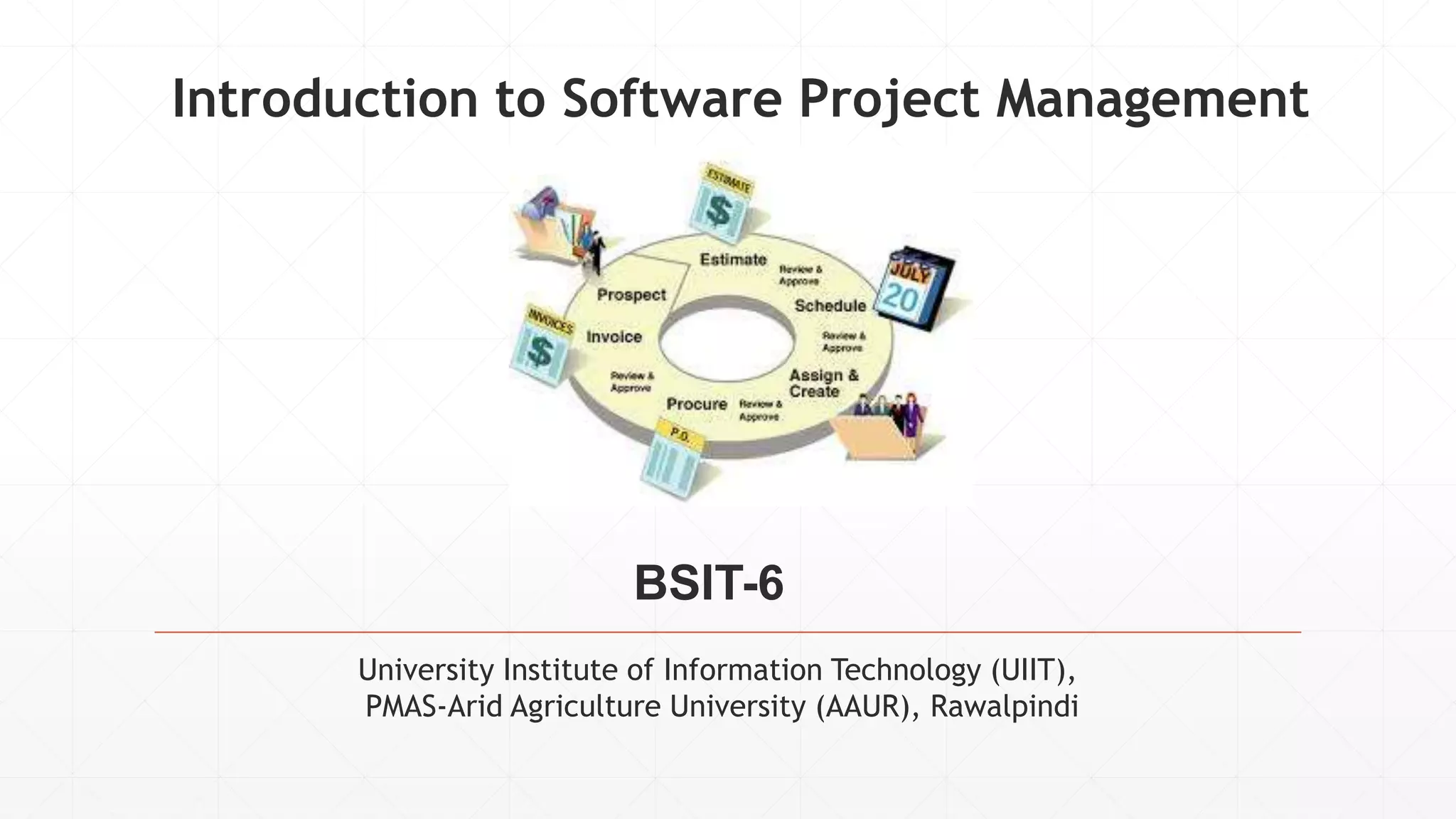
Introduction to Software Project Management

  • 1.
    University Institute ofInformation Technology (UIIT), PMAS-Arid Agriculture University (AAUR), Rawalpindi Introduction to Software Project Management BSIT-6
  • 2.
    Course Information Course Title:Software Project Management (SPM) Lecture Time: Instructor: Bushra Hamid Course Cr. Hrs: 03 Hours Class Website: Course Materials: Syllabus, Lecture Notes, Projects, Slides all available in due time
  • 3.
    Course Organization -Learning and Assessment SPM Course Contents Lectures Assessmen t Quiz Assignme nt Project Demonstrati ons
  • 4.
    Course Reference Material PrimarySources ▪ Managing & Leading Software Projects by F. Richard E. (Dick), 2009 (find e-copy at website) ▪ Software Project Management in Practice, Pankaj Jalote, 2008 Reference Text ▪ Sudhakar, G.P, Elements of Software Project Management, 2010 (Case Study) ▪ PMBOK Guide 4th edition (find e-copy at website) http://ebookbrowse.com/pmbok-english-4th-edition-pmi-pdf- d461809300 ▪ Software Engineering, A Practitioner’s Approach by Roger S. Pressman
  • 5.
    Software Project Management = Software+ Project + Management (Managing Projects to Develop Software-intensive Systems)
  • 7.
    Course Objectives Software ProjectManagement (SPM) course introduces the students to the core concepts of SPM including but not limited to planning, estimation, risk analysis and management, execution, and monitoring software projects in a scientific way. The course aims to disseminate theoretical knowledge and practical skills that can help students to become successful software engineers in general and software project managers in particular. Fundamentals of Software Process and Project Management Project Scheduling, Estimation and Risk Management Economics of SPM, Advanced Topics and Learning Reflections
  • 8.
    Do and Donot in the Lecture Do - Participate and contribute! - Argue and counter-argue - Basically, do whatever that promotes discussion and learning regarding SPM and beyond Do not - Compromise class discipline (chats, off-line discussions) - Be late, however if you are late do inform me - Use mobile phones
  • 9.
  • 10.
    Lecture Agenda ▪ Whatis Software Project Management (SPM) ▪ Why Software Project Management ▪ Major Activities of Software Project Management ▪ Function of Effective of Management ▪ Factors of Successful SPM ▪ Professional Bodies & Introduction to PMI - PMBOK ▪ Course Contents, Learning Expectations and Outcomes
  • 11.
    ▪ Software canbe considered a product of engineering just like an airplane, automobile, television, or an other object that requires a high degree of skill to turn a raw material into a usable product. ▪ But software is developed or engineered, not manufactured! No wear-out ▪ Software is a set of programs or data combined with its documentation which is helpful or even needed to run the application. (Hesse et al. 1984) What is Software?
  • 12.
    What is Software? Softwarecan be of different types: - System software - Application software - Engineering / Scientific software - Embedded software - Product-line software - Web-applications - Information system - Medical software - Telecommunication software - Dependable software i.e. Different Taxonomies? Each type is exhibiting different characteristics e.g. Safety is more critical for Dependable Software This is one Facet of Project Situation Stakeholders, Project Size, Team Expertise, Environmental & Organizational Factors, infrastructure, Budget & Time. Level of information is available etc.
  • 13.
    What is aProject? ▪ Project Management Institute (PMI) definition: A project is a planned piece of work that has a specific purpose, to create a unique product or service.
  • 14.
    A project ischaracterized as follows: • a one-time effort is planned • starting and ending dates are prescribed • a project team is assembled • schedule and budget are allocated • well-defined objectives are established • activities are defined, roles are identified, responsibilities are assigned, and authority is delegated Software projects are temporary organizational units What is a Project?
  • 15.
    ▪ Temporary ▪ Itmeans that every project has a definite beginning and definite end ▪ End is reached when project’s objectives have been achieved OR it is clear that objective will not be met. The project is terminated in such a situation ▪ The term temporary does not apply to a project’s product or service (which is a lasting result) ▪ Unique ▪ It means that the product or service is different in some distinguishing way from all similar products or services What is a Project?
  • 16.
    ▪ Projects mayinvolve a single person or thousands ▪ Projects may be completed in hours, several months or years ▪ Examples of projects; different situation ▪ Developing a new product or service ▪ Designing a new vehicle ▪ Constructing a building ▪ Running a campaign for political office ▪ Implementing a new business procedure or process ▪ And so on … What is a Project? Are Projects cancelled sometime before achieving the objective...?
  • 17.
    Management – anoverview ▪ Managers: the group of individuals who make decisions about how a business is run. ▪ A stream of decision and actions to achieve goal(s) efficiently and effectively. ▪ Management is the process of designing and maintaining an environment in which individuals, working together in groups, efficiently [and effectively] accomplish selected aims.
  • 18.
    What is Management? Itis a set of activities and tasks undertaken by one or more persons for the purpose of planning & controlling the activities of others in order to achieve an objective or complete an activity. Synergy: the combined effect is greater than the sum of the individual effects GOV. Efforts NGO’s Work Good Social Work
  • 19.
    Management – anoverview ▪ Effectiveness and Efficiency ▪ Effectiveness: The achievement of objectives ▪ Efficiency: The achievement of ends with least amount of resources ▪ Managing is concerned with productivity ▪ “Productivity” ? ▪ Productivity = outputs/inputs ▪ Productivity can be increased by ▪ Using “same” amount of resource but more output ▪ Using less resources but giving “same” output ▪ Using less resources but more output ▪ Business vs non-business
  • 20.
    Five Core Functionsof Management - I ▪ Planning ▪ Organizing ▪ Staffing ▪ Leading ▪ Controlling ▪ Involves selecting missions and objectives and the actions to achieve them ▪ Requires decisions making that is, choosing future courses of action from among alternatives
  • 21.
    Five Core Functionsof Management - II ▪ Planning ▪ Organizing ▪ Staffing ▪ Leading ▪ Controlling ▪ People working together in groups to achieve some goal must have roles to play ▪ Organizing involves establishing an “intentional” structure of roles for people to fill in an organization. ▪ intentional in the sense of making sure that all the tasks necessary to accomplish goals are assigned.
  • 22.
    Five Core Functionsof Management - III ▪ Planning ▪ Organizing ▪ Staffing ▪ Leading ▪ Controlling ▪ Involves filling, and keeping filled the positions in the organization structure. ▪ This is done by identifying work-force requirements, inventorying the people available; and ▪ Recruiting, selecting, placing, promoting, appraising, planning the careers of, compensating, and training or otherwise developing both candidates and current jobholders so that tasks are accomplished effectively and efficiently
  • 23.
    Five Core Functionsof Management - IV ▪ Planning ▪ Organizing ▪ Staffing ▪ Leading ▪ Controlling ▪ Influencing people so that they will contribute to organization and group goals ▪ Predominantly with the interpersonal aspect of managing. ▪ Deals with problems arising from people’s desires and attitudes. Their behavior as individuals and in groups ▪ Involves motivation, leadership styles and approaches, and communication
  • 24.
    Five Core Functionsof Management - V ▪ Planning ▪ Organizing ▪ Staffing ▪ Leading ▪ Controlling ▪ Measuring and correcting individual and organizational performance to ensure that events conform to plans ▪ Involves measuring performance against goals and plans, showing where deviations form standard exist, and helping to correct them
  • 25.
    Project Management It isthe discipline of planning, organizing, and managing resources to bring about the successful completion of specific project goals and objectives PMI*, Project Management Body of Knowledge PMBOK® Guide Project management is “the application of knowledge, skills, tools, and techniques to project activities in order to meet project requirements” *The Project Management Institute (PMI) is an international professional society. Their web site is www.pmi.org.
  • 26.
    Context of yourLearning: Knowledge, Skills… Project Management Processes Project Management Tools Context Managerial Technical Communication & Reporting Planning Scheduling Control Quality Management Risk Management HR Management Configuration Management Procurement Management Project Management
  • 27.
    Software Project Management ASoftware Project Management is sub- discipline of project management in which software projects are planned, monitored and controlled… Management Project Management Software Project Management
  • 28.
    Adding the termSOFTWARE in Previous Definitions of Project Management Project management is the discipline of planning, organizing, and managing resources to bring about the successful completion of specific SOFTWARE project goals and objectives Project management is “the application of knowledge, skills, tools, and techniques to SOFTWARE project activities in order to meet SOFTWARE project requirements” Software Project Management
  • 29.
    ▪ Software developmentis a complex undertaking particularly when it involves many people working over a relatively long time. ▪ Hence software development projects need to be managed. ▪ Everyone involved “manages” to some extent, but the scope of management activities varies for every person. Software Project Management
  • 30.
    Software Project Management(SPM) is the art and science of planning and coordinating the work of software developers and other personnel - to develop and modify software artefacts - that are pleasing to users and customers - that are developed and modified in an economical and timely manner - and that can be maintained efficiently and effectively Software Project Management
  • 31.
  • 32.
  • 33.
    Project Management Trade-offTriangle ▪ Know which of these are fixed & variable for every project
  • 34.
  • 35.
    Introduction to ProjectManagement Bodies
  • 36.
    Project Management ▪ ProfessionalBodies ▪ Professional Organizations ▪ Project Management Institute (PMI)* ▪ Software Engineering Institute (SEI) ▪ IEEE Software Engineering Group. ▪ Certifications (offered by PMI) ▪ PMP (Project Management Professional) ▪ CAPM (Certified Associate in Project Management) ▪ PMBOK – Project Management Body of Knowledge, published by PMI ▪ Tools ▪ MS Project ▪ Primavera Project Manager *The Project Management Institute (PMI) is an international professional society. Their web site is www.pmi.org.
  • 37.
    PMI * -PMBOK ▪ The Project Management Body of Knowledge (PMBOK) is a collection of processes and knowledge areas generally accepted as best practice within the project management discipline. ▪ Generally accepted means that it is applicable to most of the projects most of the time. ▪ IMP: Guidance for project management in all fields in general however it is not specific to any engineering domain i.e. chemical, system, software engineering or civil ▪ It is an internationally recognized standard (IEEE Std 1490-2003).
  • 38.
    ▪ PMBOK recognizes5 basic process groups and 9 knowledge areas typical of almost all projects. ▪ The five basic process groups are: ▪ Initiating ▪ Planning ▪ Executing ▪ Monitoring and Controlling ▪ Closing PMBOK
  • 39.