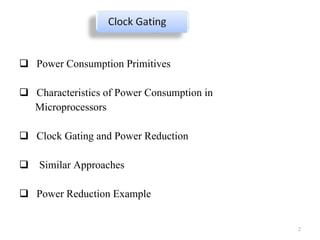
Power Consumption Primitives Characteristics of Power Consumption in  Microprocessors Clock Gating and Power Reduction Similar Approaches Power Reduction Example
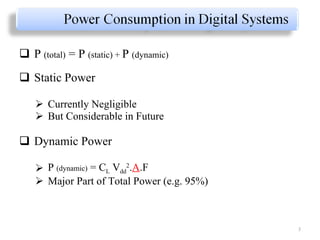
P  (total)  = P  (static) +  P  (dynamic) Static Power Currently Negligible But Considerable in Future Dynamic Power P  (dynamic)  = C L  V dd 2 . A .F Major Part of Total Power (e.g. 95%)
Clock Circuitry Power Consumption 15 to 45% of Total P (clock circuitry) ~ Frequency Activity of Functional Units A (units) < 50%  in Execution Time
Clock tree consume more than 50 % of dynamic power. The components of this power are:  Power consumed by combinatorial logic whose values are changing on each clock edge  2) Power consumed by flip-flops and  3) The power consumed by the clock buffer tree in the design.  Clock Gating and Power Reduction
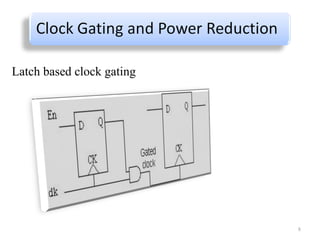
There are two types of clock gating styles available. They are: Latch-based clock gating  2) Latch-free clock gating.
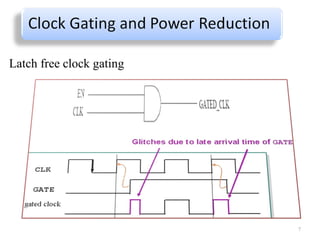
Latch free clock gating
Latch based clock gating
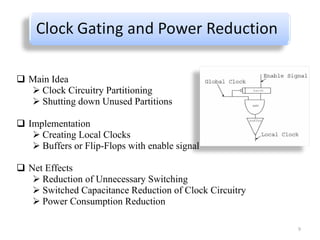
Main Idea  Clock Circuitry Partitioning  Shutting down Unused Partitions Implementation Creating Local Clocks Buffers or Flip-Flops with enable signal Net Effects  Reduction of Unnecessary Switching Switched Capacitance Reduction of Clock Circuitry Power Consumption Reduction
How to determine unused modules? Dynamically in Decode Stage Statically with Compiler Assistance Disadvantages Additional Circuitry More Complicated Timing Analysis, Design, Test and Verification Possible High L x di/dt Noise
Data Gating Effective in Wide Modules Like ALUs Complicated Design Possible Increase of Critical Path Delay Powering Down Unused Modules  Possible Long Wake-up Times Need of Compiler and/or OS Support Using Asynchronous Systems  Unnecessary Activity Elimination Harder Design
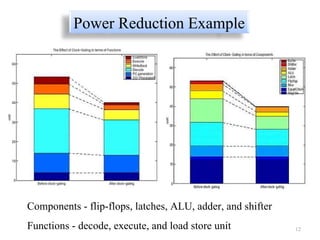
Components - flip-flops, latches, ALU, adder, and shifter  Functions - decode, execute, and load store unit  Power Reduction Example
Clock Gating as an Architectural Technique Turning Unused Parts of Circuit Off High P(dynamic)/P (total) Ratio Decrease of Activity to Reduce Power Considerable Power Reduction (up to 25%) Highly Used Technique Summary

Clock gating

  • 1.
  • 2.
    Power Consumption PrimitivesCharacteristics of Power Consumption in Microprocessors Clock Gating and Power Reduction Similar Approaches Power Reduction Example
  • 3.
    P (total) = P (static) + P (dynamic) Static Power Currently Negligible But Considerable in Future Dynamic Power P (dynamic) = C L V dd 2 . A .F Major Part of Total Power (e.g. 95%)
  • 4.
    Clock Circuitry PowerConsumption 15 to 45% of Total P (clock circuitry) ~ Frequency Activity of Functional Units A (units) < 50% in Execution Time
  • 5.
    Clock tree consumemore than 50 % of dynamic power. The components of this power are: Power consumed by combinatorial logic whose values are changing on each clock edge 2) Power consumed by flip-flops and 3) The power consumed by the clock buffer tree in the design. Clock Gating and Power Reduction
  • 6.
    There are twotypes of clock gating styles available. They are: Latch-based clock gating 2) Latch-free clock gating.
  • 7.
  • 8.
  • 9.
    Main Idea Clock Circuitry Partitioning Shutting down Unused Partitions Implementation Creating Local Clocks Buffers or Flip-Flops with enable signal Net Effects Reduction of Unnecessary Switching Switched Capacitance Reduction of Clock Circuitry Power Consumption Reduction
  • 10.
    How to determineunused modules? Dynamically in Decode Stage Statically with Compiler Assistance Disadvantages Additional Circuitry More Complicated Timing Analysis, Design, Test and Verification Possible High L x di/dt Noise
  • 11.
    Data Gating Effectivein Wide Modules Like ALUs Complicated Design Possible Increase of Critical Path Delay Powering Down Unused Modules Possible Long Wake-up Times Need of Compiler and/or OS Support Using Asynchronous Systems Unnecessary Activity Elimination Harder Design
  • 12.
    Components - flip-flops,latches, ALU, adder, and shifter Functions - decode, execute, and load store unit Power Reduction Example
  • 13.
    Clock Gating asan Architectural Technique Turning Unused Parts of Circuit Off High P(dynamic)/P (total) Ratio Decrease of Activity to Reduce Power Considerable Power Reduction (up to 25%) Highly Used Technique Summary

Editor's Notes

  • #2 &amp;quot;Clock Gating&amp;quot; An Effective Low-Power Technique
  • #5 &amp;quot;Clock Gating&amp;quot; An Effective Low-Power Technique