OIF CEI-56G Common Electrical
Interfaces
Tom Palkert
Luxtera/MoSys
OIF PLL Vice Chair Electrical
Tom Palkert
Luxtera/MoSys
OIF PLL Vice Chair Electrical
Outline
 Port Density Requirements
 OIF CEI-56G applications
• USR (die to die in an MCM)
• XSR (Chip to optical engine/memory)
• VSR (Chip to Pluggable module)
• MR (Chip to Chip)
• LR (Backplane)
 NRZ and PAM4 test and simulation results
 NRZ vs PAM4 arguments
 Conclusion
2 FOE 2015
 Port Density Requirements
 OIF CEI-56G applications
• USR (die to die in an MCM)
• XSR (Chip to optical engine/memory)
• VSR (Chip to Pluggable module)
• MR (Chip to Chip)
• LR (Backplane)
 NRZ and PAM4 test and simulation results
 NRZ vs PAM4 arguments
 Conclusion
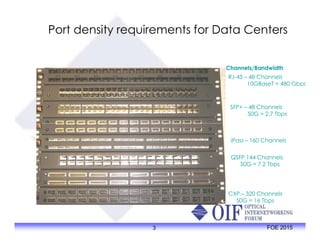
Port density requirements for Data Centers
de
RJ-45 – 48 Channels
10GBaseT = 480 Gbps
SFP+ – 48 Channels
50G = 2.7 Tbps
Channels/Bandwidth
3 FOE 2015
iPass – 160 Channels
QSFP 144 Channels
50G = 7.2 Tbps
CXP – 320 Channels
50G = 16 Tbps
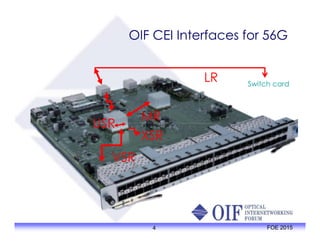
OIF CEI Interfaces for 56G
LR
MR
Switch card
XSR
USR
4 FOE 2015
VSR
MR
XSR
USR
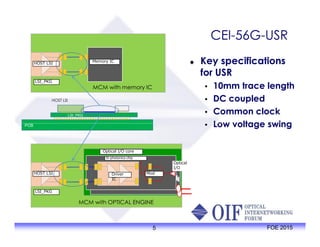
CEI-56G-USR
 Key specifications
for USR
• 10mm trace length
• DC coupled
• Common clock
• Low voltage swing
HOST LSI
PCB
LSI_PKG
HOST LSI
LSI_PKG
Memory IC
MCM with memory IC
5 FOE 2015
 Key specifications
for USR
• 10mm trace length
• DC coupled
• Common clock
• Low voltage swing
Optical I/O core
HOST LSI Driver
IC
Mod
Optical
I/O
LSI_PKG
Si-photonics chip
PCB
MCM with OPTICAL ENGINE
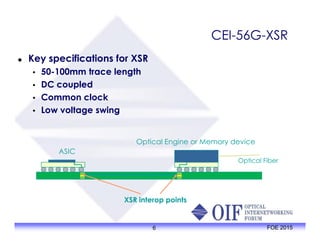
CEI-56G-XSR
 Key specifications for XSR
• 50-100mm trace length
• DC coupled
• Common clock
• Low voltage swing
6 FOE 2015
XSR interop points
ASIC
Optical Engine or Memory device
Optical Fiber
 Key specifications for XSR
• 50-100mm trace length
• DC coupled
• Common clock
• Low voltage swing
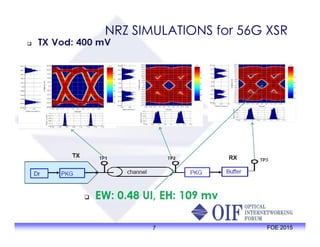
NRZ SIMULATIONS for 56G XSR
7 FOE 2015
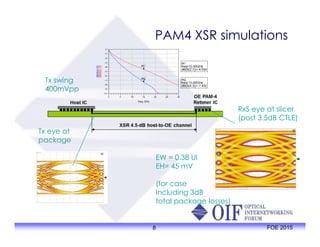
PAM4 XSR simulations
RxS eye at slicer
(post 3.5dB CTLE)
Tx swing
400mVpp
8 FOE 2015
EW = 0.38 UI
EH= 45 mV
(for case
Including 3dB
total package losses)
Tx eye at
package
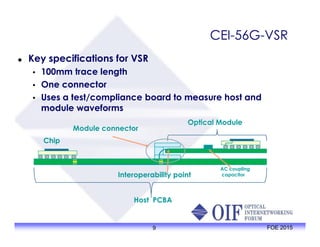
CEI-56G-VSR
 Key specifications for VSR
• 100mm trace length
• One connector
• Uses a test/compliance board to measure host and
module waveforms
Optical Module
Module connector
9 FOE 2015
 Key specifications for VSR
• 100mm trace length
• One connector
• Uses a test/compliance board to measure host and
module waveforms
Host PCBA
Optical Module
Interoperability point
Chip
Module connector
AC coupling
capacitor
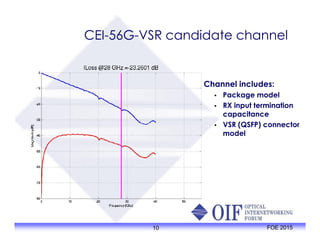
CEI-56G-VSR candidate channel
Channel includes:
• Package model
• RX input termination
capacitance
• VSR (QSFP) connector
model
10 FOE 2015
Channel includes:
• Package model
• RX input termination
capacitance
• VSR (QSFP) connector
model
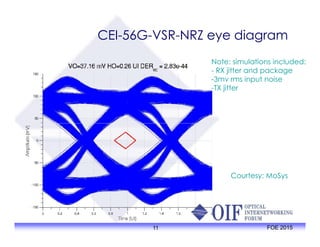
CEI-56G-VSR-NRZ eye diagram
Note: simulations included:
- RX jitter and package
-3mv rms input noise
-TX jitter
11 FOE 2015
Courtesy: MoSys
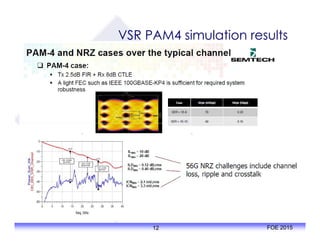
VSR PAM4 simulation results
12 FOE 2015
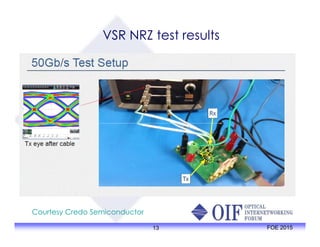
VSR NRZ test results
13 FOE 2015
Courtesy Credo Semiconductor
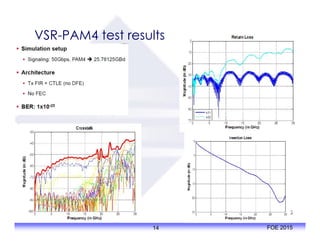
VSR-PAM4 test results
14 FOE 2015
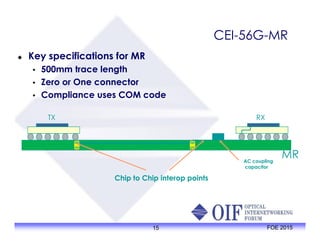
CEI-56G-MR
TX RX
 Key specifications for MR
• 500mm trace length
• Zero or One connector
• Compliance uses COM code
15 FOE 2015
Chip to Chip interop points
AC coupling
capacitor
MR
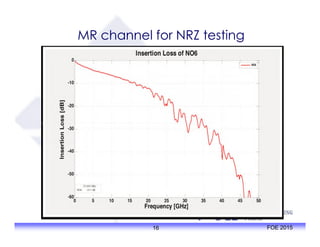
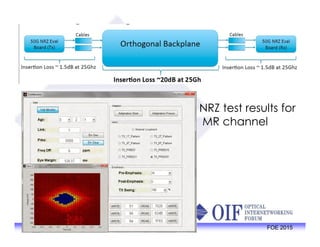
MR channel for NRZ testing
16 FOE 2015
NRZ test results for
MR channel
17 FOE 2015
NRZ test results for
MR channel
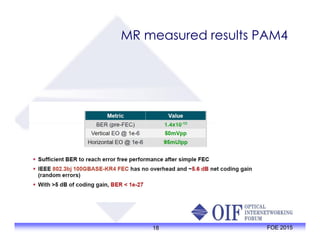
MR measured results PAM4
18 FOE 2015
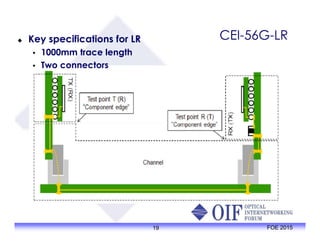
CEI-56G-LR Key specifications for LR
• 1000mm trace length
• Two connectors
19 FOE 2015
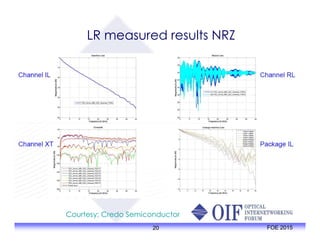
LR measured results NRZ
20 FOE 2015
Courtesy: Credo Semiconductor
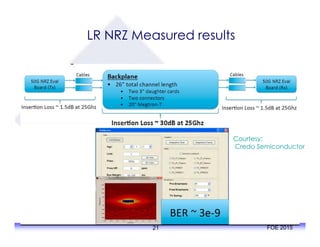
LR NRZ Measured results
21 FOE 2015
Courtesy:
Credo Semiconductor
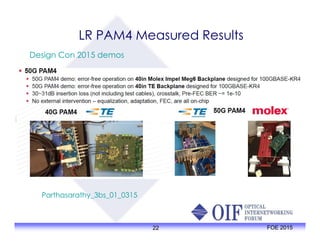
LR PAM4 Measured Results
Design Con 2015 demos
22 FOE 2015
Parthasarathy_3bs_01_0315
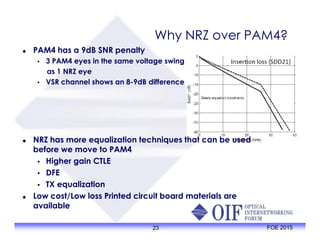
Why NRZ over PAM4?
 PAM4 has a 9dB SNR penalty
• 3 PAM4 eyes in the same voltage swing
as 1 NRZ eye
• VSR channel shows an 8-9dB difference
 NRZ has more equalization techniques that can be used
before we move to PAM4
• Higher gain CTLE
• DFE
• TX equalization
 Low cost/Low loss Printed circuit board materials are
available
23 FOE 2015
 PAM4 has a 9dB SNR penalty
• 3 PAM4 eyes in the same voltage swing
as 1 NRZ eye
• VSR channel shows an 8-9dB difference
 NRZ has more equalization techniques that can be used
before we move to PAM4
• Higher gain CTLE
• DFE
• TX equalization
 Low cost/Low loss Printed circuit board materials are
available
Why PAM4 over NRZ?
 As process nodes get smaller density is increasing
but not speed
• PAM designs can use lower cost semiconductor
processes
 PAM operates over legacy channels
• Same baud rate as 28G NRZ
 Lower loss channels may not require as much
equalization as NRZ
24 FOE 2015
 As process nodes get smaller density is increasing
but not speed
• PAM designs can use lower cost semiconductor
processes
 PAM operates over legacy channels
• Same baud rate as 28G NRZ
 Lower loss channels may not require as much
equalization as NRZ
Conclusions
1) The OIF is defining solutions for the next generation
electrical interfaces
2) Both NRZ and PAM4 specifications are being
developed for CEI-56G solutions
25 FOE 2015

OIF CEI 56-G-FOE-April2015

  • 1.
    OIF CEI-56G CommonElectrical Interfaces Tom Palkert Luxtera/MoSys OIF PLL Vice Chair Electrical Tom Palkert Luxtera/MoSys OIF PLL Vice Chair Electrical
  • 2.
    Outline  Port DensityRequirements  OIF CEI-56G applications • USR (die to die in an MCM) • XSR (Chip to optical engine/memory) • VSR (Chip to Pluggable module) • MR (Chip to Chip) • LR (Backplane)  NRZ and PAM4 test and simulation results  NRZ vs PAM4 arguments  Conclusion 2 FOE 2015  Port Density Requirements  OIF CEI-56G applications • USR (die to die in an MCM) • XSR (Chip to optical engine/memory) • VSR (Chip to Pluggable module) • MR (Chip to Chip) • LR (Backplane)  NRZ and PAM4 test and simulation results  NRZ vs PAM4 arguments  Conclusion
  • 3.
    Port density requirementsfor Data Centers de RJ-45 – 48 Channels 10GBaseT = 480 Gbps SFP+ – 48 Channels 50G = 2.7 Tbps Channels/Bandwidth 3 FOE 2015 iPass – 160 Channels QSFP 144 Channels 50G = 7.2 Tbps CXP – 320 Channels 50G = 16 Tbps
  • 4.
    OIF CEI Interfacesfor 56G LR MR Switch card XSR USR 4 FOE 2015 VSR MR XSR USR
  • 5.
    CEI-56G-USR  Key specifications forUSR • 10mm trace length • DC coupled • Common clock • Low voltage swing HOST LSI PCB LSI_PKG HOST LSI LSI_PKG Memory IC MCM with memory IC 5 FOE 2015  Key specifications for USR • 10mm trace length • DC coupled • Common clock • Low voltage swing Optical I/O core HOST LSI Driver IC Mod Optical I/O LSI_PKG Si-photonics chip PCB MCM with OPTICAL ENGINE
  • 6.
    CEI-56G-XSR  Key specificationsfor XSR • 50-100mm trace length • DC coupled • Common clock • Low voltage swing 6 FOE 2015 XSR interop points ASIC Optical Engine or Memory device Optical Fiber  Key specifications for XSR • 50-100mm trace length • DC coupled • Common clock • Low voltage swing
  • 7.
    NRZ SIMULATIONS for56G XSR 7 FOE 2015
  • 8.
    PAM4 XSR simulations RxSeye at slicer (post 3.5dB CTLE) Tx swing 400mVpp 8 FOE 2015 EW = 0.38 UI EH= 45 mV (for case Including 3dB total package losses) Tx eye at package
  • 9.
    CEI-56G-VSR  Key specificationsfor VSR • 100mm trace length • One connector • Uses a test/compliance board to measure host and module waveforms Optical Module Module connector 9 FOE 2015  Key specifications for VSR • 100mm trace length • One connector • Uses a test/compliance board to measure host and module waveforms Host PCBA Optical Module Interoperability point Chip Module connector AC coupling capacitor
  • 10.
    CEI-56G-VSR candidate channel Channelincludes: • Package model • RX input termination capacitance • VSR (QSFP) connector model 10 FOE 2015 Channel includes: • Package model • RX input termination capacitance • VSR (QSFP) connector model
  • 11.
    CEI-56G-VSR-NRZ eye diagram Note:simulations included: - RX jitter and package -3mv rms input noise -TX jitter 11 FOE 2015 Courtesy: MoSys
  • 12.
    VSR PAM4 simulationresults 12 FOE 2015
  • 13.
    VSR NRZ testresults 13 FOE 2015 Courtesy Credo Semiconductor
  • 14.
  • 15.
    CEI-56G-MR TX RX  Keyspecifications for MR • 500mm trace length • Zero or One connector • Compliance uses COM code 15 FOE 2015 Chip to Chip interop points AC coupling capacitor MR
  • 16.
    MR channel forNRZ testing 16 FOE 2015
  • 17.
    NRZ test resultsfor MR channel 17 FOE 2015 NRZ test results for MR channel
  • 18.
    MR measured resultsPAM4 18 FOE 2015
  • 19.
    CEI-56G-LR Key specificationsfor LR • 1000mm trace length • Two connectors 19 FOE 2015
  • 20.
    LR measured resultsNRZ 20 FOE 2015 Courtesy: Credo Semiconductor
  • 21.
    LR NRZ Measuredresults 21 FOE 2015 Courtesy: Credo Semiconductor
  • 22.
    LR PAM4 MeasuredResults Design Con 2015 demos 22 FOE 2015 Parthasarathy_3bs_01_0315
  • 23.
    Why NRZ overPAM4?  PAM4 has a 9dB SNR penalty • 3 PAM4 eyes in the same voltage swing as 1 NRZ eye • VSR channel shows an 8-9dB difference  NRZ has more equalization techniques that can be used before we move to PAM4 • Higher gain CTLE • DFE • TX equalization  Low cost/Low loss Printed circuit board materials are available 23 FOE 2015  PAM4 has a 9dB SNR penalty • 3 PAM4 eyes in the same voltage swing as 1 NRZ eye • VSR channel shows an 8-9dB difference  NRZ has more equalization techniques that can be used before we move to PAM4 • Higher gain CTLE • DFE • TX equalization  Low cost/Low loss Printed circuit board materials are available
  • 24.
    Why PAM4 overNRZ?  As process nodes get smaller density is increasing but not speed • PAM designs can use lower cost semiconductor processes  PAM operates over legacy channels • Same baud rate as 28G NRZ  Lower loss channels may not require as much equalization as NRZ 24 FOE 2015  As process nodes get smaller density is increasing but not speed • PAM designs can use lower cost semiconductor processes  PAM operates over legacy channels • Same baud rate as 28G NRZ  Lower loss channels may not require as much equalization as NRZ
  • 25.
    Conclusions 1) The OIFis defining solutions for the next generation electrical interfaces 2) Both NRZ and PAM4 specifications are being developed for CEI-56G solutions 25 FOE 2015