Fatheya refat
2014/2015
Dr. Falah Hassn | Fatheya Refat
GRADUATION
PROJECT
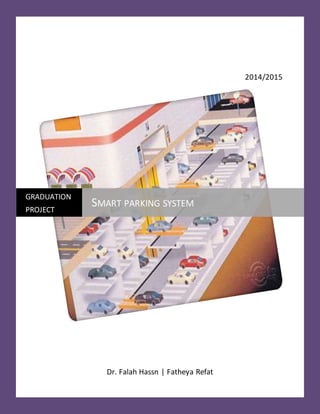
SMART PARKING SYSTEM
Smart Parking System Najah NationalUniversity
i
Fatheya Refat
Contents
Abstract________________________________________________________________________________ v
1 Chapter 1 __________________________________________________________________________ 1
1.1 Overview ______________________________________________________________________ 1
1.2 The main goal and the suggestion solutions for the problem____________________________ 2
2 CHAPTER 2 ________________________________________________________________________ 10
2.1 Our project implementation ______________________________________________________ 10
2.2 How we must choose the suitable sensor to implement our project_____________________ 10
2.3 How the ultrasonic sensor work? _________________________________________________ 11
3 CHAPTER 3________________________________________________________________________ 14
3.1 Hardware and components ______________________________________________________ 14
3.2 The circuit in details ____________________________________________________________ 15
4 CHAPTER 4 ________________________________________________________________________ 18
Methodology __________________________________________________________________________ 18
5 CHAPTER 5 ________________________________________________________________________ 20
Result and Analysis______________________________________________________________________ 20
6 CHAPTER 6 ________________________________________________________________________ 24
Technical andeconomic feasibility_________________________________________________________ 24
7 CHAPTER 7 ________________________________________________________________________ 25
Conclusion and Recommendation _________________________________________________________ 25
8 References ________________________________________________________________________ 26
9 Appendix____________________________________________________________________________ 27
Appendix A_________________________________________________________________________ 27
Smart Parking System Najah NationalUniversity
ii
Fatheya Refat
Table of figures
Figure 1 improper parking ______________________________________________________________________________ 2
Figure 2the system features _____________________________________________________________________________ 3
Figure 3ultrasonic sensor principle of operation ___________________________________________________________ 4
Figure 4 how the ultrasonic system work _________________________________________________________________ 4
Figure 5Agent based parking assistance system.___________________________________________________________ 6
Figure 6[Vehicular communication-based smart parking technique.__________________________________________ 7
Figure 7wifi system SPS_________________________________________________________________________________ 9
Figure 8 LCD view_____________________________________________________________________________________ 10
Figure 9 Ultra sonic sensor_____________________________________________________________________________ 11
Figure 10 Principle of operation of the ultrasonic sensor ___________________________________________________ 12
Figure 11 Principle of operation of the ultrasonic sensor ___________________________________________________ 12
Figure 12 ____________________________________________________________________________________________ 13
Figure 13-design circuit _______________________________________________________________________________ 14
Figure 14-sensor with arduino__________________________________________________________________________ 15
Figure 15-arduino circut _______________________________________________________________________________ 16
Smart Parking System Najah NationalUniversity
iii
Fatheya Refat
Nomenclature:
LED : Light emitting diode
SPS: Smart Parking System
Smart Parking System Najah NationalUniversity
iv
Fatheya Refat
DISCLAIMER
This report was written by student at Electrical Engineering department, faculty of
Engineering, An-Najah National University. It has not been altered or corrected, other than
editorial corrections, as a result of assessment and it may contain language as well as
content errors. The views expressed in it together with any outcomes and
recommendations are solely those of the student. An-Najah National University accepts no
responsibility or liability for the consequence of this report being used for a purpose other
than the purpose for which it was commissioned.
Smart Parking System Najah NationalUniversity
v
Fatheya Refat
Abstract
With the increase in vehicle production and world population, more and more parking
spaces and facilities are required. In this project a new parking system called Smart
Parking System (SPS) is proposed to assist drivers to find vacant spaces in a car park in a
shorter time.
The new system uses ultrasonic sensors to detect either car park occupancy or improper
parking actions. Different detection technologies are reviewed and compared to determine
the best technology for developing SPS. Features of SPS include vacant parking space
detection, detection of improper parking, display of available parking spaces, and
directional indicators toward vacant parking spaces, payment facilities and different types
of parking spaces (vacant, occupied, reserved and handicapped) through the use of specific
LEDs.
This report also describes the use of an SPS system from the entrance into a parking lot
until the finding of a vacant parking space.
The system architecture defines the essential design features such as location of sensors,
required number of sensors and LEDs for each level, and indoor and outdoor display
boards.
Fatheya refat 1
1 Chapter 1
1.1 Overview
Searching for a vacant parking space in a metropolitan area is the daily concern for most
drivers, and it is time-consuming. It commonly results more traffic congestion and air
pollution by constantly cruising in certain area only for an available parking space. For
instance, a recent survey [1] shows that during rush hours in most big cities, the traffic
generated by cars searching for parking spaces takes up to 40% of the total traffic. To
alleviate such traffic congestion and improve the convenience for drivers, many smart
parking systems aiming to satisfy the involved parties (e.g., parking service providers and
drivers) have been deployed.
The current smart parking or parking guidance systems only obtain the availability
information of parking spaces from deployed sensor networks, and simply publish the
parking information to direct drivers.
However, since these systems cannot guide the drivers to their desired parking
destinations, even sometimes make the situation worse, they are not “smart” enough. For
instance, when the number of vacant spaces in an area is limited, more drivers, who obtain
the parking information, are heading for these spaces. It will cause severer congestion. It is,
therefore, strongly desired to provide an effective strategy to address these concerns
In this project an LED display in the entrance of the parking will show to the drivers which
level of the parking has available spaces and which space is the closest to driver.
Our proposed SPS detection system is based on alight sensor, as we know any parking
should divide into many spaces, in our project each space should contain alight sensor
under the vacant when the driver enter to the park and the car take its place the sensor will
measure the reflected light and then it will send to the display that this place is not
available now
Smart Parking System Najah NationalUniversity
2
Fatheya Refat
1.2 The main goal and the suggestion solutions for the problem
In this Project, we mainly focus on designing a new smart parking system that assists drivers to
find parking spaces in a specific parking district. In addition, an important goal of the system is
to reduce the traffic searching for parking, hence reduce energy consumption and air pollution.
If a car is parked in such a way that it occupies two parking slots rather than one, this is called
improper parking. Improper parking can happen when a driver is not careful about another
driver’s rights. Sometimes improper parking occurs when a driver parks on or a bit outside of the
lines of a parking space. The driver may notice his improper parking after leaving his car, but
may not be willing to unlock his car, restart it, and adjust it to be inside the lines. This matter
annoys other drivers and most of the time a driver who wants to park ina small leftover slot will
give up and feel frustrated. Figure1 presents an improper parking situation.
Figure 1 improper parking
There are too many solutions for the implementation of smart parking system
a) The first solution is a web based advanced parking system:
Parking spaces generated by lines using LED lighting technology creating real-time spaces for
cars, motorcycles, handicap spots and other vehicles ,preset by operator or computer system.
The mobile phone is used to assess Internet, over Wi-Fi or GSM cellular network, to obtain
the information of parking availability and make parking reservation from the Internet server.
The mobile phone also provides the Bluetooth module to communicate with sensors when
verifying the driver's identity [1]
Smart Parking System Najah NationalUniversity
3
Fatheya Refat
Figure 2the system features
Drivers want to know:
 the location of car park nearby
 how to reduce waiting time for car park during holidays or peak parking
hours
 how to enter the target car park without stuck
 in traffic congestion
 comparison of parking fees of every car park
 the length , width , height and ground condition
 of parking space
 the number of parking spaceavailable and their location on each floor in
car park
 Whether car parks have discounts or special benefits. Example: Some
shopping malls waive the parking fees when consumers’ purchases reach
the required amount.[2]
b) The second solution:
Smart Parking System (SPS) Architecture using ultrasonic detector the following figure
show how the ultrasonic sensor work
Smart Parking System Najah NationalUniversity
4
Fatheya Refat
Figure 3ultrasonic sensor principle of operation
In order to find vacant spaces, drivers look at an LED display board
which shows how many and which type of vacant spaces are available at
each level at that time. After navigating to the desired parking level,
drivers look at internal signs hanging from the ceiling at the end of each
aisle. Each internal sign shows two parts: the number of available spaces
and the direction (left, right or forward) of the aisle which has a vacant
space. Each individual parking space is equipped with LED lights which
are located above the space and can show green, red, blue or yellow. The
color indicates the status of that space: green means the space is vacant,
red means the space is occupied, blue means the space is assigned for
handicapped drivers and yellow means it has been booked or is a VIP or
reserved space for specific reasons. When a driver enters a vacant space,
the green light changes to red. The following figure describe the system
[2]
Figure 4 how the ultrasonic system work
Ultrasonic sensors transmit sound waves between 25 kHz and 50 kHz. They use
thereflected energy to analyze and detect the status of a parking space. Ultrasonic
Smart Parking System Najah NationalUniversity
5
Fatheya Refat
waves areemitted from the head of an ultrasonic vehicle detection sensor every
60 milliseconds, and thepresence or absence of vehicles is determined by time
differences between the emitted andreceived signals. Ultrasonic sensors can be
used for counting vehicles and assessing theoccupancy status of each parking
space [10]. Despite the low cost and easy installation ofultrasonic sensors, they do
have some disadvantages, particularly sensitivity to temperaturechanges and
extreme air turbulence.
The LED lights can be attached to the detector sensor or mounted separately. SPS
uses separate LED indicator to be more flexible and make it possible to fix both
pieces at the bestposition. The LED and the sensor connect to each other through
a phone cable. When theindicator displays green, it means the parking space is
available; when the indicator displaysred, it means the space is occupied. In case
of a handicapped parking space, a blue LEDindicates vacancy and red indicates
occupancy. Reserved spaces areidentified by a yellowLED.
Figure 5 LED indictors
c) The third solution:
Intelligent Car Parking System: This system has a number of subsystems
namely an Ad-hoc subsystem, a parking gateway subsystem, a vehicle
detection subsystem and a video image processor sensor
subsystem.Every car has a unique Vehicle Identification Number (VID)
associated with it. For overcoming the common discrepancies of the
existing vision based target parking position labeled methods in dark
indoor parking sites, [42] proposes a light stripe projection based free
parking space recognition method. For recognition of the 3D information
Smart Parking System Najah NationalUniversity
6
Fatheya Refat
of parking site, light stripe projection method is used. System is able to
recognize discontinue points, pivot and opposite site reference points,
once the
Analysis of 3D information takes place. For automatic steering movement
during parking operation; a kind of driver assistant system known as
intelligent parking assist system is used, which has the following six
parts[3]
 Target position designation
 Deciding the path
 Finding the path
 Active steering
 Active braking
 Human Machine Interface (HMI)
There are two classesof cars which are considered by this architecture
Figure 5Agent based parking assistance system.
Smart Parking System Najah NationalUniversity
7
Fatheya Refat
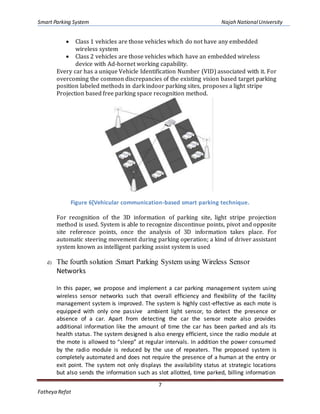
 Class 1 vehicles are those vehicles which do not have any embedded
wireless system
 Class 2 vehicles are those vehicles which have an embedded wireless
device with Ad-hornet working capability.
Every car has a unique Vehicle Identification Number (VID) associated with it. For
overcoming the common discrepancies of the existing vision based target parking
position labeled methods in dark indoor parking sites, proposes a light stripe
Projection based free parking space recognition method.
Figure 6[Vehicular communication-based smart parking technique.
For recognition of the 3D information of parking site, light stripe projection
method is used. System is able to recognize discontinue points, pivot and opposite
site reference points, once the analysis of 3D information takes place. For
automatic steering movement during parking operation; a kind of driver assistant
system known as intelligent parking assist system is used
d) The fourth solution :Smart Parking System using Wireless Sensor
Networks
In this paper, we propose and implement a car parking management system using
wireless sensor networks such that overall efficiency and flexibility of the facility
management system is improved. The system is highly cost-effective as each mote is
equipped with only one passive ambient light sensor, to detect the presence or
absence of a car. Apart from detecting the car the sensor mote also provides
additional information like the amount of time the car has been parked and als its
health status. The system designed is also energy efficient, since the radio module at
the mote is allowed to “sleep” at regular intervals. In addition the power consumed
by the radio module is reduced by the use of repeaters. The proposed system is
completely automated and does not require the presence of a human at the entry or
exit point. The system not only displays the availability status at strategic locations
but also sends the information such as slot allotted, time parked, billing information
Smart Parking System Najah NationalUniversity
8
Fatheya Refat
and directional details to the user’s mobile phone via SMS (Short Message Service).
By introducing the SMS feature we are basically targeting everyone as the number of
mobile subscribers in the world are very high, which is expected to increase further
tremendously. Furthermore, including the SMS feature helps us avoid the usage of
paper or plastic cards that are currently used for the purpose of parking/billing [4]
The block diagram of the system is shown in the Figure below and the CSS comprises
of components as shown below . The operation of the systemic as follows:
• A user enters the parking facility. At the entrance, there will be a keypad and a
displays shown is Figure 9. The driver enters his mobile phone number using the
keypad.
• On successful entry of the phone number, ID of the nearest empty parking slot, time
of entry and route direction information will be displayed on the monitor. The same
information will also be sent to the user’s mobile phone via SMS.
• In order to incorporate the SMS feature, ages modem is connected to the CSS. A
java based SMS gateway at the CSS provides the essential functionality using AT
commands to the send the SMS
• When the driver parks the car in the designated slot, a timer is started in the mote
present in that slot. The mote will inform the CSS that the slot has been currently
occupied.
• The CSS will update the database of the motes with the occupancy information
along with the corresponding user mobile phone number. This is done to uniquely
identify the parking slot with the vehicle.
• When the driver leaves the parking slot area, immediately the timer in that slot’s
mote stops. The timer data is communicated to the CSS.
• The CSS consults its database, extracts the mobile phone number field
corresponding to the mote ID it received, and sends an SMS tithe user. The SMS will
contain information of how long the vehicle was parked and the billing amount
• By the time the driver reaches the exit of the parking facility, he/she would have
received the SMS containing the billing information.[4]
Smart Parking System Najah NationalUniversity
9
Fatheya Refat
Figure 7wifi system SPS
Smart Parking System Najah NationalUniversity
10
Fatheya Refat
2 CHAPTER 2
2.1 Our project implementation
After our studying and researching for the suggestion solutions to implement a smart parking
system that corresponding the requirement to facilitate the entry and exit of vehicles to the
parking we Quote the idea from the second solution from the above suggestions that is Smart
Parking System (SPS) Architecture Using Ultrasonic sensor that is the ultrasonic sensor to
detect the availability of the car in the parking spaces and we will use the LCD and the LED to
indicate what is the available spaces In the parking the LCD will show to the enter drivers where
is the most closest level and free space to directs the driver where must him to go at first to any
level and then to any space number in the level as shown in the next figure .
Figure 8 LCD view
2.2 How we must choose the suitable sensor to implement our project
Another detection technology uses sensors to detect vacant spaces in a parking
lot. With the availability of various types of sensors, selecting a suitable detection
system is an important part of implementing a smart parking system. Different
factors play a role in choosing the proper sensor, including size, reliability,
adaptation to environmental changes, robustness and cost.
Sensors technologies are categorized as either intrusive or non-intrusive.
Intrusive sensors need to be installed directly on the pavement surface, so digging
and tunneling under the road surface are required. Magnetometers, pneumatic
tubes, inductive loops, weight-in-motion Sensors and piezoelectric cables are
considered intrusive sensors [9]. Non-intrusive sensors only require fixing on the
ceiling or on the ground. Ultrasonic sensors are categorized as nonintrusive
sensors, meaning that they require simpler installation compared to intrusive
sensors.
In our project we need to use the ultrasonic sensor to detect the availability of the
car in the parking spaces we need to know how this sensor work
Smart Parking System Najah NationalUniversity
11
Fatheya Refat
2.3 How the ultrasonic sensor work?
Ultrasonic sensors have long been used for range measurements, tank level control, and web
brake and proximity detection in difficult environments, challenging reflection surfaces or the
need for extreme accuracy render traditional optical sensing devices unsuitable.
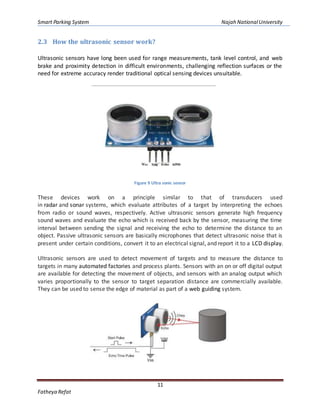
Figure 9 Ultra sonic sensor
These devices work on a principle similar to that of transducers used
in radar and sonar systems, which evaluate attributes of a target by interpreting the echoes
from radio or sound waves, respectively. Active ultrasonic sensors generate high frequency
sound waves and evaluate the echo which is received back by the sensor, measuring the time
interval between sending the signal and receiving the echo to determine the distance to an
object. Passive ultrasonic sensors are basically microphones that detect ultrasonic noise that is
present under certain conditions, convert it to an electrical signal, and report it to a LCD display.
Ultrasonic sensors are used to detect movement of targets and to measure the distance to
targets in many automated factories and process plants. Sensors with an on or off digital output
are available for detecting the movement of objects, and sensors with an analog output which
varies proportionally to the sensor to target separation distance are commercially available.
They can be used to sense the edge of material as part of a web guiding system.
Smart Parking System Najah NationalUniversity
12
Fatheya Refat
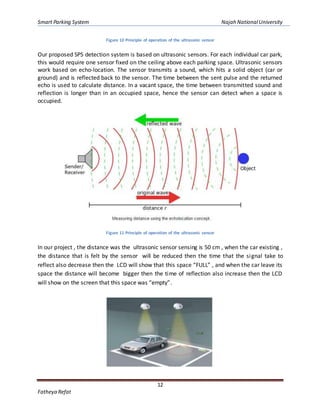
Figure 10 Principle of operation of the ultrasonic sensor
Our proposed SPS detection system is based on ultrasonic sensors. For each individual car park,
this would require one sensor fixed on the ceiling above each parking space. Ultrasonic sensors
work based on echo-location. The sensor transmits a sound, which hits a solid object (car or
ground) and is reflected back to the sensor. The time between the sent pulse and the returned
echo is used to calculate distance. In a vacant space, the time between transmitted sound and
reflection is longer than in an occupied space, hence the sensor can detect when a space is
occupied.
Figure 11 Principle of operation of the ultrasonic sensor
In our project , the distance was the ultrasonic sensor sensing is 50 cm , when the car existing ,
the distance that is felt by the sensor will be reduced then the time that the signal take to
reflect also decrease then the LCD will show that this space “FULL” , and when the car leave its
space the distance will become bigger then the time of reflection also increase then the LCD
will show on the screen that this space was “empty”.
Smart Parking System Najah NationalUniversity
13
Fatheya Refat
Figure 12
The sensor measure the car park space every the 30 seconds.
Smart Parking System Najah NationalUniversity
14
Fatheya Refat
3 CHAPTER 3
3.1 Hardware and components
The following picture show the circuit we depend on in our project,
Figure 13-design circuit
in our project the main part of the circuit depends on the sensor we use , as shown in the
picture above the Ultrasonic sensors are often used in robots for obstacle avoidance,
navigation and map building. Much of the early work was based on a device developed by
Polaroid for camera range finding that their ultrasonic range sensor works by emitting a short
burst of 40 kHz ultrasonic sound from a piezoelectric transducer. A small amount of sound
energy is reflected by objects in front of the device and returned to the detector, another
piezoelectric transducer. The receiver amplifier sends these reflected signals (echoes) to [a]
micro-controller which times them to determine how far away the objects are, by using the
speed of sound in air. The calculated range is then converted to a constant current signal and
sent it to the RCX.
Smart Parking System Najah NationalUniversity
15
Fatheya Refat
3.2 The circuit indetails
1. IC U1 555 timer:
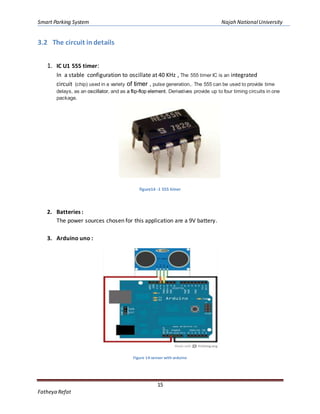
In a stable configuration to oscillate at 40 KHz , The 555 timer IC is an integrated
circuit (chip) used in a variety of timer , pulse generation,. The 555 can be used to provide time
delays, as an oscillator, and as a flip-flop element. Derivatives provide up to four timing circuits in one
package.
figure14 -1 555 timer
2. Batteries :
The power sources chosen for this application are a 9V battery.
3. Arduino uno :
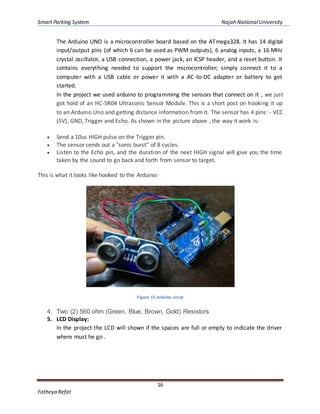
Figure 14-sensor with arduino
Smart Parking System Najah NationalUniversity
16
Fatheya Refat
The Arduino UNO is a microcontroller board based on the ATmega328. It has 14 digital
input/output pins (of which 6 can be used as PWM outputs), 6 analog inputs, a 16 MHz
crystal oscillator, a USB connection, a power jack, an ICSP header, and a reset button. It
contains everything needed to support the microcontroller; simply connect it to a
computer with a USB cable or power it with a AC-to-DC adapter or battery to get
started.
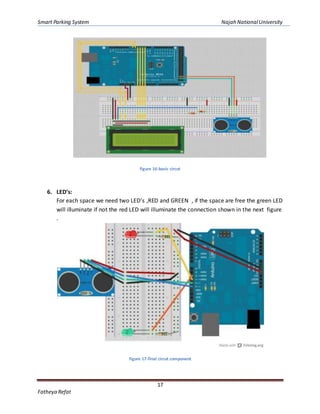
In the project we used arduino to programming the sensors that connect on it , we just
got hold of an HC-SR04 Ultrasonic Sensor Module. This is a short post on hooking it up
to an Arduino Uno and getting distance information from it. The sensor has 4 pins: - VCC
(5V), GND, Trigger and Echo. As shown in the picture above , the way it work is:
 Send a 10us HIGH pulse on the Trigger pin.
 The sensor sends out a "sonic burst" of 8 cycles.
 Listen to the Echo pin, and the duration of the next HIGH signal will give you the time
taken by the sound to go back and forth from sensor to target.
This is what it looks like hooked to the Arduino:
Figure 15-arduino circut
4. Two (2) 560 ohm (Green, Blue, Brown, Gold) Resistors
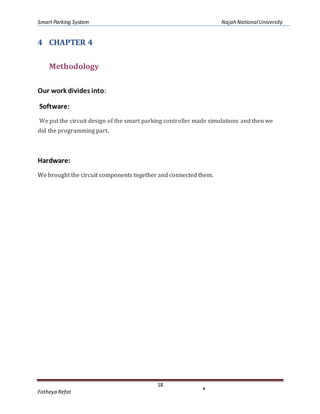
5. LCD Display:
In the project the LCD will shown if the spaces are full or empty to indicate the driver
where must he go .
Smart Parking System Najah NationalUniversity
17
Fatheya Refat
figure 16-basic circut
6. LED’s:
For each space we need two LED’s ,RED and GREEN , if the space are free the green LED
will illuminate if not the red LED will illuminate the connection shown in the next figure
.
figure 17-final circut component
Smart Parking System Najah NationalUniversity
18
Fatheya Refat
4 CHAPTER 4
Methodology
Our work divides into:
Software:
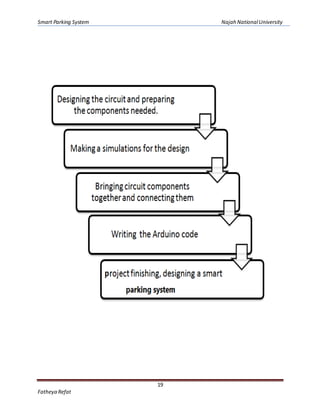
We put the circuit design of the smart parking controller made simulations and then we
did the programming part.
Hardware:
We brought the circuit components together and connected them.
Smart Parking System Najah NationalUniversity
19
Fatheya Refat
Smart Parking System Najah NationalUniversity
20
Fatheya Refat
5 CHAPTER 5
Result and Analysis
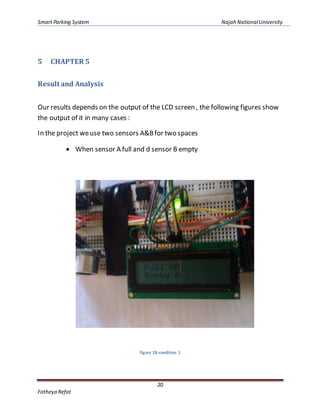
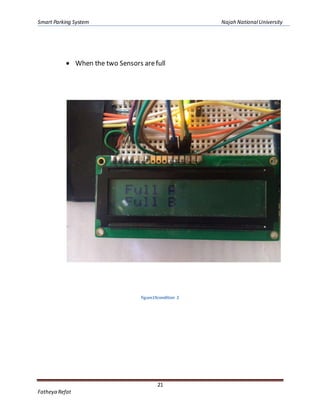
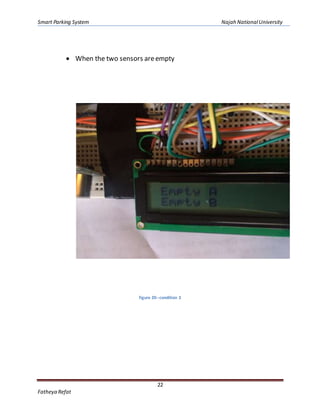
Our results depends on the output of the LCD screen , the following figures show
the output of it in many cases :
In the project weuse two sensors A&Bfor two spaces
 When sensor A full and d sensor B empty
figure 18-condition 1
Smart Parking System Najah NationalUniversity
21
Fatheya Refat
 When the two Sensors arefull
figure19condition 2
Smart Parking System Najah NationalUniversity
22
Fatheya Refat
 When the two sensors areempty
figure 20--condition 3
Smart Parking System Najah NationalUniversity
23
Fatheya Refat
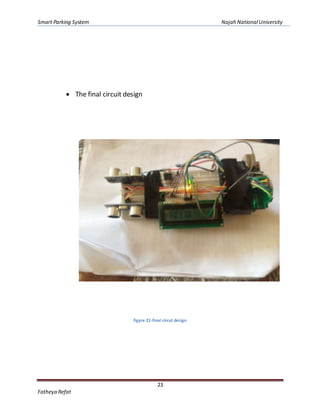
 The final circuit design
figyre 21-final circut design
Smart Parking System Najah NationalUniversity
24
Fatheya Refat
6 CHAPTER 6
Technical and economic feasibility
The proposed system of a smart parking is economically efficient, because the ultrasonic
sensors we use are relatively cheap adding to this, it will save the workers’ salaries.
Smart Parking System Najah NationalUniversity
25
Fatheya Refat
7 CHAPTER 7
Conclusionand Recommendation
The main contribution of this study is to introduce the most significant parking problem —i.e.,
finding an empty space — and propose a solution. Ultrasonic sensor can be used both for parking
space detection and improper parking detection. The proposed architecture for aparking detection
system would decrease searching time for vacant spaces and reduce instances of single cars
improperly parking across two spaces. Future research might examine car park booking
procedures and optimization of sensor usage. Cost effectiveness and marketing could be studied
as well.
Smart Parking System Najah NationalUniversity
26
Fatheya Refat
8 References
[1]Ajzen,M.F. (1975). Belief, Attitudeand behavior,and an Introduction to theory and beResearch.
Addison-Wesley.
AminKianpisheh,N.M.(2012). SmartParkingSystem(SPS) ArchitectureUsingUltrasonicDetector.
InternationalJournalof SoftwareEngineering and ItsApplications ,6 (3), 51-58.
[3] S. Yasunobu,K.Kinoshita,"Developmentof IntelligentParkingSupportSystemforWelfareVehicle”,
IEEE InternationalSymposiumonComputational IntelligenceInRoboticsAndAutomation,pp.682- 687
16-20 July2003.
[4] M. Wada, K. Yoon,H. Hashimoto,S.Matsuda, "Developmentof AdvancedParkingAssistance System
usingHumanGuidance”,IEEE/ASME International Conference onAdvancedIntelligentMechatronics,
pp.997-1002, 1999.
[5] L. Winching,X.Fanghua,L. Fishing,“DesignofInnerIntelligentCarParkingSystem”,International
Conference onInformationManagement,InnovationManagementandIndustrial Engineering2008.
[6 ] E. Seignez,A.Lambert,T.Maurin,“Autonomous ParkingCarrierforIntelligentVehicle”,IEEE
Intelligent VehiclesSymposium,pp.411- 416, 6-8 June 2005.
Smart Parking System Najah NationalUniversity
27
Fatheya Refat
9 Appendix
Appendix A
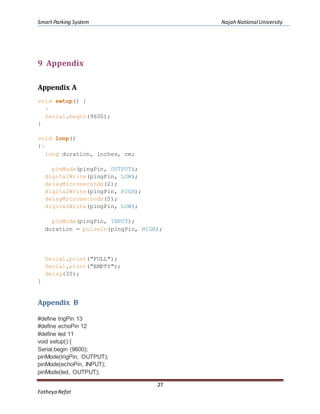
void setup() {
:
Serial.begin(9600);
}
void loop()
{:
long duration, inches, cm;
pinMode(pingPin, OUTPUT);
digitalWrite(pingPin, LOW);
delayMicroseconds(2);
digitalWrite(pingPin, HIGH);
delayMicroseconds(5);
digitalWrite(pingPin, LOW);
pinMode(pingPin, INPUT);
duration = pulseIn(pingPin, HIGH);
Serial.print("FULL");
Serial.print("EMPTY");
delay(30);
}
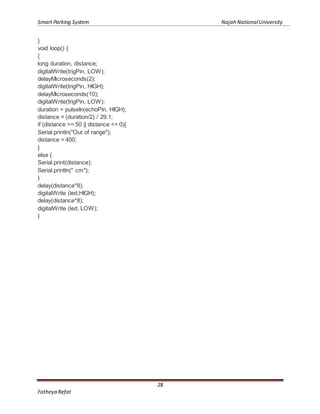
Appendix B
#define trigPin 13
#define echoPin 12
#define led 11
void setup() {
Serial.begin (9600);
pinMode(trigPin, OUTPUT);
pinMode(echoPin, INPUT);
pinMode(led, OUTPUT);
Smart Parking System Najah NationalUniversity
28
Fatheya Refat
}
void loop() {
{
long duration, distance;
digitalWrite(trigPin, LOW);
delayMicroseconds(2);
digitalWrite(trigPin, HIGH);
delayMicroseconds(10);
digitalWrite(trigPin, LOW);
duration = pulseIn(echoPin, HIGH);
distance = (duration/2) / 29.1;
if (distance >= 50 || distance <= 0){
Serial.println("Out of range");
distance = 400;
}
else {
Serial.print(distance);
Serial.println(" cm");
}
delay(distance*8);
digitalWrite (led,HIGH);
delay(distance*8);
digitalWrite (led, LOW);
}

Smart parking system

  • 1.
    Fatheya refat 2014/2015 Dr. FalahHassn | Fatheya Refat GRADUATION PROJECT SMART PARKING SYSTEM
  • 2.
    Smart Parking SystemNajah NationalUniversity i Fatheya Refat Contents Abstract________________________________________________________________________________ v 1 Chapter 1 __________________________________________________________________________ 1 1.1 Overview ______________________________________________________________________ 1 1.2 The main goal and the suggestion solutions for the problem____________________________ 2 2 CHAPTER 2 ________________________________________________________________________ 10 2.1 Our project implementation ______________________________________________________ 10 2.2 How we must choose the suitable sensor to implement our project_____________________ 10 2.3 How the ultrasonic sensor work? _________________________________________________ 11 3 CHAPTER 3________________________________________________________________________ 14 3.1 Hardware and components ______________________________________________________ 14 3.2 The circuit in details ____________________________________________________________ 15 4 CHAPTER 4 ________________________________________________________________________ 18 Methodology __________________________________________________________________________ 18 5 CHAPTER 5 ________________________________________________________________________ 20 Result and Analysis______________________________________________________________________ 20 6 CHAPTER 6 ________________________________________________________________________ 24 Technical andeconomic feasibility_________________________________________________________ 24 7 CHAPTER 7 ________________________________________________________________________ 25 Conclusion and Recommendation _________________________________________________________ 25 8 References ________________________________________________________________________ 26 9 Appendix____________________________________________________________________________ 27 Appendix A_________________________________________________________________________ 27
  • 3.
    Smart Parking SystemNajah NationalUniversity ii Fatheya Refat Table of figures Figure 1 improper parking ______________________________________________________________________________ 2 Figure 2the system features _____________________________________________________________________________ 3 Figure 3ultrasonic sensor principle of operation ___________________________________________________________ 4 Figure 4 how the ultrasonic system work _________________________________________________________________ 4 Figure 5Agent based parking assistance system.___________________________________________________________ 6 Figure 6[Vehicular communication-based smart parking technique.__________________________________________ 7 Figure 7wifi system SPS_________________________________________________________________________________ 9 Figure 8 LCD view_____________________________________________________________________________________ 10 Figure 9 Ultra sonic sensor_____________________________________________________________________________ 11 Figure 10 Principle of operation of the ultrasonic sensor ___________________________________________________ 12 Figure 11 Principle of operation of the ultrasonic sensor ___________________________________________________ 12 Figure 12 ____________________________________________________________________________________________ 13 Figure 13-design circuit _______________________________________________________________________________ 14 Figure 14-sensor with arduino__________________________________________________________________________ 15 Figure 15-arduino circut _______________________________________________________________________________ 16
  • 4.
    Smart Parking SystemNajah NationalUniversity iii Fatheya Refat Nomenclature: LED : Light emitting diode SPS: Smart Parking System
  • 5.
    Smart Parking SystemNajah NationalUniversity iv Fatheya Refat DISCLAIMER This report was written by student at Electrical Engineering department, faculty of Engineering, An-Najah National University. It has not been altered or corrected, other than editorial corrections, as a result of assessment and it may contain language as well as content errors. The views expressed in it together with any outcomes and recommendations are solely those of the student. An-Najah National University accepts no responsibility or liability for the consequence of this report being used for a purpose other than the purpose for which it was commissioned.
  • 6.
    Smart Parking SystemNajah NationalUniversity v Fatheya Refat Abstract With the increase in vehicle production and world population, more and more parking spaces and facilities are required. In this project a new parking system called Smart Parking System (SPS) is proposed to assist drivers to find vacant spaces in a car park in a shorter time. The new system uses ultrasonic sensors to detect either car park occupancy or improper parking actions. Different detection technologies are reviewed and compared to determine the best technology for developing SPS. Features of SPS include vacant parking space detection, detection of improper parking, display of available parking spaces, and directional indicators toward vacant parking spaces, payment facilities and different types of parking spaces (vacant, occupied, reserved and handicapped) through the use of specific LEDs. This report also describes the use of an SPS system from the entrance into a parking lot until the finding of a vacant parking space. The system architecture defines the essential design features such as location of sensors, required number of sensors and LEDs for each level, and indoor and outdoor display boards.
  • 7.
    Fatheya refat 1 1Chapter 1 1.1 Overview Searching for a vacant parking space in a metropolitan area is the daily concern for most drivers, and it is time-consuming. It commonly results more traffic congestion and air pollution by constantly cruising in certain area only for an available parking space. For instance, a recent survey [1] shows that during rush hours in most big cities, the traffic generated by cars searching for parking spaces takes up to 40% of the total traffic. To alleviate such traffic congestion and improve the convenience for drivers, many smart parking systems aiming to satisfy the involved parties (e.g., parking service providers and drivers) have been deployed. The current smart parking or parking guidance systems only obtain the availability information of parking spaces from deployed sensor networks, and simply publish the parking information to direct drivers. However, since these systems cannot guide the drivers to their desired parking destinations, even sometimes make the situation worse, they are not “smart” enough. For instance, when the number of vacant spaces in an area is limited, more drivers, who obtain the parking information, are heading for these spaces. It will cause severer congestion. It is, therefore, strongly desired to provide an effective strategy to address these concerns In this project an LED display in the entrance of the parking will show to the drivers which level of the parking has available spaces and which space is the closest to driver. Our proposed SPS detection system is based on alight sensor, as we know any parking should divide into many spaces, in our project each space should contain alight sensor under the vacant when the driver enter to the park and the car take its place the sensor will measure the reflected light and then it will send to the display that this place is not available now
  • 8.
    Smart Parking SystemNajah NationalUniversity 2 Fatheya Refat 1.2 The main goal and the suggestion solutions for the problem In this Project, we mainly focus on designing a new smart parking system that assists drivers to find parking spaces in a specific parking district. In addition, an important goal of the system is to reduce the traffic searching for parking, hence reduce energy consumption and air pollution. If a car is parked in such a way that it occupies two parking slots rather than one, this is called improper parking. Improper parking can happen when a driver is not careful about another driver’s rights. Sometimes improper parking occurs when a driver parks on or a bit outside of the lines of a parking space. The driver may notice his improper parking after leaving his car, but may not be willing to unlock his car, restart it, and adjust it to be inside the lines. This matter annoys other drivers and most of the time a driver who wants to park ina small leftover slot will give up and feel frustrated. Figure1 presents an improper parking situation. Figure 1 improper parking There are too many solutions for the implementation of smart parking system a) The first solution is a web based advanced parking system: Parking spaces generated by lines using LED lighting technology creating real-time spaces for cars, motorcycles, handicap spots and other vehicles ,preset by operator or computer system. The mobile phone is used to assess Internet, over Wi-Fi or GSM cellular network, to obtain the information of parking availability and make parking reservation from the Internet server. The mobile phone also provides the Bluetooth module to communicate with sensors when verifying the driver's identity [1]
  • 9.
    Smart Parking SystemNajah NationalUniversity 3 Fatheya Refat Figure 2the system features Drivers want to know:  the location of car park nearby  how to reduce waiting time for car park during holidays or peak parking hours  how to enter the target car park without stuck  in traffic congestion  comparison of parking fees of every car park  the length , width , height and ground condition  of parking space  the number of parking spaceavailable and their location on each floor in car park  Whether car parks have discounts or special benefits. Example: Some shopping malls waive the parking fees when consumers’ purchases reach the required amount.[2] b) The second solution: Smart Parking System (SPS) Architecture using ultrasonic detector the following figure show how the ultrasonic sensor work
  • 10.
    Smart Parking SystemNajah NationalUniversity 4 Fatheya Refat Figure 3ultrasonic sensor principle of operation In order to find vacant spaces, drivers look at an LED display board which shows how many and which type of vacant spaces are available at each level at that time. After navigating to the desired parking level, drivers look at internal signs hanging from the ceiling at the end of each aisle. Each internal sign shows two parts: the number of available spaces and the direction (left, right or forward) of the aisle which has a vacant space. Each individual parking space is equipped with LED lights which are located above the space and can show green, red, blue or yellow. The color indicates the status of that space: green means the space is vacant, red means the space is occupied, blue means the space is assigned for handicapped drivers and yellow means it has been booked or is a VIP or reserved space for specific reasons. When a driver enters a vacant space, the green light changes to red. The following figure describe the system [2] Figure 4 how the ultrasonic system work Ultrasonic sensors transmit sound waves between 25 kHz and 50 kHz. They use thereflected energy to analyze and detect the status of a parking space. Ultrasonic
  • 11.
    Smart Parking SystemNajah NationalUniversity 5 Fatheya Refat waves areemitted from the head of an ultrasonic vehicle detection sensor every 60 milliseconds, and thepresence or absence of vehicles is determined by time differences between the emitted andreceived signals. Ultrasonic sensors can be used for counting vehicles and assessing theoccupancy status of each parking space [10]. Despite the low cost and easy installation ofultrasonic sensors, they do have some disadvantages, particularly sensitivity to temperaturechanges and extreme air turbulence. The LED lights can be attached to the detector sensor or mounted separately. SPS uses separate LED indicator to be more flexible and make it possible to fix both pieces at the bestposition. The LED and the sensor connect to each other through a phone cable. When theindicator displays green, it means the parking space is available; when the indicator displaysred, it means the space is occupied. In case of a handicapped parking space, a blue LEDindicates vacancy and red indicates occupancy. Reserved spaces areidentified by a yellowLED. Figure 5 LED indictors c) The third solution: Intelligent Car Parking System: This system has a number of subsystems namely an Ad-hoc subsystem, a parking gateway subsystem, a vehicle detection subsystem and a video image processor sensor subsystem.Every car has a unique Vehicle Identification Number (VID) associated with it. For overcoming the common discrepancies of the existing vision based target parking position labeled methods in dark indoor parking sites, [42] proposes a light stripe projection based free parking space recognition method. For recognition of the 3D information
  • 12.
    Smart Parking SystemNajah NationalUniversity 6 Fatheya Refat of parking site, light stripe projection method is used. System is able to recognize discontinue points, pivot and opposite site reference points, once the Analysis of 3D information takes place. For automatic steering movement during parking operation; a kind of driver assistant system known as intelligent parking assist system is used, which has the following six parts[3]  Target position designation  Deciding the path  Finding the path  Active steering  Active braking  Human Machine Interface (HMI) There are two classesof cars which are considered by this architecture Figure 5Agent based parking assistance system.
  • 13.
    Smart Parking SystemNajah NationalUniversity 7 Fatheya Refat  Class 1 vehicles are those vehicles which do not have any embedded wireless system  Class 2 vehicles are those vehicles which have an embedded wireless device with Ad-hornet working capability. Every car has a unique Vehicle Identification Number (VID) associated with it. For overcoming the common discrepancies of the existing vision based target parking position labeled methods in dark indoor parking sites, proposes a light stripe Projection based free parking space recognition method. Figure 6[Vehicular communication-based smart parking technique. For recognition of the 3D information of parking site, light stripe projection method is used. System is able to recognize discontinue points, pivot and opposite site reference points, once the analysis of 3D information takes place. For automatic steering movement during parking operation; a kind of driver assistant system known as intelligent parking assist system is used d) The fourth solution :Smart Parking System using Wireless Sensor Networks In this paper, we propose and implement a car parking management system using wireless sensor networks such that overall efficiency and flexibility of the facility management system is improved. The system is highly cost-effective as each mote is equipped with only one passive ambient light sensor, to detect the presence or absence of a car. Apart from detecting the car the sensor mote also provides additional information like the amount of time the car has been parked and als its health status. The system designed is also energy efficient, since the radio module at the mote is allowed to “sleep” at regular intervals. In addition the power consumed by the radio module is reduced by the use of repeaters. The proposed system is completely automated and does not require the presence of a human at the entry or exit point. The system not only displays the availability status at strategic locations but also sends the information such as slot allotted, time parked, billing information
  • 14.
    Smart Parking SystemNajah NationalUniversity 8 Fatheya Refat and directional details to the user’s mobile phone via SMS (Short Message Service). By introducing the SMS feature we are basically targeting everyone as the number of mobile subscribers in the world are very high, which is expected to increase further tremendously. Furthermore, including the SMS feature helps us avoid the usage of paper or plastic cards that are currently used for the purpose of parking/billing [4] The block diagram of the system is shown in the Figure below and the CSS comprises of components as shown below . The operation of the systemic as follows: • A user enters the parking facility. At the entrance, there will be a keypad and a displays shown is Figure 9. The driver enters his mobile phone number using the keypad. • On successful entry of the phone number, ID of the nearest empty parking slot, time of entry and route direction information will be displayed on the monitor. The same information will also be sent to the user’s mobile phone via SMS. • In order to incorporate the SMS feature, ages modem is connected to the CSS. A java based SMS gateway at the CSS provides the essential functionality using AT commands to the send the SMS • When the driver parks the car in the designated slot, a timer is started in the mote present in that slot. The mote will inform the CSS that the slot has been currently occupied. • The CSS will update the database of the motes with the occupancy information along with the corresponding user mobile phone number. This is done to uniquely identify the parking slot with the vehicle. • When the driver leaves the parking slot area, immediately the timer in that slot’s mote stops. The timer data is communicated to the CSS. • The CSS consults its database, extracts the mobile phone number field corresponding to the mote ID it received, and sends an SMS tithe user. The SMS will contain information of how long the vehicle was parked and the billing amount • By the time the driver reaches the exit of the parking facility, he/she would have received the SMS containing the billing information.[4]
  • 15.
    Smart Parking SystemNajah NationalUniversity 9 Fatheya Refat Figure 7wifi system SPS
  • 16.
    Smart Parking SystemNajah NationalUniversity 10 Fatheya Refat 2 CHAPTER 2 2.1 Our project implementation After our studying and researching for the suggestion solutions to implement a smart parking system that corresponding the requirement to facilitate the entry and exit of vehicles to the parking we Quote the idea from the second solution from the above suggestions that is Smart Parking System (SPS) Architecture Using Ultrasonic sensor that is the ultrasonic sensor to detect the availability of the car in the parking spaces and we will use the LCD and the LED to indicate what is the available spaces In the parking the LCD will show to the enter drivers where is the most closest level and free space to directs the driver where must him to go at first to any level and then to any space number in the level as shown in the next figure . Figure 8 LCD view 2.2 How we must choose the suitable sensor to implement our project Another detection technology uses sensors to detect vacant spaces in a parking lot. With the availability of various types of sensors, selecting a suitable detection system is an important part of implementing a smart parking system. Different factors play a role in choosing the proper sensor, including size, reliability, adaptation to environmental changes, robustness and cost. Sensors technologies are categorized as either intrusive or non-intrusive. Intrusive sensors need to be installed directly on the pavement surface, so digging and tunneling under the road surface are required. Magnetometers, pneumatic tubes, inductive loops, weight-in-motion Sensors and piezoelectric cables are considered intrusive sensors [9]. Non-intrusive sensors only require fixing on the ceiling or on the ground. Ultrasonic sensors are categorized as nonintrusive sensors, meaning that they require simpler installation compared to intrusive sensors. In our project we need to use the ultrasonic sensor to detect the availability of the car in the parking spaces we need to know how this sensor work
  • 17.
    Smart Parking SystemNajah NationalUniversity 11 Fatheya Refat 2.3 How the ultrasonic sensor work? Ultrasonic sensors have long been used for range measurements, tank level control, and web brake and proximity detection in difficult environments, challenging reflection surfaces or the need for extreme accuracy render traditional optical sensing devices unsuitable. Figure 9 Ultra sonic sensor These devices work on a principle similar to that of transducers used in radar and sonar systems, which evaluate attributes of a target by interpreting the echoes from radio or sound waves, respectively. Active ultrasonic sensors generate high frequency sound waves and evaluate the echo which is received back by the sensor, measuring the time interval between sending the signal and receiving the echo to determine the distance to an object. Passive ultrasonic sensors are basically microphones that detect ultrasonic noise that is present under certain conditions, convert it to an electrical signal, and report it to a LCD display. Ultrasonic sensors are used to detect movement of targets and to measure the distance to targets in many automated factories and process plants. Sensors with an on or off digital output are available for detecting the movement of objects, and sensors with an analog output which varies proportionally to the sensor to target separation distance are commercially available. They can be used to sense the edge of material as part of a web guiding system.
  • 18.
    Smart Parking SystemNajah NationalUniversity 12 Fatheya Refat Figure 10 Principle of operation of the ultrasonic sensor Our proposed SPS detection system is based on ultrasonic sensors. For each individual car park, this would require one sensor fixed on the ceiling above each parking space. Ultrasonic sensors work based on echo-location. The sensor transmits a sound, which hits a solid object (car or ground) and is reflected back to the sensor. The time between the sent pulse and the returned echo is used to calculate distance. In a vacant space, the time between transmitted sound and reflection is longer than in an occupied space, hence the sensor can detect when a space is occupied. Figure 11 Principle of operation of the ultrasonic sensor In our project , the distance was the ultrasonic sensor sensing is 50 cm , when the car existing , the distance that is felt by the sensor will be reduced then the time that the signal take to reflect also decrease then the LCD will show that this space “FULL” , and when the car leave its space the distance will become bigger then the time of reflection also increase then the LCD will show on the screen that this space was “empty”.
  • 19.
    Smart Parking SystemNajah NationalUniversity 13 Fatheya Refat Figure 12 The sensor measure the car park space every the 30 seconds.
  • 20.
    Smart Parking SystemNajah NationalUniversity 14 Fatheya Refat 3 CHAPTER 3 3.1 Hardware and components The following picture show the circuit we depend on in our project, Figure 13-design circuit in our project the main part of the circuit depends on the sensor we use , as shown in the picture above the Ultrasonic sensors are often used in robots for obstacle avoidance, navigation and map building. Much of the early work was based on a device developed by Polaroid for camera range finding that their ultrasonic range sensor works by emitting a short burst of 40 kHz ultrasonic sound from a piezoelectric transducer. A small amount of sound energy is reflected by objects in front of the device and returned to the detector, another piezoelectric transducer. The receiver amplifier sends these reflected signals (echoes) to [a] micro-controller which times them to determine how far away the objects are, by using the speed of sound in air. The calculated range is then converted to a constant current signal and sent it to the RCX.
  • 21.
    Smart Parking SystemNajah NationalUniversity 15 Fatheya Refat 3.2 The circuit indetails 1. IC U1 555 timer: In a stable configuration to oscillate at 40 KHz , The 555 timer IC is an integrated circuit (chip) used in a variety of timer , pulse generation,. The 555 can be used to provide time delays, as an oscillator, and as a flip-flop element. Derivatives provide up to four timing circuits in one package. figure14 -1 555 timer 2. Batteries : The power sources chosen for this application are a 9V battery. 3. Arduino uno : Figure 14-sensor with arduino
  • 22.
    Smart Parking SystemNajah NationalUniversity 16 Fatheya Refat The Arduino UNO is a microcontroller board based on the ATmega328. It has 14 digital input/output pins (of which 6 can be used as PWM outputs), 6 analog inputs, a 16 MHz crystal oscillator, a USB connection, a power jack, an ICSP header, and a reset button. It contains everything needed to support the microcontroller; simply connect it to a computer with a USB cable or power it with a AC-to-DC adapter or battery to get started. In the project we used arduino to programming the sensors that connect on it , we just got hold of an HC-SR04 Ultrasonic Sensor Module. This is a short post on hooking it up to an Arduino Uno and getting distance information from it. The sensor has 4 pins: - VCC (5V), GND, Trigger and Echo. As shown in the picture above , the way it work is:  Send a 10us HIGH pulse on the Trigger pin.  The sensor sends out a "sonic burst" of 8 cycles.  Listen to the Echo pin, and the duration of the next HIGH signal will give you the time taken by the sound to go back and forth from sensor to target. This is what it looks like hooked to the Arduino: Figure 15-arduino circut 4. Two (2) 560 ohm (Green, Blue, Brown, Gold) Resistors 5. LCD Display: In the project the LCD will shown if the spaces are full or empty to indicate the driver where must he go .
  • 23.
    Smart Parking SystemNajah NationalUniversity 17 Fatheya Refat figure 16-basic circut 6. LED’s: For each space we need two LED’s ,RED and GREEN , if the space are free the green LED will illuminate if not the red LED will illuminate the connection shown in the next figure . figure 17-final circut component
  • 24.
    Smart Parking SystemNajah NationalUniversity 18 Fatheya Refat 4 CHAPTER 4 Methodology Our work divides into: Software: We put the circuit design of the smart parking controller made simulations and then we did the programming part. Hardware: We brought the circuit components together and connected them.
  • 25.
    Smart Parking SystemNajah NationalUniversity 19 Fatheya Refat
  • 26.
    Smart Parking SystemNajah NationalUniversity 20 Fatheya Refat 5 CHAPTER 5 Result and Analysis Our results depends on the output of the LCD screen , the following figures show the output of it in many cases : In the project weuse two sensors A&Bfor two spaces  When sensor A full and d sensor B empty figure 18-condition 1
  • 27.
    Smart Parking SystemNajah NationalUniversity 21 Fatheya Refat  When the two Sensors arefull figure19condition 2
  • 28.
    Smart Parking SystemNajah NationalUniversity 22 Fatheya Refat  When the two sensors areempty figure 20--condition 3
  • 29.
    Smart Parking SystemNajah NationalUniversity 23 Fatheya Refat  The final circuit design figyre 21-final circut design
  • 30.
    Smart Parking SystemNajah NationalUniversity 24 Fatheya Refat 6 CHAPTER 6 Technical and economic feasibility The proposed system of a smart parking is economically efficient, because the ultrasonic sensors we use are relatively cheap adding to this, it will save the workers’ salaries.
  • 31.
    Smart Parking SystemNajah NationalUniversity 25 Fatheya Refat 7 CHAPTER 7 Conclusionand Recommendation The main contribution of this study is to introduce the most significant parking problem —i.e., finding an empty space — and propose a solution. Ultrasonic sensor can be used both for parking space detection and improper parking detection. The proposed architecture for aparking detection system would decrease searching time for vacant spaces and reduce instances of single cars improperly parking across two spaces. Future research might examine car park booking procedures and optimization of sensor usage. Cost effectiveness and marketing could be studied as well.
  • 32.
    Smart Parking SystemNajah NationalUniversity 26 Fatheya Refat 8 References [1]Ajzen,M.F. (1975). Belief, Attitudeand behavior,and an Introduction to theory and beResearch. Addison-Wesley. AminKianpisheh,N.M.(2012). SmartParkingSystem(SPS) ArchitectureUsingUltrasonicDetector. InternationalJournalof SoftwareEngineering and ItsApplications ,6 (3), 51-58. [3] S. Yasunobu,K.Kinoshita,"Developmentof IntelligentParkingSupportSystemforWelfareVehicle”, IEEE InternationalSymposiumonComputational IntelligenceInRoboticsAndAutomation,pp.682- 687 16-20 July2003. [4] M. Wada, K. Yoon,H. Hashimoto,S.Matsuda, "Developmentof AdvancedParkingAssistance System usingHumanGuidance”,IEEE/ASME International Conference onAdvancedIntelligentMechatronics, pp.997-1002, 1999. [5] L. Winching,X.Fanghua,L. Fishing,“DesignofInnerIntelligentCarParkingSystem”,International Conference onInformationManagement,InnovationManagementandIndustrial Engineering2008. [6 ] E. Seignez,A.Lambert,T.Maurin,“Autonomous ParkingCarrierforIntelligentVehicle”,IEEE Intelligent VehiclesSymposium,pp.411- 416, 6-8 June 2005.
  • 33.
    Smart Parking SystemNajah NationalUniversity 27 Fatheya Refat 9 Appendix Appendix A void setup() { : Serial.begin(9600); } void loop() {: long duration, inches, cm; pinMode(pingPin, OUTPUT); digitalWrite(pingPin, LOW); delayMicroseconds(2); digitalWrite(pingPin, HIGH); delayMicroseconds(5); digitalWrite(pingPin, LOW); pinMode(pingPin, INPUT); duration = pulseIn(pingPin, HIGH); Serial.print("FULL"); Serial.print("EMPTY"); delay(30); } Appendix B #define trigPin 13 #define echoPin 12 #define led 11 void setup() { Serial.begin (9600); pinMode(trigPin, OUTPUT); pinMode(echoPin, INPUT); pinMode(led, OUTPUT);
  • 34.
    Smart Parking SystemNajah NationalUniversity 28 Fatheya Refat } void loop() { { long duration, distance; digitalWrite(trigPin, LOW); delayMicroseconds(2); digitalWrite(trigPin, HIGH); delayMicroseconds(10); digitalWrite(trigPin, LOW); duration = pulseIn(echoPin, HIGH); distance = (duration/2) / 29.1; if (distance >= 50 || distance <= 0){ Serial.println("Out of range"); distance = 400; } else { Serial.print(distance); Serial.println(" cm"); } delay(distance*8); digitalWrite (led,HIGH); delay(distance*8); digitalWrite (led, LOW); }