Prepared by:
1.AKSHA JOSHI (12012041002)
2.YASHTILVA (12012041122)
3.RASESH POPAT(12012041108)
 The NationalTransportation Safety Board(NTSB) in
the United States have indicated the significant
danger of fatigued drivers operating heavy vehicles.
52% of heavy truck single vehicle accidents were
fatigue-related. Annually, it is estimated there are
40,000 injuries and 1,550 fatalities caused from
fatigued persons at the wheel.
 Also based on researches done by the RealAutomóvil
Club de España (RACE), driver drowsiness involves a
high percentage (30%) of traffic accidents.
 Also a research suggests that up to 25% of accidents
on monotonous roads in India are fatigue related.
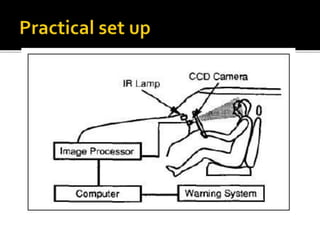
 The objective is to overcome the problem
related to the accidents related to drivers
experiencing fatigue leads to a need arises to
design a system that keeps the driver focused on
the road.
 Therefore many designs and prototypes have
been implemented in automobiles to avoid such
accidents by keeping the whole focus and
concentration on accurately monitoring the
open and closed state of the driver’s eye in real
time.
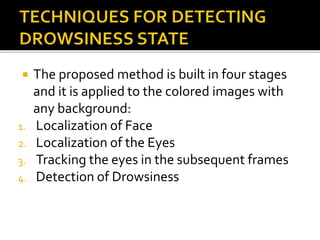
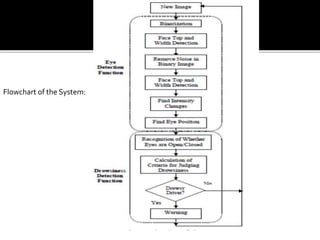
 The proposed method is built in four stages
and it is applied to the colored images with
any background:
1. Localization of Face
2. Localization of the Eyes
3. Tracking the eyes in the subsequent frames
4. Detection of Drowsiness
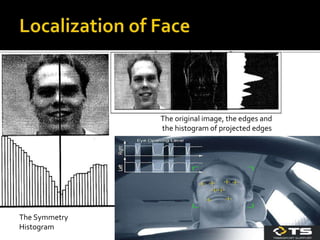
 Since the Face is symmetric, a symmetry-based
approach. It was found that it is enough to use a sub
sampled, gray-scale version of the image. A
symmetry-value is then computed for every pixel-
column in the reduced image.
 If the image is represented as I(x, y) then the
symmetry value for a pixel-column is given by :
S(x) = ∑∑ [abs I ((x,y-w)-(x,y+w))].
 S(x) is computed for X € [k,size-k] where k is the
maximum distance from the pixel-column that
symmetry is measured, and x size is
 the width of the image.The x corresponding to the
lowest value of S(x) is the center of the face.
The Symmetry
Histogram
The original image, the edges and
the histogram of projected edges
 A raster scan algorithm is used for the exact location
of the eyes and extracts that vertical location of eyes.
 The eye is tracked by looking for the darkest pixel in
the predicted region. In order to recover from tracking
errors, it’s made sure that none of the geometrical
constraints are violated. If they are, the eyes are re-
localized to the next frame.
 To find the best match for the eye template, it’s
initially centered at the darkest pixel, and then a
gradient descent is performed in order to find a local
minimum.
 The eyes is tracked by looking for the darkest pixel in
the predicted region.
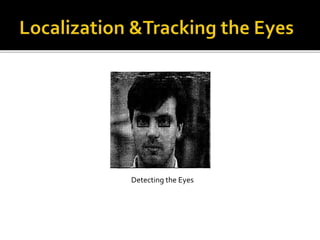
Detecting the Eyes
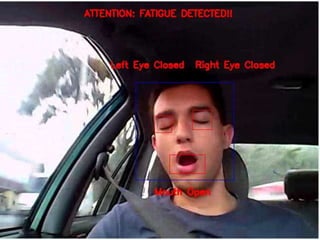
 As the driver becomes more fatigued, he/she
is expected the eye-blinks to last longer.This
lead to generation of consecutive frames
which depict that the eyes are closed.
 These frames are counted in order to decide
the condition of the driver.
 To determine whether the eyes are closed or
open, a method is implemented that looks at
the horizontal histogram across the pupil.

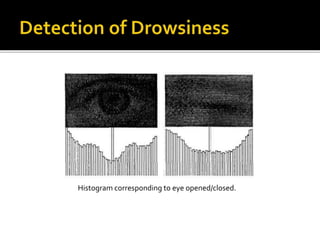
Histogram corresponding to eye opened/closed.
Flowchart of the System:
 A number of leading automotive companies
have implemented the DRIVER FATIGUE
DETECTION SYSTEM which assist drivers in
the physical and mental well being when
behind the wheel.
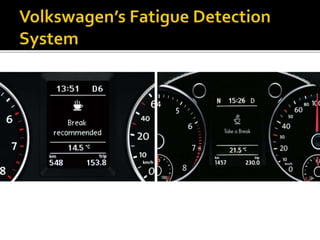
 Automobile companies likeVolkswagen and
Volvo have been the initial car developers to
implement this system
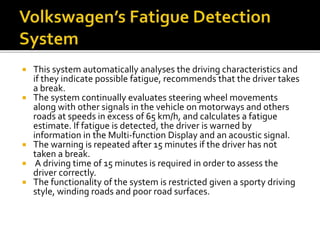
 This system automatically analyses the driving characteristics and
if they indicate possible fatigue, recommends that the driver takes
a break.
 The system continually evaluates steering wheel movements
along with other signals in the vehicle on motorways and others
roads at speeds in excess of 65 km/h, and calculates a fatigue
estimate. If fatigue is detected, the driver is warned by
information in the Multi-function Display and an acoustic signal.
 The warning is repeated after 15 minutes if the driver has not
taken a break.
 A driving time of 15 minutes is required in order to assess the
driver correctly.
 The functionality of the system is restricted given a sporty driving
style, winding roads and poor road surfaces.
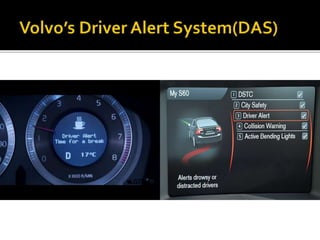
 The Driver Alert System is a system that detects
fatigued drivers and warns them before they fall
asleep behind the wheel.
 The Driver Alert System is intended to assist drivers
whose driving ability is deteriorating or who are
inadvertently leaving the lane they are driving on.
 Also to attract the driver's attention when he/she
starts to drive less consistently, e.g. if he/she becomes
distracted or starts to fall asleep.
 Driver Alert Control was the first fatigue detection
system developed by a car manufacturer, and has
been on the market since 2007.
 https://en.wikipedia.org/wiki/Fatigue_Detection
_Software
 http://www.volkswagen.com.au/en/technology_
and_service/technical-glossary/fatigue-
detection.html
 http://support.volvocars.com/uk/cars/pages/own
ers-
manual.aspx?mc=Y555&my=2015&sw=14w20&a
rticle=2e82f6fc0d1139c2c0a801e800329d4e
 http://www.transportsupport.co.uk/product/
Driver fatigue detection system

Driver fatigue detection system

  • 1.
    Prepared by: 1.AKSHA JOSHI(12012041002) 2.YASHTILVA (12012041122) 3.RASESH POPAT(12012041108)
  • 2.
     The NationalTransportationSafety Board(NTSB) in the United States have indicated the significant danger of fatigued drivers operating heavy vehicles. 52% of heavy truck single vehicle accidents were fatigue-related. Annually, it is estimated there are 40,000 injuries and 1,550 fatalities caused from fatigued persons at the wheel.  Also based on researches done by the RealAutomóvil Club de España (RACE), driver drowsiness involves a high percentage (30%) of traffic accidents.  Also a research suggests that up to 25% of accidents on monotonous roads in India are fatigue related.
  • 3.
     The objectiveis to overcome the problem related to the accidents related to drivers experiencing fatigue leads to a need arises to design a system that keeps the driver focused on the road.  Therefore many designs and prototypes have been implemented in automobiles to avoid such accidents by keeping the whole focus and concentration on accurately monitoring the open and closed state of the driver’s eye in real time.
  • 4.
     The proposedmethod is built in four stages and it is applied to the colored images with any background: 1. Localization of Face 2. Localization of the Eyes 3. Tracking the eyes in the subsequent frames 4. Detection of Drowsiness
  • 5.
     Since theFace is symmetric, a symmetry-based approach. It was found that it is enough to use a sub sampled, gray-scale version of the image. A symmetry-value is then computed for every pixel- column in the reduced image.  If the image is represented as I(x, y) then the symmetry value for a pixel-column is given by : S(x) = ∑∑ [abs I ((x,y-w)-(x,y+w))].  S(x) is computed for X € [k,size-k] where k is the maximum distance from the pixel-column that symmetry is measured, and x size is  the width of the image.The x corresponding to the lowest value of S(x) is the center of the face.
  • 6.
    The Symmetry Histogram The originalimage, the edges and the histogram of projected edges
  • 7.
     A rasterscan algorithm is used for the exact location of the eyes and extracts that vertical location of eyes.  The eye is tracked by looking for the darkest pixel in the predicted region. In order to recover from tracking errors, it’s made sure that none of the geometrical constraints are violated. If they are, the eyes are re- localized to the next frame.  To find the best match for the eye template, it’s initially centered at the darkest pixel, and then a gradient descent is performed in order to find a local minimum.  The eyes is tracked by looking for the darkest pixel in the predicted region.
  • 8.
  • 9.
     As thedriver becomes more fatigued, he/she is expected the eye-blinks to last longer.This lead to generation of consecutive frames which depict that the eyes are closed.  These frames are counted in order to decide the condition of the driver.  To determine whether the eyes are closed or open, a method is implemented that looks at the horizontal histogram across the pupil. 
  • 10.
    Histogram corresponding toeye opened/closed.
  • 12.
  • 13.
     A numberof leading automotive companies have implemented the DRIVER FATIGUE DETECTION SYSTEM which assist drivers in the physical and mental well being when behind the wheel.  Automobile companies likeVolkswagen and Volvo have been the initial car developers to implement this system
  • 14.
     This systemautomatically analyses the driving characteristics and if they indicate possible fatigue, recommends that the driver takes a break.  The system continually evaluates steering wheel movements along with other signals in the vehicle on motorways and others roads at speeds in excess of 65 km/h, and calculates a fatigue estimate. If fatigue is detected, the driver is warned by information in the Multi-function Display and an acoustic signal.  The warning is repeated after 15 minutes if the driver has not taken a break.  A driving time of 15 minutes is required in order to assess the driver correctly.  The functionality of the system is restricted given a sporty driving style, winding roads and poor road surfaces.
  • 16.
     The DriverAlert System is a system that detects fatigued drivers and warns them before they fall asleep behind the wheel.  The Driver Alert System is intended to assist drivers whose driving ability is deteriorating or who are inadvertently leaving the lane they are driving on.  Also to attract the driver's attention when he/she starts to drive less consistently, e.g. if he/she becomes distracted or starts to fall asleep.  Driver Alert Control was the first fatigue detection system developed by a car manufacturer, and has been on the market since 2007.
  • 19.
     https://en.wikipedia.org/wiki/Fatigue_Detection _Software  http://www.volkswagen.com.au/en/technology_ and_service/technical-glossary/fatigue- detection.html http://support.volvocars.com/uk/cars/pages/own ers- manual.aspx?mc=Y555&my=2015&sw=14w20&a rticle=2e82f6fc0d1139c2c0a801e800329d4e  http://www.transportsupport.co.uk/product/

Editor's Notes

  • #3 In Australia, 60-65% of truck haulage accidents are directly related to operator fatigue, and 30% of all crashes are related to fatigue.
  • #6 abs-This MATLAB function returns the absolute value of each element in array X.