SMART PARKING
SYSTEM
Gani Amanda
Budi Hariyanto
Referensi :
Smart Parking Service based on Wireless Sensor Networks
(Jihoon Yang, Jorge Portilla and Teresa Riesgo)
Automatic Smart Parking System using Internet of Things (IOT)
(Mr. Basavaraju S R)
On the Design of Smart Parking Networks in the Smart Cities: An Optimal
Sensor Placement Model
(Antoine Bagula ,Lorenzo Castelli and Marco Zennaro)
A Reservation-based Smart Parking System
(Hongwei Wang and Wenbo He)
➜In metropolitan areas, most vehicle drivers have the daily
concern of finding a vacant parking space especially during the
rush hours. It is time-consuming and it is leading to more traffic
congestion, air pollution and driver frustration.
➜A recent report presents that the traffic congestion is
generated by vehicles searching for parking spaces takes up to
45% of the total traffic. So, many parking management systems
have been deployed in order to reduce such traffic congestion
and improve the convenience for vehicle drivers.
➜Current Sytems cannot guide the drivers to their desired
parking destinations, For instance, when the number of vacant
spaces in an area is limited, more drivers, who obtain the parking
information, are heading for these spaces. It will cause severer
congestion.
ABSTRACT
➜ A few systems focused on the applications of vehicle parking
system using video camera sensor technologies to collect the
information in vehicle parking field. However, a video camera
sensor is expensive
➜ Expensive line or cabling
➜ Video Camera sensing generate a large amount of data that
can be difficult to transmit in wireless network.
➜Not provide flexibility of deployment
➜ Could tell the availability but could not make a reservation
COMMON PARKING SYSTEM
HOW CAN WE FIND EFFECTIVELY
FIND PARKING SPACES???
1. INTRODUCTION
“Smart Parking Services based on Wireless Sensor Networks
(WSNs)”
Wireless sensor network mote [1] is a tiny device which
usually consists of a low cost-sensor module, a microprocessor
module and a communication module, and provides a powerful
consortium of distributed sensing, computing and
communication. These modules can rapidly and easily be
deployed to collect, process, and transmit information.
“Reservation-based Smart Parking System (RSPS)”
not only to broadcast real-time parking information to the drivers
as part of a communal application, but also to provide
reservation service as part of user-targeted service.
INTRODUCTION
The proposed smart parking system consists of wireless sensor
networks, embedded web-server, central web-server and mobile
phone application as Android and iPhone. In this system, low-
cost wireless sensors network modules are deployed into each
parking slot equipped with one sensor node. The state of the
parking slot is detected by sensor node and is reported
periodically to the embedded web-server via the deployed
wireless sensor network. And this information is sent to central
web-server using WiFi networks in real-time.
sensing data from sensor network in parking lot and published
parking availability information. The drivers can retrieve parking
information and reserve their desired vacant spaces via Wi-Fi or
Internet
INTRODUCTION
2. SYSTEM
ARCHITECTURE
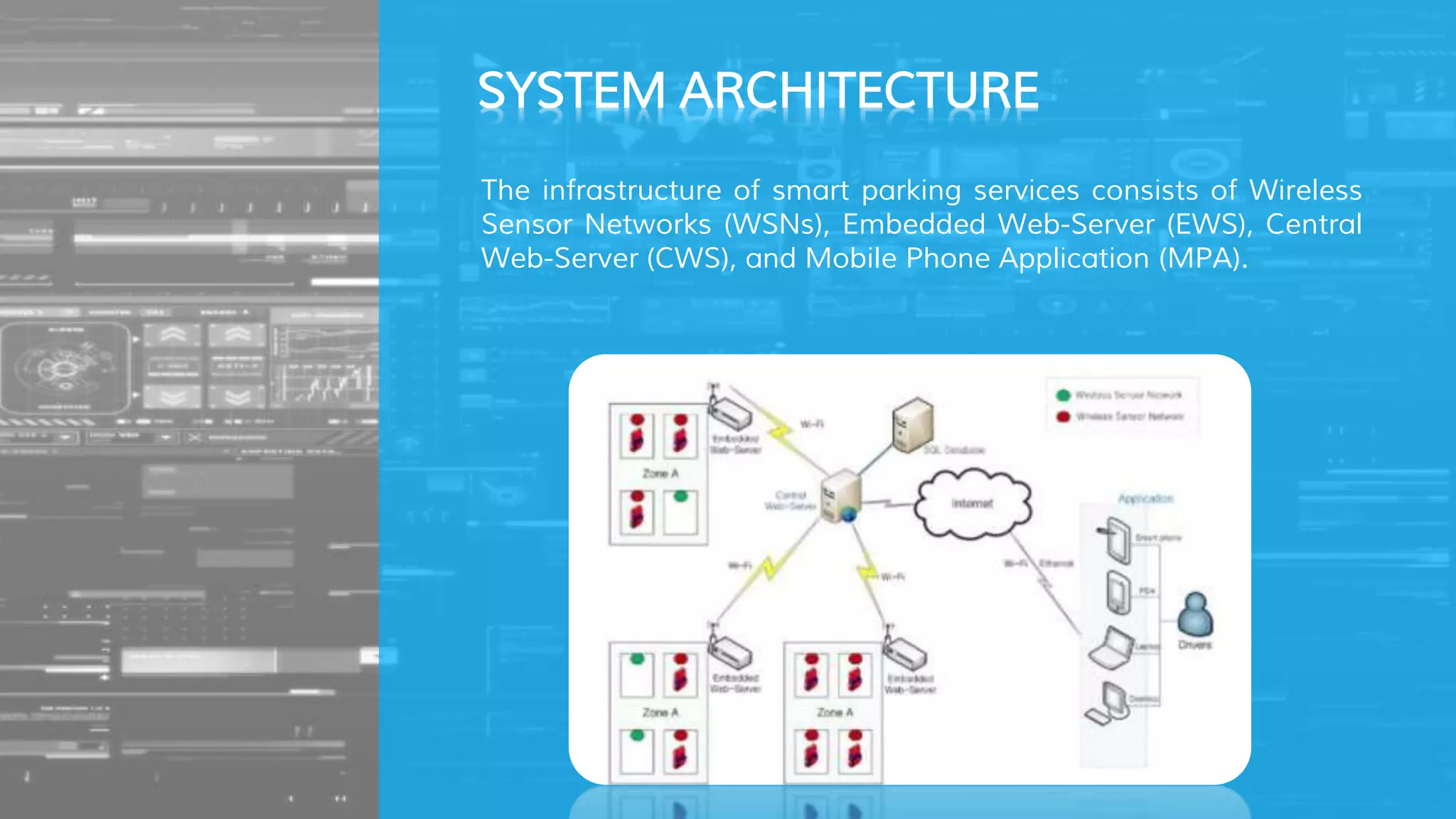
The infrastructure of smart parking services consists of Wireless
Sensor Networks (WSNs), Embedded Web-Server (EWS), Central
Web-Server (CWS), and Mobile Phone Application (MPA).
SYSTEM ARCHITECTURE
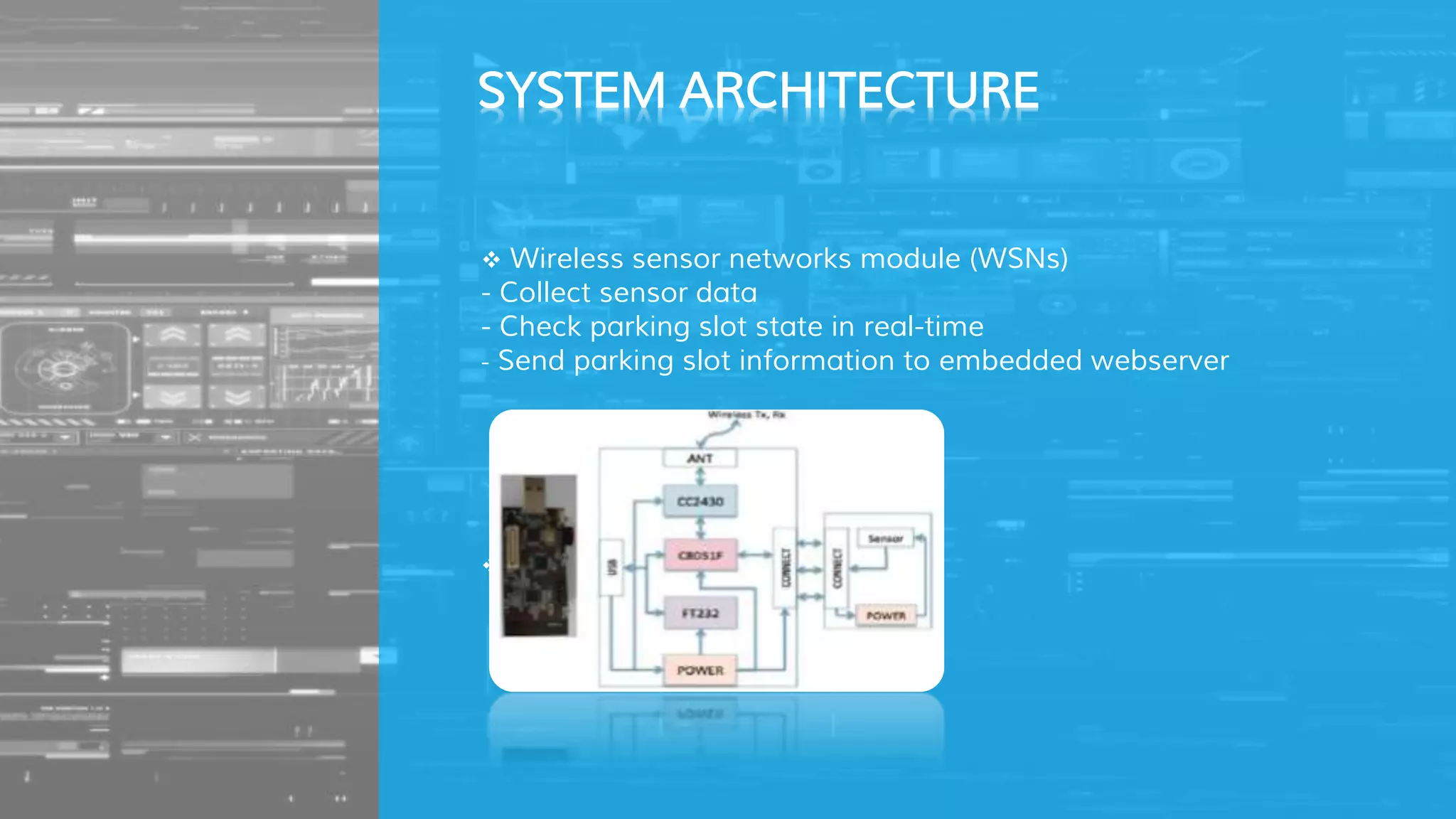
 Wireless sensor networks module (WSNs)
- Collect sensor data
- Check parking slot state in real-time
- Send parking slot information to embedded webserver

SYSTEM ARCHITECTURE
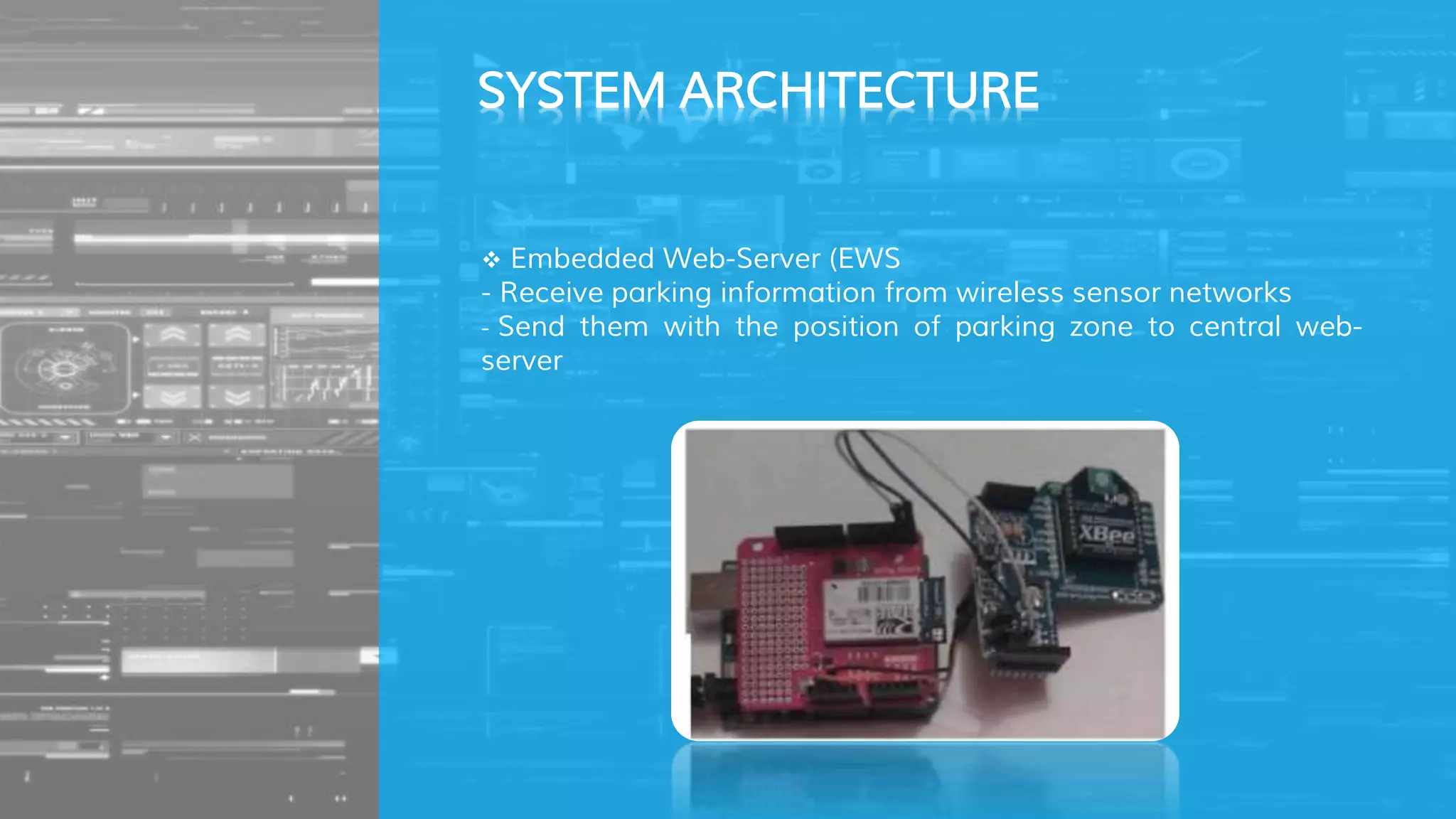
 Embedded Web-Server (EWS
- Receive parking information from wireless sensor networks
- Send them with the position of parking zone to central web-
server
SYSTEM ARCHITECTURE
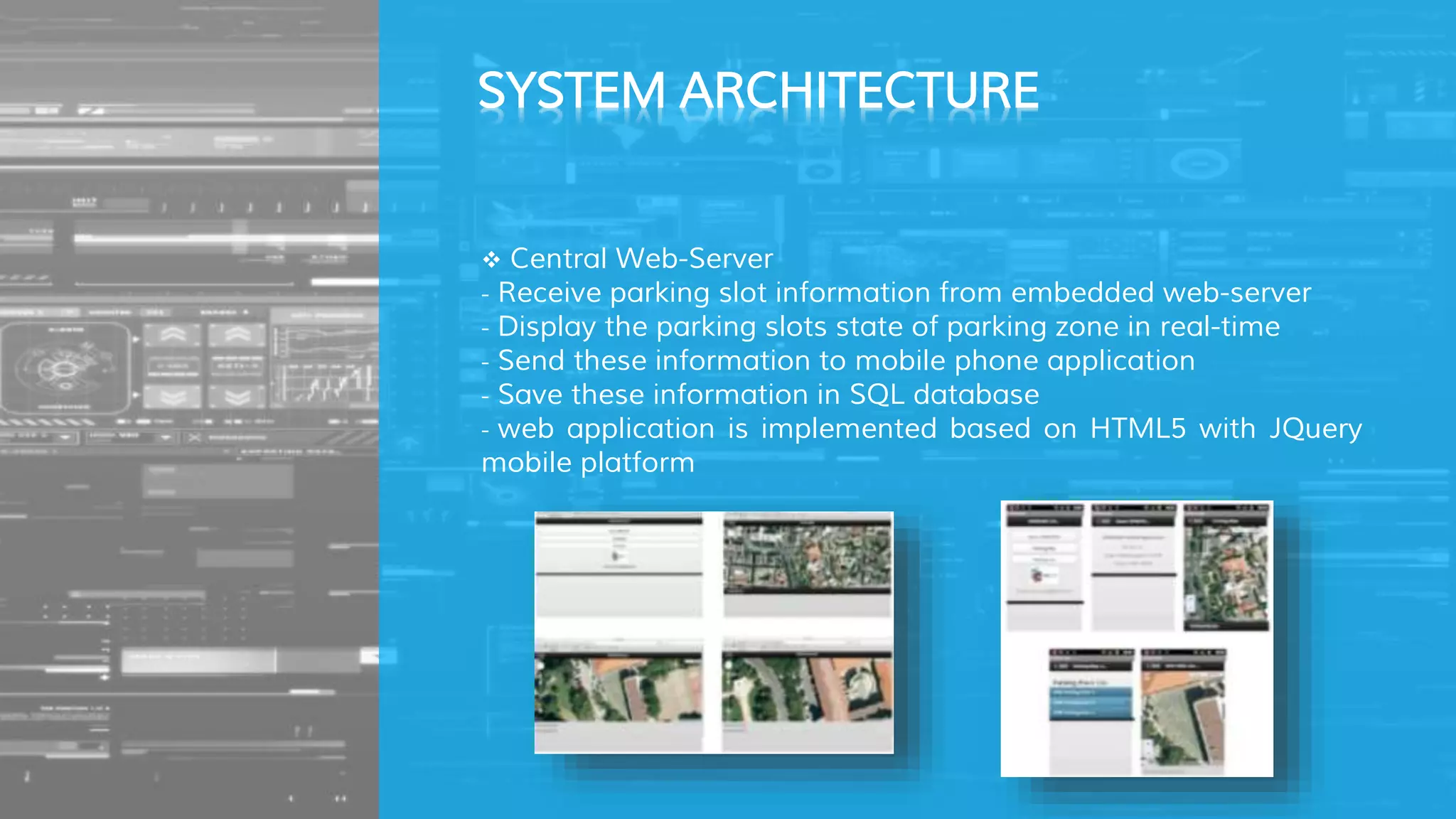
 Central Web-Server
- Receive parking slot information from embedded web-server
- Display the parking slots state of parking zone in real-time
- Send these information to mobile phone application
- Save these information in SQL database
- web application is implemented based on HTML5 with JQuery
mobile platform
SYSTEM ARCHITECTURE
 Mobile device of driver
- Connect to central web-server
- Receive parking slot information from central web-server
- Display the real-time monitoring of parking slots
- State in the nearest parking zone
SYSTEM ARCHITECTURE
3. SCENARIO
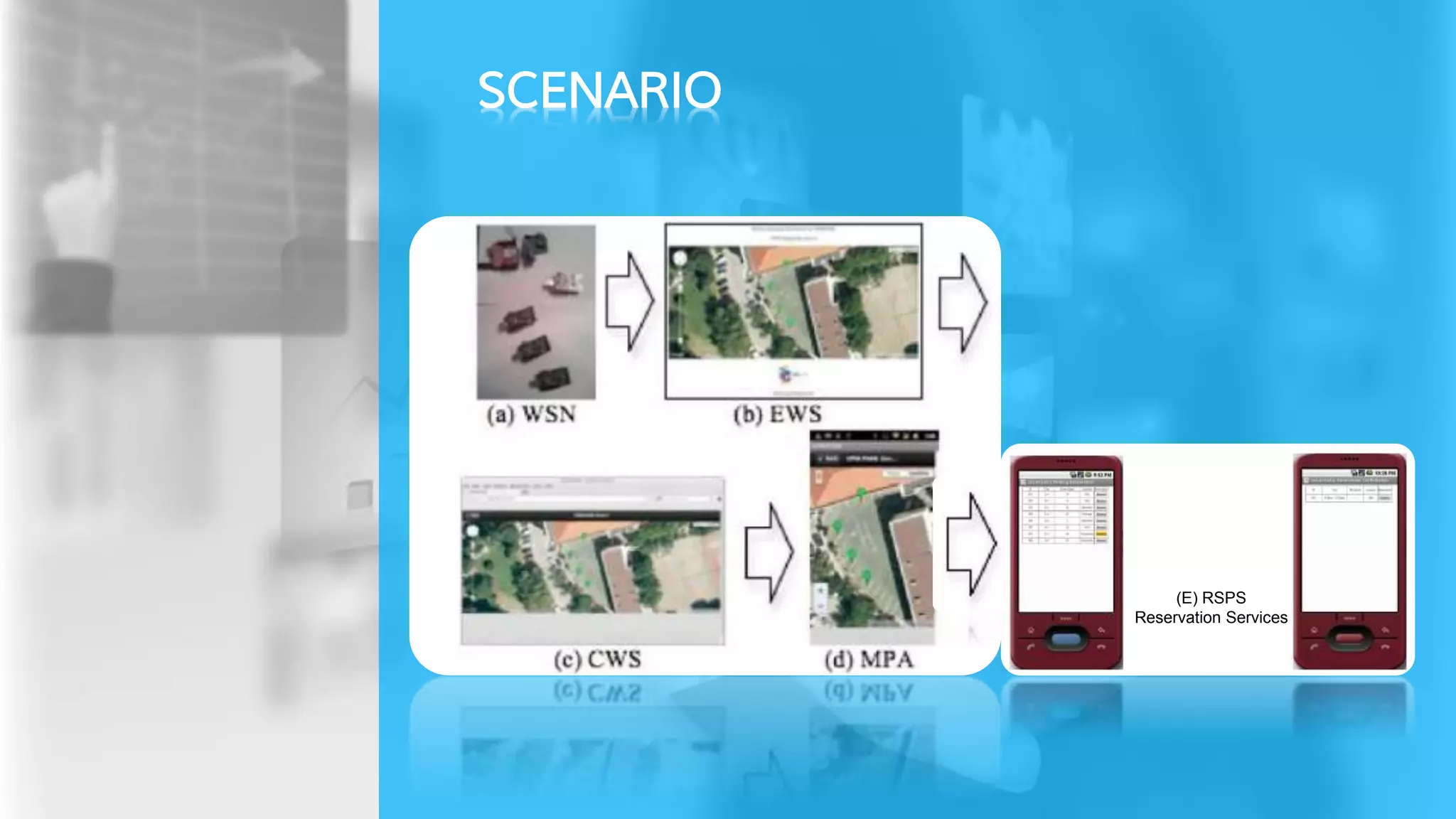
 Step 1 (WSN): Collect sensor data and
check parking slot state such as vacant slot
or occupied slot.
 Step 2 (EWS): Receive parking information,
display them on web-page, and send this
information.
 Step 3 (CWS): Display parking slots state
on web-page, save them in database,
provide parking information to reservation
Aplication.
Step 4 (RSPS) : Display the real-time
parking information, and provide reservation
and pricing.
 Step 5 (MPA): Connect to central web-
server, monitor parking slots state in real-
time.
SCENARIO
In this system, low-cost wireless sensors networks module are deployed into
each parking slot equipped with one sensor node. The state of the parking slot is
detected by sensor node and is reported periodically to the embedded web-
server via the deployed wireless sensor networks. And this information is sent to
central web-server using Wi-Fi networks in real-time. Besides, the vehicle driver
can find vacant parking lots using their mobile devices.
 When Wireless sensor network node has a cover, the parking slot become
unavailable for parking, then red-marker is indicated on web-page of embedded
web-server, central web-server. Therefore, the vehicle driver will be able to
confirm the parking slots state using mobile phone application in real-time.
 On the other hand, if wireless sensor network node does not the cover, the
parking slot become available for parking, then the green marked is indicated.
SCENARIO
SCENARIO
(E) RSPS
Reservation Services

Smart Parking

  • 1.
  • 2.
    Referensi : Smart ParkingService based on Wireless Sensor Networks (Jihoon Yang, Jorge Portilla and Teresa Riesgo) Automatic Smart Parking System using Internet of Things (IOT) (Mr. Basavaraju S R) On the Design of Smart Parking Networks in the Smart Cities: An Optimal Sensor Placement Model (Antoine Bagula ,Lorenzo Castelli and Marco Zennaro) A Reservation-based Smart Parking System (Hongwei Wang and Wenbo He)
  • 3.
    ➜In metropolitan areas,most vehicle drivers have the daily concern of finding a vacant parking space especially during the rush hours. It is time-consuming and it is leading to more traffic congestion, air pollution and driver frustration. ➜A recent report presents that the traffic congestion is generated by vehicles searching for parking spaces takes up to 45% of the total traffic. So, many parking management systems have been deployed in order to reduce such traffic congestion and improve the convenience for vehicle drivers. ➜Current Sytems cannot guide the drivers to their desired parking destinations, For instance, when the number of vacant spaces in an area is limited, more drivers, who obtain the parking information, are heading for these spaces. It will cause severer congestion. ABSTRACT
  • 4.
    ➜ A fewsystems focused on the applications of vehicle parking system using video camera sensor technologies to collect the information in vehicle parking field. However, a video camera sensor is expensive ➜ Expensive line or cabling ➜ Video Camera sensing generate a large amount of data that can be difficult to transmit in wireless network. ➜Not provide flexibility of deployment ➜ Could tell the availability but could not make a reservation COMMON PARKING SYSTEM
  • 5.
    HOW CAN WEFIND EFFECTIVELY FIND PARKING SPACES???
  • 6.
  • 7.
    “Smart Parking Servicesbased on Wireless Sensor Networks (WSNs)” Wireless sensor network mote [1] is a tiny device which usually consists of a low cost-sensor module, a microprocessor module and a communication module, and provides a powerful consortium of distributed sensing, computing and communication. These modules can rapidly and easily be deployed to collect, process, and transmit information. “Reservation-based Smart Parking System (RSPS)” not only to broadcast real-time parking information to the drivers as part of a communal application, but also to provide reservation service as part of user-targeted service. INTRODUCTION
  • 8.
    The proposed smartparking system consists of wireless sensor networks, embedded web-server, central web-server and mobile phone application as Android and iPhone. In this system, low- cost wireless sensors network modules are deployed into each parking slot equipped with one sensor node. The state of the parking slot is detected by sensor node and is reported periodically to the embedded web-server via the deployed wireless sensor network. And this information is sent to central web-server using WiFi networks in real-time. sensing data from sensor network in parking lot and published parking availability information. The drivers can retrieve parking information and reserve their desired vacant spaces via Wi-Fi or Internet INTRODUCTION
  • 9.
  • 10.
    The infrastructure ofsmart parking services consists of Wireless Sensor Networks (WSNs), Embedded Web-Server (EWS), Central Web-Server (CWS), and Mobile Phone Application (MPA). SYSTEM ARCHITECTURE
  • 11.
     Wireless sensornetworks module (WSNs) - Collect sensor data - Check parking slot state in real-time - Send parking slot information to embedded webserver  SYSTEM ARCHITECTURE
  • 12.
     Embedded Web-Server(EWS - Receive parking information from wireless sensor networks - Send them with the position of parking zone to central web- server SYSTEM ARCHITECTURE
  • 13.
     Central Web-Server -Receive parking slot information from embedded web-server - Display the parking slots state of parking zone in real-time - Send these information to mobile phone application - Save these information in SQL database - web application is implemented based on HTML5 with JQuery mobile platform SYSTEM ARCHITECTURE
  • 14.
     Mobile deviceof driver - Connect to central web-server - Receive parking slot information from central web-server - Display the real-time monitoring of parking slots - State in the nearest parking zone SYSTEM ARCHITECTURE
  • 15.
  • 16.
     Step 1(WSN): Collect sensor data and check parking slot state such as vacant slot or occupied slot.  Step 2 (EWS): Receive parking information, display them on web-page, and send this information.  Step 3 (CWS): Display parking slots state on web-page, save them in database, provide parking information to reservation Aplication. Step 4 (RSPS) : Display the real-time parking information, and provide reservation and pricing.  Step 5 (MPA): Connect to central web- server, monitor parking slots state in real- time. SCENARIO
  • 17.
    In this system,low-cost wireless sensors networks module are deployed into each parking slot equipped with one sensor node. The state of the parking slot is detected by sensor node and is reported periodically to the embedded web- server via the deployed wireless sensor networks. And this information is sent to central web-server using Wi-Fi networks in real-time. Besides, the vehicle driver can find vacant parking lots using their mobile devices.  When Wireless sensor network node has a cover, the parking slot become unavailable for parking, then red-marker is indicated on web-page of embedded web-server, central web-server. Therefore, the vehicle driver will be able to confirm the parking slots state using mobile phone application in real-time.  On the other hand, if wireless sensor network node does not the cover, the parking slot become available for parking, then the green marked is indicated. SCENARIO
  • 18.