Smallpox (Variola)
DR.JEEVAN YADAV
Professor,
Community Medicine,
D. Y. Patil Medical
College, Kolhapur
Smallpox (Variola)
 1st disease been ERADICATED from India
 Milestones-
– May 1975- last case in India (Bihar)
– April 1977- India declared smallpox free
– Oct 1977- World’s last case (Somalia)
– 1978 – Laboratory accident
– 8th May 1990- WHO declaration on smallpox
eradication .
Smallpox
 Acute infectious disease caused by Veriola virus
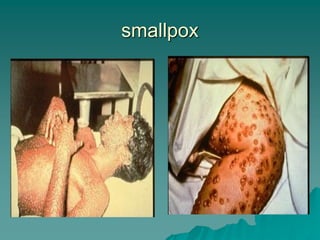
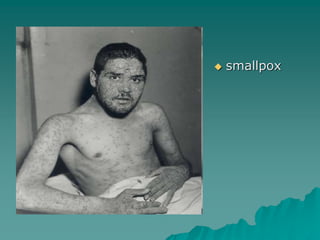
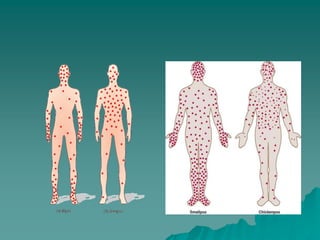
 Fever of sudden onset with Centrifugal rash on
3rd day- characteristic,
headache,
backache,
vomiting,
sometime convulsion in child
Smallpox
 Smallpox eradication – Golden
milestone in history of 20th century
 SmPx eradication –leads to prevention of
– 2 million deaths,
– few lakhs cases of blindness,
– 10-15 million cases of smallpox
disease
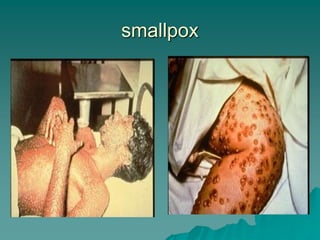
smallpox
 smallpox
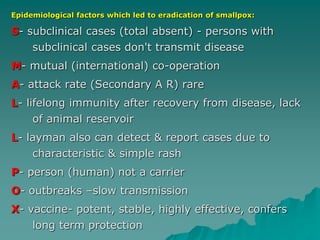
Epidemiological factors which led to eradication of smallpox:
S- subclinical cases (total absent) - persons with
subclinical cases don't transmit disease
M- mutual (international) co-operation
A- attack rate (Secondary A R) rare
L- lifelong immunity after recovery from disease, lack
of animal reservoir
L- layman also can detect & report cases due to
characteristic & simple rash
P- person (human) not a carrier
O- outbreaks –slow transmission
X- vaccine- potent, stable, highly effective, confers
long term protection
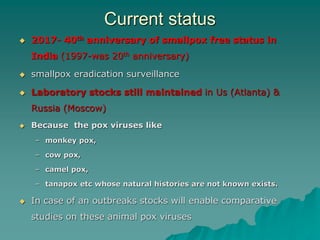
Current status
 2017- 40th anniversary of smallpox free status in
India (1997-was 20th anniversary)
 smallpox eradication surveillance
 Laboratory stocks still maintained in Us (Atlanta) &
Russia (Moscow)
 Because the pox viruses like
– monkey pox,
– cow pox,
– camel pox,
– tanapox etc whose natural histories are not known exists.
 In case of an outbreaks stocks will enable comparative
studies on these animal pox viruses
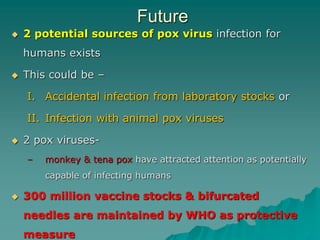
Future
 2 potential sources of pox virus infection for
humans exists
 This could be –
I. Accidental infection from laboratory stocks or
II. Infection with animal pox viruses
 2 pox viruses-
– monkey & tena pox have attracted attention as potentially
capable of infecting humans
 300 million vaccine stocks & bifurcated
needles are maintained by WHO as protective
measure
Chickenpox
(Vericella zoster infection)
Chickenpox (Vericella zoster infection)
 Def:
– Acute , highly infectious disease,
– caused by vericella zoster (VZ) virus
- characterized by vesicular rash with fever &
malaise.
 Worldwide- epidemic & endemic form
 Chickenpox & herpes zoster
– now regarded as different host responses
to same etiological agent
Epidemiology
 Agent factors-
a)Chicken pox,
- v-z virus {human (alpha) herpes virus 3 }
–Primary infection – causes
Chickenpox
– Recovery from primary infection- followed
by latent infection in sensory ganglia after
decades without clinical manifestation,
When cell mediated immunity wanes with
age , immunosuppressive therapy-
– virus reactivate – resulting in Zoster- a
painful, vesicular, pustular eruption on
one / more sensory nerve roots
b) Source of inf-
 Case of chicken pox & rarely patients with
herpes zoster
 Virus occurs in oropharyngeal secretions
& lesions of skin & mucosa
 Scabs not infective
 Virus isolated from vesicular fluid- during
first 3 days of illness
c) Infectivity-
– 1-2 days before rash & 4-5 days after rash
d) Secondary attack rate-
– Highly communicable disease ,
– SAR in household contact 90%
e) Mode of spread-
– Direct contact,
– Droplet or air borne infection
– Face to face (personal contact)
f) Incubation period-
– 14-16 days (15 days)
g) Portal of entry- resp. tract
h) Placental barrier-
– crossed by virus-
– infect fetus- congenital vericella
Host factors-
1. Age-
 children <10 yrs, may be until adulthood
2. Pregnancy-
 infection during pregnancy risk factor for
fetus & neonate
3. Immunity-
 one attack give durable immunity,
 second attack rare
 Maternal antibody protect in first few months
of life
 IgG antibodies protective against vericella
 Cell mediated immunity important in recovery
from v-z infection
Environmental factors-
 This shows seasonal trend in India
 Common occurrence in first 6 months of yr
(Jan-May)
 Overcrowding favors transmission
Clinical features-
 Mild to severe form
 Two stages
1. Pre-eruptive stage-
 Characterized by
 sudden onset of fever- mild to moderate,
 pain in back, shivering & malaise- last for 24
hrs
2. Eruptive stage-
 In children- first sign is Rash
 Rash comes on day the fever starts
 Characteristics of Rash are-
– ‘Centripetal distribution’-rash is symmetrical
– First appears on trunk, then to face, arms,
legs.
– Also mucosal surfaces (buccal, pharyngeal)
involved
– Axilla may be affected, but palm & soles not
ii) Rapid evolution-
– Rash advances quickly through stages of
-Macule – papule – vesicle – scab
– ‘Dew drop’ appearance – vesicles filled
with clear fluid on skin, surrounded by
area of inflammation & not umblicated
– Scabbing begins 4-7 days after rash
appears
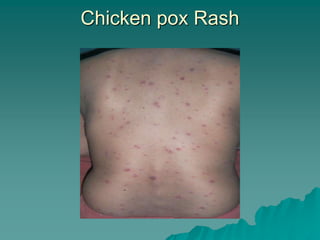
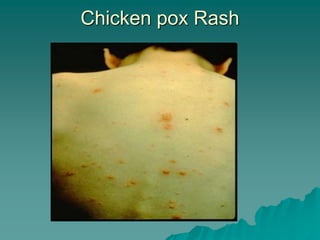
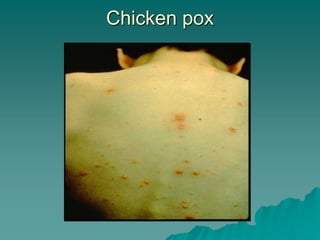
iii) ‘Pleomorphism’ –
– characteristic feature of rash in chickenpox
– i.e. all stages of rash (macule, papule, vesicle,
crust)-
– seen simultaneously at one time, in same area,
due to successive crops in 4-5 days.
iv) fever-
– usually exacerbations (increase temp) with each
fresh crop of eruption
Complications-
– Usually mild, self limiting
– Mortality < 1% in uncomplicated cases
– In immunosuppressive cases-
 pneumonia, hemorrhage, encephalitis,
– Reye’s syndrome (acute encephalopathy with
fatty degeneration of liver), congenital vericella
– Maternal vericella- fetal wastage, birth defect,
microcephally, oncogenecity
Chicken pox Rash
Chicken pox Rash
Pleomorphic rash in chicken pox
 Papule ,
vesicle,
crust
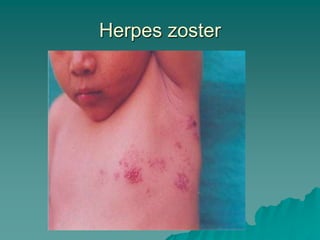
Herpes zoster
Laboratory diagnosis-
1. Clinical signs
2. Examination of vesicle fluid-
– immunofluroscent staining of vesicular
scarping
– Serological tests in epidemiological surveys
Control-
 No specific treatment- (Antiviral-Azovir suspension
in children just to reduce the severity?)
 Notification-
 Isolation - of cases for about 6 days
after onset of rash
 Disinfection – of articles soiled nose &
throat discharges
Prevention-
1. Passive immunization-
 Vericella-zoster immunoglobulin (VZIG)-
 ideally given within 3 days,
 if not at least within 7 days
 125 – 600 IU (1.5 – 5ml IM) as per body wt.
 Reserved for immunocompromised contact / newborn
contact / pregnant woman / pt. with leukemia
 Prevents or modifies disease
2. Active immunization
 Vericella vaccine-
 Live attenuated OKA strain, Japan
 Available as lyophilized powder
 Dissolve in 0.5 ml diluent
 12 mon – 12 yr – single Subcutaneous injection
 >13 yrs- 2 dose- 4-6 wks apart
 Efficacy- 95-99%
 No booster needed
 Prevents disease in >80% of exposed, if administered
within 3 days of exposure
Chickenpox
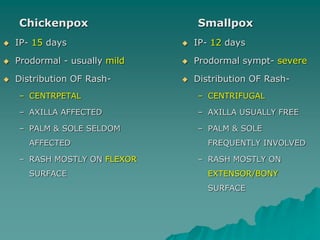
 IP- 15 days
 Prodormal - usually mild
 Distribution OF Rash-
– CENTRPETAL
– AXILLA AFFECTED
– PALM & SOLE SELDOM
AFFECTED
– RASH MOSTLY ON FLEXOR
SURFACE
Smallpox
 IP- 12 days
 Prodormal sympt- severe
 Distribution OF Rash-
– CENTRIFUGAL
– AXILLA USUALLY FREE
– PALM & SOLE
FREQUENTLY INVOLVED
– RASH MOSTLY ON
EXTENSOR/BONY
SURFACE
Chickenpox
 Characteristics of
Rash-
– Superficial
– Unilocular, Dew drop
like
– Pleomorphic rash- one
time
– Inflamed area – around
Smallpox
 Characteristics of
Rash-
– Deep seated
– Multilocular, umblicated
– Only one stage at one
time
– No inflamed area –
around
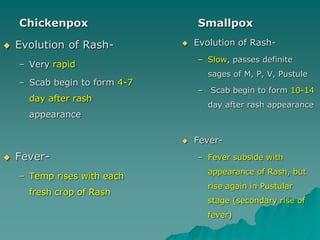
Chickenpox
 Evolution of Rash-
– Very rapid
– Scab begin to form 4-7
day after rash
appearance
 Fever-
– Temp rises with each
fresh crop of Rash
Smallpox
 Evolution of Rash-
– Slow, passes definite
sages of M, P, V, Pustule
– Scab begin to form 10-14
day after rash appearance
 Fever-
– Fever subside with
appearance of Rash, but
rise again in Pustular
stage (secondary rise of
fever)
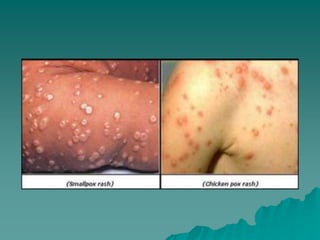
Chicken pox
smallpox
Questions
1. Difference between Chicken
pox & small pox
2. Epidemiology of Chicken pox

Thanks

Communicable diseases smallpox &amp; chiken pox

  • 1.
    Smallpox (Variola) DR.JEEVAN YADAV Professor, CommunityMedicine, D. Y. Patil Medical College, Kolhapur
  • 2.
    Smallpox (Variola)  1stdisease been ERADICATED from India  Milestones- – May 1975- last case in India (Bihar) – April 1977- India declared smallpox free – Oct 1977- World’s last case (Somalia) – 1978 – Laboratory accident – 8th May 1990- WHO declaration on smallpox eradication .
  • 3.
    Smallpox  Acute infectiousdisease caused by Veriola virus  Fever of sudden onset with Centrifugal rash on 3rd day- characteristic, headache, backache, vomiting, sometime convulsion in child
  • 4.
    Smallpox  Smallpox eradication– Golden milestone in history of 20th century  SmPx eradication –leads to prevention of – 2 million deaths, – few lakhs cases of blindness, – 10-15 million cases of smallpox disease
  • 5.
  • 6.
  • 7.
    Epidemiological factors whichled to eradication of smallpox: S- subclinical cases (total absent) - persons with subclinical cases don't transmit disease M- mutual (international) co-operation A- attack rate (Secondary A R) rare L- lifelong immunity after recovery from disease, lack of animal reservoir L- layman also can detect & report cases due to characteristic & simple rash P- person (human) not a carrier O- outbreaks –slow transmission X- vaccine- potent, stable, highly effective, confers long term protection
  • 8.
    Current status  2017-40th anniversary of smallpox free status in India (1997-was 20th anniversary)  smallpox eradication surveillance  Laboratory stocks still maintained in Us (Atlanta) & Russia (Moscow)  Because the pox viruses like – monkey pox, – cow pox, – camel pox, – tanapox etc whose natural histories are not known exists.  In case of an outbreaks stocks will enable comparative studies on these animal pox viruses
  • 9.
    Future  2 potentialsources of pox virus infection for humans exists  This could be – I. Accidental infection from laboratory stocks or II. Infection with animal pox viruses  2 pox viruses- – monkey & tena pox have attracted attention as potentially capable of infecting humans  300 million vaccine stocks & bifurcated needles are maintained by WHO as protective measure
  • 10.
  • 11.
    Chickenpox (Vericella zosterinfection)  Def: – Acute , highly infectious disease, – caused by vericella zoster (VZ) virus - characterized by vesicular rash with fever & malaise.  Worldwide- epidemic & endemic form  Chickenpox & herpes zoster – now regarded as different host responses to same etiological agent
  • 12.
    Epidemiology  Agent factors- a)Chickenpox, - v-z virus {human (alpha) herpes virus 3 } –Primary infection – causes Chickenpox
  • 13.
    – Recovery fromprimary infection- followed by latent infection in sensory ganglia after decades without clinical manifestation, When cell mediated immunity wanes with age , immunosuppressive therapy- – virus reactivate – resulting in Zoster- a painful, vesicular, pustular eruption on one / more sensory nerve roots
  • 14.
    b) Source ofinf-  Case of chicken pox & rarely patients with herpes zoster  Virus occurs in oropharyngeal secretions & lesions of skin & mucosa  Scabs not infective  Virus isolated from vesicular fluid- during first 3 days of illness
  • 15.
    c) Infectivity- – 1-2days before rash & 4-5 days after rash d) Secondary attack rate- – Highly communicable disease , – SAR in household contact 90% e) Mode of spread- – Direct contact, – Droplet or air borne infection – Face to face (personal contact)
  • 16.
    f) Incubation period- –14-16 days (15 days) g) Portal of entry- resp. tract h) Placental barrier- – crossed by virus- – infect fetus- congenital vericella
  • 17.
    Host factors- 1. Age- children <10 yrs, may be until adulthood 2. Pregnancy-  infection during pregnancy risk factor for fetus & neonate
  • 18.
    3. Immunity-  oneattack give durable immunity,  second attack rare  Maternal antibody protect in first few months of life  IgG antibodies protective against vericella  Cell mediated immunity important in recovery from v-z infection
  • 19.
    Environmental factors-  Thisshows seasonal trend in India  Common occurrence in first 6 months of yr (Jan-May)  Overcrowding favors transmission
  • 20.
    Clinical features-  Mildto severe form  Two stages 1. Pre-eruptive stage-  Characterized by  sudden onset of fever- mild to moderate,  pain in back, shivering & malaise- last for 24 hrs
  • 21.
    2. Eruptive stage- In children- first sign is Rash  Rash comes on day the fever starts  Characteristics of Rash are- – ‘Centripetal distribution’-rash is symmetrical – First appears on trunk, then to face, arms, legs. – Also mucosal surfaces (buccal, pharyngeal) involved – Axilla may be affected, but palm & soles not
  • 22.
    ii) Rapid evolution- –Rash advances quickly through stages of -Macule – papule – vesicle – scab – ‘Dew drop’ appearance – vesicles filled with clear fluid on skin, surrounded by area of inflammation & not umblicated – Scabbing begins 4-7 days after rash appears
  • 23.
    iii) ‘Pleomorphism’ – –characteristic feature of rash in chickenpox – i.e. all stages of rash (macule, papule, vesicle, crust)- – seen simultaneously at one time, in same area, due to successive crops in 4-5 days. iv) fever- – usually exacerbations (increase temp) with each fresh crop of eruption
  • 24.
    Complications- – Usually mild,self limiting – Mortality < 1% in uncomplicated cases – In immunosuppressive cases-  pneumonia, hemorrhage, encephalitis, – Reye’s syndrome (acute encephalopathy with fatty degeneration of liver), congenital vericella – Maternal vericella- fetal wastage, birth defect, microcephally, oncogenecity
  • 25.
  • 26.
  • 27.
    Pleomorphic rash inchicken pox  Papule , vesicle, crust
  • 28.
  • 29.
    Laboratory diagnosis- 1. Clinicalsigns 2. Examination of vesicle fluid- – immunofluroscent staining of vesicular scarping – Serological tests in epidemiological surveys
  • 30.
    Control-  No specifictreatment- (Antiviral-Azovir suspension in children just to reduce the severity?)  Notification-  Isolation - of cases for about 6 days after onset of rash  Disinfection – of articles soiled nose & throat discharges
  • 31.
    Prevention- 1. Passive immunization- Vericella-zoster immunoglobulin (VZIG)-  ideally given within 3 days,  if not at least within 7 days  125 – 600 IU (1.5 – 5ml IM) as per body wt.  Reserved for immunocompromised contact / newborn contact / pregnant woman / pt. with leukemia  Prevents or modifies disease
  • 32.
    2. Active immunization Vericella vaccine-  Live attenuated OKA strain, Japan  Available as lyophilized powder  Dissolve in 0.5 ml diluent  12 mon – 12 yr – single Subcutaneous injection  >13 yrs- 2 dose- 4-6 wks apart  Efficacy- 95-99%  No booster needed  Prevents disease in >80% of exposed, if administered within 3 days of exposure
  • 33.
    Chickenpox  IP- 15days  Prodormal - usually mild  Distribution OF Rash- – CENTRPETAL – AXILLA AFFECTED – PALM & SOLE SELDOM AFFECTED – RASH MOSTLY ON FLEXOR SURFACE Smallpox  IP- 12 days  Prodormal sympt- severe  Distribution OF Rash- – CENTRIFUGAL – AXILLA USUALLY FREE – PALM & SOLE FREQUENTLY INVOLVED – RASH MOSTLY ON EXTENSOR/BONY SURFACE
  • 34.
    Chickenpox  Characteristics of Rash- –Superficial – Unilocular, Dew drop like – Pleomorphic rash- one time – Inflamed area – around Smallpox  Characteristics of Rash- – Deep seated – Multilocular, umblicated – Only one stage at one time – No inflamed area – around
  • 35.
    Chickenpox  Evolution ofRash- – Very rapid – Scab begin to form 4-7 day after rash appearance  Fever- – Temp rises with each fresh crop of Rash Smallpox  Evolution of Rash- – Slow, passes definite sages of M, P, V, Pustule – Scab begin to form 10-14 day after rash appearance  Fever- – Fever subside with appearance of Rash, but rise again in Pustular stage (secondary rise of fever)
  • 38.
  • 39.
  • 40.
    Questions 1. Difference betweenChicken pox & small pox 2. Epidemiology of Chicken pox 
  • 41.