
TOPICS:
1. SMALL POX
2. CHICKEN POX
3.RUBELLA
4. MEASLES
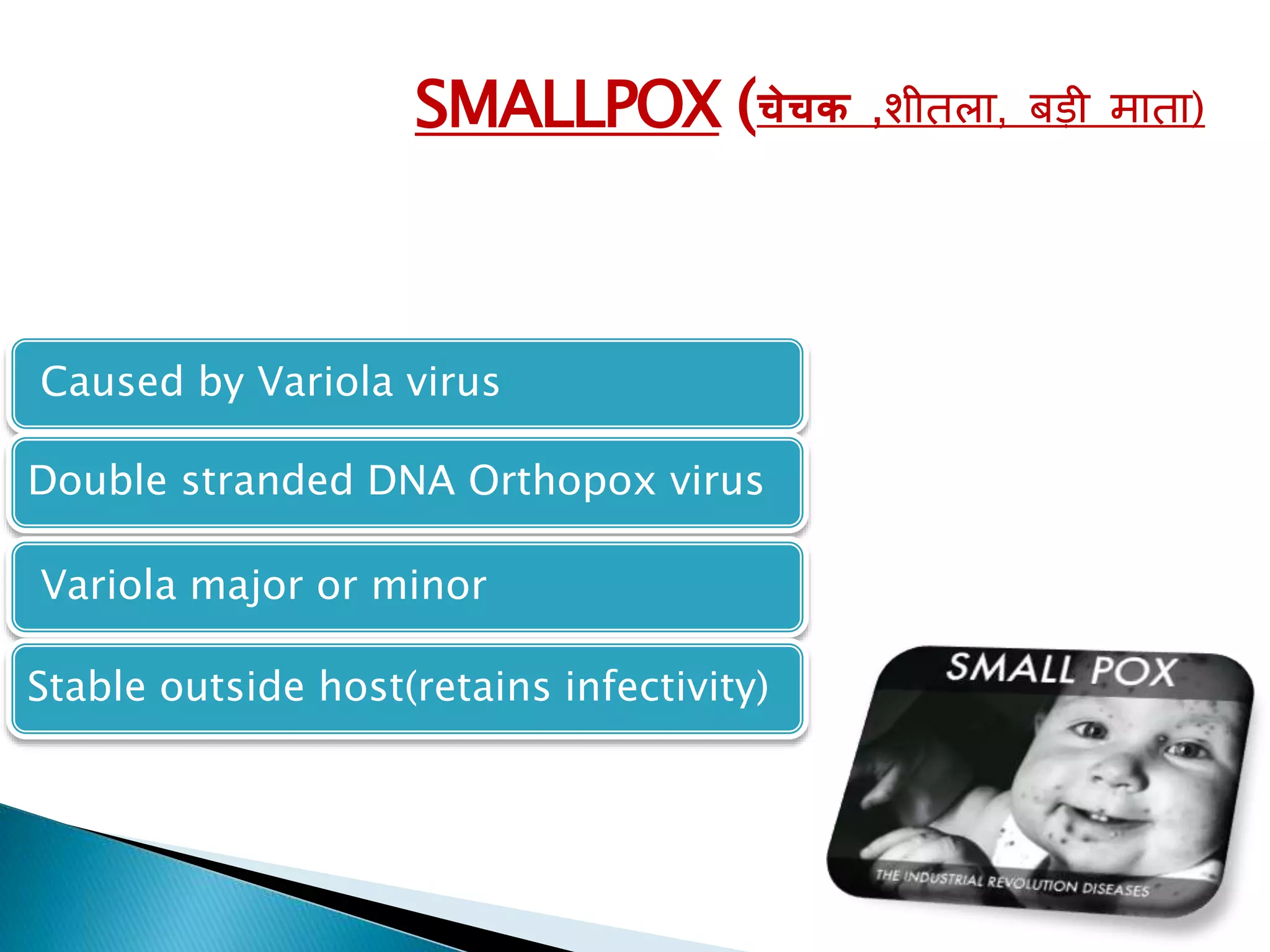
Caused by Variola virus
Double stranded DNA Orthopox virus
Variola major or minor
Stable outside host(retains infectivity)
SMALLPOX (चेचक ,शीतला, बडी माता)
 RESERVOIR
 Before global eradication, the only reservoir -
humans.
 No natural reservoir for the virus currently exists.
 AGENT
 variola major or minor
 TRANSMISSION
 Inhalation of droplet or aerosols originating from
the mouth of smallpox-infected humans
 Direct contact with skin lesions or infected body
fluids of smallpox-infected humans
 Direct contact with contaminated clothing or bed
linens
 In the 18th century, British troops in North America
gave smallpox infected blankets to their enemies,
who went on to suffer severe outbreaks of
smallpox.
 Russian scientists describe covert Russian
operations during the 1970s and 1980s that
focused on bioweapons research and
development including creation of more virulent
smallpox strains and development of missiles and bombs
that couldrelease smallpox
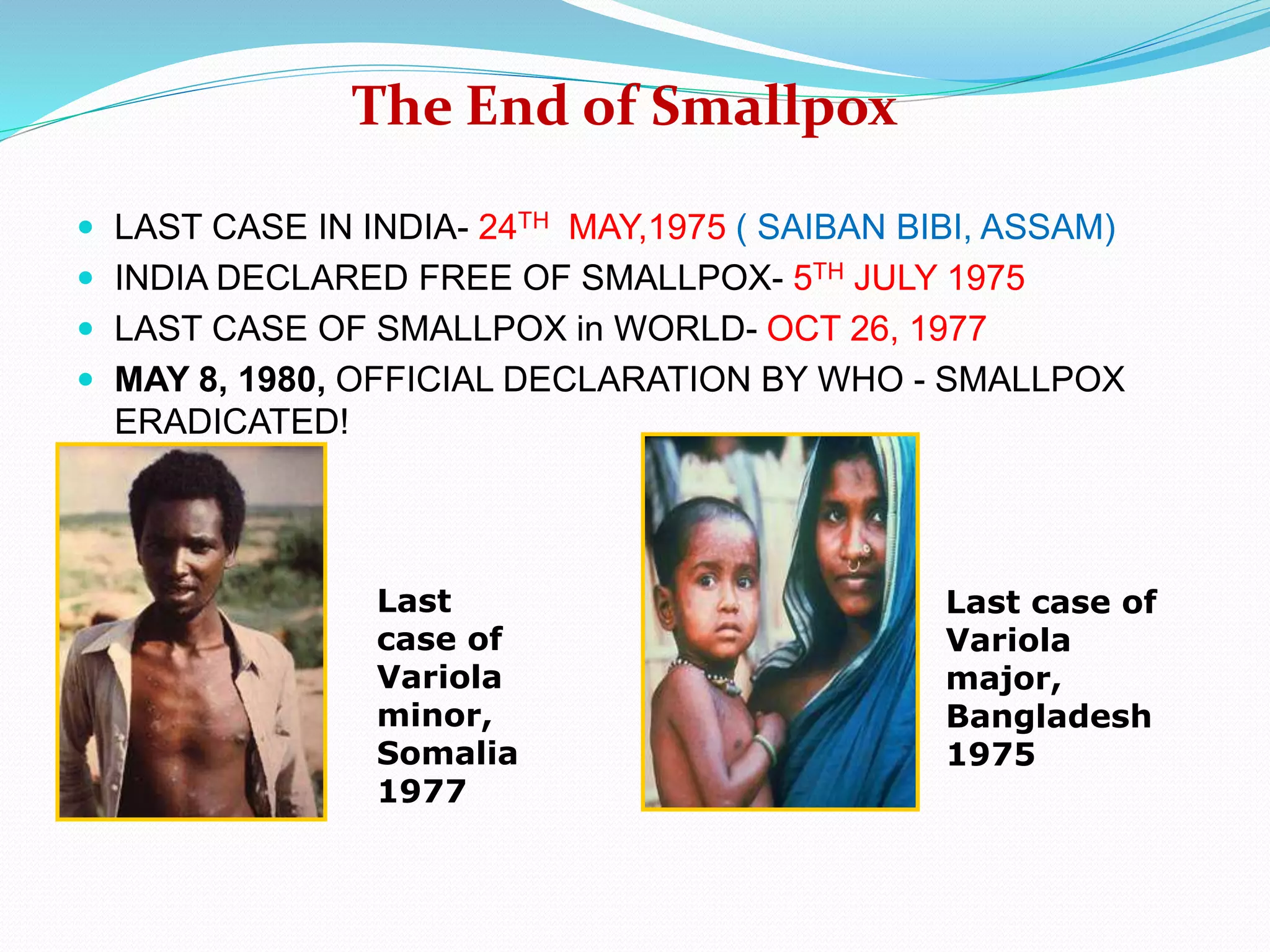
 LAST CASE IN INDIA- 24TH MAY,1975 ( SAIBAN BIBI, ASSAM)
 INDIA DECLARED FREE OF SMALLPOX- 5TH JULY 1975
 LAST CASE OF SMALLPOX in WORLD- OCT 26, 1977
 MAY 8, 1980, OFFICIAL DECLARATION BY WHO - SMALLPOX
ERADICATED!
The End of Smallpox
Last
case of
Variola
minor,
Somalia
1977
Last case of
Variola
major,
Bangladesh
1975
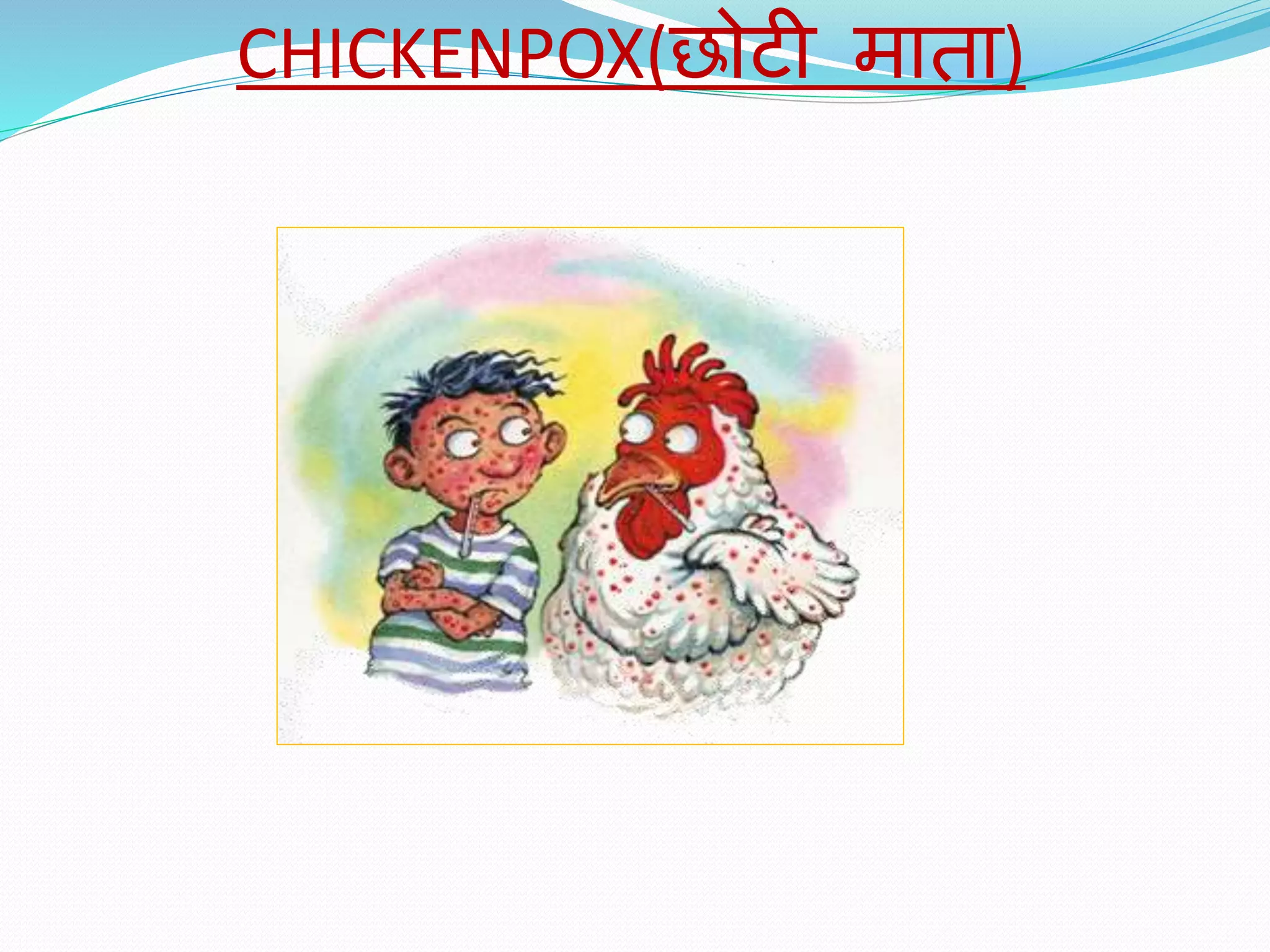
CHICKENPOX(छोटी माता)
EPIDEMIOLOGY
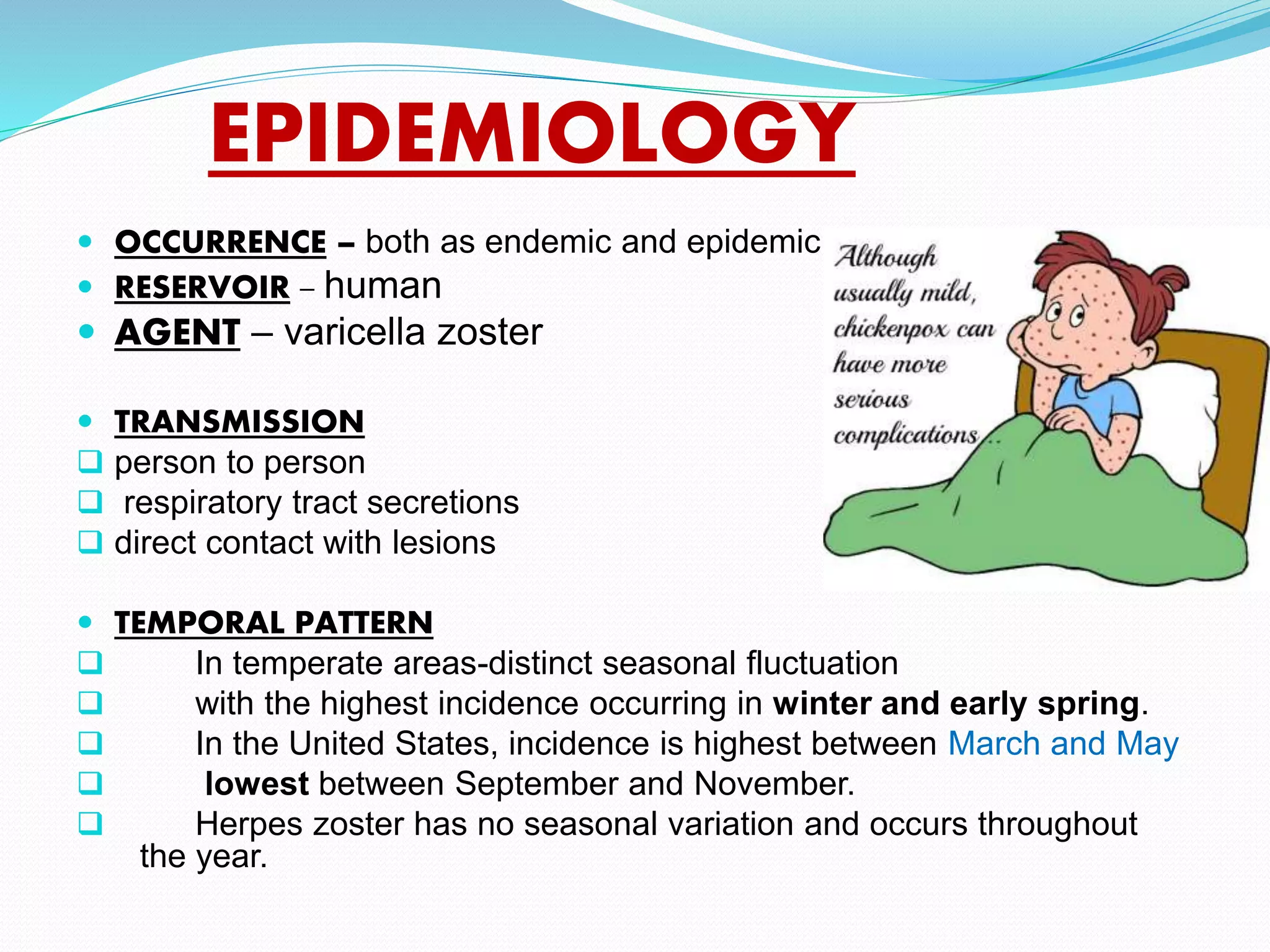
 OCCURRENCE – both as endemic and epidemic
 RESERVOIR – human
 AGENT – varicella zoster
 TRANSMISSION
 person to person
 respiratory tract secretions
 direct contact with lesions
 TEMPORAL PATTERN
 In temperate areas-distinct seasonal fluctuation
 with the highest incidence occurring in winter and early spring.
 In the United States, incidence is highest between March and May
 lowest between September and November.
 Herpes zoster has no seasonal variation and occurs throughout
the year.
GLOBAL STATUS
 Chickenpox led to about 105 deaths a year during
the pre-vaccine years of 1990 to 1994.
 Between 2002 and 2007, the annual average
number of chickenpox deaths was the lowest ever
reported, with 14 deaths recorded in 2007 and just
13 the year before.
 In 2006, a second dose was added to the
vaccination roster which really eliminates casualties
 Chickenpox related deaths are now extremely rare.
 The CDC's new report from THE NATIONAL CENTER
FOR IMMUNIZATION AND RESPIRATORY DISEASES,
which updates an earlier analysis from 1995 to 2001,
shows deaths have dropped by as much as 88 percent
over the first 12 years in all age groups and by 97
percent in young people( 20 and under), since the
varicella vaccine was introduced.
INDIAN STATUS OF CHCKEN
POX
 In 2013- 28090 cases of chicken pox with 61 deaths
 Case fatality rate = 0.21%
 Kerala – highest (121168 cases)
 West bengal – max deaths
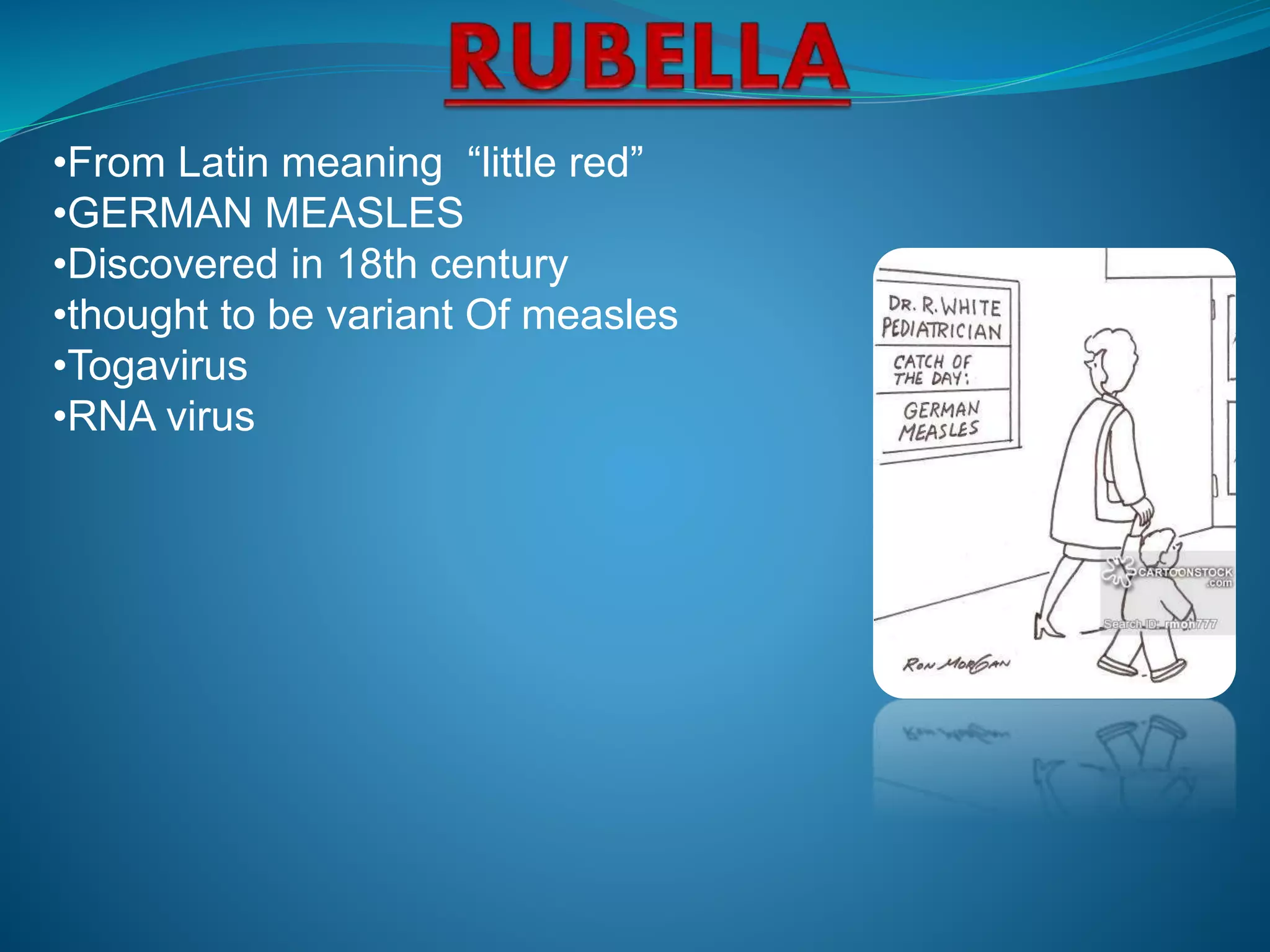
•From Latin meaning “little red”
•GERMAN MEASLES
•Discovered in 18th century
•thought to be variant Of measles
•Togavirus
•RNA virus
EPIDEMIOLOGY
 OCCURRENCE -Rubella occurs worldwide
 RESERVOIR -human
There is no known animal reservoir
 Transmission - spread from person to person via
droplets shed from the respiratory secretions of
infected persons. There is no evidence of insect
transmission
 Temporal pattern - peak in late winter and spring
MEASLES (खसरा)
 morbilli, rubeola or red measles
 Paramyxovirus (RNA)
 Rapidly inactivated by - heat, sunlight, acidic pH, ether
and trypsin
 Highly contagious viral illness
 First described in 7th century
 Near universal infection of childhood in prevaccination
era
 Common and often fatal in developing countries
EPIDEMIOLOGY
 OCCURRENCE -Measles occurs throughout the world
 RESERVOIR -human
 There is no known animal reservoir, and an asymptomatic carrier
state has not been documented.
 TRANSMISSION - respiratory Airborne
via aerosolized droplet nuclei has been documented in closed
areas (e.g., office, examination room) for up to 2 hours after a person
with measles occupied the area.
 Temporal pattern -peak in late winter–spring
 Communicability -4 days before to 4 days after rash onset
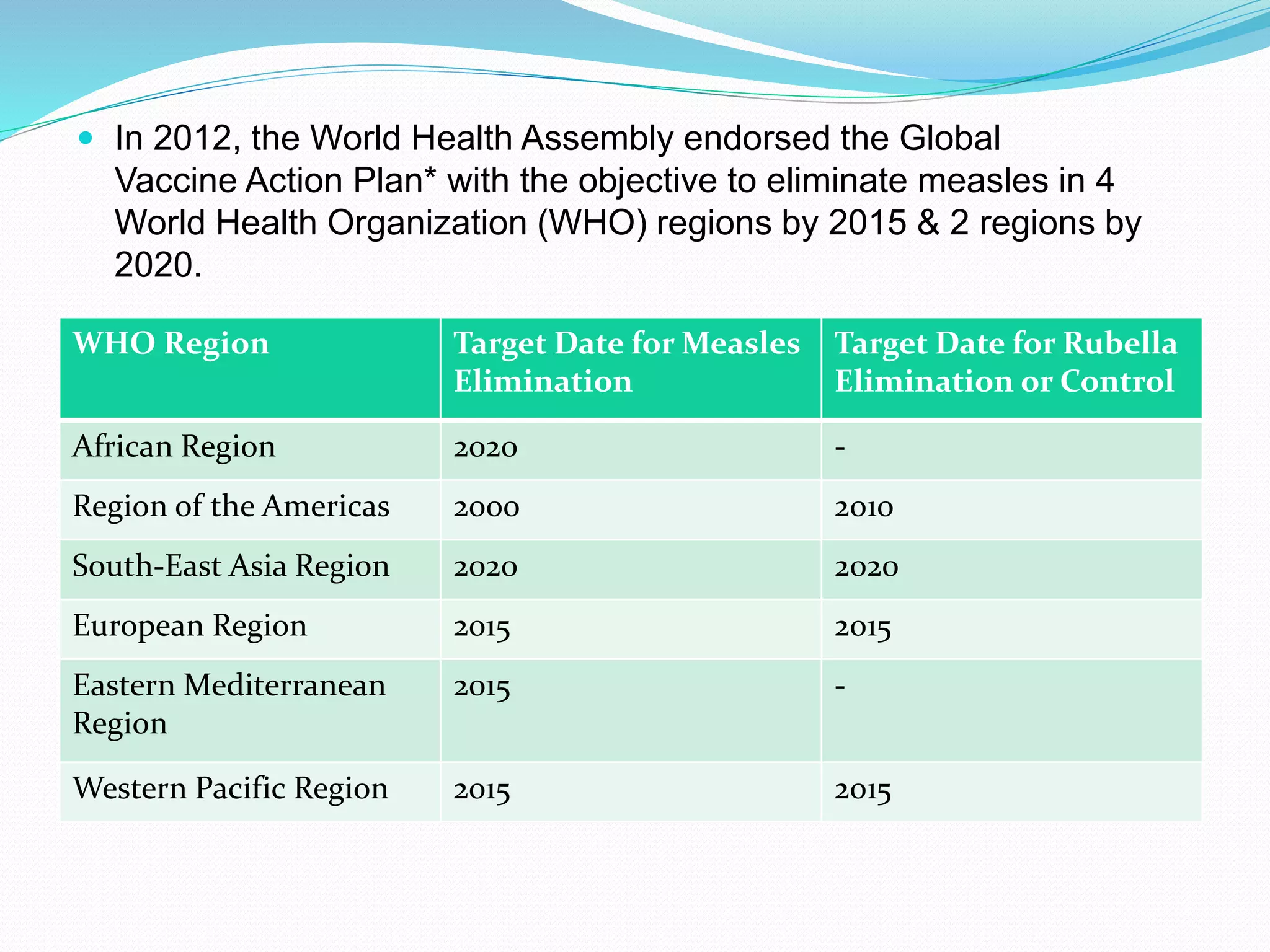
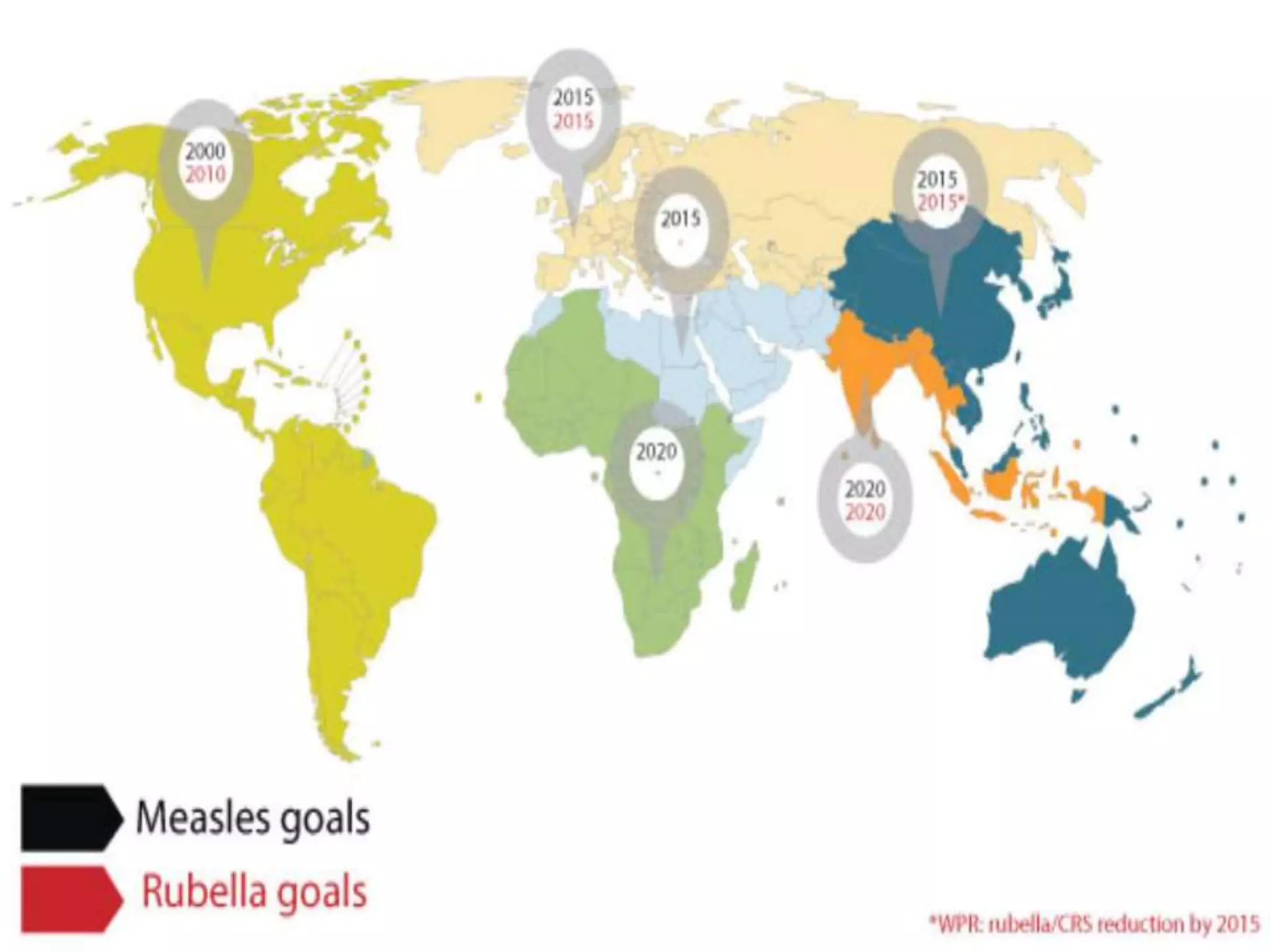
 In 2012, the World Health Assembly endorsed the Global
Vaccine Action Plan* with the objective to eliminate measles in 4
World Health Organization (WHO) regions by 2015 & 2 regions by
2020.
WHO Region Target Date for Measles
Elimination
Target Date for Rubella
Elimination or Control
African Region 2020 -
Region of the Americas 2000 2010
South-East Asia Region 2020 2020
European Region 2015 2015
Eastern Mediterranean
Region
2015 -
Western Pacific Region 2015 2015

MEASLES 1993-2011
 Endemic transmission interrupted
 Record low annual total in 2004 (37 total cases)
 Many cases among adults
 Most persons with measles were unvaccinated
or unknown vaccination status
 In 2011, CDC reported 16 outbreaks of measles
and 220 measles cases, most of which were
imported cases in unvaccinated persons
GLOBAL STATUS OF MEASLES
 Estimates of measles-related deaths have been
considered a crucial indicator to evaluate the
progress of any nation towards measles elimination
 The global estimates for the year 2013 suggest that
close to 0.14 million deaths were attributed to
measles, accounting for nearly 16 deaths each hour
(Infection Ecology and Epidemiology 2015)
MEASLES STATUS IN INDIA
 More than one third of all measles deaths worldwide
(around 56 000 in 2011) are among children in India.
 With support from WHO, in November 2010, India
launched a massive polio-style measles vaccination
project in 14 high-burden states, in a three-phase
campaign.
 Health workers were trained to detect and report measles
outbreaks, and they found an unexpectedly high number
of infections.
INCREASING CHILD VACCINATION
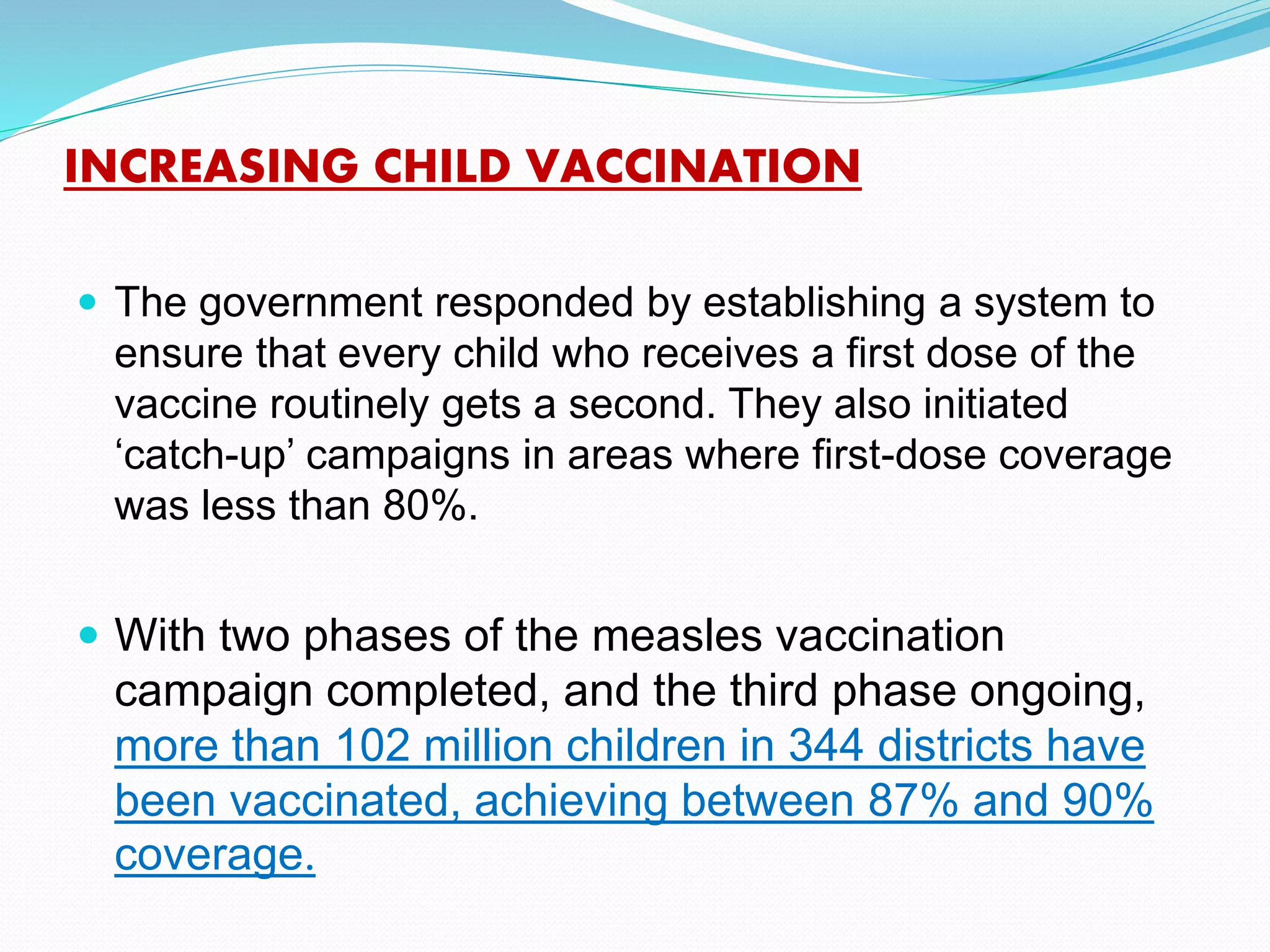
 The government responded by establishing a system to
ensure that every child who receives a first dose of the
vaccine routinely gets a second. They also initiated
‘catch-up’ campaigns in areas where first-dose coverage
was less than 80%.
 With two phases of the measles vaccination
campaign completed, and the third phase ongoing,
more than 102 million children in 344 districts have
been vaccinated, achieving between 87% and 90%
coverage.
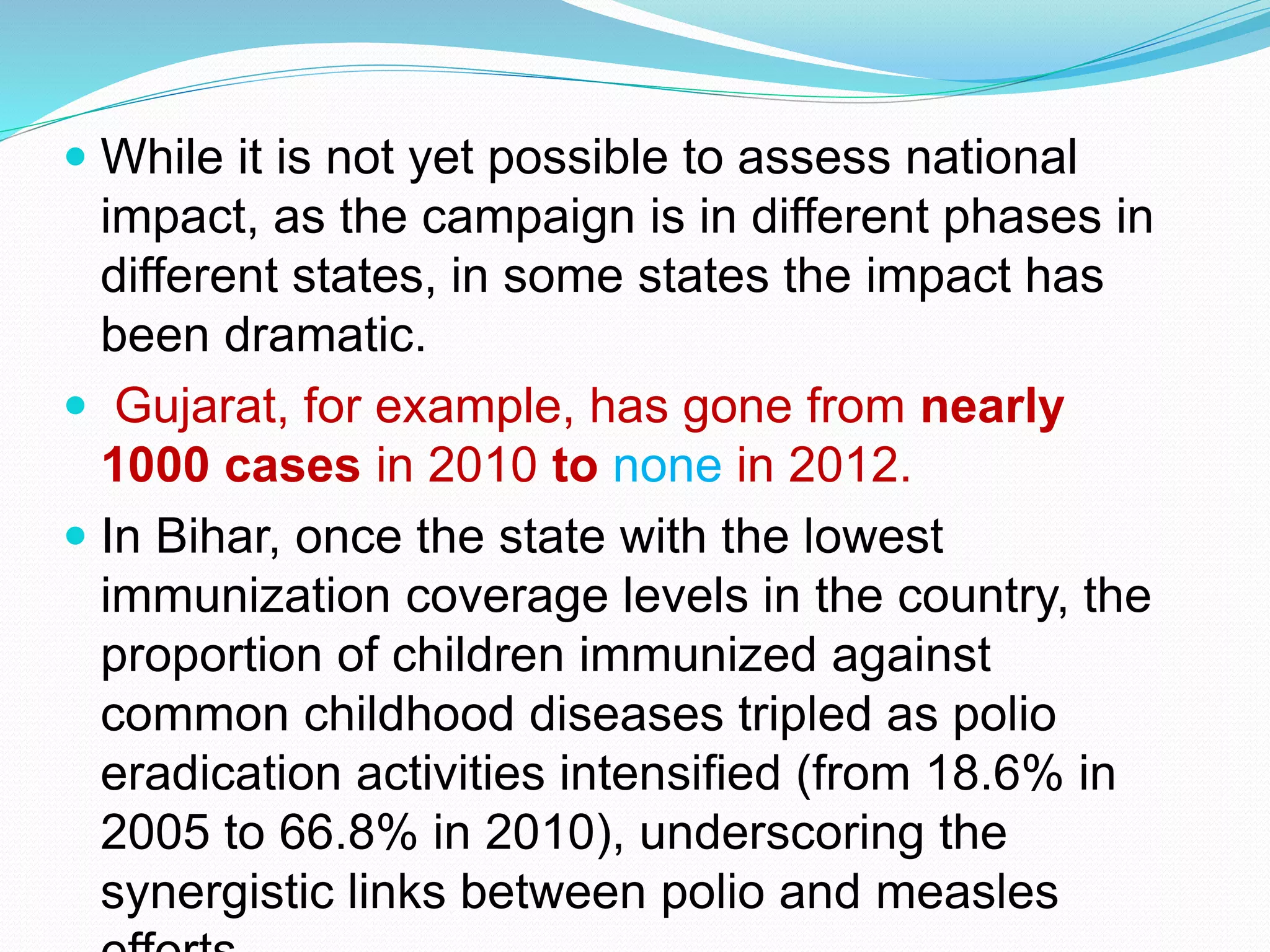
 While it is not yet possible to assess national
impact, as the campaign is in different phases in
different states, in some states the impact has
been dramatic.
 Gujarat, for example, has gone from nearly
1000 cases in 2010 to none in 2012.
 In Bihar, once the state with the lowest
immunization coverage levels in the country, the
proportion of children immunized against
common childhood diseases tripled as polio
eradication activities intensified (from 18.6% in
2005 to 66.8% in 2010), underscoring the
synergistic links between polio and measles
Epidemiology of smallpox,chickenpox,rubella and measles

Epidemiology of smallpox,chickenpox,rubella and measles

  • 2.
    TOPICS: 1. SMALL POX 2.CHICKEN POX 3.RUBELLA 4. MEASLES
  • 3.
    Caused by Variolavirus Double stranded DNA Orthopox virus Variola major or minor Stable outside host(retains infectivity) SMALLPOX (चेचक ,शीतला, बडी माता)
  • 4.
     RESERVOIR  Beforeglobal eradication, the only reservoir - humans.  No natural reservoir for the virus currently exists.  AGENT  variola major or minor  TRANSMISSION  Inhalation of droplet or aerosols originating from the mouth of smallpox-infected humans  Direct contact with skin lesions or infected body fluids of smallpox-infected humans  Direct contact with contaminated clothing or bed linens
  • 5.
     In the18th century, British troops in North America gave smallpox infected blankets to their enemies, who went on to suffer severe outbreaks of smallpox.  Russian scientists describe covert Russian operations during the 1970s and 1980s that focused on bioweapons research and development including creation of more virulent smallpox strains and development of missiles and bombs that couldrelease smallpox
  • 6.
     LAST CASEIN INDIA- 24TH MAY,1975 ( SAIBAN BIBI, ASSAM)  INDIA DECLARED FREE OF SMALLPOX- 5TH JULY 1975  LAST CASE OF SMALLPOX in WORLD- OCT 26, 1977  MAY 8, 1980, OFFICIAL DECLARATION BY WHO - SMALLPOX ERADICATED! The End of Smallpox Last case of Variola minor, Somalia 1977 Last case of Variola major, Bangladesh 1975
  • 8.
  • 9.
    EPIDEMIOLOGY  OCCURRENCE –both as endemic and epidemic  RESERVOIR – human  AGENT – varicella zoster  TRANSMISSION  person to person  respiratory tract secretions  direct contact with lesions  TEMPORAL PATTERN  In temperate areas-distinct seasonal fluctuation  with the highest incidence occurring in winter and early spring.  In the United States, incidence is highest between March and May  lowest between September and November.  Herpes zoster has no seasonal variation and occurs throughout the year.
  • 10.
    GLOBAL STATUS  Chickenpoxled to about 105 deaths a year during the pre-vaccine years of 1990 to 1994.  Between 2002 and 2007, the annual average number of chickenpox deaths was the lowest ever reported, with 14 deaths recorded in 2007 and just 13 the year before.  In 2006, a second dose was added to the vaccination roster which really eliminates casualties  Chickenpox related deaths are now extremely rare.
  • 11.
     The CDC'snew report from THE NATIONAL CENTER FOR IMMUNIZATION AND RESPIRATORY DISEASES, which updates an earlier analysis from 1995 to 2001, shows deaths have dropped by as much as 88 percent over the first 12 years in all age groups and by 97 percent in young people( 20 and under), since the varicella vaccine was introduced.
  • 12.
    INDIAN STATUS OFCHCKEN POX  In 2013- 28090 cases of chicken pox with 61 deaths  Case fatality rate = 0.21%  Kerala – highest (121168 cases)  West bengal – max deaths
  • 13.
    •From Latin meaning“little red” •GERMAN MEASLES •Discovered in 18th century •thought to be variant Of measles •Togavirus •RNA virus
  • 14.
    EPIDEMIOLOGY  OCCURRENCE -Rubellaoccurs worldwide  RESERVOIR -human There is no known animal reservoir  Transmission - spread from person to person via droplets shed from the respiratory secretions of infected persons. There is no evidence of insect transmission  Temporal pattern - peak in late winter and spring
  • 15.
    MEASLES (खसरा)  morbilli,rubeola or red measles  Paramyxovirus (RNA)  Rapidly inactivated by - heat, sunlight, acidic pH, ether and trypsin  Highly contagious viral illness  First described in 7th century  Near universal infection of childhood in prevaccination era  Common and often fatal in developing countries
  • 16.
    EPIDEMIOLOGY  OCCURRENCE -Measlesoccurs throughout the world  RESERVOIR -human  There is no known animal reservoir, and an asymptomatic carrier state has not been documented.  TRANSMISSION - respiratory Airborne via aerosolized droplet nuclei has been documented in closed areas (e.g., office, examination room) for up to 2 hours after a person with measles occupied the area.  Temporal pattern -peak in late winter–spring  Communicability -4 days before to 4 days after rash onset
  • 17.
     In 2012,the World Health Assembly endorsed the Global Vaccine Action Plan* with the objective to eliminate measles in 4 World Health Organization (WHO) regions by 2015 & 2 regions by 2020. WHO Region Target Date for Measles Elimination Target Date for Rubella Elimination or Control African Region 2020 - Region of the Americas 2000 2010 South-East Asia Region 2020 2020 European Region 2015 2015 Eastern Mediterranean Region 2015 - Western Pacific Region 2015 2015
  • 18.
  • 19.
    MEASLES 1993-2011  Endemictransmission interrupted  Record low annual total in 2004 (37 total cases)  Many cases among adults  Most persons with measles were unvaccinated or unknown vaccination status  In 2011, CDC reported 16 outbreaks of measles and 220 measles cases, most of which were imported cases in unvaccinated persons
  • 20.
    GLOBAL STATUS OFMEASLES  Estimates of measles-related deaths have been considered a crucial indicator to evaluate the progress of any nation towards measles elimination  The global estimates for the year 2013 suggest that close to 0.14 million deaths were attributed to measles, accounting for nearly 16 deaths each hour (Infection Ecology and Epidemiology 2015)
  • 21.
    MEASLES STATUS ININDIA  More than one third of all measles deaths worldwide (around 56 000 in 2011) are among children in India.  With support from WHO, in November 2010, India launched a massive polio-style measles vaccination project in 14 high-burden states, in a three-phase campaign.  Health workers were trained to detect and report measles outbreaks, and they found an unexpectedly high number of infections.
  • 22.
    INCREASING CHILD VACCINATION The government responded by establishing a system to ensure that every child who receives a first dose of the vaccine routinely gets a second. They also initiated ‘catch-up’ campaigns in areas where first-dose coverage was less than 80%.  With two phases of the measles vaccination campaign completed, and the third phase ongoing, more than 102 million children in 344 districts have been vaccinated, achieving between 87% and 90% coverage.
  • 24.
     While itis not yet possible to assess national impact, as the campaign is in different phases in different states, in some states the impact has been dramatic.  Gujarat, for example, has gone from nearly 1000 cases in 2010 to none in 2012.  In Bihar, once the state with the lowest immunization coverage levels in the country, the proportion of children immunized against common childhood diseases tripled as polio eradication activities intensified (from 18.6% in 2005 to 66.8% in 2010), underscoring the synergistic links between polio and measles