Saudi Board of Preventive Medicine, Riyadh Ministry of Health, KSA Lecture 06/10
Dr. S. A. Rizwan, M.D.Demystifying statistics series: Meta-analysis course
Fixed-effect vs. Random-effects
models in meta-analysis
Dr. S. A. Rizwan M.D.,
Public Health Specialist & Lecturer,
Saudi Board of Preventive Medicine – Riyadh,
Ministry of Health, KSA
25.11.2019 1
With thanks to Michael Borenstein
Saudi Board of Preventive Medicine, Riyadh Ministry of Health, KSA Lecture 06/10
Dr. S. A. Rizwan, M.D.Demystifying statistics series: Meta-analysis course
Outline
• Provide a description of fixed and of random effects models
• Outline the underlying assumptions of these two models in order to
clarify the choices a reviewer has in a meta-analysis
• Discuss how to estimate key parameters in the model
25.11.2019 2
Saudi Board of Preventive Medicine, Riyadh Ministry of Health, KSA Lecture 06/10
Dr. S. A. Rizwan, M.D.Demystifying statistics series: Meta-analysis course
Our choice between the two depends on
• Our assumption about how the effect sizes vary in our meta-analysis
• The two models are based on different assumptions about the nature
of the variation among effect sizes in our research synthesis
25.11.2019 3
Saudi Board of Preventive Medicine, Riyadh Ministry of Health, KSA Lecture 06/10
Dr. S. A. Rizwan, M.D.Demystifying statistics series: Meta-analysis course
Sampling assumptions
• Fixed-effect
• Sampling takes place at one level only
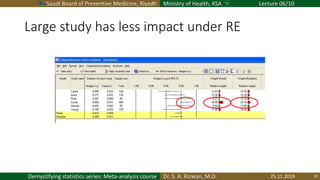
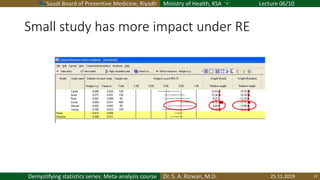
• Any between-study variance will be ignored when assigning weights
• Random-effects
• Sampling takes place at two levels
• Any between-study variance will be used when assigning weights
25.11.2019 4
Saudi Board of Preventive Medicine, Riyadh Ministry of Health, KSA Lecture 06/10
Dr. S. A. Rizwan, M.D.Demystifying statistics series: Meta-analysis course
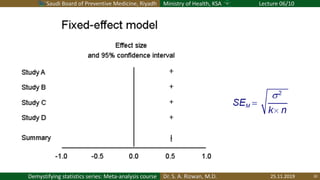
Fixed-effect
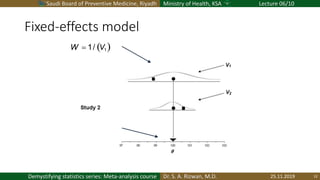
• When there is reason to believe that all the studies are functionally identical
• When our goal is to compute the common effect size, for the studies in the
analysis
• Example of drug company has run five studies to assess the effect of a drug
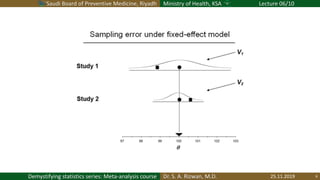
• Note that the effect size from each study estimate a single common mean –
the fixed-effect
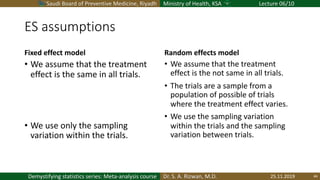
• We know that each study will give us a different effect size, but each effect
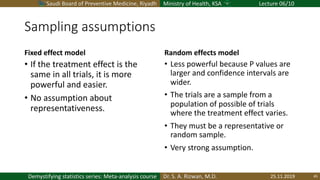
size is an estimate of a common mean, designated in the prior picture as θ
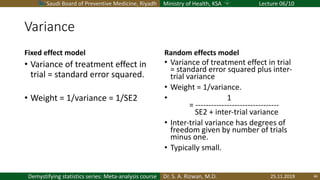
25.11.2019 5
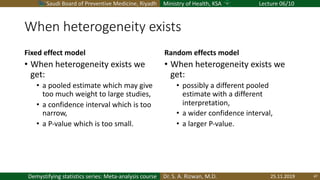
Saudi Board of Preventive Medicine, Riyadh Ministry of Health, KSA Lecture 06/10
Dr. S. A. Rizwan, M.D.Demystifying statistics series: Meta-analysis course 25.11.2019 6
Saudi Board of Preventive Medicine, Riyadh Ministry of Health, KSA Lecture 06/10
Dr. S. A. Rizwan, M.D.Demystifying statistics series: Meta-analysis course
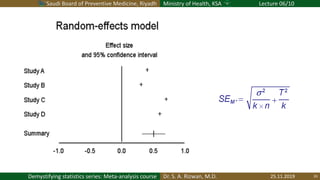
Random-effects
• We assume two components of variation:
• – Sampling variation as in our fixed-effect model assumption
• – Random variation because the effect sizes themselves are sampled from
population of effect sizes
• In a random effects model, we know that our effect sizes will differ
because they are sampled from an unknown distribution
• Our goal in the analysis will be to estimate the mean and variance of
the underlying population of effect sizes
• All the studies are functionally equivalent
• Example of studies culled from publications
25.11.2019 7
Saudi Board of Preventive Medicine, Riyadh Ministry of Health, KSA Lecture 06/10
Dr. S. A. Rizwan, M.D.Demystifying statistics series: Meta-analysis course
Random-effects
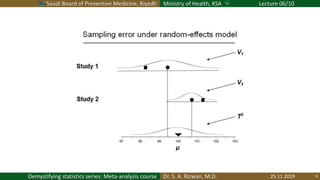
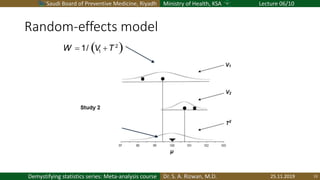
• We see in the picture that each distribution has its own mean that is
sampled from the underlying population distribution of effect sizes
• That underlying population distribution also has its own variance, τ2,
commonly called the variance component
• Thus, each effect size has two components of variation, one due to
sampling error, and one from the underlying distribution
25.11.2019 8
Saudi Board of Preventive Medicine, Riyadh Ministry of Health, KSA Lecture 06/10
Dr. S. A. Rizwan, M.D.Demystifying statistics series: Meta-analysis course 25.11.2019 9
Saudi Board of Preventive Medicine, Riyadh Ministry of Health, KSA Lecture 06/10
Dr. S. A. Rizwan, M.D.Demystifying statistics series: Meta-analysis course
Definition of combined effect
• Fixed effect model
• There is one true effect
• Summary effect is estimate of this value
• Random effects model
• There is a distribution of effects
• Summary effect is mean of distribution
25.11.2019 10
Saudi Board of Preventive Medicine, Riyadh Ministry of Health, KSA Lecture 06/10
Dr. S. A. Rizwan, M.D.Demystifying statistics series: Meta-analysis course
How weights are assigned?
25.11.2019 11
Saudi Board of Preventive Medicine, Riyadh Ministry of Health, KSA Lecture 06/10
Dr. S. A. Rizwan, M.D.Demystifying statistics series: Meta-analysis course
W = 1/ (V1)
Fixed-effects model
25.11.2019 12
Saudi Board of Preventive Medicine, Riyadh Ministry of Health, KSA Lecture 06/10
Dr. S. A. Rizwan, M.D.Demystifying statistics series: Meta-analysis course
Random-effects model
25.11.2019 13
1W = 1/ (V +T 2
)
Saudi Board of Preventive Medicine, Riyadh Ministry of Health, KSA Lecture 06/10
Dr. S. A. Rizwan, M.D.Demystifying statistics series: Meta-analysis course
190
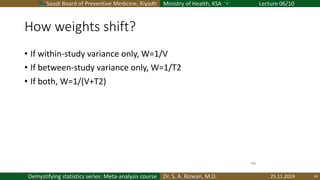
How weights shift?
• If within-study variance only, W=1/V
• If between-study variance only, W=1/T2
• If both, W=1/(V+T2)
25.11.2019 14
Saudi Board of Preventive Medicine, Riyadh Ministry of Health, KSA Lecture 06/10
Dr. S. A. Rizwan, M.D.Demystifying statistics series: Meta-analysis course 25.11.2019 15
Saudi Board of Preventive Medicine, Riyadh Ministry of Health, KSA Lecture 06/10
Dr. S. A. Rizwan, M.D.Demystifying statistics series: Meta-analysis course 25.11.2019 16
Saudi Board of Preventive Medicine, Riyadh Ministry of Health, KSA Lecture 06/10
Dr. S. A. Rizwan, M.D.Demystifying statistics series: Meta-analysis course
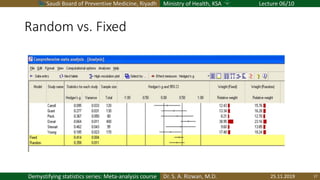
Random vs. Fixed
25.11.2019 17
Saudi Board of Preventive Medicine, Riyadh Ministry of Health, KSA Lecture 06/10
Dr. S. A. Rizwan, M.D.Demystifying statistics series: Meta-analysis course
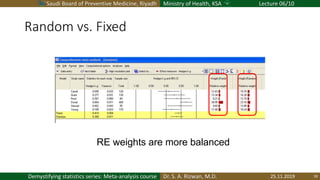
Random vs. Fixed
25.11.2019 18
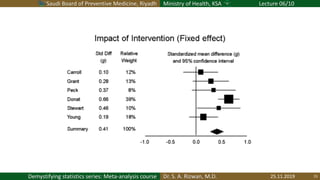
RE weights are more balanced
Saudi Board of Preventive Medicine, Riyadh Ministry of Health, KSA Lecture 06/10
Dr. S. A. Rizwan, M.D.Demystifying statistics series: Meta-analysis course
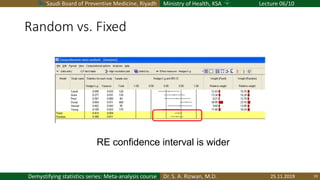
Random vs. Fixed
25.11.2019 19
RE confidence interval is wider
Saudi Board of Preventive Medicine, Riyadh Ministry of Health, KSA Lecture 06/10
Dr. S. A. Rizwan, M.D.Demystifying statistics series: Meta-analysis course
Large study has less impact under RE
25.11.2019 20
Saudi Board of Preventive Medicine, Riyadh Ministry of Health, KSA Lecture 06/10
Dr. S. A. Rizwan, M.D.Demystifying statistics series: Meta-analysis course
Small study has more impact under RE
25.11.2019 21
Saudi Board of Preventive Medicine, Riyadh Ministry of Health, KSA Lecture 06/10
Dr. S. A. Rizwan, M.D.Demystifying statistics series: Meta-analysis course
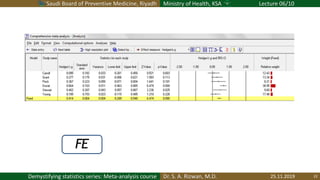
FE
25.11.2019 22
Saudi Board of Preventive Medicine, Riyadh Ministry of Health, KSA Lecture 06/10
Dr. S. A. Rizwan, M.D.Demystifying statistics series: Meta-analysis course
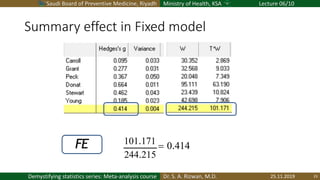
Summary effect in Fixed model
25.11.2019 23
244.215
101.171
= 0.414FE
Saudi Board of Preventive Medicine, Riyadh Ministry of Health, KSA Lecture 06/10
Dr. S. A. Rizwan, M.D.Demystifying statistics series: Meta-analysis course
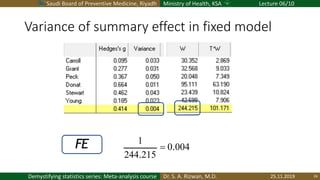
Variance of summary effect in fixed model
25.11.2019 24
1
244.215
= 0.004FE
Saudi Board of Preventive Medicine, Riyadh Ministry of Health, KSA Lecture 06/10
Dr. S. A. Rizwan, M.D.Demystifying statistics series: Meta-analysis course
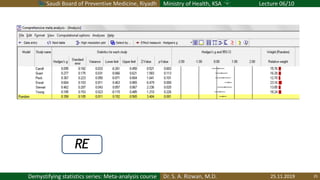
RE
25.11.2019 25
Saudi Board of Preventive Medicine, Riyadh Ministry of Health, KSA Lecture 06/10
Dr. S. A. Rizwan, M.D.Demystifying statistics series: Meta-analysis course
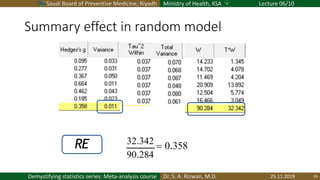
Summary effect in random model
25.11.2019 26
90.284
32.342
= 0.358RE
Saudi Board of Preventive Medicine, Riyadh Ministry of Health, KSA Lecture 06/10
Dr. S. A. Rizwan, M.D.Demystifying statistics series: Meta-analysis course
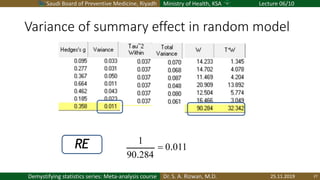
Variance of summary effect in random model
25.11.2019 27
1
90.284
= 0.011RE
Saudi Board of Preventive Medicine, Riyadh Ministry of Health, KSA Lecture 06/10
Dr. S. A. Rizwan, M.D.Demystifying statistics series: Meta-analysis course
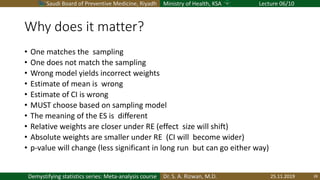
Why does it matter?
• One matches the sampling
• One does not match the sampling
• Wrong model yields incorrect weights
• Estimate of mean is wrong
• Estimate of CI is wrong
• MUST choose based on sampling model
• The meaning of the ES is different
• Relative weights are closer under RE (effect size will shift)
• Absolute weights are smaller under RE (CI will become wider)
• p-value will change (less significant in long run but can go either way)
25.11.2019 28
Saudi Board of Preventive Medicine, Riyadh Ministry of Health, KSA Lecture 06/10
Dr. S. A. Rizwan, M.D.Demystifying statistics series: Meta-analysis course
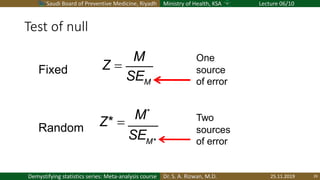
Test of null
25.11.2019 29
M
M
Z =
SE
M*
M*
Z* =
SE
Fixed
Random
Two
sources
of error
One
source
of error
Saudi Board of Preventive Medicine, Riyadh Ministry of Health, KSA Lecture 06/10
Dr. S. A. Rizwan, M.D.Demystifying statistics series: Meta-analysis course
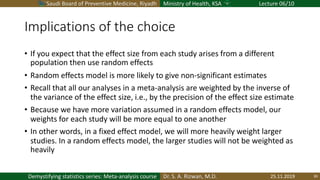
Implications of the choice
• If you expect that the effect size from each study arises from a different
population then use random effects
• Random effects model is more likely to give non-significant estimates
• Recall that all our analyses in a meta-analysis are weighted by the inverse of
the variance of the effect size, i.e., by the precision of the effect size estimate
• Because we have more variation assumed in a random effects model, our
weights for each study will be more equal to one another
• In other words, in a fixed effect model, we will more heavily weight larger
studies. In a random effects model, the larger studies will not be weighted as
heavily
25.11.2019 30
Saudi Board of Preventive Medicine, Riyadh Ministry of Health, KSA Lecture 06/10
Dr. S. A. Rizwan, M.D.Demystifying statistics series: Meta-analysis course
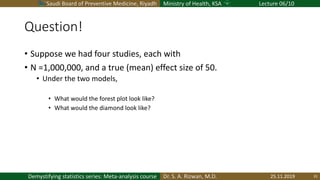
Question!
• Suppose we had four studies, each with
• N =1,000,000, and a true (mean) effect size of 50.
• Under the two models,
• What would the forest plot look like?
• What would the diamond look like?
25.11.2019 31
Saudi Board of Preventive Medicine, Riyadh Ministry of Health, KSA Lecture 06/10
Dr. S. A. Rizwan, M.D.Demystifying statistics series: Meta-analysis course 25.11.2019 32
Saudi Board of Preventive Medicine, Riyadh Ministry of Health, KSA Lecture 06/10
Dr. S. A. Rizwan, M.D.Demystifying statistics series: Meta-analysis course 25.11.2019 33
Saudi Board of Preventive Medicine, Riyadh Ministry of Health, KSA Lecture 06/10
Dr. S. A. Rizwan, M.D.Demystifying statistics series: Meta-analysis course
Which model should we use?
• Base decision on the model that matched the way the data were
collected
• Not on test of homogeneity
25.11.2019 34
Saudi Board of Preventive Medicine, Riyadh Ministry of Health, KSA Lecture 06/10
Dr. S. A. Rizwan, M.D.Demystifying statistics series: Meta-analysis course
What you may hear
• Fixed-effect is simple model
• Random-effects is more complicated
25.11.2019 35
Saudi Board of Preventive Medicine, Riyadh Ministry of Health, KSA Lecture 06/10
Dr. S. A. Rizwan, M.D.Demystifying statistics series: Meta-analysis course
Actually
• Fixed-effect is more restricted model
• Random-effects makes less assumptions
25.11.2019 36
Saudi Board of Preventive Medicine, Riyadh Ministry of Health, KSA Lecture 06/10
Dr. S. A. Rizwan, M.D.Demystifying statistics series: Meta-analysis course
An alternate view
• Random-effects model only makes sense if we have a clear picture of
the sampling frame
• Otherwise, we should report the mean and CI for the studies in our
sample without attempt to generalize to a larger universe
25.11.2019 37
Saudi Board of Preventive Medicine, Riyadh Ministry of Health, KSA Lecture 06/10
Dr. S. A. Rizwan, M.D.Demystifying statistics series: Meta-analysis course
Goals in a fixed effect model
• In a fixed effect model, we will be most interested in estimating our
common effect, θ, and its standard error
• We will also want to know if there is heterogeneity present by
computing Q
• HOWEVER, WE WILL NOT decide on the basis of a significant Q that
we should really do a random effects model
• WE WILL make a decision about fixed effect versus random effects
models because of our substantive knowledge of the area of the
systematic review
25.11.2019 38
Saudi Board of Preventive Medicine, Riyadh Ministry of Health, KSA Lecture 06/10
Dr. S. A. Rizwan, M.D.Demystifying statistics series: Meta-analysis course
Goals in a random effects model
• We also want to estimate a mean effect size, but now this is the mean
effect size from the underlying population, μ
• We also want to estimate the variance of the underlying effect size, τ2
• We will test heterogeneity by testing whether τ2 is different from 0.
• Biggest difficulty: how to estimate τ2
25.11.2019 39
Saudi Board of Preventive Medicine, Riyadh Ministry of Health, KSA Lecture 06/10
Dr. S. A. Rizwan, M.D.Demystifying statistics series: Meta-analysis course
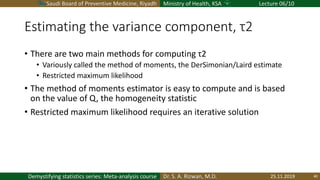
Estimating the variance component, τ2
• There are two main methods for computing τ2
• Variously called the method of moments, the DerSimonian/Laird estimate
• Restricted maximum likelihood
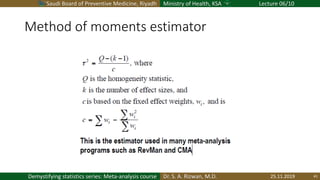
• The method of moments estimator is easy to compute and is based
on the value of Q, the homogeneity statistic
• Restricted maximum likelihood requires an iterative solution
25.11.2019 40
Saudi Board of Preventive Medicine, Riyadh Ministry of Health, KSA Lecture 06/10
Dr. S. A. Rizwan, M.D.Demystifying statistics series: Meta-analysis course
Method of moments estimator
25.11.2019 41
Saudi Board of Preventive Medicine, Riyadh Ministry of Health, KSA Lecture 06/10
Dr. S. A. Rizwan, M.D.Demystifying statistics series: Meta-analysis course
Restricted maximum likelihood estimator
• Many statisticians do not like the method of moments estimator
• Can estimate τ2 using HLM, SAS Proc Mixed, or R
25.11.2019 42
Saudi Board of Preventive Medicine, Riyadh Ministry of Health, KSA Lecture 06/10
Dr. S. A. Rizwan, M.D.Demystifying statistics series: Meta-analysis course
Differences between the two
models
25.11.2019 43
Saudi Board of Preventive Medicine, Riyadh Ministry of Health, KSA Lecture 06/10
Dr. S. A. Rizwan, M.D.Demystifying statistics series: Meta-analysis course
ES assumptions
Fixed effect model
• We assume that the treatment
effect is the same in all trials.
• We use only the sampling
variation within the trials.
Random effects model
• We assume that the treatment
effect is the not same in all trials.
• The trials are a sample from a
population of possible of trials
where the treatment effect varies.
• We use the sampling variation
within the trials and the sampling
variation between trials.
25.11.2019 44
Saudi Board of Preventive Medicine, Riyadh Ministry of Health, KSA Lecture 06/10
Dr. S. A. Rizwan, M.D.Demystifying statistics series: Meta-analysis course
Sampling assumptions
Fixed effect model
• If the treatment effect is the
same in all trials, it is more
powerful and easier.
• No assumption about
representativeness.
Random effects model
• Less powerful because P values are
larger and confidence intervals are
wider.
• The trials are a sample from a
population of possible of trials
where the treatment effect varies.
• They must be a representative or
random sample.
• Very strong assumption.
25.11.2019 45
Saudi Board of Preventive Medicine, Riyadh Ministry of Health, KSA Lecture 06/10
Dr. S. A. Rizwan, M.D.Demystifying statistics series: Meta-analysis course
Variance
Fixed effect model
• Variance of treatment effect in
trial = standard error squared.
• Weight = 1/variance = 1/SE2
Random effects model
• Variance of treatment effect in trial
= standard error squared plus inter-
trial variance
• Weight = 1/variance.
• 1
= --------------------------------
SE2 + inter-trial variance
• Inter-trial variance has degrees of
freedom given by number of trials
minus one.
• Typically small.
25.11.2019 46
Saudi Board of Preventive Medicine, Riyadh Ministry of Health, KSA Lecture 06/10
Dr. S. A. Rizwan, M.D.Demystifying statistics series: Meta-analysis course
When heterogeneity exists
Fixed effect model
• When heterogeneity exists we
get:
• a pooled estimate which may give
too much weight to large studies,
• a confidence interval which is too
narrow,
• a P-value which is too small.
Random effects model
• When heterogeneity exists we
get:
• possibly a different pooled
estimate with a different
interpretation,
• a wider confidence interval,
• a larger P-value.
25.11.2019 47
Saudi Board of Preventive Medicine, Riyadh Ministry of Health, KSA Lecture 06/10
Dr. S. A. Rizwan, M.D.Demystifying statistics series: Meta-analysis course
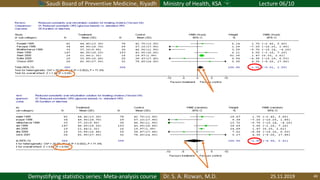
When heterogeneity doesn’t exist
Fixed effect model
• When heterogeneity does not
exists:
• a pooled estimate which is
correct,
• a confidence interval which is
correct,
• a P-value which is correct.
Random effects model
• When heterogeneity does not
exist:
• a pooled estimate which is
correct,
• a confidence interval which is too
wide,
• a P-value which is too large.
25.11.2019 48
Saudi Board of Preventive Medicine, Riyadh Ministry of Health, KSA Lecture 06/10
Dr. S. A. Rizwan, M.D.Demystifying statistics series: Meta-analysis course 25.11.2019 49
Saudi Board of Preventive Medicine, Riyadh Ministry of Health, KSA Lecture 06/10
Dr. S. A. Rizwan, M.D.Demystifying statistics series: Meta-analysis course
Thank you
Kindly email your queries to sarizwan1986@outlook.com
25.11.2019 50

Fixed-effect and random-effects models in meta-analysis

  • 1.
    Saudi Board ofPreventive Medicine, Riyadh Ministry of Health, KSA Lecture 06/10 Dr. S. A. Rizwan, M.D.Demystifying statistics series: Meta-analysis course Fixed-effect vs. Random-effects models in meta-analysis Dr. S. A. Rizwan M.D., Public Health Specialist & Lecturer, Saudi Board of Preventive Medicine – Riyadh, Ministry of Health, KSA 25.11.2019 1 With thanks to Michael Borenstein
  • 2.
    Saudi Board ofPreventive Medicine, Riyadh Ministry of Health, KSA Lecture 06/10 Dr. S. A. Rizwan, M.D.Demystifying statistics series: Meta-analysis course Outline • Provide a description of fixed and of random effects models • Outline the underlying assumptions of these two models in order to clarify the choices a reviewer has in a meta-analysis • Discuss how to estimate key parameters in the model 25.11.2019 2
  • 3.
    Saudi Board ofPreventive Medicine, Riyadh Ministry of Health, KSA Lecture 06/10 Dr. S. A. Rizwan, M.D.Demystifying statistics series: Meta-analysis course Our choice between the two depends on • Our assumption about how the effect sizes vary in our meta-analysis • The two models are based on different assumptions about the nature of the variation among effect sizes in our research synthesis 25.11.2019 3
  • 4.
    Saudi Board ofPreventive Medicine, Riyadh Ministry of Health, KSA Lecture 06/10 Dr. S. A. Rizwan, M.D.Demystifying statistics series: Meta-analysis course Sampling assumptions • Fixed-effect • Sampling takes place at one level only • Any between-study variance will be ignored when assigning weights • Random-effects • Sampling takes place at two levels • Any between-study variance will be used when assigning weights 25.11.2019 4
  • 5.
    Saudi Board ofPreventive Medicine, Riyadh Ministry of Health, KSA Lecture 06/10 Dr. S. A. Rizwan, M.D.Demystifying statistics series: Meta-analysis course Fixed-effect • When there is reason to believe that all the studies are functionally identical • When our goal is to compute the common effect size, for the studies in the analysis • Example of drug company has run five studies to assess the effect of a drug • Note that the effect size from each study estimate a single common mean – the fixed-effect • We know that each study will give us a different effect size, but each effect size is an estimate of a common mean, designated in the prior picture as θ 25.11.2019 5
  • 6.
    Saudi Board ofPreventive Medicine, Riyadh Ministry of Health, KSA Lecture 06/10 Dr. S. A. Rizwan, M.D.Demystifying statistics series: Meta-analysis course 25.11.2019 6
  • 7.
    Saudi Board ofPreventive Medicine, Riyadh Ministry of Health, KSA Lecture 06/10 Dr. S. A. Rizwan, M.D.Demystifying statistics series: Meta-analysis course Random-effects • We assume two components of variation: • – Sampling variation as in our fixed-effect model assumption • – Random variation because the effect sizes themselves are sampled from population of effect sizes • In a random effects model, we know that our effect sizes will differ because they are sampled from an unknown distribution • Our goal in the analysis will be to estimate the mean and variance of the underlying population of effect sizes • All the studies are functionally equivalent • Example of studies culled from publications 25.11.2019 7
  • 8.
    Saudi Board ofPreventive Medicine, Riyadh Ministry of Health, KSA Lecture 06/10 Dr. S. A. Rizwan, M.D.Demystifying statistics series: Meta-analysis course Random-effects • We see in the picture that each distribution has its own mean that is sampled from the underlying population distribution of effect sizes • That underlying population distribution also has its own variance, τ2, commonly called the variance component • Thus, each effect size has two components of variation, one due to sampling error, and one from the underlying distribution 25.11.2019 8
  • 9.
    Saudi Board ofPreventive Medicine, Riyadh Ministry of Health, KSA Lecture 06/10 Dr. S. A. Rizwan, M.D.Demystifying statistics series: Meta-analysis course 25.11.2019 9
  • 10.
    Saudi Board ofPreventive Medicine, Riyadh Ministry of Health, KSA Lecture 06/10 Dr. S. A. Rizwan, M.D.Demystifying statistics series: Meta-analysis course Definition of combined effect • Fixed effect model • There is one true effect • Summary effect is estimate of this value • Random effects model • There is a distribution of effects • Summary effect is mean of distribution 25.11.2019 10
  • 11.
    Saudi Board ofPreventive Medicine, Riyadh Ministry of Health, KSA Lecture 06/10 Dr. S. A. Rizwan, M.D.Demystifying statistics series: Meta-analysis course How weights are assigned? 25.11.2019 11
  • 12.
    Saudi Board ofPreventive Medicine, Riyadh Ministry of Health, KSA Lecture 06/10 Dr. S. A. Rizwan, M.D.Demystifying statistics series: Meta-analysis course W = 1/ (V1) Fixed-effects model 25.11.2019 12
  • 13.
    Saudi Board ofPreventive Medicine, Riyadh Ministry of Health, KSA Lecture 06/10 Dr. S. A. Rizwan, M.D.Demystifying statistics series: Meta-analysis course Random-effects model 25.11.2019 13 1W = 1/ (V +T 2 )
  • 14.
    Saudi Board ofPreventive Medicine, Riyadh Ministry of Health, KSA Lecture 06/10 Dr. S. A. Rizwan, M.D.Demystifying statistics series: Meta-analysis course 190 How weights shift? • If within-study variance only, W=1/V • If between-study variance only, W=1/T2 • If both, W=1/(V+T2) 25.11.2019 14
  • 15.
    Saudi Board ofPreventive Medicine, Riyadh Ministry of Health, KSA Lecture 06/10 Dr. S. A. Rizwan, M.D.Demystifying statistics series: Meta-analysis course 25.11.2019 15
  • 16.
    Saudi Board ofPreventive Medicine, Riyadh Ministry of Health, KSA Lecture 06/10 Dr. S. A. Rizwan, M.D.Demystifying statistics series: Meta-analysis course 25.11.2019 16
  • 17.
    Saudi Board ofPreventive Medicine, Riyadh Ministry of Health, KSA Lecture 06/10 Dr. S. A. Rizwan, M.D.Demystifying statistics series: Meta-analysis course Random vs. Fixed 25.11.2019 17
  • 18.
    Saudi Board ofPreventive Medicine, Riyadh Ministry of Health, KSA Lecture 06/10 Dr. S. A. Rizwan, M.D.Demystifying statistics series: Meta-analysis course Random vs. Fixed 25.11.2019 18 RE weights are more balanced
  • 19.
    Saudi Board ofPreventive Medicine, Riyadh Ministry of Health, KSA Lecture 06/10 Dr. S. A. Rizwan, M.D.Demystifying statistics series: Meta-analysis course Random vs. Fixed 25.11.2019 19 RE confidence interval is wider
  • 20.
    Saudi Board ofPreventive Medicine, Riyadh Ministry of Health, KSA Lecture 06/10 Dr. S. A. Rizwan, M.D.Demystifying statistics series: Meta-analysis course Large study has less impact under RE 25.11.2019 20
  • 21.
    Saudi Board ofPreventive Medicine, Riyadh Ministry of Health, KSA Lecture 06/10 Dr. S. A. Rizwan, M.D.Demystifying statistics series: Meta-analysis course Small study has more impact under RE 25.11.2019 21
  • 22.
    Saudi Board ofPreventive Medicine, Riyadh Ministry of Health, KSA Lecture 06/10 Dr. S. A. Rizwan, M.D.Demystifying statistics series: Meta-analysis course FE 25.11.2019 22
  • 23.
    Saudi Board ofPreventive Medicine, Riyadh Ministry of Health, KSA Lecture 06/10 Dr. S. A. Rizwan, M.D.Demystifying statistics series: Meta-analysis course Summary effect in Fixed model 25.11.2019 23 244.215 101.171 = 0.414FE
  • 24.
    Saudi Board ofPreventive Medicine, Riyadh Ministry of Health, KSA Lecture 06/10 Dr. S. A. Rizwan, M.D.Demystifying statistics series: Meta-analysis course Variance of summary effect in fixed model 25.11.2019 24 1 244.215 = 0.004FE
  • 25.
    Saudi Board ofPreventive Medicine, Riyadh Ministry of Health, KSA Lecture 06/10 Dr. S. A. Rizwan, M.D.Demystifying statistics series: Meta-analysis course RE 25.11.2019 25
  • 26.
    Saudi Board ofPreventive Medicine, Riyadh Ministry of Health, KSA Lecture 06/10 Dr. S. A. Rizwan, M.D.Demystifying statistics series: Meta-analysis course Summary effect in random model 25.11.2019 26 90.284 32.342 = 0.358RE
  • 27.
    Saudi Board ofPreventive Medicine, Riyadh Ministry of Health, KSA Lecture 06/10 Dr. S. A. Rizwan, M.D.Demystifying statistics series: Meta-analysis course Variance of summary effect in random model 25.11.2019 27 1 90.284 = 0.011RE
  • 28.
    Saudi Board ofPreventive Medicine, Riyadh Ministry of Health, KSA Lecture 06/10 Dr. S. A. Rizwan, M.D.Demystifying statistics series: Meta-analysis course Why does it matter? • One matches the sampling • One does not match the sampling • Wrong model yields incorrect weights • Estimate of mean is wrong • Estimate of CI is wrong • MUST choose based on sampling model • The meaning of the ES is different • Relative weights are closer under RE (effect size will shift) • Absolute weights are smaller under RE (CI will become wider) • p-value will change (less significant in long run but can go either way) 25.11.2019 28
  • 29.
    Saudi Board ofPreventive Medicine, Riyadh Ministry of Health, KSA Lecture 06/10 Dr. S. A. Rizwan, M.D.Demystifying statistics series: Meta-analysis course Test of null 25.11.2019 29 M M Z = SE M* M* Z* = SE Fixed Random Two sources of error One source of error
  • 30.
    Saudi Board ofPreventive Medicine, Riyadh Ministry of Health, KSA Lecture 06/10 Dr. S. A. Rizwan, M.D.Demystifying statistics series: Meta-analysis course Implications of the choice • If you expect that the effect size from each study arises from a different population then use random effects • Random effects model is more likely to give non-significant estimates • Recall that all our analyses in a meta-analysis are weighted by the inverse of the variance of the effect size, i.e., by the precision of the effect size estimate • Because we have more variation assumed in a random effects model, our weights for each study will be more equal to one another • In other words, in a fixed effect model, we will more heavily weight larger studies. In a random effects model, the larger studies will not be weighted as heavily 25.11.2019 30
  • 31.
    Saudi Board ofPreventive Medicine, Riyadh Ministry of Health, KSA Lecture 06/10 Dr. S. A. Rizwan, M.D.Demystifying statistics series: Meta-analysis course Question! • Suppose we had four studies, each with • N =1,000,000, and a true (mean) effect size of 50. • Under the two models, • What would the forest plot look like? • What would the diamond look like? 25.11.2019 31
  • 32.
    Saudi Board ofPreventive Medicine, Riyadh Ministry of Health, KSA Lecture 06/10 Dr. S. A. Rizwan, M.D.Demystifying statistics series: Meta-analysis course 25.11.2019 32
  • 33.
    Saudi Board ofPreventive Medicine, Riyadh Ministry of Health, KSA Lecture 06/10 Dr. S. A. Rizwan, M.D.Demystifying statistics series: Meta-analysis course 25.11.2019 33
  • 34.
    Saudi Board ofPreventive Medicine, Riyadh Ministry of Health, KSA Lecture 06/10 Dr. S. A. Rizwan, M.D.Demystifying statistics series: Meta-analysis course Which model should we use? • Base decision on the model that matched the way the data were collected • Not on test of homogeneity 25.11.2019 34
  • 35.
    Saudi Board ofPreventive Medicine, Riyadh Ministry of Health, KSA Lecture 06/10 Dr. S. A. Rizwan, M.D.Demystifying statistics series: Meta-analysis course What you may hear • Fixed-effect is simple model • Random-effects is more complicated 25.11.2019 35
  • 36.
    Saudi Board ofPreventive Medicine, Riyadh Ministry of Health, KSA Lecture 06/10 Dr. S. A. Rizwan, M.D.Demystifying statistics series: Meta-analysis course Actually • Fixed-effect is more restricted model • Random-effects makes less assumptions 25.11.2019 36
  • 37.
    Saudi Board ofPreventive Medicine, Riyadh Ministry of Health, KSA Lecture 06/10 Dr. S. A. Rizwan, M.D.Demystifying statistics series: Meta-analysis course An alternate view • Random-effects model only makes sense if we have a clear picture of the sampling frame • Otherwise, we should report the mean and CI for the studies in our sample without attempt to generalize to a larger universe 25.11.2019 37
  • 38.
    Saudi Board ofPreventive Medicine, Riyadh Ministry of Health, KSA Lecture 06/10 Dr. S. A. Rizwan, M.D.Demystifying statistics series: Meta-analysis course Goals in a fixed effect model • In a fixed effect model, we will be most interested in estimating our common effect, θ, and its standard error • We will also want to know if there is heterogeneity present by computing Q • HOWEVER, WE WILL NOT decide on the basis of a significant Q that we should really do a random effects model • WE WILL make a decision about fixed effect versus random effects models because of our substantive knowledge of the area of the systematic review 25.11.2019 38
  • 39.
    Saudi Board ofPreventive Medicine, Riyadh Ministry of Health, KSA Lecture 06/10 Dr. S. A. Rizwan, M.D.Demystifying statistics series: Meta-analysis course Goals in a random effects model • We also want to estimate a mean effect size, but now this is the mean effect size from the underlying population, μ • We also want to estimate the variance of the underlying effect size, τ2 • We will test heterogeneity by testing whether τ2 is different from 0. • Biggest difficulty: how to estimate τ2 25.11.2019 39
  • 40.
    Saudi Board ofPreventive Medicine, Riyadh Ministry of Health, KSA Lecture 06/10 Dr. S. A. Rizwan, M.D.Demystifying statistics series: Meta-analysis course Estimating the variance component, τ2 • There are two main methods for computing τ2 • Variously called the method of moments, the DerSimonian/Laird estimate • Restricted maximum likelihood • The method of moments estimator is easy to compute and is based on the value of Q, the homogeneity statistic • Restricted maximum likelihood requires an iterative solution 25.11.2019 40
  • 41.
    Saudi Board ofPreventive Medicine, Riyadh Ministry of Health, KSA Lecture 06/10 Dr. S. A. Rizwan, M.D.Demystifying statistics series: Meta-analysis course Method of moments estimator 25.11.2019 41
  • 42.
    Saudi Board ofPreventive Medicine, Riyadh Ministry of Health, KSA Lecture 06/10 Dr. S. A. Rizwan, M.D.Demystifying statistics series: Meta-analysis course Restricted maximum likelihood estimator • Many statisticians do not like the method of moments estimator • Can estimate τ2 using HLM, SAS Proc Mixed, or R 25.11.2019 42
  • 43.
    Saudi Board ofPreventive Medicine, Riyadh Ministry of Health, KSA Lecture 06/10 Dr. S. A. Rizwan, M.D.Demystifying statistics series: Meta-analysis course Differences between the two models 25.11.2019 43
  • 44.
    Saudi Board ofPreventive Medicine, Riyadh Ministry of Health, KSA Lecture 06/10 Dr. S. A. Rizwan, M.D.Demystifying statistics series: Meta-analysis course ES assumptions Fixed effect model • We assume that the treatment effect is the same in all trials. • We use only the sampling variation within the trials. Random effects model • We assume that the treatment effect is the not same in all trials. • The trials are a sample from a population of possible of trials where the treatment effect varies. • We use the sampling variation within the trials and the sampling variation between trials. 25.11.2019 44
  • 45.
    Saudi Board ofPreventive Medicine, Riyadh Ministry of Health, KSA Lecture 06/10 Dr. S. A. Rizwan, M.D.Demystifying statistics series: Meta-analysis course Sampling assumptions Fixed effect model • If the treatment effect is the same in all trials, it is more powerful and easier. • No assumption about representativeness. Random effects model • Less powerful because P values are larger and confidence intervals are wider. • The trials are a sample from a population of possible of trials where the treatment effect varies. • They must be a representative or random sample. • Very strong assumption. 25.11.2019 45
  • 46.
    Saudi Board ofPreventive Medicine, Riyadh Ministry of Health, KSA Lecture 06/10 Dr. S. A. Rizwan, M.D.Demystifying statistics series: Meta-analysis course Variance Fixed effect model • Variance of treatment effect in trial = standard error squared. • Weight = 1/variance = 1/SE2 Random effects model • Variance of treatment effect in trial = standard error squared plus inter- trial variance • Weight = 1/variance. • 1 = -------------------------------- SE2 + inter-trial variance • Inter-trial variance has degrees of freedom given by number of trials minus one. • Typically small. 25.11.2019 46
  • 47.
    Saudi Board ofPreventive Medicine, Riyadh Ministry of Health, KSA Lecture 06/10 Dr. S. A. Rizwan, M.D.Demystifying statistics series: Meta-analysis course When heterogeneity exists Fixed effect model • When heterogeneity exists we get: • a pooled estimate which may give too much weight to large studies, • a confidence interval which is too narrow, • a P-value which is too small. Random effects model • When heterogeneity exists we get: • possibly a different pooled estimate with a different interpretation, • a wider confidence interval, • a larger P-value. 25.11.2019 47
  • 48.
    Saudi Board ofPreventive Medicine, Riyadh Ministry of Health, KSA Lecture 06/10 Dr. S. A. Rizwan, M.D.Demystifying statistics series: Meta-analysis course When heterogeneity doesn’t exist Fixed effect model • When heterogeneity does not exists: • a pooled estimate which is correct, • a confidence interval which is correct, • a P-value which is correct. Random effects model • When heterogeneity does not exist: • a pooled estimate which is correct, • a confidence interval which is too wide, • a P-value which is too large. 25.11.2019 48
  • 49.
    Saudi Board ofPreventive Medicine, Riyadh Ministry of Health, KSA Lecture 06/10 Dr. S. A. Rizwan, M.D.Demystifying statistics series: Meta-analysis course 25.11.2019 49
  • 50.
    Saudi Board ofPreventive Medicine, Riyadh Ministry of Health, KSA Lecture 06/10 Dr. S. A. Rizwan, M.D.Demystifying statistics series: Meta-analysis course Thank you Kindly email your queries to sarizwan1986@outlook.com 25.11.2019 50