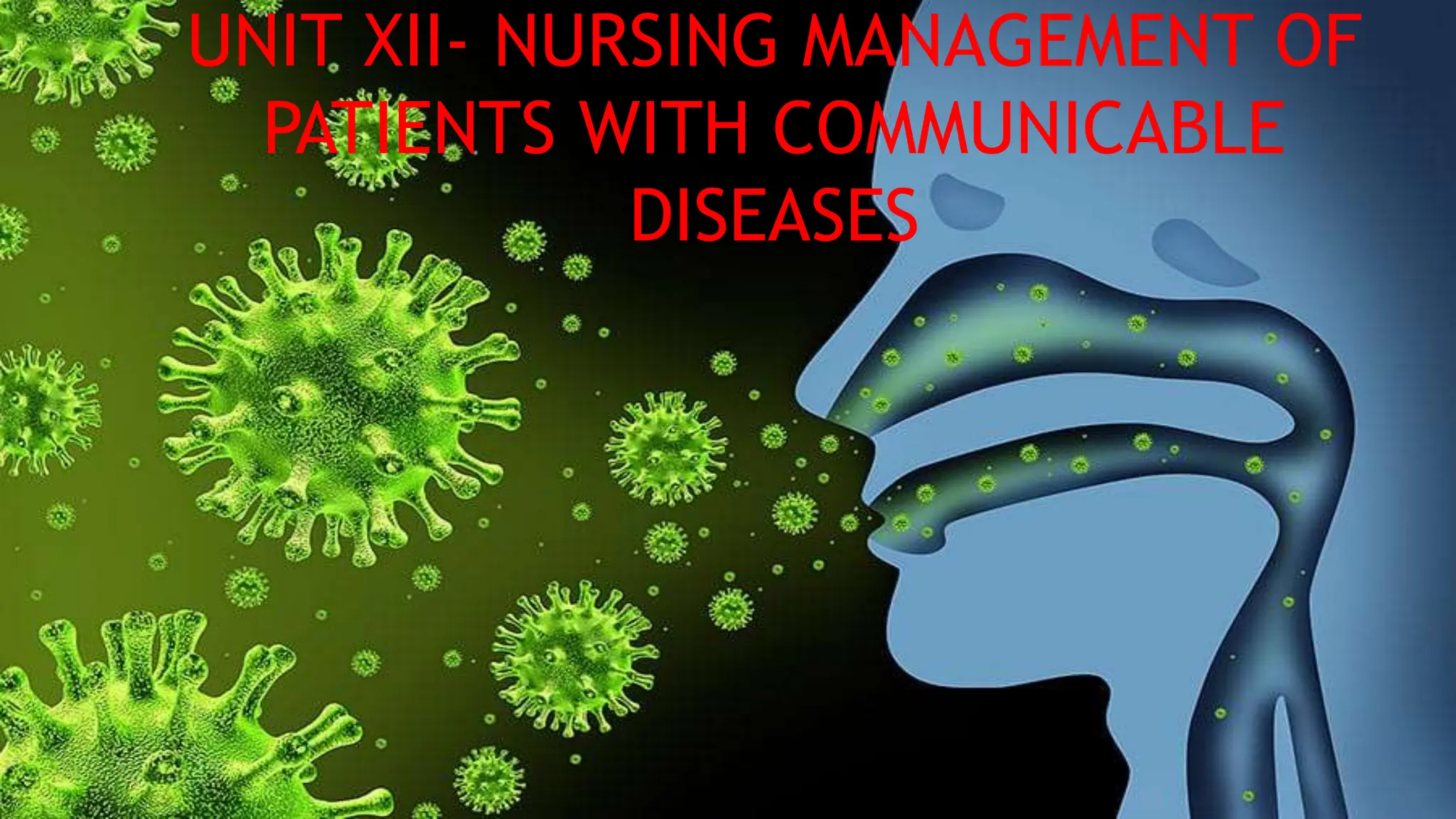
UNIT XII- NURSING MANAGEMENT OF
PATIENTS WITH COMMUNICABLE
DISEASES
CHICKEN POX AND
SMALLPOX
By
Krishna Priya C V
M.Sc Nursing 1st year
OBJECTIVES
 Definition
 Causative agent
 Risk factors
 Mode of transmission
 Infectious period
 Pathophysiology
 Signs and symptoms
 Diagnosis
 Treatment
 Complication and Prevention
 Nursing Management
COMMON TERMINOLOGIES
 INCUBATION PERIOD
It is the time taken for an infection to
appear its first signs and symptoms also called
latent period. It is a time elapse between exposure
to a pathogenic organism and when symptoms or
signs first appear.
 INFECTIOUS PERIOD
The infectious period is the time interval
during which a host (individual or patient) is infectious, i.e.
capable of directly or indirectly transmitting pathogenic
infectious agents or pathogens to another susceptible host.
The infectious period can start before, during, or after the
onset of symptoms, and it may stop before or after the
symptoms stop showing. It is also known as communicability
period, contagious period,
CHICKEN POX
 It is an infectious disease caused by a virus called
Varicella Zoster virus belongs to the Herpes virus family
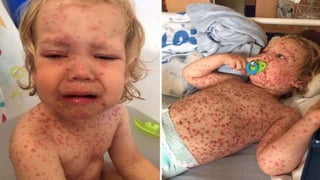
 People who get the virus often develop a rash of spots
that look like blisters all over the bodies
 The blisters are small and sit on an area of red skin that
can be anywhere and they are of varying size.
 Most common in winter and spring
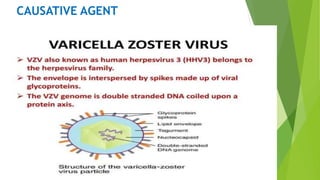
CAUSATIVE AGENT
SOURCE OF INFECTION
The virus is present in the nose and
throat secretions and lesions of the skin, mucous
membranes, and blood.
RISK FACTORS
 Environmental factors: It shows seasonal trends in
temperature settings and in most tropical settings with peak
incidence during winter and spring.
 A person who hasn’t already had chickenpox or hasn’t had the
chickenpox vaccine.
 People who smoke.
 Pregnant women who haven't had chickenpox or
the vaccine.
 People whose immune system is weakened
 Mainly in children below the age of 10 years
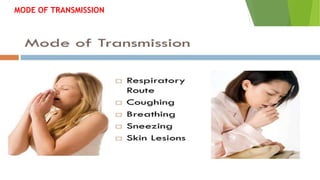
MODE OF TRANSMISSION
INFECTIOUS PERIOD
A person who is infected with
chickenpox can spread the virus even before
he or she has any symptoms. Chickenpox can
spread from 2 to 3 days before the rash
appears until all the blisters have crusted
over.
PATHOPHYSIOLOGY
Inhalation of respiratory droplets
Virus infect upper respiratory tract mucosa
Viral proliferation in the regional lymph node of the
URT[ 2-4 days after initial infection]
Virus enters the blood
PRIMARY VIREMIA leads to fever, malaise,fatigue
Virus starts to target lymphocytes in order to multiply
and spread even further
Viral replication in other organs [ liver and spleen]
Stage of secondary viremia at 14-16
days
Diffuse viral invasion of capillary endothelial cells and the epidermis
Viral infection of epidermal cells produces both intracellular
and intercellular edema resulting in vesicle
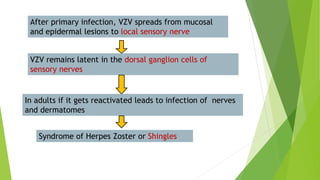
After primary infection, VZV spreads from mucosal
and epidermal lesions to local sensory nerve
VZV remains latent in the dorsal ganglion cells of
sensory nerves
In adults if it gets reactivated leads to infection of nerves
and dermatomes
Syndrome of Herpes Zoster or Shingles
SIGNS AND SYMPTOMS
PRE-ERUPTIVE STAGE [ BEFORE THE ONSET OF RASHES]
 Mild or moderate fever usually 1-2 days before the onset of
rashes 100-101 Fahrenheit
 Pain in the back
 Shivering and malaise
 Loss of appetite
 Headache
 Sore throat
ERUPTIVE STAGE
In children, Rash is often the first sign it comes on the day fever
starts usually during the secondary viremia stage [14- 16 days ]
1. DISTRIBUTION:
Rashes are symmetrical they first appear on the trunk where it
is abundant, then come on arms, face, and legs where it is less
abundant. Rashes also appear on the mucosal surface of the
buccal and pharyngeal.
RAPID EVOLUTION
The rashes advance quickly through the stages
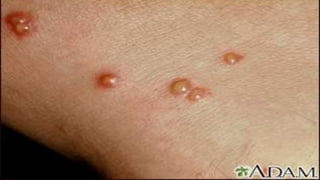
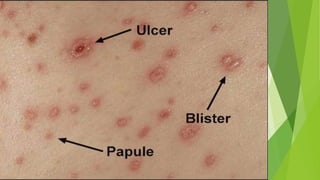
of Macule [small patches of skin that are altered in colour
but not elevated], Papules [ elevated solid lesion of skin less
than 1 cm ] Vesicles[ a thin-walled sac filled with a fluid,
usually clear and small less than 1 cm ] with in 24 hours.
The vesicles may form a crust without going
to pustular stage. Usually, they are superficial in site ,with
easily ruptured wall
PLEOMORPHISM
A characteristic feature of the rashes in
chickenpox is pleomorphism. That is all stages of rash
[papules, vesicles, and crusts] present simultaneously at one
time in the same area. This is due to rashes appearing
continuously for 4-5 days in the same area
The incubation period of chicken pox is about 15
days [range 7-21 days]
DIAGNOSIS
• Chickenpox can be diagnosed with its classical symptoms
through physical examination
• Microscopic examination of the skin lesion can be done
for laboratory confirmation of the disease
• Examination of vesicle fluid under an electron microscope
• Detection of viral DNA by PCR [ Polymerase Chain
Reaction ]
• Serology to assess antibodies usually [IgG present against
VZV virus]
TREATMENT
MEDICAL MANAGEMENT
1. Analgesics, such as paracetamol and ibuprofen
are prescribed to relieve the pain.
2. Calamine lotion is used in relieving the itching
during chickenpox.
3. Antihistamines such as benadryl, to ease
symptoms.
4. Acyclovir In children, 2-16 years of age, the oral dosage is
20 mg/kg 4 times a day for 5 days, (maximum of 800 mg 4
times a day) Adults can receive upto 800 mg 5 times a day
5. Varicella zoster immunoglobulin: Given within 72 hours of
exposure has been recommended for prevention 1.25-5 ml
given IM.
COMPLICATIONS and PREVENTION
NURSING MANAGEMENT
 Educate patient and family members about the
importance and safety of varicella zoster vaccine.
 Perform a complete physical assessment.
 Monitor the vital signs of the patient.
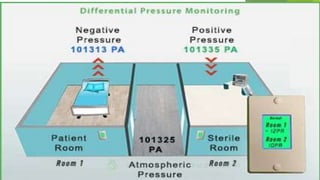
 Isolate the patient for at least 6 days after the
onset of rash.
 Instruct family members to frequently change the
cloths of patient which is soiled by the secretion
from the lesion.
 Instruct patient to cover his/her mouth while
coughing or sneezing.
 Provide a full and unrestricted diet to the patient
 Wear a PPE or have the patient wear a mask to
prevent respiratory spread.
 Instruct patient to trim his/her nails to prevent
injury while scratching lesion. Advice to avoid
rubbing or scratching of the lesion
 Manage itching with calamine lotion or cool
compresses
 Disinfect material contaminated by nasal and
throat secretion and wound
 Patient is advised to consume plenty of fluids
 Administer medicines as ordered by physician
SMALLPOX
STOCK PILES
Since 1984, small pox virus has been held in just
two places in world at
United States Centre for disease control and
prevention laboratory in Atlanta, Vector laboratory
Russia
Due to bioterrorism now they invented Antiviral
drug Tecovirimat [July2018 ] and Brincidovir [2021]
Smallpox is an acute contagious disease caused by
variola virus, a member of the ortho- poxvirus
family. Naturally occurring smallpox was eradicated
worldwide by 1980
 Smallpox is caused by the variola virus, a member of
the orthopoxvirus family.
 It is easily transmitted from person to person by
direct contact or inhalation of respiratory droplets.
 Spread through contaminated clothing and bedding.
 In contact with an infected person who coughs or
sneezes
 Affect all ages and both gender
ETIOLOGY
RISK FACTORS
 Exposure to contaminated aerosolized particles.
 Contaminated body fluid
 Physical contact with someone who has small pox
FORMS OF SMALL POX
 Variola major - the most serious and most
common form of small pox. It produces an
extensive rash and fever.
 VARIOLA MINOR – It is less common and less
serious form of small pox
PATHOPHYSOLOGY
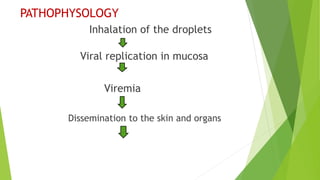
Inhalation of the droplets
Viral replication in mucosa
Viremia
Dissemination to the skin and organs
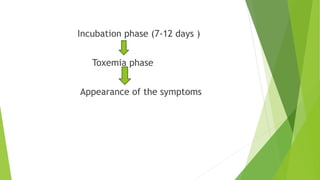
Incubation phase (7-12 days )
Toxemia phase
Appearance of the symptoms
CLINICAL MANIFESTATION
 Discomfort
 Fever
 Headache
 Back pain
 Flat and red spots on hands, face, forearm and on
the trunk later on
 Lesions change into small blisters which the turn
into pus and scab in the later phase which leaves
scar
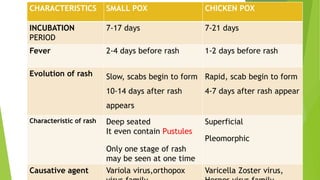
CHARACTERISTICS SMALL POX CHICKEN POX
INCUBATION
PERIOD
7-17 days 7-21 days
Fever 2-4 days before rash 1-2 days before rash
Evolution of rash Slow, scabs begin to form
10-14 days after rash
appears
Rapid, scab begin to form
4-7 days after rash appear
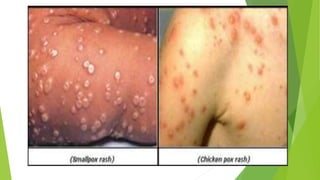
Characteristic of rash Deep seated
It even contain Pustules
Only one stage of rash
may be seen at one time
Superficial
Pleomorphic
Causative agent Variola virus,orthopox Varicella Zoster virus,
SUMMARY
QUESTIONS
1) Mention any two risk factors of chickenpox?
2) What are the stages of chicken pox symptoms?
3) Mention any two medical management for chickenpox ?
4) Mention any two complications of chicken pox?
5) Difference between smallpox and chicken pox [two point]?
BIBLIOGRAPHY
TEACHER REFERENCES
1.Suddharth &Brunner. Textbook of Medical Surgical Nursing, 13th edition:
Wolter Kluwer publication; 2014.pgno 1450-1460.
2.Black JM, Hawks JH. Medical Surgical Nursing, 1st edition : Elseiver
publication;2019. pgno 1458-1489.
3.Sharma S,Sonia L. Medical Surgical Nursing, 1st edition : Elseiver
publication ;2016. pgno 720-725
4.Park K. Textbook of Preventive and Social Medicine,27th edition :Bhanot
publication ; 2020.pgno 480-490
STUDENT REFERENCE
1. Kaur,Ansari .Medical-Surgical Nursing, 2nd edition: PV
publication;2017.pgno 69-80
2. Sharma. Medical Surgical Nursing, 3rd edition :AITBS
publication ;2017 .pgno 90-96
chicken pox and small pox management.pptx

chicken pox and small pox management.pptx

  • 1.
    UNIT XII- NURSINGMANAGEMENT OF PATIENTS WITH COMMUNICABLE DISEASES
  • 3.
    CHICKEN POX AND SMALLPOX By KrishnaPriya C V M.Sc Nursing 1st year
  • 4.
    OBJECTIVES  Definition  Causativeagent  Risk factors  Mode of transmission  Infectious period  Pathophysiology  Signs and symptoms  Diagnosis  Treatment  Complication and Prevention  Nursing Management
  • 5.
    COMMON TERMINOLOGIES  INCUBATIONPERIOD It is the time taken for an infection to appear its first signs and symptoms also called latent period. It is a time elapse between exposure to a pathogenic organism and when symptoms or signs first appear.
  • 6.
     INFECTIOUS PERIOD Theinfectious period is the time interval during which a host (individual or patient) is infectious, i.e. capable of directly or indirectly transmitting pathogenic infectious agents or pathogens to another susceptible host. The infectious period can start before, during, or after the onset of symptoms, and it may stop before or after the symptoms stop showing. It is also known as communicability period, contagious period,
  • 7.
    CHICKEN POX  Itis an infectious disease caused by a virus called Varicella Zoster virus belongs to the Herpes virus family  People who get the virus often develop a rash of spots that look like blisters all over the bodies  The blisters are small and sit on an area of red skin that can be anywhere and they are of varying size.  Most common in winter and spring
  • 8.
  • 9.
    SOURCE OF INFECTION Thevirus is present in the nose and throat secretions and lesions of the skin, mucous membranes, and blood.
  • 10.
    RISK FACTORS  Environmentalfactors: It shows seasonal trends in temperature settings and in most tropical settings with peak incidence during winter and spring.  A person who hasn’t already had chickenpox or hasn’t had the chickenpox vaccine.  People who smoke.
  • 11.
     Pregnant womenwho haven't had chickenpox or the vaccine.  People whose immune system is weakened  Mainly in children below the age of 10 years
  • 12.
  • 13.
    INFECTIOUS PERIOD A personwho is infected with chickenpox can spread the virus even before he or she has any symptoms. Chickenpox can spread from 2 to 3 days before the rash appears until all the blisters have crusted over.
  • 14.
  • 16.
    Inhalation of respiratorydroplets Virus infect upper respiratory tract mucosa Viral proliferation in the regional lymph node of the URT[ 2-4 days after initial infection] Virus enters the blood PRIMARY VIREMIA leads to fever, malaise,fatigue
  • 17.
    Virus starts totarget lymphocytes in order to multiply and spread even further Viral replication in other organs [ liver and spleen] Stage of secondary viremia at 14-16 days Diffuse viral invasion of capillary endothelial cells and the epidermis Viral infection of epidermal cells produces both intracellular and intercellular edema resulting in vesicle
  • 18.
    After primary infection,VZV spreads from mucosal and epidermal lesions to local sensory nerve VZV remains latent in the dorsal ganglion cells of sensory nerves In adults if it gets reactivated leads to infection of nerves and dermatomes Syndrome of Herpes Zoster or Shingles
  • 19.
    SIGNS AND SYMPTOMS PRE-ERUPTIVESTAGE [ BEFORE THE ONSET OF RASHES]  Mild or moderate fever usually 1-2 days before the onset of rashes 100-101 Fahrenheit  Pain in the back  Shivering and malaise  Loss of appetite  Headache  Sore throat
  • 20.
    ERUPTIVE STAGE In children,Rash is often the first sign it comes on the day fever starts usually during the secondary viremia stage [14- 16 days ] 1. DISTRIBUTION: Rashes are symmetrical they first appear on the trunk where it is abundant, then come on arms, face, and legs where it is less abundant. Rashes also appear on the mucosal surface of the buccal and pharyngeal.
  • 22.
    RAPID EVOLUTION The rashesadvance quickly through the stages of Macule [small patches of skin that are altered in colour but not elevated], Papules [ elevated solid lesion of skin less than 1 cm ] Vesicles[ a thin-walled sac filled with a fluid, usually clear and small less than 1 cm ] with in 24 hours. The vesicles may form a crust without going to pustular stage. Usually, they are superficial in site ,with easily ruptured wall
  • 26.
    PLEOMORPHISM A characteristic featureof the rashes in chickenpox is pleomorphism. That is all stages of rash [papules, vesicles, and crusts] present simultaneously at one time in the same area. This is due to rashes appearing continuously for 4-5 days in the same area
  • 27.
    The incubation periodof chicken pox is about 15 days [range 7-21 days]
  • 29.
    DIAGNOSIS • Chickenpox canbe diagnosed with its classical symptoms through physical examination • Microscopic examination of the skin lesion can be done for laboratory confirmation of the disease • Examination of vesicle fluid under an electron microscope • Detection of viral DNA by PCR [ Polymerase Chain Reaction ] • Serology to assess antibodies usually [IgG present against VZV virus]
  • 30.
    TREATMENT MEDICAL MANAGEMENT 1. Analgesics,such as paracetamol and ibuprofen are prescribed to relieve the pain. 2. Calamine lotion is used in relieving the itching during chickenpox. 3. Antihistamines such as benadryl, to ease symptoms.
  • 31.
    4. Acyclovir Inchildren, 2-16 years of age, the oral dosage is 20 mg/kg 4 times a day for 5 days, (maximum of 800 mg 4 times a day) Adults can receive upto 800 mg 5 times a day 5. Varicella zoster immunoglobulin: Given within 72 hours of exposure has been recommended for prevention 1.25-5 ml given IM.
  • 32.
  • 34.
    NURSING MANAGEMENT  Educatepatient and family members about the importance and safety of varicella zoster vaccine.  Perform a complete physical assessment.  Monitor the vital signs of the patient.  Isolate the patient for at least 6 days after the onset of rash.
  • 35.
     Instruct familymembers to frequently change the cloths of patient which is soiled by the secretion from the lesion.  Instruct patient to cover his/her mouth while coughing or sneezing.  Provide a full and unrestricted diet to the patient  Wear a PPE or have the patient wear a mask to prevent respiratory spread.
  • 36.
     Instruct patientto trim his/her nails to prevent injury while scratching lesion. Advice to avoid rubbing or scratching of the lesion  Manage itching with calamine lotion or cool compresses  Disinfect material contaminated by nasal and throat secretion and wound  Patient is advised to consume plenty of fluids  Administer medicines as ordered by physician
  • 37.
  • 38.
    STOCK PILES Since 1984,small pox virus has been held in just two places in world at United States Centre for disease control and prevention laboratory in Atlanta, Vector laboratory Russia Due to bioterrorism now they invented Antiviral drug Tecovirimat [July2018 ] and Brincidovir [2021]
  • 39.
    Smallpox is anacute contagious disease caused by variola virus, a member of the ortho- poxvirus family. Naturally occurring smallpox was eradicated worldwide by 1980
  • 40.
     Smallpox iscaused by the variola virus, a member of the orthopoxvirus family.  It is easily transmitted from person to person by direct contact or inhalation of respiratory droplets.  Spread through contaminated clothing and bedding.  In contact with an infected person who coughs or sneezes  Affect all ages and both gender ETIOLOGY
  • 41.
    RISK FACTORS  Exposureto contaminated aerosolized particles.  Contaminated body fluid  Physical contact with someone who has small pox
  • 42.
    FORMS OF SMALLPOX  Variola major - the most serious and most common form of small pox. It produces an extensive rash and fever.  VARIOLA MINOR – It is less common and less serious form of small pox
  • 43.
    PATHOPHYSOLOGY Inhalation of thedroplets Viral replication in mucosa Viremia Dissemination to the skin and organs
  • 44.
    Incubation phase (7-12days ) Toxemia phase Appearance of the symptoms
  • 45.
    CLINICAL MANIFESTATION  Discomfort Fever  Headache  Back pain  Flat and red spots on hands, face, forearm and on the trunk later on  Lesions change into small blisters which the turn into pus and scab in the later phase which leaves scar
  • 46.
    CHARACTERISTICS SMALL POXCHICKEN POX INCUBATION PERIOD 7-17 days 7-21 days Fever 2-4 days before rash 1-2 days before rash Evolution of rash Slow, scabs begin to form 10-14 days after rash appears Rapid, scab begin to form 4-7 days after rash appear Characteristic of rash Deep seated It even contain Pustules Only one stage of rash may be seen at one time Superficial Pleomorphic Causative agent Variola virus,orthopox Varicella Zoster virus,
  • 47.
  • 50.
    QUESTIONS 1) Mention anytwo risk factors of chickenpox? 2) What are the stages of chicken pox symptoms? 3) Mention any two medical management for chickenpox ? 4) Mention any two complications of chicken pox? 5) Difference between smallpox and chicken pox [two point]?
  • 51.
    BIBLIOGRAPHY TEACHER REFERENCES 1.Suddharth &Brunner.Textbook of Medical Surgical Nursing, 13th edition: Wolter Kluwer publication; 2014.pgno 1450-1460. 2.Black JM, Hawks JH. Medical Surgical Nursing, 1st edition : Elseiver publication;2019. pgno 1458-1489. 3.Sharma S,Sonia L. Medical Surgical Nursing, 1st edition : Elseiver publication ;2016. pgno 720-725 4.Park K. Textbook of Preventive and Social Medicine,27th edition :Bhanot publication ; 2020.pgno 480-490
  • 52.
    STUDENT REFERENCE 1. Kaur,Ansari.Medical-Surgical Nursing, 2nd edition: PV publication;2017.pgno 69-80 2. Sharma. Medical Surgical Nursing, 3rd edition :AITBS publication ;2017 .pgno 90-96