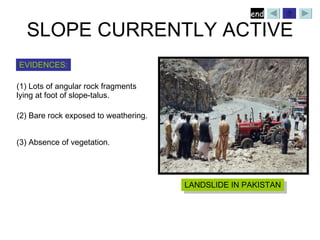
SLOPE CURRENTLY ACTIVE LANDSLIDE IN PAKISTAN Lots of angular rock fragments  lying at foot of slope-talus. EVIDENCES: (2) Bare rock exposed to weathering. (3) Absence of vegetation.
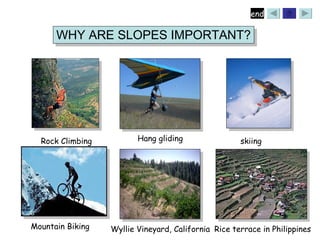
WHY ARE SLOPES IMPORTANT? Wyllie Vineyard, California Rock Climbing skiing Hang gliding Mountain Biking Rice terrace in Philippines
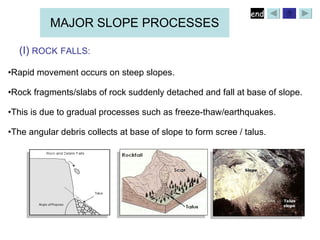
MAJOR SLOPE PROCESSES (I)  ROCK   FALLS: Rapid movement occurs on steep slopes. Rock fragments/slabs of rock suddenly detached and fall at base of slope. This is due to gradual processes such as freeze-thaw/earthquakes. The angular debris collects at base of slope to form scree / talus.
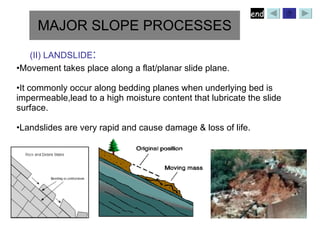
MAJOR SLOPE PROCESSES (II) LANDSLIDE : Movement takes place along a flat/planar slide plane. It commonly occur along bedding planes when underlying bed is impermeable,lead to a high moisture content that lubricate the slide surface. Landslides are very rapid and cause damage & loss of life.
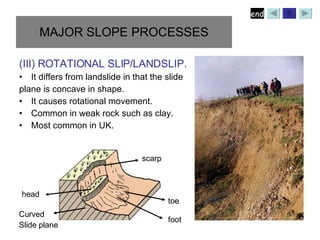
(III) ROTATIONAL SLIP/LANDSLIP. It differs from landslide in that the slide  plane is concave in shape. It causes rotational movement. Common in weak rock such as clay. Most common in UK.  MAJOR SLOPE PROCESSES head scarp Curved Slide plane foot toe
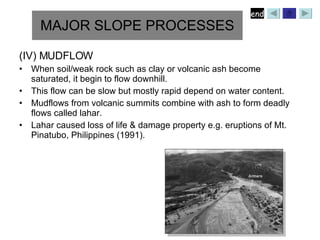
(IV) MUDFLOW When soil/weak rock such as clay or volcanic ash become saturated, it begin to flow downhill. This flow can be slow but mostly rapid depend on water content. Mudflows from volcanic summits combine with ash to form deadly flows called lahar. Lahar caused loss of life & damage property e.g. eruptions of Mt. Pinatubo, Philippines (1991). MAJOR SLOPE PROCESSES
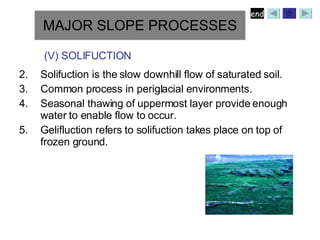
Solifuction is the slow downhill flow of saturated soil. Common process in periglacial environments. Seasonal thawing of uppermost layer provide enough water to enable flow to occur. Gelifluction refers to solifuction takes place on top of frozen ground. MAJOR SLOPE PROCESSES (V) SOLIFUCTION
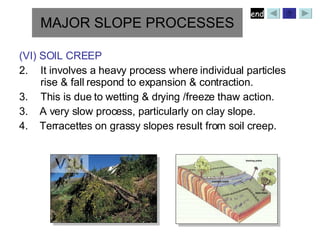
(VI) SOIL CREEP It involves a heavy process where individual particles rise & fall respond to expansion & contraction. This is due to wetting & drying /freeze thaw action.  3.  A very slow process, particularly on clay slope. 4.  Terracettes on grassy slopes result from soil creep. MAJOR SLOPE PROCESSES
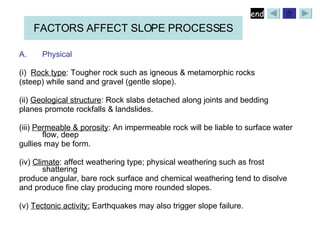
FACTORS AFFECT SLOPE PROCESSES Physical (i)  Rock type : Tougher rock such as igneous & metamorphic rocks  (steep) while sand and gravel (gentle slope). (ii)  Geological structure : Rock slabs detached along joints and bedding  planes promote rockfalls & landslides. (iii)  Permeable & porosity : An impermeable rock will be liable to surface water flow, deep  gullies may be form. (iv)  Climate : affect weathering type; physical weathering such as frost shattering  produce angular, bare rock surface and chemical weathering tend to disolve and produce fine clay producing more rounded slopes. (v)  Tectonic activity:  Earthquakes may also trigger slope failure.
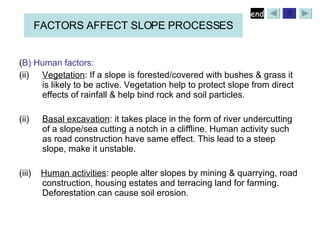
( B) Human factors: Vegetation : If a slope is forested/covered with bushes & grass it is likely to be active. Vegetation help to protect slope from direct effects of rainfall & help bind rock and soil particles. (ii) Basal excavation : it takes place in the form of river undercutting of a slope/sea cutting a notch in a cliffline. Human activity such as road construction have same effect. This lead to a steep slope, make it unstable. (iii)  Human activities : people alter slopes by mining & quarrying, road construction, housing estates and terracing land for farming. Deforestation can cause soil erosion. FACTORS AFFECT SLOPE PROCESSES
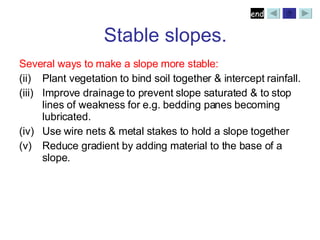
Several ways to make a slope more stable: Plant vegetation to bind soil together & intercept rainfall. Improve drainage to prevent slope saturated & to stop lines of weakness for e.g. bedding panes becoming lubricated. Use wire nets & metal stakes to hold a slope together Reduce gradient by adding material to the base of a slope. Stable slopes.

Slope Movement

  • 1.
    SLOPE CURRENTLY ACTIVELANDSLIDE IN PAKISTAN Lots of angular rock fragments lying at foot of slope-talus. EVIDENCES: (2) Bare rock exposed to weathering. (3) Absence of vegetation.
  • 2.
    WHY ARE SLOPESIMPORTANT? Wyllie Vineyard, California Rock Climbing skiing Hang gliding Mountain Biking Rice terrace in Philippines
  • 3.
    MAJOR SLOPE PROCESSES(I) ROCK FALLS: Rapid movement occurs on steep slopes. Rock fragments/slabs of rock suddenly detached and fall at base of slope. This is due to gradual processes such as freeze-thaw/earthquakes. The angular debris collects at base of slope to form scree / talus.
  • 4.
    MAJOR SLOPE PROCESSES(II) LANDSLIDE : Movement takes place along a flat/planar slide plane. It commonly occur along bedding planes when underlying bed is impermeable,lead to a high moisture content that lubricate the slide surface. Landslides are very rapid and cause damage & loss of life.
  • 5.
    (III) ROTATIONAL SLIP/LANDSLIP.It differs from landslide in that the slide plane is concave in shape. It causes rotational movement. Common in weak rock such as clay. Most common in UK. MAJOR SLOPE PROCESSES head scarp Curved Slide plane foot toe
  • 6.
    (IV) MUDFLOW Whensoil/weak rock such as clay or volcanic ash become saturated, it begin to flow downhill. This flow can be slow but mostly rapid depend on water content. Mudflows from volcanic summits combine with ash to form deadly flows called lahar. Lahar caused loss of life & damage property e.g. eruptions of Mt. Pinatubo, Philippines (1991). MAJOR SLOPE PROCESSES
  • 7.
    Solifuction is theslow downhill flow of saturated soil. Common process in periglacial environments. Seasonal thawing of uppermost layer provide enough water to enable flow to occur. Gelifluction refers to solifuction takes place on top of frozen ground. MAJOR SLOPE PROCESSES (V) SOLIFUCTION
  • 8.
    (VI) SOIL CREEPIt involves a heavy process where individual particles rise & fall respond to expansion & contraction. This is due to wetting & drying /freeze thaw action. 3. A very slow process, particularly on clay slope. 4. Terracettes on grassy slopes result from soil creep. MAJOR SLOPE PROCESSES
  • 9.
    FACTORS AFFECT SLOPEPROCESSES Physical (i) Rock type : Tougher rock such as igneous & metamorphic rocks (steep) while sand and gravel (gentle slope). (ii) Geological structure : Rock slabs detached along joints and bedding planes promote rockfalls & landslides. (iii) Permeable & porosity : An impermeable rock will be liable to surface water flow, deep gullies may be form. (iv) Climate : affect weathering type; physical weathering such as frost shattering produce angular, bare rock surface and chemical weathering tend to disolve and produce fine clay producing more rounded slopes. (v) Tectonic activity: Earthquakes may also trigger slope failure.
  • 10.
    ( B) Humanfactors: Vegetation : If a slope is forested/covered with bushes & grass it is likely to be active. Vegetation help to protect slope from direct effects of rainfall & help bind rock and soil particles. (ii) Basal excavation : it takes place in the form of river undercutting of a slope/sea cutting a notch in a cliffline. Human activity such as road construction have same effect. This lead to a steep slope, make it unstable. (iii) Human activities : people alter slopes by mining & quarrying, road construction, housing estates and terracing land for farming. Deforestation can cause soil erosion. FACTORS AFFECT SLOPE PROCESSES
  • 11.
    Several ways tomake a slope more stable: Plant vegetation to bind soil together & intercept rainfall. Improve drainage to prevent slope saturated & to stop lines of weakness for e.g. bedding panes becoming lubricated. Use wire nets & metal stakes to hold a slope together Reduce gradient by adding material to the base of a slope. Stable slopes.