Presentation
on
Land Slides
Course Name: Engineering geology
Course Teacher: Ma’am Mehwish
Presented by 2nd Group
Group Members:
Salman Hafeez 2kx5-CE-106
Ali Farooq 2kx5-CE-107
Mujahid Ur Rehman 2kx5-CE-108
Amjad Fareed 2kx5-CE-109
Mudassar Elahi 2kx5-CE-110
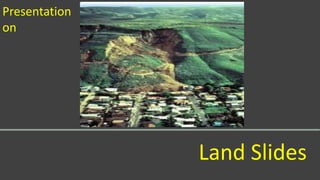
Land Slides
Loose material ordinarily creeps downhill under the force of gravity. However, on sloping in the
presence of water, the creeping may be become a fast-moving landslide. Thus the rate of
movement of earth material varies from very slow to very rapid. All movement of land masses
are referred as landslides, but differ in many respects, therefore two major types of landslides
are categorized as Earth Movements.
◦Earthflows
◦Landslides
Earthflows
In earthflows the unconsolidated material flows slowly downhill under the pull of gravity. The
movements are distributed through the mass, and the well defined slip surface which is
characteristic of landslides, does not occur.
The various types of earthflows are :
◦ Soil Creep
◦ Rock creep
◦ Solifluction
◦ Mudflows
Soil Creep
◦ The soil creep is continuous and slow movement of unconsolidated earth material down the
slop.
◦ Movement of the soil occurs in regions which are subjected to freeze-thaw conditions. The
freeze lifts the particles of soil and rocks and when there is a thaw, the particles are set back
down, but not in the same place as before.
◦ The rate of soil creep on a hill side depends mainly on (i) temperature changes, (ii) amount of
rainfall, (iii) angel of slop, (iv) type of soil, (v) nature of the parent material .
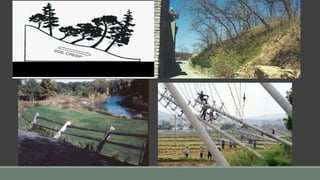
◦ The creep is indicated by the presence of tilted fence posts and telegraph poles, curved tree
trunks, broken and displaced retaining walls and man other features.
Rock creep
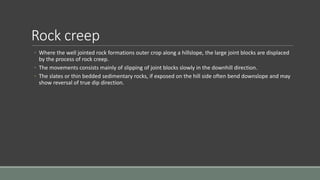
◦ Where the well jointed rock formations outer crop along a hillslope, the large joint blocks are displaced
by the process of rock creep.
◦ The movements consists mainly of slipping of joint blocks slowly in the downhill direction.
◦ The slates or thin bedded sedimentary rocks, if exposed on the hill side often bend downslope and may
show reversal of true dip direction.
SOLIFUCTION
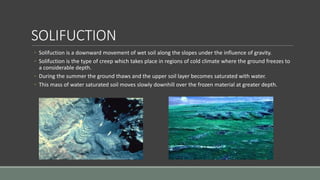
◦ Solifuction is a downward movement of wet soil along the slopes under the influence of gravity.
◦ Solifuction is the type of creep which takes place in regions of cold climate where the ground freezes to
a considerable depth.
◦ During the summer the ground thaws and the upper soil layer becomes saturated with water.
◦ This mass of water saturated soil moves slowly downhill over the frozen material at greater depth.
Mudflows
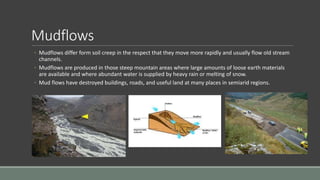
◦ Mudflows differ form soil creep in the respect that they move more rapidly and usually flow old stream
channels.
◦ Mudflows are produced in those steep mountain areas where large amounts of loose earth materials
are available and where abundant water is supplied by heavy rain or melting of snow.
◦ Mud flows have destroyed buildings, roads, and useful land at many places in semiarid regions.
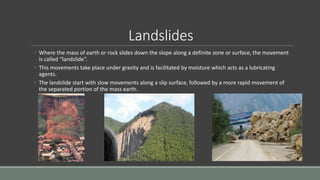
Landslides
◦ Where the mass of earth or rock slides down the slope along a definite zone or surface, the movement
is called “landslide”.
◦ This movements take place under gravity and is facilitated by moisture which acts as a lubricating
agents.
◦ The landslide start with slow movements along a slip surface, followed by a more rapid movement of
the separated portion of the mass earth.
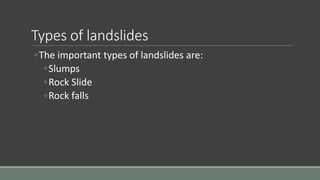
Types of landslides
◦The important types of landslides are:
◦Slumps
◦Rock Slide
◦Rock falls
Slumps
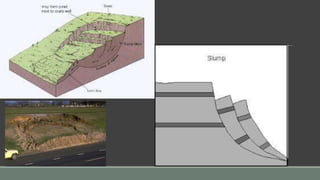
◦ The movements of the mass starts by cracking along a shearing surface and
then the separated mass slides dejected rapidly. Such a slide is called a
“Slump” or “Shear slide”.
◦ In a more or less homogeneous cohesive material such as clays and some
soils, a slope fails primarily by shear and the slip surface is approximately
cylindrical or spoon-shaped.
◦ Slump is often accompanied by bulges at the toe.
Rock Slides
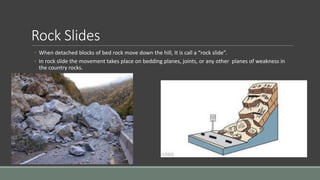
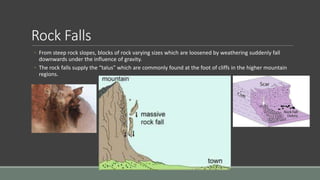
◦ When detached blocks of bed rock move down the hill, It is call a “rock slide”.
◦ In rock slide the movement takes place on bedding planes, joints, or any other planes of weakness in
the country rocks.
Rock Falls
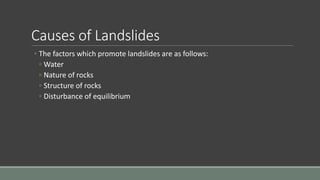
◦ From steep rock slopes, blocks of rock varying sizes which are loosened by weathering suddenly fall
downwards under the influence of gravity.
◦ The rock falls supply the “talus” which are commonly found at the foot of cliffs in the higher mountain
regions.
Causes of Landslides
◦ The factors which promote landslides are as follows:
◦ Water
◦ Nature of rocks
◦ Structure of rocks
◦ Disturbance of equilibrium
• Water
Water is the main factor of causing landslides. It acts in three ways:
i. it reduced cohesion
ii. It adds weight to the material
iii. On freezing it exerts an expansive force
• Nature of Rocks
Land slides often occur where weak and slippery materials like clay, shale, volcanic tuff,
phyllites present.
• Structure of Rocks
Joints, fractures, shear zones, and bedding planes usually become the slip-surface in case
of rock slide. Landslide are particularly common on hill slopes dip of rock beds is also in the
same direction.
• Disturbance of Equilibrium
The existing equilibrium of the earth or rock mass may be disturbed by
(i) Over steepening of slope by natural erosion or by man made excavations
(ii) Over loading of the upper part of the slope
(iii) Earthquake vibration or
(iv) Increase in the water content of the material
Effects of Landslides
◦ The effects of landslides are given below:
◦ The effects of catastrophic landslides is dangerous to humans and to other living things
◦ Concentrated mixture of rock and mud may destroy the trees, houses, and cars and blocking the
bridge
◦ it can produce enough energy to destroy the bridge
◦ Pyroclastic flows (pyroclastic) arising from dust debris of ash, poisonous gas and hot rock from
volcanic eruptions that spread quickly to eat anything that traveled to the effects of destruction and
death.
Among the social effects that can be described as:
◦ 1. Economic Decline
◦ 2. Damage To Infrastructure
◦ 3. Loss Of Life
◦ 4. Changes In The Surface Landscape
Prevent of Landslides
The important methods of prevention of landslides are as follows.
◦ Slides in impervious materials are prevented by reducing slopes. Efforts should also be made not to
allow the additional water to enter in the material.
◦ In order to check the surface water to enter the unstable ground, it is diverted and made to sun off as
rapidly as possible away from that area.
◦ In previous materials, the landslides may be prevented by increasing the internal friction of the mass by
lowering the water content. The water content may be removed by drain pipes, by drainage through
tunnels, or by pumping from wells.
◦ In situations where slides may causes loss of life and property, the loose rock material are prevented
from sliding by constructing retaining walls, concrete piers, or by use of piling.
◦ At some places the unstable material may be consolidated by cement grouting, by chemical means, and
by artificial freezing.
Thanks to all

Landslideing

  • 2.
  • 3.
    Course Name: Engineeringgeology Course Teacher: Ma’am Mehwish Presented by 2nd Group Group Members: Salman Hafeez 2kx5-CE-106 Ali Farooq 2kx5-CE-107 Mujahid Ur Rehman 2kx5-CE-108 Amjad Fareed 2kx5-CE-109 Mudassar Elahi 2kx5-CE-110
  • 4.
    Land Slides Loose materialordinarily creeps downhill under the force of gravity. However, on sloping in the presence of water, the creeping may be become a fast-moving landslide. Thus the rate of movement of earth material varies from very slow to very rapid. All movement of land masses are referred as landslides, but differ in many respects, therefore two major types of landslides are categorized as Earth Movements. ◦Earthflows ◦Landslides
  • 5.
    Earthflows In earthflows theunconsolidated material flows slowly downhill under the pull of gravity. The movements are distributed through the mass, and the well defined slip surface which is characteristic of landslides, does not occur. The various types of earthflows are : ◦ Soil Creep ◦ Rock creep ◦ Solifluction ◦ Mudflows
  • 6.
    Soil Creep ◦ Thesoil creep is continuous and slow movement of unconsolidated earth material down the slop. ◦ Movement of the soil occurs in regions which are subjected to freeze-thaw conditions. The freeze lifts the particles of soil and rocks and when there is a thaw, the particles are set back down, but not in the same place as before. ◦ The rate of soil creep on a hill side depends mainly on (i) temperature changes, (ii) amount of rainfall, (iii) angel of slop, (iv) type of soil, (v) nature of the parent material . ◦ The creep is indicated by the presence of tilted fence posts and telegraph poles, curved tree trunks, broken and displaced retaining walls and man other features.
  • 8.
    Rock creep ◦ Wherethe well jointed rock formations outer crop along a hillslope, the large joint blocks are displaced by the process of rock creep. ◦ The movements consists mainly of slipping of joint blocks slowly in the downhill direction. ◦ The slates or thin bedded sedimentary rocks, if exposed on the hill side often bend downslope and may show reversal of true dip direction.
  • 9.
    SOLIFUCTION ◦ Solifuction isa downward movement of wet soil along the slopes under the influence of gravity. ◦ Solifuction is the type of creep which takes place in regions of cold climate where the ground freezes to a considerable depth. ◦ During the summer the ground thaws and the upper soil layer becomes saturated with water. ◦ This mass of water saturated soil moves slowly downhill over the frozen material at greater depth.
  • 10.
    Mudflows ◦ Mudflows differform soil creep in the respect that they move more rapidly and usually flow old stream channels. ◦ Mudflows are produced in those steep mountain areas where large amounts of loose earth materials are available and where abundant water is supplied by heavy rain or melting of snow. ◦ Mud flows have destroyed buildings, roads, and useful land at many places in semiarid regions.
  • 11.
    Landslides ◦ Where themass of earth or rock slides down the slope along a definite zone or surface, the movement is called “landslide”. ◦ This movements take place under gravity and is facilitated by moisture which acts as a lubricating agents. ◦ The landslide start with slow movements along a slip surface, followed by a more rapid movement of the separated portion of the mass earth.
  • 12.
    Types of landslides ◦Theimportant types of landslides are: ◦Slumps ◦Rock Slide ◦Rock falls
  • 13.
    Slumps ◦ The movementsof the mass starts by cracking along a shearing surface and then the separated mass slides dejected rapidly. Such a slide is called a “Slump” or “Shear slide”. ◦ In a more or less homogeneous cohesive material such as clays and some soils, a slope fails primarily by shear and the slip surface is approximately cylindrical or spoon-shaped. ◦ Slump is often accompanied by bulges at the toe.
  • 15.
    Rock Slides ◦ Whendetached blocks of bed rock move down the hill, It is call a “rock slide”. ◦ In rock slide the movement takes place on bedding planes, joints, or any other planes of weakness in the country rocks.
  • 16.
    Rock Falls ◦ Fromsteep rock slopes, blocks of rock varying sizes which are loosened by weathering suddenly fall downwards under the influence of gravity. ◦ The rock falls supply the “talus” which are commonly found at the foot of cliffs in the higher mountain regions.
  • 17.
    Causes of Landslides ◦The factors which promote landslides are as follows: ◦ Water ◦ Nature of rocks ◦ Structure of rocks ◦ Disturbance of equilibrium
  • 18.
    • Water Water isthe main factor of causing landslides. It acts in three ways: i. it reduced cohesion ii. It adds weight to the material iii. On freezing it exerts an expansive force • Nature of Rocks Land slides often occur where weak and slippery materials like clay, shale, volcanic tuff, phyllites present. • Structure of Rocks Joints, fractures, shear zones, and bedding planes usually become the slip-surface in case of rock slide. Landslide are particularly common on hill slopes dip of rock beds is also in the same direction. • Disturbance of Equilibrium The existing equilibrium of the earth or rock mass may be disturbed by (i) Over steepening of slope by natural erosion or by man made excavations (ii) Over loading of the upper part of the slope (iii) Earthquake vibration or (iv) Increase in the water content of the material
  • 19.
    Effects of Landslides ◦The effects of landslides are given below: ◦ The effects of catastrophic landslides is dangerous to humans and to other living things ◦ Concentrated mixture of rock and mud may destroy the trees, houses, and cars and blocking the bridge ◦ it can produce enough energy to destroy the bridge ◦ Pyroclastic flows (pyroclastic) arising from dust debris of ash, poisonous gas and hot rock from volcanic eruptions that spread quickly to eat anything that traveled to the effects of destruction and death. Among the social effects that can be described as: ◦ 1. Economic Decline ◦ 2. Damage To Infrastructure ◦ 3. Loss Of Life ◦ 4. Changes In The Surface Landscape
  • 20.
    Prevent of Landslides Theimportant methods of prevention of landslides are as follows. ◦ Slides in impervious materials are prevented by reducing slopes. Efforts should also be made not to allow the additional water to enter in the material. ◦ In order to check the surface water to enter the unstable ground, it is diverted and made to sun off as rapidly as possible away from that area. ◦ In previous materials, the landslides may be prevented by increasing the internal friction of the mass by lowering the water content. The water content may be removed by drain pipes, by drainage through tunnels, or by pumping from wells. ◦ In situations where slides may causes loss of life and property, the loose rock material are prevented from sliding by constructing retaining walls, concrete piers, or by use of piling. ◦ At some places the unstable material may be consolidated by cement grouting, by chemical means, and by artificial freezing.
  • 21.