
Mass-Wasting
Movement of Large Amounts of
Material Downhill under Gravity
Dr. P. Sarathbabu M.Sc. B.Ed. Ph.D
Department of Geology
Acharya Nagarjuna University
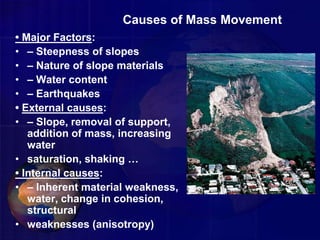
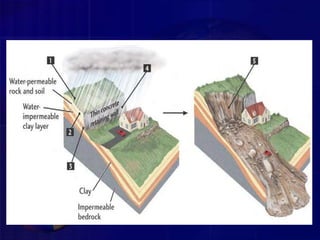
Causes of Mass Movement
• Major Factors:
• – Steepness of slopes
• – Nature of slope materials
• – Water content
• – Earthquakes
• External causes:
• – Slope, removal of support,
addition of mass, increasing
water
• saturation, shaking …
• Internal causes:
• – Inherent material weakness,
water, change in cohesion,
structural
• weaknesses (anisotropy)
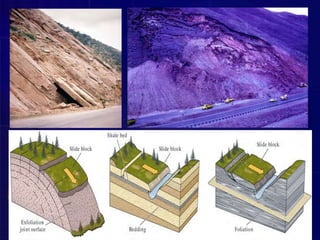
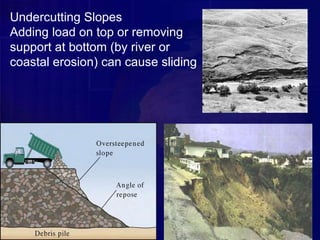
Undercutting Slopes
Adding load on top or removing
support at bottom (by river or
coastal erosion) can cause sliding
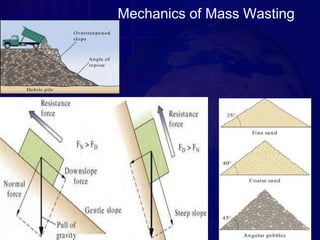
Mechanics of Mass Wasting
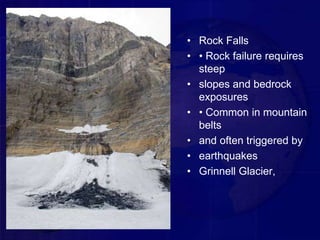
• Rock Falls
• • Rock failure requires
steep
• slopes and bedrock
exposures
• • Common in mountain
belts
• and often triggered by
• earthquakes
• Grinnell Glacier,
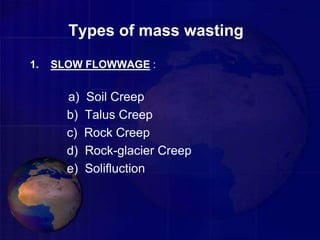
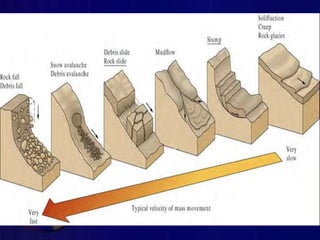
Types of mass wasting
1. SLOW FLOWWAGE :
a) Soil Creep
b) Talus Creep
c) Rock Creep
d) Rock-glacier Creep
e) Solifluction
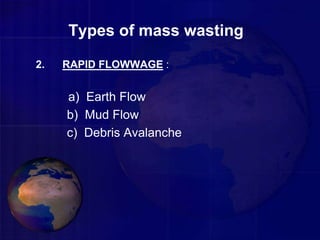
Types of mass wasting
2. RAPID FLOWWAGE :
a) Earth Flow
b) Mud Flow
c) Debris Avalanche
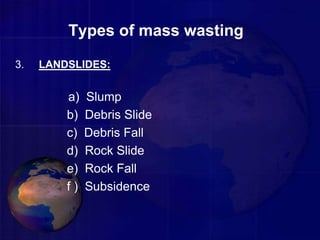
Types of mass wasting
3. LANDSLIDES:
a) Slump
b) Debris Slide
c) Debris Fall
d) Rock Slide
e) Rock Fall
f ) Subsidence
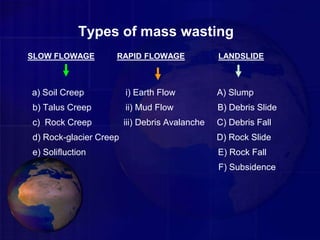
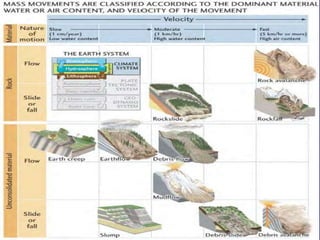
SLOW FLOWAGE RAPID FLOWAGE LANDSLIDE
a) Soil Creep i) Earth Flow A) Slump
b) Talus Creep ii) Mud Flow B) Debris Slide
c) Rock Creep iii) Debris Avalanche C) Debris Fall
d) Rock-glacier Creep D) Rock Slide
e) Solifluction E) Rock Fall
F) Subsidence
Types of mass wasting
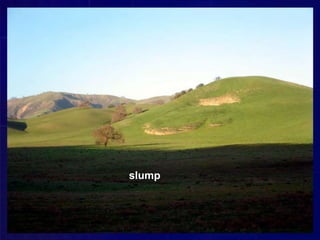
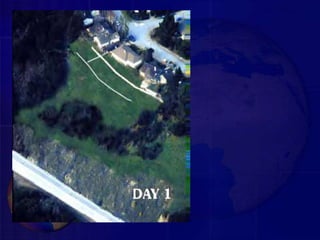
• ā€œSlumpDownword slipping of one or more units of rock
fragments due gravity is known as slump
• Debris flow: rapid rolling or unconsolidated earth debris
without backward rotation of mass (amount of water is low)
• Debris fall: It is nearly free fall from vertical cliff
• Rock slide: sliding of individual rocks (Ex.Fault)
• Roc fall: Free falling of rocks blocks are moves at any steep
slope
• (small blocks are dethatched from big rock blocks
• Subsidence: downward displacement of
superficial material without a free surface
and horizontal displacement (Ex:Rift valley)
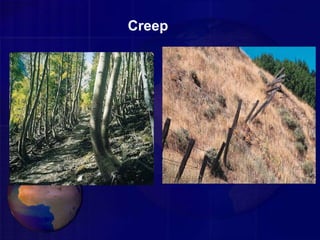
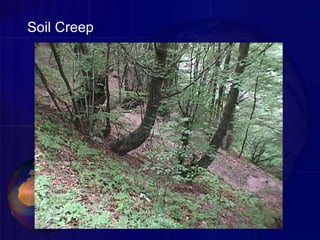
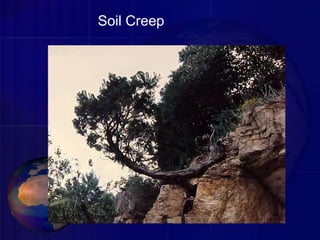
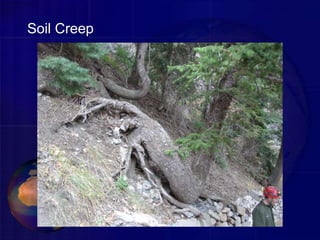
• Soil Creep : The continuous movement of soil down a slope
in response to gravity is known as soil creep.
• Talus Creep : Talus is the slow down slope movement of
rock fragments or scree (accumulation of fragmented rock
waste below a cliff or rock face)
• Rock Creep : The movement of rock fragments across an
inclined surface by means of intermittent slip along a plane
between the fragments and the ground surface.
• Rock-Glacier Creep : It’s the downslope movement of
tongues of rock waste.
• Solifluction : The slow downhill movement of masses of
rock debris which are saturated with water and not confined
to definite channels.
SLOW FLOWAGE
• Earth Flow : The rapid movement of water-soil material
down a slope is known as earth flow..
• Mud Flow : Mud flow is type of mass movement on an
unstable slope, similar to an earth flow but of greater velocity
because of the high percentage of water present in the
mixture .
• Debris Avalanche : A sudden downslope (gravitational)
movement of debris due saturation by heavy rain. Infact it is
a debris slide, in which the mass of material moves
downslope without any rotational movement.
RAPID FLOWAGE
• : The continuous movement of soil down a slope in
response to gravity is known as soil creep.
• Talus Creep : Talus is the slow down slope movement of
rock fragments or scree (accumulation of fragmented rock
waste below a cliff or rock face)
• Rock Creep : The movement of rock fragments across an
inclined surface by means of intermittent slip along a plane
between the fragments and the ground surface.
• Rock-Glacier Creep : It’s the downslope movement of
tongues of rock waste.
• Solifluction : The slow downhill movement of masses of
rock debris which are saturated with water and not confined
to definite channels.
SLOW FLOWAGE
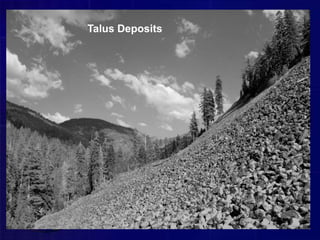
Talus Deposits
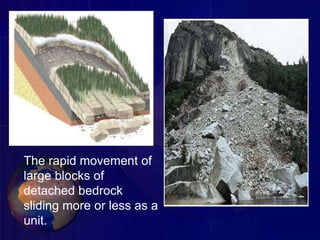
The rapid movement of
large blocks of
detached bedrock
sliding more or less as a
unit.
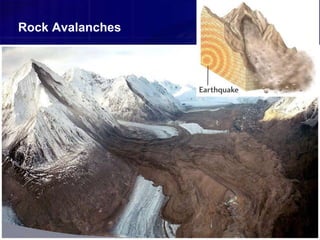
Rock Avalanches
slump
Creep
• Earth Flows
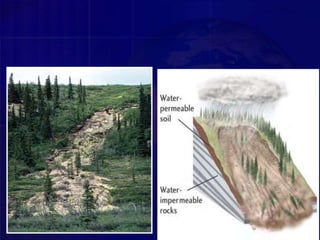
• Take unconsolidated soil and sediment on
moderate slope
• Add lots of water – Shake or Stir
• A fluid movement of relatively fine-grained material,
e.g. soils, weathered shale, and clay.
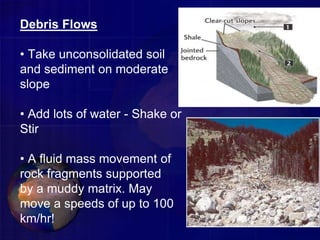
Debris Flows
• Take unconsolidated soil
and sediment on moderate
slope
• Add lots of water - Shake or
Stir
• A fluid mass movement of
rock fragments supported
by a muddy matrix. May
move a speeds of up to 100
km/hr!
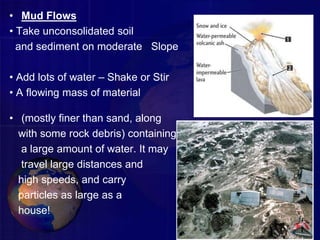
• Mud Flows
• Take unconsolidated soil
and sediment on moderate Slope
• Add lots of water – Shake or Stir
• A flowing mass of material
• (mostly finer than sand, along
with some rock debris) containing
a large amount of water. It may
travel large distances and
high speeds, and carry
particles as large as a
house!
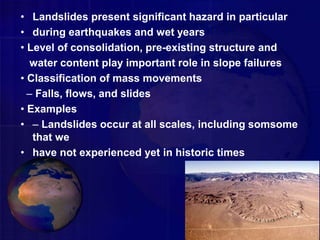
• Landslides present significant hazard in particular
• during earthquakes and wet years
• Level of consolidation, pre-existing structure and
water content play important role in slope failures
• Classification of mass movements
– Falls, flows, and slides
• Examples
• – Landslides occur at all scales, including somsome
that we
• have not experienced yet in historic times
Soil Creep
Soil Creep
Soil Creep
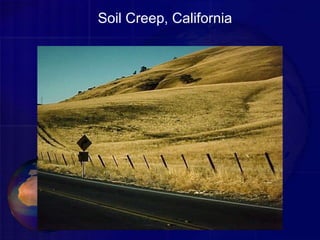
Soil Creep, California
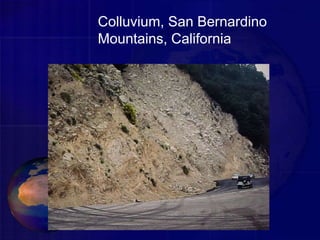
Colluvium, San Bernardino
Mountains, California
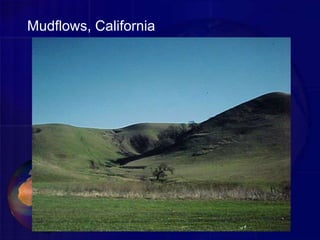
Mudflows, California
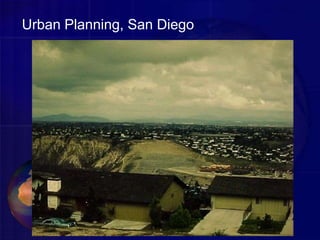
Urban Planning, San Diego
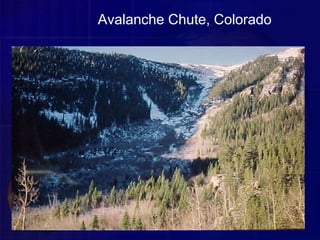
Avalanche Chute, Colorado
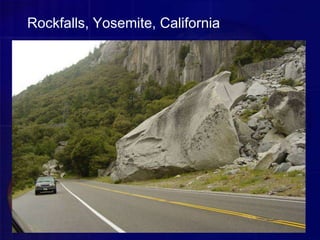
Rockfalls, Yosemite, California
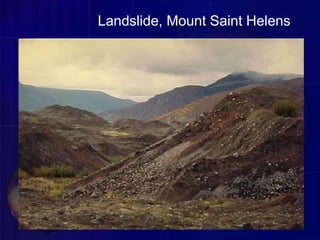
Landslide, Mount Saint Helens
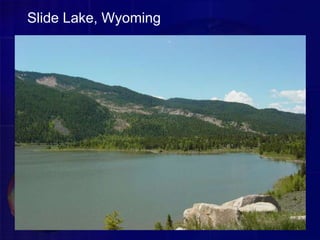
Slide Lake, Wyoming
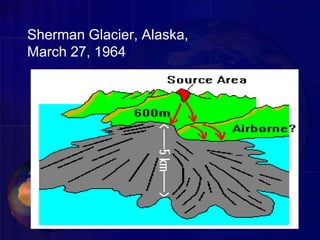
Sherman Glacier, Alaska,
March 27, 1964
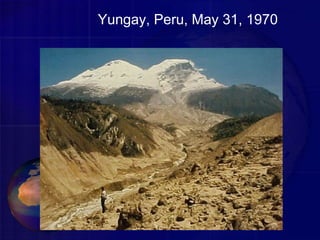
Yungay, Peru, May 31, 1970
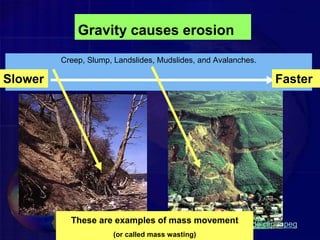
Gravity causes erosion
landslide clip.mpeg
Creep, Slump, Landslides, Mudslides, and Avalanches.
These are examples of mass movement
(or called mass wasting)
Slower Faster
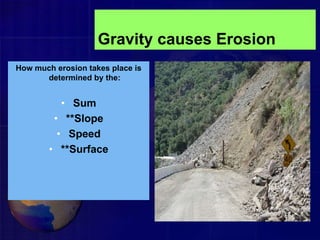
Gravity causes Erosion
How much erosion takes place is
determined by the:
• Sum
• **Slope
• Speed
• **Surface
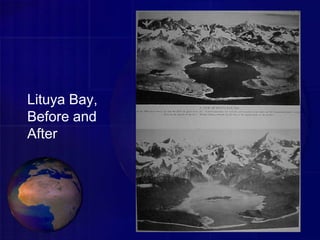
Lituya Bay,
Before and
After
EFFECTS OF MASS WASTING
1. Disruption of transport or blocking
communications by damaging roads and
railways and telegraph poles
2. Obstruction to the river flow in valleys,
leading to their overflow and floods
3. Damage to sewer and other pipelines
4. Burial or destruction of buildings and
other construction
5. Some times earthquake may be formed
due to mass wasting.
The main factors which contribute to landslide occurrence are
slope, water content, structural defects, unconsolidated or
loose character of the overburden, lithology and human
interference.
The factors may tackled as follows:
1. To counter the effect of slope
2. To counter the effect of water
3. To counter the structural defects
4. Not to resort to reduce the stability of existing slops
5. To counter the loose nature of overbuden
6. Avoid heavy traffic and blasting operations near the
vulnerable places naturally helps in preventing the
occurrence of mass wasting.
PREVENTIVE MEASURE FOR MASS WASTING
1. To counter the effect of slope : Retaining walls may be
constructed against the slopes, so that the material
which rolls down is not only prevented from further
fall but also reduced the slope.
2. To counter the effect of water : A proper drainage
system is the suitable measure. This involves the
quick removal of percolated moisture by means of
surface drainage and sub-surface drainage.
Construction of suitable ditches and waterways along
slopes and provision of trenches at the bottom and
drainage tunnels help in draining off the water from
the loose overburden.
3. To counter the structural defects : The different
structural defects such as weak planes and zone may
be either covered or grouted suitably so that they are
effectively sealed off.
4. Not to resort to reduce the stability of existing slops:
This is done by not undertaking any undercuttings on
the surface slope and by not undertaking any
construction at the top of the hills.
5. To counter the loose nature of overburden: Growing
vegetation, plants and shrubs on loose ground helps
in keeping the loose soil together.
6. Avoid heavy traffic and blasting operations near the
vulnerable places naturally helps in preventing the
occurrence of mass wasting.
Mass-Wasting(original).ppt

Mass-Wasting(original).ppt

  • 1.
    Mass-Wasting Movement of LargeAmounts of Material Downhill under Gravity Dr. P. Sarathbabu M.Sc. B.Ed. Ph.D Department of Geology Acharya Nagarjuna University
  • 4.
    Causes of MassMovement • Major Factors: • – Steepness of slopes • – Nature of slope materials • – Water content • – Earthquakes • External causes: • – Slope, removal of support, addition of mass, increasing water • saturation, shaking … • Internal causes: • – Inherent material weakness, water, change in cohesion, structural • weaknesses (anisotropy)
  • 6.
    Undercutting Slopes Adding loadon top or removing support at bottom (by river or coastal erosion) can cause sliding
  • 7.
  • 8.
    • Rock Falls •• Rock failure requires steep • slopes and bedrock exposures • • Common in mountain belts • and often triggered by • earthquakes • Grinnell Glacier,
  • 9.
    Types of masswasting 1. SLOW FLOWWAGE : a) Soil Creep b) Talus Creep c) Rock Creep d) Rock-glacier Creep e) Solifluction
  • 10.
    Types of masswasting 2. RAPID FLOWWAGE : a) Earth Flow b) Mud Flow c) Debris Avalanche
  • 11.
    Types of masswasting 3. LANDSLIDES: a) Slump b) Debris Slide c) Debris Fall d) Rock Slide e) Rock Fall f ) Subsidence
  • 12.
    SLOW FLOWAGE RAPIDFLOWAGE LANDSLIDE a) Soil Creep i) Earth Flow A) Slump b) Talus Creep ii) Mud Flow B) Debris Slide c) Rock Creep iii) Debris Avalanche C) Debris Fall d) Rock-glacier Creep D) Rock Slide e) Solifluction E) Rock Fall F) Subsidence Types of mass wasting
  • 13.
    • ā€œSlumpDownword slippingof one or more units of rock fragments due gravity is known as slump • Debris flow: rapid rolling or unconsolidated earth debris without backward rotation of mass (amount of water is low) • Debris fall: It is nearly free fall from vertical cliff • Rock slide: sliding of individual rocks (Ex.Fault) • Roc fall: Free falling of rocks blocks are moves at any steep slope • (small blocks are dethatched from big rock blocks • Subsidence: downward displacement of superficial material without a free surface and horizontal displacement (Ex:Rift valley)
  • 14.
    • Soil Creep: The continuous movement of soil down a slope in response to gravity is known as soil creep. • Talus Creep : Talus is the slow down slope movement of rock fragments or scree (accumulation of fragmented rock waste below a cliff or rock face) • Rock Creep : The movement of rock fragments across an inclined surface by means of intermittent slip along a plane between the fragments and the ground surface. • Rock-Glacier Creep : It’s the downslope movement of tongues of rock waste. • Solifluction : The slow downhill movement of masses of rock debris which are saturated with water and not confined to definite channels. SLOW FLOWAGE
  • 15.
    • Earth Flow: The rapid movement of water-soil material down a slope is known as earth flow.. • Mud Flow : Mud flow is type of mass movement on an unstable slope, similar to an earth flow but of greater velocity because of the high percentage of water present in the mixture . • Debris Avalanche : A sudden downslope (gravitational) movement of debris due saturation by heavy rain. Infact it is a debris slide, in which the mass of material moves downslope without any rotational movement. RAPID FLOWAGE
  • 16.
    • : Thecontinuous movement of soil down a slope in response to gravity is known as soil creep. • Talus Creep : Talus is the slow down slope movement of rock fragments or scree (accumulation of fragmented rock waste below a cliff or rock face) • Rock Creep : The movement of rock fragments across an inclined surface by means of intermittent slip along a plane between the fragments and the ground surface. • Rock-Glacier Creep : It’s the downslope movement of tongues of rock waste. • Solifluction : The slow downhill movement of masses of rock debris which are saturated with water and not confined to definite channels. SLOW FLOWAGE
  • 18.
  • 19.
    The rapid movementof large blocks of detached bedrock sliding more or less as a unit.
  • 20.
  • 21.
  • 23.
  • 24.
    • Earth Flows •Take unconsolidated soil and sediment on moderate slope • Add lots of water – Shake or Stir • A fluid movement of relatively fine-grained material, e.g. soils, weathered shale, and clay.
  • 26.
    Debris Flows • Takeunconsolidated soil and sediment on moderate slope • Add lots of water - Shake or Stir • A fluid mass movement of rock fragments supported by a muddy matrix. May move a speeds of up to 100 km/hr!
  • 27.
    • Mud Flows •Take unconsolidated soil and sediment on moderate Slope • Add lots of water – Shake or Stir • A flowing mass of material • (mostly finer than sand, along with some rock debris) containing a large amount of water. It may travel large distances and high speeds, and carry particles as large as a house!
  • 29.
    • Landslides presentsignificant hazard in particular • during earthquakes and wet years • Level of consolidation, pre-existing structure and water content play important role in slope failures • Classification of mass movements – Falls, flows, and slides • Examples • – Landslides occur at all scales, including somsome that we • have not experienced yet in historic times
  • 30.
  • 31.
  • 32.
  • 33.
  • 34.
  • 35.
  • 36.
  • 37.
  • 38.
  • 39.
  • 40.
  • 41.
  • 42.
  • 43.
    Gravity causes erosion landslideclip.mpeg Creep, Slump, Landslides, Mudslides, and Avalanches. These are examples of mass movement (or called mass wasting) Slower Faster
  • 44.
    Gravity causes Erosion Howmuch erosion takes place is determined by the: • Sum • **Slope • Speed • **Surface
  • 45.
  • 46.
    EFFECTS OF MASSWASTING 1. Disruption of transport or blocking communications by damaging roads and railways and telegraph poles 2. Obstruction to the river flow in valleys, leading to their overflow and floods 3. Damage to sewer and other pipelines 4. Burial or destruction of buildings and other construction 5. Some times earthquake may be formed due to mass wasting.
  • 47.
    The main factorswhich contribute to landslide occurrence are slope, water content, structural defects, unconsolidated or loose character of the overburden, lithology and human interference. The factors may tackled as follows: 1. To counter the effect of slope 2. To counter the effect of water 3. To counter the structural defects 4. Not to resort to reduce the stability of existing slops 5. To counter the loose nature of overbuden 6. Avoid heavy traffic and blasting operations near the vulnerable places naturally helps in preventing the occurrence of mass wasting. PREVENTIVE MEASURE FOR MASS WASTING
  • 48.
    1. To counterthe effect of slope : Retaining walls may be constructed against the slopes, so that the material which rolls down is not only prevented from further fall but also reduced the slope. 2. To counter the effect of water : A proper drainage system is the suitable measure. This involves the quick removal of percolated moisture by means of surface drainage and sub-surface drainage. Construction of suitable ditches and waterways along slopes and provision of trenches at the bottom and drainage tunnels help in draining off the water from the loose overburden.
  • 49.
    3. To counterthe structural defects : The different structural defects such as weak planes and zone may be either covered or grouted suitably so that they are effectively sealed off. 4. Not to resort to reduce the stability of existing slops: This is done by not undertaking any undercuttings on the surface slope and by not undertaking any construction at the top of the hills. 5. To counter the loose nature of overburden: Growing vegetation, plants and shrubs on loose ground helps in keeping the loose soil together. 6. Avoid heavy traffic and blasting operations near the vulnerable places naturally helps in preventing the occurrence of mass wasting.