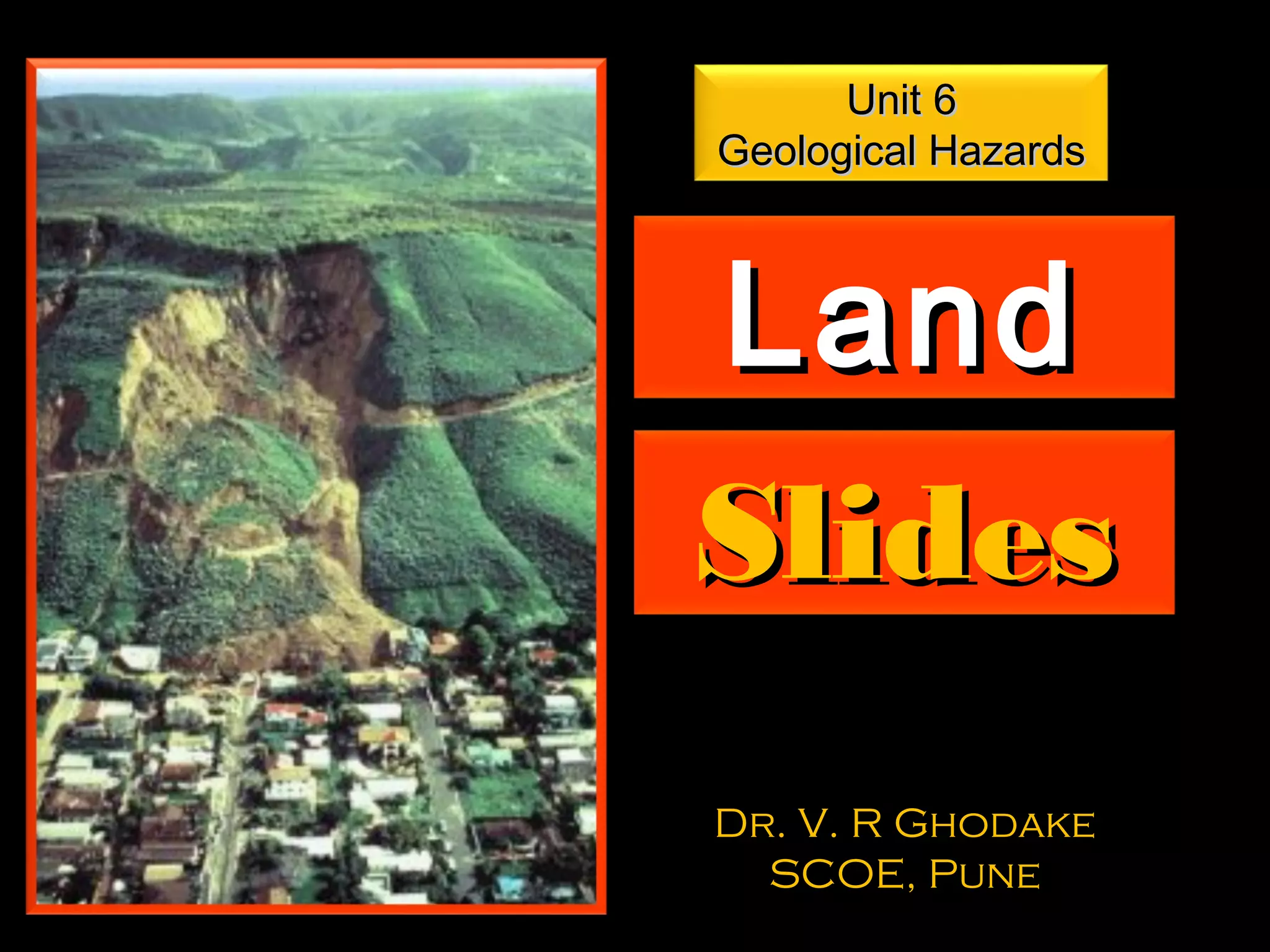
SlidesSlides
LandLand
Dr. V. R Ghodake
SCOE, Pune
Unit 6Unit 6
Geological HazardsGeological Hazards
Landslide: refers to the downward sliding of huge quantities of land mass
which occur along steep slopes of hills
or mountains and may be sudden or
slow
Definition
●Landslides are rock, earth, and/or
debris flowing or sliding down slopes due
to gravity.
Causes
●Heavy rains
●Earthquakes
●Volcano eruptions
●Floods
●Terrain Cutting
●Droughts
Air
●Confined by falling rock debris, air may
act as a cushion to reduce the friction
between the sliding material and the
underlying rock or ground.
Gravity
●Gravity provides the energy to displace
the soil and bedrock, but other factors
contribute to an increase in stress and
decrease in strength. A stress tends to
make part of a block material slide block
material slide with respect to an
adjoining part.
Vibrations
●Vibrations from blasting, heavy traffic
and earthquakes also can contribute to
shear stress and precipitate slides.
Speed
●Landslides travel at least over than 260
feet per second
Types
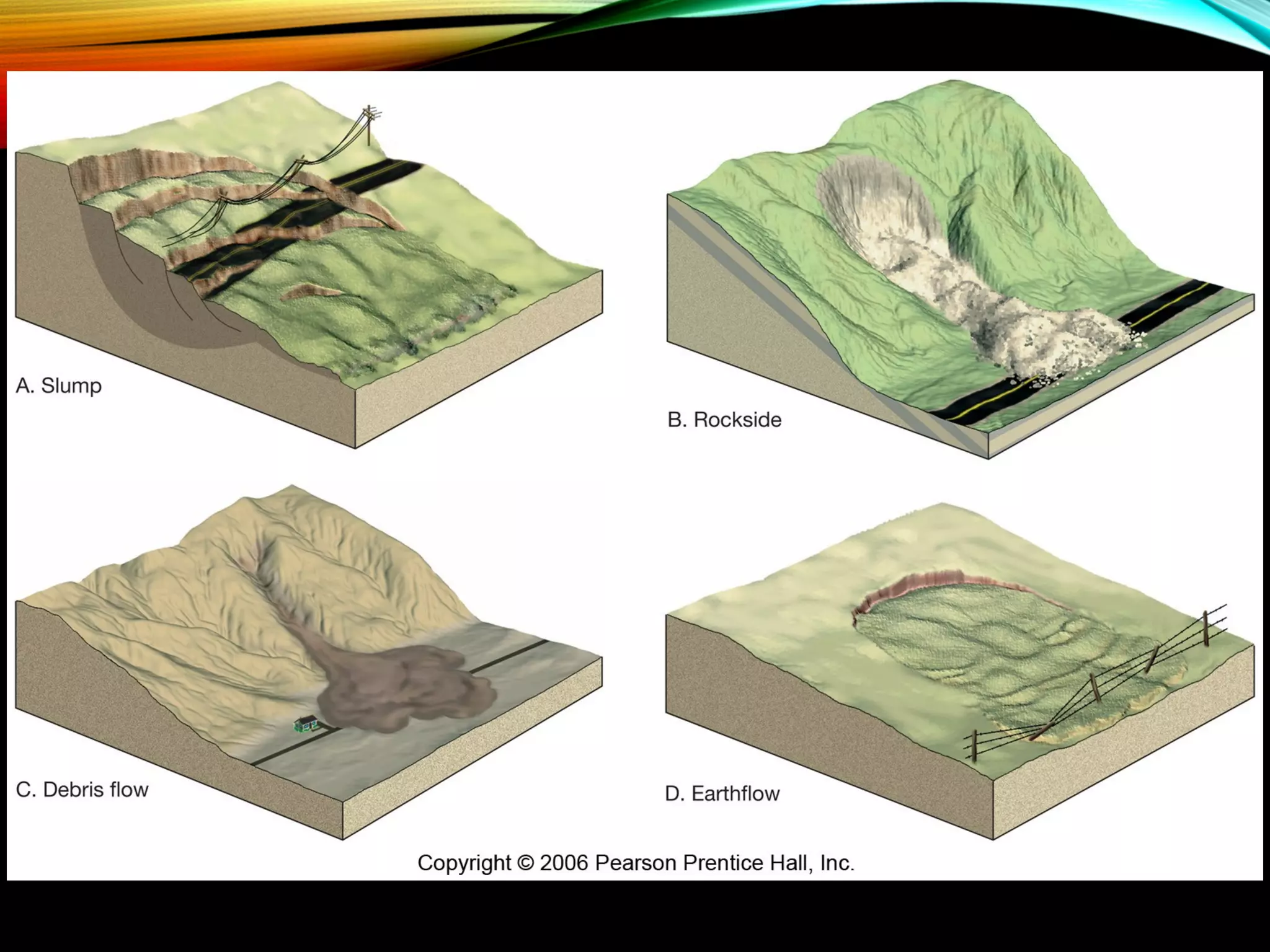
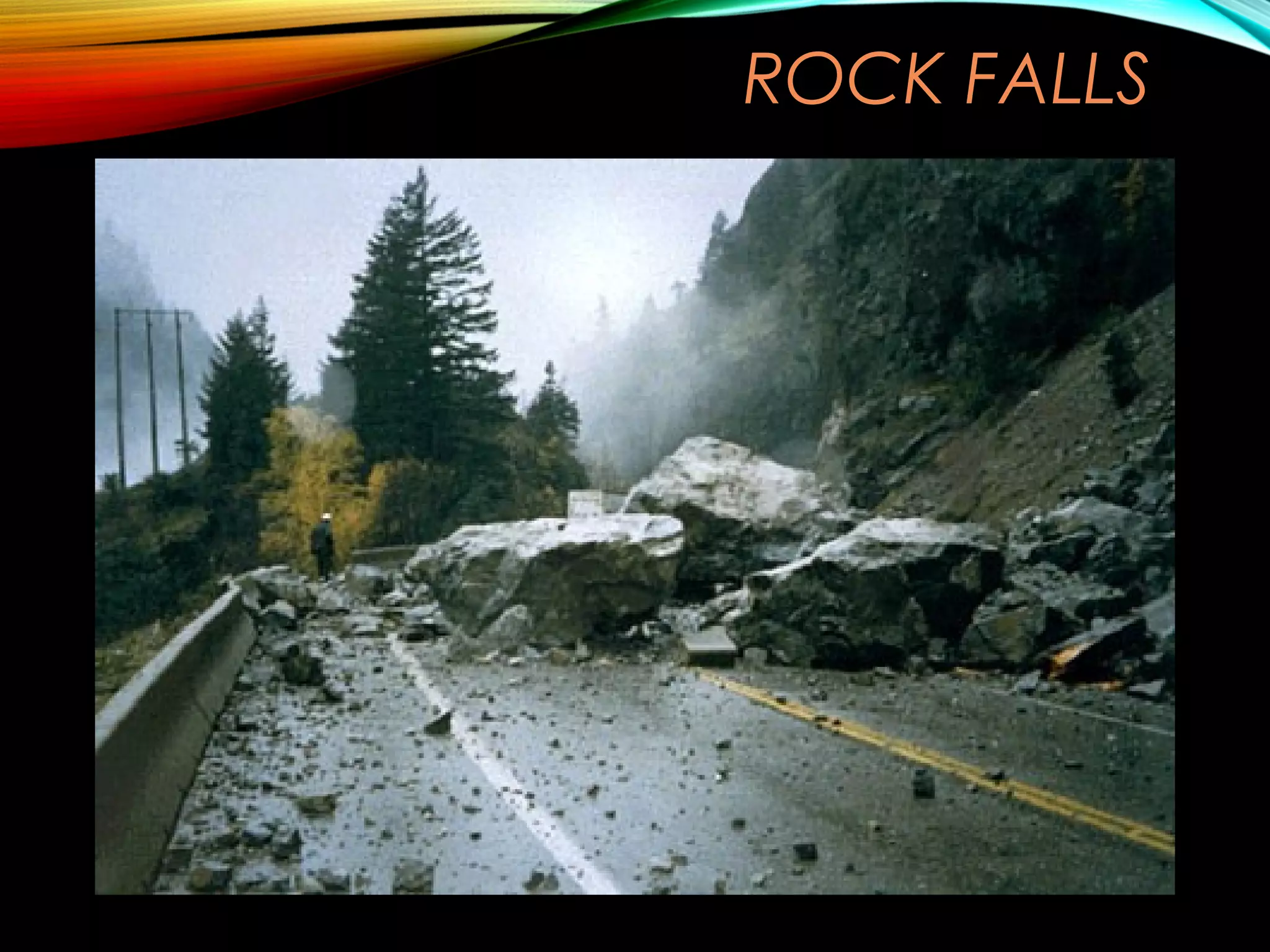
●Rock falls- large chunks of rock that tumble down a cliff or steep slopes
●Lahars- ash from a volcano mixes with water, to form a thick river of mud
●Earthflows- contain less water and flow more slowly; move shorter distances
●Slope Failure- involve one block or a series of slump blocks
●Slump- larges masses move downward and outward due to a gravity pull
●Debris Slides- consist of moving masses of mud, soil, and rocks mixed with water
Hotspots
●Anywhere with steep slopes and weathering
●High mountain ranges, sheer cliffs, and steep
sided river valleys
●Where volcanoes erupt and along coasts
EffectsEffects
Landslides also sweep up trees, cars, and buildingsLandslides also sweep up trees, cars, and buildings
Traffic Stops
●Landslides can cause a headache for many
travelers on the road
●Landslides occur on hills near roads quite often
causing bad traffic
Pictures
http://landslides.usgs.gov/
research/other/
centralamerica.php
http://web.ndmc.gov.za
/images/landslide1.jpg
CLASSIFICATION OF EARTH
MOVEMENTS
• All movement of land masses are referred as landslides, but
differ in many respects, therefore all types of landslides are
categorized as Earth Movements.
• These are classified as
Earth Flow Landslides Subsidence
Solifluction
Creep
Rapid flows
Rock slides
Rock falls
Debris slide or
slump
collapse
Plastic flow
SOLIFUCTION
• Solifuction is a
downward movement
of wet soil along the
slopes under the
influence of gravity.
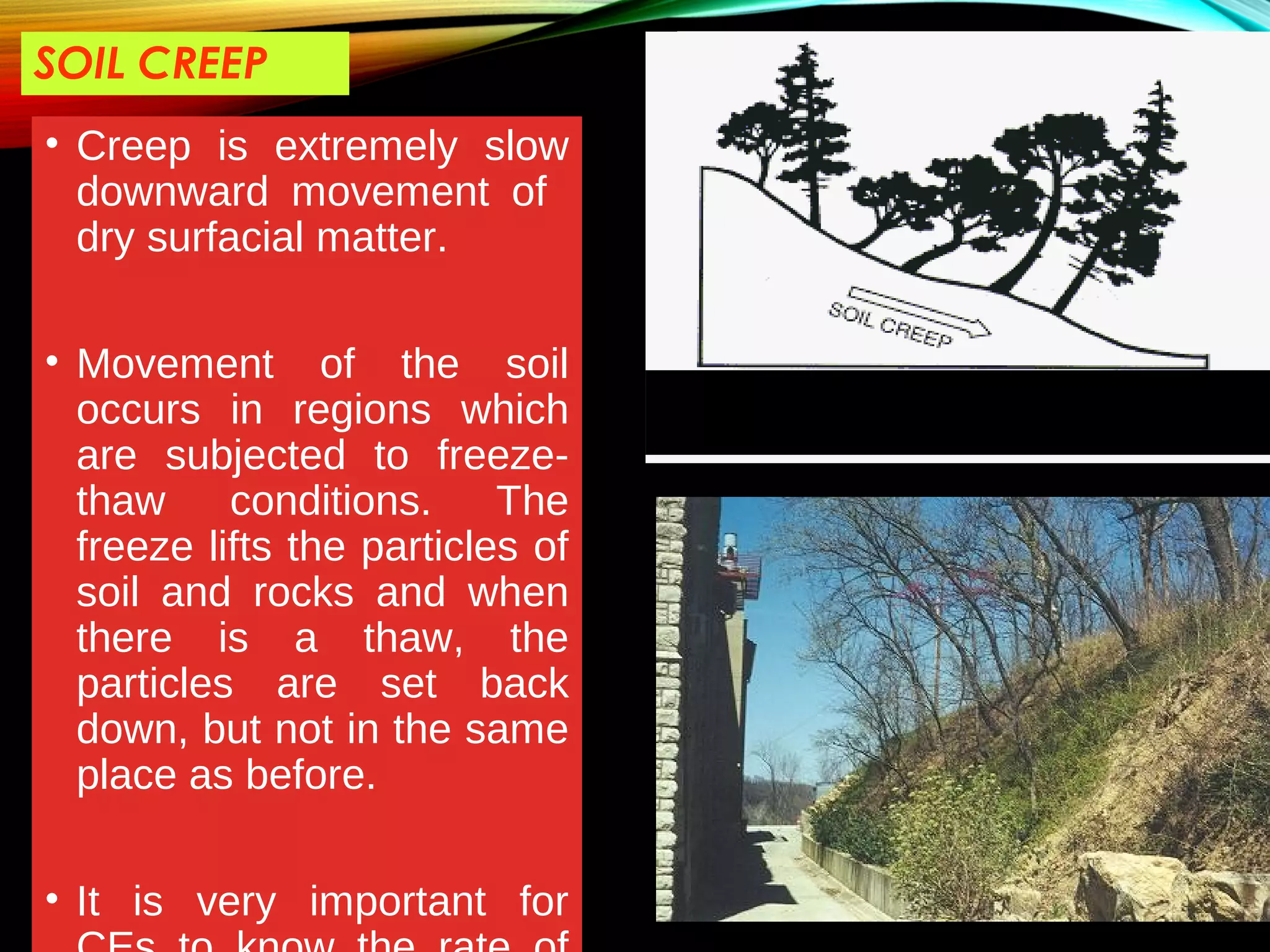
SOIL CREEP
• Creep is extremely slow
downward movement of
dry surfacial matter.
• Movement of the soil
occurs in regions which
are subjected to freeze-
thaw conditions. The
freeze lifts the particles of
soil and rocks and when
there is a thaw, the
particles are set back
down, but not in the same
place as before.
• It is very important for
• RAPID FLOWS: Rapid flow is similar to the creep,
but differ in terms of speed and depth. It is faster.
• Creep is involved upto shallow depth (app. 1-2
m), whereas the rapid flow is involved to greater
depth (app. upto 5 m or more)
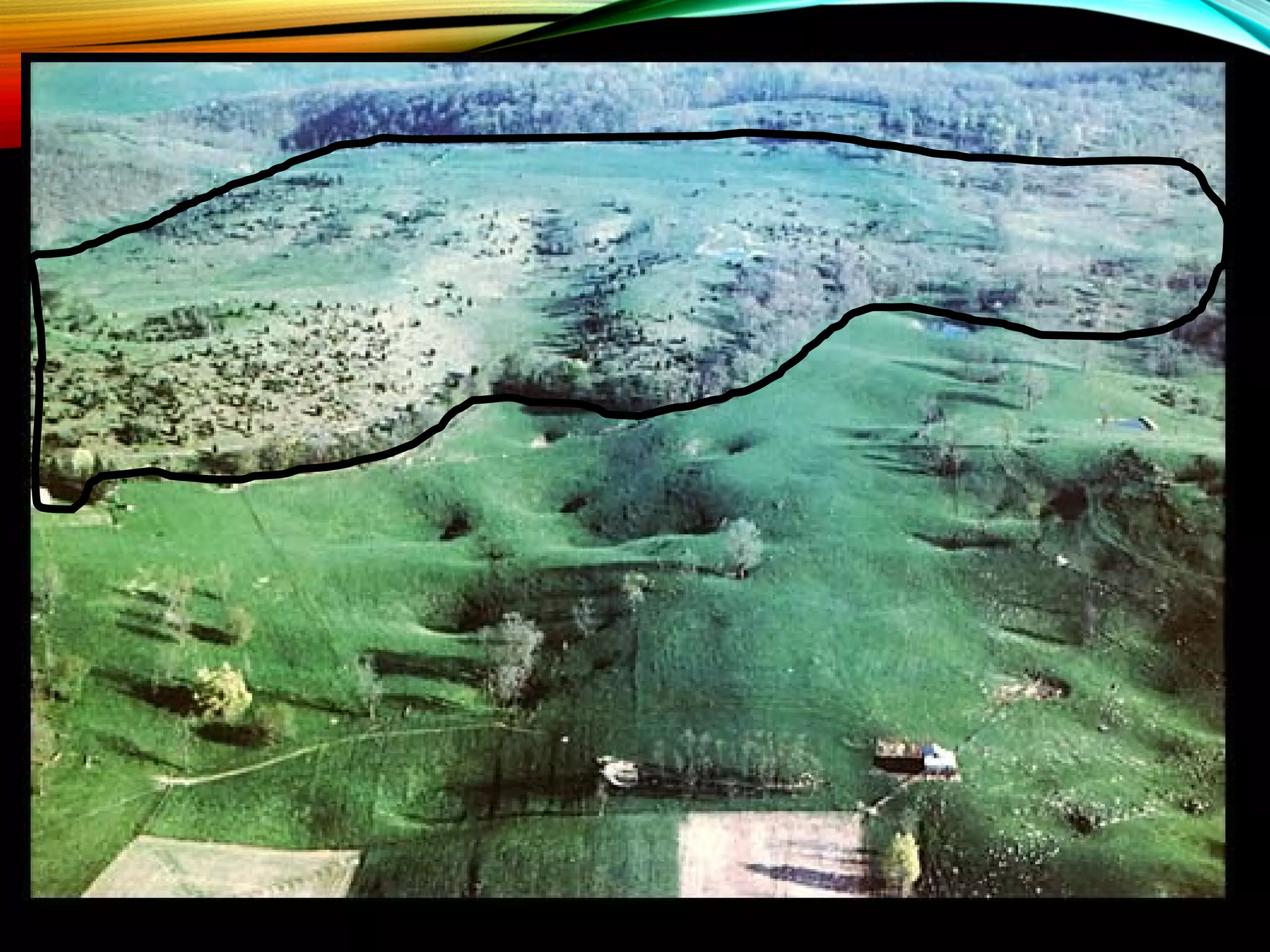
It happened again in 2004…
in exactly the same place…
LANDSLIDES
• If a mass of earth moves along a
definite plane or surface the failure is
termed as Landslide
• Large block known as a slump block
moves during the landslide.
• The scar above a landslide is easily
visible.
• They can occur along a slope where
the internal resistance of the rocks
are reduced or they loose their
holding capacity.
• Common after earthquakes or after
removal of part of the slope due to
construction, particularly for
construction of roads.
• During the movement landslide can
result into the Debris slides - are
failure of unconsolidated material on a
surface; Rock slide or Rock Fall –
where movement of large rock block
rolls
• They are also common along the
steep banks of rivers, lakes etc.
• Pore Water Pressure is the key to
monitoring landslides. Shear strength
(a resisting force) decreases and the
weight (a driving force increases).
• Talus – accumulation formed
by the coarser rock fragments
resulted from the mechanical
weathering along a slope
under influence of gravity
• It represents the downward movement of the surface
• It may occur due to plastic outflow of the underlying strata or
due to the compaction of the underlying material
• (1) Subsidence due to Plastic outflow: It may occur when a
plastic layer like clay bed is squeezed outward due to
overlying heavy load
• (2) Subsidence due to collapse: It occur due to extensive pull
out of large volume of underground water or due to
subsurface solution activity in limestone terrain.
SubsidenceSubsidence
• The Leaning
Tower of Pisa,
Italy, the tilting
of which
accelerated as
groundwater
was withdrawn
from aquifers to
supply the
growing city.
CAUSES OF LANDSLIDES
• LANDSLIDES OCCUR DUE OF VARIOUS REASONS
• Internal Causes:
• Influence of slope- Provides favorable condition for landslides; steeper slope are
prone to slippage of land. It is known that most of the materials are stable upto
certain angle- “Critical angle” or “angle of repose” – it varies from 300
for
unconsolidated sediments to 900
for massive rocks and 600
-900
for partially jointed
rocks.
• Ground water or associated water- Main factor responsible for slippage. Suppose the
hard or massive rocks are underlined by softer rocks (shale or clay bed)
• When rain water percolates through some fractures or joints the clayey beds
becomes very plastic and acts as slippery base, which enhance the chances of loose
overburden to slip downward.
• Water is the most powerful solvent, which not only causes decomposition of minerals
but also leaches out the soluble matter of the rock and reduces the strength.
• Lithology- rock which are rich in clay, mica, calcite,
gypsum etc are prone to landslide because these
minerals are prone to weathering.
• Geological structures- Occurrence of inclined bedding
planes, joints, fault or shear zone are the planes of
weakness, which create conditions of instability.
• Human Influence- undercutting along the hill slopes for
laying roads or rail tracks can result into instability.
• Deforestation in the uplands, result into more erosion
during the rainy season.
•External factorsExternal factors
• Most common is the vibration resulted due to earthquakes;Most common is the vibration resulted due to earthquakes;
blasting to explosives; volcanic eruption etc.blasting to explosives; volcanic eruption etc.
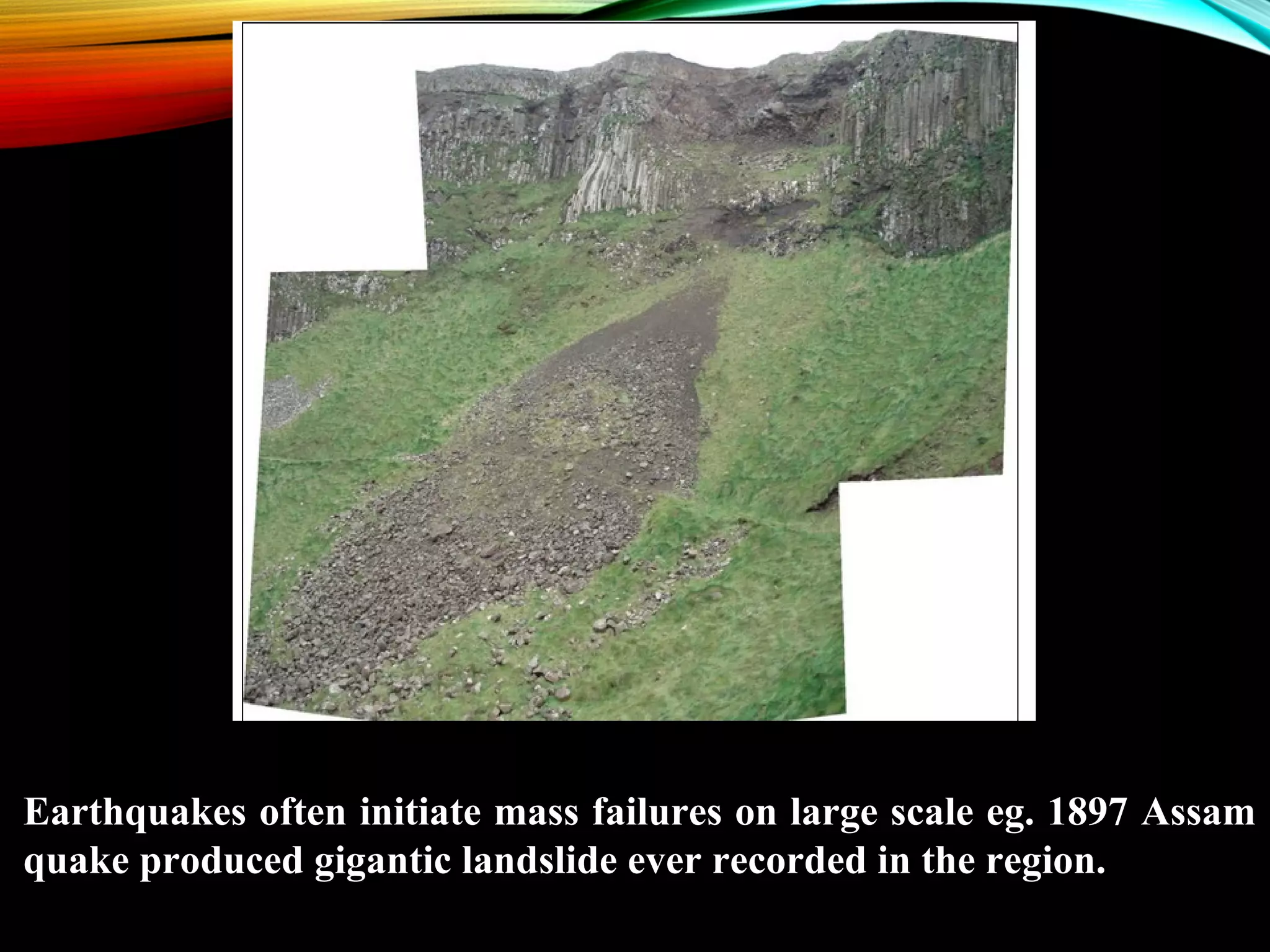
Earthquakes often initiate mass failures on large scale eg. 1897 AssamEarthquakes often initiate mass failures on large scale eg. 1897 Assam
quake produced gigantic landslide ever recorded in the region.quake produced gigantic landslide ever recorded in the region.
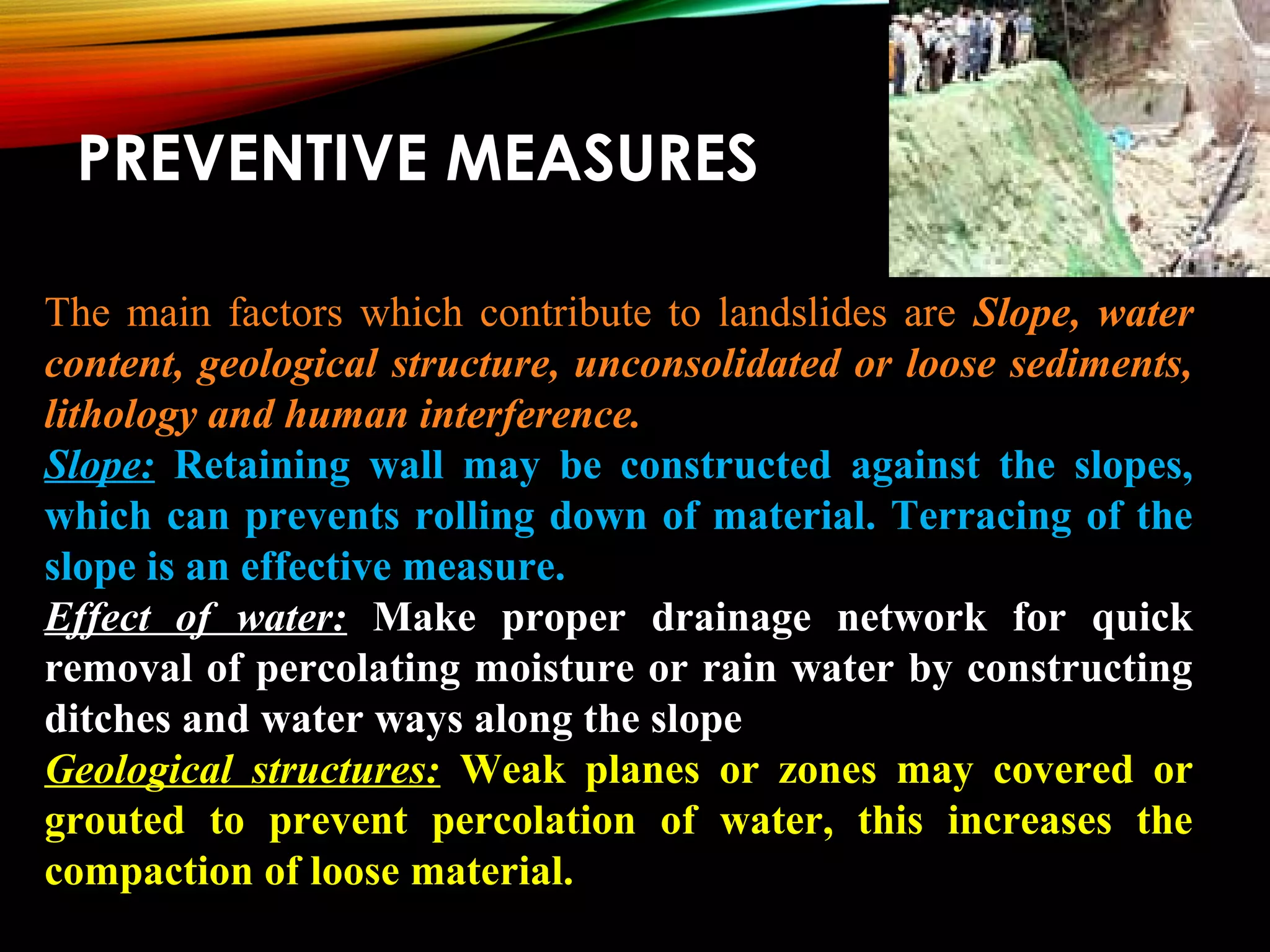
PREVENTIVE MEASURES
The main factors which contribute to landslides areThe main factors which contribute to landslides are Slope, waterSlope, water
content, geological structure, unconsolidated or loose sediments,content, geological structure, unconsolidated or loose sediments,
lithology and human interference.lithology and human interference.
Slope:Slope: Retaining wall may be constructed against the slopes,Retaining wall may be constructed against the slopes,
which can prevents rolling down of material. Terracing of thewhich can prevents rolling down of material. Terracing of the
slope is an effective measure.slope is an effective measure.
Effect of water:Effect of water: Make proper drainage network for quickMake proper drainage network for quick
removal of percolating moisture or rain water by constructingremoval of percolating moisture or rain water by constructing
ditches and water ways along the slopeditches and water ways along the slope
Geological structures:Geological structures: Weak planes or zones may covered orWeak planes or zones may covered or
grouted to prevent percolation of water, this increases thegrouted to prevent percolation of water, this increases the
compaction of loose material.compaction of loose material.
Safe Spots From LandslidesSafe Spots From Landslides
●Stay on hard bedrock that has not beenStay on hard bedrock that has not been
moved lately or in the pastmoved lately or in the past
●Stay on relatively flat-lying areas far fromStay on relatively flat-lying areas far from
slopes or river banksslopes or river banks
●Stay at the top of ridges, away from theStay at the top of ridges, away from the
top of slopes top of slopes 
• LANDSLIDES AND MUDFLOWS
• Plant ground cover on slopes and build retaining
walls.
• In mudflow areas, build channels or deflection
walls to direct the flow around buildings.
• Install flexible pipe fittings to avoid gas or water
leaks.
La Conchita, CA
1982 SAN MATEO COUNTY
ROCK FALLS

Landslide

  • 1.
    SlidesSlides LandLand Dr. V. RGhodake SCOE, Pune Unit 6Unit 6 Geological HazardsGeological Hazards
  • 2.
    Landslide: refers tothe downward sliding of huge quantities of land mass which occur along steep slopes of hills or mountains and may be sudden or slow
  • 3.
    Definition ●Landslides are rock,earth, and/or debris flowing or sliding down slopes due to gravity.
  • 4.
  • 5.
    Air ●Confined by fallingrock debris, air may act as a cushion to reduce the friction between the sliding material and the underlying rock or ground.
  • 6.
    Gravity ●Gravity provides theenergy to displace the soil and bedrock, but other factors contribute to an increase in stress and decrease in strength. A stress tends to make part of a block material slide block material slide with respect to an adjoining part.
  • 7.
    Vibrations ●Vibrations from blasting,heavy traffic and earthquakes also can contribute to shear stress and precipitate slides.
  • 8.
    Speed ●Landslides travel atleast over than 260 feet per second
  • 9.
    Types ●Rock falls- largechunks of rock that tumble down a cliff or steep slopes ●Lahars- ash from a volcano mixes with water, to form a thick river of mud ●Earthflows- contain less water and flow more slowly; move shorter distances ●Slope Failure- involve one block or a series of slump blocks ●Slump- larges masses move downward and outward due to a gravity pull ●Debris Slides- consist of moving masses of mud, soil, and rocks mixed with water
  • 10.
    Hotspots ●Anywhere with steepslopes and weathering ●High mountain ranges, sheer cliffs, and steep sided river valleys ●Where volcanoes erupt and along coasts
  • 11.
    EffectsEffects Landslides also sweepup trees, cars, and buildingsLandslides also sweep up trees, cars, and buildings
  • 12.
    Traffic Stops ●Landslides cancause a headache for many travelers on the road ●Landslides occur on hills near roads quite often causing bad traffic
  • 13.
  • 14.
    CLASSIFICATION OF EARTH MOVEMENTS •All movement of land masses are referred as landslides, but differ in many respects, therefore all types of landslides are categorized as Earth Movements. • These are classified as Earth Flow Landslides Subsidence Solifluction Creep Rapid flows Rock slides Rock falls Debris slide or slump collapse Plastic flow
  • 16.
    SOLIFUCTION • Solifuction isa downward movement of wet soil along the slopes under the influence of gravity.
  • 17.
    SOIL CREEP • Creepis extremely slow downward movement of dry surfacial matter. • Movement of the soil occurs in regions which are subjected to freeze- thaw conditions. The freeze lifts the particles of soil and rocks and when there is a thaw, the particles are set back down, but not in the same place as before. • It is very important for
  • 18.
    • RAPID FLOWS:Rapid flow is similar to the creep, but differ in terms of speed and depth. It is faster. • Creep is involved upto shallow depth (app. 1-2 m), whereas the rapid flow is involved to greater depth (app. upto 5 m or more)
  • 19.
    It happened againin 2004… in exactly the same place…
  • 20.
    LANDSLIDES • If amass of earth moves along a definite plane or surface the failure is termed as Landslide • Large block known as a slump block moves during the landslide. • The scar above a landslide is easily visible. • They can occur along a slope where the internal resistance of the rocks are reduced or they loose their holding capacity. • Common after earthquakes or after removal of part of the slope due to construction, particularly for construction of roads.
  • 21.
    • During themovement landslide can result into the Debris slides - are failure of unconsolidated material on a surface; Rock slide or Rock Fall – where movement of large rock block rolls • They are also common along the steep banks of rivers, lakes etc. • Pore Water Pressure is the key to monitoring landslides. Shear strength (a resisting force) decreases and the weight (a driving force increases).
  • 22.
    • Talus –accumulation formed by the coarser rock fragments resulted from the mechanical weathering along a slope under influence of gravity
  • 23.
    • It representsthe downward movement of the surface • It may occur due to plastic outflow of the underlying strata or due to the compaction of the underlying material • (1) Subsidence due to Plastic outflow: It may occur when a plastic layer like clay bed is squeezed outward due to overlying heavy load • (2) Subsidence due to collapse: It occur due to extensive pull out of large volume of underground water or due to subsurface solution activity in limestone terrain. SubsidenceSubsidence
  • 25.
    • The Leaning Towerof Pisa, Italy, the tilting of which accelerated as groundwater was withdrawn from aquifers to supply the growing city.
  • 26.
    CAUSES OF LANDSLIDES •LANDSLIDES OCCUR DUE OF VARIOUS REASONS • Internal Causes: • Influence of slope- Provides favorable condition for landslides; steeper slope are prone to slippage of land. It is known that most of the materials are stable upto certain angle- “Critical angle” or “angle of repose” – it varies from 300 for unconsolidated sediments to 900 for massive rocks and 600 -900 for partially jointed rocks. • Ground water or associated water- Main factor responsible for slippage. Suppose the hard or massive rocks are underlined by softer rocks (shale or clay bed) • When rain water percolates through some fractures or joints the clayey beds becomes very plastic and acts as slippery base, which enhance the chances of loose overburden to slip downward. • Water is the most powerful solvent, which not only causes decomposition of minerals but also leaches out the soluble matter of the rock and reduces the strength.
  • 27.
    • Lithology- rockwhich are rich in clay, mica, calcite, gypsum etc are prone to landslide because these minerals are prone to weathering. • Geological structures- Occurrence of inclined bedding planes, joints, fault or shear zone are the planes of weakness, which create conditions of instability. • Human Influence- undercutting along the hill slopes for laying roads or rail tracks can result into instability. • Deforestation in the uplands, result into more erosion during the rainy season.
  • 28.
    •External factorsExternal factors •Most common is the vibration resulted due to earthquakes;Most common is the vibration resulted due to earthquakes; blasting to explosives; volcanic eruption etc.blasting to explosives; volcanic eruption etc.
  • 29.
    Earthquakes often initiatemass failures on large scale eg. 1897 AssamEarthquakes often initiate mass failures on large scale eg. 1897 Assam quake produced gigantic landslide ever recorded in the region.quake produced gigantic landslide ever recorded in the region.
  • 30.
    PREVENTIVE MEASURES The mainfactors which contribute to landslides areThe main factors which contribute to landslides are Slope, waterSlope, water content, geological structure, unconsolidated or loose sediments,content, geological structure, unconsolidated or loose sediments, lithology and human interference.lithology and human interference. Slope:Slope: Retaining wall may be constructed against the slopes,Retaining wall may be constructed against the slopes, which can prevents rolling down of material. Terracing of thewhich can prevents rolling down of material. Terracing of the slope is an effective measure.slope is an effective measure. Effect of water:Effect of water: Make proper drainage network for quickMake proper drainage network for quick removal of percolating moisture or rain water by constructingremoval of percolating moisture or rain water by constructing ditches and water ways along the slopeditches and water ways along the slope Geological structures:Geological structures: Weak planes or zones may covered orWeak planes or zones may covered or grouted to prevent percolation of water, this increases thegrouted to prevent percolation of water, this increases the compaction of loose material.compaction of loose material.
  • 31.
    Safe Spots FromLandslidesSafe Spots From Landslides ●Stay on hard bedrock that has not beenStay on hard bedrock that has not been moved lately or in the pastmoved lately or in the past ●Stay on relatively flat-lying areas far fromStay on relatively flat-lying areas far from slopes or river banksslopes or river banks ●Stay at the top of ridges, away from theStay at the top of ridges, away from the top of slopes top of slopes 
  • 32.
    • LANDSLIDES ANDMUDFLOWS • Plant ground cover on slopes and build retaining walls. • In mudflow areas, build channels or deflection walls to direct the flow around buildings. • Install flexible pipe fittings to avoid gas or water leaks.
  • 33.
  • 34.
  • 35.